T and A: #1 Benefit of Public Schools

I’ve no doubt raised a few eyebrows with the title of this post. Get your mind out of the gutter people, I’m talking about transparency and accountability!

Let me be clear…I believe America’s public schools are what made our country great. They ensured all children had the opportunity to learn and they coalesced our communities and all the different types of people within them. But, in terms of today’s school choice landscape, the number one benefit offered by public district schools over all other choices, is transparency and accountability.

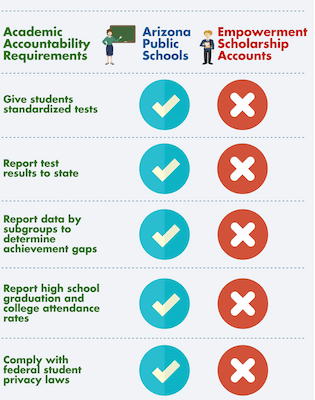
Of course, in this alternate universe the GOP has created, up is down, left is right, black is white, and private school choice options (private, religious, and home schools) are the more transparent and accountable schools for parents and taxpayers. Nothing could be further from the truth. District schools, with publicly elected school board members and the requirement to follow Open Meeting Law (at least in Arizona), are by far the most transparent and accountable. Yes, our charter schools are also public schools, but they don’t have publicly elected boards. Rather, charter school board members may not even live in the same state, let alone in the same town. But as public schools, both district and charter schools have myriad transparency requirements private school choice options don’t. These include the need to follow Open Meeting Law, ensuring the public’s right to witness the discussion, deliberation, and decision-making done in its name. They also must: accept all students; comply with stringent requirements for reporting, procurement, and auditing; and allow parents the right to review all instructional material and intercede in their child’s education where they believe it is necessary. There are many more differences in transparency and accountability, but you get the idea.

And yet, those advocating for school privatization have managed to convince many parents (especially in today’s highly partisan environment), that public schools (especially district schools) are trying to indoctrinate their children with values and ideology that are different than their own.

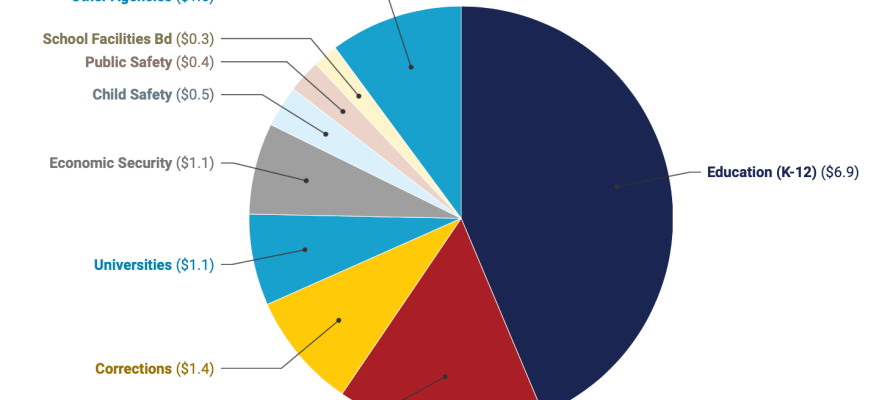
What it is really about though, as pointed out by fellow education blogger Jan Resseger in her recent post, is money and power. After all, the total bill for K-12 education in the U.S. in 2018-2019 school year was already $800B. In Arizona this year, K-12 education constitutes almost 44% of the state budget. Privatizing public education is a lucrative triple-play for the rich and powerful and those lawmakers they keep in office. Privatization allows the reduction of the need for taxation, it offers the opportunity for corporations to profit directly from the education industry, and it reduces the voice of the people making it easier to ignore their will. As Resseger points out, Gordon Lafer, in “The One-Percent Solution”, said,

(F)or those interested in lowering citizens’ expectations of what we have a right to demand from government, there is no more central fight than around public education. In all these ways, then, school reform presents something like the perfect crystallization of the corporate legislative agenda.”

The brilliancy of packaging school privatization was convincing parents that their “right to choose”, was what was important. Resseger also quoted Benjamin Barber, in his book “Consumed”, who deftly makes the point that this ability to choose, however, is not the real power.

We are seduced into thinking that the right to choose from a menu is the essence of liberty, but with respect to relevant outcomes the real power, and hence the real freedom, is in the determination of what is on the menu. The powerful are those who set the agenda, not those who choose from the alternatives it offers. We select menu items privately, but we can assure meaningful menu choices only through public decision-making.

In other words, you are either at the table, or on the menu. In fact, I previously wrote a post with this same title back in 2014. With public schools, parents, voters and taxpayers are at the table (if they exercise their rights the way they should). Unfortunately, it takes work to exercise our rights and hold our elected officials accountable. But then, that’s what is meant by “of the people, by the people, and for the people”. “We the people”, must do our part if we want our government and its institutions to reflect our values. At least in public schools, we have that opportunity.


Tom Horne: An Old Dog with a CRT Bone

AZ Superintendent of Public Instruction Tom Horne is the living embodiment of the saying that an old dog can’t learn new tricks. His campaign gave us a preview that he was not going to change his ways. After all, he didn’t tout plans to improve our public schools (he was vying for the position overseeing “public” instruction after all), but rather, posted countless campaign signs shouting, “STOP CRITICAL RACE THEORY”. Never mind that actual CRT, (which rests on the premise that racial bias – intentional or not – is baked into U.S. laws and institutions), is not taught in elementary or secondary schools, but at the university level, most often in law schools. For Republicans, however, the term became synonymous with being “woke” and their focus on “owning the libs” carried Horne back to his old office.

This isn’t a new fight for Horne. After his recent election, MSNBC called him,

a pioneer in the right-wing crusade against school teachings centered on nonwhite people and social inequality.

As evidence, MSNBC cited his fight against “ethnic studies” which led to a ban on such instruction in Arizona schools in 2010. He also banned bilingual education services that same year which the Justice Department found illegal. The ban on ethnic studies held until 2017, when a federal judge overturned it, finding that it had an,

invidious discriminatory racial purpose, and a politically partisan purpose.

At 77, it is no surprise Horne hasn’t changed his spots. After all, it mostly works for him as evidenced by his previous elections to serve as State Superintendent from 2003 to 2011, as well as his election to a term as AZ Attorney General. Now, he’s swept into office on his STOP CRT broom, promising to,

eradicate teaching on diversity and equity and eliminate the use of social emotional learning in Arizona schools.

He’s off to a running start, canceling previously approved diversity presentations at the education conference hosted by his department and wrapping up today. Michaela Rose Classen, an education consultant originally scheduled to speak, expressed worry to the AZ Daily Star about excising social-emotional learning from schools saying,

When students enter the classroom, I think the assumption by some folks is that they just enter ready to learn. But there are different levels of experiences and often trauma that students are bringing into the classroom with them,’ Claussen said. ‘And they’re not quite developed yet emotionally, like we are as adults, to leave it at the door. So we have to really be cautious about how are we paying attention to student needs.

Horne doesn’t believe this type of learning has any place in the classroom. A 2022 Pew Research Poll, however, showed that about two-thirds of parents believe it is important their children’s school teaches social-emotional skills. These skills, in a nutshell, are:

  • Self-Management – managing emotions and behaviors to achieve one’s goals
  • Self-Awareness – recognizing one’s emotions and values as well as one’s strengths and challenges
  • Responsible Decision Making – making ethical, constructive choices about personal and social behavior
  • Relationship Skills – forming positive relationships, working in teams, dealing effectively with conflict
  • Social Awareness – Showing understanding and empathy

As a school board member in my 11th year of service, I can unequivocally say that many of our students need help with social-emotional skills. Should parents and communities teach these skills? YES, ABSOLUTELY!! But, in many cases, this isn’t happening and the global pandemic exacerbated difficulties with students trying to learn and interact with friends remotely. In fact, I’m guessing most would agree that our society in general needs help with these skills more than ever.

Horne, no doubt, thinks our kids just need to “man up” and stick to learning “readin’, writin’, and ‘rithmatic” with his stated focus on improving academics and increasing test scores. Unfortunately, the narrowing of curriculum and “teaching to the test” are making our students less prepared for the real world. And speaking of that, I noted he allowed presentations on suicide prevention at the education conference. Does he not understand the relationship social-emotional learning has on student mental health relating to not only suicide prevention but also the mass shootings plaguing our schools?

Another of Horne’s first acts was to eliminate the Diversity, Equity, and Inclusion Department at ADE, stating that in the context of CRT “equity has come to mean equal outcomes by racial groups”. That may be how sees it, but Google’s Dictionary defines equity as “the quality of being fair and impartial”. Doesn’t this mean we recognize not every child is born with the same opportunities to succeed and we should do what we can to make the opportunities available for those who are willing to apply themselves?

There will no doubt be many battles to fight with Horne, (with his “politically partisan purpose”), leading Arizona’s public schools. The inefficiency of jerking our teachers and students around with policy reversals is frustrating. But it is the potential for setting back another generation of our students that really worries me. As the slogan for the United Negro College Fund states, “A mind is a terrible thing to waste.”

How $200M Could Have Been Better Spent

Although the real total costs will likely never be known, the Arizona Republic reported yesterday that Governor Ducey’s

five-month effort to close gaps along the U.S.-Mexico border with shipping containers will cost Arizona taxpayers more than $200 million.

I’m not writing to debate the wisdom of Ducey’s actions, (okay, just for a second, it was a stupid political stunt). But rather, I’d like to make a case for how that money could have been better spent.

Regardless of what you’ve heard from GOP lawmakers, or have read in right-leaning media, Arizona schools are not flush with cash. Rather, much of what’s been added recently just reinstates part of what was taken away since 2007 and leaves Arizona still at 48th in the nation for per-pupil funding. Additionally, our schools are still hemorrhaging teachers with almost 9,700 vacancies at the start of the 2022-23 school year and about 4,900 filled with alternate teaching requirements or long-term subs.

Another statistic that should also raise alarms, is Arizona’s student-to-counselor ratio. The American School Counselor Association recommends schools maintain a ratio of 250 to 1. The nationwide student-to-school-counselor ratio in the 2021-2022 school year was 408 to 1. Arizona’s ratio that same year was 716 to 1. Although this is down from the 905 to 1 Arizona had in 2019, it is still approaching double the national average and keeps us last in the nation in yet another dismal education statistic.

Superintendent Kathy Hoffman focused on this issue, tweeting in 2022,

Since 2019, I’ve successfully lobbied for the funds to add hundreds of school counselors, lowering our student to school counselor ratio by 20%

The AZPBS’ CronkiteNews verified her claim citing “an increase of 290 counselors in three years” for an improvement of 21%. This was one of Hoffman’s priorities because, as she said,

In an era of balloning classroom sizes, teachers feel unequipped to manage a class of 30 children while also finding the time to provide individualized attention to their students, especially those facing depression, anxiety, or suicidal thoughts.

And that was in 2019, before the global pandemic which according to the American Academy of Pediatrics, the American Academy of Child and Adolescent Psychiatry, and the Children’s Hospital Association declared in November 2021,

pandemic-related decline in child and adolescent mental health has become a national emergency.

Hoffman was right to focus on this issue. What’s the chance “Stop CRT” Horne will do the same? (Yes, that is a rhetorical question.)

Before I start down that rabbit hole, let’s get back to the $200M. Based on what I’ve written thus far, I’m betting you can guess it has something to do with school counselors.

According to a SOSAZNETWORK.org report, 135 of Arizona’s 223 school districts are rural and serve 35% of the state’s students. More than 23% of these rural children live in poverty, the second highest poverty rate in the nation. They also have one of the lowest high school graduation rates in the U.S. These kids need the additional help a qualified counselor can provide.

So, what if instead of using OUR $200M for a stupid, partisan, political stunt, Ducey had bought more school counselors with it?  The average salary for school counselors in Arizona is about $55K. To be safe, let’s add 30% for benefits which brings the total cost to $71,500. Let’s see, $200M divided by $71,500 average counselor salary and benefits buys 2,797 counselors for one year. That number of counselors divided by 135 school districts, would give us 20.71 years of one counselor per district. Think of the lives this could impact.

Okay, I know this math is VERY rough, after all, I’m a writer, not a statistician. We know that salaries would increase and it would be difficult to find enough counselors willing to go to some of these rural areas, even if we could fund them (that’s the case in my rural district). Maybe we would need to contract with companies to provide the professional support we need and this likely would cost substantially more. Maybe even then we couldn’t find them and we’d have to start a program to grow our own?

The point isn’t to solve this problem in this article, but rather to show that there were much more important priorities for the $200M than Doug Ducey’s personal erector set project. This is just one example, don’t even get me started on the needs in our rural animal shelters. I’ll save that for another post.

Let’s hope Governor Hobbs can find a way to work with the Arizona Legislature to make headway on fixing Arizona’s major problems. So far, she seems focused on education and water. That sounds about right to me. Nose to the grindstone Governor!

Drowning Public Education in the Bathtub

Those of you who’ve been around a while will remember lobbyist Grover Norquist, who founded Americans for Tax Reform in 1985. This was during the Reagan years when government was seen as a drag on the free market. Norquist is probably best known for this quote in 2001: “I don’t want to abolish government. I simply want to reduce it to the size where I can drag it into the bathroom and drown it in the bathtub”

It has been obvious for many years that Arizona Republican lawmakers want to drown our district schools since the budget for K-12 education makes up almost 44% of the state budget. But then, the predominant responsibilities of the AZ state government are to provide for public safety and public education, so…it stands to figure that education would comprise a large portion of the budget.

If you’ve listened to the AZ Republican lawmakers’ talking points over the last few years, you’d tend to believe that public education has been showered with funding. The truth however is quite another story. In fact, adjusting for inflation, K-12 funding per public school student hasn’t increased in 21 years and leaves us still 48th in the nation. In 2001, districts were provided $8,824 per student, and now, only $8,770. The high-water mark in 2007 of $10,182 per student was under Democratic Governor Janet Napolitano. This was actually $1,412 more than in 2022.

You see, pretty much all the GOP has been doing over the last few years is to reinstate funding they took away to begin with. And to add insult to injury, they’ve been chipping away at the amount available to district schools by the continuous expansion of privatization options.

Guess you’d have to be living under a rock to have missed the battle over vouchers (Empowerment Scholarship Accounts) during the past decade. ESAs were enacted in 2011 and GOP lawmakers have been steadily expanding these vouchers over the years. In 2022, (I’m really cutting to the chase here), they were finally successful in enacting a universal expansion. Not only are students no longer required to have previously attended a district school to qualify for a voucher, but there are no guardrails or caps and no transparency or accountability for private schools. And, only two months into the new law, AZ DOE had received nearly 30,000 filings for the vouchers, totaling an immediate hit to the state fund of $210M. The Joint Legislative Budget Committee only budgeted $33M for the program for the 2022-23 school year, but some now estimate the bill could approach as much as $500M.

Student Tuition Organizations (STOs) are another vehicle to poke holes in the district funding life raft. They allow taxpayers to take a dollar-for-dollar reduction in their state taxes when they give to an approved STO which provides scholarship funding to children attending grades K-12 at qualified private schools in Arizona. These STOs basically serve as a pass-through for tax credit donations to private schools while keeping 10 percent for themselves. STOs have also seen tremendous expansion over the years with the individual tax credit amount now at $1,306 which is over six times that which taxpayers can give to district schools. There are also two types of tax credits corporations can take and the combined cap for those is now up to $141M.

Just introduced last week by Representative Livingston, is HB 2014 which seeks to expand the aggregate dollar amount of STO tax credits from $6M in 2021-22 to $10M in 2022-23, to $15M in 2023-24, and to $20M in 2024-25. It also would eliminate the need for recipients of a corporate, low-income scholarship to have attended a district school prior to receiving the scholarship. Keep in mind that removing the requirement to have first attended a district school prior to receiving STO or ESA monies, accommodates students already in private school or being homeschooled, at their parent’s expense. In fact, that was the case for 80% of the filings for the universal expansion last year. And, when a student taking an ESA or STO scholarship was never in a district school, there is zero reduction in cost to that district school and ultimately, taxpayers.

These schemes are chipping away at the foundation of our district (community) schools so that eventually, they can be “drowned in the bathtub”. This is not by accident, but rather, by design. There are those in the Legislature, who do not believe in equal opportunity to learn and thrive, but rather, in survival of the fittest. And, they are hell-bent on deciding who the “fittest” are. Privatizing public education primarily serves those who “have” at the expense of those who “have not”. This continued war on public education will continue to weaken our communities and our democracy as it solidifies power and influence with those at the very top.

Want to fight back? Go to SOSArizona.org.