Why the Sudden Flurry of Posts?

Hello Everyone! Yes, I’m back to writing. If you’ve been following me on Substack, don’t bother looking at these because you’ve already seen them. If not, you might want to take a quick peek.

I had trouble getting into my WordPress account so wasn’t posting there. Just wanted to catch up.

If you aren’t yet on Substack (as Restore Reason and @LindaLyon), you might want to check it out. Lots of great, very knowledgeable writers I think you’ll enjoy. (Just don’t forget about me, okay?)

Anyway, thanks very much for your past interest and support. Hope I can continue to earn it!

Take Care, Linda

Dealing with Crazy is Exhausting

and there’s plenty of crazy in Arizona’s voucher program

After watching the Presidential Debate last night, one of my takeaways was that “dealing with crazy is exhausting”. This also describes how I feel about Arizona’s runaway voucher program. It isn’t just the bottomless pit of spending that continues to drain our state coffers and forced cutbacks this year in funding for roads, water, community colleges, universities, and K-12 schools. Even worse, is the fallout from children unprepared for their future and indoctrinated with misinformation and propaganda.

I’ve already written about how voucher parents are using AI to create curriculum that justifies purchases such as Oscar Mayer hot dog machines. And, you’ve no doubt heard about the dune buggy debacle. You know, the one where the parent purchased dune buggies for her kids with voucher funds. The Department of Education initially denied the expense and then approved it. In appealing that decision reported The Arizona Republic, ‘the parent got an occupational therapist to testify that her kids learn better after a trek through the desert, allowing them “to engage in movement before returning to more traditional learning environments.”’ I guess riding a bicycle or going to a playground just wasn’t good enough for this parent. Fortunately, the state Board of Education eventually rejected the parent’s appeal and the state is now trying to claw back the funds originally approved. Of course, parents can still buy $900 Lego sets, kayaks, luxury car driving lessons, and expresso machines.

Now, we see on a Facebook group for Arizona voucher families, a parent asking “Anyone know of a flat earth curriculum”? Others in the group provided interesting responses as you can see below.

Yes, this is real. As the first contributor says, “some people believe in flat earth and some don’t. Ya’ll don’t want to try to discuss how gravity is only a theory. Let this mom teach her kids her way.” Seriously? Are these people stuck in the 3rd century BC? 

When did we become a nation that believes people are not only entitled to their own opinions but their own facts? Maybe about the same time we began to greatly expand Arizona’s voucher program without any guardrails to ensure our children would learn what they needed to be productive citizens.

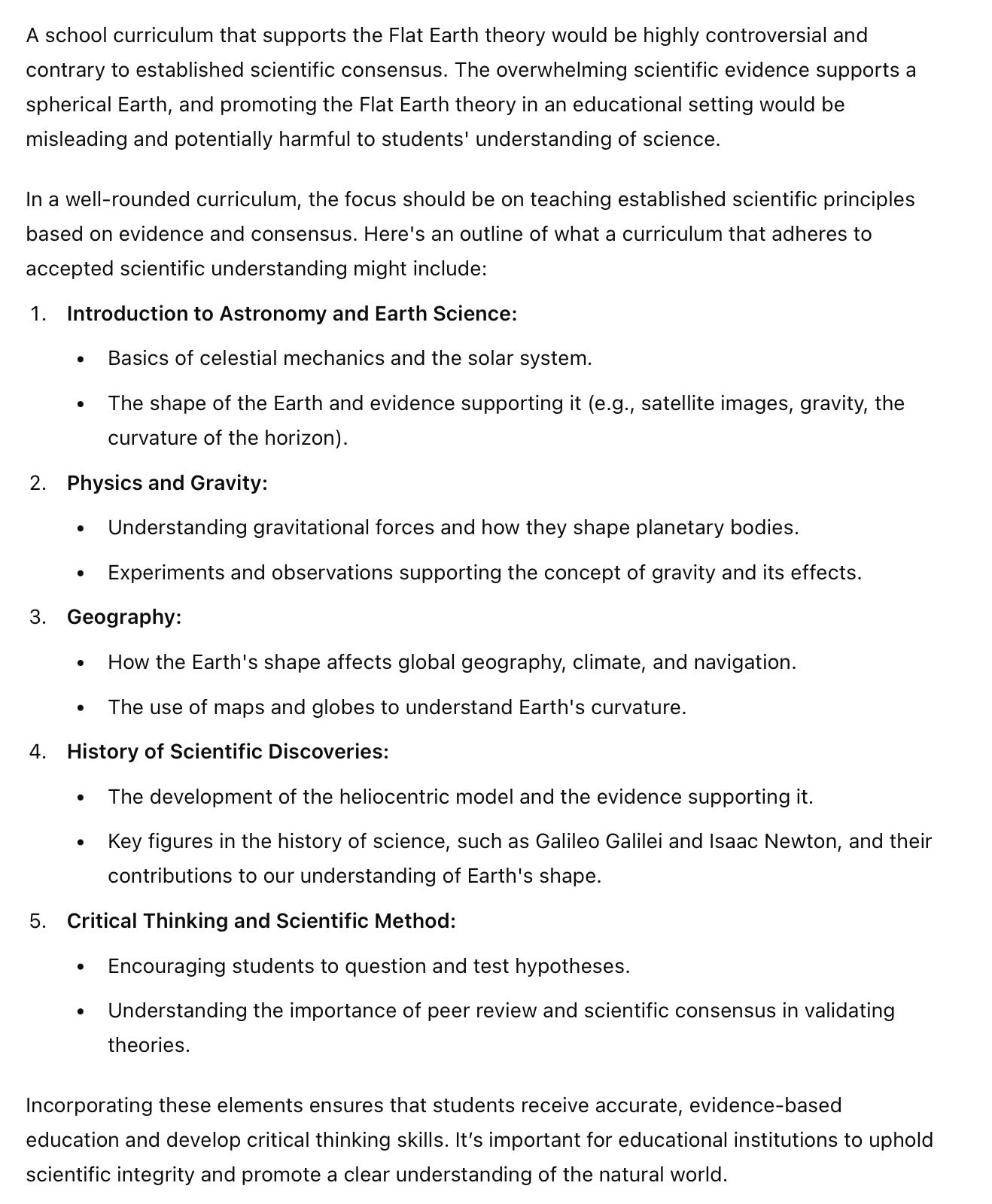
I decided to try ChatGPT to see what kind of curriculum it would write to support the flat earth theory. It only took about 10 seconds for ChapGPT to write the below. Please note the second sentence that states, 

“The overwhelming scientific evidence supports a spherical Earth, and promoting the Flat Earth theory in an educational setting would be misleading and potentially harmful to students’ understanding of science”. 

Please also note the last paragraph that states “Students should receive accurate, evidenced-based education and develop critical thinking skills”. 

Unfortunately, there are no standards in place in Arizona to ensure students on vouchers receive accurate, evidence-based education”. As stated on SOSAZNetwork.org

Arkansas, Iowa, Indiana, and Florida all require voucher students to either sit for state testing or take a nationally norm-referenced assessment. Utah and West Virginia allow students to submit a portfolio showcasing their academic progress in lieu of an assessment, but crucially still require some form of proof of academic progress. In Arizona, there is zero requirement for voucher students to show they are meeting state standards or even learning at all.

Arizona’s lack of academic oversight is compounded by its failure to approve  voucher-funded private schools, unlike Iowa, Florida, Utah, and West Virginia, which require schools participating in their state voucher programs to register with the state and meet certain standards of accreditation. In Utah, private schools with a potential for financial troubles are explicitly prohibited from joining the program. 

No such vetting exists in Arizona. Any fly-by-night for-profit private school or microschool can open anywhere (even in unsafe garages, living rooms, or strip mall buildings) and accept ESA voucher student funding without any proof of accreditation or quality.” 

The unmitigated malfeasance exercised by Arizona’s GOP in not only supporting but steadfastly pushing forward this unaccountable voucher program is astonishing. From 2011 through 2021, they expanded the program to categories of students they thought they could justify. Then in 2022, they pushed through universal vouchers against the will of the people of Arizona who voted “NO” (by a 2 to 1 margin) to the program in 2018. All this without any real accountability to ensure our tax dollars were well spent and our children were well educated.

The only way to fix this problem is to elect different state legislators in November. The GOP has proven time and again that they have no intention of introducing common-sense accountability measures such as an annual cap on voucher expenditures or a requirement to provide information on student progress to include math and reading test scores, and promotion, graduation, and dropout rates. Why not? The only plausible reason is they don’t want us to know we are not getting our money’s worth with the voucher program…not even close.

This November, help curb the crazy and vote for pro-public education candidates. Learn who those candidates are at Vote 4 Public Ed.

Beatings Will Continue Until Morale Improves

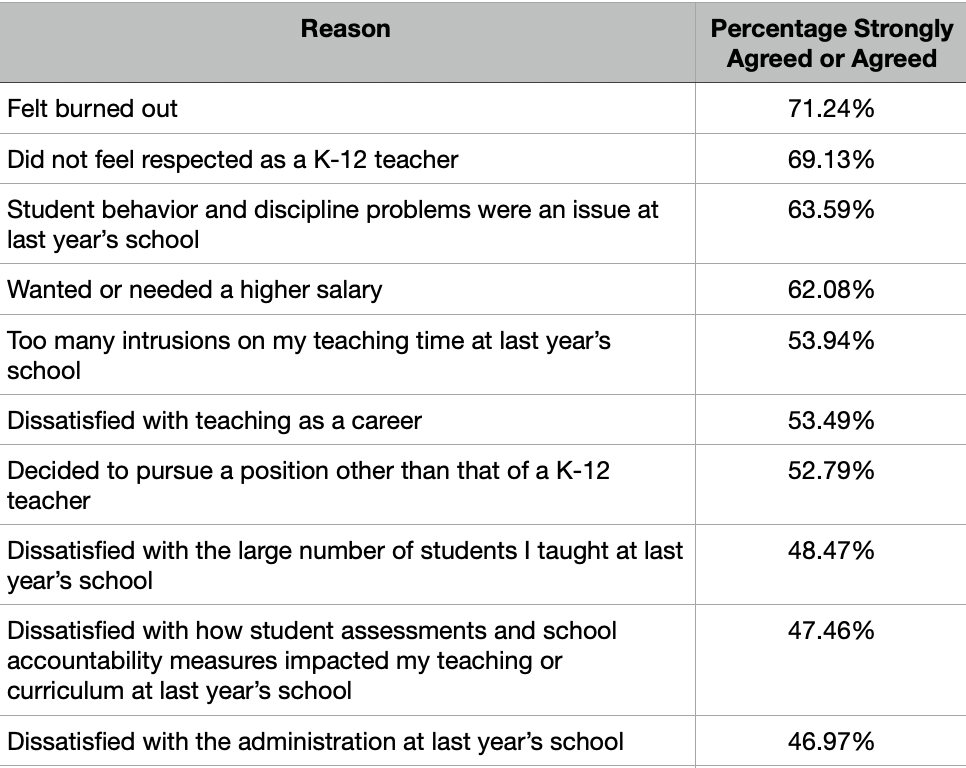
Although not politically correct, the title of this post is a saying sometimes used in the military to describe decisions by senior leadership that seemed extra harsh and detrimental to troop morale. This saying came to mind when I read of Arizona’s Superintendent of Public Instruction Tom Horne’s response to an AZ Department of Education survey of teachers who chose not to return to the classroom for the 2024-2025 school year. The results were released earlier this week and the top four reasons for teachers leaving included: burnout, lack of respect, student behavior and discipline, and low salaries. 

Almost 2,500 of the 5,900 teachers not returning responded to the survey, but 1,500 of the responses were removed for reasons such as those teachers were retiring, promoted to administration, or had accepted a monitoring job. The thousand or so remaining responses most often “strongly agreed” or “agreed” to the following:

Of course, Superintendent Tom Horne honed in on “student behavior and discipline problems” (ignoring burnout and lack of respect) as the significant contributing factor for teachers leaving their jobs. This then, provided him more justification to further push proposed legislation to link school letter grades to a tougher stance on discipline. The AZ Daily Star reported SB 1459 would have required “the state Board of Education to lower a school’s letter grade if it did not implement disciplinary actions in at least 75% of the total number of student discipline referrals submitted by teachers in a single year”. 

The bill was passed in the Senate, but two Republicans in the House refused to vote for it, killing the bill in this session. Of their vote, Horne said “Shame on the legislators who voted against it” claiming it is simply a way to incentivize district support for teachers regarding discipline.

Rep. Nancy Gutierrez, D-Tucson, saw an ulterior motive for the proposal. During the debate on the House floor, she said, 

“It is my opinion that this bill has been put forward in order not to support teachers but in order to make it so that there’s an easier way to have more public schools with D and F grades to support some of the rhetoric that we hear that public schools are failing our students”. 

This of course is just another way for Horne and GOP legislators to push parents toward vouchers and other privatization efforts. Representative Judy Schwiebert, D-Phoenix, agreed and blamed the Legislature for contributing to the teacher retention problems by funding Arizona schools at one of the lowest per-pupil rates in the nation. Schwiebert went on to say that, 

“The job of our local schools and boards is to make direct decisions that apply most specifically to their schools,” she said. “We see the legislature criticizing public schools when we are not doing our job. Arizona ranks 49th in the nation in per pupil funding. We’re pointing our finger at public schools, blaming them for problems that we have created because of too large class sizes, failure to pay teachers enough, failure to provide support staff.”

A Forbes.com article titled, “No More Teachers: The Epic Crisis Facing Education in 2024” agreed, stating that low pay is the biggest reason for the declining numbers of new teachers. In 2022, says veteran teacher and author Jay Schroder, “teachers made on average 26.4% less than other similarly educated professionals”. 

‘Schroder contends that the low pay, combined with high stress and a strong sense of disrespect from some outspoken sections of society, make the job of teaching unattractive to many college graduates. “If this were just a PR problem, it would be easier to solve,” he says. “The truth is that the pay is low and the stress is high.”’

According to K12Dive.com, the Educators for Excellence (E4E) 7th annual Voices from the Classroom survey of teachers this May, highlighted the crisis by reporting that, 

“A mere 19% of teachers believe the profession is sustainable, with only 16% of teachers recommending the profession to others, and less than half expressing commitment to staying in it for the long haul.”

We have been headed for a real crisis regarding teacher shortages; one that has only been exacerbated by the pandemic. And while the trailblazing Arizona Teachers Academy (ATA), passed with bipartisan support in 2018 was working to address our state’s crisis, lawmakers cut $14 million from the program’s budget this year. According to AZCentral.com, the program had expanded in 2023, to serve 3,255 aspiring teachers with an average scholarship of $8,555. The cuts made to the program this year, mean that some 1,700 fewer students will be working their way through a proven pipeline. In the past, ATA has also provided funding for mentors to support new teachers and National Board Certification for experienced teachers.

Turning around teacher dissatisfaction won’t be easy, but neither does it seem super complicated. It boils down to treating them as the professionals they are, not “beating down” them, their administrators, or their schools. Competitive compensation, autonomy to do the jobs they were trained for, an adequate support structure, a collaborative environment, and quality school leadership are some of the more important tools. Also important though, is a recognition by the public and those we elect to represent us, that quality teachers are a most worthy investment critical to the future of our communities, our country, and our world. 

As Anatole France, a French poet, journalist, and best-selling novelist, once said, “Nine-tenths of education is encouragement”. That applies to both students in the classroom and all the professionals who teach them. In my experience as a leader in the Air Force, the carrot is almost always mightier than the stick, but that approach does require a more confident and skilled leader. I guess it is just easier for Superintendent Horne to continue to try the “beatings” approach.

Books in the Library Before Dune Buggies in the Driveway

Public Tax dollars Should Fund Accountable and Transparent Public Schools!


EducationNext.org
, according to SourceWatch.org, “is a propaganda outlet for corporate education reform policies such as charter schools, school vouchers, and merit pay”. That helps explain the “opposing” views below on vouchers for all by Derrell Bradford and Michael J. Petrilli. 

Bradford advocates for vouchers for all (including the rich), because,

“If the rich are not in your coalition, you have a weak coalition. If they don’t benefit from your policy, you have a policy that will be difficult to maintain. It is just that simple.”

This may be somewhat true, but it is also cynical and a sad statement about our democracy and commitment to supporting the common good. Public schools, often the hubs of their communities, are a quintessential common good. Rich people may not send their children to many of these schools, but they too benefit when public schools succeed. When students are prepared to be responsible citizens who not only support themselves but contribute to society, everyone wins.

Bradford though, seeks to denigrate public schools as the choice serving the wealthy’s interests,

‘The public schools have the rich in their coalition, and they pay handsomely for them with a noxious policy concoction that secures their backing. The proposition works like this: “Support us and we will give you a publicly subsidized school, but it won’t be open to the public at large. It will, instead, only be available to you and your neighbors or a small group of students who can afford to pay tuition to attend, if we allow them to enroll. We will draw an attendance boundary around the school to ensure its exclusivity, and we will fine, arrest, or prosecute anyone who violates that boundary by lying about their address or through other trickery. You will also get to thump your chest and describe yourself as a ‘public school parent,’ which may be of great use to you in certain social circles. Finally, in the greatest subsidy available, your housing value will appreciate as a function of this exclusivity. In return, you’ll oppose schools or methods of school finance that would break the link between you, the house, the school, the boundary, and us.”’

Bradford’s assertion is dishonest. Forty-three states had some form of open enrollment policy as of 2023 according to EducationNext. Some of these states, such as Arizona, have policies that require students to be allowed to enroll in any public school in the state. Others, require students to be allowed to enroll in any school in the district of residence. 

He also makes it sound like the public school apparatus” (whatever that is) has diabolically plotted to focus on the wealthy to the detriment of those with less, 

“The well-off are a powerful constituency, and the public school apparatus has offered them an educational and financial package so lucrative that few people could (or do) say no, whether they reside in red states or blue. Thus, in building a “diverse” constituency to ballast themselves politically, the public schools have appealed not in a targeted way to the needy, but broadly and most beneficially to those who need very little. And, to date, this strategy of subsidizing the rich has worked brilliantly for the system.”

Don’t know about you, but when I think of a “diverse constituency” that is ballasting itself politically”, it is the pro-choice crowd, not public schools that comes to mind. Diversity is part of this constituency, but only as a means to an end. The school choice movement is incredibly well-financed and has powerful forces behind it. I believe their primary objective is to reduce the power of the people. And yet, no voucher issue has, thus far, survived the ballot box. That’s not because of some “public school apparatus”, but because voters understand the importance of public schools to our communities and our nation. 

Our founding fathers also understood that importance. They believed an educated populace was key to preserving our democracy and “recognized that educating people for citizenship would be difficult to accomplish without a more systematic approach to schooling”. Early on, schools were funded in a variety of ways and many charged tuition. Then in 1785 and 1787, federal laws trusted large amounts of federal lands to new states entering the union, as long as they agreed to use at least some of the lands for the support of public schools. This strategy helped build stable communities across America and showed the value our founding fathers “placed on education as [a] positive element of nation-building.

Are today’s public schools supported by local tax dollars? Yes, but also by state and federal. The current strategy for funding public schools wasn’t developed by the “public school apparatus”, but rather, by lawmakers who often make choices about education funding not based on the best outcome, but on what will support their reelection. 

How about we commit to properly resourcing our public schools instead of diluting the available funding? What makes more sense? Allowing a family with one child to purchase a piano with a voucher, or a public school purchasing a piano for its music program enjoyed by numerous students? Of course, what voucher recipient wouldn’t appreciate buying dune buggies or an Oscar Mayer hot dog machine on the taxpayer’s dime? Yes, these are real examples of voucher purchases.

And yet, the GOP continues to be all in for unaccountable universal school choice with Arizona serving as the model. This is despite the fact, that the universal voucher program in Arizona ballooned from an estimated $65 million last year to roughly $332 million according to ProPublica. This year, vouchers are expected to cost $429 million. This unbudgeted spending has necessitated cuts to critical water infrastructure projects, highway expansion and repair projects in congested areas, community colleges, and much more.

In a lukewarm rebuttal, Petrilli begins by agreeing with Bradford,

“It’s long past time for schools to be subject to the same competitive forces as other goods and services. And in our huge, diverse society, it makes sense to embrace a pluralistic school system that allows all families to find educational institutions that match their values, hopes, and goals for their children.”

Whoa! Our public schools are not a Big Mac or a drive-thru car wash. They are an investment in the future of our nation. Making them subject to the “same competitive forces as other goods and services” is often not effective nor efficient, especially when the rules of the game are not the same for everyone. Yes, some amount of competition for students can encourage schools to step up their game. But, the lack of accountability and transparency with vouchers, for example, makes it impossible to compare return on investment. 

But he goes on to admit that the savings voucher advocates claim just haven’t panned out, 

“But when the government starts to subsidize students already enrolled in private schools, it incurs a brand-new public expense. Those kids weren’t already attending school with taxpayer assistance. And with about 9 percent of students attending private schools—and those children coming disproportionately from wealthy families—adding them to the public rolls can add up fast. Maybe bringing these families into the school choice coalition has some political benefit—but surely it also exacts a political cost as taxpayers watch millions of dollars flow to prosperous elites who don’t need the money.”

He also disagrees with Bradford about including the wealthy in taxpayer-supported school choice options:

“But in general, state governments don’t spend much on educating the richest children. So it should be with school choice programs.”

Government (public) funds for education, at all levels, should first fund public schools that provide a quality education for all children. If parents with means want to send their children to private schools, that’s their right. It is our right to demand that we know how our tax dollars are spent and the return on investment. Our public schools offer the greatest amount of accountability and transparency and are still the choice for some 80 percent of America’s children. They must though, be resourced to get the job done. Unfortunately, as Save Our Schools Arizona executive director Beth Lewis told ProPublica.org,

“Spending hundreds of millions of dollars on vouchers to help kids who are already going to private school keep going to private school won’t just sink the budget, Lewis said. It’s funding that’s not going to the public schools, keeping them from becoming what they could and should be.”

What is Horne’s End Game?

because it doesn’t seem to be to support our public schools

Anyone who has watched Arizona public education for any time knows that the Superintendent of Public Instruction Tom Horne is not a friend of our state’s public schools. This, even though he served for 24 years as a member of the Paradise Valley Unified School District board.

Horne also served two terms as a member of the AZ House of Representatives and then was elected to his first term as Superintendent of Public Instruction in 2003 where he also served two terms. During that time, according to AZCentral.com, “he worked to dismantle ethnic studies in Tucson Unified School District and limit bilingual instruction for English language learners”. He was then elected Arizona’s attorney general, taking office in 2011, and defending the state in the federal government’s challenge to SB 1070 immigration law. In 2017, he was found to have misused the attorney general’s office staff to work on his re-election effort.

This self-described anti-racist who was born in Quebec, fell back on divisive racial politics when he ran for Superintendent again in 2022. He promised to remove critical race theory (CRT) from Arizona schools and start a hotline for reporting educators thought to be teaching it. He also promised to end bilingual education for English language learners, discourage the use of social-emotional learning that encourages students to learn interpersonal skills and self-control, and more aggressive discipline in classrooms. No matter that CRT is a university-level concept not taught in K-12, that some experts tout bilingual education as more supportive, that social-emotional learning helps head off discipline problems, and that his “more aggressive discipline” idea seems to rely mostly on more suspensions as the answer.

Horne is now under fire for losing $29 million in federal school funding because his department failed to spend the money before the September 30, 2023 deadline to use it. AZMirror.com reported that Governor Hobbs and legislative Democrats are calling for a special audit of the federal school improvement grants that should have gone to the 150-200 district and charter high-need schools. This funding was slated to pay for extra staff, professional development, and training. 

The AZ DOE didn’t even know they had missed the deadline for six months according to Horne’s Associate Superintendent. In the meantime, schools all over the state were left struggling to figure out how to make do with the cuts. In early August, the U.S. Department of Education contacted AZ DOE to offer a waiver that would allow the state to recoup the money. According to KJZZ.org, this was a result of reporters from the Arizona Republic and KJXX News contacting the U.S. Department of Education to inquire whether the state could request an extension. 

I try not to traffic in conspiracy theories, but in this case, it seems Horne is either out-of-touch, incompetent, or purposefully wanting to deny funding for some of our highest-need schools. After all, as the Superintendent of Public Instruction, he has no problem with running high-cost ads during the Olympics for the expansion of universal vouchers. Is his real end-game the destruction of our public district schools?

Whatever the end game, it is clear he is stoking culture wars to distract us from the real issues. As reported on PhoenixNew Times.com, The AZ Department of Education recently posted a photo of Horne and three “self-proclaimed Grandmas from Sun City West” on X, stating they were meeting to “talk about making schools better and protecting women and girls from changes to federal Title IX. In response, Beth Lewis, Executive Director of Save Our School AZ, responded by questioning “Why do Tom Horne and these Grandmas care who my kids are sharing a bathroom with??? Seriously?! My kids and their peers accept each other — gay, straight, lesbian, trans, bi, they DON’T CARE!”

A week after Lewis’ post, Horne blasted Lewis in a press release on the AZ Department of Education website stating, ‘“Save Our Schools” leader Beth Lewis owes her membership and Arizona educators an explanation for her support of having biological boys with male genitalia shower in girls’ locker rooms and using girls’ restrooms.’ Lewis responded on X by calling Horne “a weirdo who is publicly obsessing over kids’ genitals.”

It is bad enough Horne is so focused on issues like who uses which potty, that he can’t be bothered to ensure proper oversight of 29 million dollars to help students in high-need schools. The fact that he is also using governmental resources to attack and silence a private citizen is all the more egregious. Horne will appear before a legislative audit committee next month, but I’m not optimistic his feet will be held to the fire by GOP leaders. Our only real hope for policy and action that truly supports all Arizona’s public school students is to flip the Legislature in November.

The GOP Plan for Education – 3

What it Means for Arizona – Part 3

Below is part 3 on the GOP promises for education in the 2024 RNC Platform. The first two parts dealt with promises one through six. This one reviews the final promises, seven through nine.

7. Promote Love of Country with Authentic Civics Education: Republicans will reinstate the 1776 Commission, promote Fair and Patriotic Civics Education, and veto efforts to nationalize Civics Education. We will support schools that teach America’s Founding Principles and Western Civilization.

Interestingly, the GOP is against any efforts to “nationalize Civics Education”. This is weird, because civics is, after all, the study of the rights and duties of citizenship. States do not have citizens, only nations, and all citizens of the United States share rights and duties. Why, therefore, would we not nationalize civics education? Oh, that’s right, because the GOP wants all power to reside in the states.

For that matter, what is “authentic” civics education, and who determines that? I guess the GOP’s desire to reinstate Trump’s 1776 Commission, means that’s what they believe “authentic” civics education is. According to Forbes.com the Commission ‘pushes back on the “decline of American education” led by “progressive educators” who “sought to reshape students in the image they thought best.” The Civil Rights Movement, the Commission argues”, was “almost immediately turned to programs that ran counter to the lofty ideals of the founders.” And, in his executive order creating the commission, Trump said, “Many students are now taught in school to hate their own country”. So when the GOP “promotes Fair and Patriotic Civics Education”, we probably can’t be too hopeful that includes the important role people of color played in the shaping of America.

In Arizona, the statute already requires civics instruction in public schools that must include instruction on: “the original intent of the founding documents and principles of the United States as found in source documents” and “the civic-minded expectations of an upright and desirable citizenry that recognizes and accepts responsibility for preserving and defending the blessings of liberty inherited from prior generations and secured by the United States Constitution”.

GOP’s statement that they’ll “support schools that teach America’s Founding Principles and Western Civilization”, is just more of the same one-dimensional thinking. In a quick Internet search, I found several different ideas about what the Founding Principles are. The Library of Congress lists the ideas that all people are created equal and that these people have fundamental rights, such as liberty, free speech, freedom of religion, due process of law, and freedom of assembly. The National Archives lists checks and balances, federalism, limited government, popular sovereignty, republicanism, and separation of powers. What Founding Principles is the GOP referring to and why would we only want our children to learn about Western civilization? They will have to compete in a global economy – shouldn’t they understand something about the world in which it operates?

8. Freedom to Pray: Republicans will champion the First Amendment Right to Pray and Read the Bible in school, and stand up to those who violate the Religious Freedoms of American students.

Firstly, the First Amendment does not provide the “right to pray and read the bible in school”. The First Amendment states: 

“Congress shall make no law respecting an establishment of religion, or prohibiting the free exercise thereof, or abridging the freedom of speech, or of the press, or the right of the people peaceably to assemble, and to petition the Government for a redress of grievances.”

Although the “separation of church and state” does not specifically appear in the U.S. Constitution, the concept is enshrined in the first line of the First Amendment. This line is known as “the establishment clause” which prohibits the government from creating an official religion or favoring one religion (or nonreligion) over another. When public schools teach the Judaic-Christian Bible, that smells a whole lot like the government favoring one religion over another. 

9. Return Education to the States: The United States spends more money per pupil on Education than any other Country in the World, and yet we are at the bottom of every educational list in terms of results. We are going to close the Department of Education in Washington, D.C. and send it back to the States, where it belongs, and let the States run our educational system as it should be run. Our Great Teachers, who are so important to the future wellbeing of our Country, will be cherished and protected by the Republican Party so that they can do the job of educating our students that they so dearly want to do. It is our goal to bring Education in the United States to the highest level, one that it has never attained before!

It cannot surprise anyone that the GOP wants to eliminate the Department of Education. After all, the main jobs of the Department are to:

  • Establish policies on federal financial aid for education and distribute and monitor those funds
  • Collect data on Americas’ schools and disseminate research
  • Focus national attention on key educational issues
  • Prohibit discrimination and ensure equal access to education

You may have heard that red states are the biggest net “takers” (state residents pay less in federal taxes than the federal government gives back to the state). As of 2022, Arizona was seventh in the nation for the states most dependent on the Federal Government with almost 41% of Arizona’s funding coming from it. When it comes to education, AZ K-12 schools receive $2.36 billion, or $2,090 per pupil, from the federal government. Of course, as I discussed in item #2 above, the GOP doesn’t want to give up this funding, they just don’t want a federal agency administering it. Rather, they want it to go directly to the states in “no strings attached” block grants that allow the state to determine how to spend the money, such as giving it directly to parents. Arizonans, having seen the runaway, unaccountable voucher program in action, should recognize what a disaster that could be.

I’m not surprised the GOP wants to stop collecting data on America’s schools. Data helps make informed decisions but if you don’t want that data perhaps you’ve decided your way forward irrespective of the facts. It is obvious the GOP wants to privatize public education and Arizona has been leading that effort. 

As I mentioned at the beginning of this three-part post, I took the liberty of connecting the RNC Platform and Project 2025. There are plenty of ties between the two, and with Trump, all we need do is follow the people who worked for him and are prominent in the “Cult of Trump”. Paul E. Peterson, Professor of Education Policy and Governance at Harvard University, makes the connection between the RNC Platform and Project 2025 much more eloquently though. He writes that, although the former is “spare” and the latter “complex”, they “can be construed as entirely consistent with one another”. “Read together”, he offers, they “strongly suggest that a Trump presidency implies a smaller federal footprint in K12 education, support for school choice, less federal regulation, opposition to affirmative action and reversal of the sex and gender policies of the Biden Administration.” 

I don’t know about you, but I hope and pray “we are not going back”!

The GOP Plan for Education – 2

What It Means For Arizona – Part 2

Below is part 2 on the GOP promises for education in the 2024 RNC Platform. The first part dealt with promises one through three. This one reviews promises four through six.

4. Safe, Secure, and Drug-Free Schools: Republicans will support overhauling standards on school discipline, advocate for immediate suspension of violent students, and support hardening schools to help keep violence away from our places of learning.

Arizona has been losing a net of 3,300 teachers per year according to Superintendent Horne and although 67% of them left the profession last year due to low pay, 61% said a lack of support in dealing with student behavior and discipline was also to blame. His predecessor, Kathy Hoffman, tapped into Federal Recovery Act dollars to add hundreds of school counselors. But in the 2022-2023 school year, we still had only one counselor for every 667 students, almost double the national average. 

Now, federal funding is running out and lawmakers are looking for less expensive solutions. HB 2460, passed in the Legislature and signed by the governor in 2023, retracted previous legislation allowing kindergarten through fourth-grade students to be suspended. This year, Horne proposed Senate Bill 1459 which would have reduced a school’s letter grade if disciplinary action was not taken in at least 75% of teacher referrals. It had significant opposition and was eventually held in the House.

There is plenty of evidence though, that punitive discipline is not the best solution. As reported in ChalkBeat.org, “Students who get suspended tend to have lower test scores and higher dropout rates, and students who attend schools with high suspension rates are more likely to be arrested and incarcerated as adults — what advocates call the school-to-prison pipeline.” Morgan Craven, national policy director at education civil rights group IDRA says, “if lawmakers want to make schools safer, they should ensure that students have access to mental health services and programs that teach positive behaviors. “Our response should not be”, she added: “OK, let’s just find faster, easier ways to simply kick them out.” As reported on KAWC.org, Rep. Jennifer Pawlik, D-Chandler, a former school teacher, said “A lot of people are leaving right now because classroom behaviors have accelerated,” Pawlik said. “And it’s really hard to be a teacher right now.” The answer though she added, is not to put in “punitive measures”, but rather, to consider class size, mentors for new teachers, and “appropriate staffing of our schools that includes mental health providers and paraprofessionals” (trained aides that support teachers).

I’d like to see the GOP deal with the cause for the need to harden our schools, but I’m not holding my breath. I’m also not holding my breath for the funding to harden our campuses. The reality is that not only do Arizona’s schools not have funding to “harden” their campuses, they don’t even have sufficient funding to ensure basic maintenance. A trial finally began in June of this year, on a lawsuit filed in 2017 on behalf of several school districts and the Arizona School Boards Association, which claims “Arizona’s funding model puts low-income schools at a disadvantage and violates the state’s constitution”. An Arizona Supreme Court ruling in 1994 prompted the state legislature to pass the Students FIRST law funded at $1.3 billion to provide emergency funding for capital projects. However, the Legislature has cut at least $4.56 billion from education funding since 2009, and according to 12News.com, “rural districts are at a greater disadvantage because they can’t raise enough money from bonds and overrides and their property tax wealth is limited.” 

5. Restore Parental Rights: Republicans will restore Parental Rights in Education, and enforce our Civil Rights Laws to stop schools from discriminating on the basis of Race. We trust Parents!

I am SO tired of this parental empowerment and parental rights language. First of all, parents are not the only stakeholders in the education of their children. In a well-functioning civil society, we all have a stake in ensuring children are taught a full curriculum that enables them to think for themselves and become productive citizens. And oh by the way, if you take my tax dollars to educate your child in a private school setting, I should have a say in what that education consists of. 

Just try to think of another publicly funded service where the public has no say in how that good or service is provided. Why do we tolerate it in education? As previously pointed out, Arizona vouchers require very little accountability from parents using them. And, there is no reporting of educational outcomes required by the schools. Therefore, we the voters, have no idea how it is going and can’t then, hold our lawmakers responsible for their decisions to support them.

Sorry if I don’t believe the GOP’s desire to “enforce our Civil Rights Laws”, is genuine, at least not for any person other than a white male. After all, Project 2025 wants to scale back the federal government’s ability to enforce civil rights laws like Title IX, which prohibits sex-based discrimination, and Title VI, which prohibits race-based discrimination, by any entity accepting Federal monies.

6. Knowledge and Skills, Not CRT and Gender Indoctrination: Republicans will ensure children are taught fundamentals like Reading, History, Science, and Math, not Leftwing propaganda. We will defund schools that engage in inappropriate political indoctrination of our children using Federal Taxpayer Dollars.

Arizona’s public district schools teach what is required by law, and there is very little time in the schedule or funding to do otherwise. School curriculum is dictated by law via the Arizona Academic Standards spelled out by the Department of Education. School success in teaching these standards is reported via the annual Arizona Academic Standards Assessment. However, students who take vouchers and Student Tuition Scholarships to attend homeschools, micro-schools, religious schools, or other private schools, as provided by the AZ GOP-led Legislature, do not participate in these assessments and the schools are not required to report any assessment data.

The hypocrisy behind “we will defund schools that engage in inappropriate political indoctrination” is staggering. The Arizona Legislature hasn’t yet followed Oklahoma in requiring the Bible to be taught in our public schools or Louisiana in requiring the Ten Commandments to be posted in the classroom, but the Arizona Department of Education and multiple AZ GOP lawmakers have been working with the controversial conservative group PragerU to offer new lesson plans on what they call “American Values”.  State Superintendent Horne wants this curriculum offered in Arizona classrooms as an alternative to the “extreme left side [that] has been presented”. Save our Schools Arizona Director Beth Lewis disagrees and calls PragerU content “dangerous. I’m in classrooms all over the state. I see what educators are teaching,” Lewis said. “The things they’re being accused of are not happening. They’re teaching accurate, truthful science and history.”

So, in fulfilling these three promises, the GOP would deliver more punitive discipline measures which will likely reduce protections for girls and children of color, and continue to feed the school-to-prison pipeline. Oh, by the way, six of Arizona’s 10 prisons are already privately owned. Just sayin’…

The GOP Plan for Education – 1

What It Means for Arizona – Part 1

First of all, what IS the GOP plan for education? Great question. According to the New York Times, the Republican National Committee (RNC) Platform was meticulously prepared by Team Trump and passed at the convention with “ruthless efficiency… that squelched, silenced or steamrolled any forces who might oppose” it. It is the “official” plan but by design, is short and vague, because according to Zack Beauchamp writing on Vox.com, “[Trump] wanted nothing in the platform that would give Democrats an opening to attack him”. Project 2025 from the conservative Heritage Foundation, provides many more details but Trump now disavows any knowledge of it despite plenty of evidence to the contrary. “The now-infamous document puts meat on the platform’s bones” writes Beauchamp, “It details a set of proposals for how to take the RNC’s vague Trumpy principles and turn them into actual, concrete policy. In essence, it is serving as the policy shot for a party uninterested in doing its own homework.” 

In reading the plans for education in both documents, The Republican National Committee platform looks to be the “Cliff Notes” for Project 2025 which wants to eliminate the U.S. Department of Education and according to Newsweek, “seeks to unravel decades-long efforts to cultivate equitable learning spaces and systems. If implemented, it would unwind critical protections for American schoolchildren…and erase any effort from the federal government to improve America’s schools.” 

The RNC Platform itself initially sounds less innocuous, but the devil is definitely in the details. The chapter on education begins with the heading “Cultivate Great K-12 Schools Leading to Great Jobs and Great Lives for Young People.” Then it provides a paragraph called “Our Commitment” which states: 

“Republicans offer a plan to cultivate great K-12 schools, ensure safe learning environments free from political meddling, and restore Parental Rights. We commit to an Education System that empowers students, supports families, and promotes American Values. Our Education System must prepare students for successful lives and well-paying jobs.” 

It then provides nine promises. In this three-part post, I’ll at times use points from Project 2025 to help explain what the GOP Platform might intend, and what it means for Arizona. Yes, it is a leap. But, I would argue, not a huge one and, because of the potential danger of another Trump Administration’s impact on public K-12 education, one worth taking. 

1. Great Principals and Great Teachers: Republicans will support schools that focus on Excellence and Parental Rights. We will support ending Teacher Tenure, adopting Merit pay, and allowing various publicly supported Educational models.

Arizona’s version of teacher tenure is called “continuing status” and is granted to teachers who have not been rated as “ineffective” for the major portion of more than three years. All other teachers have “probationary” status. Continuing status, simply means these teachers cannot be terminated without adequate notice and the opportunity to correct ineffective performance. 

Eliminating teacher tenure would make it even harder for Arizona to attract and retain good teachers who accept lower pay (than other comparable career fields) for a more secure and stable job. Just a few weeks into the last school year, Arizona had “2,229 teaching vacancies across 131 districts”, according to a survey by the Arizona School Personnel Administration Association. Part of the problem is an average teacher salary of $9,000 less than the national average, but it is also about teachers feeling unvalued, unsupported, and overworked. Jay Schroder, a veteran teacher, and author, “contends that the low pay, combined with high stress and a strong sense of disrespect from some outspoken sections of society, make the job of teaching unattractive to many college graduates”. “If this were just a PR problem, it would be easier to solve,” he says. “The truth is that the pay is low and the stress is high.” Eliminating teacher tenure would only increase that stress, and make the low pay even less desirable for even the most passionate professionals. 

Merit pay refers to any system in which compensation is partly based on an evaluation of the employee’s job performance. Arizona statutes already require that district governing boards prescribe specific procedures for the teacher performance evaluation system that include an annual evaluation of each teacher by a qualified evaluator. This evaluation must include two classroom observations at least 60 days apart, and quantitative data on the academic progress of the teacher’s students, (which accounts for 20 to 33 percent of the overall evaluation). The statutes provide exceptions to some of these rules (such as omitting the second classroom observation) where teachers are proven high performers. 

2. Universal School Choice: Republicans believe families should be empowered to choose the best Education for their children. We support Universal School Choice in every State in America. We will expand 529 Education Savings Accounts and support Homeschooling Families equally.

Arizona has offered open enrollment (allowing parents to enroll their child in any district school that has openings), and charter schools since 1994. Additionally, family-funded homeschooling and private school attendance have always been options, but with the universal voucher (Empowerment Scholarship Accounts) expansion, the AZ GOP pushed through the Legislature in 2022 (voters rejected them two-to-one in 2018), we all must now foot the bill. Unfortunately, the voucher program requires almost no accountability and the AZ GOP-led legislature hasn’t been interested in introducing even common-sense checks and balances. This prevents us from measuring their return on investment and holding anyone accountable for results; exactly opposite to our requirements for our public district schools.

As for homeschooling, Arizona couldn’t make it any easier. Homeschoolers must only send a letter (Affidavit of Intent) to their county school superintendent stating they will homeschool and can now get vouchers to cover their costs. Arizona statutes require the curriculum to include reading, grammar, math, social studies, and science, but there are no teacher qualifications or assessment requirements to help ensure quality learning takes place. 

The GOP didn’t spell out how they plan to expand 529 Education Savings Accounts but Project 2025 could give us a clue. According to Education Week, Project 2025 proposes phasing out Title I funds for educating disadvantaged or underserved children over the next decade. Until then, it states that Title I funds should be transitioned to “no-strings-attached” block grants administered by state education departments. This could allow funds to flow directly to parents in the form of 529 education savings accounts for private school and other education expenses. It also discusses doing the same for special education funds from the Individuals with Disability Education Act (IDEA). Arizona already fully supports and promotes 529 accounts to pay for qualified postsecondary education and apprenticeship program expenses. AZ529.gov states that it “offers a tax deduction each year ($2,000 per beneficiary per tax filer) for investing in the Arizona 529 Plan or any state’s 529 plan” and that “There is no limit on the number of beneficiaries Arizona residents can make contributions to in a tax year.”

3. Prepare Students for Jobs and Careers: Republicans will emphasize Education to prepare students for great jobs and careers, supporting project-based learning and schools that offer meaningful work experience. We will expose politicized education models and fund proven career training programs.

The Arizona Legislature enacted statutes that allowed public school districts to form Career and Technical Education Districts (CTED) in 1990. We now have 14 CTEDs across the state with almost 161,000 students receiving career and technical education.These students learn skills required to be aircraft mechanics, dental assistants, firefighters, graphic designers, plumbers, vet techs, welders, and much more. The results of the program speak for themselves with students in CTE courses statewide graduating at a rate of 97% versus 81% of those students in traditional track programs. Not only that, but they are prepared for high-paying positions in their chosen fields. 

So in fulfilling these first three promises, the GOP would likely exacerbate our teacher shortages and export Arizona’s runaway and unaccountable voucher program to the rest of the country. Please stay tuned for the rest of their plan.

Are We Strong and Determined?

Our Public Schools and Common Good Depend on It

According to the New York Times, Project 2025 suggests that the federal Department of Education should be “eliminated”. The Republican Party’s 2024 platform shares this idea and although Trump has been trying to distance himself from it, there is plenty of proof that he has endorsed it in the past. Not only that, but his positions are even weirder.

It is not surprising, that Trump’s position on education is low on content and high on red meat. He promises “the direct election of school principals by the parents” and to cut “federal funding for any school or program pushing critical race theory, gender ideology or other inappropriate racial, sexual or political content to our children”. To counter the threat he says is posed by the “Marxists” and “pink-haired Communists teaching our kids”, he’ll “create a new credentialing body” (the “world’s gold standard”), “to certify teachers who embrace patriotic values, support our way of life and understand that their job is not to indoctrinate children but very simply to educate them.” Wait, whaaaaaaat?

Firstly, under our current laws, he can’t make good on his promise to allow parents to directly elect principals. And, why do they need to? Parents (and other voters) already elect governing board members responsible for oversight of district administration. If parents aren’t happy with the way the school is run, they have the power to address it. Secondly, just so I understand, teaching kids the true history of America as a multi-cultural melting pot that has promised, but not always delivered, liberty and justice for all is indoctrination. But, teachers embracing patriotic values (as defined by the right-wing) and supporting our way of life (assuming “our” refers to white, heterosexual, Christians with children) is not indoctrination. Good to know.

What is also good to know, is that these issues were those of the last election, not of this one. As reported in The74, “an online survey of 1,300 likely 2024 voters – including parents of school-age children, found Americans now care about different issues related to public education: safety, high-quality teaching, and literacy. Or as The74 puts it, safe schools and kids who can read.

The truth is, Trump and his GOP cronies aren’t out to improve academic outcomes for all America’s children. They are out to keep the rich and powerful ensconced in their ivory towers by dividing the rest of us. This is why they promote the privatization of our public schools and couch (maybe I should have used a different word here) it as school choice and parental empowerment. The truth is that where vouchers have gone on the ballot, voters have rejected them. Voters know that our public schools are the hubs of our communities. They bring us together and help bond us in a shared identity. There is power in this shared identity.

We can though, fight back. We must vote for lawmakers who will legislate for the next generation versus the next election. We must recognize that America’s public schools have always been a big part of our success as a nation and are our best solution to ensure the “educated citizenry” Thomas Jefferson wrote was “a vital requisite for our survival as a free people”.

I am no pedagogical expert, but I learned a long time ago that people care how much you care, long before they care how much you know. So, let’s just start with really caring. That would mean we no longer accept firearms as the number one cause of death for children in the U.S. killing more children each year than car accidents, drug poisoning, drowning, and suffocation. Everytown.com reports that in 2024, there were at least 124 incidents of gunfire on school grounds, resulting in 34 deaths and 71 injuries nationally. It is inexcusable that school shootings are now just a way of life in classrooms around our country and lockdown kits are yet something else schools need along with locked single entry points, metal detectors, cameras, and active shooter drills. If we continue to allow the carnage, we just don’t care enough and that simply IS who we are.

A second step is for all of us to understand education is an investment, not an expense. The future is only as bright as the children who inherit it and we can’t give them what they need without a serious commitment of time and resources. Those resources include high-quality teachers and support staff, a full curriculum, and well-fed “butts in seats”. The GOP’s Project 2025 may call Federal school meals an entitlement program inferring it a bad thing, but students focus better when they are fed and we should care more about them being fed than about who does the feeding. We also need them to attend school. As the New York Times reported, “an estimated 26% of students were considered chronically absent (missing around 18 days) in 2023. Increased discipline problems are intertwined with absenteeism and both are holding back progress in our schools.

In a 2017 New York Times magazine article titled “Have We Lost Sight of the Promise of Public Education?” Author Nikole Hannah-Jones discusses how American public institutions and systems have long struggled with the ideal of serving the common good against the strong influence of the private market economy. She wrote, “If there is hope for a renewal of our belief in public institutions and the common good, it may reside in public schools”. I believe it does reside in our public schools, but only if we fight for them. It’s just sad that in the seven years since her article, the forces fighting back seem stronger, or at least more determined, than ever. Are we?

So…What’s the Real Deal with Vouchers?

Hint: It’s not about improving educational outcomes for disadvantaged children

I was reminded by someone today that back in the 1970s, Arizona public schools were 19th in the nation for funding. Now, they rank 49th. This didn’t occur in a vacuum, nor was it by accident. Rather, it has been, and is, a concerted effort to wrest power from the people by defunding the common good and destroying our sense of community. 

One of the most effective routes to this end is to privatize public education and Arizona has been the pace car. From being the first state to allow charter schools in 1994, to leading the effort to offer dollar-for-dollar tax credits to fund private school scholarships in 1997, Arizona has leaned into the school privatization effort. Although the path hasn’t always been a straight line, (an initial voucher attempt was ruled unconstitutional and the first try at universal expansion was successfully killed by a Save Our Schools AZ ballot initiative), AZ GOP lawmakers finally succeeded in passing universal vouchers in 2022.

Of course, those lawmakers didn’t do it on their own. The American Federation for Children (Betsy DeVos), Americans for Prosperity (Koch Brothers), American Legislative Exchange Council (national conservative bill mill), and the Goldwater Institute were all behind the voucher expansion here in Arizona and elsewhere. According to the Arizona Center for Investigative Reporting (AZCIR), Arizona’s Goldwater Institute has said, “It won’t stop until parents in every state in the nation are empowered to decide what education path truly meets their children’s needs”. 

What, I would ask, about the rest of our needs? These programs, despite proponent’s claims, have not saved taxpayers money. Rather, they’ve diverted and diluted the funding available to our district schools, where 80% of our students are educated. In an analysis of state education spending, Columbia University researchers found from 2008 to 2019, “Arizona was one of the few states where public school spending declined even as enrollment increased. Per-pupil public school spending dropped by 5.7% during that period, according to the analysis, while spending on voucher and tax-credit programs climbed by 270%”. According to the Arizona Department of Education, the total annual ESA awards for students enrolled in Quarter 3 of this year is $735 million this year. And to those who claim that there is a direct cost reduction to public schools when students take a voucher, that is only true if the student was attending a public school when they took the voucher. In FY 2023, only 21% of those taking vouchers were in public schools at the time indicating families are likely using vouchers to subsidize expenses they had formerly covered. As of March 2024, AZ DOE claimed the number has risen to 61.5%. Regardless, when a public school student leaves to take a voucher, there are always fixed costs that the public school can’t reduce when one or a handful of students leave (bus routes, number of teachers required, utility consumption, etc.”). In the meantime, tightened funding hampers our public school leaders in ensuring facilities are well-maintained, and that transportation, technology, and other needs are addressed.

These programs also offer us no real accountability. Private schools aren’t required to participate in state or national testing, nor to publicly report the efficacy of their educational efforts with indicators such as grades and graduation rates. This might have been okay when parents self-funded their children’s private education, but it is not when taxpayers foot the bill. We have a right to know how those tax dollars are spent and whether or not we are getting an adequate return on our investment. Instead, the GOP-led Legislature has resisted any attempts to introduce more accountability into the voucher program. 

Of course, this is all by design. If schools (whether it be private schools, homeschools, micro-schools, or religious schools) accepting vouchers aren’t required to report on academic progress, they can’t be compared to public schools. This allows voucher proponents to make claims that can’t be supported with data. And, the more funding that is cut from our public schools, the harder it is for them to succeed. As Maria Polletta from the Arizona Center for Investigative Reporting writes, “The harder you make it for public schools to succeed, the easier it is to sell the alternatives. And, plenty of well-financed conservative groups are working to do just that”. This leaves us to ask ourselves what’s in it for them.

I’d argue that the desire to maintain and grow their power and wealth is driving privatization proponents. We already have proof that vouchers work better for well-resourced students than lower-income ones. This dynamic, (according to Professor Derek Black who specialized in the intersection of constitutional law and public education), “will continue to exacerbate segregation and create a fragmented educational landscape”. Black goes on to say, “The people who propose these types of things, in my mind, are either highly ignorant of or highly dismissive of a 200-year commitment to public education with the understanding that democracy itself rests upon it.” Or maybe, just maybe, they know exactly what they are doing…