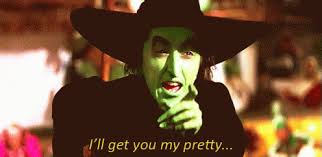
Finchem to teachers: “I’ll get you my pretty”

Voter suppression is alive and well in America and Arizona is no exception. Yes, some strides were made by county recorders to ensure more people had the opportunity to cast their ballots and have them counted, but the work to disenfranchise voters and strip away their voice, continues.

I’ve personally experienced a little bit of this, because as the President of the Arizona School Boards Association (ASBA), I had to be mindful of even giving an appearance the Association was attempting to influence the outcome of any election. Given my natural tendency to speak my mind, I found it frustrating to be silent while unethical candidates peddled their spin and thousands of grassroots volunteers labored across the state to get pro-public education initiatives passed. And although too many of the former won reelection, at least the full expansion of vouchers was killed. Other good news (at least for me) is that since I passed the President’s gavel this week, I am now once again free to comment away. It has been an incredible honor to serve as President of this awesome organization, but I am happy to be unmuzzled.

I just read Arizona Capitol Times reporting that AZ Representative Mark Finchem isn’t waiting for the start of the legislative session to exact retribution on educators who stood up for themselves and their students this year. To the teachers in his district (LD 11) who marched on the Capitol this year and saw him in action, this will not come as a surprise. After all, one teacher who visited him during the #RedForEd walkout told me that when they went to see him, he told them to “get their asses back to work”. I cannot verify this charge, but in my experience with Finchem, can say that I have found him to: 1) say what he thinks, 2) not be subtle and 3) not be supportive of public education.

His new bill, H2002 (educators; ethics professional responsibility), would require the State Board of Education to adopt uniform rules for all certified teachers in “taxpayer supported schools” to bar them from political activities. Funny thing is, Arizona Revised Statue (ARS) 15.511 already forbids the use of public school resources to influence elections and, levies a fine of $5,000 per violation. And, as Chris Kotterman, ASBA’s legislative Liaison said, “everyone who works in public schools is keenly aware that they’re under a microscope in regard to political activity.”

True to form though, Finchem wants to not only drive the point home (just in case educators are too stupid to understand it), but also lock them in a box and throw away the key. According to AZ Capitol Times, he proposes a prohibition on “the endorsement or opposition of any candidate or elected or appointed official; any pending or enacted legislation, rule or regulation; pending, proposed or decided court case; or pending, proposed or executed executive action.”

As Kotterman observes, “Finchem’s bill does not appear to be a genuine effort to improve the teaching profession, but rather a list of grievances.” Kotterman also said, “This just doesn’t feel serious to me. It feels 100 percent political. If you were serious about having a teacher code of ethics, it would cover more than just stuff that seems to have happened in the last 24 months.”

Finchem’s past words and actions have made it clear that he is: disdainful of higher education that teaches critical thinking, not a fan of local control, and, that in favor of teaching revisionist history. Perhaps these are the some of the reasons he is also proposing a prohibition on “any controversial issue that is not germane to the topic of the course or academic subject,” where “controversial issue” is defined as “a point in a political party platform,” and on “partisan advocacy of a controversial issue.” He also wants banned, the “segregation of students according to race” and that teachers not be allowed to “single out one racial group of students as being responsible for the suffering or inequities experienced by another racial group of students. Of this, AZ Capitol Times reporter Katie Campbell writes, ” That provision seems to hint at Tucson Unified School District’s former Mexican American Studies program, of which Finchem has been a frequent critic.” Kotterman commented on that too, saying, “We have been down this road. We have a law on the books about this. It’s been litigated three times. Believe me when I say that school districts understand their responsibilities.”
Yes, districts and educators do understand and that’s why, until this election cycle, they remained largely silent. It was just easier to stay silent than to risk an accidental infraction. But when they watch the #RedForEd wave work its way across our country, they realized if there was any possibility of driving real positive change for their students, they were going to have to be the ones to drive it. I suspect Finchem didn’t like them “getting to big for their britches” (my words not his) and it doesn’t surprise me he wants to put them back in their place. Legislation he sponsors and positions he espouses is routinely focused on showing who’s the boss and in his view…its not the people of Arizona. And, when the people forget the Legislature is “the Boss” he is good at whacking them on the proverbial knuckles – or at least trying to.

And yet, the voters of LD 11 returned him to the Legislature, rewarding him for his condescending, mean-spirited attitude. The good news is that some of his more egregious bills fail. The bad news is, many of them don’t and now on his third term, he will be even more emboldened.

I don’t know about you, but I’d like to have elected officials that work to make our lives better, not worse. I’d like to have our elected officials focused on finding ways to “lift us up” versus “keep us down.” Unfortunately, at least in LD 11, that’s just not reality. So, it requires us, his constituents, to stay informed and engaged, to remind Finchem that we ARE the boss of him and not the other way around.
Wealth Redistributed

I was recently in a public forum on education when a school board member asked me whether my call to address inequities in our schools was a call for the “redistribution of wealth”. I told him local control dictates that our Governing Boards, representing the communities in which they live, are best positioned to decide how to allocate district resources for the maximum benefit of all their students.  I hoped, I said, they would do that.

His question though, caused me to think about this term, and why it seems to be a lightning rod for conservatives. Social scientist researcher Brené Brown believes it is because of the “scarcity” worldview held by Republicans/conservatives. “The opposite of scarcity is not abundance” she writes, “It’s enough.” Basically, “they believe that the more people they exclude from “having”, the more is available to them.” And, in this binary way of thinking, the world is very black and white (pun sort of intended), e.g., if you aren’t a success, you’re a failure, and should be excluded. Of course, this sort of mindset is a gold mine for those who fear-monger to garner support for their exclusionary agendas. “We’ve got to stop the illegal hoards from coming across the border” the narrative goes, or “they’ll be stealing our jobs and elections.”

I offer that the redistribution of wealth can also flow the other way as with the            privatization of our public schools. Those who already “have” are redistributing the “wealth” of those who “have not”. They do this by encouraging the siphoning of taxpayer monies from our district public schools, for charters, home and private schools. Once slated for the education of all, our hard-earned tax dollars are now increasingly available to offset costs for those already more advantaged.  

In Arizona, approximately 60% of our one million public K-12 students qualify for the free and reduced price lunch program, with over 1,000 schools having over 50% of their students qualifying. As you might guess, schools with the highest number of students qualifying for “free and reduced” are located in higher poverty areas and with few exceptions, have lower school letter grades. Zip code it turns out, is an excellent predictor (irrespective of other factors) of school letter grade. According to a study by the Arizona Partnership for Healthy Communities, “Your ZIP code is more important to your health than your genetic code” and a life-expectancy map for Phoenix released three years ago, “found life expectancy gaps as high as 14 years among ZIP codes.”

Clearly, when it comes to inequities in our public schools, the “public” part of the equation is at least as important as the “schools” part. In other words, the problem is bigger than our schools and must be dealt with more holistically if it is to be solved. Poverty is obviously a big part of the problem and is nothing new. What is relatively new, is the purposeful devaluation of concern for the common good and the marketing of privatization as the solution to all our problems. 

Privatization has not however, proven itself to be the panacea for fixing our “failing schools”, rather, it is exacerbating their problems. In Arizona, all forms of education privatization (vouchers, tax credits, home schooling, for-profit charters) are taking valuable resources out of the public district school system while delivering mixed results. We’ve also seen countless examples of shameless self-enrichment and outright fraud with taxpayer dollars. Meanwhile, some 80% of Arizona students are left in underresourced district schools, many of which are seeing (not by accident), their highest level of segregation since the 1960s. 

Noliwe M. Rooks, director of American studies at Cornell University and author of  “Cutting School: Privatization, Segregation, and the End of Public Education, coined the term “segrenomics” to define the business of profiting from high levels of this segregation. In an interview with Valerie Strauss of the Washington Post, Rooks said that, “Children who live in segregated communities and are Native American, black or Latino are more likely to have severely limited educational options. In the last 30 years, government, philanthropy, business and financial sectors have heavily invested in efforts to privatize certain segments of public education; stock schools with inexperienced, less highly paid teachers whose hiring often provides companies with a “finder’s fee”; outsource the running of schools to management organizations; and propose virtual schools as a literal replacement for — not just a supplement to — the brick and mortar educational experience. “ She went on to say that, “The attraction, of course, is the large pot of education dollars that’s been increasingly available to private corporate financial interests. The public education budget funded by taxpayers is  roughly $500 billion to $600 billion per year. Each successful effort that shifts those funds from public to private hands — and there has been a growing number of such efforts since the 1980s — escalates corporate earnings.”

This shift of taxpayer dollars from public to private hands is clearly a redistribution of wealth. Worst of all, in Arizona, it is a redistribution of wealth with little to no accountability nor transparency. Private, parochial and home schools are not required to provide the public information on their return on investment. And make no mistake, this investment is significant and continues to grow. In 2017 alone, taxpayer dollars diverted from district schools to private school options, amounted to close to $300 million. About $160 million of this, from corporate and personal tax credits with the other $130 million from vouchers. All told, according to the Payson Roundup, “vouchers have diverted more than $1 billion in taxpayer money to private schools. These dollars could have instead, gone into the general fund to ensure the vast majority of Arizona students were better served. In a 2016 study reported in USA Today, “a 20 percent increase in public school funding corresponds with low-income students completing nearly a year of additional education — enough to drastically reduce achievement gaps and adulthood poverty.” Of course, corporate reformers argue that school choice affords poor, disadvantaged children the opportunity to access the same education as their wealthier counterparts. But, does it?

The Arizona Republic reported in 2017 that, “75% of the voucher money came from school districts rated “A” or “B” and only 4% from those rated “D” or lower.“ And, not only were the tax payer dollars disproportionately siphoned from better (at least by the state’s grading system) performing schools, but “students leaving the ‘A’ and ‘B’ rated districts had an average award of about $15,300, while for those leaving the ‘D’ or lower rated schools, the average award was only about $6,700.” With the average private elementary school cost at about $6,000 and high school at $18,000, it is easy to see, even without the added hardships of having to provide transportation and lunches, that opportunity does not equal access for low-income students and that those students are not the ones taking advantage of other than district school, school choice options.

Unfortunately, low-income parents are sometimes lucrative targets to the promise of school choice. As Professor Rook writes, “What I learned writing this book is that parents in poor communities care so deeply about education that they are willing to go to almost any lengths, both tested and experimental, to find the silver bullet that might possibly provide their children with the educational access that has been so long denied.”

I believe the answer lies in recognizing that the common good matters and in the long run, is important to everyone, rich, poor, or in between. As Mark Baer wrote on Huffington Post, “ the more people you essentially exclude from participating in the economy, the worse the economy becomes because the money isn’t circulating.” There are after all, only so many yachts a billionaire needs (Betsy DeVos and her 10 yachts aside).

The point is, the more people we have participating in the American Dream, the stronger that Dream and our country, will be. Our system of public education for all, that created the greatest middle class in the world, is at risk and if we aren’t careful, will take our communities, the very fabric of our society, with it.  

Breathtaking Hipocrisy

There are many things to be upset about in today’s world, especially in the political arena. What probably gets my blood boiling quickest though, is the unadulterated hypocrisy I see coming from the Right.

According to the Arizona Capitol Times, AZ House Speaker Mesnard recently criticized Maricopa County Recorder Adrian Fontes for his opening of certain Emergency Early Voting Centers during the General Election. He accused Fontes of selectively choosing where to open these centers and said, “those type of ‘shenanigans’ foster doubt in the public about the integrity of our election system.” Mesnard added that “And I cannot think of a more dangerous reality than people questioning the integrity of an election system.”

Okay, maybe he really does believe this. It is of course, something that any patriotic American should be worried about. Even if he does believe it though, his party and foremost, its leader (President Trump), has been stoking this “dangerous reality” ad-nauseam. And, the Arizona Republican Party recently jumped on his bandwagon with unfounded claims of deliberate election fraud by the Democrats.

At the same time, GOP Congressman Andy Biggs published an op-ed in the Daily Caller titled, “Democrats have a Civility Problem to Fix.” How about this Andy, you guys go first. I mean REALLY, the audacity! I find it beyond the pale that Biggs is lecturing Democrats about civil discourse. After all, his party’s fearless leader has been a master at fomenting hatred and polarization. In 2017, Trump’s first year in office, the FBI reports hate crimes alone were up by 17%.

In his piece, Biggs criticizes Congresswoman Maxine Waters for “incit[ing] criminal conduct by promoting harassment and intimidation of Republicans, conservatives, and Trump supporters. Okay, there may be some truth to his criticism, but she only responded to President Trump calling her “crazy”, “one of the most corrupt people in politics” and of being a “low IQ individual…somewhere in the mid–60s.” No, his attacks do not excuse her of any bad behavior, but let’s not act like she drew first blood. And oh by the way, what she actually said, was “If you see anybody from that Cabinet in a restaurant, in a department store, at a gasoline station, you get out and you create a crowd” she followed later on MSNBC with a prediction that people are “going to protest, they are going to absolutely harass” Trump staffers. None of that sounds like “destruction in American politics. Especially not, in comparison to the incendiary comments and Tweets routinely coming out of the Oval Office. How’s about Biggs and his Congressional colleagues do their job as a co-equal branch of our government and act as a check on the worst impulses of this Commander-in-Chief?

Congressman Biggs goes on to write that, “I suspect we will continue to see masked domestic terrorists commit crimes against conservatives and reprehensible conduct toward conservatives.” I assume he is referring to the Antifa protestors who wore scarves on their faces, but I can’t recall any actual terrorism they perpetrated. I do however, remember James Alex Fields, the white nationalist who ran down Heather Heyer, at the Unite the Right rally in Charlottesville. Heather was one of the counter-protestors carrying signs promoting equality and protesting against racial discrimination, hardly the stuff of domestic terrorists. I also remember Cesar Sayoc, an early and impassioned Trump supporter, who mailed pipe bombs to numerous prominent Democrats and news organizations who had been critical of President Trump (their constitutional right as American citizens). And, I remember Robert Bowers, the white nationalist who killed 11 worshippers in a Jewish synagogue. Bowers is an anti-Semite who wrote on his social media page about his stark opposition to immigrants, especially the migrant caravan President Trump has been scaring everyone with (and now post-election, has gone silent about). Are these maybe the incidents of domestic terrorism Biggs is referring to?

I do agree with Biggs’ statement that there are “destructive ironies in American politics today, and they must be corrected before the foundations of our Republic collapse.” But, I suspect the ironies I see aren’t the same ones to which he refers. Rather, that people (especially those in Congress who have responsibility to care for our Nation and all its people), would march lock-step with this nationalistic (by his own claim) President and at the same time, pretend to hold the high ground. No side is totally blameless for the mess we currently find ourselves in. But, I think we have a better chance of finding our way out of it if each side just focuses on cleaning up their own piece of it before they resort to slinging mud across the aisle. What was that proverb about those living in glass houses?

Balance is the key

I just listened to “The Coming Storm”, by Michael Lewis. I didn’t carefully read the description before diving in, and thought it would inform me about the increasing violence of weather. Rather, I learned about the privatization of weather, or at least the reporting of it, and the Department of Commerce.

Turns out, the Department of Commerce has little to do with commerce and is actually forbidden by law from engaging in business. Rather, it runs the U.S. Census, the Patent and Trademark Office, and the National Institute of Standards and Technology. Over half of its $9B budget though, is spent by the National Oceanic and Atmospheric Administration (NOAA) to figure out the weather. And figuring out the weather, is largely about collecting data. “Each and every day, NOAA collects twice as much data as is contained in the entire book collection of the Library of Congress.” One senior policy adviser from the George W. Bush administration, said the Department of Commerce should really be called the Department of Science and Technology. When he mentioned this to Wilbur Ross, Trump’s appointee to lead the Department, Ross said, “Yeah, I don’t think I want to be focusing on that.” Unfortunately for all of us, Ross also wasn’t interested in finding someone who would do it for him.

In October 2017, Barry Myers, a lawyer who founded and ran AccuWeather, was nominated to serve as the head of the NOAA. This is a guy who in the 1990s, argued the NWS should be forbidden (except in cases where human life and property was at stake) from delivering any weather-related knowledge to Americans who might be a consumer of AccuWeather products. “The National Weather Service” Myers said, “does not need to have the final say on warnings…the government should get out of the forecasting business.”

Then in 2005, Senator Rick Santorum (a recipient of Myers family contributions) introduced a bill to basically eliminate the National Weather Service’s ability to communicate with the public. Lewis asks his readers to “consider the audacity of that manuever. A private company whose weather predictions were totally dependent on the billions of dollars spent by the U.S. taxpayer to gather the data necessary for those predictions, and on decades of intellectual weather work sponsored by the U.S. taxpayer, and on the very forecasts that the National Weather Service generated, was, in effect, trying to force the U.S. taxpayer to pay all over again for the National Weather Service might be able to tell him or her for free.”

It was at this point in my listening that I began to think how this privatization story was paralleling that of education’s. In both cases, those in the public sector are in it for the mission, not the money. In both cases, the private sector only “wins” if the public sector “loses”. In both cases, it is in the interest of the private sector to facilitate the failure of the public sector or make it look like it is failing.

Just as private and charter schools profit when district schools are perceived to be of lower quality, Barry Myers has worked hard to make government provided weather services look inferior to that which the private sector can provide. As Lewis points out, “The more spectacular and expensive the disasters, the more people will pay for warning of them. The more people stand to lose, the more money they will be inclined to pay. The more they pay, the more the weather industry can afford to donate to elected officials, and the more influence it will gain over the political process.”

Myers clearly understood the private weather sector’s financial interest in catastrophe and had no qualms about maximizing on it. One of those opportunities presented itself in Moore, Oklahoma when the NWS failed to spot a tornado that had spun up quickly and rapidly vanished. AccuWeather managed to catch it and immediately sent out a press release bragging that they’d sent a tornado alert to their paying corporate customers 12 minutes before the tornado hit. But, they never broadcast the warning…only those who had paid for it got it. This focus on profit above all else is why when the Trump Administration asked a former Bush Commerce department official to provide a list of those who should lead NOAA, Barry Myers’ name was not on it. “I don’t want someone who has a bottom line, or a concern with shareholders”, said the official, “in charge of saving lives and protecting property.”

That sentiment is how I feel about the provision of “public” education by private and charter schools. I don’t want someone who has a bottom line, or a concern with corporate shareholders, in charge of educating America’s children without full transparency and complete accountability to taxpayers and the public. Rather, when taxpayer dollars are funding a service previously provided by the public sector, the potential must be weighed, for damage to the common good caused by the motive to profit.

Unfortunately, that’s not what’s happening today. As described by Jim Sleeper in a recent Salon.com article titled “Republic derangement: A party I used to respect has gone off the cliff”, “the disease of turbo-marketing [is] reducing American education, entertainment, social media, politics and the dignity of work itself to levels determined by a mania to maximize profits and shareholder dividends, no matter the social costs.

No, I’m not saying there aren’t problems with the public sector. But, the idea that the public has more control over a private corporation than it does over a public entity is ludicrous. The idea that parents have more say over a charter school’s Education Management Organization (EMO) or a private school’s owner, than they do over a school district governing board is ludicrous. Ever try to attend an EMO’s board meeting, let alone be allowed to make a “call to the public” at one? How about gaining visibility to the financial documents of a private school? Not happening.

The key to public sector performance is public engagement. For-profit corporations are generally motivated by profit. That is as it should be. Public entities are generally motivated by doing good for the public, again, as it should be. Neither is inherently bad or good, they each have their place and purpose. In some cases, there can even be a good mix of the two, such as with the U.S. Postal Service. But, the focus on privatization is currently being overplayed, to the detriment of our public institutions and the common good of our Nation and our world.

Truth is, government can provide a valuable check on corporate greed. Likewise, fair competition from the private sector can provide a check on the potential for government complacency or really, that of any monopoly, private or public.

Balance is the key. As Simon Sinek said, “The trick to balance is to not make sacrificing important things become the norm.” One of the most “important things” in my mind, is to care for those who do not have the capacity to care for themselves. To ensure ALL OUR children have the opportunity to lead healthy, productive lives, no matter the circumstances of their birth, or the zip code in which they live. In the words of John Dewey, “What the best and wisest parent wants for his child, that must we want for all the children of the community. Anything less is unlovely, and left unchecked, destroys our democracy.”

Oh No She Didn’t!

AZ Capitol Times reported today that in response to a Save Our Schools suggestion that voucher expansion should be “sidelined” while the battle for public education funding continues, Kim Martinez, a spokeswoman for the American Federation For Children, said she was “unimpressed”. Martinez also said that, “It is unfortunate that Save Our Schools continues to take a stance against children who need ESAs, a program that helps disadvantaged students who are slipping through the cracks at their neighborhood schools. It is short-sighted to put funding concerns above children whose learning requirements have to be met today.”

Bravo Ms. Martinez, I couldn’t have said it better myself, at least not your words about the urgency of meeting children’s learning requirements. It totally IS short-sighted to put funding concerns above children whose learning requirements have to be met today. It IS totally unacceptable that public school students entering high school next year, have yet to be in an adequately funded classroom. It IS totally unacceptable that the Arizona Legislature continues to favor corporate welfare over ensuring our public schools are adequately funded.

As for your swipe at Save Our Schools for their “stance against…disadvantaged students who are slipping through the cracks at their neighborhood schools”, give me a break! We know that Save Our Schools is fighting for exactly these children and all one million Arizona public school students. We also know that you are fighting for Betsy DeVos and her privatization movement. Neither Save Our Schools, nor our public schools at large, are responsible for “disadvantaged students who are slipping through the cracks. The enemies of these students are 1) poverty and 2) our failure to deal with it.

Our children cannot continue to wait for the adults to understand that education is not an expense, it is an investment. They cannot wait for us to realize that every child matters and deserves the opportunity to succeed. Every day that passes without this as our driving force, is another day of lost opportunity for us all.

Liberals don’t see the problems; Conservatives, the promise

Recently, I saw a bumper sticker that said, “When the government gives you something, they take something away from someone else.” “Wow”, I thought. “What a cynical way to look at the common good.” Why not view it as “when the government gives you something, it is really your neighbor giving you a helping hand”? The government is after all, nothing more or less than all of us.

And yet, the GOP has managed to convince many Americans that as Ronald Reagan said, “government is not the solution of our problem; government is the problem” and Grover Nordquist said, he wanted to “shrink it down to the size where we can drown it in the bathtub.”

There are however, a multitude of functions that can only be effectively and fairly provided by government. There are many examples of this such as national defense and public education, but basically, I think the primary role of government is to provide for life, liberty and the pursuit of happiness. William Weld, a former Republican governor of Massachusetts, wrote that,

“Liberals often don’t see the problems, and conservatives don’t see the promise, of government.”

I certainly can’t speak for all liberals, (which literally, is not a four letter word oh by the way), but I think I’m fairly clear-eyed about some of the problems of government. But…I haven’t found many Conservatives who will admit to the essential good that government can provide. Yes, government is not perfect. It tends to be bureaucratic and inefficient. But…if we the people, do our one main job (voting) correctly, we elect those who will make it the best it can be.

Weld’s circa 2000 article talks about the role of government to act as a check on corporate greed that doesn’t serve the greater good, to protect the environment, and to as Lincoln said, “appeal to the better angels of our nature.” Weld noted that, “Oliver Wendell Holmes once said that the desire to exclude other people from your circle and surround yourself with people just like yourself is a perfectly natural human phenomenon.”

That natural tendency though argued Weld, must be “guarded against and restrained.” He added that,

“Government can contribute to a shared sense of purpose on the part of the citizenry; that’s its highest and best application.”

This role to contribute to a “shared sense of purpose”, is I believe the biggest failure of President Trump. Not only has he not appealed to our “better angels”; he has stoked the fires of division and then continually turned up the heat. Whether race-baiting, declaring himself a nationalist, declaring the press the “enemy of the people”, or working to reduce people’s trust in our nations’ institutions, he continues to appeal to the lowest common denominators of hate and fear. And, unfortunately, GOP leadership has pretty much been “lock-step” with him.

In an article published two days ago on Salon.com, Jim Sleeper, a lecturer at Yale and author of two books on liberalism and race wrote,

“Yet Aristotle was right to warn that humans who lose the art and discipline of “the political” become lower than beasts. When conservatism talks about the sanctity of property and, at the same time, about the dangers of materialism and of public-deficit financing, both of which it pursues to strengthen plutocrats and to bankrupt Social Security, public education and health care, it opens the vacuum to Trumpian malevolence and corruption. Its “pre-political” anti-politics subverts its own professed ideals of republican self-governance, which should reinforce mutual trust, not dog-eat-dog competition and empty salvific, decadent and scapegoating escapes. But what they didn’t do – what we need to do most now – is to stop the disease of turbo-marketing from dissolving the republic that has given its insurgents enough breathing room and footholds to transcend even themselves.”

If we are to change the narrative, the Democrats in Congress now must, (as my wife had hoped to do in the Arizona Legislature), prove that government CAN work for the people. It CAN function well to ensure the people’s needs are addressed. That, rather than investigations and committee hearings, will speak loudest to the American people.

I-11? NIMBY

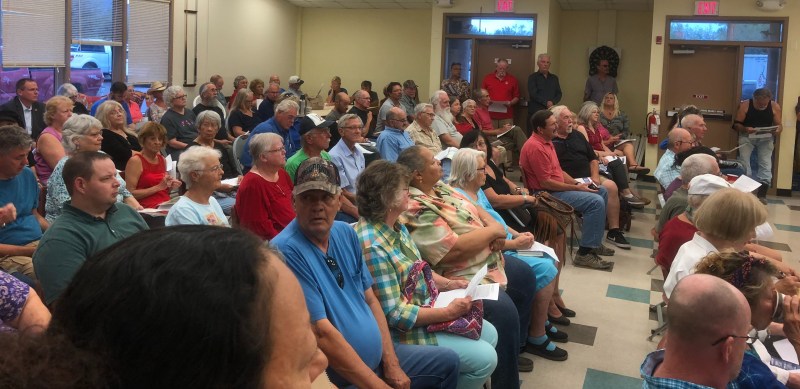
Picture Rocks (a rural, unincorporated community west of Marana) was the place to be this past Tuesday night when representatives from the Arizona Department of Transportation (ADOT) and the Federal Highway Administration (FHWA) came to a Citizens for Picture Rocks (C4PR) meeting to brief residents about the proposed I-11 highway. I counted about 120 people overflowing the community center and although people were mostly polite, it was obvious feelings run raw on this subject.img_2037.jpg

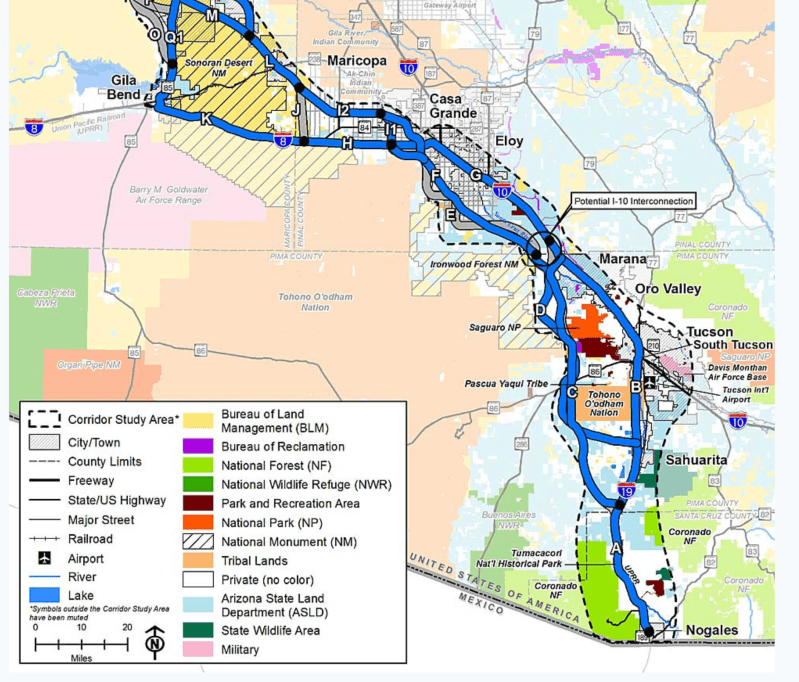
I-11, is a new north-south Interstate Highway envisioned to someday run from Mexico to Canada. In Arizona, the project is at the Tier 1 Environmental Impact Study (EIS) stage to identify a Selected Corridor Alternative on a 280-mile long corridor between Nogales and Wickenburg. This EIS was authorized by the State Transportation Board in December 2014 and was slated to run for three years at a cost of $15 million to determine the “preferred alternative” route.  i11 map

Jay Van Echo, ADOT project manager for I-11, gave a “15 minute presentation” that must have lasted at least 45 minutes. During that time, he frequently stated that the “facility” (highway) project is in the deliberative, not decision stage. But, at a meeting in May 2016, he acknowledged there are only two serious possibilities: “through the Avra Valley or along the existing I-10.” The latter alternative involved the possibility of double-decking six miles of Ruthrauff and I-19. According to then-ADOT State Engineer Jennifer Toth in 2008, “it would do everything planners want for the next 30 years at one-third the cost. That would save taxpayers nearly $2 billion.” But, according to the article in TucsonLocalMedia.com, ADOT rejected that option due to “cost”.

History like this might be why, despite very diverse political viewpoints, the Picture Rocks community (and many other stakeholders) is united in their opposition to an outcome many believe has been predetermined. That outcome, is a new interstate running through pristine Sonoran desert, and what they want to know is, how to stop it.

Although unified in opposition, they voiced a variety of reasons for it. Most of course, are concerned about losing their homes or having their property values negatively impacted. One resident though, raised concerns about how the proposed highway would obviously help Mexico and Canada, but was not about putting “America First”. Another, wondered how the President’s border wall would affect the project. Yet another raised a concern about a conspiracy between various government entities and with wealthy people who appear to be buying up land in the area. Nothing it appears, is apolitical, or what it seems, these days.

Other questions included concern for how pollution from trucks would be mitigated, whether homeowners would be fully compensated for their property if forced to move, whether there was any benefit for residents of Avra Valley (which abuts the Ironwood National Monument area) and when the final decision of a route would be made. On that last one, I never heard a definitive answer. What I gleaned from the i11study.com website, is that once the EIS analysis is complete this month, the effort will progress to the Final EIS from November 2018 to October 2019 to identify the preferred alternative and then the Record of Decision will identify the selected alternative between October and November 2019.

Van Echo repeated several times that there would be more opportunities for community members to provide comment and ask questions prior to the eventual decision being made. I got the impression though, that those responsible for this decision are not necessarily listening. Both the questions presented on behalf of the C4PR Board and members of the Picture Rocks Transportation Committee, and comments eventually allowed later by those in attendance, led me to that conclusion.

It’s not that people aren’t trying to be heard. The I-11 Joint Stakeholder Community Planning Group (JSCPG) provided a clear position in their I-11 position statement issued on August 3, 2018. Consisting of representatives from the Coalition for Sonoran Desert Protection, (comprised of 34 environmental and community groups and representing 30,000 people) and others in Pima County and beyond, agreed that,

Of the two routes proposed for a future 1-11 highway, the expansion and reconfiguration of the existing I-10 and I-19 corridor is the only acceptable route. A by pass through Avra Valley is not acceptable.

I imagine a NIMBY (not in my backyard) approach to a project such as this is fairly common. After all, an interstate may be good for business, but I can’t imagine anyone wants it running through their neighborhood. In a flyer handed out at the meeting, the JSCPG raised the point that this project could provide significant opportunity to address historic consequences resulting from the construction of I-10, “which physically divided our community and diminished the quality of life of our downtown and other neighborhoods along the highway.” They also encouraged ADOT and FHWA to refer to the I-11 Super Corridor study submitted to ADOT in 2016. This transdisciplinary study  was completed by the University of Arizona, Arizona State University and the University of Nevada, Las Vegas. The recommendations they put forward consisted of a comprehensive approach such as “the addition of light and heavy rail, walking, cycling, new technology for controlling traffic, as well as incorporating alternative forms of energy production and transportation.

Albert Lannon, a Picture Rocks resident and member of the Avra Valley Coalition, concludes of the two routes available, double decking I-10 through town, or making the truck route through Avra Valley, the FHWA is leaning toward the latter. But, Lannon isn’t taking that eventuality sitting down. According to the Arizona Daily Independent, in January of this year, he filed a formal complaint with the Board of Supervisors alleging the County Administrator and his staff of ignoring BOS Resolution 2007-343 which expressly “oppose[d] the construction of any new highways in or around the county that have the stated purpose by [sic] bypassing the existing Interstate 10 as it is believed that the environmental, historic, archaeological, and urban form impacts could not be adequately mitigated.” The resolution also discussed Avra Valley as worthy of protection.  His complaint was dismissed.

Unfortunately for the resident stakeholders and groups that want to protect our environment and wildlife, Pima County isn’t the only government entity now on-board with the project. According to PinalCentral.com, the “Pinal County Board of Supervisors passed its own resolution in 2010 in relation to Interstate 11, though this one expressed support for the project and deemed I-11 a ‘transportation priority.”‘ Likewise, both towns of Eloy and Casa Grande have issued statements of support for the project.

Meanwhile, Albert Lannon is not giving up and having watched the dynamics at the C4PR meeting, there are plenty who plan to fight on. Lannon obviously believes the cause is too important, claiming, “the new freeway would hinder existing businesses that cater to truckers driving on I-10 and damage the tourism industry that thrives in the many wildlife parks around Avra Valley.” He says his coalition will continue to hold candidates accountable. In an election year, maybe that matters, but I wouldn’t hold my breath.


LD 11 Incumbents on Support for K-12 Ed

Note: In the interest of full disclosure, I should note that I am a campaign manager for a candidate challenging Mark Finchem for the AZ House in LD 11.

Unless you’ve been living under a rock this year, you probably know that this is an election year where K-12 education has been on center stage, at least here in Arizona. Here in LD 11, where I live, both Representatives Mark Finchem (running for reelection to the AZ House) and Vince Leach (running this year for the AZ Senate), have intimated they are supporters of education and have worked to restore funding back to 2008 levels.

First of all, I believe that if a politician doesn’t specify they are a supporter of PUBLIC education, they probably aren’t. Secondly, funding for Arizona public education is still almost $800 million short per year from 2008 levels, even with the plus-up in budget approved this year. And oh by the way, bringing our funding back up to 2008 levels isn’t exactly something to brag about, and the 5 percent raises promised teachers in 2019 and 2020 don’t count until they actually happen. For now, they are just promises that future legislators will need to make good on.

Secondly, the only way to really know where an incumbent stands on an issue is to look at the votes they cast, to include the budget they voted for. As former Vice-President Joe Biden once said,

Don’t tell me what you value, show me your budget and I’ll tell you what you value.

That’s why it is important for all of us to delve a little deeper. One resource for learning about incumbents’ voting records on K-12 education bills is the Friends of ASBA (Arizona School Boards Association) “Educating Arizona” voting guide. It is published each year to show how Arizona legislative candidates voted on key bills impacting K-12 education. Votes on bills however, aren’t the only measurement ASBA uses to track support for public education. They also assess “how helpful (or not) a given legislator was in advancing the ASBA political agenda during the legislative session, and how the legislator acted toward public education in general.” (Note: ASBA’s political agenda is brought forth by Arizona school boards all around the state and contains agenda items from across the political spectrum. It is then condensed by a Legislative Committee made up of a very diverse group of school board members and finally, is voted on by representatives from each school board at our annual delegate assembly.) Helpful actions legislators take are considered for extra credit and include helping to get bills heard (or not) in committee and helping to prevent bad bills from advancing. Based on this total assessment, ASBA awards legislators a thumbs up (Champion), thumbs sideways (Friend), or thumbs down (Foe).

I thought I’d go back to the 2015 guide to see how my legislators have voted on K-12 education bills since they first got in office. That year, both Representatives Finchem and Leach voted with the ASBA position on only two of the ten bills. Among other bills, they voted to expand Empowerment Scholarship Accounts to children living on tribal lands and grandchildren being raised by their grandparents, as well as to replace common core.

In 2016, Finchem voted with the ASBA position on only three of seven of the bills and Leach only three of eight. They voted to establish caps on additional state aid, to phase-in empowerment scholarship accounts (ESAs), and to expand and modify administration of ESAs (vouchers). They also voted against eliminating the freeze on KidsCare.

In the 2017 legislative session, Finchem voted with ASBA on three of six bills and Leach on four. They both however, voted in opposition of ASBA, for SB 1431, the full expansion of ESAs. It really can’t get more anti-public education than that, and their “thumbs down” rating reflects that reality.

2018 saw both Finchem and Leach vote on eight key K-12 education bills and each of them voted with ASBA on six of them. The most significant bill passed was SB 1390/ HB 2158 which renewed Prop 301 for 20 years and kept public education funding from going off a cliff in 2021. Although they both voted for this bill, their lack of support in general, earned them another “thumbs down” and “Foe” moniker with regard to public education.

Just in case there is any lingering doubt about their focus when it comes to support for public education, Finchem writes on his website, “School Voucher Program expansion is an important element to creating a diverse and well qualified employment pool, a factor that many job creators look for when deciding on which state to locate in.” Leach does not include education as one of his top five issues, prioritizing the 2nd Amendment and support for Pro-Life over opportunity for students.

Elections matter, and I encourage all voters to be informed where candidates stand on the issues that matter most to them. As Franklin Roosevelt said,

Democracy cannot succeed unless those who express their choice are prepared to choose wisely. The real safeguard of democracy, therefore, is education.


We Get What We Deserve

Wow! I normally think of Laurie Roberts as a fair-minded reporter with a pro-public education bent. I don’t know what happened to her this morning, maybe she ran out of leaded coffee and had to drink decaf. At any rate, I couldn’t let her opinion piece, “Does Arizona really need 236 school districts?” go unanswered.

First of all, the answer is no. But of course, this isn’t the sort of question that can be answered with a simple “yes” or “no” because there are so many variables that must be factored in. For example, I was recently on the Diné (Navajo) reservation where even relatively close to Tuba City, the students must travel over REALLY bad roads for over an hour each way every day to get to and from school. Could we do more to consolidate district schools on tribal lands? Maybe a little, but I’m guessing opportunities would be very few and far between.

Sure you say, but that’s a really different situation than what they have in downtown Phoenix. Yes, that’s true, but I’m guessing there are other unique circumstances in those schools and the voters elect locally elected governing boards to make decisions about what is best for their students and their communities. Do they always get it right? No – no one ever does. But, they are closest to the action and have the best chance of making the right calls.

Roberts finds it curious Governor Ducey has never shown interest in merging school districts. I seriously doubt she really finds it curious and suspect she understands that this is a hot potato issue the Governor would rather just keep off his plate. And as for Robert’s claim that Governor Napolitano’s plan to reduce the number of districts went down in flames because “school officials fired up torches in defense of ‘local control’”, I don’t believe that was where the main pushback originated. If school officials were fighting the consolidations, I’m betting it was because their parents and community members were pushing them to do so. What parent after all, wants their child on longer school bus rides than necessary, or further away from home during the school day?

As for her assertion that “On average, school districts in Arizona spend a woeful 53.8 percent of their budget in the classroom”, Roberts knows this is “woefully” misleading. Here’s the facts about what public district schools spend in the classroom and what they spend on administration:
1. Yes, Arizona districts spent 53.5 percent of their available operating dollars on instruction in FY 2016 per the AZ Auditor General’s Arizona School District Spending report. But, the Arizona School Boards Association disagrees with what is included in that “classroom spending” and the Governor and Arizona Legislature agreed back in 2015. That’s because the AG’s report doesn’t count instructional support (5.7 percent) and student support services (8.2 percent). These areas include physical and occupational therapists, reading and math intervention specialists, media specialists/librarians, counselors and social workers. All of these specialists are critical to a student’s academic success and when included, take the total amount of classroom spending up to 67.4 percent.
2. Even at that, as Roberts points out, Arizona districts spend less on administration than the national average. My research shows we spend only 67 percent of the U.S. average spent on administration, not just the one percent she cites. Even assuming she is correct, the important point is that we do better than the national average.
3. For all their touting of efficiencies gained due to their relief from bureaucracy, Arizona charter schools spend DOUBLE the amount on administration than do district schools.

She really loses me though, when she opines, “if the school lobby succeeds with its plan to soak the rich with a massive income tax hike….” Words have meaning and it is by no accident that she chose “lobby” and “soak”. I mean, imagine if she’d wrote the sentence this way: “if public education advocates succeed with their plan to more fairly distribute additional taxation to ensure our districts are funded just at 2008 levels….”

Besides, if you want to make a case for efficiency of public school operations, how about we start exercising more control over where charter schools can build and operate. Does it really make sense for a Legacy Traditional Charter School to have been built in Peoria a couple of years ago for 1,500 students when there were 8 “A” and “B” rated schools WITH capacity, within a two-mile radius of where the charter went in? And that’s just one example of the waste generated via the lack of accountability in a state that is intent on siphoning taxpayer dollars away from its public schools with little transparency to the process.

The bottom line is that district schools, with their locally-elected governing boards, open meeting law requirements, and procurement rules, (unlike charters and certainly, private schools) offer the greatest degree of accountability and transparency of any school choice option. But…for the system to work, the public must be informed and engaged, and government MUST provide the checks and balances. Just like with government at large, we get the public schools we deserve.

Another Conservative Breaks Free Of The Matrix

Conservative columnist George Will, in an opinion piece published in the Washington Post yesterday, urges Americans vote against the GOP in the midterms. He cited the “family-shredding policy along the southern border” as “the most telegenic recent example of misrule” as sort of the straw that broke the camel’s back.

The principle by which people should vote is that,

The congressional Republican caucuses must be substantially reduced. So substantially that their remnants, reduced to minor ties we be stripped of the Constitution’s Article I powers that they have been too invertebrate to use against the current wielded of Article II powers. They will then have leisure time to wonder why they worked so hard to achieve membership in a legislature whose unexercised muscles have atrophied because of people like them.

Will lambasts House Speaker Paul Ryan as a “Vesuvius of mendacities” for wagering

his dignity on the patently false proposition that it is possible to have sustained transactions with today’s president, without being degraded.

He goes on to write that, “Ryan and many other Republicans have become the president’s poodles”, not because our system has failed, but “because today’s abject careerists have failed to be worthy of it.” Will nails it when he writes that,

By leaving dormant the powers inherent in their institution, they vitiate the Constitution’s vital principle: the separation of powers.

The Senate, Will writes, refused to vote on Senator Corker’s measure to require “Congress to vote to approve any trade restrictions imposed in the name of ‘national security’.” This would have been only the second amendment voted on this year, but they refused to do it because of fear it would have “peeved the easily peeved president.” They also “waited for Trump to undo by unilateral decree the border folly they could have prevented by actually legislating. This, writes Will,

is an advertisement for the unimportance of Republican control.

In the end, Will’s point is that we need to vote for Democrats to

affirm the nation’s honor, while quarantining [Trump].

And to those who are worried about Democrats’ ability to appoint judges, Will writes that,

Article III institutions are not more important than those of Articles I and II combined.

Please God, let this be yet another sign, that real change, that which can save our institutions and the Democracy they serve, is on the horizon. Then, let the people show up to the polls to deliver that change.