Chair of AZ Senate Ed Cmte Needs Education

AZ Senator Sylvia Allen, Senate Education Committee Chair, recently asked, “When is it [funding for education] ever enough?” That depends on what kind of educational opportunities we want to offer our students. Additional funding alone can’t assure high quality schools, but it can provide a broader curriculum, more experienced teachers, smaller class sizes, better maintained facilities more conducive to learning, and much more.

It might be better to ask how much IS NOT enough. I believe there is not enough when: our educational performance is ranked 44th in the nation, our per pupil funding 48th, and our teacher salaries 50th; 2,000 of our classrooms are without a teacher and another 2,000-plus are filled by uncertified personnel; and our districts received only two percent of the facility repair and maintenance funding they needed from 2008 to 2012, creating a backlog impossible to clean up under current funding constraints.

Senator Allen refers to the Proposition 204 vote as proof Arizonans aren’t willing to pay higher taxes to support education. Well, that was five years ago, and polling data from December 2016 shows 77 percent of Arizonans believe the state should spend more on education and 61 percent (about the same percentage that defeated 204) support paying higher taxes to do just that. Yes, Proposition 123 was “creative”, but it didn’t provide enough to move us up even one place in per pupil funding and as the AZ Daily Sun points out, those in charge at the Capitol are “running out of non-tax gimmicks to tap.”

She also asks if people are willing to move funding from another area — should we let our roads deteriorate or sex offenders out of prison or reverse the millions spent on child safety? Bad examples in my mind since the AZ Legislature has consistently raided the HURF monies to fund the Department of Public Safety essentially causing residents to be taxed again when car repairs are forced by deteriorating roads, and private prisons cost us $4.60 per day per prisoner more than the public ones they replaced $4.60 per day per prisoner in 2010. Yes, this figure is dated, but a more current one is not available because the Legislature mandated the collection of that data be halted.

I’m guessing Senator Allen has her own ideas about how to better support the 80 percent of Arizona students in our district schools. Since she specifically asked for recommendations from readers, though, I will offer mine:
1. Curtail the tax cuts and credits for corporations;
2. Stop attempts to allow even more siphoning off of our district funds to private and religious schools via voucher (Empowerment Scholarship Accounts) expansions;
3. Close corporate loopholes in the tax code;
4. Renew Proposition 301 (which expires in 2020) and increase it to a full penny (currently at one-half cent). Sixty-five percent of the respondents to the December poll supported this idea which will bring in an estimated $400 million more per year; and
5. Convene stakeholder meetings to discuss recommendations from the Governor’s Classrooms First Council (which state additional funding was needed) and long-term funding solutions that include new revenue sources and an update of Proposition 301.

Senator Allen concludes by saying, “I understand as legislators we’re an easy target…”, As an Arizona taxpaying citizen, I would remind her that she and her colleagues get paid to ensure the state’s business is taken care of, including the constitutional mandate to provide for, maintain and enrich our public schools. President Teddy Roosevelt said, “Complaining about a problem without proposing a solution is called whining.” I’ve offered five realistic solutions to get our district schools the resources they need. How about you Senator Allen?

Vouchers: Some Common Sense Questions

Unless you’ve been living under a rock for the last few years, you know corporate reformers are anxious to implement vouchers as a way to expand school choice. The secret sauce they say, is that the dollars follow the student because parents know best about what is best for their child’s education.

Just for a few moments though, I’d like to ask you to please forget whether or not you believe school choice and vouchers are the answer to “Make American Education Great Again.” Forget all the hype and promises, just ask yourself which of these scenarios makes more sense?

  1. Which is more accountable and transparent to parents, the taxpayers and voters and therefore less likely to experience less fraud, waste and abuse? #1 Hint to the answer. #2 Hint to the answer. #3 Hint to the answer.
    a. District schools that must report every purchase, competitively bid out purchases over a certain amount, have all purchases scrutinized by a locally elected governing board, undergo an extensive state-run audit each year, and are publicly reported on for performance efficiency and student achievement by the AZ Auditor General’s office each year?
    b. A voucher system which puts the onus on recipient parents to submit proof of expenditures to an understaffed AZ Department of Education office responsible for monitoring the $37 million ($99.7 million since 2011) in voucher expenditures for 4,102 different students?
  2. Which is more likely to be held accountable for student achievement and thereby taxpayer return on investment? Hint to the answer.
    a. A district school where students are given a standardized state test with scores rolled up to the state and made public, where data is reported (following federal guidelines for data protection) by subgroups to determine achievement gaps, and where high school graduation and college attendance rates are reported?
    b. A private school that does not provide any public visibility to test results and where the state (per law) has no authority to request or require academic progress from voucher recipients or the school?
  3. Which is more likely regarding the portability (with no impact) of per student funding when students leave their district schools?
    a. When a student leaves a district school with their education funding in their backpack, they take all associated expenses with them?
    b. That there are fixed costs left behind (approx. 19%) that the school is required to still fund such as teachers and other staff that cannot be eliminated just because a couple of students left a classroom, or a bus route that can’t be done away with just because one student is no longer taking that bus, or a building air conditioner that can’t be turned off because the occupancy in the classrooms is down by three students. That what the “drain” causes instead, is larger class sizes, less support services, less variety in the curricula, etc.?
  4. Which is more likely to serve disadvantaged students — the ones most in need of our help? Hint to the answer.
    a. A district school, where the vast majority of educational expenses are covered by the taxpayer, where students are transported from their home to school, where free and reduced lunches are provided and which must accept all comers?
    b. A $5,200 voucher to a private or parochial school which has total control over which students they accept, does not provide transportation and according to PrivateSchoolReview.com costs an average of $6,000 for elementary schools and $18,000 for high schools in 2016-17?

I hope you came to the same conclusions I did some time ago, that when it comes to transparency, accountability and equity, district schools outperform private schools. I’d also like to make the unequivocal claim that district schools also (across the board) produce more achievement than private schools, but as you can see, they don’t report their results so I don’t know that for sure.

And yet, the Arizona Legislature continues to push expansion of vouchers in our state. A push for full expansion last year by Debbie Lesko (Peoria-R) was killed, largely due to its potentially negative impact on the passage of Proposition 123, but she has revived the effort this year in the form of SB 1431. This bill, which would fully expand vouchers to ALL 1.1 million Arizona students by the 2020-2021 school year has been assigned to the Senate Education and Rules Committees and is scheduled to be heard by the Senate Ed Cmte on 2/9/17. Senator Steve Smith (Maricopa-R) has sponsored an associated bill, SB 1281, that requires the AZ DOE to contract with an outside firm (I’m sure that’s much better…just like private prisons) to help administer the ESA program, and makes various changes to the program. The bill stipulates that AZ DOE may request (not MUST request) confirmation toward graduation from high school or completion of a GED. This is obviously an attempt to defuse the argument there is insufficient accountability in the AZ voucher programAZEDNEWS also reports that Lesko supports adding a requirement to her bill to track achievement of ESA students, but that requirement would be only to report test results to parents, not the AZ DOE.

No matter how much sugar the commercializers try to coat vouchers with, they are still just a vehicle for siphoning tax dollars away from our district community schools to private and parochial (religious) schools with no accountability or transparency. For every person who says “parents have the right to use their child’s education tax dollars as they see fit”, I say, “and taxpayers have the right to know the return on investment for their tax dollars.” The former right in no way “trumps” the latter.

We must stop this terrible legislation. If you are signed up for the Legislature’s Request to Speak system, please click here to log in today and leave a comment for the Senate Education Committee about why you oppose SB 1431 and SB 1281. If you aren’t signed up, please leave me a comment to this post and I will get you signed up and ensure you are trained to use it. The system allows you to comment on pending legislation from your home computer or mobile device, you don’t have to go to the Legislature and speak in person unless you want to.

If you don’t want to use RTS, please call or email the members of the Senate Education Committee (listed below) and your district legislators (click here to find out who they are) to let them know how you feel. There is strength in numbers and the people do have the power, we just have to exercise it!

Senate Education Committee Members

Sylvia Allen, Chairman – 602.926.5409

David Bradley – 602.926.5262

Kate Brophy McGee – 602.926.4486

Catherine Miranda – 602.926.4893

Steve Montenegro, Vice-Chairman – 602.926.5955

Steve Smith – 602.926.5685

Kimberly Yee – 602.926.3024


School Choice: Get informed, then join the fight!

This week is National School Choice Week and not surprisingly, there is a fair amount of confusion about just what school choice is. Maybe because even in Arizona, (the state the American Legislative Exchange Council (ALEC) rates as #1 for its school choice policies), over 80% of Arizona students actually “choose” their community district schools and therefore don’t pay much attention to the school choice debate. But, that percentage may be at risk since corporate profiteers are well-funded and persistent and continue to purchase influence with lawmakers who chip away at district resources and ease the way for the commercialization of our community schools.

This commercialization has been fed by a lucrative $700 billion education market and the Conservative mantra that all human endeavors placed in the hands of private enterprise succeed, whereas those run by the government do poorly. President Reagan famously quipped after all, “Government is not the solution to our problems; government is the problem.”

I believe though, there are some services that government is best suited for. These include those that provide for our security, safety such as our military, fire and police services, and  yes, those whose mission is to ensure the education of ALL children. Can private entities provide these services? Yes, but from my 22 year experience in the military, they are likely to cost more (contract creep), less likely to serve all equitably, and more likely to be concerned about making a profit than focused on meeting the needs of those they are hired to served.

One thing the private sector does very well though, is spin and marketing and when it comes to privatizing education, they have spin in spades. But facts still matter, and the facts are that: 1) charter schools produce no better results (across the board) than district schools, 2) we don’t know how private schools are performing because they don’t have to tell us (even when they accept taxpayer dollars), and 3) high-quality district schools and widespread, aggressive school choice cannot co-exist; the pie is only so big.

That latter point means that those of us who believe district schools are critical to ensuring every student has equal opportunity, must understand what we are up against. In my advocacy work, I often see we have much work to do in that regard. So, I provide the list of definitions below to further the conversation. If we are to successfully battle the powerful forces attacking our district schools, we must first ensure we are equipped with the right intelligence to strategically bring our limited resources to bear.

  1. Accountability. Conservatives love to talk about accountability for taxpayer dollars until it seems, we are talking about commercial schools (charters and privates.) Arizona statute requires district schools to be fully accountable for the tax dollars that fund them and the academic results they achieve. Those same requirements do not apply to any other type of school in the state and in some cases, state law prohibits such accountability.
  2. Achievement Gap. There are real differences in student’s ability to achieve that have very little to do with the district schools they attend. This term usually refers to disparities in achievement levels of student groups based on race, ethnicity or family income. We already know that poverty and the education attainment of one’s parents are the greatest predictors of a student’s success. We also know that the more challenges a student experiences outside the classroom, the more challenging it is to educate them in the classroom. Commercial schools also know this and that’s why they generally accept fewer of these “at-risk” students.
  3. Administrative Expenses. This term makes some people think about highly paid superintendents and principals. The expenses involved though, include administrative staff and support services (such as school nurse, librarian, speech therapists, etc.); superintendent’s office and governing board; and the business office and central support services. Governor Ducey has focused much attention on the need to decrease district administrative expenses thereby increasing dollars in the classroom even though Arizona has among the lowest administrative expense percentages in the nation, at one-third less than the national average. Additionally, although some see district schools as beaurocratic, charter schools in Arizona actually have double the administrative expenses of district schools.
  4. At-Risk Students. Students or groups that have a higher likelihood of academic failure—broad categories often include those who are: not fluent in English; experience high poverty, homeless, etc.
  5. Average Daily Membership (ADM). The average number of students registered or enrolled (as opposed to in attendance) in a school during the time it is in session. This number is especially important on the 100th day of public schools because it determines the amount of funding the schools receive from the state. Sometimes, charters wait until after this date to attrit students who then return to the district schools. When this happens, the charter keeps the funding associated with that student and the district must educate him/her for the rest of the year without any associated funding.
  6. Blended Learning Programs. These combine online classes and classes taught in a school building. All types of schools (including districts) are using these types of programs along with the “flipped classroom” concept where students watch on-line instruction at home and then do hands-on work at school.
  7. Certification. Process by which a state or approved board authorizes a person to teach in public schools; also called licensure. Important because the state does not require (as they do with districts) for commercial schools to hire certified teachers.
  8. Charter Penetration. The higher the charter penetration, the higher the adverse impact on district finances, as districts are confronted with plummeting student enrollment and with a rising population of students in need of special education services.
  9. Charter Schools. Privately managed, taxpayer-funded “public” schools that contract with the state to provide tuition free educational services and are exempted from some rules applicable to district schools (such as the requirement to hire certified teachers.) They were initially designed to serve as incubators of teacher innovation for exportation to all public schools. Over time, they have become more autocratic, (empowering management versus teachers) and more segregated (by race and income.)
  10. Commercial Schools. A term I use to refer to for-profit charter and private schools in response to the corporate reformers insistence on referring to district schools as “government schools” and, to accurately characterize (in most cases) their profit motive.
  11. Community Schools. District schools located in the communities their students live. Previously referred to as “traditional schools,” these schools are increasingly innovative while continuing to serve as the hubs of their communities.
  12. Corporate Reformers. A term used to describe those who are more seemingly more interested in the profit to be made off the nation’s $700 billion K–12 education market than they are with actually improving the academic and “whole-child” achievement of all our students.
  13. District Schools. These schools were originally known as “public schools” until charters came along, then “traditional public schools.” They are the only schools to be governed by locally elected boards responsive to voters and constituents. They are also the only schools that are fully accountable and transparent to taxpayers for the public funding they receive. They were created as the instrument through which the legislature carries out its constitutional mandate to provide for a system of K–12 public education.
  14. District Charter Schools. For a time, some districts opened charters. In 2015, however, the Arizona Legislature attached a provision to the 2015 state budget prohibiting school districts from sponsoring charters and dissolving those created after June 30, 2013.
  15. Education Management Organizations (EMOs). Usually for-profit firms that provide “whole-school operation” services to public school agencies. EMOs contract with school districts and charter-granting bodies to use tax money and venture capital to operate public schools. The growth and prevalence of EMOs is controversial as they are seen as substantially contributing to the privatization of public education and the associated profiteering from tax dollars supporting that public education.
  16. English Language Learners (ELL). Also known as Limited English Proficient (LEP) students, this term refers to students who are reasonably fluent in another language but who have not yet achieved comparable mastery in reading, writing, understanding, or speaking English. Arizona statute defines “English learner” or “limited English proficient student” as “a child who does not speak English or whose native language is not English, and who is not currently able to perform ordinary classroom work in English.” Per statute, “children who are English learners shall be educated through sheltered English immersion during a temporary transition period not normally intended to exceed one year.”
  17. Empowerment Scholarship Accounts (ESAs). The Arizona Legislature’s answer to vouchers. Currently there are some eight general categories of students that qualify for vouchers ranging from those with disabilities to those living on tribal lands; and as of fall 2016, 0.28% of Arizona’s students were attending private or parochial schools via a voucher. For the second year in a row, legislation is underway (pushed by ALEC’s Arizona Chair Sen. Debbie Lesko) to fully expand eligibility for the vouchers, worth a basic value is $5,200 (special needs students get more), to ALL students in Arizona. The legislation was killed last year to prevent it from impacting Prop. 123’s passage, but it may get legs this year. If passed, it will enable the accellerated drainage of district resources.
  18. Fixed Costs. These are expenses that a district has regardless of the number of students in a classroom. They include administrative and teacher salaries, utilities, facility maintenance, and technology and transportation costs. When students leave district schools to attend charter schools or attend private schools via a voucher, they leave behind approx. 19% of the costs associated with their attendance at that district school. That is important because the corporate profiters would have you believe that the funding should be completely portable because there is no negative impact on district schools.
  19. Free and Reduced Lunch. This term describes the program by which students are provided discounted or free meals while at school based upon their families meeting federal guidelines for poverty. In 2016, 58% of Arizona district school children qualified for free and reduced lunch which is at least 12% more than charter schools. It is generally seen as a more accurate way to describe the poverty challenges present in schools than referring to the Census poverty rate. For example, in my school district, we have a free and reduced lunch percentage of 62%, but because of the active adult communities that surround the district, the Census poverty rate is 14%.
  20. For-Profit Charters. There are both non-profit and for-profit charter schools but in practice, there isn’t much difference. Unlike what many may believe, a non-profit designation does not mean that entity may not make a profit. Rather, it means it uses its surplus revenues to further achieve its purpose or mission, rather than distributing its surplus income to the organization’s shareholders (or equivalents) as profit or dividends.
  21. Government Schools. A perjorative term used by corporate reformers and some school choice advocates to refer to district schools. (In the vein of “government is the problem.”)
  22. Homeschooling. The education of children within the home versus in a school. Although it is difficult to find information on how many children are being homeschooled in Arizona, one source showed it as 22,000 in 2011, or approximately 2% of total students. There are no formal requirements for how students are homeschooled, to do so, all parents must do is send a letter of such intent to their county schools superintendent. Arizona statute does not require homeschooled students to be tested unless that is, they wish to enroll in a district school. Then, they are required to be tested to determine in which grade they should be placed.
  23. Individuals with Disabilities Education Act (IDEA). A federal funding statute requiring schools that receive monies under this law to provide a free, appropriate public education to all eligible children with disabilities. A specially designed plan for student services called an I.E.P. (Individual Education Plan) must be developed to meet the needs of each eligible student. As can be imagined, students with disabilities cost more to educate and rarely are all the required dollars provided. Commercial schools, as a result, manage to enroll a much smaller percentage of these students.
  24. On-Line Schools. Also known as “virtual” schools, these schools have proliferated with the privatization movement. Online schools provide virtual classes a student takes from home. These schools are notorious for low achievement results, high dropouts and fraudulent operations.
  25. Parochial Schools. A private primary or secondary school affiliated with a religious organization, whose curriculum includes general religious education in addition to secular subjects, such as science, mathematics and language arts. In Arizona, taxpayer dollars are siphoned to these schools through both vouchers and tax credits.
  26. Private Schools. A school supported by a private organization or private individuals rather than by the government. The Merriam-Webster dictionary says a private school is “a school that does not get money from the government and that is run by a group of private individuals.” The Cambridge English Dictionary says a private school is: “a school that does not receive financial support from the government.” I cite these definitions to point out that both of them say private schools are schools that “do not get funding from the government.” In Arizona, taxpayer dollars are siphoned to these schools through both vouchers and tax credits.
  27. Privatization. Giving everything public over to market “forces,” i.e., market rule.
  28. Right to Work. A term that describes the law that prohibits union security agreements, or agreements between employers and labor unions, that govern the extent to which an established union can require employees’ membership, payment of union dues, or fees as a condition of employment, either before or after hiring. I included this term because unlike what people think, Arizona is a right to work state and does not collective bargaining in place for teachers.
  29. School Choice. Billed as the right of parents to select the right school for their child. In reality, when it comes to charter and private schools the choice actually belongs to the schools. Charters, although mandated by law to accept all, manage to be selective of who they accept or, weed out those who aren’t exccelling. Private schools have total control over who they accept.
  30. School Tax Credits. Arizona allows five separate types of tax credits taxpayers may take. There are three individual, one for public schools and two for private schools. It should be noted that the amount that an individual can claim for private schools is five (5) times that which can be claimed for public schools. There are also two types of corporate tax credits that may be taken through school tuition organizations (that award funding to private and parochial schools.) The first one is for corporate contributions for low income students and the other one is for displaced/disadvantaged students.
  31. School Tuition Organization. A School Tuition Organization (STO) is one that is tax exempt under Section 501(c)(3) of the Internal Revenue Code and allocates at least 90% of its annual revenue to tuition awards, and makes its tuition awards available to students from more than one qualified private or parochial school. In 2008, three-fourths of Arizona companies paid only the minimum $50 in corporate taxes and with a 20% increase in cap allowed every year, the program is causing significant impact to the general fund.
  32. Teacher Shortage. You may have heard about Arizona’s severe teacher shortage. A recent survey of Arizona school districts revealed that a full 53% of teacher positions are either vacant or filled by uncertified teachers. It isn’t so much that we don’t have enough certified, qualified teachers in Arizona, but just that they’ve turned to other types of employment to enable them to support their families.
  33. Transparency. A term related to accountability that describes how open a school is to the scrutiny of parents, taxpayers and voters. Only district schools, governed by locally-elected boards, are fully transparent.

Hopefully these definitions have clarified for you, some of the issues surrounding school choice. If you don’t agree with any of my definitions or, you have additional ones I should add to the list, I’d love to hear from you. If you care about truly public (district) education, the time to show it is now, more than ever. Now, before what Betsy DeVos espouses for educations shifts the Overton Window, (a term coined by the Mackinac Center for Public Policy, a conservative think tank she supports), on what is acceptable to the public. Now, before the bedrock of our democracy, that which once built the greatest middle class in the world, is auctioned off brick by brick and student by student. Now, before it is too late.

Ooops, there it is!

We knew it was coming and awaited it with dread. And, drumroll please…crash goes the cymbal! Yes, here it is, this year’s attempt to exponentially expand Arzona’s voucher (Empowerment Scholarship Accounts, or ESA) program. Of course, the American Legislative Exchange Council’s (ALEC) chief water carrier for Arizona, Senator Debbie Lesko, R-Peoria, is the one proposing the expansion. Lesko claims the expansion of ESAs will “not lead to a mass exodus of children from public schools.” I, for the most part, agree with that statement since Arizona parents have made it clear district schools are their choice with 80% of students attending district schools and another almost 15% in charter schools.

But, to infer a massive voucher expansion will have no negative impact on district schools is disingenuous at best. No matter how slowly students may attrit from district schools, each student’s departure leaves behind a 19% budget shortfall. That’s because there are numerous fixed costs (teacher salaries, facility maintenance, utilities, buses, etc.) that cannot be reduced student by student. The siphoning of dollars from our district schools has been steadily increasing and just exacerbates an already inadequately resourced system.

This isn’t the first year the Legislature has attempted to expand the voucher program. In fact, they’ve been successful in expansions every year since the ESA program was launched in 2011. This isn’t even the first time a full expansion has been attempted, with a very similar proposal going down in flames last year due to public outcry and a perceived conflict with securing voter approval of Prop. 123. This year though, Lesko has sweetened the deal by requiring the testing of students attending private schools on vouchers. She says she “doesn’t personally think this requirement is necessary,” but obviously is trying to defuse the argument from voucher opponents that there is no accountability or return on investment for vouchered students.

She is right about one thing, district education advocates want more accountability and transparency where taxpayer dollars are spent on the myriad of school choice options. As the only schools governed by locally elected school boards and with annual efficiency reports published by the Office of the AZ Attorney General, district schools are the only schools fully accountable and transparent to the taxpayers. Pro-choice advocates tout that parents should have the right to choose where they send their child to school at government expense. As a taxpayer, I maintain I have the right to know the return on investment of my tax dollars. Their right should not trump mine.

Senator Lesko also infers that vouchers will save money because the average voucher amount for students without special needs is $5,200, yet it costs $9,529 to educate Arizona’s average student in public schools. This is misleading because she is comparing apples and oranges and she knows it. The $9,529 figure she quotes is a total of all funding sources, federal, state and local (bonds and overrides) while the $5,200 is only state funding. So, if a student transfers from a district where state funding is offset by locally supported funding (due to the equalization formula), that student’s voucher will actually cost the state general fund more than if that student had remained in their district school. Lesko also notes that vouchers and school choice are a national trend as evidenced by President Trump’s nomination of Betsy DeVos as Secretary of Education.

Oh no, she did NOT go there! Trying to sell vouchers as mainstream by pointing to Trump’s nomination of DeVos is akin to denying global warming by citing colder temperatures in parts of the country. After all, DeVos’ success with promoting school choice in Michigan has been dismal. In the two-plus decades she has championed this crusade (those knowledgeable about DeVos will understand my choice of that word), she has purchased legislative influence to expand charters and greatly reduce accountability. She has also worked hard to introduce vouchers in the state, but thus far, the voters have prevailed to keep those “wolves” at bay. And the improvements she has promised haven’t materialized with scores on the National Assessment of Educational Progress (NAEP) for 4th graders declining from 28th in reading and 27th in math in 2003, to 41st in reading and 42nd in math in 2015.

According to the Arizona Capitol Times, the American Federation for Children (AFC) is pushing vouchers nationwide. I’m only going to give you three guesses as to who the chair of AFC is, and the first two don’t count. Yep, none other than Betsy DeVos. In addition to pushing for school choice and vouchers around the country, AFC has spent big bucks on rewarding those legislators working to expand privatization and punishing those who try to stand up for the 90% of students attending our nation’s districts schools. As reported by Richard Gilman on his website BringingUpArizona.com, AFC is a 501(c)4 free to pour dark money into political campaigns. And pour they have. Gilman writes, “Since its inception in 2010, the organization has poured nearly three-quarters of a million dollars into Arizona elections in a largely successful effort to sway the makeup of the Legislature.” The state’s “demonstrated appetite for school choice” is what AFC cites for its focus on Arizona. Of course, common causes make “strong” bedfellows and Gilman tracks AFC’s interest in Arizona back to Clint Bolick (once Vice President of Litigation at the Goldwater Institute and now AZ Supreme Court Justice.) Bolick served as the first president and general counsel for the Alliance for School Choice (AFC’s predecessor.)

But, I digress. The point is that no matter what snake oil the corporate reformers try to sell us, there is an incredibly well-funded, high-powered effort to have two school systems in Arizona. One is the commercial system of charters, private, parochial, virtual and homeschools that serve the whiter and wealthier students, and the other is the district schools, starved for resources, that will have the poorer, browner, and more challenged students to educate. According to recent polls, this is not what the vast majority of Arizonan voters want. But, until Arizonans clearly draw the nexus between voting for Legislators who don’t support our public district schools (most of them with an “R” after their name), and the fact that our district schools are way under resourced, nothing will change. If we want something different, we have to do something different. To continue doing the same thing and expecting different results, is as you know…the definition of insanity.

They can have their own opinions, but not their own facts

The first session of the 53rd Legislature began yesterday and as we public education advocates “batten down the hatches” and plan our “assaults”, I thought it a good time to provide what I believe are some of the most salient facts about the state of education in Arizona today.

  1. Educational Achievement. The Annie E. Casey Foundation’s Kids Count 2016 report ranks us 44th in the nation, Education Week’s Quality Counts 2016 ranks us 45th, and WalletHub 48th. Might there be a nexus to our other rankings provided below?
  2. Per Pupil Funding. Our K–12 state formula spending (inflation-adjusted), was cut 14.9% from 2008 to 2016 leaving us 48th in the nation.
  3. Propositions. The $3.5 billion Prop. 123 provides over 10 years (only 70% of what voters approved and the courts adjudicated) disappears in 2026. Prop. 301, which includes a 0.6% state sales tax, raises about $600 million per year for schools and self-destructs in 2021. There is now talk of increasing the tax to a full cent which would bring in around $400 million more per year or, adding an additional penny which would up it $1 billion.
  4. Teacher Shortage. We have a critical shortage of teachers willing to work in the classroom with 53% of teacher positions either vacant or filled by an individual who does not meet standard state teacher certification requirements. With 25% of the state’s teachers eligible for retirement by 2020, this problem is only going to get worse. Pay is just one of the reasons teachers are opting out, but with Arizona ranking 45th in terms of teacher salaries against the national average, it is real. In fact, “Arizona’s teachers earn just 62.8% of the salary that other college degree-holders do in the state – the lowest ratio nationwide. WalletHub scored the state the third-worst for teachers in terms of ”job opportunity and competition“ and ”academic & work environment.” Providing them a $10,000 raise (more in line with national averages) would cost the state an additional $600 million.
  5. Voter Support. In a December 2016 poll of Arizona voters, 77% said the state should spend more on education and 61% said they’d be willing to pay higher taxes to do so.
  6. Double-Down Ducey. Our Governor has promised not to raise taxes but to propose a tax cut every year he is in office. This, on top of two decades of tax cuts that equal a cumulative impact on the 2016 general fund of $4 billion in lost revenue. In fact, more than 90% of the decline in revenue since 1992 has resulted from tax cuts versus economic downturn–our troubles ARE NOT a result of the great recession. And, Arizona ranks in the bottom third of states in terms of tax rates.
  7. Good Ideas With No Way to Implement Is Called Philosophy. In her 2017 AZ Kids Can’t Wait plan, Superintendent of Public Instruction Diane Douglas has recommended an additional $680 million in common-sense, no frills funding for public schools but points out it is not her job to appropriate funds and the Governor’s Classrooms First Council spent over a year studying how to modernize the school funding formula only to determine that just rearranging the deck chairs won’t be enough…more money must be provided.
  8. They Owe, They Owe, So Off To Court We Go. Over 20 years ago, the AZ Supreme Court voided the system under which districts were responsible for capital costs because of the “gross inequities” created. The Legislature agreed to have the state assume responsibility for building and maintaining schools but that vanished under Governor Brewer’s time as a budget-saving maneuver leaving us back where we started. In fact from 2008 to 2012, districts only received about 2% of the funding they needed for renovations and repair of school facilities and the problem continues. A new lawsuit is in the works.
  9. It’s For The Poor Kids…NOT! Arizona’s educational tax credit (individual and corporate) and the Student Tuition Organizations (STOs) that funnel the monies to private and parochial schools will deny the AZ General Fund of almost $67 million in revenue in 2016/17 (the maximum allowed.) Due to a 20% allowable increase each year, the cap for corporate tax credits will be $662 million by 2030. By way of comparison, the total corporate income tax revenue for FY 2015 was only $663 million. And yet, even in 2011, As many as two-thirds of Arizona corporations paid almost no state income tax partially as a result of the program which predominantly serves students whose parents could afford the private schools without taxpayer assistance. Just for the original individual tax credit for example, 8 STOs awarded over half of their scholarship funding in 2014 to students whose families had incomes above $80,601. By the same token, Arizona’s voucher program (Empowerment Scholarship Accounts) is billed as the way for disadvantaged students in failing schools to have more opportunity. Truth is, in the 2015/16 school year ESAs drained $20.6 million from  district schools rated “A” or “B”are and only $6.3 million from schools rated C or D. Besides, the mere existence of school choice in whatever form it takes does not in itself provide access and opportunity. As Charles Tack, spokesman for AZ Department of Education said, “The economic situation of a family will always factor in.”
  10. Want A Voice? Stick With Where You Have a Vote! Parental and taxpayer oversight and voice is vastly greater in district schools with locally-elected governing boards, annual state-run audits, annual Auditor General reports on school efficiencies, AzMERIT test score results, and other required reporting. Commercial schools (charters and privates) do not have the same requirements for certified teachers and transparency and accountability; nor are they required to provide taxpayers any information regarding return on investment.
  11. Apples and Oranges. Commercial schools do not – across the board – perform better than do our district schools. Yes, there are pockets of excellence, but those exist in district schools as well. Comparisons are difficult to make because the playing field is not level, with commercial schools often managing to pick the cream of the crop while district schools take all comers. A key point to note though, is that charter schools spend double the amount on administration than districts.
  12. A Great Start Is Critical For All Kids. Full-day kindergarten is essential to ensure every child (especially those who are disadvantaged) has a more equal footing on which to start their education. In today’s fast paced, global economy, preschool is also critical and has been proven to provide as much return on investment as $7 for every $1 spent. Restoring all-day kindergarten statewide would cost an additional $240 million. We’ve had it before incidentally. In 2006, Napolitano made a deal with legislative leadership for all-day kindergarten in exchange for a 10% cut in individual income tax. Four years later, the Legislature cut full-day kindergarten but the reduction in taxes still exists.
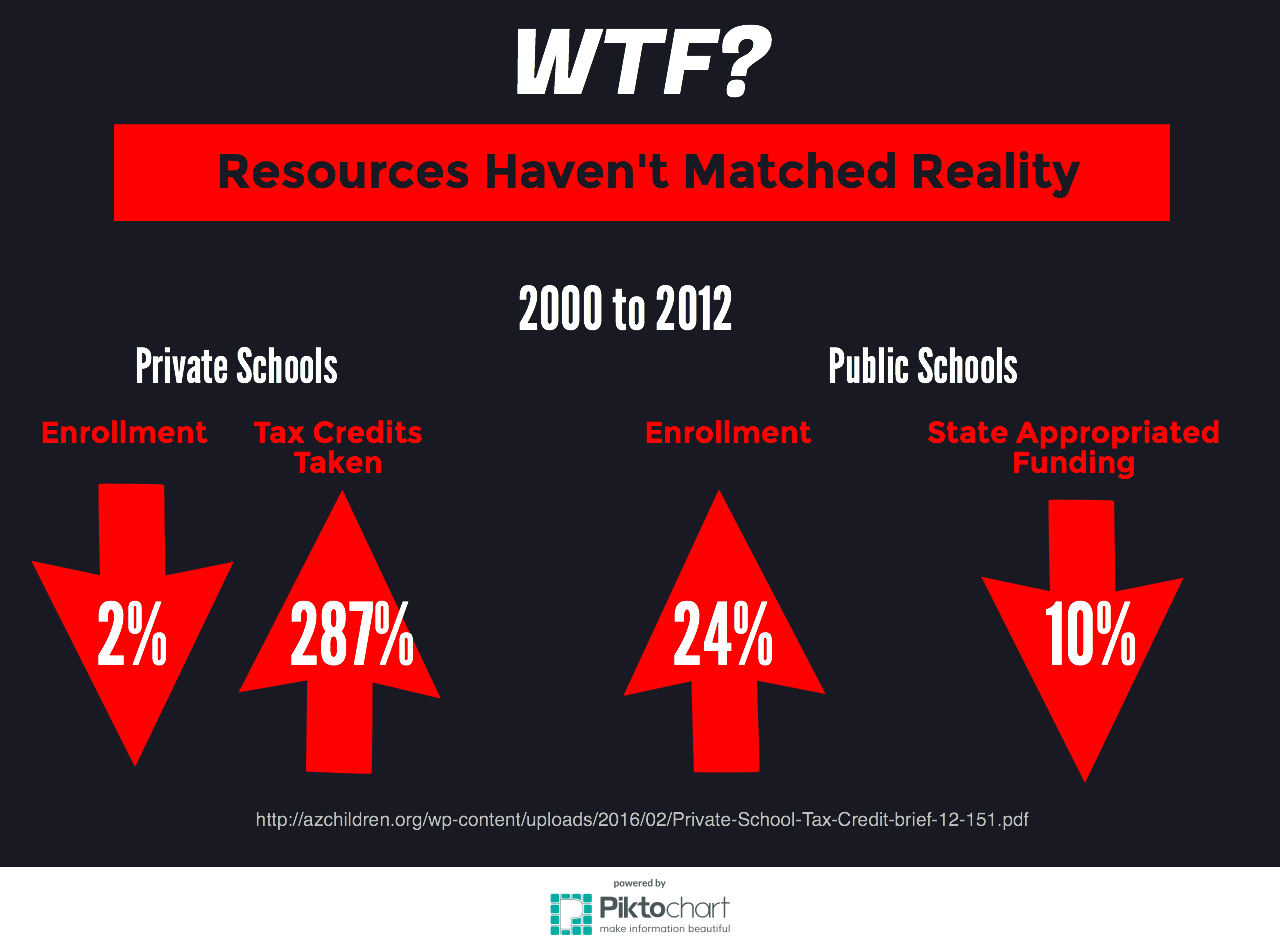
  13. District Schools and School Choice Cannot Co-Exist. When students trickle out to commercial schools, almost 1/5 of the expense associated with educating them remains despite the district’s total loss of the revenue. And while private school enrollment dropped two percent from 2000 to 2012, tax credits claimed for the students has increased by 287%. This, while public school enrollment increased 24.1% during that same time but state appropriations (from General Fund, State Land Funprivate-public-school-fundingds, and Prop. 301 monies) decreased by 10%.

It is clear there are several current and looming crises in Arizona K–12 education. And yet, Senator Debbie Lesko (R), has been quoted as saying, “Balancing the budget is always the most important work of the state legislature.” Really? That’s why the people of Arizona elect our state lawmakers? I don’t think so. Rather, I think we want them to ensure our children receive a quality education, that our roads are safe to drive and our water is safe to drink, and that our police and other first responders protect us from danger. In short, we want the Legislature to ensure appropriate capability to provide for the common good and we send them to Phoenix to figure out how to do that. Yes, they are mandated to balance the budget but, I would argue, that isn’t their raison d’être.

Arizona voters have made it clear they are willing to pay higher taxes to provide more funding to our public schools unfortunately, not enough have made the connection between a lack of funding for public education and the legislators they elect that are causing that problem. Yes, the prohibition to raising the required revenue is pain self-inflicted by our Governor and GOP-led Legislature. And, we need only look to Kansas to see that cutting taxes to attract companies to our state is a race to the bottom. I guarantee over the long haul, quality companies prefer a well-educated workforce and good quality of life for their employees over tax cuts.

In his State of the State address yesterday, Governor Ducey said, “I have a commitment our educators can take to the bank: starting with the budget I release Friday, I will call for an increased investment in our public schools – above and beyond inflation – every single year I am governor.” What is notable about this statement is his reference to “public schools” and, the fact that he followed it up with the statement that “we won’t raise taxes.” Promising support for public schools isn’t the same thing as promising it for district schools. In fact, some lawmakers now equate the term “public schools” to mean any school that accepts taxpayer dollars.

Let me be clear. I believe any promise to provide significant additional monies to public education without a willingness to raise additional revenue, is total bullshit. The pie is only so big and there are only four basic ways to significantly increase its size. Either corporate tax cuts are curtailed, additional taxes are levied, funding meant for other purposes is siphoned off or, important programs are cut. Senator Steve Smith (LD11-R) who sits on the Senate’s education committee, suggested funding could be found by moving money away from state programs “that may not be working so well.” Perhaps he was thinking of Child Protective Services which has continued to flounder and endanger children (primarily because sufficient resources have not been provided) even after Governor Ducey promised fixes when he first took office in 2015?

Arizona simply cannot move the educational needle without a significant additional investment in our district schools. These schools are where close to 85% of Arizona’s students are receiving their education, doesn’t it make sense that this is where we should dedicate the majority of our funding and efforts?

Wishing doesn’t make it so

Arizona’s Superintendent of Public Instruction Diane Douglas just released her 2017 “AZ Kids Can’t Wait” education plan calling for pay raises to teachers, repairing school facilities and buying new buses. At the same time, business leaders such as the CEOs of PetSmart, Goodman’s Interior Structures, and Empire Southwest Caterpillar, are proposing a five-year funding phase-in of full-day kindergarten.

These are both laudable pursuits. We know Arizona has a critical teacher shortage, our school facilities are in need of repair and upgrade, and our busses are beyond old. We also know how critical full-day kindergarten is the to the long-term success of our students both in school and beyond. But, understanding the problem is only half of the solution. The other half, is providing the funding to make it happen.

In terms of the AZ Kids Can’t Wait plan, the bill is $680 million. That’s $200 million without strings attached; $140 million to boost teacher salaries; $60 million to increase rural transportation funding and help with teacher recruitment; and $280 million to begin to address district capital funding requirements. There’s nothing wrong with Superintendent Douglas’ plan, districts desperately need this help. At a press conference where she announced it, Douglas made it clear it isn’t her job to find the funding. “I don’t appropriate money“she said, and went on to make the point that, “the state has about $450 million in it’s ‘rainy day’ fund” and it is up to the governor and lawmakers to decide to spend it on education.

Business leaders don’t appropriate state dollars either, but they are pushing full-day kindergarten because they know it is critical to moving Arizona out of 48th in quality of education. Prior to 2010, state lawmakers recognized that as well and were funding it. Then, when times got tough; the GOP-led Legislature cut $218 million from the program on the backs of some of our youngest students. That price tag was from 2010; today’s bill for reinstating full-day kindergarten is estimated at $240 million.

The total cost of funding these requirements is almost $1 billion. What’s the chances our state lawmakers will work to fund what amounts to only about $100 more per Arizona K-12 district student? I wouldn’t give odds on it. Governor Ducey has promised to reduce taxes every year he’s in office and so far, he’s on track ($8 million for business in 2016 alone.) And, cuts continue to be made to district budgets such as the move from prior-year funding to current year funding for districts, one that will cost districts statewide a total of $33 million. Then, there is the $380 million cut to District Additional Assistance funding (soft capital monies for items such as textbooks, curriculum, technology, school buses and some capital funding.) Additionally, the six-tenths of a cent per dollar sales tax provided by Prop. 301 is set to expire in 2020. If not renewed, that would be another $624 million (2015 collection) loss to our districts.

The Governor and Legislature have made it clear that raising additional tax revenue is not going to happen. Given their position, there are only two ways they can deliver any of the badly needed assistance identified above. Either they take the funding from some other part of the K-12 budget or other important program (Department of Child Safety perhaps), or they push the funding requirement down to the local level.

In the case of full-day kindergarten for example, they likely would mandate the districts fund it with the budgets they already have. Of course, many districts are already funding the program by underfunding something else because they’ve deemed it so critical to a student’s success. A mandate from state lawmakers absent additional funding does nothing to help districts and in some cases, would hurt. As far as pushing requirements down to the local level, it is a good thing that 75 percent of the bond and override measures passed this year because locally funded support has become increasingly critical as Arizona districts try to deal with the deepest cuts in the nation in K-12 per pupil funding from 2008 to 2014.

We, the voters, have culpability in this mis-match of funding to requirements. A poll of Arizonans taken after Proposition 123 passed showed that 74 percent of registered voters think the state is spending “too little” on K-12 education. Sixty-three percent also indicated they’d support extending the one percent sales tax to help pay for it.

But, politicians don’t usually respond to what voters say, they respond to how they vote and this year, as in many years past, Arizona voters have reelected legislators committed to not raising taxes. Arizona voters must realize a per pupil funding level that places us 48th in the nation, isn’t going to allow us to significantly move the achievement needle statewide. David Daugherty, Director of Research at ASU’s Morrison Institute said it well. “If Arizonans want a bright, successful, fiscally strong future for the state, a top-rate education system must be its primary investment.” If we fail in this regard, he said, “the future will be far less attractive and everyone will feel the effect.” Voters must elect legislators that believe education is an investment in our future and that have the political will to do what needs to be done to effect real change. The choice is ours, but pretending to care and then not acting in concert with that care, is duplicitous at best.

Failure is NOT an option!

Its 2:22 am and I can’t sleep. I was too worn out to stay up and watch the election results, but then woke up just in time to see the news that Hillary had conceded to Trump. I watched his victory speech, listened to the stunned pundits on MSNBC and then thought I’d go back to sleep. Well, that didn’t work out like I planned it. None…of…it!

So yeah, as the markets around the world are proving, these are tumultuous times and I’m worried. My eyes are wide open and I don’t like what they see. I understand this election was a referendum on an establishment that didn’t care enough to really listen to the concerns of many Americans. It was also though, one of fear and hatred and it brought to the forefront, all that characterizes the “ugly” American.

In addition to all the hateful rhetoric spewed by President-Elect Trump, I am concerned about his stance on public education. His vision for K-12 education is to: 1) immediately add an additional federal investment of $20 billion towards school choice and says he’ll do this by reprioritizing existing federal dollars (just imagine the role district schools play in this reprioritization); 2) give states the option for backpack funding and favor states for grants that have maximum school choice; and 3) establish a national goal of providing school choice to all 11 million school aged children living in poverty.  It is easy of course to promise to fund something without being specific about where it will come from or and to promise you’ll provide school choice to the poor. After all, the definition of “opportunity” is “a set of circumstances that makes it possible to do something.” If the student can’t avail him or herself of the opportunity (because for example, he or she has no transportation to the school), it makes no difference how much “school choice opportunity” they’ve been given.

And yet, I have hope. This isn’t the first time our country has faced a crisis and it won’t be the last. Despite all the challenges our nation has experienced in its short 224 years of existence, the strength of our Constitution and the resiliency of our people have ensured we not only survive, but thrive.

I also have hope because as Diane Ravitch wrote, there were many “piece[s] of good news in the midst of a dark night.” The one she specifically referred to is that the voters of Massachusetts “overwhelmingly defeated Question 2, by a margin of about 62%-38%. This ballot issue would have permitted 12 charter schools to be added in that state every year in perpetuity. Despite the proponents spending at least $22 million, much of it from out of state donors, billionaires and hedge fund managers, the little guys rallied to save the say. Over 200 school committees passed resolutions against Question 2 because they understood every charter built would drain funding from the district schools…schools that in many cases are already the best in the nation. In Arizona, voters have yet to come to the realization of what the commercialization of our schools is doing to the 85% of Arizona students that choose district schools. The “horse” is definitely out of the “barn” and I’m not sure how we can coax it back in.

Of course, public (district) education advocates were certainly hoping to see more pro-district education candidates elected in our state. Unfortunately, when I looked at the results as of 11/9/2016 at 2:28:31 am, the counts in the Senate remained the same with 17 Republicans and 13 Democrats. The House, likewise, remained unchanged with 36 Republicans and 24 Democrats. But then I looked at the 9:04:43 am results and Daniel Hernandez had pulled ahead of Chris Ackerley and Mitzi Epstein had pulled ahead of Bob Robson to make the House 34 Republicans to 26 Democrats. I noted the Brophy-McGee versus Meyer race had tightened as well to less than one percentage point. Only 97.55% of precincts had reported at this point, so these results are unofficial.

I wanted to get a feel for what all this meant to the K-12 education in the coming 53rd Legislature so I did a very unscientific analysis. I first looked at the voting records of all the incumbents from the 2016 Friends of ASBA Educating Arizona guide. This guide shows which legislators voted with ASBA K-12 legislation in 2016. Based on my rudimentary review, the average percentage all legislators voted with ASBA was 62% of the time. Then I carried those numbers over for incumbents and gave newly elected legislators an average score based on how their Republican (60%) or Democratic (80%) counterparts had voted. This resulted in an average predictive score of voting with the ASBA position of 63 for the incoming 53rd Legislature.

I don’t know if my analysis has any real validity, I’ll leave that to the statisticians among us. What I do know is we probably shouldn’t expect too much change from the Legislature on K-12 education legislation. I’ve no doubt we’ll see an attempt to once again push through a full-blown expansion of vouchers (Empowerment Scholarship Accounts) and tax credits to maximize the siphoning of tax dollars from district schools to commercial ones with no increase to the badly needed accountability and transparency. The GOP-led Arizona Legislature has made no secret of their intent to privatize public education, and voters continue to validate their position. Until we can get enough voters to speak with our votes on behalf of their community schools, they’ll continue to lose out.

It is easy to get disheartened and defeatist, but giving up won’t help the 85% of Arizona students choosing to be educated in our district schools. Now is not the time to “shelter in-place”, but to look for any silver linings we can find and build on them. There is much to fix in our schools, our communities, our state and our nation and it will take all of us working together to do that. So, today you can be afraid, you can be angry, you can be disappointed or depressed. Tomorrow though, is a new day and the work to support our district students and all those who work so hard to educate them, must continue. Buckle up; it’s got to be a hell of a ride because failure is not an option.

123: Show Me The Money!

Since the passage of Proposition 123, I’ve heard people ask where the money went. Did it really go to raise the salaries of Arizona’s teachers?

An August 2016 survey on Prop. 123 funding conducted by the Arizona School Boards Association and the Arizona Association of School Business Officials had 83 school districts (representing over half of Arizona’s students) respond. The survey largely reinforced the narrative that adequate compensation to attract and retain teachers towers as the top priority statewide. Most of the districts concentrated their Prop. 123 funding in teacher and staff bonuses for FY2016, and a full 74% of districts budgeted the additional FY2017 funds for the same.

Survey responses from across the state (21% urban, 24% suburban, 53% rural and 2% remote) affirmed the varied needs of our district schools and for locally elected governance. In some cases, the funding priorities were supplies, textbooks, technology and school building maintenance and repair, all of which support the learning environment.

The need to buy essential supplies and services with the funds should surprise no one. After all, the Arizona Legislature has cut more than $2 billion in district funding since FY2009. In addition to impacting the ability to fund the needs listed above, the cuts eliminated state funding for full-day kindergarten and ninth grade career and technical education students. Let’s not forget Prop. 123 provided no new funding to help offset these cuts. Rather, only 70% of what the voters had already mandated and the courts adjudicated. It was better than nothing, but after years of hollowing out district resources, the funding was rapidly absorbed by the many pressing needs districts had long deferred.

One clear example of those pressing needs is the severe teacher shortage facing Arizona. A recent survey of 130 school districts and charter schools conducted by the Arizona School Personnel Administrators Association found almost 8,200 teacher openings for the 2016-2017 school year. By August 28, 2016, 47% of these remained vacant or were filled by individuals not meeting standard teacher requirements.

With fewer college students pursuing a teaching career and a wave of teachers soon eligible for retirement, this problem is only going to get worse and is proof positive that Prop. 123 was not the solution, just a step in the right direction. Almost three-fourths of Arizona’s registered voters agree, stating in a recent Arizona Republic/Morrison Institute/Cronkite News poll they believe the state is spending “too little” on K-12 education.

Yes, Prop. 123 was a critical infusion of funding allowing districts some ability to more appropriately compensate our teachers and support other critical needs. Let’s be real, though. It didn’t even move Arizona out of our 48th place for per pupil funding which would have required double the funding from Prop. 123. That’s why Support Our Schools AZ and the Arizona Parent Network support funding for our district schools that ensures equity (regardless of ZIP code) and stability (critical to continuity of staffing and programming, which enables more effective operations.) State-provided funding and other support should respect that choice.

Our district educators have done more and more with less and less for many years, and ultimately, our students are the ones who suffer the lack of certified teachers in their classroom, higher class sizes, narrowed curricula, outdated technology and rundown facilities. It is incumbent upon each of us to remember those students when we vote today. The bottom line is if we want different results, we need to elect different candidates — pro-public (district) education candidates!

Death by a thousand cuts

A post-Prop. 123 election poll showed 74% of Arizonans support even more funding for our public schools. This, even though I suspect most of the general public has little idea about ALL the “death by a thousand cuts” our public school districts are experiencing. One of those amounts to an estimated loss of about $33 million statewide. In effect, districts will not be paid for the 2015-2016 school year due to the transition from prior-year, to current-year funding and in many cases it basically wipes out the gains districts made from Prop. 123.

Even as the voters “giveth” again via Prop. 123, the Legislature taketh away with the move last year to change the how “student count” is determined. Prior to the law change, district budgets were calculated using the 100th day average daily membership (ADM) count from the prior year. Now, districts are forced to base their budgets on an estimated number of students for the current year before school starts. Budgets are then adjusted during the year to reflect actual student enrollment. Unfortunately these adjustments are just on paper; they don’t fix the funding problem districts must then live with. If they overestimate, they’ll overspend their budgets and have state aid reduced times two the amount overspent. If they underestimate, they won’t have sufficient funding to operate for the current year. Either way, being forced to guess on student count can mean hiring freezes, delays in discretionary expenditures, postponing payments to vendors, teacher lay offs, and ultimately, the district being placed into receivership if they fail to create a solid repayment plan.

The difference to district budgets can be substantial. Balsz Unified for example, could see a $1 million reduction in their budget for 2017/2018. For TUSD, the estimated impact is $4.5 million. In addition to the resulting operational constraints, current year funding also impacts district ability to garner override and bond funds. AZCentral.com reported that if current-year funding had been the law in 2015 when Gilbert Public Schools passed their 10% override, the amount generated would have been about $300,000 less. Another consequence of the probable deficits or surpluses in ending-year cash balances is tax rates that may fluctuate drastically from one year.” That will surely please taxpayers, especially our retirees on a fixed income. Guess what block of voters are the most consistent in voting? Anyone? Anyone?…Bueller?

It is interesting that we’ve gone down this road, since we’ve traveled it before. In 1980, districts were allowed to build budgets with current year or prior year students counts. The process was changed because districts got in trouble with estimating student counts. They overspent budget capacities and miscalculated tax rates. School business officials and administrators are asking if it was a bad idea then, why is it a good idea now?

Bottom line is, it isn’t. Arizona is experiencing a critical shortage of teachers, especially highly effective ones, with many districts having numerous unfilled positions. This means substitutes are in many classrooms, classes are combined, or class sizes are larger than ever. Where there are teachers, their inexperience or turnover can have an impact on the achievement of students, especially for those in low-income and low-performing schools as well as at-risk students. Potentially exacerbating the situation, districts may be forced to (as ARS 14-544 allows) eliminate certificated teachers “to effectuate economies in the operation of the district or to improve the efficient conduct and administration of the schools of the school district.”

The projected savings from the change to current year funding is one-time and the model increases administrative burdens at a time when school districts are being directed to reduce administrative costs. It also comes when District Additional Assistance (used for soft capital costs such as classroom materials and supplies and capital funding such as facility maintenance, busses and technology) was estimated to be reduced by over $381 million. The perfect storm conditions were then made complete with the Arizona Department of Education’s transition to a new data collection system called AzEDS.

So why did the Legislature change the law? One anonymous source told me the Arizona Tax Research Association (ATRA), represented by their former Senior Research Analyst Justin Olson, pushed the change. In a February 2008 paper, ATRA advocated for: 1) moving from the “prior year plus growth” to current year funding to ensure districts are not paid for students who are now enrolled elsewhere, 2) ensuring districts student growth reports are legitimate and 3) eliminating or reduce rapid decline funding. Unfortunately, as a Prescott Schools Current Year Funding Concerns paper points out, “Current year funding will create unpredictability in ADM (average daily membership or student count), resulting in cash deficits or significant positive cash balances.” Yes, some districts experiencing student growth may receive additional funding, but it is largely offset by unpredictability that is counter-productive to employee morale.

 If the way student counts were determined was the problem, why aren’t current year numbers used for all school funding formulas? Chuck Essigs, Executive Director of the Arizona Association of School Business Officials) writes that “only the Base Support Level for both school districts and Joint Technical Education Districts will be based upon current year count,” the largest component in determining state aid and budget capacity. Other school funding components that use student count in the formulas are the Classroom Site Fund, Instructional Improvement Fund, small school exemption, tuition calculations and more.

Color me cynical, but it would appear this move is just one more step toward education privatization by the Arizona Legislature. The narrative goes like this: 1) decrease funding to district schools to make it harder for them to succeed, 2) introduce more instability to district school funding to make it harder for them to attract and retain the best teachers and 3) refuse to hold commercial schools (for-profit charters and private) to the same level of accountability and transparency to help them look better.

Want to change the narrative to one that works for 85% of Arizona’s children? Sure you do and, you know how. Let your vote be your voice on November 8th. Vote only for pro-public DISTRICT education candidates. They, like pro-district public education advocates, won’t kill charters, we recognize they have their place. We just don’t think it should be first place. What they will do, is ensure the priority for funding and support is on our district schools…the only schools that accept all students, are governed by locally elected school board members (your neighbors), are fully transparent, and are fully accountable for the taxpayer dollar!

In Defense of Full-Day K

One of the topics of discussion at the recent Arizona State Board of Education was the need for full day kindergarten. The minutes of the meeting report that Phil Francis, CEO of Petsmart, “gave a presentation about the importance of full day kindergarten as a grade and the efforts to bring this to Arizona. The intention of the group, comprised of business leaders, legislators and parents, is to make kindergarten a grade with rigor, requirements, accountability and benchmarks.” Arizona State Senator Steve Smith also spoke at the meeting “as a parent and as a legislator in support of this initiative.” He said “his goal is to first find out if this is something that Arizona wants and then the legislature will find money during the budget process.”

I have several issues with both their comments. First of all, there is no research data that shows kindergarten should be “a grade with rigor, requirements, accountability and benchmarks.” In fact, Finland (generally considered the best school system in the world), does not even start their children in school until they are seven years old. Numerous studies show young children need time to play and that putting too much pressure on our youngest students may cause them to miss out on other critical development and lose a love of learning.

Secondly, I am suspect whenever Senator Steve Smith appears to support something good for public education. According to the Friends of ASBA (Arizona School Boards Association) annual legislator report card, Smith only voted for our district schools and their students half of the time last year and that was better than previous years. He has consistently been a proponent of school choice and the diversion of taxpayer public education monies to private and religious schools via vouchers. Call me cynical, but if Smith is in favor of restoring the funding to full day kindergarten, there’s profit to be made by commercial schools. Further Empowerment Scholarship Account (vouchers) expansion anyone?

The meeting minutes also stated that Lisa Fink, founder of Adams Traditional Academy, spoke against the initiative saying that “many of the gains of full day k are gone by the second grade. I’m not sure what research Fink is using, but I can point to plenty that shows her conclusion is incorrect. A 2004 National Center for Education Statistics longitudinal study showed a 32 percent gain in reading and 22 percent gain in math achievement for kindergarten students in full-day programs versus half-day. A more recent study (2014) showed a sizable learning advantage for full-day students. For Hispanic full-day kindergarteners, the advantage was nearly twice that of Hispanic half-day students. In a study of over 17,000 students in Philadelphia, researchers found that “by the time they reached the third and fourth grades, former full-day kindergarteners were… 26 percent more likely than graduates of half-day programs—to have made it there without having repeated a grade.”  The National Association of School Psychologists (NASP) Center says the advantages of full-day kindergarten include: higher long-term achievement, fewer grade retentions, higher self-esteem and independence, and greater creativity.

Where the gains have been less than obvious, it is likely due to outside factors. In 2008, another early childhood longitudinal study found that full-day students were statistically more likely to live below the poverty line and be of low birth weight and have unmarried parents who did not pursue education beyond high school. That is why researchers such as Chloe Gibbs at the University of Virginia, used students in her 2014 study who had a lottery to allocate full-day kindergarten slots, thus ensuring a random sampling. She concluded that full-day kindergarten produces greater learning gains per dollar spent than other well know early education interventions (such as Head Start and class size reductions.) It not only ensured all students did better, it also closed the literacy achievement gap between Hispanic and other students by 70 percent. This is important for several reasons. First of all, Hispanics are now the majority/minority in our Arizona’s district schools. Secondly, their achievement levels on the latest AzMERIT tests are lower than that of their white counterparts. Thirdly, Dr. Rottweiler, reminded the Board that “the same year we created move on when reading to increase literacy scores, we cut the funding to full day kindergarten.” In other words, at the same time the Legislature cut funding for full-day kindergarten, they enacted a law to hold students back who couldn’t read adequately by the third grade. Talk about tying the students legs together and then asking them to run….

Sometimes though, “fadeout” (an apparent loss of gains as the student progresses through school) does occur. Studies documenting the phenomenon though, “often show better adult outcomes—better health, higher earnings, etc.,” than for students who didn’t have the full-day kindergarten experience. Additionally, there is no consistency across states for kindergarten programs. Quality matters and it really matters with our youngest students.  The National Association of School Psychologists (NASP) Center says the advantages of full-day kindergarten include: higher long-term achievement, fewer grade retentions, higher self-esteem and independence, and greater creativity.

One advantage of half-day kindergarten that matters to the Arizona Legislature is undoubtedly the fact that it costs less; $218 million less in 2010. Of course, the program cuts may not have been just about offsetting the state’s revenue shortfall. Cutting full-day kindergarten forced a choice on districts to either a) just offer half-day or b) trim other services (increase class sizes, eliminating art or music, cutting athletic directors) to pay for it. No matter which decision districts made, it hurt their ability to be fully successful. Not offering full-day kindergarten meant they might lose potential students who would likely have stayed through graduation. Since districts are funded on a per-student formula, this translates into lost funding. And I know there are those thinking “if the kid leaves, the cost of educating him leaves as well, so what’s the problem?” The problem is that districts have numerous fixed costs that continue to exist in full whether or not students attrit out (or never come in.) These include costs such as that for utilities, facility and grounds maintenance, and personnel.

Fortunately, there were others at the Board meeting who “get it.” Janiene Marlow, H.R. Director at Cave Creek USD, reiterated to the Board that “Full Day K programs are crucial.” Channel Powe, Balsz Elementary School District Board Member, also testified in support of full day kindergarten. Jack Smith, Yavapai County Board of Supervisors, spoke as a parent and discussed how kindergarten spring-boarded his children to success.

Of course, a move back to full-day kindergarten will cost significant monies. Kelley Murphy, from the Arizona Community Education Association (AZECA), stressed that in order to implement this in statute there must be a designated funding source. Remember that in his comments at the meeting, Senator Smith said, “the legislature will find money during the budget process.” I can guarantee you he is not talking about raising additional revenue to fund full-day kindergarten. I’m guessing he means the legislature will look at the K-12 budget to see what they can cut to fund it. Keep in mind that even after the Prop. 123 monies, Arizona is still 48th in the nation in K-12 per-pupil funding. Arizona’s GOP-led legislature is just not concerned and/or focused on truly improving the educational outcomes for the 80-plus percent of Arizonan students that attend our district schools. That’s why I’m only partially excited about the potential restoration of funding for full-day kindergarten, even though I think it is critical. It, like any other initiative we pursue in K-12 education, is not a silver bullet. It must be pursued as part of a comprehensive educational system. It must also be funded to a level that will help ensure a quality program. Junk in after all, produces junk out.

The hard truth is that as long as we accept mediocre support for our district schools, they will have a very hard time producing stellar results. The fact that some districts are excelling at the highest levels and most others are continuing to improve, is a testimony to the underpaid and undervalued but totally dedicated educational professionals in 230 community school districts around the state. They do it because they love the kids. Both they and the kids deserve much better.