Ooops, there it is!

We knew it was coming and awaited it with dread. And, drumroll please…crash goes the cymbal! Yes, here it is, this year’s attempt to exponentially expand Arzona’s voucher (Empowerment Scholarship Accounts, or ESA) program. Of course, the American Legislative Exchange Council’s (ALEC) chief water carrier for Arizona, Senator Debbie Lesko, R-Peoria, is the one proposing the expansion. Lesko claims the expansion of ESAs will “not lead to a mass exodus of children from public schools.” I, for the most part, agree with that statement since Arizona parents have made it clear district schools are their choice with 80% of students attending district schools and another almost 15% in charter schools.

But, to infer a massive voucher expansion will have no negative impact on district schools is disingenuous at best. No matter how slowly students may attrit from district schools, each student’s departure leaves behind a 19% budget shortfall. That’s because there are numerous fixed costs (teacher salaries, facility maintenance, utilities, buses, etc.) that cannot be reduced student by student. The siphoning of dollars from our district schools has been steadily increasing and just exacerbates an already inadequately resourced system.

This isn’t the first year the Legislature has attempted to expand the voucher program. In fact, they’ve been successful in expansions every year since the ESA program was launched in 2011. This isn’t even the first time a full expansion has been attempted, with a very similar proposal going down in flames last year due to public outcry and a perceived conflict with securing voter approval of Prop. 123. This year though, Lesko has sweetened the deal by requiring the testing of students attending private schools on vouchers. She says she “doesn’t personally think this requirement is necessary,” but obviously is trying to defuse the argument from voucher opponents that there is no accountability or return on investment for vouchered students.

She is right about one thing, district education advocates want more accountability and transparency where taxpayer dollars are spent on the myriad of school choice options. As the only schools governed by locally elected school boards and with annual efficiency reports published by the Office of the AZ Attorney General, district schools are the only schools fully accountable and transparent to the taxpayers. Pro-choice advocates tout that parents should have the right to choose where they send their child to school at government expense. As a taxpayer, I maintain I have the right to know the return on investment of my tax dollars. Their right should not trump mine.

Senator Lesko also infers that vouchers will save money because the average voucher amount for students without special needs is $5,200, yet it costs $9,529 to educate Arizona’s average student in public schools. This is misleading because she is comparing apples and oranges and she knows it. The $9,529 figure she quotes is a total of all funding sources, federal, state and local (bonds and overrides) while the $5,200 is only state funding. So, if a student transfers from a district where state funding is offset by locally supported funding (due to the equalization formula), that student’s voucher will actually cost the state general fund more than if that student had remained in their district school. Lesko also notes that vouchers and school choice are a national trend as evidenced by President Trump’s nomination of Betsy DeVos as Secretary of Education.

Oh no, she did NOT go there! Trying to sell vouchers as mainstream by pointing to Trump’s nomination of DeVos is akin to denying global warming by citing colder temperatures in parts of the country. After all, DeVos’ success with promoting school choice in Michigan has been dismal. In the two-plus decades she has championed this crusade (those knowledgeable about DeVos will understand my choice of that word), she has purchased legislative influence to expand charters and greatly reduce accountability. She has also worked hard to introduce vouchers in the state, but thus far, the voters have prevailed to keep those “wolves” at bay. And the improvements she has promised haven’t materialized with scores on the National Assessment of Educational Progress (NAEP) for 4th graders declining from 28th in reading and 27th in math in 2003, to 41st in reading and 42nd in math in 2015.

According to the Arizona Capitol Times, the American Federation for Children (AFC) is pushing vouchers nationwide. I’m only going to give you three guesses as to who the chair of AFC is, and the first two don’t count. Yep, none other than Betsy DeVos. In addition to pushing for school choice and vouchers around the country, AFC has spent big bucks on rewarding those legislators working to expand privatization and punishing those who try to stand up for the 90% of students attending our nation’s districts schools. As reported by Richard Gilman on his website BringingUpArizona.com, AFC is a 501(c)4 free to pour dark money into political campaigns. And pour they have. Gilman writes, “Since its inception in 2010, the organization has poured nearly three-quarters of a million dollars into Arizona elections in a largely successful effort to sway the makeup of the Legislature.” The state’s “demonstrated appetite for school choice” is what AFC cites for its focus on Arizona. Of course, common causes make “strong” bedfellows and Gilman tracks AFC’s interest in Arizona back to Clint Bolick (once Vice President of Litigation at the Goldwater Institute and now AZ Supreme Court Justice.) Bolick served as the first president and general counsel for the Alliance for School Choice (AFC’s predecessor.)

But, I digress. The point is that no matter what snake oil the corporate reformers try to sell us, there is an incredibly well-funded, high-powered effort to have two school systems in Arizona. One is the commercial system of charters, private, parochial, virtual and homeschools that serve the whiter and wealthier students, and the other is the district schools, starved for resources, that will have the poorer, browner, and more challenged students to educate. According to recent polls, this is not what the vast majority of Arizonan voters want. But, until Arizonans clearly draw the nexus between voting for Legislators who don’t support our public district schools (most of them with an “R” after their name), and the fact that our district schools are way under resourced, nothing will change. If we want something different, we have to do something different. To continue doing the same thing and expecting different results, is as you know…the definition of insanity.
The Festering Wound

First, let me be absolutely clear. I will applaud any modicum of success Donald Trump realizes as POTUS. It’s currently hard to envision, but if it does happen, I will give credit where credit is due. My bottom line is that I want our country to succeed and flourish.

Second, although I didn’t vote for him, I don’t believe President Trump is the worst threat to our democracy. He is just the most visible symptom…the metaphorical “pus” that oozes from the infected wound. Yes, part of reason he was elected is that middle America is tired of being ignored and wants change. I get that. I wish our system had offered them better choices. But, he was also propelled to victory because of the “bacteria” of racism and hatred, fed by the “talking heads” and Internet content of questionable veracity. Over time, this bacteria infected the wound, generating the “pus” which indicated a problem.

What was the original wound? Well, it depends on how far back you want to go. In my lifetime, I think it would have to be the denial of civil rights that led to the civil rights movement that led to resentments (that I believe were unjustified) that so significantly wounded our national psyche. Please don’t get me wrong. President Lyndon Johnson was absolutely right to sign the Civil Rights Act in 1964. It helped right many of the wrongs that had permeated for too long against way too many. Unfortunately, the change in law was, in some ways, just a band-aid that masked the wound. It helped the healing begin, but did not deliver the antibiotics to cure the sickness. No doubt, the antibiotics (eradicate poverty, fix the criminal justice system, win the war on drugs) were huge pills that we weren’t willing to swallow. As a result, the wound never properly healed.

The more optimistic part of me says, “at least now the hatred and resentment is out in the open. At least now we can see the extent of the sickness and begin to deal with it.” Problem is, it will now take even more powerful and costly antibiotics to heal the wound, assuming we could even agree what the wound is.

A couple of days ago, I was listening to NPR’s “On Point.” The discussion was about President Obama’s legacy and a caller said he was really glad Obama was gone because of “the hate he sowed.” The show’s host was obviously incredulous and asked the caller why he thought this. The caller said, “when Trayvon Martin was killed, Obama immediately came out with a statement about how ‘it could have been my son.’” The host said he didn’t think there wasn’t anything racist in that statement, rather, President Obama was trying to empathize with Trayvon’s family. The caller though seemed undeterred. I don’t think he was trying to be inflammatory, but sincerely believed Obama was stoking racism. Try as I might, I can’t begin to understand how he came to that conclusion and it makes me really sad for our country and our democracy. Day after day, especially since Trump’s election, I encounter viewpoints from neighbors and acquaintances that are 180 degrees different from mine on a myriad of issues. How did we get to this place and more importantly, what are we going to do about it?

Obviously there were a combination of factors that brought us here. First, the choice of “news” sources we now enjoy ensures there is much less homogeny in our perspectives than when Walter Cronkite told all of us “that’s the way it is” at the end of each day. Not only that, but algorithmed social media continually feeds us “news” that only serves to ingrain the beliefs we already hold. This is compounded by the “echo chambers” “that allow us to promote our favorite narratives, form polarized groups and resist information that doesn’t conform to our beliefs.”

Second, some of us have lost the true meaning of patriotism. I contend patriotism is not about symbolism such as wearing a flag pin or flying the flag. In fact, George Washington implored Americans to “Guard against the impostures of pretended patriotism.” Rather, as John F. Kennedy said, patriotism is about asking “what we can do for our country” versus what “our country can do for us.” Patriotism is also, as Republican President Theodore Roosevelt said, “to stand by the country. It does not mean to stand by the president or any other public official, save exactly to the degree in which he himself stands by the country. It is patriotic to support him insofar as he efficiently serves the country. It is unpatriotic not to oppose him to the exact extent that by inefficiency or otherwise he fails in his duty to stand by the country. In either event, it is unpatriotic not to tell the truth, whether about the president or anyone else.”  Our nations’ newest President would do well to heed the words of his 26th predecessor who was after all, immortalized on Mt. Rushmore for being one of the most popular and important of our Presidents.

Third, is our “me-first” attitude at the expense of any concern for the common good. Government is evil and should be reduced in size “where we can drown it in the bathtub” said Grover Norquist. And yet, government is us. It is our collective voice. It is the entity that we elect to ensure the safety and security of our citizens and the education of our children. In fact, our lack of national committment to a well-rounded, well-resourced, and truly public, educational system is a great example of the “me-first” attitude. The school choice movement, pushed by corporate profiteers, is cleverly devised to take advantage of this. It is not about ensuring ALL children have every opportunity to succeed, just “my” kid. It IS about resegregating our society by socio-economic status thereby over the long-term, ensuring wealth inequity is only exacerbated. It is also about reducing the people’s voice in our democracy and funneling as much of the $700 billion education market to the private sector as possible. It should be no surprise this is the goal of the rich and powerful. After all, as Dr. Martin Luther King Jr., said, “The function of education is to teach one to think intensively and to think critically.” The less we all think it seems, the more our leaders can…well…“stink”, without us calling them on it.

Last, is our collective laziness surrounding the exercise of our civic duties. “Somebody” we say, should vote, should call, should march, should write letters, should run for office. Truth is, all of us should do most of those things. Charles de Montesquieu, a French philosopher who lived in the 17th and 18th century, said, “The tryanny of a prince in an oligarchy is not so dangerous to the public welfare as the apathy of a citizen in a democracy.” A democracy simply must have an engaged citizenry to be successful. I believe one of the important ways to be engaged is for each of us to pay our fair share of taxes. Author Alain de Botton eloquently said, “Paying tax should be framed as a glorious civic duty worthy of gratitude – not a punishment for making money.” Performing jury service or signing up for the draft are two other ways we fulfill our civic duties. The important point is that each of us realizes that the freedoms we enjoy don’t come free.

As for what we can do to turn things around, well therein lies the rub, right? I’m pretty sure that it starts with listening to each other again. As the saying goes, “that’s why God gave us two ears and one mouth.” It’s not just enough to listen though, we must actually hear and respond with compassion because even though it doesn’t seem like it now, we really are all in this together. If we could just find some common ground, we could start to rebuild. This rebuilding would initially look like tolerance of each other but hopefully would work its way up to acceptance. It would require respect for one another’s right to life, liberty and the pursuit of happiness; and that each of us strive to develop a “more perfect union.” Of course, to truly be a “more perfect union” we must understand that there are blue states and red states, white people and people of color, Christians and Muslims, men and women, etc. We must understand that our diversity doesn’t “ruin” America, it is what makes us great. It is what has always made us great. United we stand, divided we fall. Words to live by, now more than ever.

They can have their own opinions, but not their own facts

The first session of the 53rd Legislature began yesterday and as we public education advocates “batten down the hatches” and plan our “assaults”, I thought it a good time to provide what I believe are some of the most salient facts about the state of education in Arizona today.

  1. Educational Achievement. The Annie E. Casey Foundation’s Kids Count 2016 report ranks us 44th in the nation, Education Week’s Quality Counts 2016 ranks us 45th, and WalletHub 48th. Might there be a nexus to our other rankings provided below?
  2. Per Pupil Funding. Our K–12 state formula spending (inflation-adjusted), was cut 14.9% from 2008 to 2016 leaving us 48th in the nation.
  3. Propositions. The $3.5 billion Prop. 123 provides over 10 years (only 70% of what voters approved and the courts adjudicated) disappears in 2026. Prop. 301, which includes a 0.6% state sales tax, raises about $600 million per year for schools and self-destructs in 2021. There is now talk of increasing the tax to a full cent which would bring in around $400 million more per year or, adding an additional penny which would up it $1 billion.
  4. Teacher Shortage. We have a critical shortage of teachers willing to work in the classroom with 53% of teacher positions either vacant or filled by an individual who does not meet standard state teacher certification requirements. With 25% of the state’s teachers eligible for retirement by 2020, this problem is only going to get worse. Pay is just one of the reasons teachers are opting out, but with Arizona ranking 45th in terms of teacher salaries against the national average, it is real. In fact, “Arizona’s teachers earn just 62.8% of the salary that other college degree-holders do in the state – the lowest ratio nationwide. WalletHub scored the state the third-worst for teachers in terms of ”job opportunity and competition“ and ”academic & work environment.” Providing them a $10,000 raise (more in line with national averages) would cost the state an additional $600 million.
  5. Voter Support. In a December 2016 poll of Arizona voters, 77% said the state should spend more on education and 61% said they’d be willing to pay higher taxes to do so.
  6. Double-Down Ducey. Our Governor has promised not to raise taxes but to propose a tax cut every year he is in office. This, on top of two decades of tax cuts that equal a cumulative impact on the 2016 general fund of $4 billion in lost revenue. In fact, more than 90% of the decline in revenue since 1992 has resulted from tax cuts versus economic downturn–our troubles ARE NOT a result of the great recession. And, Arizona ranks in the bottom third of states in terms of tax rates.
  7. Good Ideas With No Way to Implement Is Called Philosophy. In her 2017 AZ Kids Can’t Wait plan, Superintendent of Public Instruction Diane Douglas has recommended an additional $680 million in common-sense, no frills funding for public schools but points out it is not her job to appropriate funds and the Governor’s Classrooms First Council spent over a year studying how to modernize the school funding formula only to determine that just rearranging the deck chairs won’t be enough…more money must be provided.
  8. They Owe, They Owe, So Off To Court We Go. Over 20 years ago, the AZ Supreme Court voided the system under which districts were responsible for capital costs because of the “gross inequities” created. The Legislature agreed to have the state assume responsibility for building and maintaining schools but that vanished under Governor Brewer’s time as a budget-saving maneuver leaving us back where we started. In fact from 2008 to 2012, districts only received about 2% of the funding they needed for renovations and repair of school facilities and the problem continues. A new lawsuit is in the works.
  9. It’s For The Poor Kids…NOT! Arizona’s educational tax credit (individual and corporate) and the Student Tuition Organizations (STOs) that funnel the monies to private and parochial schools will deny the AZ General Fund of almost $67 million in revenue in 2016/17 (the maximum allowed.) Due to a 20% allowable increase each year, the cap for corporate tax credits will be $662 million by 2030. By way of comparison, the total corporate income tax revenue for FY 2015 was only $663 million. And yet, even in 2011, As many as two-thirds of Arizona corporations paid almost no state income tax partially as a result of the program which predominantly serves students whose parents could afford the private schools without taxpayer assistance. Just for the original individual tax credit for example, 8 STOs awarded over half of their scholarship funding in 2014 to students whose families had incomes above $80,601. By the same token, Arizona’s voucher program (Empowerment Scholarship Accounts) is billed as the way for disadvantaged students in failing schools to have more opportunity. Truth is, in the 2015/16 school year ESAs drained $20.6 million from  district schools rated “A” or “B”are and only $6.3 million from schools rated C or D. Besides, the mere existence of school choice in whatever form it takes does not in itself provide access and opportunity. As Charles Tack, spokesman for AZ Department of Education said, “The economic situation of a family will always factor in.”
  10. Want A Voice? Stick With Where You Have a Vote! Parental and taxpayer oversight and voice is vastly greater in district schools with locally-elected governing boards, annual state-run audits, annual Auditor General reports on school efficiencies, AzMERIT test score results, and other required reporting. Commercial schools (charters and privates) do not have the same requirements for certified teachers and transparency and accountability; nor are they required to provide taxpayers any information regarding return on investment.
  11. Apples and Oranges. Commercial schools do not – across the board – perform better than do our district schools. Yes, there are pockets of excellence, but those exist in district schools as well. Comparisons are difficult to make because the playing field is not level, with commercial schools often managing to pick the cream of the crop while district schools take all comers. A key point to note though, is that charter schools spend double the amount on administration than districts.
  12. A Great Start Is Critical For All Kids. Full-day kindergarten is essential to ensure every child (especially those who are disadvantaged) has a more equal footing on which to start their education. In today’s fast paced, global economy, preschool is also critical and has been proven to provide as much return on investment as $7 for every $1 spent. Restoring all-day kindergarten statewide would cost an additional $240 million. We’ve had it before incidentally. In 2006, Napolitano made a deal with legislative leadership for all-day kindergarten in exchange for a 10% cut in individual income tax. Four years later, the Legislature cut full-day kindergarten but the reduction in taxes still exists.
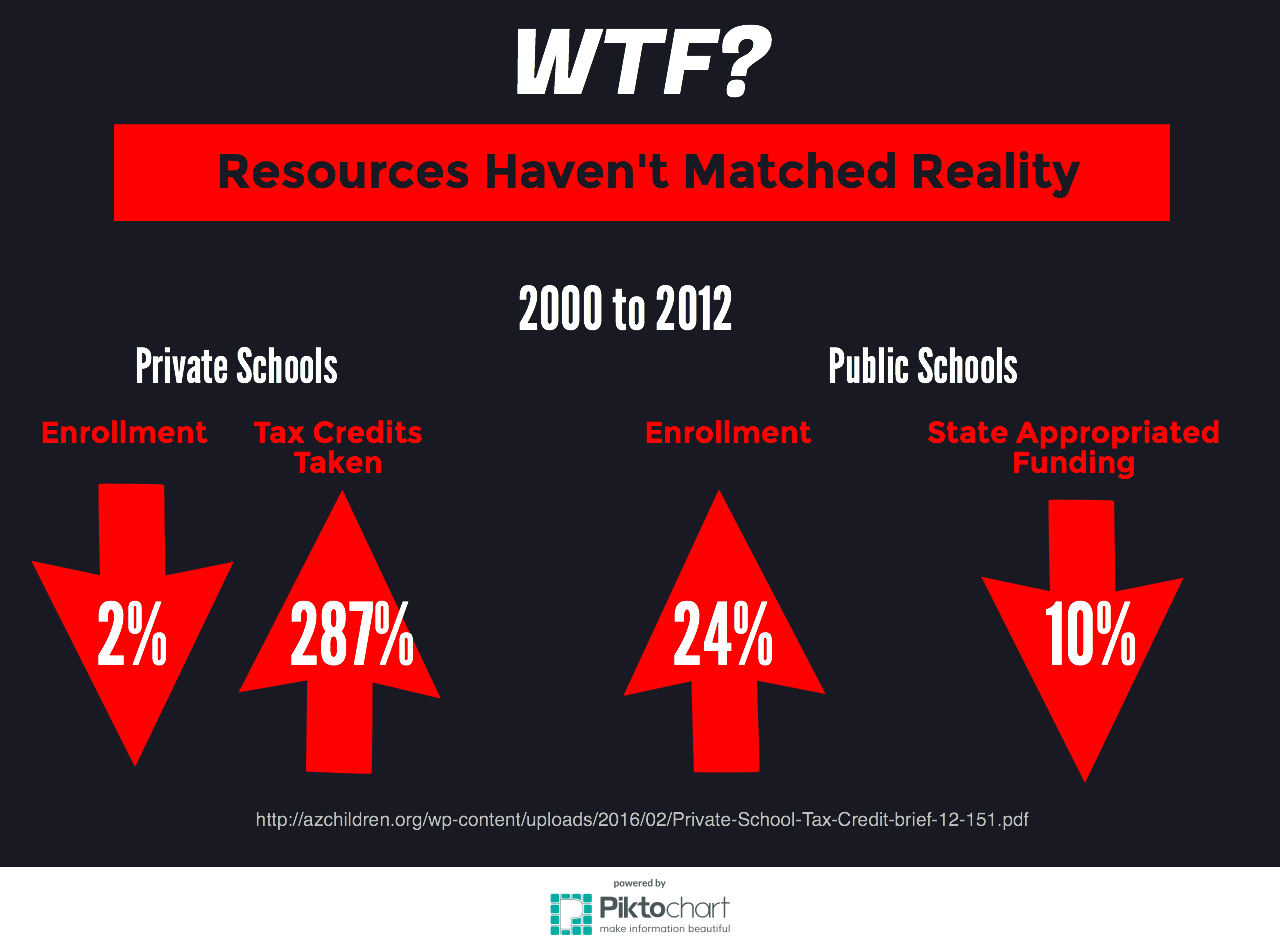
  13. District Schools and School Choice Cannot Co-Exist. When students trickle out to commercial schools, almost 1/5 of the expense associated with educating them remains despite the district’s total loss of the revenue. And while private school enrollment dropped two percent from 2000 to 2012, tax credits claimed for the students has increased by 287%. This, while public school enrollment increased 24.1% during that same time but state appropriations (from General Fund, State Land Funprivate-public-school-fundingds, and Prop. 301 monies) decreased by 10%.

It is clear there are several current and looming crises in Arizona K–12 education. And yet, Senator Debbie Lesko (R), has been quoted as saying, “Balancing the budget is always the most important work of the state legislature.” Really? That’s why the people of Arizona elect our state lawmakers? I don’t think so. Rather, I think we want them to ensure our children receive a quality education, that our roads are safe to drive and our water is safe to drink, and that our police and other first responders protect us from danger. In short, we want the Legislature to ensure appropriate capability to provide for the common good and we send them to Phoenix to figure out how to do that. Yes, they are mandated to balance the budget but, I would argue, that isn’t their raison d’être.

Arizona voters have made it clear they are willing to pay higher taxes to provide more funding to our public schools unfortunately, not enough have made the connection between a lack of funding for public education and the legislators they elect that are causing that problem. Yes, the prohibition to raising the required revenue is pain self-inflicted by our Governor and GOP-led Legislature. And, we need only look to Kansas to see that cutting taxes to attract companies to our state is a race to the bottom. I guarantee over the long haul, quality companies prefer a well-educated workforce and good quality of life for their employees over tax cuts.

In his State of the State address yesterday, Governor Ducey said, “I have a commitment our educators can take to the bank: starting with the budget I release Friday, I will call for an increased investment in our public schools – above and beyond inflation – every single year I am governor.” What is notable about this statement is his reference to “public schools” and, the fact that he followed it up with the statement that “we won’t raise taxes.” Promising support for public schools isn’t the same thing as promising it for district schools. In fact, some lawmakers now equate the term “public schools” to mean any school that accepts taxpayer dollars.

Let me be clear. I believe any promise to provide significant additional monies to public education without a willingness to raise additional revenue, is total bullshit. The pie is only so big and there are only four basic ways to significantly increase its size. Either corporate tax cuts are curtailed, additional taxes are levied, funding meant for other purposes is siphoned off or, important programs are cut. Senator Steve Smith (LD11-R) who sits on the Senate’s education committee, suggested funding could be found by moving money away from state programs “that may not be working so well.” Perhaps he was thinking of Child Protective Services which has continued to flounder and endanger children (primarily because sufficient resources have not been provided) even after Governor Ducey promised fixes when he first took office in 2015?

Arizona simply cannot move the educational needle without a significant additional investment in our district schools. These schools are where close to 85% of Arizona’s students are receiving their education, doesn’t it make sense that this is where we should dedicate the majority of our funding and efforts?

Just rearranging the deck chairs ain’t gonna cut it

Representing the AZSchools Now Coalition, Arizona’s 2016 Teacher of the Year Christine Marsh and I recently attended and spoke at a Classrooms First Initiative Council meeting in Phoenix. The Coalition consists of the Arizona Associations of: Education, Business and Education, School Boards, Superintendents, and Parent and Teachers. Also part of the coalition are the Children’s Action Alliance, Valley Interfaith Project, and Support Our Schools AZ. It was formed post-Prop 123 to provide focus to reinvesting in public schools as a way to boost student achievement.

The Classrooms First Initiative Council was established by Governor Ducey in January 2015 and charged with modernizing the school finance formula to ensure adequate funding is available for teachers and classroom instruction. The first of the two main events of this latest meeting was a presentation by Expect More Arizona on the Education Progress Meter. This meter has been accepted by virtually every education group, numerous community and municipality organizations, and 26 major business entities. It measures Arizona’s progress in eight areas to include teacher pay, preschool enrollment, 3rd grade reading, 8th grade math, high school graduation, opportunity youth, college going, and post-secondary attainment.

The other main discussion was about the proposals submitted by education groups for the Council’s consideration. In speaking for the AZSchools Now proposal, I advocated for additional resources to attract and retain high quality teachers in light of the both the current shortage as well as the some 26,000 eligible for retirement starting in 2018. Not only is the shortage critical, but teacher turnover is disruptive and expensive, costing as much as $50,000 to find and contract a new one. ADE reports we have almost 93,000 certified teachers in Arizona, but only 67,000 of them are working in the profession. Many of those who left would love to still be teaching, but were forced to seek employment that would better support their families. (According to the Bureau of Labor Statistics, the median Arizona elementary school teacher salary is $40,590 while the national median is $54,120. Starting salaries are much lower, often in the $30,000-per-year range.) Even so, one of the changes under consideration by the Council is to eliminate the Teacher Experience Index. As you might guess, this index helps keep experienced teachers in our AZ classrooms and the Coalition believes eliminating it will only exacerbate the problem. If we want to ensure high-quality education, we must have high-quality teachers and that can’t be done on the cheap. With fewer teachers entering the pipeline and over 26,000 eligible to retire by 2018, merely “rearranging the deck chairs on Titanic” I said, won’t do anything to keep this “boat from sinking.”

I also spoke about the Coalition’s recommendation to consider adding a B-weight for poverty to the school finance formula. This is critical because statewide, 58 percent of our K-12 students are eligible for free and reduced meals and many deal with a multitude of poverty related challenges at home, greatly affecting their preparedness to learn at school. That’s why the Coalition believes it is one of the most significant steps needed to make the school finance formula more equitable and fair. We know these students typically face barriers relating to transportation, housing, and levels of support in their communities and families for which additional resources are needed to help them achieve success.

Christine also made a case for additional funding, but her impassioned plea was focused on ensuring reasonable classroom sizes so that no students fall between the cracks. She told of average student loads for AZ high school teachers of 170 students and said that makes it tough for teachers to give each student the individualized attention they deserve. (The National Center for Education Statistics’ reports Arizona has 1.1 million K-12 students, and just 48,358 full-time teachers making our student-teacher ratio almost 23:1 compared to the national average of 16:1. According to WalletHub, only California and Utah are worse.)

She also pointed out that a future President of the United States is in a K-12 classroom somewhere, and current events highlight the importance of our getting this right. Stating that yes, salary is an important factor to encourage teachers to stay in their profession, Christine said it is also important that teachers feel they have what they need to really make a difference. And although she wanted to focus on the needs of students, not teachers, she noted the reality of workloads on the ability to do the job. Even if, she said, she only assigns three writing assignments per week to her 160 students, and each of those papers only takes five minutes to grade, that can amount to over 40 hours of grading time per week, and that takes place outside of the classroom. As if illustrating this point, after she spoke to the Council Christine resumed grading the stack of student papers she had brought with her.

Chris Thomas, Lead Council for the Arizona School Bards Association, said Arizona has one of the most equitable funding formulas in the nation, but is not adequately funding the formula. He highlighted the need for reinstating the cost analysis for special education funding as a way to ensure costs to provide service to these students are adequately funded while not pulling funding away from other programs. Chris also made the point that in considering a new funding formula, transparency should be ensured for the use of all public funds. Sarah Ellis, a Flagstaff Governing Board member, spoke during public comments, reiterating the need for locally controlled funding and the continuation of desegregation funding. For the Flagstaff Unified School District she said, the desegregation funds exceed that received from Prop. 123.

I was encouraged by the questions asked by members of the Council as well as the number of attendees in the audience. There was standing room only and attendees had come from all over the state to participate. I was pleased to hear some Council members voice their concerns that viable solutions to the finance formula would not be possible without additional resources, including the Chair, Jim Swanson. One member did note the reality of convincing the state legislature of this reality, but Swanson indicated he is ready to take on those who may not agree with the Council’s eventual recommendations.

Overall, I was encouraged by the meeting. Although I would have liked the membership of the Council to be more representative of the K-12 population in our state (majority Hispanic), I found them to be actively listening and serious about finding the best solutions. I am also very encouraged about the AZSchools Now coalition. One of the Coalition members, Support Our Schools AZ and its subsidiary the Arizona Parents Network, is an example of the grassroots efforts that has blossomed during and since the post-Prop 123 battle. What is especially important about this development is that it involves mostly parents who are naturally fierce advocates for their children.

One such fierce parent is Alana Brussin, whose My Turn” op-ed titled Tying school success to vouchers is a sham was recently published by the Arizona Republic. Her piece highlights the reasons community district schools are the overwhelming choice of Arizona families, in spite of the best efforts of state leaders and other school privatization advocates.

Just as Mothers Against Drunk Driving turned the tide on the public’s acceptance of drinking and driving, I’m confident our fierce parents can turn the tide on the assault on community district schools and ultimately the students they serve. Every child deserves every opportunity to succeed and when that happens, we all succeed. It really is that simple.

#BeTheMaverick

Senator John McCain recently said of Donald Trump’s comments about Khizr Khan’s remarks at the Democratic National Convention “I hope Americans understand that the remarks do not represent the views of our Republican Party, its officers, or candidates.” Uh, wait a minute John, yes they do. Trump’s remarks do represent the views of the Republican Party, its officers and candidates because…wait for it…Donald Trump is THE GOP NOMINEE for President of the United States. And, more than that, Donald Trump represents all those GOP leaders who have either endorsed him, or not denounced him, which includes…again, wait for it…Speaker of the House Paul Ryan, Senate Majority Leader Mitch McConnell and yes, YOU!

There was a time I could have voted for John McCain. Admittedly, I didn’t live in Arizona at the time, but I believed in his “maverick” status; I thought he was a standup guy who did what he thought was right, despite the prevailing winds. Then came his failed bid for President, which included his huge misstep in selecting Sarah Palin as his running mate. This, I thought, is what selling your soul looks like.

Since then, McCain has continued to slide in stature in both my book and I think, for many Americans. He appears bitter about the lost presidential race and his bitterness permeates his service. McCain reached a new, very deep low however, when he allowed Trump to basically call him a loser for being captured as a prisoner of war and then, McCain went on to endorse Trump anyway. Remember, Trump said of McCain, “He’s not a war hero. He was a war hero because he was captured. I like people who weren’t captured.” This, by a man who sought and got five deferments to service. This, by a man who claims he has had more military training than most of our service members because he attended a military prep school. This, by a man who claims he knows more about ISIS than do our generals.

Yet, McCain not only didn’t repudiate Trump, he actively ENDORSED him! Talk about stooping to a new low. And now, even though McCain has “forcefully condemned Trump’s slander of Gold Star parents Khizr and Ghazala Khan, he hasn’t pulled his endorsement of the candidate. Yes, McCain’s admonishment to Trump is much, much more than anything Ryan or McConnell offered in response to this debacle, but I still would like to see McCain stand up and be the man I once thought he was.

In his admonishment statement, McCain said, “he challenged the nominee to set the example for what our country can and should represent.” Well, I say to Senator McCain, withdraw your endorsement and support for Donald Trump. You know he does not represent the ideals of the GOP, you know he does not represent all that is good about America and you know he is not prepared to serve as President of these United States. Reestablish your legacy John; go out on a high note, #BeTheMaverick once again.


“Someone to Shine Our Shoes”

In a recent article titled “Chartered Cruise” on knpr.org, the author Hugh Jackson wrote: “Today’s charter industry, much like Nevada’s voucher plan, reflects a chronic civic defeatism. Echoing the perverse social Darwinism of more than a century ago, faith in free-market education is surrender to pessimism. Society really isn’t incapable of providing a fair educational opportunity to every citizen. Some people are doomed to fail, that’s just the way it is, so best to segregate those with promise, the achievers, in separate schools. As for everyone else, well, too bad for them.” Of course, this attitude isn’t confined to only Nevada; I have a real life example of it right here in Arizona. Three or so years ago, an acquaintance of mine asked an Arizona Senator whether or not he supported public education. He replied, “of course I do, we need someone to shine our shoes.”

It’s bad enough the Senator thought this, let alone that he said it out loud to a public education advocate. That says as much about the voter contempt some of our lawmakers hold (especially when the voter is from a different party) as it does what they think of public education. As the primary water carrier for the American Legislative Exchange Council’s (ALEC), the Arizona Legislature has led the nation in efforts to offer school choice options. Proponents tout school choice as the way to help disadvantaged children, but truth is, they’ve already written these children off. Instead, school choice is really about resegregation (the highest we’ve seen since the mid 1960s) and profiteering.

The school choice and education privatization movement gives me great pause because:

  1. The vast majority of our students (85%) are attending significantly underfunded district schools;
  2. Taxpayer dollars are increasingly being siphoned off to profiteers with very little (if any) accountability and transparency;
  3. The claim of school choice proponents that school choice provides much better results, either isn’t backed up by facts, or is an oranges and pineapple comparison;
  4. Voucher and charter schools actually provide parents less choice than district schools.

Allow me to explain. By now, most Arizonans probably know our state is 48th in per pupil funding. Even if the $3.5 billion infusion from Prop 123 is approved by voters this month, it won’t move us from 48th place in overall per pupil funding. To move up just one notch (above Oklahoma), we’d have to give out districts twice that much. That’s how far behind Arizona is.

As for the lack of accountability and transparency in Arizona’s school choice programs, for-profit companies dominate the charter school movement.  These companies do not have school boards, let alone locally elected boards and are not required to disclose the details of their business operations. As for private schools that take Empowerment Scholarship Account (voucher) or Student Tuition Organization tax credit dollars, there is no way for taxpayers to determine funding efficacy. Private school students are not required to take state assessments nor provide any academic results. Neither are private schools required to disclose any information regarding their business operations.

Then, there’s the apple and oranges comparison. Irrespective of the law requiring charter schools to accept all students, it is a well documented fact that most manage to steer clear of special needs and English language learning students and that they manage to attrit (at incredibly high rates) students of color or those on the lower end of the socio-economic scale. Of course, when these students return to the district schools, it is often after the 100th day of the school year, when the average daily attendance has been calculated and the charter school has cemented the funding for the year for that student. The district school is forced to absorb that same student for the rest of the year with no compensation.

Finally, district schools are run by locally elected governing boards that are accountable to the community. School district residents have the right to be present at board meetings and have their voice heard. They also have a right to know how their tax money is spent. Charters and private schools are run by executive boards not accountable and often not responsive to parents. If you aren’t happy with the way they are being run, your only recourse is to withdraw your child.

The myth perpetuated by those bent on destroying pubic district education is that district schools are failing and that privatization in various forms is the answer. The reality says that school choice will never be the answer for the vast majority. The evidence also shows despite charters and private schools being much more selective of their students, most charters and almost all cyber charters do worse than their district schools. We don’t really know how private schools do since they aren’t required to provide any information about results.

The movement to privatize public education is straight from the GOP playbook on reducing government. As President Reagan said in his first inaugural address: “Government is not the solution to our problem; government is the problem.” That might have been a good sound bite for the right, but I believe concentrated, unchecked power is the problem. Our system works best when we have a balance of power that ensures all sides are heard and produces compromises to come up with the best possible solution. It also works best when government provides for the public good and checks and balances are put in place to ensure efficiencies and effectiveness of both the public and private sectors where taxpayer dollars are involved. Those checks and balances are lacking in school choice options and taxpayers are paying the price. Examples abound of virtual (on-line) school scams, greedy charter school operators, and even illegal purchases with voucher dollars. No, district schools are not entirely immune from fraud, but at least they have locally elected school boards responsible to the taxpayer for oversight and the state conducts annual audits. Neither of these happens when taxpayer dollars fund school choice options.

The original intent of charter schools was to provide teachers greater flexibility to experiment with new ways to educate students. Charters were not meant to compete with or replace district schools, but rather complement them. Now, charters and vouchers have become a way for state legislatures to deflect their responsibility to provide a quality public education for all. When funding follows the child, it becomes the parent’s responsibility to ensure a quality education. School choice also allows our lawmakers to obfuscate the real problem, poverty and all the challenges it brings to our district schools.  Of course, the focus on school choice creates demand which causes funding loss in districts, making it harder for them to excel and reinforces the message that they are failing. The truth is, that despite significant funding shortfalls, severe teacher shortages and crumbling infrastructure, our district schools continue to do well. It makes one wonder what miracles could be achieved if they received the funding and support currently being siphoned off to charters and private schools.

The one thing I know for sure is that until we elect new pro-public education candidates, nothing is going to change. We will continue to see efforts to take the brakes off vouchers, create laws more favorable to charter schools, and attempts to de-professionalize the teaching profession. We have the power to create change; the only question that remains is do we have the will? Prop 123 has raised the level of attention to the challenges of our district schools. Many have been vocal on both sides of the issue. Let’s come together on May 19th at 4 pm for a Pro-Public Education Rally to tell our Legislature that enough is enough, we are done with them short-changing our kids and our state’s future! #ItStartsNow #YouPlusOne #RememberInNovember

Our Nation Hangs in the Balance

Nine months ago, it was virtually impossible to imagine Donald Trump as the apparent nominee of any political party in the United States, let alone that of a major one. Yet here we are. And although I understand the seething sentiments behind his rise, I am still incredulous that his “shtick” has actually worked.

I recently had a conversation with my Dad about whom he was going to vote for in the primary. When he told me Trump, it took me back a little, but then I delved a little deeper. My Dad was a Green Beret and still lives, eats, and breathes his military service. When I asked him what he thought about Trump saying he would “force the U.S. military to commit war crimes”, he responded with “oh he’s just spouting off.”

This statement made me realize that there really is no making sense of those who vote for Trump. They like how he speaks his mind, but then when he goes overboard, they chalk it up to Trump being Trump (boys will be boys.) They like his toughness, so much so that those who have been abused at campaign rallies actually draw the ire of Trump supporters. They eat up the nonsense he spouts off because they want to believe America can return to a “simpler” timed.

At 84 years of age, my Dad has a solidly middle-class quality of life that is much better than he could have envisioned as a young man. Despite that, I suspect he longs for the “good old days” portrayed in Leave it to Beaver and the Andy Griffith show. Yes, life was simpler then and the American Dream was very much alive (at least for some people.) The truth is though, no matter who gets elected President, America will never be going back to those days. Our country is less homogenous and more complex than ever and that trend will only continue.

On MSNBC’s “Morning Joe” this morning, the director, Rob Reiner, said of Trump: “The words that have been flung out from his mouth are insane. If he was not a celebrity, if Donald Trump was not a celebrity, the words that come out of his mouth, you’d see a guy in a park, a lunatic in a park on a soapbox, and you’d walk right by him. But the fact that he is a celebrity, all of a sudden, we’re all interested.” (I actually think it also has to do with him being very wealthy.)

Then, when one of the show’s regulars, Willie Geist, basically asked how Reiner explains all the millions and millions of people who like what they hear from Trump and are voting for him? Reiner said “Well, there are a lot of people who are racist.”

Much has been made of the shocked reaction of the hosts and regulars to Reiner’s comment because after all, any reasonable person could easily conclude not only are some of Trump’s supporters racist, but that he himself is both a racist and a mysogynist. Trump is the one who said:

He also by the way, was the only presidential candidate endorsed by David Duke of the KKK.

The real shocker is that any thinking person would be remotely surprised that Trump is referred to as a racist, and I applaud Rob Reiner for saying what others haven’t. Reiner should “know one if he sees one” after all, he played Archie Bunker’s “Meathead” son-in-law on “All in the Family” for seven years. Come to think of it, Archie Bunker’s world is probably a place many of Trump’s supporters would like to revisit. Communities were less diverse, women didn’t work outside the home and deferred to their husbands, and political correctness wasn’t even a term yet.

The really depressing thing for me about the Trump candidacy is not the candidate himself; he’s just one delusional narcissist. What most has me down about the Trump phenomena is how many people have bought into his bullshit hook, line and sinker. Don’t get me wrong. I’m not saying that all Trump supporters are bad people. Many of them are probably just people who have been dealt some hard knocks in life and are tired of things not getting better. It is scary though that even if Trump loses, his supporters will still be around and they’ll likely be even more angry and vocal. This will pose a problem for the next president to deal with. We certainly don’t need a country more polarized than it is now.

In the final analysis though, those who truly believe Trump is the answer are probably on the fringe. Most of us know that no president has the power to fix all that ails us and ultimately we need a steady hand at the helm. Who shows up to vote though, will determine what the future holds. It brings to mind the Thomas Jefferson quote “We in America do not have government by the majority. We have government by the majority who participate.”

I’m advocating that for the November elections, you commit to voting and that you get one new voter to the polls. I’m calling it #YouPlusOne. The future of our nation likely hangs in the balance.

Toto, we ARE in Kansas!

Open revolt in the Kansas GOP is now plaguing Governor Sam Brownback in his attempt to slash personal income taxes. His reasoning for the cuts was that it would encourage business expansion and hiring (sound familiar Arizonans?) But five years in, his plan hasn’t produced the promised results but rather, has the state budget in a crisis so deep that many of the Republicans that originally backed the plan are now jumping ship.

Brownback and the Kansas Legislature’s (where three-fourths of the seats are held by Republicans) plan was to cut top personal income tax (surprise, surprise) by 29 percent and exempt more than 330,000 farmers and business owners from income taxes. The predicted business expansion didn’t happen, and now the state is in trouble. Kansas Senate President Susan Wagle said the Legislature still  supports low income taxes, but they’d “prefer to see some real solutions coming from the Governor’s office.” What a concept!

What’s the chances Governor Ducey and Senator Biggs are paying attention to what’s happening in Kansas and…learning the right lesson from it? Uh yeah, that’s what I thought. It is obvious though that they are working from the same playbook in making cuts. Brownback’s most recent cuts have been to universities and public education (sound familiar?) And yes, just like in Arizona, Kansas has siphoned off big money from highway projects (over $750 million in just two years.)

Thus far, Brownback isn’t backing down and blames a slow global economy for his state’s troubles (guess the buck doesn’t stop on his desk.) An economist for the conservative Tax Foundation however, says those benefitting are pocketing the tax savings rather than using it to expand and create jobs. One former ally of Brownback who is now a critic said the continuing budget turmoil has been “just amateurish.”

I don’t know that I would characterize Arizona’s budget issues as amateurish, maybe self-serving instead. I’ve written before about the fallacy of trickle-down economics, there are plenty of examples that show it is a very flawed theory. Why do GOP lawmakers continue to go down that rabbit hole? Could it be that they are considering donors deep pockets more than the big picture for our state and all its citizens?

I’m currently reading the book “The Political Brain” in which author Drew Westen makes the point that the Democrats don’t have, and haven’t had, “a plan.” Think I prefer that to the Republican plan which seems to be to do the same thing over and over and expect different results. At least there’s a chance the Dems will get it right every now and then. The GOP’s plan is just literally the definition of insanity.

Mad as Hell and You’re Not Going to Take it Anymore!

Okay fellow liberal southern Arizonans, I get it. You are mad as hell and you aren’t going to take anymore. Prop 123 is a bridge too far, a river too wide and the proverbial final straw breaking the camel’s back.

I join you in being pissed off. I’m pissed at the Legislature who has failed to follow the people’s mandate since 2009 and ignored the Superior Court judge’s order to follow that same mandate. I’m pissed that Governor Ducey is dead set against raising the appropriate revenue to ensure our districts get the funding they are due. I’m also pissed at the current and previous state treasurers who have come out against Prop 123 since I wonder where they’ve been as the Legislature has steadily eroded our districts’ budgets.

I’m especially pissed though, at the voters who continue to elect anti-public education candidates, whether they voted for them, or just didn’t vote at all. After all, we know that 89 percent of Arizona voters prioritize K-12 public education funding at the top and that two-thirds are willing to pay more taxes to make that happen. We also know that in 2014, only 36 percent of eligible voters actually voted. Polls tell us what voters want, but they aren’t voting in a way to ensure they’ll actually get it.

I just wonder how many of you (who have decided this is the time and the place to plant the flag of “I’m not going to take it anymore”) are in the classroom, administering a school district, serving on a school board, or even have children currently in K-12 district schools. I ask this because I’m fairly sure all of these people are pissed too and they’d like to plant their own flags. But, they know that if Prop 123 doesn’t pass, it will be their students/children that suffer. It will be the 5th graders who have never been in a fully funded classroom. It will be those numerous students in Arizona who now have long-term uncertified and/or substitute teachers because of the severe shortage* of teachers in our state. It will be those students in class sizes higher than the national average because that is the only way districts could make ends meet. It will also be those students who are in facilities that haven’t been properly maintained because districts only received 2 percent of required funding to do so.

We now have Prop 123 because parents, teachers, school board members and others kept the pressure on to settle the school inflation-funding lawsuit. Years and years of cuts have made Arizona #1 in cuts to public education funding and Prop 123 won’t make much of a dent in that, but it is a start. Let me be clear…this is ONLY a start. It ONLY settles the inflation-funding lawsuit. The next step is up to all of us. We simply must elect different legislators if we expect different results. To do otherwise begins to meet the definition of insanity. We totally have the power to do this, we need only exercise it.

Please start now by taking the Prop 123GO Pledge.** Also as a reminder, the last day to register to vote in this special election is April 18th and early voting begins on April 20th. Our kids are counting on you to put them first, to end the wait, to up the fight. I will be there for them, will you?

Notes:

*To be clear, we probably have enough certified teachers in Arizona, they just can’t support their families on a teacher’s salary and have decided to work in other fields. In 2014, Arizona was 45th in the Nation for teacher salaries.

**If you are a school district employee or board member, please remember that district resources (including email) cannot be used to produce or circulate pro/con election materials.

The real trick to making America great again

There is a path to getting America back on track, but it has nothing to do with whom we elect to be our next president. The singular most significant action each of us can take this year is to demand the members of Congress put the good of the country ahead of partisan gamesmanship and special interests. And, if they don’t, vote them out of office!

Here’s the deal. Experts agree the best way to get out economy moving again is for the Federal government to invest big in repairing the country’s infrastructure. It is up to the government to do it because of what Nobel Prize-winning economist Joseph Stiglitz calls “a deficiency of aggregate demand, brought on by a combination of growing inequality and a mindless wave of fiscal austerity.” Basically, no matter how much they spend, the wealthy just can’t spend enough to adequately stimulate the economy. At the same time, as of the second quarter of 2015, corporate America had more cash on-hand that the economies of Belgium and Sweden combined ($1.43 trillion for S&P companies excluding those in the financial sector.) Tech companies are especially cash rich with Microsoft having $96 billion in cash, Google $70 billion and Cisco $60 billion. Although this hoarding means companies are positioned to weather tough economic times, it hurts the economy (especially since most of this money is held in off-shore accounts to reduce tax liability.)

We are all aware that our country’s infrastructure is in bad shape. Are roads are pothole laden and our bridges are structurally unsound.   The most recent Infrastructure Report Card from the Americans Society of Civil Engineers (ASCE) gives our Nation’s infrastructure a D+, and states that we need to invest $3.6 trillion by 2020 just to get it up to standard. The number one solution toward beginning to raise the grade according to ASCE is to “increase leadership in infrastructure renewal” and the organization maintains, “America’s infrastructure needs bold leadership and a compelling vision at the national level.

Such leadership and vision was provided by President Franklin Roosevelt in his establishment of the Works Progress Administration (WPA.) He designed the public works program “to put more men back to work, both directly on the public works themselves, and indirectly in the industries supplying the materials for these public works,” because “no country, however rich, can afford the waste of its human resources.” 2014 marked the 80th anniversary of the WPA, a Federal government program that provided 8 million Americans jobs during the Great Depression. According to the Smithsonian, “the WPA built, improved or renovated 39,370 schools; 2,550 hospitals; 1,074 libraries; 2,700 firehouses; 15,100 auditoriums, gymnasiums and recreational buildings; 1,050 airports, 500 water treatment plants, 12,800 playgrounds, 900 swimming pools; 1,200 skating rinks, plus many other structures. It also dug more than 1,000 tunnels; surfaced 639,000 miles of roads and installed nearly 1 million miles of sidewalks, curbs and street lighting, in addition to tens of thousands of viaducts, culverts and roadside draining ditches.” The San Antonio River Walk, the development of the park which paved the way for St. Louis’ Gateway Arch, and Camp David in Maryland are also just a few amazing products of the WPA.

Unfortunately, attempts to start even mildly ambitious efforts today have gone nowhere. Ray LaHood, who says, “our infrastructure is on life support”, was the secretary of transportation during Obama’s first administration. He is now co-chairman of Building America’s Future, a bipartisan coalition of current and former elected officials urgently pushing for more spending on infrastructure. In an interview on 60 Minutes, LaHood talked about the federal Highway Trust Fund, which gets its revenue from the federal gas tax of 18 cents per gallon which will be broke in 2016 unless something is done. The last time we raised the gas tax (how we funded the interstate system) was in 1993 said LaHood and spending on infrastructure has fallen to its lowest level since 1947. This reality he said, has caused us to fall from having the best infrastructure in the world, to being ranked 16th according to the World Economic Forum.

Big business recognizes the dire need to find solutions and has been vocal about sounding the alarm. In 2015, the conservative U.S. Chamber of Commerce voiced strong support for raising the gas tax for the first time in 20 years. It isn’t just roads and bridges that they are worried about. Our shortage of airport runways and outmoded air traffic control systems have made US air travel the most congested in the world, only two of our 14 major ports will soon be able to handle the biggest cargo ships, and although there are 14,000 miles of high speed rail around the world, none of it is in the US. ASCE says “by failing to invest in our vital transportation systems by 2020, businesses would pay an extra $430 billion in transportation costs, household incomes would fall by $7,000 and U.S. exports would fall by $28 billion.”

Former Pennsylvania Governor Rendell says, “The cost of inaction is greater than the cost of doing something. It’s become this literally crazed idea that spending money is bad. Federal governments and state governments have to spend money on certain things that are important.” In fact, just to maintain infrastructure as it is, an expert panel at the University of Virginia determined we need to spend $134 to $194 billion more each year through 2035. Total cost estimates to modernize top $2.3 trillion plus over the next decade, just for our transportation, energy and water infrastructure needs. Unfortunately, our infrastructure investment, currently at 2.4 percent of GDP, is only half of what it was 50 years ago.

Continuing to kick this can down the road only means there’s going to be hell to pay. There are over 240,000 water main breaks each year and rail congestion caused Midwest farmers to lose over $500 million in 2013 and 2014 in rail delays. The average ages of bridges and roads exceed 45 years and the average elementary school is 45 years old. “Our substandard roads, for example, cost urban motorists $700 to $1,000 per driver in repairs, wear and tear, and fuel. This doesn’t count the lost time involved in lower speeds and detours.”

And, with the U.S. Treasury’s ability to borrow at essentially zero (low interest rates offset by inflation), this is the perfect time to make the necessary investments in our infrastructure. Even if we only invested $18 billion per year, according to the Economic Policy Institute, it would produce a $29 billion increase in GDP and a net addition of 216,000 jobs within the first year. Of course, our real needs in terms of infrastructure investment are over $1 trillion, so the jobs eventually created could easily top one million.

So why won’t Congress get off the dime on infrastructure spending? There are a number of reasons, but I believe it basically boils down to the exact opposite of “it would be amazing how much we could get done if no one cares who gets the credit” and, the desire to starve the beast that is the Federal government. So, once again, ideology and partisan gridlock is keeping our Nation, and the rest of the world by association, from moving forward. Want to do your part to drive the required action? Use the only power many of us have left. VOTE!

Stay tuned for a subsequent discussion about Arizona’s infrastructure story.