The color of accountability

I wasn’t surprised by The Republic’s recent findings that during the 2015-16 school year, the vast majority of funding ($20.6 million) for vouchers was taken from public schools rated A or B, but only $6.3 million was taken from schools rated C or D. I’d previously seen a statistic that in 2012, about 92 percent of students taking advantage of the voucher (Empowerment Scholarship Account) program would have attended private schools anyway regardless of voucher availability. Let’s face it; this was never about helping the poor, disadvantaged minority child. The reality is that vouchers were never for poorer Arizonans who can’t cover the average private-school tuition costs of $10,421 when a voucher provides only $5,200.

And yet, the AZ Legislature is pushing two bills to fully open the floodgates on voucher availability, making every student in Arizona eligible for vouchers for homeschooling, tutoring, private school, or to save for college. This, despite the fact that there is little accountability in the program. Yes, recipients must provide quarterly reports of their spending, but DOE staffing for oversight is reportedly insufficient and the schooling options that vouchers pay for have no responsibility for reporting any kind of results. The taxpayer then, has no way to determine return on investment.

Here’s where I start to get confused. The GOP nay, Teapublican-led Arizona Legislature, loves to tout the need for accountability of taxpayer dollars. They are great however, at picking and choosing their targets for applying this accountability. [Please read on, this post isn’t really about vouchers.]

In 2015 for example, Representative Mark Finchem, R-LD11, basically accused both the Phoenix Union High School (PUHSD) and Tucson Unified (TUSD) school districts of using desegregation (deseg) funding for purposes other than what they were intended for. TUSD Superintendent H.T. Sanchez said he was not aware of any misuse, citing the fact that there is a strict review process for every deseg dollar spent. In fact, oversight of this funding is provided by the plaintiffs in a deseg suit against the district, the DOJ, a federal judge and the special master, a deseg expert overseeing the district’s efforts all get to weight in on how deseg funds can be used. Finchem though was undeterred and demanded forensic audits that the schools would have to pay for because “these are taxpayer dollars and we want to make sure those dollars are being spent wisely, that they’re not being misappropriated. And I think that’s an obligation this body has to see to it that those dollars are spent that way.”

Fortunately, SB 1120 failed. Senator Steve Farley, D-LD9, who had a child in TUSD, said, “Finchem represents no part of the Tucson Unified School District.” Finchem never took the time to discuss the issue first with Sanchez, meet with district officials or review audits already done according to Farley.

So, why don’t AZ Legislators care about accountability when it comes to vouchers, but are all over it when it comes to desegregation funds? Could it just have something to do with the socio-economic status and color of most voucher (private school) students versus those who are beneficiaries of deseg funds? Just sayin’…

I must admit I hadn’t really taken the time to learn the details about deseg funding (my district doesn’t get any) until a recent email exchange with Representative Vince Leach, R-LD11. In his email, he intimated that “districts continue to violate civil rights after billions of dollars have been spent to fix the problem” and asked, “Where is the accountability in that?” Again, that whole accountability thing. Yet, when I asked him to please vote no on the voucher expansion, citing in part the lack of accountability, he said “I think you know I am going to vote for them.”

So yes, I took the time to learn more about desegregation funding. The issue dates back to at least 1974 when two families filed separate lawsuits against TUSD and the court found TUSD “had acted with segregative intent” and failed to fix the problem. In 1979, the U.S. Department of Education’s Office for Civil Rights (OCR) launched an investigation against PUHSD and a lawsuit was filed in 1982 for allegedly engaging in segregation practices. Problems were also found in the Tempe Elementary School District to include deliberately segregating minority and non-English speaking students, assigning minority teachers to the district’s poorest schools and placing a disproportionate number of English language learners in special education classrooms. Schools in wealthier parts of the District also had full-day kindergarten, nurses and librarians, but the others did not.

In 1985, Arizona enacted legislation to allow districts under federal court orders or OCR agreements to bring racial and ethnic balance to their schools and provide equal access to high quality education, to levy property taxes above their revenue control limit. As a result, those districts were able to levy a limited amount of higher local property taxes without voter approval. Although there were some problems along the way, in 2005, PUHSD gained “unitary status” followed by TUSD in 2009. This status meant that these districts had formally fulfilled their desegregation court order. Plaintiffs in the TUSD suit disagreed the problem was fixed, filed an appeal of the District’s unitary status designation and in 2011; the Appeals Court reversed the decision and appointed a highly paid special master (in Massachusetts) to help TUSD develop a new “road map.” This road map outlines required activities including student assignment, transportation, faculty and staff assignment, quality of education, discipline, family engagement, access to facilities and technology and transparency and accountability.

There are now 19 school districts with almost 250,000 students (about 23% of the total) around Arizona that receive $211 million for racial and ethnic discrimination remediation (unchanged since 2009.) Since 1986, the total comes to $4.3 billion, with 97 percent going to Phoenix and Tucson Schools. Only PUHSD and TUSD actually receive “desegregation funding”, the other 16 districts have administrative agreements with OCR. Two bills in the AZ Legislature, seek to reduce and eventually eliminate all this funding (within 5 years for those with OCR agreements and 10 years for those in unitary status.) SB 1125 (a follow-on to last session’s unsuccessful 1371), sponsored by AZ Senator Debbie Lesko, R-LD21, passed by the Senate Finance committee on 2/11/16 and claims state property tax rate caps require the general fund to make up some $23 million in 2015 in desegregation funding garnered at the local level. HB 2401 sponsored by Representatives Vince Leach and Mark Finchem is a companion bill which has been retained on the calendar as of 2/23/16.

Of her bill, Lesko said “That’s money from all over the state that shouldn’t just go to a couple districts.” She thinks that rather then relying on deseg funding, districts should ask voters to approve budget overrides. According to the Senate Fact Sheet for SB1125 however, although the state funded this “cap gap” through FY 2015, the Legislature has now capped the state’s cost of the 1 percent cap program to $1 million per county, i.e., the state passed on a portion of the cost for the gap to the counties (who must then pass these costs on to the taxpayer.) Irrespective of the caps however, affected districts contend they would be violating a federal agreement and a lawsuit will ensue if the funding is discontinued. Additionally, according to a recent analysis by The Republic, districts receiving desegregation funding did not spend more per pupil than all others in 2014. This is because there are many different funding sources for schools including varying amounts of federal dollars, bonds and overrides.

For PUHSD, the largest in the state with over 27,000 students, the loss of deseg funding would translate to about $53 million and would require closing four high schools with a loss of 702 teaching and staff jobs (estimates put the state-wide loss of jobs at about 2,500.) The superintendent, Dr. Chad Gestson, says, “The proposed elimination of desegregation funding is simply a huge tax cut on the backs of our poorest students.” He goes on to say that the ramifications go beyond public education and will affect property values, crime rates, reduced tax base, more burden on the city, county and state and a lower quality of life. Superintendent Robbie Koerperich of Holbrook Unified School District says “we all deserve it…we [shouldn’t] bring Holbrook [down] to the same level as similar school districts, but we should fund the other districts to bring them up.”

Proponents of the funding however say the results speak for themselves with the graduation rate at PUHSD at 80 percent up from 55 percent 15 years ago. Same thing with dropout rates that went from 15 percent over 20 years ago to 3.4 percent today. The Districts grads are also earning more scholarships for college than only six years ago, $50 million now, versus $13 million then.

The $211 million currently spent in deseg funding works out to an average of $844 per student. The question we should be asking isn’t “is it unfair for the 19 districts under deseg orders or with OCR agreements to receive this funding”, but what is the appropriate level of funding for all our students. Arizona k-12 education saw the highest cuts in per pupil funding in the Nation from 2008 to 2014 and to move up to even 45th place, we would need to spend $1 billion more, or almost $950 per pupil. Of course, other than the badly needed Prop 123 monies, our Legislature isn’t talking about education plus-ups, only cuts. (Sorry, but the recent restoration of all but $2 million of JTED funding doesn’t count, that was just about rectifying the bad decision made in last year’s budget.)

To the Arizona Legislature I say, the voters are waking up to your pretension that you give a damn about All Arizona’s children. To the voters, I say NOTHING speaks louder than your vote.


Screw you, I’ve got mine

Now that it looks like the AZ Legislature will be successful in finally opening the floodgates on vouchers (empowerment scholarship accounts) for K-12 education, I’ve got some other ideas they should consider. After all, the Legislature has made it clear that taxpayers are the ones best equipped to decide where their tax dollars go and that transparency and accountability don’t matter. Other than quarterly reports on spending, there is virtually no accountability in the voucher program; students aren’t even required to test and private schools don’t need to report any kind of results so there is no way for taxpayers to determine if their tax dollars were well spent.

Since I don’t have any children or grandchildren, I’ve been thinking about how I can take advantage of the Legislature’s privatization fixation. My first idea is one of safety and security. We don’t live in an incorporated township, so we rely on the county sheriff’s department to ensure our safety and security. The service provided is adequate, but I really think I can do better by looking to a private security firm to meet my needs. After all, surely a private security firm can do a better job right? That Blackwater firm was just an anomaly, right? So, I’m not sure what percentage of my tax dollars support the county sheriff’s office, but I want the state to give that back to me and I’ll hire my own guys. I’ll probably have to pay extra for the private solution, but it will be worth it.

While I’m at it, think I’ll look at the taxes I pay for maintenance of roads. After all, what do I care about roads in other parts of the state? I want the roads I drive each and every day to be in pristine condition. Maybe the state should just turn every road into a toll road and then I would only pay for those roads on which I drive. What? There would be many cases where there isn’t enough traffic to support maintenance of roads in remote areas? Too bad, so sad, not my problem.

Oh, and I live within a half mile of a fire department so I don’t think I should have to pay as much in taxes as those who live further away. After all, if there is a fire at my house, the department will save money in fuel and travel time to deal with it.

Obviously, I provide the above to make a point. When did we descend into this “screw you, I’ve got mine” mentality? No matter what proponents claim, vouchers are NOT the solution for the vast majority of Arizona’s children. What they are, is a way to: 1) redistribute our tax dollars from the greater good to those who LEAST need the help; 2) bolster the private education industry and; 3) relieve the state Legislature of the responsibility for ensuring and providing for education. The two major jobs of the state are to provide for public safety and public education. Once these voucher bills pass, legislators will no doubt feel they can wash their hands of the responsibility to “provide for the establishment and maintenance of a general and uniform public school system.” Truth is, they will have just done the very thing that drives a stake in the heart of their ability to ensure a “uniform” system.

Make no mistake; this is NOT about providing parents a choice. What it is about, and has always been about, is the corporate “reform” of public education or in other words, taking the “public” out of public education. Vouchers are also not ensuring the best for ALL our students. With every student exits their district school on a voucher, the fixed costs of running that district must be born by a smaller budget, which means the students left in are increasingly short-changed. The nature of the beast is that these students will invariably be those with the most challenges such as English Language Learners, special needs students, or just those lowest on the socio-economic ladder. Unlike district and charter schools, private schools can choose whom they wish to admit. They also don’t provide transportation and their tuition commonly exceeds the $5,200 parents receive with the voucher. It is not hard to see why many of Arizona’s parents will continue to choose to send their children to their community district schools and yet, these schools will increasingly be abandoned in terms of state support.

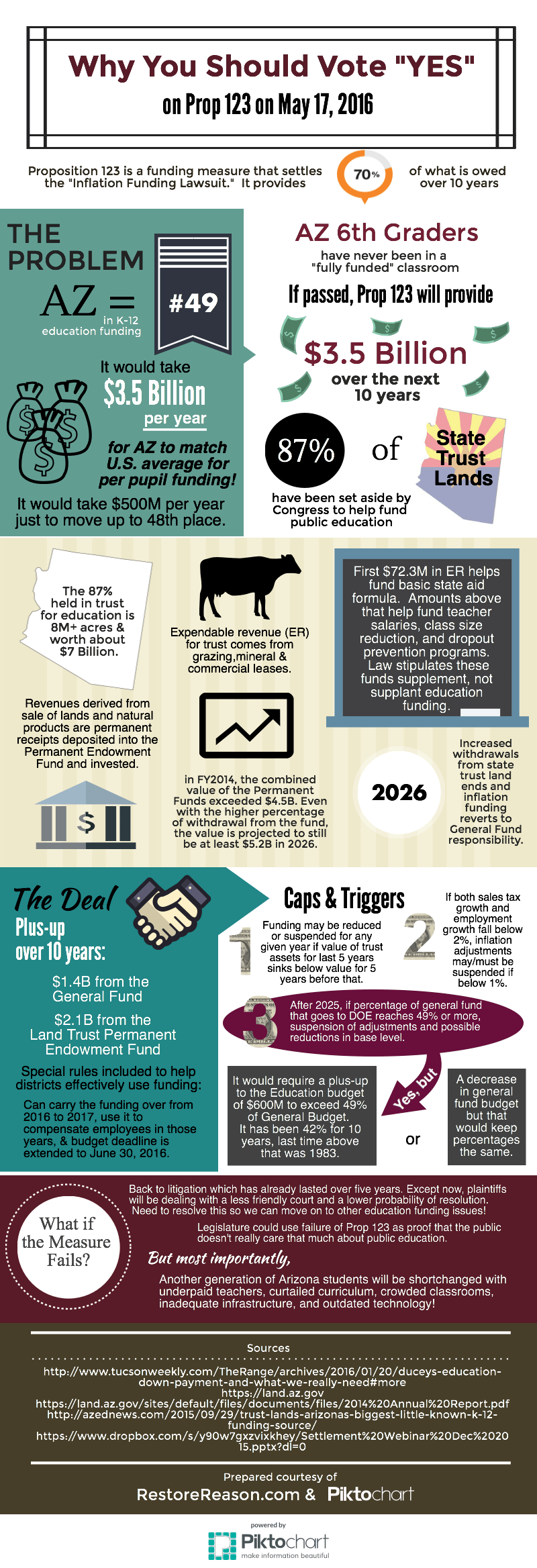
I’ve made it known that I am for the approval of Prop. 123 to get more funding into our schools now! Is it the way I would want to do it? NO!! I want to Arizona to stop giving corporate handouts and if necessary, to raise taxes to fund the type of schools our students needs for the future we all want. After all, Arizonans largely support this. If this opening of the floodgates on vouchers passes though, I may have to rethink my position. It is bad enough that the Legislature has thumbed it’s nose at the will of the voters, the decisions of the court and has finally agreed to pay our schools only 70 percent of what they owe with money that is already technically theirs. I can’t stomach the thought of this money getting siphoned off by those who could largely afford to go to private schools without the voucher money.

If you agree, you can’t just sit silently by and let this happen. If you want things to be different, you MUST ACT. Call your legislator, send them an email and make comments in the Legislature’s “Request to Speak” program. If you aren’t signed up for the program, please email me and I’ll personally go to the Capitol and sign you up (you must be signed up through the kiosk at the Capitol to be able to actually comment on bills.) Then you can, from the comfort of your home, tell the Legislature just what you think about the bills they are considering and, your comments will become part of the permanent record.

Ultimately though, the only long-term solution is to elect pro-public education legislators to replace those who aren’t acting in our students’ or our state’s best interest. Please ACT NOW. Our kids are counting on you and they can’t wait any longer for us to come to their rescue.


AZ again at bottom in “50 States Report”

The Network for Public Education (NPE), a public education advocacy group headed by the Nation’s preeminent public education expert and advocate, Diane Ravitch, released their “A 50 State Report Card” today. As the name indicates, the report card grades the 50 states and the District of Columbia on six criteria: No High Stakes Testing, Professionalization of Teaching, Resistance to Privatization, School Finance, Spend Taxpayer Resources Wisely, and Chance for Success. Letter grades from “A” to “F” were then averaged to create the overall GPA and letter grade for each state.

I was proud to note the study was conducted with the help of Francesca Lopez, Ph.D. and her student research team at the University of Arizona. They assisted in the identification of 29 measurable factors that guided the ratings of the six criteria and created a 0-4 scale for ratings and then evaluated each state on the 29 factors. The graders were tough, with only 5 states earning an “A” grade and no state’s overall grade exceeding a “C.”

Not surprising to anyone who keeps up with Arizona public education, the state ranked 48th, but I assume only because Arizona begins with an “A.”   Arizona’s grade of 0.67 earned it an overall “F”, numerically tying it with Idaho and Texas (in 49th and 50th place), just above Mississippi.

The first criterion evaluated was “High Stakes Testing” which according to NPE has caused “the narrowing of the curriculum and excessive classroom time devoted to preparing for tests.” The organization also points to peer-reviewed studies highlighting “the potentially negative impacts of this practice, including the dismissal of quality teachers and the undermining of morale.” Five states received an “A” grade for their rejection of the use of exit exams to determine high school graduation, the use of test results to determine student promotion, and educator evaluation systems that include test results. Arizona received a grade of “C” in this area.

The second criterion evaluated was “Professionalization of Teaching”, because “many of the current popular American reforms give lip service to the professionalization of teaching while displaying an appalling lack of understanding of what professionalization truly means.” NPE points to research that “shows that experience matters and leads to better student outcomes, including increased learning, better attendance and fewer disciplinary referrals.” High grades were given to states that exhibited a commitment to teaching as a profession. Unfortunately, no states were awarded an “A” in this area and only two states, Iowa and New York received a “B.” Arizona received a grade of “F” which goes a long way towards explaining our state’s critical shortage of teachers.

In the area of “Resistance to Privatization”, seven states received an “A” grade. The evaluation of this criterion was centered on school choice policies that “move control of schools from democratic, local control to private control.” Market-based approaches (vouchers, charters and parent trigger laws) reports NPE, “take the governance of schools out of the hands of democratically elected officials and the local communities they serve, and place it in the hands of a few individuals – often elites or corporations with no connections to the community.” Such policies drain resources from neighborhood schools and don’t overall, produce better results in general. NPE writes “they also serve to undermine the public’s willingness to invest in the education of all children while creating wider inequities across the system as a whole.” Since NPE believes in strengthening community schools, they evaluated states on whether they have laws, policies and practices that support and protect their neighborhood schools. As an early leader in school choice, Arizona more than earned the “F” grade it was awarded.

Since the level of poverty in a school is the single best predictor of average student performance, “School Finance” was another criterion evaluated. NPE looked at whether states adequately and fairly funded their schools noting that “resources like smaller class sizes and more support staff lead to significantly higher achievement and graduation rates – especially for poor and minority students.” Only one state, New Jersey, received an “A” grade in this area. This is not surprising since in the past decade, the gap in spending between rich and poor districts has grown by 44%. NPE calls for states to sufficiently fund public education and implement progressive financial polices that “provide the most funds to districts that demonstrate the greatest need.” The factors used to determine a state’s grade were: per-pupil expenditure adjusted for poverty, wages and district size/density; resources spent on education in relation to the state’s ability to pay based on gross product; and increased proportion of aid given to high-poverty districts than to low-poverty. Once again, Arizona received an “F” grade in this area.

In evaluating the criterion of “Spend Taxpayer Resources Wisely”, NPE looked at how states’ education dollars are spent. As research shows the significant benefit of early childhood education, high quality pre-school and all-day Kindergarten were a significant factor in the evaluation as were lower class sizes and the rejection of virtual schools.   In this area, Arizona received a “D” grade, with no states receiving an “A” and only Montana receiving a “B” grade.

“Chance for Success” was the final criterion evaluated. It looked at state policies directly affecting the income, living conditions and support received by students and their parents/guardians. NPE says that residential segregation is largely responsible for school segregation. However, the organization says, “state policies that promote school choice typically exacerbate segregation and charters often isolate students by race and class.” The states that had fewer students living in or near poverty, and have the most integrated schools received the highest grades. No states received an “A” grade, but 10 received a grade of “B.” In this final area, Arizona received a grade of “D.”

It can be no coincidence that Arizona continues to finish last, or close to last, in the vast majority of every report on state public education performance. In fact, the only report I’ve found it to be rated better than at the bottom is from the American Legislative Exchange Council’s (ALEC) Report Card on American Education. Not surprising from this highly conservative “bill mill” for the Koch Brothers and the GOP, which works to develop model legislation favorable to its corporate members and provide it to legislators for implementation in their states. It speaks volumes about ALEC’s focus when even though Arizona ranked 47th on the 2013 National Assessment of Educational Progress (NAEP), they gave the state an overall B- on education policy. That’s because ALEC values states’ support of charter schools, embrace of home schools and private school choice programs, teacher quality (as defined by the National Council on Teacher Quality) and digital learning. For the most part, the positions ALEC takes on education policy are the exact opposite of NPE’s positions. ALEC pushes school choice and the privatization of public education and in Arizona, the Goldwater Institute does it’s part to support ALEC in it’s efforts to kill public education. What’s in it for ALEC, the Goldwater Institute, their legislators, donors and corporate members? As is often the case, it’s all about money in the form of campaign donations for legislators, profits for those in the for-profit charter and private school business, increased tax breaks for donors and welfare for corporate members. You might ask how privatizing education can lead to increased corporate welfare when such privatization will undoubtedly lead to increased costs? (Think privatization of prisons.) Easy, when the state’s cost for “public” education is passed on to those taking advantage of the privatized option via vouchers and charters. It is well known that both often cost more than the state provided funding covers and parents must pick up the tab.

I attended the first NPE Conference held in 2013 in Austin, Texas where I was privileged to meet and hear Diane and numerous other leaders in the effort to save public education. I, like them, believe (as Diane writes in the NPE report) “educating all children is a civil responsibility, not a consumer good.” And although the phrase “civil rights issue of our time” is way overused, I deeply believe it rings true when, (as Diane writes) it refers to “sustaining our system of free, equitable and democratically-controlled public schools that serve all children.”  I’ve quoted him before, but John Dewey’s words bear repeating until we, as a nation “get it”: “What the best and wisest parent wants for his child, that must we want for all the children of the community. Anything less is unlovely, and left unchecked, destroys our democracy.” Yes, we should act on public education as our very democracy is at stake, because it is!

The needs of the many…

Spoiler Alert: I am really glad I didn’t drive to Phoenix today for the House Ways and Means Committee meeting during which they considered HB 2842, Empowerment Scholarship Accounts (ESAs); Expansion; Phase-In. I’m glad I stayed home because I’m sure my presence would have made no difference. Instead, I watched live streaming of the meeting and gleaned from the testimony that ESAs are lacking in accountability and transparency and serve the few at the expense of the majority.

The first “against” speaker I viewed was Ms. Stacey Morley from the Arizona Education Association. She talked about how when the full cap is reached, 5,500 students could have accepted ESAs at a cost of $13M to the state. Tory Anderson, from the Secular Coalition of Arizona expressed her organization’s opposition to any use of taxpayer dollars to fund religious schools. An AZ Department of Education representative said DOE is neutral on the bill, but wants to ensure they get their full 5% portion of the ESA funds for ensuring accountability. These funds are prescribed by law, but haven’t always been fully included in the budget. He talked about the importance of adequate oversight and referred to the 700 to 1 ratio currently in place for program liaisons that work with families to provide that oversight. As high as that number is, he wanted to ensure further budget cuts don’t make the challenge even tougher.

Mike Barnes, from the Arizona Superintendent’s Association talked about how ESAs make it very difficult for districts to determine their potential enrollment and therefore the impact on their budget. He said he doesn’t see how under this structure, the state doesn’t end paying for students that were going to attend private school anyway. He mentioned that the funds given in an ESA equal about $5,200 which is $600 more than is given to a district, but $600 less than what a charter costs. Representative Bruce Wheeler asked him if we knew how many of those students who take ESA have parents that make in excess of $100K. He said he did not.

The next speaker was Julie Horwin, a grandparent of two children who attend private schools. I assumed she was going to advocate for ESAs but that was not the case. She opened by saying that ESAs mean we are paying with two separate school systems with public funds. She then relayed a story of a private school principal who is paid $40K per year and found out that his board members each get paid $150K per year with public monies. She finished by saying that this bill will not help the greater majority of our students.

Janice Palmer from the Arizona School Boards Association (ASBA) said school choice is robust and noted that ASBA was the first school boards association to participate in National School Choice Week. She said the bill is disconcerting because in a competitive environment, it is important to be fair. Parents she said, definitely need to have the largest voice in their children’s education but when public dollars are involved, taxpayers also need to be part of the equation. Finally, she noted that this is not a zero sum game. If we choose to press ahead with the expansion of ESAs, but refuse to increase taxes, other programs will suffer to cover the additional expenses to the state budget.

The “for” speakers were three parents or grandparents of special needs children and Michael Hunter from the Goldwater Institute. Those who spoke regarding the value of ESAs for their special needs students were eloquent and convincing. There could be no doubt that the ESA program has provided them options they might not have otherwise had. But, the option for special needs students already exists in the law the expansion of HB 2842 is well beyond just them, but ultimately for all students in Arizona. Michael Hunter of the Goldwater Institute pointed out that changes like this are always met with resistance. First, there was open enrollment and then charter schools, both which were touted by opponents as being detrimental to district schools. He said that instead of looking at the impact on district schools, we should look at each family’s situation. Representative Reginald Bolding went back and forth with him a couple of times trying to pin him down (with little avail) about the difference in accountability and transparency, especially with regard to academic standards, but in the end Bolding was left to make his points on his own.

When the committee members voted, only Representative Bruce Wheeler and Reginald Bolding explained their votes. Wheeler called it subsidization of the rich and voted no and Bolling said he just wanted to ensure we have good schools for all our students and he was worried that individuals who might benefit from the program wouldn’t know about it. In the end, the vote was not surprisingly, along party lines and the measure passed (5-3-1.) The vote was predictable, but still depressing. I am convinced it will do nothing to improve education in Arizona and will do very little to help those who most need it. The Senate Education Committee meets this Thursday, February 4th at 9:00 am in Senate Hearing Room 1 and will be considering SB 1279, also about ESA expansion. If you are registered in the Request to Speak system, please make a request to speak on this bill and if not, please email or call your legislators to let them know you do not support it. Anyway you look at it, ESAs are vouchers and, they are siphoning valuable taxpayer dollars to private (to include religious) schools. Register your concerns and let your voice be heard. In this case, the needs of the many, must take precedence over the needs of the few.


Accountability in Arizona…not so much

Two headlines in the AZ Star caught my attention this morning: “Plan adds state cash for private education” and “Veto-proof majority backs repeal of JTED cuts.” The first one is about Representative Justin Olson’s bill to remove any limits on Empowerment Scholarship Accounts (ESAs.)  The second is about the Legislature’s plan to reinstate the $30 million in JTED cuts they made last year. Evidently the Legislature is now saying “my bad” about the 7.5% cut (about $400 per student) to charters and districts with students enrolled in JTED. According to Diane McCarthy at West-MEC, legislators weren’t really aware of what they were doing. “After the fact, some legislators said they didn’t understand what the impact of that (cut) was,” McCarthy said. “There’s a lot of talk about how do we fix it.”

I’m really glad the Legislature has come to its senses and intends to restore the funding, since 96% of Arizona students enrolled in CTE graduate from high school, 21% above those who don’t. Most CTE graduates also go on to post-secondary education and jobs and they score higher on standardized tests. CTE really is a win-win-win as the recent letter to the AZ Legislature signed by 32 business and education entities made clear. What really caught my eye about the JTED article was a quote from Senator Don Shooter who introduced the legislation to repeal the cuts. In response to Senate President Andy Bigg’s accusation that the program has insufficient oversight, Shooter said one key is “transparency.” Thanks for the segue Don.

Don Shooter is correct that transparency leads to more accountability, but evidently he and his fellow GOP legislators don’t understand that concept when it comes to ESAs (basically vouchers by another name.) As of mid-April 2014, approximately $17 million had been handed out through ESAs. That is a lot of money to be handed out without any way to ascertain return on investment. Unlike district school students, ESA recipients are exempted from all state assessments so there is no way to know whether the money was well spent.  Although there is a quarterly spending report required from ESA recipients, parents must only provide proof of spending 25% of the funding they receive each year. The money they don’t spend can be saved from year to year and can even be used for college. If the money isn’t spent, does it mean the parent was efficient with their child’s education or does it mean they skimped? Also, the vast majority of ESA funding goes to private schools (92% in 2012) and at least in Arizona, 70% of private schools are religious. I know this has been deemed constitutional because the money is given to parents who then give it to the schools, but sorry if it looks like a rose and smells like a rose…

The ESA program has been expanded little by little, (students: with disabilities, wards of the court or those that were, students of active duty military members or those killed while serving on active duty, those who had attended a D or F school the prior year, siblings of students currently in the program, and students who reside within the boundaries of an Indian reservation) but it has always been the intention of the GOP-led Legislature to open up the program to all. So far, pro-public legislators and those who believe in good stewardship of government dollars have been able to keep the wolves at bay. Make no mistake however; this legislation is much more about privatizing public education than it is about opportunities for disadvantaged children. Proponents say we need to transition from financing schools to funding students. Problem is, when students accept an ESA and leave the district school, they take all the funding with them, but none of the costs of running the school. A certain amount of overhead costs are fairly independent of student count and schools are incapable of rapidly adjusting their operating expenses with each student lost.

School choice is alive and well in Arizona and still a full 85% of Arizona’s students choose district schools.   The Legislature can pretend they care about these kids, but the truth is that they have a stranglehold on the necks of our district schools and as they continue to restrict the flow of resources to these schools, our kids are the losers. The more they encourage parents to look for greener grass outside our district schools, the more likely it is that resources will be pulled away from these schools making it harder for them to continue to educate the majority of students who remain.

If the Legislature really cares about Arizona students, why not just support our district schools why not just support what we know works: great teachers, small class sizes, infrastructure that supports learning and curriculum that is rich and challenging. We also know that schools can’t do it on their own. Many of our children face obstacles outside of school that affect their ability to learn inside school.

I am incredibly tired of our children being used as a political football. It is time for all good people to say enough is enough. We must stand up and speak for those who have no voice and no power to save themselves. It will be hard to make Arizona public education the envy of the Nation. But, it is possible and that possibility gives me hope.

Why Ducey’s Promise to Lower Taxes is a Lie

During Governor Ducey’s inaugural address in 2015, he indicated that he would not support higher taxes with: “prosperity moves, and as taxes go up, it moves away. Gone as well are jobs, people and companies that found a better welcome someplace else.” Likewise, during his 2016 State of the State address, he bragged about lowering taxes and assured Arizonans that he will “lower taxes this year. Next year. And the year after.” Yes, he has been consistent about his promise to lower taxes and even to do away with the state income tax. He obviously subscribes to the GOP mantra of supply-side (some call it trickle-down) economics.

The basic theory of supply side economics is that marginal tax rates and less government regulation will help business expand and create more jobs. The Laffer Curve, named after Arthur Laffer, is a central theory of this philosophy and posits that lowering tax rates generates more economic activity eventually leading to more tax revenue. Proponents of this philosophy include the Koch-brothers-financed American Legislative Exchange Council (ALEC), Americans for Prosperity, and the Wall Street Journal’s editorial board. They claim that the nine states without personal income taxes are outperforming the rest of the states and that their success can be easily replicated in those states that abandon their income tax.   The non-partisan Institute on Taxation and Economic Policy (ITEP) however, says that Laffer focused on “blunt aggregate measure of economic growth” to support his contention. The truth says ITEP, is that states with personal income tax, even those with the highest rates, are experiencing as good, or better, economic conditions than those without. Still, there are plenty of examples of governors who insist on leading their states down the proverbial rabbit hole.

Take Governor Sam Brownback for example. When he took the reins in Kansas, he dropped the top income-tax rate by 25%, lowered sales taxes and created a huge exemption for business owners filing taxes as individuals. Now, five years after doubling down, his state lags in job creation, tax revenue is far short of expectations and bond and credit ratings have been downgraded.

In Oklahoma, Governor Mary Fallin and the GOP-led Legislature enacted a quarter-point reduction in the top income tax rate two years ago and corporate tax breaks when oil crude prices were riding high. Oklahoma’s Republican Treasurer Ken Miller, who advocates for revenue-neutral tax cuts, blamed his GOP colleagues for the now “self-inflicted” crisis. Miller said: “Common sense dictates that until the state proves it can live within its means, it really should stop reducing them, yet some ‘thinkers’ continue to advocate eliminating the state income tax – even arguing that the state’s largest funding source and be vanished without a replacement and still fund needed teacher pay raises.” To Arizonans I ask: “sound familiar?”

In Wisconsin, Governor Walker enacted several permanent tax cuts just as the national recession ended and state revenues began to climb. His speech this year to ALEC was all about how his “big, bold reforms took the power out of the hands of big government special interests.” What he didn’t say is that his reforms produced only about half of the jobs he promised and resulted in delayed debt payments and deep cuts to education to balance the budget.

In North Carolina, with all three branches of government now securely under GOP control, money saved from cutting safety net programs wasn’t reinvested into education, job training or infrastructure, but given to the wealthy and corporations in the form of tax breaks. In September, the NC legislature signed a budget into law that provides $400 million in income tax cuts to be offset by taxes on repair, installation and maintenance services.  Alexandra Sirota, who studies tax policy for the NC Justice Center said the affect of the lower taxes “is a huge revenue loser” and that “the revenue losses aren’t fully accounted for in the next few years.”

At the root of it all are ALEC’s questionable economic and fiscal assumptions and faulty analysis. Specifically, these policies include deep cuts in income taxes, particularly for affluent households and corporations; a repeal of state income and estate taxes; and a shift in state revenues from graduated-rate income taxes to sales taxes that are much higher than what exist today. They also include the end of various state-based tax credits for low-income working families; a Taxpayer Bill of Rights (TABOR) that would impose rigid constitutional limits on state revenues and spending; requirements that state legislatures garner two-thirds or other “super-majority” votes to raise any taxes or fees; and other mechanisms to reduce the funds available to finance public services. ALEC also pushes the repeal of state personal and corporate income taxes, which typically provide one-third to one-half of a state’s funding for schools, health care and other services. Finally, ALEC and its supporters fail to acknowledge that public services such as education or infrastructure are important to a state’s long-term prosperity.

Mainstream economic research though, shows that state taxes average less than one percent of a business’ total costs. Extensive economic research indicates that tax-funded public services like education, health, transportation, and public safety are more important for attracting businesses and jobs.  In fact, Paul O’Neill, former CEO of Alcoa and President George W. Bush’s first Secretary of Treasury said: “[As a businessman] I never made an investment decision based on the Tax Code…[I]f you are giving money away I will take it. If you want to give me inducements for something I am going to do anyway, I will take it. But good business people do not do things because of inducements, they do it because they can see that they are going to be able to earn the cost of capital out of their own intelligence and organization of resources.” Robert Ady, of Ady International has assisted in countless business site locations. He says that “subsidies cannot make a bad place good.” Good places are competitive because their long-term business basics (labor, materials, marketing, overhead, and transportation) are solid. As Greg LeRoy, founder and director of Good Jobs First, said in his book The Great American Jobs Scam, “any subsidies are icing on the cake, but the cake is already baked.”

Yet, Governor Ducey insists on following the ALEC playbook with his plan to eliminate state income tax. During his gubernatorial campaign, he promised not to postpone a $225 million corporate tax cut to be phased in over three years. To the Arizona Tax Research Association, Ducey bragged about signing legislation to index the state’s income tax brackets ensuring salary increases that don’t outpace inflation don’t bump earners into higher tax brackets. Ducey claimed it was “an important first step in our mission to reduce income taxes in the State of Arizona every year.”

Stay tuned for the second half of this post in which I’ll explain why I claim Governor Ducey’s promise to lower taxes is a lie. Small spoiler alert…he may be committed to reducing income taxes, but there is WAY more to this story.

Open Letter to Governor Ducey

It was fitting that your propaganda piece, “Arizona schools win big in my budget” was published in AZCentral.com’s “AZ I See It” column. After all, I understand this is your view of reality. But, the fact that it is your view, doesn’t make it factual.

You open your piece speaking of last year: “we protected priorities, like K-12 education…” Not sure how you can claim you protected K-12 education when in 2015, you cut $113.5 million from K-12 district schools and reduced charter additional assistance funding by $10.3 million. This year, you claim credit for “an historic $3.5 billion funding package for schools.” Yeah Governor, you are just a regular education philanthropist, digging deep into the schools own coffers (state trust lands revenues set aside for education funding) to give our schools the money they’ve been owed since 2009. You offered this deal to take additional monies from state trust lands, despite Arizona ending last fiscal year with an extra $312 million in the bank and being on-track to end FY2017 with $621 million. To add insult to injury, you now plan to pad the states’ rainy day fund with an additional $10 million to bring the balance to $470 million. I have to wonder how many corporate tax breaks will that fund?

 Despite your largely unearned grandstanding, I’m going to hold my nose and vote for Prop. 123, because I think it is the only way we will get any significant additional funding for our schools anytime soon. Rest assured though that education advocates throughout the state are going into this eyes wide open. We know there are caps and triggers in the deal that could allow the legislature to cheat our kids yet again. Just know that we will be more vigilant than ever and that “Hell hath no fury” like advocates scorned after negotiating in good faith.

Of course, taking credit for new funding when you are really just restoring it seems to be a trend for you. You claim to be targeting high-need employment sectors with a “new”, $30 million investment in career and technical education (CTE.) Give me a break! This is the same $30 million the Legislature cut from CTE in 2015. It is definitely not a “new” investment and you aren’t even proposing to give it all back at once. Rather, you: plan to give only $10 million per year over three years; only want it spent on certain kinds of programs; and are requiring matching funds from business. House Minority Leader Eric Meyer said “two thirds of the JTEDS across the state will disappear under this plan, it will create havoc.” He went on to question “why we are ‘fixing’ this program that already works so well to train our kids for the workforce.” These programs are proven to produce higher graduation rates, provide job skills for those not necessarily destined for college, and provide employers the skilled workers they so badly need. The reduced funding won’t only hurt JTEDs, but also district schools who get funding for their students participating in the job training programs.

Speaking of reduced funding in district schools, I noticed you didn’t mention that FY2017 will see the implementation of last year’s legislation to change the district funding model to “current year funding” versus the “prior year funding they’ve been using for the past 30 plus years. Essentially, this will immediately cheat our district schools out of one year’s worth of funding totaling $40 million across 64% of Arizona’s districts. And, while you claim this year’s budget proposal makes new investments in our universities, you failed to mention that your “plus-up” is really only $8 million, less than 10% of the $99 million cut in the 2015 budget. As for our community colleges, I note you also didn’t mention restoring any of the state funding you entirely eliminated from Maricopa and Pima colleges in 2015.

I do thank you for inviting all Arizonans to read your budget and join the conversation about it. You do, after all, work for us and we absolutely should give you feedback on the job you are doing. You can bet I’ll visit azgovernor.gov/budget, read your budget in detail, and comment. I wholeheartedly encourage all my fellow Arizonans to do the same.

Respectfully, Linda Lyon


Bottom Five List – Discouraged but Hopeful

A recent article in The Atlantic magazine featured experts on K-12 education who offered their reasons for hope and despair with regard to education. It was an interesting read and prompted me to come up with my own list for Arizona. In this first of two posts, I share my “Bottom Five” list of what discourages me and what I’m hopeful about. First, what discourages me:

10. The extremely well funded efforts of the corporate “reformers.” Make no mistake about it, the effort by the corporate “reformers” to make sweeping changes to the Nation’s public education system is as much about making a profit as it is an interest in making a difference. The exact number is up for debate, but The Nation magazine says the American K-12 public education market is worth almost $800 billion. Now, everyone from basketball players to Turkish billionaires want a piece of the pie. It is no accident that the Koch brothers backed, corporate bill mill ALEC is pushing many of the reforms, and the technology magnates Bill Gates and Mark Zuckenberg are heavily involved in the “reforming.” All you have to do is follow the money and the intent becomes clear.

9.  The apathy of Arizona voters. I worked on three Arizona Legislative campaigns in the past few years and although I mostly enjoyed talking to voters, I was beyond dismayed when I learned that in 2014, not even half of the LD11 voters with mail-in ballots bothered to mail them in. These are people who are registered to vote and are on the Permanent Early Voters List (PEVL). They are mailed their ballots and can fill them out in the comfort of their home. They don’t even have to put a stamp on them, postage is pre-paid. These votes should have been the “low-hanging fruit.” Combined with the overall Arizona voter turnout of 27%, this is pathetic by anyone’s definition.

8.  The fact that Arizona leads in all the wrong metrics. Does Arizona care about children? Let me count the ways maybe not so much. According to the Annie E. Casey’s “Kids Count Databook”, Arizona ranks: 46th in overall child well-being, 42nd in economic well-being, 44th in education achievement, and 42nd in children’s health. The Databook also reports that 26% of Arizona’s children live in poverty, 4% more than the nationwide average. The personal finance website WalletHub reports much the same, ranking Arizona 49th for child welfare which shouldn’t surprise anyone given the dysfunction in our Department of Child Safety. I don’t know about you, but these statistics disgust me and should absolutely drive what our Legislature spends our taxpayer dollars on. It is about defining what kind of people we are, it is about helping those who can’t help themselves and it is about the future of our state.

7.  Some seem to think the path to success is to lower the bar. Even though there are people whose opinions I value that think Senator Sylvia Allen will do a good job as the Chair of the Senate Education Committee, I remain hopeful but have my doubts. Call me crazy, but I think the legislator with the most sway over what education bills see the light of day should actually have more than a high school education. Along those same lines, Arizona Representative Mark Finchem (LD11-Republican) evidently doesn’t think teaching experience is valuable for our county schools superintendents. He has already submitted House Bill 2003 for this legislative session, which seeks to delete the requirement for county schools superintendents to have a teaching certificate. Instead, it will require only a bachelor’s degree in any subject, or an associate’s degree in business, finance or accounting. I know some would ask why should county schools superintendents have certificates when the state superintendent of public instruction doesn’t require one. Well, I’d rather see us make it a condition of both jobs.

6.  The polarization of our county makes it seem impossible to come together to find real, workable solutions. I was recently speaking to a friend of mine who I’ve known for over 25 years. We started talking about education and he started railing about how all public schools do is waste money. He talked about the fancy new high school in his town that was built (in his opinion) much more ostentatious than necessary. “Why do the kids need that to learn” he asked? “Why not just give them a concrete box?” Really?? Where do I begin? Truth is, I didn’t even try because I knew he wouldn’t listen. He knew what he knew and no amount of fact was going to sway him.

But all is not lost and I am more optimistic than pessimistic about Arizona’s public education. Here’s what makes me hopeful:

10.  Across the Nation, more and more charter school scandals come to light every day highlighting the need for more transparency and accountability. I’m not glad there are charter school scandals, but I am glad the public are learning more about the dangers of a profit-making focus with inadequate oversight. That’s one of the reasons district schools have rules and controls; they are after all, dealing with taxpayer dollars. And oh by the way, it’s no longer just charter schools we need to watch. The continuous expansion of vouchers exponentially broadens the potential for abuse and requires the same kind of public oversight. There just is no magic pill to student achievement. It takes resources, dedicated professionals, and hard work. Short cuts in other words, don’t cut it.

9.  The fact that we still have dedicated professionals willing to teach in our district schools. Despite low pay, higher class sizes than the national average, insufficient supplies, inadequate facilities, and ever-changing mandates, Arizona still has close to 50,000 district teachers willing to be in our classrooms because they love the kids and they love their work. They are underappreciated and sometimes even vilified, but they know their work is important. Now, if only our Legislature acted like they knew this too.

8.  Recognition is growing that early childhood education is really important. Even Governor Ducey said in April 2015: “Research shows that a quality early childhood education experience can yield significant long-term benefits on overall development of a child. It’s the most profitable investment we can make in their future.” A recent review of 84 preschool programs showed an average of a third of a year of additional learning across language, reading and math skills. Preschool has also been shown to have as much as a seven-fold return on dollars spent over the life of the child. The public is starting to “get it” and support for preschool funding is growing.

7.  Speaking of Common Core, it seems to be working okay. Yes, I saw the recently released AzMERIT results, but we knew they would be low. That’s what happens when you raise the bar. Despite no additional funding or resources to implement Common Core (oops, I mean Arizona College and Career Standards), our districts made it happen and the numerous teachers and administrators I’ve talked to say our students are now learning more. Efforts are underway to determine what should be changed about the Arizona standards, but my guess is that they will be minor.

6.  If nothing else, the passage of the Every Student Succeeds Act (ESSA) saves us from the really bad legislation that was No Child Left Behind. Everything I’ve read about the new ESSA touts it an improvement over its predecessor. It reduces what some considered Federal overreach and provides states more flexibility in implementing their K-12 education programs. Which, oh by the way, makes me concerned our state legislature will look to relax requirements where it serves them, at the expense of those children who most need our help. At least now though, they won’t be able to blame everything on “the Feds”, to include whatever version of the Common Core standards we end up with.

Please stay tuned, still to come are the top five reasons I’m discouraged and hopeful.

CTE is a win-win-win

Tim Cook, CEO of Apple was recently asked why his company moved its production to China. “It’s skill”, said Cook in response to Charlie Rose on “60 Minutes. “The U.S., over time, began to stop having as many vocational kind of skills” he said. “I mean, you can take every tool and die maker in the United States and probably put them in a room that we’re currently sitting in. In China, you would have to have multiple football fields.” Okay, so the CEO of the most profitable company in the world moved production out of the U.S. because American workers don’t have enough vocational skills.   Surely, that makes alleged “pro-business” legislators stand up and take notice, right? You would think, but this is Arizona.

In our state, the public high school districts charged with offering these tuition-free “vocational kind of skills” or Career and Technical Education (CTE) are Joint Technical Education Districts (JTED.) These JTED offer a variety of programs in fields such as business, computers and media, health science; and industrial technologies just to name a few. Students in JTED programs earn high school credit, and in some cases, may earn college credit, industry certifications, and/or a state license through combination of hands-on training and classroom instruction.

As the Pinal County Chair for the Arizona School Boards Association, I toured the Central Arizona Valley Institute of Technology (CAVIT) in Coolidge this year.   This district has a partnership with eleven area high schools and offers aesthetics, cosmetology, dental assistant, fire science, law enforcement, massage therapy, medical assistant, nursing assistant, and veterinary assistant training programs. I was very impressed with what I saw at CAVIT. Engaged students were learning not only valuable trades skills that will earn them certificates and jobs when they graduate from high school, but also how to be valued employees. I left CAVIT thinking “this is exactly what we need in Arizona.”

Unfortunately, the AZ Legislature obviously doesn’t agree or just doesn’t “get it”. In 2011, they cut CTE funding for freshmen to the tune of $29 million. In 2017, another 7.5 percent cut takes affect. That may not sound like much, but on top of previous cuts it will devastate the program. In fact, JTED aren’t the only districts impacted since about 70 percent of the funding they receive is passed through to regular school districts where many of the classes are taught. JTED keeps the other 30 percent for operation of their central campuses. Jeremy Plumb, superintendent of Mountain Institute JTED in Yavapai County, said: [As the] programs continue to grow and expand critical partnerships; business and industry leaders are mind-boggled by the recent statewide program cuts.” Plumb also confirmed that Arizona is beginning to see epidemic employment shortages in industries such as health care, power and electrical systems, and aviation just to name a few. David Jones, president of the Arizona Construction Association, likewise confirms that quality carpenters, welders, electricians, plumbers and landscapers are in high demand adding: “There’s a stigma attached to going to a vocational school in the U.S.” Perhaps, but this stigma hasn’t extinguished student demand in Arizona with over 90,000 students enrolled in one of the state’s 13 JTED. After all, college is expensive and job opportunities aren’t what they used to be. JTED offers an alternative with less risk and at least as much promise for a secure future.

Truth is, although Americans love to tout “college for all” fewer than one in three young people achieve that dream. Some can’t even make it to college, but the real problem is our drop-out rate which is the highest in the industrialized world. There are a variety of reasons, to include that many college students (as with high school students who drop out) can’t see a direct connection between their studies and future employment. In fact, 81 percent of high school dropouts say relevant, real-world educational offerings would have kept them in school. This matters because the average dropout will contribute about $300,000 less to society than their high school graduate counterpart. CTE participation has proven to help. In Tucson Unified School District, students who took three or more CTE classes saw as much as a 60 percent decrease in the likelihood of dropping out of high school. In the Mesa Public Schools, students taking just two CTE classes were 79 percent less likely to drop out. Of this type of “applied learning” Richard Condit, Chief Administrative Officer, Sundt Corporation said: It is clear that when students see application of content, they are more engaged in and committed to their education.”

Not only does JTED/CTE provide skilled workers to eager employers, and keep students in school, it often provides young adults higher paying jobs than if they had gone to a four-year college. This is especially true when the avoidance of student debt is considered. A 2011 Harvard study showed that 27 percent of people with post-secondary licenses or certificates—credentials short of an associate’s degree—earn more than the average bachelor’s degree recipient. In today’s tough economy, the percentage is probably higher.

So, CTE is a win-win-win program. And yet, our Legislature seems intent on killing it. Yes, I know it is a budget issue. Yes, I know Governor Ducey is determined not to raise taxes (at least not directly), but this is a choice! This is HIS choice! This is inspite (or maybe in SPITE) of the fact that a recent poll found 66 percent of Arizonans would pay higher taxes to improve public schools.

It is OUR choice whether we continue to let our elected officials act counter to our wishes. Guess what? We ARE the boss of them! We grant them their jobs, we pay their salaries, and we should be giving them performance feedback. Click here for the Governor’s feedback form, and click here to find and email your legislative district’s representatives. And, if you want to make a difference real-time during the next legislative session, click here for the form to sign up for the Legislature’s Request to Speak System where you can engage from your home computer and have your comments become part of the public record. You CAN do something and what you do will matter. As Nike says, “just do it.”