AZ Chamber Prez says AZ Teachers are “Crybabies”

Glenn Hamer, President of the Arizona Chamber of Commerce, said, “It’s amazing to me that the teachers unions are out there like a bunch of crybabies screaming about the difficult of getting additional pay to teachers.” His comment was in response to why teachers union should support reforms to the initiative process.

There are so many things wrong with this comment, I don’t even know where to start. First of all, Hamer makes about six times the amount the average Arizona teacher makes. After all, Arizona’s teachers are the 47th lowest paid in the nation with the average teacher pay falling nationally 1.6 percent over the past decade, but 7.6 percent in Arizona. The low pay is a big part of the reason 53 percent of Arizona teacher positions were either vacant or filled by uncertified personnel in January 2017. And oh by the way, teacher colleges enrollment is down and 25 percent of AZ teachers will be eligible for retirement by 2020, further exacerbating the problem.

Secondly, just what teachers’ unions is he talking about? Arizona is a “right to work” state (which basically means workers have no rights.) This means that our teachers don’t enjoy the collective bargaining power a union would afford. The Arizona Education Association (AEA) advocates for support of our public schools and works to improve the professional lives of teachers and school staff members.

Thirdly, if education advocacy organizations like AEA aren’t “out there…screaming…for additional teacher pay,” who will ensure our teachers are paid enough so they can feed their families on their teaching salaries. Teachers don’t teach to get rich. They do it because they love their students. They don’t want to be out advocating for pay raises, they want to be in the classroom teaching our kids. Teachers earn just 62.8 percent of the salary that other college degree-holders do in the state – the lowest nationwide. Wallethub scored the state the third-worst for teachers in terms of “job opportunity and competition” and academic & work environment.” To bring all our teachers up to more in line with national averages, it would cost about $600 million ($10K per teacher.)

Hamer no doubt has an agenda. He recently teamed up with Lisa Graham Keegan to publish an exuberant support piece for Betsy DeVos on the website “A for Arizonahttp://www.aforaz.org/blog/two-enthusiastic-thumbs-up-for-education-secretary-pick-betsy-devos.” In it, they wrote, they are “very pleased with her nomination” writing that it, “signals a shift in the conversation around education policy in exactly the right way.” That “right way” no doubt is the full-steam ahead commercialization of our district community schools.

You’ve no doubt seen the national backlash to President Trump’s nomination of Betsy DeVos for Secretary of Education. You also probably saw at least snippets of her confirmation hearings. She has proven herself entirely unqualified by her lack of credentials and experience with public education, her responses to questions during her hearings and the total lack of positive results she affected on education in Michigan. And yet, Glenn Hamer sings her praises.

But let me return to where I began, and that is with Hamer calling Arizona teachers “crybabies” for asking they be paid a wage that allows them to stay in the classroom AND feed their families. I don’t think that is asking too much and according to recent polling, most Arizonans (77 percent) think our schools need more funding with teacher pay a high priority. If you, like me, would like to send a message to Hamer that he doesn’t speak for most Arizonans who value our teachers and want them properly compensated, click here to link to the corporate members page on the Arizona Chamber of Commerce. I encourage you to look through the various levels of membership and note those companies that belong. Then click on a few of their logos or links to get their contact info and let them know you do not appreciate their Chamber President’s words. You can also click here to go to the Chamber’s contact page to express your displeasure with Mr. Hamer himself.We DO have power, we just need to use it!


They can have their own opinions, but not their own facts

The first session of the 53rd Legislature began yesterday and as we public education advocates “batten down the hatches” and plan our “assaults”, I thought it a good time to provide what I believe are some of the most salient facts about the state of education in Arizona today.

  1. Educational Achievement. The Annie E. Casey Foundation’s Kids Count 2016 report ranks us 44th in the nation, Education Week’s Quality Counts 2016 ranks us 45th, and WalletHub 48th. Might there be a nexus to our other rankings provided below?
  2. Per Pupil Funding. Our K–12 state formula spending (inflation-adjusted), was cut 14.9% from 2008 to 2016 leaving us 48th in the nation.
  3. Propositions. The $3.5 billion Prop. 123 provides over 10 years (only 70% of what voters approved and the courts adjudicated) disappears in 2026. Prop. 301, which includes a 0.6% state sales tax, raises about $600 million per year for schools and self-destructs in 2021. There is now talk of increasing the tax to a full cent which would bring in around $400 million more per year or, adding an additional penny which would up it $1 billion.
  4. Teacher Shortage. We have a critical shortage of teachers willing to work in the classroom with 53% of teacher positions either vacant or filled by an individual who does not meet standard state teacher certification requirements. With 25% of the state’s teachers eligible for retirement by 2020, this problem is only going to get worse. Pay is just one of the reasons teachers are opting out, but with Arizona ranking 45th in terms of teacher salaries against the national average, it is real. In fact, “Arizona’s teachers earn just 62.8% of the salary that other college degree-holders do in the state – the lowest ratio nationwide. WalletHub scored the state the third-worst for teachers in terms of ”job opportunity and competition“ and ”academic & work environment.” Providing them a $10,000 raise (more in line with national averages) would cost the state an additional $600 million.
  5. Voter Support. In a December 2016 poll of Arizona voters, 77% said the state should spend more on education and 61% said they’d be willing to pay higher taxes to do so.
  6. Double-Down Ducey. Our Governor has promised not to raise taxes but to propose a tax cut every year he is in office. This, on top of two decades of tax cuts that equal a cumulative impact on the 2016 general fund of $4 billion in lost revenue. In fact, more than 90% of the decline in revenue since 1992 has resulted from tax cuts versus economic downturn–our troubles ARE NOT a result of the great recession. And, Arizona ranks in the bottom third of states in terms of tax rates.
  7. Good Ideas With No Way to Implement Is Called Philosophy. In her 2017 AZ Kids Can’t Wait plan, Superintendent of Public Instruction Diane Douglas has recommended an additional $680 million in common-sense, no frills funding for public schools but points out it is not her job to appropriate funds and the Governor’s Classrooms First Council spent over a year studying how to modernize the school funding formula only to determine that just rearranging the deck chairs won’t be enough…more money must be provided.
  8. They Owe, They Owe, So Off To Court We Go. Over 20 years ago, the AZ Supreme Court voided the system under which districts were responsible for capital costs because of the “gross inequities” created. The Legislature agreed to have the state assume responsibility for building and maintaining schools but that vanished under Governor Brewer’s time as a budget-saving maneuver leaving us back where we started. In fact from 2008 to 2012, districts only received about 2% of the funding they needed for renovations and repair of school facilities and the problem continues. A new lawsuit is in the works.
  9. It’s For The Poor Kids…NOT! Arizona’s educational tax credit (individual and corporate) and the Student Tuition Organizations (STOs) that funnel the monies to private and parochial schools will deny the AZ General Fund of almost $67 million in revenue in 2016/17 (the maximum allowed.) Due to a 20% allowable increase each year, the cap for corporate tax credits will be $662 million by 2030. By way of comparison, the total corporate income tax revenue for FY 2015 was only $663 million. And yet, even in 2011, As many as two-thirds of Arizona corporations paid almost no state income tax partially as a result of the program which predominantly serves students whose parents could afford the private schools without taxpayer assistance. Just for the original individual tax credit for example, 8 STOs awarded over half of their scholarship funding in 2014 to students whose families had incomes above $80,601. By the same token, Arizona’s voucher program (Empowerment Scholarship Accounts) is billed as the way for disadvantaged students in failing schools to have more opportunity. Truth is, in the 2015/16 school year ESAs drained $20.6 million from  district schools rated “A” or “B”are and only $6.3 million from schools rated C or D. Besides, the mere existence of school choice in whatever form it takes does not in itself provide access and opportunity. As Charles Tack, spokesman for AZ Department of Education said, “The economic situation of a family will always factor in.”
  10. Want A Voice? Stick With Where You Have a Vote! Parental and taxpayer oversight and voice is vastly greater in district schools with locally-elected governing boards, annual state-run audits, annual Auditor General reports on school efficiencies, AzMERIT test score results, and other required reporting. Commercial schools (charters and privates) do not have the same requirements for certified teachers and transparency and accountability; nor are they required to provide taxpayers any information regarding return on investment.
  11. Apples and Oranges. Commercial schools do not – across the board – perform better than do our district schools. Yes, there are pockets of excellence, but those exist in district schools as well. Comparisons are difficult to make because the playing field is not level, with commercial schools often managing to pick the cream of the crop while district schools take all comers. A key point to note though, is that charter schools spend double the amount on administration than districts.
  12. A Great Start Is Critical For All Kids. Full-day kindergarten is essential to ensure every child (especially those who are disadvantaged) has a more equal footing on which to start their education. In today’s fast paced, global economy, preschool is also critical and has been proven to provide as much return on investment as $7 for every $1 spent. Restoring all-day kindergarten statewide would cost an additional $240 million. We’ve had it before incidentally. In 2006, Napolitano made a deal with legislative leadership for all-day kindergarten in exchange for a 10% cut in individual income tax. Four years later, the Legislature cut full-day kindergarten but the reduction in taxes still exists.
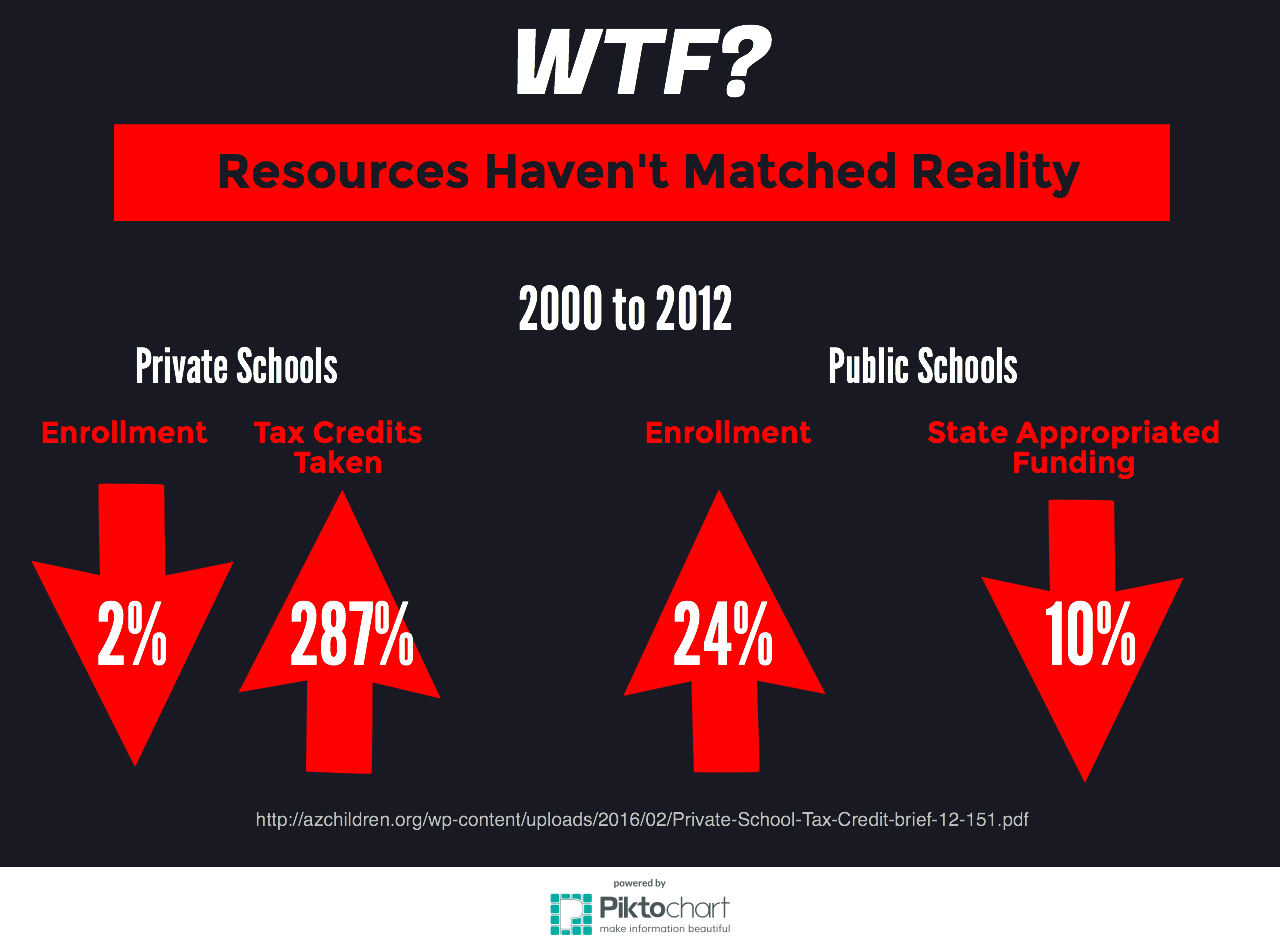
  13. District Schools and School Choice Cannot Co-Exist. When students trickle out to commercial schools, almost 1/5 of the expense associated with educating them remains despite the district’s total loss of the revenue. And while private school enrollment dropped two percent from 2000 to 2012, tax credits claimed for the students has increased by 287%. This, while public school enrollment increased 24.1% during that same time but state appropriations (from General Fund, State Land Funprivate-public-school-fundingds, and Prop. 301 monies) decreased by 10%.

It is clear there are several current and looming crises in Arizona K–12 education. And yet, Senator Debbie Lesko (R), has been quoted as saying, “Balancing the budget is always the most important work of the state legislature.” Really? That’s why the people of Arizona elect our state lawmakers? I don’t think so. Rather, I think we want them to ensure our children receive a quality education, that our roads are safe to drive and our water is safe to drink, and that our police and other first responders protect us from danger. In short, we want the Legislature to ensure appropriate capability to provide for the common good and we send them to Phoenix to figure out how to do that. Yes, they are mandated to balance the budget but, I would argue, that isn’t their raison d’être.

Arizona voters have made it clear they are willing to pay higher taxes to provide more funding to our public schools unfortunately, not enough have made the connection between a lack of funding for public education and the legislators they elect that are causing that problem. Yes, the prohibition to raising the required revenue is pain self-inflicted by our Governor and GOP-led Legislature. And, we need only look to Kansas to see that cutting taxes to attract companies to our state is a race to the bottom. I guarantee over the long haul, quality companies prefer a well-educated workforce and good quality of life for their employees over tax cuts.

In his State of the State address yesterday, Governor Ducey said, “I have a commitment our educators can take to the bank: starting with the budget I release Friday, I will call for an increased investment in our public schools – above and beyond inflation – every single year I am governor.” What is notable about this statement is his reference to “public schools” and, the fact that he followed it up with the statement that “we won’t raise taxes.” Promising support for public schools isn’t the same thing as promising it for district schools. In fact, some lawmakers now equate the term “public schools” to mean any school that accepts taxpayer dollars.

Let me be clear. I believe any promise to provide significant additional monies to public education without a willingness to raise additional revenue, is total bullshit. The pie is only so big and there are only four basic ways to significantly increase its size. Either corporate tax cuts are curtailed, additional taxes are levied, funding meant for other purposes is siphoned off or, important programs are cut. Senator Steve Smith (LD11-R) who sits on the Senate’s education committee, suggested funding could be found by moving money away from state programs “that may not be working so well.” Perhaps he was thinking of Child Protective Services which has continued to flounder and endanger children (primarily because sufficient resources have not been provided) even after Governor Ducey promised fixes when he first took office in 2015?

Arizona simply cannot move the educational needle without a significant additional investment in our district schools. These schools are where close to 85% of Arizona’s students are receiving their education, doesn’t it make sense that this is where we should dedicate the majority of our funding and efforts?

Open Letter to Frederick Hess

I could barely get through your post on educationnext.org before I began formulating my response. This is not the first time I’ve wanted to respond to a post on this blog, but I definitely couldn’t let this one go unanswered. I read your blog because I try to ensure I am informed about education from a variety of opinions and viewpoints. But, as Daniel Moynihan said, “You are entitled to your own opinions, but not to your own facts.”

In your post titled “Education Is So Far Left, It Can’t Really See the Right”, you condescendingly lay out the “blind spots” of those in “education.” Your interchange of “those in education” and “Democrats” as if there is no difference is your mistake #1. Although more teachers tend to be Democrats than Republicans, teachers are typically focused on their students in the classroom, not in setting education policy. I am a school board member and active in my state’s school board association. One thing I’ve learned in the past four years, is that those who serve with me are politically diverse and it is this diversity that ensures all viewpoints are represented. These governing board members are at the forefront of charting the course of education at the local level and they have many different ideas about how to do that. Its a great strength of the local control our system of district education offers. While I’m on the subject of ideas, I have a few others for you.

1. You write that those “in education spend so little time talking to or engaging with conservatives.” Don’t know where this comes from, but as I alluded to above, educators, administrators and school board members talk to all kinds of parents, community members and voters. They do this day in and day out. It is a big part of the “public” in public education.

2. Trump did not “narrowly lose the popular vote.” As of November 19th at 6:35am, Hillary Clinton was leading with the popular vote by 1.4 million, with 2.8 million votes still unprocessed in California. I recognize it doesn’t matter how many votes she got, Trump won the election. I just object to you making it sound like the popular vote was really, really close. It wasn’t.

3. You write that the obstructionism of Congress during Obama’s presidency was just “Republican majorities in Congress doing their job”, I say no. Congress’ job is to do the work the people sent them there to do, not to be the most do-nothing Congress ever.

4. You claim that equity is why “the Left gets out of bed each morning”, and I say damn straight, it should be one of the many reasons we all get out of bed. You know, like it says in the Declaration of Independence, “all men [and women–21st century update] are created equal…”

5. Really? You want to try to take the high ground on liberty? What about the Right’s fixation on telling women what they can and cannot do with their bodies and telling gay people who they can marry? And as for community, public district schools (especially in rural areas) are often the hub of their communities and the focus on the privatization of education (as your blog does) risks destroying those hubs and the communities they serve.

6. Are you serious? “Overhauling collective bargaining in Wisconsin? Governor Walker was trying his damnedest to totally dismantle the ability of hard-working people to fight for their rights. Employees after all, typically seek collective bargaining when they are not treated fairly. If a business owner doesn’t want his or her employees to unionize, maybe they could just provide a fair wage and decent working conditions.

7. So you think the framing of race, ethnicity, and gender ”tears at the fabric of our republic and sows ill-feeling and tribalism?“ How about the framing of racism, misogyny, and bigotry? And by the ”suppression of religious freedom“, are you referring to the desire for businesses to not discriminate against customers because of their ”deeply held religious beliefs?” Its easy. If you don’t want to be forced to serve everyone, don’t apply for a business license from the government (of the people) to operate.

I personally believe we have more in common than not and I really wish we could focus on finding common ground versus tearing each other down. Unfortunately, recent events tell me it is going to be awhile before we have any real breakthroughs in that regard. The sad thing is though, we aren’t just hurting ourselves, but the children who are counting on us to work together to get this education thing right. When will we learn?

123: Show Me The Money!

Since the passage of Proposition 123, I’ve heard people ask where the money went. Did it really go to raise the salaries of Arizona’s teachers?

An August 2016 survey on Prop. 123 funding conducted by the Arizona School Boards Association and the Arizona Association of School Business Officials had 83 school districts (representing over half of Arizona’s students) respond. The survey largely reinforced the narrative that adequate compensation to attract and retain teachers towers as the top priority statewide. Most of the districts concentrated their Prop. 123 funding in teacher and staff bonuses for FY2016, and a full 74% of districts budgeted the additional FY2017 funds for the same.

Survey responses from across the state (21% urban, 24% suburban, 53% rural and 2% remote) affirmed the varied needs of our district schools and for locally elected governance. In some cases, the funding priorities were supplies, textbooks, technology and school building maintenance and repair, all of which support the learning environment.

The need to buy essential supplies and services with the funds should surprise no one. After all, the Arizona Legislature has cut more than $2 billion in district funding since FY2009. In addition to impacting the ability to fund the needs listed above, the cuts eliminated state funding for full-day kindergarten and ninth grade career and technical education students. Let’s not forget Prop. 123 provided no new funding to help offset these cuts. Rather, only 70% of what the voters had already mandated and the courts adjudicated. It was better than nothing, but after years of hollowing out district resources, the funding was rapidly absorbed by the many pressing needs districts had long deferred.

One clear example of those pressing needs is the severe teacher shortage facing Arizona. A recent survey of 130 school districts and charter schools conducted by the Arizona School Personnel Administrators Association found almost 8,200 teacher openings for the 2016-2017 school year. By August 28, 2016, 47% of these remained vacant or were filled by individuals not meeting standard teacher requirements.

With fewer college students pursuing a teaching career and a wave of teachers soon eligible for retirement, this problem is only going to get worse and is proof positive that Prop. 123 was not the solution, just a step in the right direction. Almost three-fourths of Arizona’s registered voters agree, stating in a recent Arizona Republic/Morrison Institute/Cronkite News poll they believe the state is spending “too little” on K-12 education.

Yes, Prop. 123 was a critical infusion of funding allowing districts some ability to more appropriately compensate our teachers and support other critical needs. Let’s be real, though. It didn’t even move Arizona out of our 48th place for per pupil funding which would have required double the funding from Prop. 123. That’s why Support Our Schools AZ and the Arizona Parent Network support funding for our district schools that ensures equity (regardless of ZIP code) and stability (critical to continuity of staffing and programming, which enables more effective operations.) State-provided funding and other support should respect that choice.

Our district educators have done more and more with less and less for many years, and ultimately, our students are the ones who suffer the lack of certified teachers in their classroom, higher class sizes, narrowed curricula, outdated technology and rundown facilities. It is incumbent upon each of us to remember those students when we vote today. The bottom line is if we want different results, we need to elect different candidates — pro-public (district) education candidates!