Open Letter to Senators Flake and McCain

Dear Senators Flake and McCain,

First of all, let me thank you for your service to our state and our country. I realize your job is not an easy one, but hope you understand this is also not an easy time to be an engaged patriot. Millions of us are incredibly anxious about the future of our country and our world. At this time, more than almost anytime in my adult life, we need real leadership.

As a school board member, I am really worried about President Trump’s and his SecED nominee’s intentions with K–12 education. He thinks our nation’s current education system is “flush with cash” and that our children are “deprived of all knowledge.” For Arizona at least, both of these statements are ridiculous. Our per pupil funding is 48th in the nation and our teachers the 47th lowest paid. Even so, our student’s National Assessment of Educational Progress (NAEP) scores continue to rise and we led the nation in growth on the science test from 2009 to 2015.

If however, Betsy DeVos is confirmed, she will no doubt try to do for the nation what she did for Michigan. There she pushed for vouchers (even though she could never “sell” them in her home state) and for-profit publicly funded charters with as little accountability and transparency as possible. The results speak for themselves, with Michigan’s 4th grader scores on the NAEP from 2003 to 2015 declining from 28th to 41st in reading and from 27th to 42nd in math. This is not a formula for success.

I understand the pressure you are under to toe the party line, but the people of Arizona and our nation need you to look deep inside yourselves and determine what is really best for our country? Truly public education, that which is governed by locally elected boards, is the bedrock of our democracy and built the greatest middle class in the history of the world. It also taught us yes, we are all different, but there is strength in those differences. It can continue to support the American Dream, or, we can just give up on that dream and sell out to the highest bidder. We are at a tipping point and you have the ability to pull us back from the edge or propel us over the cliff. Please cast your vote in favor of our democracy and say NO to DeVos and her privatization agenda. We (the people) are counting on you!

Vouchers: Some Common Sense Questions

Unless you’ve been living under a rock for the last few years, you know corporate reformers are anxious to implement vouchers as a way to expand school choice. The secret sauce they say, is that the dollars follow the student because parents know best about what is best for their child’s education.

Just for a few moments though, I’d like to ask you to please forget whether or not you believe school choice and vouchers are the answer to “Make American Education Great Again.” Forget all the hype and promises, just ask yourself which of these scenarios makes more sense?

  1. Which is more accountable and transparent to parents, the taxpayers and voters and therefore less likely to experience less fraud, waste and abuse? #1 Hint to the answer. #2 Hint to the answer. #3 Hint to the answer.
    a. District schools that must report every purchase, competitively bid out purchases over a certain amount, have all purchases scrutinized by a locally elected governing board, undergo an extensive state-run audit each year, and are publicly reported on for performance efficiency and student achievement by the AZ Auditor General’s office each year?
    b. A voucher system which puts the onus on recipient parents to submit proof of expenditures to an understaffed AZ Department of Education office responsible for monitoring the $37 million ($99.7 million since 2011) in voucher expenditures for 4,102 different students?
  2. Which is more likely to be held accountable for student achievement and thereby taxpayer return on investment? Hint to the answer.
    a. A district school where students are given a standardized state test with scores rolled up to the state and made public, where data is reported (following federal guidelines for data protection) by subgroups to determine achievement gaps, and where high school graduation and college attendance rates are reported?
    b. A private school that does not provide any public visibility to test results and where the state (per law) has no authority to request or require academic progress from voucher recipients or the school?
  3. Which is more likely regarding the portability (with no impact) of per student funding when students leave their district schools?
    a. When a student leaves a district school with their education funding in their backpack, they take all associated expenses with them?
    b. That there are fixed costs left behind (approx. 19%) that the school is required to still fund such as teachers and other staff that cannot be eliminated just because a couple of students left a classroom, or a bus route that can’t be done away with just because one student is no longer taking that bus, or a building air conditioner that can’t be turned off because the occupancy in the classrooms is down by three students. That what the “drain” causes instead, is larger class sizes, less support services, less variety in the curricula, etc.?
  4. Which is more likely to serve disadvantaged students — the ones most in need of our help? Hint to the answer.
    a. A district school, where the vast majority of educational expenses are covered by the taxpayer, where students are transported from their home to school, where free and reduced lunches are provided and which must accept all comers?
    b. A $5,200 voucher to a private or parochial school which has total control over which students they accept, does not provide transportation and according to PrivateSchoolReview.com costs an average of $6,000 for elementary schools and $18,000 for high schools in 2016-17?

I hope you came to the same conclusions I did some time ago, that when it comes to transparency, accountability and equity, district schools outperform private schools. I’d also like to make the unequivocal claim that district schools also (across the board) produce more achievement than private schools, but as you can see, they don’t report their results so I don’t know that for sure.

And yet, the Arizona Legislature continues to push expansion of vouchers in our state. A push for full expansion last year by Debbie Lesko (Peoria-R) was killed, largely due to its potentially negative impact on the passage of Proposition 123, but she has revived the effort this year in the form of SB 1431. This bill, which would fully expand vouchers to ALL 1.1 million Arizona students by the 2020-2021 school year has been assigned to the Senate Education and Rules Committees and is scheduled to be heard by the Senate Ed Cmte on 2/9/17. Senator Steve Smith (Maricopa-R) has sponsored an associated bill, SB 1281, that requires the AZ DOE to contract with an outside firm (I’m sure that’s much better…just like private prisons) to help administer the ESA program, and makes various changes to the program. The bill stipulates that AZ DOE may request (not MUST request) confirmation toward graduation from high school or completion of a GED. This is obviously an attempt to defuse the argument there is insufficient accountability in the AZ voucher programAZEDNEWS also reports that Lesko supports adding a requirement to her bill to track achievement of ESA students, but that requirement would be only to report test results to parents, not the AZ DOE.

No matter how much sugar the commercializers try to coat vouchers with, they are still just a vehicle for siphoning tax dollars away from our district community schools to private and parochial (religious) schools with no accountability or transparency. For every person who says “parents have the right to use their child’s education tax dollars as they see fit”, I say, “and taxpayers have the right to know the return on investment for their tax dollars.” The former right in no way “trumps” the latter.

We must stop this terrible legislation. If you are signed up for the Legislature’s Request to Speak system, please click here to log in today and leave a comment for the Senate Education Committee about why you oppose SB 1431 and SB 1281. If you aren’t signed up, please leave me a comment to this post and I will get you signed up and ensure you are trained to use it. The system allows you to comment on pending legislation from your home computer or mobile device, you don’t have to go to the Legislature and speak in person unless you want to.

If you don’t want to use RTS, please call or email the members of the Senate Education Committee (listed below) and your district legislators (click here to find out who they are) to let them know how you feel. There is strength in numbers and the people do have the power, we just have to exercise it!

Senate Education Committee Members

Sylvia Allen, Chairman – 602.926.5409

David Bradley – 602.926.5262

Kate Brophy McGee – 602.926.4486

Catherine Miranda – 602.926.4893

Steve Montenegro, Vice-Chairman – 602.926.5955

Steve Smith – 602.926.5685

Kimberly Yee – 602.926.3024


AZ Chamber Prez says AZ Teachers are “Crybabies”

Glenn Hamer, President of the Arizona Chamber of Commerce, said, “It’s amazing to me that the teachers unions are out there like a bunch of crybabies screaming about the difficult of getting additional pay to teachers.” His comment was in response to why teachers union should support reforms to the initiative process.

There are so many things wrong with this comment, I don’t even know where to start. First of all, Hamer makes about six times the amount the average Arizona teacher makes. After all, Arizona’s teachers are the 47th lowest paid in the nation with the average teacher pay falling nationally 1.6 percent over the past decade, but 7.6 percent in Arizona. The low pay is a big part of the reason 53 percent of Arizona teacher positions were either vacant or filled by uncertified personnel in January 2017. And oh by the way, teacher colleges enrollment is down and 25 percent of AZ teachers will be eligible for retirement by 2020, further exacerbating the problem.

Secondly, just what teachers’ unions is he talking about? Arizona is a “right to work” state (which basically means workers have no rights.) This means that our teachers don’t enjoy the collective bargaining power a union would afford. The Arizona Education Association (AEA) advocates for support of our public schools and works to improve the professional lives of teachers and school staff members.

Thirdly, if education advocacy organizations like AEA aren’t “out there…screaming…for additional teacher pay,” who will ensure our teachers are paid enough so they can feed their families on their teaching salaries. Teachers don’t teach to get rich. They do it because they love their students. They don’t want to be out advocating for pay raises, they want to be in the classroom teaching our kids. Teachers earn just 62.8 percent of the salary that other college degree-holders do in the state – the lowest nationwide. Wallethub scored the state the third-worst for teachers in terms of “job opportunity and competition” and academic & work environment.” To bring all our teachers up to more in line with national averages, it would cost about $600 million ($10K per teacher.)

Hamer no doubt has an agenda. He recently teamed up with Lisa Graham Keegan to publish an exuberant support piece for Betsy DeVos on the website “A for Arizonahttp://www.aforaz.org/blog/two-enthusiastic-thumbs-up-for-education-secretary-pick-betsy-devos.” In it, they wrote, they are “very pleased with her nomination” writing that it, “signals a shift in the conversation around education policy in exactly the right way.” That “right way” no doubt is the full-steam ahead commercialization of our district community schools.

You’ve no doubt seen the national backlash to President Trump’s nomination of Betsy DeVos for Secretary of Education. You also probably saw at least snippets of her confirmation hearings. She has proven herself entirely unqualified by her lack of credentials and experience with public education, her responses to questions during her hearings and the total lack of positive results she affected on education in Michigan. And yet, Glenn Hamer sings her praises.

But let me return to where I began, and that is with Hamer calling Arizona teachers “crybabies” for asking they be paid a wage that allows them to stay in the classroom AND feed their families. I don’t think that is asking too much and according to recent polling, most Arizonans (77 percent) think our schools need more funding with teacher pay a high priority. If you, like me, would like to send a message to Hamer that he doesn’t speak for most Arizonans who value our teachers and want them properly compensated, click here to link to the corporate members page on the Arizona Chamber of Commerce. I encourage you to look through the various levels of membership and note those companies that belong. Then click on a few of their logos or links to get their contact info and let them know you do not appreciate their Chamber President’s words. You can also click here to go to the Chamber’s contact page to express your displeasure with Mr. Hamer himself.We DO have power, we just need to use it!


School Choice: Get informed, then join the fight!

This week is National School Choice Week and not surprisingly, there is a fair amount of confusion about just what school choice is. Maybe because even in Arizona, (the state the American Legislative Exchange Council (ALEC) rates as #1 for its school choice policies), over 80% of Arizona students actually “choose” their community district schools and therefore don’t pay much attention to the school choice debate. But, that percentage may be at risk since corporate profiteers are well-funded and persistent and continue to purchase influence with lawmakers who chip away at district resources and ease the way for the commercialization of our community schools.

This commercialization has been fed by a lucrative $700 billion education market and the Conservative mantra that all human endeavors placed in the hands of private enterprise succeed, whereas those run by the government do poorly. President Reagan famously quipped after all, “Government is not the solution to our problems; government is the problem.”

I believe though, there are some services that government is best suited for. These include those that provide for our security, safety such as our military, fire and police services, and  yes, those whose mission is to ensure the education of ALL children. Can private entities provide these services? Yes, but from my 22 year experience in the military, they are likely to cost more (contract creep), less likely to serve all equitably, and more likely to be concerned about making a profit than focused on meeting the needs of those they are hired to served.

One thing the private sector does very well though, is spin and marketing and when it comes to privatizing education, they have spin in spades. But facts still matter, and the facts are that: 1) charter schools produce no better results (across the board) than district schools, 2) we don’t know how private schools are performing because they don’t have to tell us (even when they accept taxpayer dollars), and 3) high-quality district schools and widespread, aggressive school choice cannot co-exist; the pie is only so big.

That latter point means that those of us who believe district schools are critical to ensuring every student has equal opportunity, must understand what we are up against. In my advocacy work, I often see we have much work to do in that regard. So, I provide the list of definitions below to further the conversation. If we are to successfully battle the powerful forces attacking our district schools, we must first ensure we are equipped with the right intelligence to strategically bring our limited resources to bear.

  1. Accountability. Conservatives love to talk about accountability for taxpayer dollars until it seems, we are talking about commercial schools (charters and privates.) Arizona statute requires district schools to be fully accountable for the tax dollars that fund them and the academic results they achieve. Those same requirements do not apply to any other type of school in the state and in some cases, state law prohibits such accountability.
  2. Achievement Gap. There are real differences in student’s ability to achieve that have very little to do with the district schools they attend. This term usually refers to disparities in achievement levels of student groups based on race, ethnicity or family income. We already know that poverty and the education attainment of one’s parents are the greatest predictors of a student’s success. We also know that the more challenges a student experiences outside the classroom, the more challenging it is to educate them in the classroom. Commercial schools also know this and that’s why they generally accept fewer of these “at-risk” students.
  3. Administrative Expenses. This term makes some people think about highly paid superintendents and principals. The expenses involved though, include administrative staff and support services (such as school nurse, librarian, speech therapists, etc.); superintendent’s office and governing board; and the business office and central support services. Governor Ducey has focused much attention on the need to decrease district administrative expenses thereby increasing dollars in the classroom even though Arizona has among the lowest administrative expense percentages in the nation, at one-third less than the national average. Additionally, although some see district schools as beaurocratic, charter schools in Arizona actually have double the administrative expenses of district schools.
  4. At-Risk Students. Students or groups that have a higher likelihood of academic failure—broad categories often include those who are: not fluent in English; experience high poverty, homeless, etc.
  5. Average Daily Membership (ADM). The average number of students registered or enrolled (as opposed to in attendance) in a school during the time it is in session. This number is especially important on the 100th day of public schools because it determines the amount of funding the schools receive from the state. Sometimes, charters wait until after this date to attrit students who then return to the district schools. When this happens, the charter keeps the funding associated with that student and the district must educate him/her for the rest of the year without any associated funding.
  6. Blended Learning Programs. These combine online classes and classes taught in a school building. All types of schools (including districts) are using these types of programs along with the “flipped classroom” concept where students watch on-line instruction at home and then do hands-on work at school.
  7. Certification. Process by which a state or approved board authorizes a person to teach in public schools; also called licensure. Important because the state does not require (as they do with districts) for commercial schools to hire certified teachers.
  8. Charter Penetration. The higher the charter penetration, the higher the adverse impact on district finances, as districts are confronted with plummeting student enrollment and with a rising population of students in need of special education services.
  9. Charter Schools. Privately managed, taxpayer-funded “public” schools that contract with the state to provide tuition free educational services and are exempted from some rules applicable to district schools (such as the requirement to hire certified teachers.) They were initially designed to serve as incubators of teacher innovation for exportation to all public schools. Over time, they have become more autocratic, (empowering management versus teachers) and more segregated (by race and income.)
  10. Commercial Schools. A term I use to refer to for-profit charter and private schools in response to the corporate reformers insistence on referring to district schools as “government schools” and, to accurately characterize (in most cases) their profit motive.
  11. Community Schools. District schools located in the communities their students live. Previously referred to as “traditional schools,” these schools are increasingly innovative while continuing to serve as the hubs of their communities.
  12. Corporate Reformers. A term used to describe those who are more seemingly more interested in the profit to be made off the nation’s $700 billion K–12 education market than they are with actually improving the academic and “whole-child” achievement of all our students.
  13. District Schools. These schools were originally known as “public schools” until charters came along, then “traditional public schools.” They are the only schools to be governed by locally elected boards responsive to voters and constituents. They are also the only schools that are fully accountable and transparent to taxpayers for the public funding they receive. They were created as the instrument through which the legislature carries out its constitutional mandate to provide for a system of K–12 public education.
  14. District Charter Schools. For a time, some districts opened charters. In 2015, however, the Arizona Legislature attached a provision to the 2015 state budget prohibiting school districts from sponsoring charters and dissolving those created after June 30, 2013.
  15. Education Management Organizations (EMOs). Usually for-profit firms that provide “whole-school operation” services to public school agencies. EMOs contract with school districts and charter-granting bodies to use tax money and venture capital to operate public schools. The growth and prevalence of EMOs is controversial as they are seen as substantially contributing to the privatization of public education and the associated profiteering from tax dollars supporting that public education.
  16. English Language Learners (ELL). Also known as Limited English Proficient (LEP) students, this term refers to students who are reasonably fluent in another language but who have not yet achieved comparable mastery in reading, writing, understanding, or speaking English. Arizona statute defines “English learner” or “limited English proficient student” as “a child who does not speak English or whose native language is not English, and who is not currently able to perform ordinary classroom work in English.” Per statute, “children who are English learners shall be educated through sheltered English immersion during a temporary transition period not normally intended to exceed one year.”
  17. Empowerment Scholarship Accounts (ESAs). The Arizona Legislature’s answer to vouchers. Currently there are some eight general categories of students that qualify for vouchers ranging from those with disabilities to those living on tribal lands; and as of fall 2016, 0.28% of Arizona’s students were attending private or parochial schools via a voucher. For the second year in a row, legislation is underway (pushed by ALEC’s Arizona Chair Sen. Debbie Lesko) to fully expand eligibility for the vouchers, worth a basic value is $5,200 (special needs students get more), to ALL students in Arizona. The legislation was killed last year to prevent it from impacting Prop. 123’s passage, but it may get legs this year. If passed, it will enable the accellerated drainage of district resources.
  18. Fixed Costs. These are expenses that a district has regardless of the number of students in a classroom. They include administrative and teacher salaries, utilities, facility maintenance, and technology and transportation costs. When students leave district schools to attend charter schools or attend private schools via a voucher, they leave behind approx. 19% of the costs associated with their attendance at that district school. That is important because the corporate profiters would have you believe that the funding should be completely portable because there is no negative impact on district schools.
  19. Free and Reduced Lunch. This term describes the program by which students are provided discounted or free meals while at school based upon their families meeting federal guidelines for poverty. In 2016, 58% of Arizona district school children qualified for free and reduced lunch which is at least 12% more than charter schools. It is generally seen as a more accurate way to describe the poverty challenges present in schools than referring to the Census poverty rate. For example, in my school district, we have a free and reduced lunch percentage of 62%, but because of the active adult communities that surround the district, the Census poverty rate is 14%.
  20. For-Profit Charters. There are both non-profit and for-profit charter schools but in practice, there isn’t much difference. Unlike what many may believe, a non-profit designation does not mean that entity may not make a profit. Rather, it means it uses its surplus revenues to further achieve its purpose or mission, rather than distributing its surplus income to the organization’s shareholders (or equivalents) as profit or dividends.
  21. Government Schools. A perjorative term used by corporate reformers and some school choice advocates to refer to district schools. (In the vein of “government is the problem.”)
  22. Homeschooling. The education of children within the home versus in a school. Although it is difficult to find information on how many children are being homeschooled in Arizona, one source showed it as 22,000 in 2011, or approximately 2% of total students. There are no formal requirements for how students are homeschooled, to do so, all parents must do is send a letter of such intent to their county schools superintendent. Arizona statute does not require homeschooled students to be tested unless that is, they wish to enroll in a district school. Then, they are required to be tested to determine in which grade they should be placed.
  23. Individuals with Disabilities Education Act (IDEA). A federal funding statute requiring schools that receive monies under this law to provide a free, appropriate public education to all eligible children with disabilities. A specially designed plan for student services called an I.E.P. (Individual Education Plan) must be developed to meet the needs of each eligible student. As can be imagined, students with disabilities cost more to educate and rarely are all the required dollars provided. Commercial schools, as a result, manage to enroll a much smaller percentage of these students.
  24. On-Line Schools. Also known as “virtual” schools, these schools have proliferated with the privatization movement. Online schools provide virtual classes a student takes from home. These schools are notorious for low achievement results, high dropouts and fraudulent operations.
  25. Parochial Schools. A private primary or secondary school affiliated with a religious organization, whose curriculum includes general religious education in addition to secular subjects, such as science, mathematics and language arts. In Arizona, taxpayer dollars are siphoned to these schools through both vouchers and tax credits.
  26. Private Schools. A school supported by a private organization or private individuals rather than by the government. The Merriam-Webster dictionary says a private school is “a school that does not get money from the government and that is run by a group of private individuals.” The Cambridge English Dictionary says a private school is: “a school that does not receive financial support from the government.” I cite these definitions to point out that both of them say private schools are schools that “do not get funding from the government.” In Arizona, taxpayer dollars are siphoned to these schools through both vouchers and tax credits.
  27. Privatization. Giving everything public over to market “forces,” i.e., market rule.
  28. Right to Work. A term that describes the law that prohibits union security agreements, or agreements between employers and labor unions, that govern the extent to which an established union can require employees’ membership, payment of union dues, or fees as a condition of employment, either before or after hiring. I included this term because unlike what people think, Arizona is a right to work state and does not collective bargaining in place for teachers.
  29. School Choice. Billed as the right of parents to select the right school for their child. In reality, when it comes to charter and private schools the choice actually belongs to the schools. Charters, although mandated by law to accept all, manage to be selective of who they accept or, weed out those who aren’t exccelling. Private schools have total control over who they accept.
  30. School Tax Credits. Arizona allows five separate types of tax credits taxpayers may take. There are three individual, one for public schools and two for private schools. It should be noted that the amount that an individual can claim for private schools is five (5) times that which can be claimed for public schools. There are also two types of corporate tax credits that may be taken through school tuition organizations (that award funding to private and parochial schools.) The first one is for corporate contributions for low income students and the other one is for displaced/disadvantaged students.
  31. School Tuition Organization. A School Tuition Organization (STO) is one that is tax exempt under Section 501(c)(3) of the Internal Revenue Code and allocates at least 90% of its annual revenue to tuition awards, and makes its tuition awards available to students from more than one qualified private or parochial school. In 2008, three-fourths of Arizona companies paid only the minimum $50 in corporate taxes and with a 20% increase in cap allowed every year, the program is causing significant impact to the general fund.
  32. Teacher Shortage. You may have heard about Arizona’s severe teacher shortage. A recent survey of Arizona school districts revealed that a full 53% of teacher positions are either vacant or filled by uncertified teachers. It isn’t so much that we don’t have enough certified, qualified teachers in Arizona, but just that they’ve turned to other types of employment to enable them to support their families.
  33. Transparency. A term related to accountability that describes how open a school is to the scrutiny of parents, taxpayers and voters. Only district schools, governed by locally-elected boards, are fully transparent.

Hopefully these definitions have clarified for you, some of the issues surrounding school choice. If you don’t agree with any of my definitions or, you have additional ones I should add to the list, I’d love to hear from you. If you care about truly public (district) education, the time to show it is now, more than ever. Now, before what Betsy DeVos espouses for educations shifts the Overton Window, (a term coined by the Mackinac Center for Public Policy, a conservative think tank she supports), on what is acceptable to the public. Now, before the bedrock of our democracy, that which once built the greatest middle class in the world, is auctioned off brick by brick and student by student. Now, before it is too late.

The campaign to control the press: Steve Bannon discredits while Trump disinforms

Cross-posted from skyislandscriber.com.

What Trump’s “running war” with the media is all about

Here is some past history that should inform the present: The Press in the Third Reich: Establishing Control of the Press

When Adolf Hitler took power in 1933, the Nazis controlled less than three percent of Germany’s 4,700 papers.

The elimination of the German multi-party political system not only brought about the demise of hundreds of newspapers produced by outlawed political parties; it also allowed the state to seize the printing plants and equipment of the Communist and Social Democratic Parties, which were often turned over directly to the Nazi Party. In the following months, the Nazis established control or exerted influence over independent press organs.

Here, now, in America we have effectively eliminated our “multi-party political system.” If we tread in the footsteps of the Third Reich, control of the press will soon follow.

Already American media is controlled by just six corporations: “almost all media comes from the same six sources. That’s consolidated from 50 companies back in 1983.” So American media ownership is following the same pattern as in the Third Reich example.

Here is another case study from the present by the Huffington Post: Putin’s Press: How Russia’s President Controls The News. “Russia may soon lose some of its last free media.”

After Putin came into power in 2000, he established control over the three main TV stations. In 2001 and 2002, he took control of the two biggest TV channels, ORT (now First Channel) and NTV. The state broadcaster, RTR (now Rossiya 1), was already under his control.

During his subsequent year in power, Putin moved more and more outlets under his influence until he controlled most of the major mainstream media. He appoints editors and general directors, either officially or unofficially. …

… Where will this situation lead? Most likely, honest journalists will have to quit their positions. I’m sending my deepest condolences to colleagues. They are not the first ones though, they are one of the last ones.

So what is happening here and now? Robert Reich reposting at billmoyers.com tells us Trump’s Seven Techniques to Control the Media. “Tyrants always try to suppress a free press; here’s Trump’s playbook.”. For the sake of brevity I’ll list them but you can read the details in Reich’s post.

Democracy depends on a free and independent press, which is why all tyrants try to squelch it. They use seven techniques that, worryingly, [now President] Donald Trump already employs.

Berate the media.
Blacklist critical media.
Turn the public against the media.
Condemn satirical or critical comments.
Threaten the media directly.
Limit media access.
Bypass the media and communicate with the public directly.

Historically, these seven techniques have been used by demagogues to erode the freedom and independence of the press.

The word “media” comes from “intermediate” between newsmakers and the public. Responsible media hold the powerful accountable by asking them hard questions and reporting on what they do. Apparently Trump wants to eliminate such intermediaries.

Discredit first, disinform second

Scriber boils all this down to two steps.

Discredit: “to give people reason to stop believing someone or to doubt the truth of something”

Disinform: Disinformation is intentionally false or misleading information that is spread in a calculated way to deceive target audiences.[1][2][3] The English word, which did not appear in dictionaries until the late–1980s, is a translation of the Russian дезинформация, transliterated as dezinformatsiya.[1][2][3] Disinformation is different from misinformation, which is information that is unintentionally false.[4] Misinformation can be used to define disinformation — where disinformation is misinformation that is purposefully and intentionally disseminated in order to defraud.[5] (See the Wiki entry for the citations.)

Evidence for Scriber’s two-step analysis follows.

Steve Bannon carries Trump warfare against the media

New York Times breaking news: Trump’s Chief Strategist Says News Media Should ‘Keep Its Mouth Shut’. The architect of Donald Duck Double-speak fires shots at the press.

Stephen K. Bannon, President Trump’s chief White House strategist, laced into the American press during an interview on Wednesday evening, arguing that news organizations had been “humiliated” by an election outcome few anticipated, and repeatedly describing the media as “the opposition party” of the current administration.

“The media should be embarrassed and humiliated and keep its mouth shut and just listen for awhile,” Mr. Bannon said during a telephone call.

“I want you to quote this,” Mr. Bannon added. “The media here is the opposition party. They don’t understand this country. They still do not understand why Donald Trump is the president of the United States.”

The scathing assessment — delivered by one of Mr. Trump’s most trusted and influential advisers, in the first days of his presidency — comes at a moment of high tension between the news media and the administration, with skirmishes over the size of Mr. Trump’s inaugural crowd and the president’s false claims that millions of illegal votes by undocumented immigrants swayed the popular vote against him.

Mr. Bannon, who rarely grants interviews to journalists outside of Breitbart News, the provocative right-wing website he ran until last August, was echoing comments by Mr. Trump this weekend, when the president said he was in “a running war” with the media and called journalists “among the most dishonest people on earth.”

During a call to discuss Sean M. Spicer, the president’s press secretary, Mr. Bannon ratcheted up the criticism, offering a broad indictment of the news media as biased against Mr. Trump and out of touch with the American public. That’s an argument familiar to readers of Breitbart and followers of Trump-friendly personalities like Sean Hannity.

You don’t really think that Bannon would stop at that. There is lots more in the Times’ report about Bannon’s campaign to discredit the media.

Dishonest Donald continues the endless stream of lies

The second step is disinformation, the technique perfected by Trump’s friend in Moscow.

Greg Sargent (Washington Post/Plum Line) reports that Trump just gave a remarkable new interview. Here’s a tally of all his lies.

1) Trump repeated his false claim that there was rampant voter fraud in the election, and when pressed on the fact that his claim has repeatedly been debunked, Trump said: “No it hasn’t. Take a look at the Pew reports.” The Pew report that Trump is citing did not show what Trump claims it did. The author of that report has repeatedly stated this in numerous interviews.

2) When ABC pressed Trump on the fact that the author of the Pew report undermined his claims, Trump claimed, somewhat unintelligibly, that this author was “groveling.” This is not even remotely true. In fact, the author told The Post’s fact-checking team last night that he stood by his claim that the report did not say what Trump says it did.

3) Trump said this about all of the people who he falsely claims voted illegally in the election: “Those were Hillary votes. And if you look at it they all voted for Hillary. They all voted for Hillary. They didn’t vote for me. I don’t believe I got one. Okay, these are people that voted for Hillary Clinton. And if they didn’t vote, it would’ve been different in the popular.” There is no way Trump could possibly know this even if those illegal voters existed, which they don’t.

4) Trump said this about his glorious victory: “I had a tremendous victory, one of the great victories ever. In terms of counties I think the most ever or just about the most ever. When you look at a map it’s all red. Red meaning us, Republicans.” The context here was the size of Trump’s victory, but there is no reasonable metric by which his margin was either tremendous or one of the greatest ever. Trump lost the popular vote by nearly three million, and the size of his electoral college win was down toward the bottom in historical terms.

5) Trump said this about the size of the audience for his inaugural speech: “When I looked at the numbers that happened to come in from all of the various sources, we had the biggest audience in the history of inaugural speeches.” This is absurdly false, no matter what angle you examine it from.

6) Trump said this about immigration: “We have to stop people from just pouring into our country.” This is not exactly a lie, since “pouring in” is not a precise statement, but it leaves an enormously misleading impression. People are not by any reasonable metric “pouring into our country.” The number of undocumented immigrants in this country has been stable for years. As for Trump’s suggestion that we have failed to “stop” this alleged “pouring in,” experts have said that the flow of illegal immigration has fallen in recent years, and that border security matters less than economic and demographic trends in determining that flow in any case.

7) Pressed by ABC on the fact that Obamacare repeal could mean at least 18 million people lose insurance, Trump said: “Nobody ever deducts all the people that have already lost their health insurance that liked it. You had millions of people that liked their health insurance and their health care and their doctor and where they went. You had millions of people that now aren’t insured anymore.” This is not quite a lie, but it is a flagrant distortion. First there’s the claim that, in measuring the impact of Obamacare, “nobody ever deducts” all of those who supposedly “lost” their insurance. This is silly. One of the most widely cited metrics for measuring the law’s impact comes from Gallup, which measures the uninsured rate. Gallup has found that since Obamacare went into effect, that rate has fallen by more than six percentage points. Thus, it’s also a distortion to suggest that the law has left millions uninsured.

Bannon discredits, Trump disinforms. Trace the history: Hitler, Putin, Trump.
A clear and present danger: Trump’s control of the press

Cross-posted from the original Wednesday January 25th post at skyislandscriber.com.

Scriber is on vacation through Thursday. Unfortunately he cannot escape the news. It’s one holy s#!t moment after another.

I have come to believe that, amidst all the turmoil and disorder being created by Daffy Donald, the most immediate threat to our democracy is that poised by Trump’s war with the press. The single most potent thing authoritarian regimes do is to seek and obtain control of information and that means controlling the press.

We already know – or should know – that Trump is actively seeking to destroy the credibility of the independent, free press. If you have doubts, check out the now notorious rant by Trump’s press secretary, Sean Spicer, reported among other sources by the Washington Post and spoofed by Andy Borowitz in the New Yorker. Listening now (Wednesday, Jan 25) to Good Morning America, Trump doubles down on his false claims about winning the election because of voter fraud. Basically he is telling the big lie and Spicer goes before the White House press corps and claims to have evidence. But the only evidence cited is what Trump believes.

Robert Reich identifies Trump’s Two-Step Strategy To Take Over the Truth.

Donald Trump is such a consummate liar that in coming days and years our democracy will depend more than ever on the independent press – finding the truth, reporting it, and holding Trump accountable for his lies.

But Trump’s strategy is to denigrate and disparage the press in the public’s mind – seeking to convince the public that the press is engaged in a conspiracy against him. And he wants to use his tweets, rallies, and videos to make himself the only credible source of public information about what is happening and what he’s doing.

It is the two-step strategy of despots. And it’s already started. It was officially launched the first full day of the Trump administration.

Step 1: Disparage the press and lie about them.
Step 2: Threaten to circumvent the press and take the “truth” directly to the people.

Reich concludes: “Trump and his advisors – Steven Bannon, formerly of “Breitbart News” as well as Spicer and others – understand that if a significant portion of the public trusts Trump’s own words more than they do the media’s, Trump can get away with saying – and doing – whatever he wants. When that happens, our democracy ends. ”

Check out Reich’s post for the evidence for each of his two steps.

What protections can the press invoke in defense against the dark arts of Trumpian dishonesty and disparagement? Apparently damn few according to the authors of this op-ed in the NY Times, Don’t Expect the First Amendment to Protect the Media. (RonNell Andersen Jones is a law professor at the University of Utah. Sonja R. West is a law professor at the University of Georgia.) Here are snippets.

When President Trump declared on Saturday that reporters are “among the most dishonest human beings on earth,” it was not the first time he had disparaged the press. Nor was it out of character when, later that same day, his press secretary threatened “to hold the press accountable” for reporting truthful information that was unflattering to Mr. Trump. Episodes like these have become all too common in recent weeks. So it’s comforting to know that the Constitution serves as a reliable stronghold against Mr. Trump’s assault on the press.

Except that it doesn’t. The truth is, legal protections for press freedom are far feebler than you may think. Even more worrisome, they have been weakening in recent years.

It is primarily customs and traditions, not laws, that guarantee that members of the White House press corps have access to the workings of the executive branch. Consider the Department of Justice’s policy of forcing reporters to reveal confidential sources only as a last, rather than a first, resort. Journalists have no recognized constitutional nor even federal statutory right for such protection. It’s merely custom.

This is why we should be alarmed when Mr. Trump, defying tradition, vilifies media institutions, attacks reporters by name and refuses to take questions from those whose coverage he dislikes. Or when he decides not to let reporters travel with him on his plane, or fails to inform them when he goes out in public. Or when he suggests he might evict the White House press corps from the West Wing and have his administration, rather than the White House Correspondents Association, determine who gets allowed to attend briefings.

We cannot simply sit back and expect that the First Amendment will rush in to preserve the press, and with it our right to know. Like so much of our democracy, the freedom of the press is only as strong as we, the public, demand it to be.

By all means march. March for civil rights. March against bigotry. March for health care. But don’t forget to march in defense of a pillar of our democracy – the freedom of the press. The freedom to ask questions of our elected officials and their responsibility to provide truthful answers. Your freedom rests on it.

Ooops, there it is!

We knew it was coming and awaited it with dread. And, drumroll please…crash goes the cymbal! Yes, here it is, this year’s attempt to exponentially expand Arzona’s voucher (Empowerment Scholarship Accounts, or ESA) program. Of course, the American Legislative Exchange Council’s (ALEC) chief water carrier for Arizona, Senator Debbie Lesko, R-Peoria, is the one proposing the expansion. Lesko claims the expansion of ESAs will “not lead to a mass exodus of children from public schools.” I, for the most part, agree with that statement since Arizona parents have made it clear district schools are their choice with 80% of students attending district schools and another almost 15% in charter schools.

But, to infer a massive voucher expansion will have no negative impact on district schools is disingenuous at best. No matter how slowly students may attrit from district schools, each student’s departure leaves behind a 19% budget shortfall. That’s because there are numerous fixed costs (teacher salaries, facility maintenance, utilities, buses, etc.) that cannot be reduced student by student. The siphoning of dollars from our district schools has been steadily increasing and just exacerbates an already inadequately resourced system.

This isn’t the first year the Legislature has attempted to expand the voucher program. In fact, they’ve been successful in expansions every year since the ESA program was launched in 2011. This isn’t even the first time a full expansion has been attempted, with a very similar proposal going down in flames last year due to public outcry and a perceived conflict with securing voter approval of Prop. 123. This year though, Lesko has sweetened the deal by requiring the testing of students attending private schools on vouchers. She says she “doesn’t personally think this requirement is necessary,” but obviously is trying to defuse the argument from voucher opponents that there is no accountability or return on investment for vouchered students.

She is right about one thing, district education advocates want more accountability and transparency where taxpayer dollars are spent on the myriad of school choice options. As the only schools governed by locally elected school boards and with annual efficiency reports published by the Office of the AZ Attorney General, district schools are the only schools fully accountable and transparent to the taxpayers. Pro-choice advocates tout that parents should have the right to choose where they send their child to school at government expense. As a taxpayer, I maintain I have the right to know the return on investment of my tax dollars. Their right should not trump mine.

Senator Lesko also infers that vouchers will save money because the average voucher amount for students without special needs is $5,200, yet it costs $9,529 to educate Arizona’s average student in public schools. This is misleading because she is comparing apples and oranges and she knows it. The $9,529 figure she quotes is a total of all funding sources, federal, state and local (bonds and overrides) while the $5,200 is only state funding. So, if a student transfers from a district where state funding is offset by locally supported funding (due to the equalization formula), that student’s voucher will actually cost the state general fund more than if that student had remained in their district school. Lesko also notes that vouchers and school choice are a national trend as evidenced by President Trump’s nomination of Betsy DeVos as Secretary of Education.

Oh no, she did NOT go there! Trying to sell vouchers as mainstream by pointing to Trump’s nomination of DeVos is akin to denying global warming by citing colder temperatures in parts of the country. After all, DeVos’ success with promoting school choice in Michigan has been dismal. In the two-plus decades she has championed this crusade (those knowledgeable about DeVos will understand my choice of that word), she has purchased legislative influence to expand charters and greatly reduce accountability. She has also worked hard to introduce vouchers in the state, but thus far, the voters have prevailed to keep those “wolves” at bay. And the improvements she has promised haven’t materialized with scores on the National Assessment of Educational Progress (NAEP) for 4th graders declining from 28th in reading and 27th in math in 2003, to 41st in reading and 42nd in math in 2015.

According to the Arizona Capitol Times, the American Federation for Children (AFC) is pushing vouchers nationwide. I’m only going to give you three guesses as to who the chair of AFC is, and the first two don’t count. Yep, none other than Betsy DeVos. In addition to pushing for school choice and vouchers around the country, AFC has spent big bucks on rewarding those legislators working to expand privatization and punishing those who try to stand up for the 90% of students attending our nation’s districts schools. As reported by Richard Gilman on his website BringingUpArizona.com, AFC is a 501(c)4 free to pour dark money into political campaigns. And pour they have. Gilman writes, “Since its inception in 2010, the organization has poured nearly three-quarters of a million dollars into Arizona elections in a largely successful effort to sway the makeup of the Legislature.” The state’s “demonstrated appetite for school choice” is what AFC cites for its focus on Arizona. Of course, common causes make “strong” bedfellows and Gilman tracks AFC’s interest in Arizona back to Clint Bolick (once Vice President of Litigation at the Goldwater Institute and now AZ Supreme Court Justice.) Bolick served as the first president and general counsel for the Alliance for School Choice (AFC’s predecessor.)

But, I digress. The point is that no matter what snake oil the corporate reformers try to sell us, there is an incredibly well-funded, high-powered effort to have two school systems in Arizona. One is the commercial system of charters, private, parochial, virtual and homeschools that serve the whiter and wealthier students, and the other is the district schools, starved for resources, that will have the poorer, browner, and more challenged students to educate. According to recent polls, this is not what the vast majority of Arizonan voters want. But, until Arizonans clearly draw the nexus between voting for Legislators who don’t support our public district schools (most of them with an “R” after their name), and the fact that our district schools are way under resourced, nothing will change. If we want something different, we have to do something different. To continue doing the same thing and expecting different results, is as you know…the definition of insanity.

The Festering Wound

First, let me be absolutely clear. I will applaud any modicum of success Donald Trump realizes as POTUS. It’s currently hard to envision, but if it does happen, I will give credit where credit is due. My bottom line is that I want our country to succeed and flourish.

Second, although I didn’t vote for him, I don’t believe President Trump is the worst threat to our democracy. He is just the most visible symptom…the metaphorical “pus” that oozes from the infected wound. Yes, part of reason he was elected is that middle America is tired of being ignored and wants change. I get that. I wish our system had offered them better choices. But, he was also propelled to victory because of the “bacteria” of racism and hatred, fed by the “talking heads” and Internet content of questionable veracity. Over time, this bacteria infected the wound, generating the “pus” which indicated a problem.

What was the original wound? Well, it depends on how far back you want to go. In my lifetime, I think it would have to be the denial of civil rights that led to the civil rights movement that led to resentments (that I believe were unjustified) that so significantly wounded our national psyche. Please don’t get me wrong. President Lyndon Johnson was absolutely right to sign the Civil Rights Act in 1964. It helped right many of the wrongs that had permeated for too long against way too many. Unfortunately, the change in law was, in some ways, just a band-aid that masked the wound. It helped the healing begin, but did not deliver the antibiotics to cure the sickness. No doubt, the antibiotics (eradicate poverty, fix the criminal justice system, win the war on drugs) were huge pills that we weren’t willing to swallow. As a result, the wound never properly healed.

The more optimistic part of me says, “at least now the hatred and resentment is out in the open. At least now we can see the extent of the sickness and begin to deal with it.” Problem is, it will now take even more powerful and costly antibiotics to heal the wound, assuming we could even agree what the wound is.

A couple of days ago, I was listening to NPR’s “On Point.” The discussion was about President Obama’s legacy and a caller said he was really glad Obama was gone because of “the hate he sowed.” The show’s host was obviously incredulous and asked the caller why he thought this. The caller said, “when Trayvon Martin was killed, Obama immediately came out with a statement about how ‘it could have been my son.’” The host said he didn’t think there wasn’t anything racist in that statement, rather, President Obama was trying to empathize with Trayvon’s family. The caller though seemed undeterred. I don’t think he was trying to be inflammatory, but sincerely believed Obama was stoking racism. Try as I might, I can’t begin to understand how he came to that conclusion and it makes me really sad for our country and our democracy. Day after day, especially since Trump’s election, I encounter viewpoints from neighbors and acquaintances that are 180 degrees different from mine on a myriad of issues. How did we get to this place and more importantly, what are we going to do about it?

Obviously there were a combination of factors that brought us here. First, the choice of “news” sources we now enjoy ensures there is much less homogeny in our perspectives than when Walter Cronkite told all of us “that’s the way it is” at the end of each day. Not only that, but algorithmed social media continually feeds us “news” that only serves to ingrain the beliefs we already hold. This is compounded by the “echo chambers” “that allow us to promote our favorite narratives, form polarized groups and resist information that doesn’t conform to our beliefs.”

Second, some of us have lost the true meaning of patriotism. I contend patriotism is not about symbolism such as wearing a flag pin or flying the flag. In fact, George Washington implored Americans to “Guard against the impostures of pretended patriotism.” Rather, as John F. Kennedy said, patriotism is about asking “what we can do for our country” versus what “our country can do for us.” Patriotism is also, as Republican President Theodore Roosevelt said, “to stand by the country. It does not mean to stand by the president or any other public official, save exactly to the degree in which he himself stands by the country. It is patriotic to support him insofar as he efficiently serves the country. It is unpatriotic not to oppose him to the exact extent that by inefficiency or otherwise he fails in his duty to stand by the country. In either event, it is unpatriotic not to tell the truth, whether about the president or anyone else.”  Our nations’ newest President would do well to heed the words of his 26th predecessor who was after all, immortalized on Mt. Rushmore for being one of the most popular and important of our Presidents.

Third, is our “me-first” attitude at the expense of any concern for the common good. Government is evil and should be reduced in size “where we can drown it in the bathtub” said Grover Norquist. And yet, government is us. It is our collective voice. It is the entity that we elect to ensure the safety and security of our citizens and the education of our children. In fact, our lack of national committment to a well-rounded, well-resourced, and truly public, educational system is a great example of the “me-first” attitude. The school choice movement, pushed by corporate profiteers, is cleverly devised to take advantage of this. It is not about ensuring ALL children have every opportunity to succeed, just “my” kid. It IS about resegregating our society by socio-economic status thereby over the long-term, ensuring wealth inequity is only exacerbated. It is also about reducing the people’s voice in our democracy and funneling as much of the $700 billion education market to the private sector as possible. It should be no surprise this is the goal of the rich and powerful. After all, as Dr. Martin Luther King Jr., said, “The function of education is to teach one to think intensively and to think critically.” The less we all think it seems, the more our leaders can…well…“stink”, without us calling them on it.

Last, is our collective laziness surrounding the exercise of our civic duties. “Somebody” we say, should vote, should call, should march, should write letters, should run for office. Truth is, all of us should do most of those things. Charles de Montesquieu, a French philosopher who lived in the 17th and 18th century, said, “The tryanny of a prince in an oligarchy is not so dangerous to the public welfare as the apathy of a citizen in a democracy.” A democracy simply must have an engaged citizenry to be successful. I believe one of the important ways to be engaged is for each of us to pay our fair share of taxes. Author Alain de Botton eloquently said, “Paying tax should be framed as a glorious civic duty worthy of gratitude – not a punishment for making money.” Performing jury service or signing up for the draft are two other ways we fulfill our civic duties. The important point is that each of us realizes that the freedoms we enjoy don’t come free.

As for what we can do to turn things around, well therein lies the rub, right? I’m pretty sure that it starts with listening to each other again. As the saying goes, “that’s why God gave us two ears and one mouth.” It’s not just enough to listen though, we must actually hear and respond with compassion because even though it doesn’t seem like it now, we really are all in this together. If we could just find some common ground, we could start to rebuild. This rebuilding would initially look like tolerance of each other but hopefully would work its way up to acceptance. It would require respect for one another’s right to life, liberty and the pursuit of happiness; and that each of us strive to develop a “more perfect union.” Of course, to truly be a “more perfect union” we must understand that there are blue states and red states, white people and people of color, Christians and Muslims, men and women, etc. We must understand that our diversity doesn’t “ruin” America, it is what makes us great. It is what has always made us great. United we stand, divided we fall. Words to live by, now more than ever.

Public education’s public enemy #1

Cross-posted from skyislandscriber.com.

Betsy DeVos is the prime example of an X/antiX cabinet pick.

Trump’s pick for Education Secretary failed to do her homework reports Steve Benen (MSNBC/MaddowBlog) thus demonstrating her complete lack of qualifications for a cabinet post. Her inability to answer Senators’ questions on topics related to public education is mind-boggling even if not surprising.

Benen quotes NBC news:

DeVos refused to promise that she would not privatize or strip funding from the public schools she would oversee if confirmed.

Asked bluntly by Sen. Patty Murray of Washington whether she would commit to keeping funding for public schools intact, DeVos dodged the question.

Benen continues with additional examples.

Over and over again, Democratic senators pressed the Education nominee on questions she must have known were coming, but DeVos was nevertheless woefully unprepared for each of them.

In one especially cringe-worthy exchange, Sen. Maggie Hassan (D-N.H.) asked about the Individuals with Disabilities Act, which DeVos didn’t realize is an existing federal law. “I may have confused it,” the nominee conceded.

Soon after, Sen. Al Franken (D-Minn.) asked about her opinions on the difference between evaluating education proficiency and growth, one of the more common areas of debate in the field. DeVos rambled for a while, before making clear she had no idea what Franken was talking about.

Asked by Sen. Chris Murphy (D-Conn.) about guns in schools, DeVos suggested grizzly bears may try to attack children in states in Wyoming, so she’d prefer to leave the matter up to states.

The Washington Post put together a video of “head-scratching moments” from DeVos’ hearing, and it wasn’t a short clip.

There is a certain irony to the developments: Trump’s choice to lead the Department of Education failed to do her homework, and as a consequence, she flunked her big test.

The truth is, DeVos’ nomination is tough to defend on the merits, even looking past yesterday’s hearing. As we discussed when she was first tapped for the position, the Republican activist has spent years crusading against public education and pushing for privatization though voucher schemes.

The New York Times reported in November, “It is hard to find anyone more passionate about the idea of steering public dollars away from traditional public schools than Betsy DeVos.”

In addition, DeVos’ qualifications as the anti-education nominee have been extensively explored in this blog by your Scriber in Trump picks school choice advocate as education head and The DeVos plan to destroy public education: “any kind of choice that hasn’t yet been thought of”, and by our contributor Linda Lyon in Graham Keegan is “Very Pleased” With DeVos…What a Shock!.

If someone attacks you, that person you might regard, with justification, as your enemy. DeVos’ history of pushing privatization and vouchers, I assert, marks her as public education’s public enemy #1.

Money matters, maybe it’s just public education that doesn’t?

Maureen Downey, on her blog getschooled.blog.myajc.com writes, “I have never understood the disagreement over whether money matters in education.” After all she points out, “top private schools – the ones that cater to the children of highly educated parents – charge tuition two to three times higher than the average per pupil spending at the local public schools. And these private schools serve students with every possible learning advantage, kids nurtured to excel from the first sonogram. The elite schools charge $17,000 to $25,000 a year in tuition and hit parents up for donations on a regular basis.”

I get where she is coming from, but also think she is taking literary license in writing she doesn’t understand the disagreement. I suspect just like me, she does understand, because it really isn’t that complicated. The “disagreement” is stoked by a myriad of those who would stand to gain from continued underfunding of public education. These include state lawmakers, who would rather divert public education funding to other special interests; commercial profiteers who look to get their piece of the nation’s $700 billion K–12 education market, and the wealthy who want to keep their piece of the pie as big as possible and not have it eaten up by more taxes to pay for “those children’s” education.

One of the most common refrains I hear from the “money doesn’t matter” crowd is “just look at how much they spend in Washington D.C. yet their schools continue to underperform.” Of course, those of us “in the know”, know that where there is concentrated poverty, there are a myriad of challenges presented that are very difficult for schools alone to overcome. We also know that how the money is spent is a key factor in how well it works. No, money is not the only answer, but there is plenty of proof that it does matter.

As reported by Rutgers professor Bruce Baker in an Albert Shanker Institute report, “On average, aggregate measures of per-pupil spending are positively associated with improved or higher student outcomes.” He goes on to write, “Clearly, there are other factors that may moderate the influence of funding on student outcomes, such as how that money is spent. In other words, money must be spent wisely to yield benefits. But, on balance, in direct tests of the relationship between financial resources and student outcomes, money matters.” Plain and simple, the things that cost money “(smaller class sizes, additional supports, early childhood programs and more competitive teacher compensation) are positively associated with student outcomes.” A study by “Jackson, Johnson & Persico in 2015, evaluated long-term outcomes of children exposed to court-ordered school finance reforms, finding that “a 10 percent increase in per-pupil spending each year for all twelve years of public school leads to 0.27 more completed years of education, 7.25 percent higher wages, and a 3.67 percentage-point reduction in the annual incidence of adult poverty; effects are much more pronounced for children from low-income families.” Likewise, a study of Kansas school finance reforms in the 1990s found that “a 20 percent increase in spending was associated with a 5 percent increase in the likelihood of students going on to postsecondary education. “There is” writes schoolfinance101wordpress.com, “a sizeable and growing body of rigorous empirical literature validates that state school finance reforms can have substantive, positive effects on student outcomes, including reductions in outcome disparities or increases in overall outcome levels.”

Of course, I’ve no doubt the “money doesn’t matter” crowd can dig up some “facts” of their own. But, I ask you to forget all the facts (after all, they don’t matter anyway, right?) and just think about what makes common sense?
– Is the critical shortage of teachers in Arizona classrooms good for student achievement? (Average AZ teacher salaries are the 48th lowest in the nation.)
– Can students learn as well when the ratio of students to teachers is 23:1 versus having 7 less children in the classroom? (Nationwide, the average number of students per teacher was 16:1 in the 2013–14 school year.)
– Can students concentrate in a classroom that is too hot or too cold, or where water leaks into it when it rains, or where lighting is insufficient? (From 2008 to 2012, districts received only two cents of every dollar they should have received for facility maintenance and renewal and a pending new lawsuit is evidence the trend isn’t improving.)school-funding-011817
So, we know that money can make a difference, and wealthy parents that pay big bucks for their children to attend elite private schools know that it matters. Small class sizes, highly qualified teachers, beautiful facilities and campuses all make a difference and that’s why parents with significant means are willing to pay for those things.

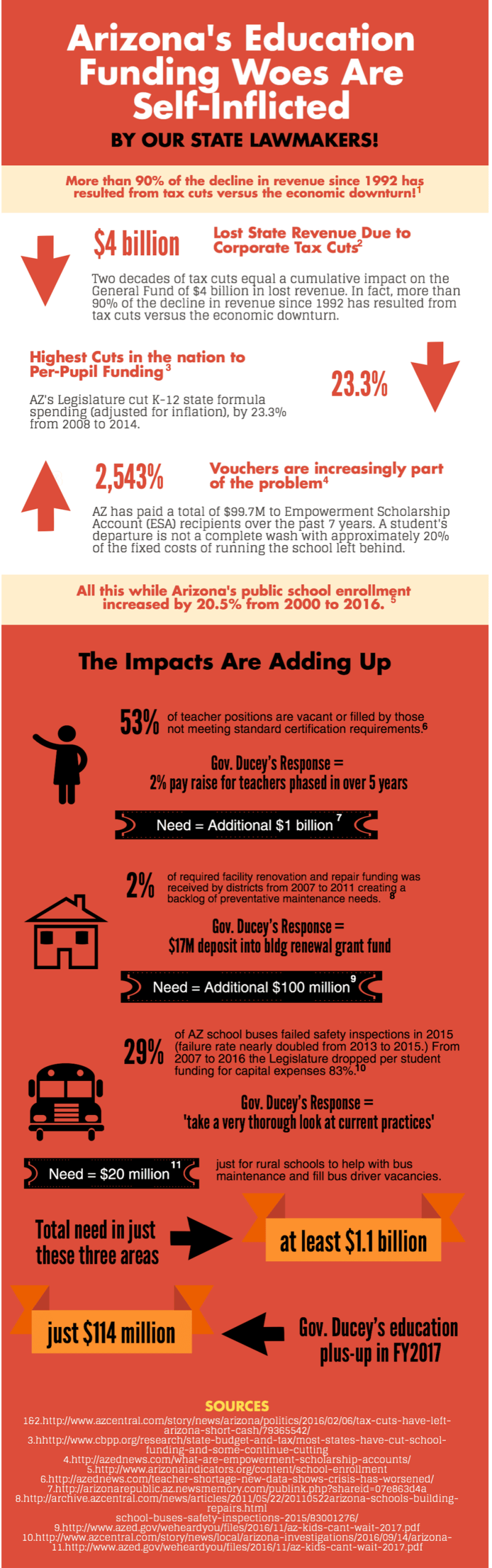
Arizonans are willing to pay more for education as well, as indicated by recent polling which shows 70% think we need to plus-up education spending and with 61% willing to pay higher taxes to do it. “Read my lips” Governor Ducey though, is determined not only to not raise taxes, but cut them every year he is in office while also continuing his steadfast committment to corporate welfare in the form of tax cuts. The $114 million he has proposed for the FY 2018 budget isn’t nothing (and it is new money as opposed to that which already belongs to education), but it also isn’t nearly enough. As David Safier points out in TucsonWeekly.com, it moves us all the way from 49th in per student spending to well…49th. And, this is just the Governor’s proposal, the Legislature is the entity actually charged with passing the budget. In addition, it isn’t just that our districts are currently underfunded, but that the funding continues to be siphoned away by commercial schools’ choice. The impacts of a “leaking bucket” with an insufficient stream of water to keep ahead of the losses are really starting to stack up. Money matters alright, maybe its just public education that doesn’t (at least to our Legislature.)