Is Accountability Really Too Much to Ask?

It is, after all OUR money…

You’ve no doubt seen the stories about parents using voucher money to purchase dune buggies and Oscar Mayer hot dog machines and looking for a curriculum to teach their children the “flat earth theory”. Any reasonable person would realize that Arizona’s voucher program must be made more accountable to safeguard taxpayer dollars and ensure students are taught what they need to know to be productive citizens. 

Reasonability is probably not a word ordinarily associated with the Goldwater Institute though, as is indicated by their recently filed lawsuit against the state of Arizona. As reported by The Arizona Republic, this lawsuit is about “a recent change to the school voucher program that requires parents to tie supplemental materials, including books, pencils and calculators, to a curriculum”. The Goldwater Institute claims “The change has added ‘bureaucratic hoops’ and ‘arbitrary paperwork’ that bog down the reimbursement process”.

The voucher reform was introduced this year after AZ Attorney General Kris Mayes’ office began investigating allegations that the AZ Department of Education had approved illegal expenses under the program. Again, from The Republic,

“State law required textbooks and supplemental materials to relate to a curriculum, according to the Attorney General’s Office, but the official program handbook did not require families to prove such a connection.”

The Goldwater Institute filed the lawsuit on behalf of two Moms, Veila Aguirre and Rosemary McAtee. Aguirre was quoted in a Goldwater Institute news release as saying, “No other teacher in the state has to provide curriculum for purchasing things for their classroom”.

That might be because state standards dictate what must be taught in public school classrooms and district governing boards approve curriculum and textbooks. Teachers also must submit requests for supplemental materials purchase to the district office and governing board members must approve the vouchers detailing all those purchases right down to yes, pencils and erasers.

And I find it really rich that McAtee said, “All of a sudden we have a government telling us, ‘Here’s one more thing for the list’. She misses the point that she is taking taxpayer dollars that the government gives her so maybe they (we) should have the right to ask for accountability for those dollars.

This has been an ongoing theme for voucher parents. At the September State Board of Education meeting, parents claimed the longer delays required by the new rules have led to “missed academic opportunities for their kids”. 

I suspect many of Arizona’s currently 75,000 students now on vouchers are experiencing many “missed academic opportunities”, but not because the state is trying to introduce more accountability into the program. Rather, it is because there are no standards for what should be taught, nor is there any accountability to prove those students learned. And oh by the way, if voucher parents don’t have the time or willingness to prove our money will be well spent, maybe we shouldn’t be giving them our money.

More Budget Cuts are Coming

and one way or another, we will all feel the pain

At our last school board meeting, the superintendent of our small rural district reported that five students left to be homeschooled with vouchers in the past year. It isn’t the first time students have left to attend a charter or private school, but it is the largest number to leave in one year. 

I’ve been closely watching the impact vouchers are having on our state budget and have worried about the lack of accountability and the quality of education these voucher students are receiving. This is the first time though, that it hit home. It isn’t surprising that our students wanting to take advantage of vouchers are going to be homeschooled. The closest private school is about 25 miles away. So, homeschooling or microschooling (a group version of it) is probably the predominant way parents will use vouchers in our neck of the woods.

Mind you, the voucher recipient numbers are still dwarfed by the over 90 % of students who attend public schools (including charters), but they are a fast-growing group and so is the cost of the program. It isn’t just about the actual dollars lost by the districts, however, but also the uncharted nature of it all.

Education Week reported this week that “the proliferation of private school choice programs has injected uncertainty and volatility into the already-chaotic school budgeting process”. According to Ashlee Gabrysch, an analyst who helps analyze school district financial health for credit rating firm Fitch Ratings, “Even the existence of these programs introduces a lot of uncertainty into the K-12 school budgeting or district budgeting process, both for revenue this year and/or revenues next year and beyond”.

It also is incredibly inefficient, because fewer students don’t inherently mean lower costs. Fixed costs (those that do not vary with enrollment levels and that the district has little control over) are typically expenses such as utilities, building operations and maintenance, transportation, and technology. Even instruction is largely a fixed cost since the number of teachers and para pros cannot be reduced because one or two students, (from several grades), leave the school. 

Additionally, because voucher amounts are based on 90% of charter school funding, they are worth more than a district would receive for a typical student. According to the Joint Legislature Budget Committee

  • For large school districts that receive state aid, the per-pupil cost for Grades 1 through 8 in public schools was $700 less than the cost of an ESA.
  • For public high schools, the per-pupil cost was $900 lower than an ESA.

And, the vast number of students who have been taking the vouchers weren’t even in district public schools. They were already being homeschooled or attending private schools at their parent’s expense. Now they attend that private school at taxpayer expense. In addition, a voucher doesn’t ensure equal access for all students since 1) private schools do the “choosing” not the other way around (unlike district schools who must accept all students as long as they have room) and 2) many private schools cost more than the voucher funds. That can be no surprise to anyone who understands how capitalism works.

The real truth is that vouchers are not saving Arizona taxpayers money, as the AZ Daily Star noted,

Most funding for public schools comes from taxpayers who do not have school-age children. When special interests claim that voucher users are “reclaiming their tax dollars,” they ignore the fact that the average household in Arizona is only paying about $3,000 into the state general fund per year via sales and income taxes; only $1,300 (43%) goes to public schools, while vouchers cost at least $7,000 per child.

And yet, as of February 2024, 11 states offered universal vouchers, 12 states had expanded their program, and seven had passed new voucher programs. But Arizona was the first and continues to lead in offering school choice. Unfortunately, Arizona is also the Wild West of school choice, and according to NEA Today, “has one of the least accountable voucher programs in the nation”. Unlike many other states, there is no cap on the amount of vouchers that may be granted and for the 2023-2024 school year, the cost was close to $1 billion. Arizona also doesn’t require any testing or reporting for students on vouchers, whether they are being homeschooled or enrolled in parochial or private schools. Neither does it require any sort of disclosure on how these private schools spend our tax dollars.

Some states are paying attention to the Arizona debacle. In 2023, the Texas State Teachers Association was successful in repeatedly defeating Governor Abbot’s universal proposal. The Idaho Education Association also defeated seven voucher bills in their state legislature and Illinois became the first state to end its voucher program. Just recently, the South Carolina Supreme Court ruled vouchers unconstitutional.

Unfortunately, the AZ GOP-led Legislature is unwilling to do anything to reign in its voucher debacle. State budgets must be balanced each year; they can’t run a deficit like the federal government. When unexpected costs (such as what the runaway voucher program is producing) far exceed what was budgeted, the cuts have to come from somewhere. This year, that meant cuts such as those to colleges and universities, delayed road work and highway construction, and the elimination of funding for water system upgrades. As reported by 12News.com, the final agreement also included, ‘eliminating $37 million annually to K-12 school poverty funding and $24 million annually to the “Promise” low-income college scholarship program.’

The unfunded mandate of universal vouchers is unconscionable and unsustainable and it isn’t just our public schools that are at risk but critical programs across our state. As the Arizona Education Association President, Marisol Garcia warned, “If other states want to follow Arizona, well – be prepared to cut everything that’s in the state budget – health care, housing, safe water, transportation. All of it.” 

The worst part is, that we have no way of knowing what kind of return on our investment we are getting on vouchers for education. We simply do not know whether students on vouchers are learning what they need to know to be productive members of our society. In what universe can that be a good thing?

Dealing with Crazy is Exhausting

and there’s plenty of crazy in Arizona’s voucher program

After watching the Presidential Debate last night, one of my takeaways was that “dealing with crazy is exhausting”. This also describes how I feel about Arizona’s runaway voucher program. It isn’t just the bottomless pit of spending that continues to drain our state coffers and forced cutbacks this year in funding for roads, water, community colleges, universities, and K-12 schools. Even worse, is the fallout from children unprepared for their future and indoctrinated with misinformation and propaganda.

I’ve already written about how voucher parents are using AI to create curriculum that justifies purchases such as Oscar Mayer hot dog machines. And, you’ve no doubt heard about the dune buggy debacle. You know, the one where the parent purchased dune buggies for her kids with voucher funds. The Department of Education initially denied the expense and then approved it. In appealing that decision reported The Arizona Republic, ‘the parent got an occupational therapist to testify that her kids learn better after a trek through the desert, allowing them “to engage in movement before returning to more traditional learning environments.”’ I guess riding a bicycle or going to a playground just wasn’t good enough for this parent. Fortunately, the state Board of Education eventually rejected the parent’s appeal and the state is now trying to claw back the funds originally approved. Of course, parents can still buy $900 Lego sets, kayaks, luxury car driving lessons, and expresso machines.

Now, we see on a Facebook group for Arizona voucher families, a parent asking “Anyone know of a flat earth curriculum”? Others in the group provided interesting responses as you can see below.

Yes, this is real. As the first contributor says, “some people believe in flat earth and some don’t. Ya’ll don’t want to try to discuss how gravity is only a theory. Let this mom teach her kids her way.” Seriously? Are these people stuck in the 3rd century BC? 

When did we become a nation that believes people are not only entitled to their own opinions but their own facts? Maybe about the same time we began to greatly expand Arizona’s voucher program without any guardrails to ensure our children would learn what they needed to be productive citizens.

I decided to try ChatGPT to see what kind of curriculum it would write to support the flat earth theory. It only took about 10 seconds for ChapGPT to write the below. Please note the second sentence that states, 

“The overwhelming scientific evidence supports a spherical Earth, and promoting the Flat Earth theory in an educational setting would be misleading and potentially harmful to students’ understanding of science”. 

Please also note the last paragraph that states “Students should receive accurate, evidenced-based education and develop critical thinking skills”. 

Unfortunately, there are no standards in place in Arizona to ensure students on vouchers receive accurate, evidence-based education”. As stated on SOSAZNetwork.org

Arkansas, Iowa, Indiana, and Florida all require voucher students to either sit for state testing or take a nationally norm-referenced assessment. Utah and West Virginia allow students to submit a portfolio showcasing their academic progress in lieu of an assessment, but crucially still require some form of proof of academic progress. In Arizona, there is zero requirement for voucher students to show they are meeting state standards or even learning at all.

Arizona’s lack of academic oversight is compounded by its failure to approve  voucher-funded private schools, unlike Iowa, Florida, Utah, and West Virginia, which require schools participating in their state voucher programs to register with the state and meet certain standards of accreditation. In Utah, private schools with a potential for financial troubles are explicitly prohibited from joining the program. 

No such vetting exists in Arizona. Any fly-by-night for-profit private school or microschool can open anywhere (even in unsafe garages, living rooms, or strip mall buildings) and accept ESA voucher student funding without any proof of accreditation or quality.” 

The unmitigated malfeasance exercised by Arizona’s GOP in not only supporting but steadfastly pushing forward this unaccountable voucher program is astonishing. From 2011 through 2021, they expanded the program to categories of students they thought they could justify. Then in 2022, they pushed through universal vouchers against the will of the people of Arizona who voted “NO” (by a 2 to 1 margin) to the program in 2018. All this without any real accountability to ensure our tax dollars were well spent and our children were well educated.

The only way to fix this problem is to elect different state legislators in November. The GOP has proven time and again that they have no intention of introducing common-sense accountability measures such as an annual cap on voucher expenditures or a requirement to provide information on student progress to include math and reading test scores, and promotion, graduation, and dropout rates. Why not? The only plausible reason is they don’t want us to know we are not getting our money’s worth with the voucher program…not even close.

This November, help curb the crazy and vote for pro-public education candidates. Learn who those candidates are at Vote 4 Public Ed.

Curb Gun Violence Against Children by Home Schooling

We are pathetic. Yes, all of us. We obviously don’t care enough about the carnage going on in our schools, our churches, our theaters, our grocery stores, our concerts, our workplaces, and myriad other places. If we cared enough, we would do something to curb gun violence.

I’ll be the first to admit that I started to feel hopeless, powerless, and numb after 20 first graders and six adults were slaughtered at Sandy Hook in 2012. After all, I thought, if this doesn’t change things, what will?

More than a decade and eight mass school shootings later, not much has changed. In all, as reported by the AZ Daily Starjust this morning, 175 students have been massacred in 15 school shootings since 1999. As grisly as that number is, you may have been surprised it wasn’t larger. But then, it doesn’t include all the other mass shootings, defined as where four or more people are killed. So far in 2023, we’ve seen 130 mass shootings in the United States…averaging more than one per day. And, these heinous acts don’t just kill people, they make the rest of us fearful, just as terrorism is designed to do.

Thankfully, we now have some data about the extent and causes of the carnage since President Obama blocked the two-decade effort by the gun lobby and GOP to prevent the CDC from conducting gun research. Facts like this one reported by NPR.org, help us understand the problem,

“Just over 100 people, on average, are killed by firearms in the U.S. every day. That includes crimes, suicides, gun accidents, and shootings involving law enforcement.” 

And according to the Kaiser Family Foundation, (also from CDC data),

“Firearms were the leading cause of death in children between ages 1 and 19″ in 2020.”

No other peer country except for Canada had firearms in their top 5 causes of death for this age group. Canada’s 48 deaths (versus our 4,357) made it their 5th highest cause of death. Our high number of deaths is not so surprising when you learn that in 2017, the U.S. had 4% of the world’s population, but owned 46% of the guns. WTF?

We have met the enemy…and he is us! You, me, all of us. Because you see, a healthy democracy doesn’t allow “checking out”. Martin Luther King, Jr. said, “Our lives begin to end the day we become silent about things that matter.” He understood that when we don’t engage in our democracy, we abdicate our rights to self-govern and fully live our lives the way we choose. Author Daniel Suarez put it this way, “Democracy requires active participation, and sooner or later someone ‘offers’ to take all the difficult decision-making away from you and your hectic life.”

The only problem is those “someones” we are counting on to make the difficult decisions, aren’t doing it. In this morning’s New York Times, Congressman Tim Burchett (R), Tennesse, was quoted saying about additional gun safety measures, “We’re not going to fix it…criminals are going to be criminals”. This was just hours after three children and three adults were killed at a school in his home state. He said he saw no “real role” for Congress in this matter and offered “his solution for protecting his family was to home-school his children”. In other words, the hell with all y’all, I’m taking care of mine. And, Tennessee’s governor basically touted a “murderers gonna murder” trope when he said, “we can’t control what they do”.

Burchett is not alone in his refusal to act. The New York Times reports that Senator John Cornyn (R), Texas has dismissed President Biden’s calls for banning assault weapons as a set of “tired talking points”. Senator Cynthia Lummis (R), Wyoming said “I don’t think there’s any appetite” when referring to her party’s unwillingness to take on gun control legislation.

Senate Chaplain Barry Black however, didn’t hold back in an unusually urgent plea for action. He prayed aloud to “deliver our senators from the paralysis of analysis that waits for the miraculous.” “When babies die at a church school” he said, “it is time for us to move beyond thoughts and prayers”. Not sure why it should matter that it was a church school, but have you noticed that GOP lawmakers are no longer offering their thoughts and prayers? That’s because they learned that, “that dog don’t hunt”. Instead with this latest shooting, they’ve decided they are just done with the whole thing, (as Congressman Burchett articulated) and are throwing the bullet (er…) ball, back in our court.

Well, as Abraham Lincoln said, “The ballot is stronger than the bullet” and that’s where “we the people” reclaim our power. That’s where we live the values we proclaim. That’s where we prove our individual and collective moral character by acting per our beliefs.

So, let’s not let the ball lie in our court. Let’s pick it up and commit to acting for change. How do we do that?
1. Vote in every election and help register and encourage others to vote
2. Join, donate, and volunteer for an organization such as Giffords.org or Everytown.org or BradyUnited.org, or myriad others.
3. Know which candidates support reducing gun violence and vote for them, volunteer for them, and donate to their campaigns.
4. If you can’t find someone you believe can affect the change needed, run for office yourself.
5. Hold your current lawmakers, at every level, accountable. Follow what they are doing and speak out when they don’t do the right thing. You can write letters to the editor; email, write, or call them; post about their actions on social media; or sometimes even make in-person or online “calls to the public”.

Except for running for office, the above actions are probably the bare minimum for one person to be able to affect any change. And of course, it will take many of us working together to really make a difference. Think Mothers Against Drunk Driving which “helped get over 1,000 new laws involving alcohol passed on both a local and national level, including laws regarding server liability, the setting up of sobriety checkpoints, and raising the minimum drinking age.”

With more than 393 million civilian-owned firearms in the U.S. in 2018 (one for every person with 67 million left over), change won’t happen overnight. But…could we at least start moving in the right direction? Even now, GOP lawmakers around the country continue to look for ways to make firearms even more accessible by arming teachers, allowing gun carry on campuses, limiting gun-free zones, removing background checks, and rolling back red-flag laws. The trend won’t reverse until these lawmakers are sent packing.

The Pew Research Center conducted a survey in 2021 that showed “nearly three-quarters of Americans think that gun violence is a big or moderately big problem.” What we don’t all agree on, is how to fix it. That, however, is what we pay our lawmakers to figure out. To…wait for it…compromise to find the best possible solution not just for themselves, not for just their constituents, but for the whole damn country. THAT, my friends, is how we make America great again. Let’s start (today) holding them, and ourselves, accountable to do just that.

The Indispensability of Community Public Schools

Merriam-Webster’s dictionary defines indispensable as “absolutely necessary” and “not subject to being set aside or neglected”. I can think of no better word to describe how important our public schools have been, and are, to our communities and country. Unfortunately, the GOP has made it clear they want to privatize and defund public schools. They are working very hard to “set aside and neglect” our community (real) public schools at the risk of great peril to our nation.

Yesterday, U.S. public education advocate #1, Diane Ravitch, published a blog post titled “Inclusion: the key to public school’s value” from Stephen Owens on his blog Common Grace, Common Schools. I hadn’t read anything from Owens before but found his writing both powerful and spot-on. Owens has a Ph.D. in education policy from the University of Georgia and is Director of Education at the Georgia Budget and Policy Institute. His truth-to-power straight talk aimed (at least in this post) at white people and Christians, is all the more powerful because he is himself, an evangelical Christian.

“Not only” writes Owens, “are parts of American public schooling unique, but reflect central tenets of the Christian faith.” Three of the tenets he cites are inclusion, equity, and accountability. I’ve written plenty about accountability before and in fact, believe the lack of accountability is the number one problem (or at least in the top three) facing our society today.

As for inclusion and equity, our community public schools promise to educate all, and helped make our nation the powerhouse it is. “Meanwhile”, writes Anya Kamenetz in the New York Times, “a well-funded, decades-old movement that wants to do away with public school as we know it is in ascendance.” Kamenetz is a longtime education reporter and author of “The Stolen Year: How Covid Changed Children’s Lives, and Where We Go Now”. She maintains the extended school closures during the COVID pandemic “effectively broke the social compact of universal, compulsory schooling. Sad but true, parents with means did what could ensure their kids continued to learn and the rest made do with what they had. Increasingly now, students are being home-schooled, attending private schools, or are otherwise absent from their community schools. Teacher shortages are at a crisis level, with many who are still teaching experiencing intense burnout.

Pro-choice advocates are no doubt, rejoicing at this manna dropped from heaven (or maybe pushed up from hell). Undermining our community public schools and the dedicated educators that toil in them has never been easier. Their gains, however, tear at the fabric of our communities, especially in rural locations where the school maybe not only the major employer but also the hub of the community. This is largely true because community schools, regardless of parents’ ability to pay, ensure students are educated, transported to and from school, fed, given medical attention as needed, and provided specialized help when their circumstances warrant. And, let’s be honest, they are often the source of free child care for families.

As much as we’d like to believe our society is a true meritocracy writes Owens, the “brutal truth of schooling in the U.S. is that parental income is strongly predictive of educational outcomes. The real difference in who makes it or not, he says, “is whether your parents have enough money to provide 1) security (food and housing), 2) accountability, 3) targeted support and 4) social capital.” Of course, the GOP continues to push the notion that all the supposed “disadvantaged” need to do is “pull themselves up by their bootstraps”, totally ignoring the fact that this isn’t even physically possible, even if it were true.

As for what is painfully true, many in the GOP want to go back to the “Leave it to Beaver” days. You know, when the neighborhood was all white and comfortably middle class. When Dad went off to work and Mom stayed home and cleaned the house and cooked in her dress, high heels, and pearls. Concern for the common good evidently was much easier in a homogenous society with similar values and understandings. Remember when we used to all watch Walter Cronkite at 5pm to learn about “the way that it was” for each day? That shared understanding of the news, fairly void of opining, provided us common ground upon which to stand.

Likewise, our community schools brought us together to increase our understanding of each other as we became (hopefully) productive members of society. “Without public education delivered as a public good,” writes Kamenetz, “the asylum seeker in detention, the teenager in jail, not to mention millions of children growing up in poverty, will have no realistic way to get the instruction they need to participate in democracy or support themselves”.

Of course, it isn’t just the disadvantaged that suffer, but all of us as evidenced by our extremely high level of polarization. There can be no doubt as to social media’s influence on our polarization, particularly those attacks from our enemies on the global stage (China and Russia for example). But, it is the efforts to rob our community schools of critical funding, dedicated teachers, and the ability to teach the truth, that are most insidious. As Kamenezt points out, “students of privilege will stay confined in their bubbles. Americans will lose the most powerful social innovation that helps us construct a common reality and try, imperfectly, to understand one another.” “In the eyes of conservative activists,” she says, “public education is the enemy of the people, alongside the deep state and the mainstream media, and they are working hard to make the American people believe it too.”

And their tactics are working on a swath of America. According to Phi Delta Kappan (a professional organization for educators) poll from 2020, 53% of Americans support using public tax dollars to pay for private school tuition (48% for religious schools). This should not be entirely surprising as the GOP has worked this very hard for at least 40 years when President Reagan promised to eliminate the U.S. Department of Education and Grover Nordquist advocated drowning the government in the bathtub.

As part of their Machiavellian scheme, the GOP has managed to market private school choice options as the ones that offer parents the most control. The truth is the exact opposite (what a shock). Public schools are the only school choice option that offers parents total accountability and transparency. Other school choice options offer virtually none of either.

I once thought GOP stood for “Grand Old Party”, but now I think maybe it is “Gaslighters or Prevaricators”. Ain’t tryin’ to be hatin’ on those on the Right. I understand they are not a monolithic group. Would just really like to see the party stand for something again instead of just spouting negative ideology. We need a strong two-party system to find good solutions to the many problems our country faces. And, we need to set a good example for our children so they can lead into the future they will inherit. One where the common good is again good and common and…it really matters to all of us.

T and A: #1 Benefit of Public Schools

I’ve no doubt raised a few eyebrows with the title of this post. Get your mind out of the gutter people, I’m talking about transparency and accountability!

Let me be clear…I believe America’s public schools are what made our country great. They ensured all children had the opportunity to learn and they coalesced our communities and all the different types of people within them. But, in terms of today’s school choice landscape, the number one benefit offered by public district schools over all other choices, is transparency and accountability.

Of course, in this alternate universe the GOP has created, up is down, left is right, black is white, and private school choice options (private, religious, and home schools) are the more transparent and accountable schools for parents and taxpayers. Nothing could be further from the truth. District schools, with publicly elected school board members and the requirement to follow Open Meeting Law (at least in Arizona), are by far the most transparent and accountable. Yes, our charter schools are also public schools, but they don’t have publicly elected boards. Rather, charter school board members may not even live in the same state, let alone in the same town. But as public schools, both district and charter schools have myriad transparency requirements private school choice options don’t. These include the need to follow Open Meeting Law, ensuring the public’s right to witness the discussion, deliberation, and decision-making done in its name. They also must: accept all students; comply with stringent requirements for reporting, procurement, and auditing; and allow parents the right to review all instructional material and intercede in their child’s education where they believe it is necessary. There are many more differences in transparency and accountability, but you get the idea.

And yet, those advocating for school privatization have managed to convince many parents (especially in today’s highly partisan environment), that public schools (especially district schools) are trying to indoctrinate their children with values and ideology that are different than their own.

What it is really about though, as pointed out by fellow education blogger Jan Resseger in her recent post, is money and power. After all, the total bill for K-12 education in the U.S. in 2018-2019 school year was already $800B. In Arizona this year, K-12 education constitutes almost 44% of the state budget. Privatizing public education is a lucrative triple-play for the rich and powerful and those lawmakers they keep in office. Privatization allows the reduction of the need for taxation, it offers the opportunity for corporations to profit directly from the education industry, and it reduces the voice of the people making it easier to ignore their will. As Resseger points out, Gordon Lafer, in “The One-Percent Solution”, said,

(F)or those interested in lowering citizens’ expectations of what we have a right to demand from government, there is no more central fight than around public education. In all these ways, then, school reform presents something like the perfect crystallization of the corporate legislative agenda.”

The brilliancy of packaging school privatization was convincing parents that their “right to choose”, was what was important. Resseger also quoted Benjamin Barber, in his book “Consumed”, who deftly makes the point that this ability to choose, however, is not the real power.

We are seduced into thinking that the right to choose from a menu is the essence of liberty, but with respect to relevant outcomes the real power, and hence the real freedom, is in the determination of what is on the menu. The powerful are those who set the agenda, not those who choose from the alternatives it offers. We select menu items privately, but we can assure meaningful menu choices only through public decision-making.

In other words, you are either at the table, or on the menu. In fact, I previously wrote a post with this same title back in 2014. With public schools, parents, voters and taxpayers are at the table (if they exercise their rights the way they should). Unfortunately, it takes work to exercise our rights and hold our elected officials accountable. But then, that’s what is meant by “of the people, by the people, and for the people”. “We the people”, must do our part if we want our government and its institutions to reflect our values. At least in public schools, we have that opportunity.

“Deeply Embarrassed and Frustrated”

My last blog post was an evisceration of the Pinal County Board of Directors for their September 2021 refusal to accept almost $3.4M in Federal funding to hire a vaccine equity employee and distribute COVID-19 vaccines to underserved communities. Two months later, they reversed their decision with an amendment that, “the public health department or designees shall not assist the U.S. government in the implementation or enforcement of federal orders related to quarantine and isolation”. I don’t why they reversed their decision, but I suspect public outcry was a factor.

Nine months later, Pinal County is big news again. Unless you’ve been hiding under a rock on Mt. Lemmon, you probably heard about the election fiascos in Pinal County (home to over 425,000 residents). According to the AZ Daily Star, hundreds of voters said they were “unable to immediately vote at the polls because the county had run out of some ballots”. One polling location also opened hours late because the keys to its doors were not available.

Polling locations tried to print new ballots to meet the surge in demand, but old printers were limited and delivery of ballots to the sites was slow. These problems were on top of about 63,000 incorrect mail ballots sent out in July, (missing city races), forcing the county to send out supplemental ballots.

Officials believe the contributing factors to the shortage of ballots were the unanticipated Independent voters who came in-person to polling stations and requested Republican ballots. Another, was the 10% increase in the county’s population since the last election. Other factors surely came into play however, such as Elections Director David Frisk being the third director in the position in only two years and initially having a staff of only one in a department that should have had five full-time employees. Officials said the mistake was caused by a staff member’s programming error that pre-election checks by inexperienced staff didn’t catch. Whatever the cause, there can be no doubt as AZCentral.com stated, that, “Pinal became the poster child for Election Day problems in Arizona, as only a smattering of problems were reported throughout the state”.

In the end, it is impossible to know how many people were unable to vote, although “about 25% of the county’s 95 precincts reported running out of ballots or running low and needing help”. These snafus, of course, did nothing to restore people’s confidence in our voting system. And that, and it’s impact on our democracy is the real danger.

The one silver lining is that the Pinal County Board of Supervisors, recognized the seriousness of the problem and did not try to downplay it or shift blame. At a news conference the day after the election, Chairman Jeff McClure blamed the problems on “human error”, and called it “a major screw-up”. In a statement provided later, he said the Board of Supervisors was “deeply embarrassed and frustrated” by the mistakes made and was taking immediate action to fix the problems prior to the general election. The Board of Supervisors then replaced the county Elections Director, David Frisk, appointing Recorder Virginia Ross to that position. Chairman McClure also said that, “elections experts are being sought to review election procedures and operations” and went on to say that, “I have not seen any evidence of a nefarious act. I have seen mistakes made on a grand scale.” In other words I suppose, there was no fraud.

I am a firm believer that many of the problems our country and yes, even the world, is experiencing today, have to do with the lack of accountability. The Board of Supervisors did not obfuscate and I remain hopeful (for now) they will fix the problems. I believe Virginia Ross is right person to build back the department, but she will need Board support to ensure the department is sufficiently funded, staffed, and trained. Will that all come to pass? We’ll certainly find out in November. For our democracy’s (or republic if you must) sake, let’s hope so.

Lack of Accountability is Road to Ruin

Political partisanship and the outsized influence of money have made effective governance at all levels, difficult to achieve. Lack of accountability is another significant contributor to the dysfunction and is greatly speeding us down the road to ruin.

Accountability is defined as “the fact or condition of being accountable” and “the quality or state of being accountable especially: an obligation or willingness to accept responsibility or to account for one’s actions”. We tend to think of accountability in terms of institutions, but it is just as important to think about it on an individual basis.

There have always been people who pushed the limits of the law and then gotten away with it, but over the past five years, I’ve seen a serious uptick in disregard for rule and law abidance from individuals led no doubt, by examples set by our leaders.

We were all shocked by so many things Trump said and did during his initial campaign for president and then even after he was elected. From calling Mexicans “murderers and rapists” to bragging about “grabbing women by the pussy”, to self-dealing for financial gain while President, Trump flagrantly disregarded convention and got away with it. This type of behavior from our leaders, particularly THE leader of our nation, only encourages others to do the same saying, “well, if the President can do it…”

Think about it. When’s the last time you drove somewhere traveling “safely” four or so miles above the speed limit while everyone around you was passing you like you were standing still? And, after being passed by numerous cars going way over the speed limit, don’t you start to feel like a schmuck for being the only one obeying the law? That’s what happens, lawlessness begets lawlessness. With each guardrail crashed through, we tumble further down the mountain. What’s to keep us from ending up in a flaming pile at the bottom?

This pile could easily have been the result of the January 6th insurrection if not for police, military, and lawmakers who acted bravely that day. Years of stoking resentments and perpetuating lies culminated in treasonous attacks on our democracy and although hundreds have been arrested for their unlawful actions, the lead insurrectionist, Donald Trump, has yet to be held accountable. Not only has he not been held accountable, he still vociferously maintains the election was stolen and that those who marched on the Capitol were heroes and martyrs.

So, the President gets away with murder (figuratively and some would say literally, e.g. COVID), and the rest of us feel empowered to misbehave with impunity. In fact, not only are people empowered to break the law or bend the rules, they often feel it is their God-given right to do so. At the same time, they don’t want to be held accountable for their actions. Take anti-vaxxers for example. They say it is their right to choose whether or not to be vaccinated, after all, it is their body. But…what happens when they contract COVID and wind up in the hospital? Insured or not, there is a cost to society for their care.

Maybe we ought to treat the unvaccinated (by choice), the way the military treats members injured on motorcycles while not wearing a helmet. Although medical treatment is normally free for military members, if found in violation of the mandatory helmet requirement, the military can deny coverage of the cost of medical treatment. Sound harsh? Maybe, but the potential impact on individuals, units, and mission accomplishment requires severe accountability.

But unlike choosing not to wear a helmet while riding a motorcycle, choosing not to be vaccinated for COVID doesn’t just put yourself at risk of injury or death. Yes, 99.2% of U.S. COVID deaths in June were unvaccinated people. But, not everyone who is unvaccinated has chosen not to get the vaccine. Some can’t get vaccinated because they have medical conditions. And with an efficacy rate of only 95%, a small percentage of previously vaccinated people are contracting the virus. The good news is that these vaccinated people are much less likely to die from it. We continue to learn though, about the potential long-haul effects of those who contract COVID, even if they are asymptomatic. That means others could be held accountable for a person’s choice to deny vaccination. That is not okay and reminds me of the Abraham Lincoln quote, “my right to swing my fist ends where your nose begins”. In other words, your right to proceed unimpeded must be tempered by the potentially negative impact of your actions on others.

If we are to live in a civil society, we must agree on rules of behavior and standards of conduct that keep us safe and peaceful. Rules such as as those that ensure our children are protected when in school, those that keep us safe on our roads, and yes, those that prevent the spread of disease and viruses.

It continues to amaze me how much our “greatest generation” sacrificed for the common good and how now, so many of their grandchildren refuse to make even the simplest sacrifice such as wearing a mask. Not only do they refuse to do it, but they’ve somehow managed to brand mask-wearing as un-patriotic and un-masculine.

I have no idea where all this ends, but because those refusing vaccination are the same ones refusing to be accountable to others by wearing a mask, I am certain it is a long way from over. The only thing different this time around is that it is almost entirely those who are not vaccinated who are dying from COVID. That of course is the ultimate accountability.

corruption and greed

Greed Fueling Arizona’s 48th Ranking for Anti-Corruption

We currently have many crises in America, but one that affects our ability to deal with them all, is the crisis of confidence in our public institutions. Some might argue this lack of confidence is fueled by those seeking power and profit via privatization of said institutions. Whether manufactured or organically grown, the lack of accountability and transparency among public officials is no doubt contributing to the crisis.

In 2015, PublicIntegrity.org ranked the Arizona Legislature 22nd in the nation for state government accountability and transparency. And although the scores are not directly relatable, a 2018 report by the anti-corruption Coalition for Integrity, ranking Arizona 48th in the nation, leads me to believe we are not headed in the right direction. The Coalition’s scorecard is called the “States With Anti-Corruption Measures for Public officials” or “S.W.A.M.P. Index”. It “analyzes the laws of the 50 States and District of Columbia regarding the establishment and scope of ethics agencies, the powers of those agencies, acceptance and disclosure of gifts by public officials, transparency of funding independent expenditures and client disclosure by legislators.” This is important said the Coalition’s CEO Shruti Shah, because

“There is a strong link between an ethics regime and trust in government—and state laws are the first line of defense against corruption.”

Unfortunately, Arizona state laws are lax when it comes to school choice, once again earning the state a #1 ranking for a favorable privatization environment by the conservative bill mill American Legislative Exchange Council (ALEC). According to its website, the Report Card on American Education is

“part of its mission to promote limited government, free markets and federalism.”

Note that accountability, transparency and ethical governance, are not mentioned. ALEC exists after all, to support legislation favorable to the corporations that finance their work and influence. Instead, the ALEC report card discusses private school choice, purchasing power, flexibility, and freedom. Hey, I like freedom as much as the next gal and served 22 years in the military to help preserve it. But as the saying goes, “freedom isn’t free” and it isn’t maintained by just the ultimate price that some have paid, but other “costs” such as rules, laws, responsibilities and accountability without which, we would have anarchy.

The “A” in Arizona doesn’t yet stand for anarchy, but there are those lawmakers who evidently don’t see a problem working around a few ethical conflicts of interest to benefit themselves at our expense. At least the Arizona Constitution prohibits lawmakers from employment by state, county or city governments, with the exception of serving as school board members, teachers or instructors in the public school system. Where lawmakers act ethically, this exception can help ensure we have those with educational experience helping shape educational policy. Where that is not the case however, unethical actors interested in self-enrichment, can take advantage of a system that doesn’t hold them accountable.

Take for example, Senator Yarborough who termed out in 2018. For many years now, he has run a highly profitable Student Tuition Organization (STO), while sponsoring the majority of legislation expanding the diversion of state income tax liability to STOs. Likewise, According to the AZ Republic, Representative Eddie Farnsworth (now President Pro Tempore of the Senate) profited greatly on the sell of his charter school business (the one built with taxpayer funds) to a nonprofit company after voting for legislation favorable to the non-profit’s board members. In addition to the $13.2M from the sale, he will earn $478K on a loan he made to the school, another $80K in rent on his building that serves as the school’s corporate headquarters, and a consulting fee. And of course, there are numerous GOP lawmakers who have pushed the expansion of vouchers session after session, without sufficient accountability, despite numerous instances of fraudulent expenditures by parents. At the very least, many of them benefited from campaign contributions for their trouble, from Betsy DeVos’ American Federation for Children and other pro-privatization forces.

And now, the Arizona Republic recently reports that Arizona Speaker of the House, Rusty Bowers,

“was paid more than twice the going rate ($216.62 per day versus $90) for substitute teachers in the East Valley Institute of Technology (EVIT)”.

Interestingly, Bowers was EVIT’s director of external affairs (basically a lobbyist) from July 2011 to June 2015 and was paid $62K to $64K per year for this part-time work (double what a legislator makes incidentally.) In conducting an investigation of allegations related to operational and legal compliance concerning the East Valley Institute of Technology“ lawyer Susan Segal found that,

”Bowers had no class roster and didn’t have proper certification to teach his JTED classes.“ She also found that Bowers took it upon himself to scratch out the part of his contract that required certification, and wrote in ”permanent certification of substitute teacher.“

But, as reported by the Capitol Times, the district governing board never approved that change, and Segal noted that, ”there is no such thing as a permanent substitute certification. In another instance, on top of this sentence in his contract:

“If the Legislature fails to fund fully or partially, for any reason, the amounts appropriated for the salary and benefits categories of the District budget, the Board shall reduce pro-rata the total amount of compensation due under this Contract”;

he wrote (exhibiting great hubris in my opinion):

“who gets to decide whether or not the legislature appropriates enough?”

Maybe he thinks it is the AZ Speaker of the House?

Of course, that’s mere conjecture on my part. What is not, is the fact that Bowers has failed to allow even a modicum of increased legislator accountability to move forward this legislative session. Remember former Representative Paul Mosely driving close to 100 mph in a 55 zone, (his seventh time being pulled over for excessive speeding) and then bragging about his immunity to the police officer? The incident prompted Governor Ducey to call for repeal of legislative immunity and Representative T.J. Shope to sponsor HCR 2008 to do just that. Unfortunately Speaker Bowers did not assign it to be heard in any committee, so it is basically DOA at this point. Maybe he figures passing the bill would be a slippery slope toward more ethical governance?

As long as the foxes are in charge of the hen-house at the state Legislature and we don’t hold them accountable for the carnage they wreak, the unethical behavior will continue. After all, I can’t tell you the number of times I’ve had people ask me how in the hell did Senator Yarborough continue to get away with creating and voting for legislation that personally profited him? My answer is that there was no consequence for his actions. After all, he wasn’t violating any laws or existing ethics standards, and he continued to get reelected. From his perspective, why should he do anything differently?

There is a reason greed is one of the seven deadly sins within Christian teachings. Mahatma Gandhi said,

“Earth provides enough to satisfy every man’s needs, but not every man’s greed.”

We should be able to count on our government to ensure a fair shake for all of us. But, when those governing write and enforce the rules to give themselves a leg up, we need to do our job and give them the boot out. The voters of LD5 did the right thing in voting Mosely out of office in 2018. We need to all do the right thing by demanding ethics standards for our elected representatives at every level and then holding them accountable for not only illegal, but also unethical behavior. Government can work, but it takes ALL of us doing our part.

Vouchers: Some Common Sense Questions

Unless you’ve been living under a rock for the last few years, you know corporate reformers are anxious to implement vouchers as a way to expand school choice. The secret sauce they say, is that the dollars follow the student because parents know best about what is best for their child’s education.

Just for a few moments though, I’d like to ask you to please forget whether or not you believe school choice and vouchers are the answer to “Make American Education Great Again.” Forget all the hype and promises, just ask yourself which of these scenarios makes more sense?

  1. Which is more accountable and transparent to parents, the taxpayers and voters and therefore less likely to experience less fraud, waste and abuse? #1 Hint to the answer. #2 Hint to the answer. #3 Hint to the answer.
    a. District schools that must report every purchase, competitively bid out purchases over a certain amount, have all purchases scrutinized by a locally elected governing board, undergo an extensive state-run audit each year, and are publicly reported on for performance efficiency and student achievement by the AZ Auditor General’s office each year?
    b. A voucher system which puts the onus on recipient parents to submit proof of expenditures to an understaffed AZ Department of Education office responsible for monitoring the $37 million ($99.7 million since 2011) in voucher expenditures for 4,102 different students?
  2. Which is more likely to be held accountable for student achievement and thereby taxpayer return on investment? Hint to the answer.
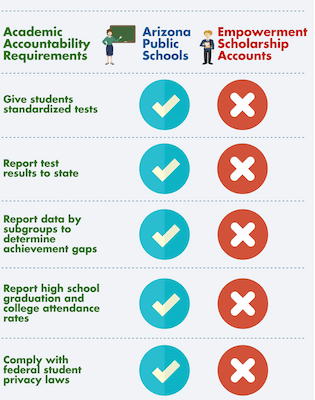
    a. A district school where students are given a standardized state test with scores rolled up to the state and made public, where data is reported (following federal guidelines for data protection) by subgroups to determine achievement gaps, and where high school graduation and college attendance rates are reported?
    b. A private school that does not provide any public visibility to test results and where the state (per law) has no authority to request or require academic progress from voucher recipients or the school?
  3. Which is more likely regarding the portability (with no impact) of per student funding when students leave their district schools?
    a. When a student leaves a district school with their education funding in their backpack, they take all associated expenses with them?
    b. That there are fixed costs left behind (approx. 19%) that the school is required to still fund such as teachers and other staff that cannot be eliminated just because a couple of students left a classroom, or a bus route that can’t be done away with just because one student is no longer taking that bus, or a building air conditioner that can’t be turned off because the occupancy in the classrooms is down by three students. That what the “drain” causes instead, is larger class sizes, less support services, less variety in the curricula, etc.?
  4. Which is more likely to serve disadvantaged students — the ones most in need of our help? Hint to the answer.
    a. A district school, where the vast majority of educational expenses are covered by the taxpayer, where students are transported from their home to school, where free and reduced lunches are provided and which must accept all comers?
    b. A $5,200 voucher to a private or parochial school which has total control over which students they accept, does not provide transportation and according to PrivateSchoolReview.com costs an average of $6,000 for elementary schools and $18,000 for high schools in 2016-17?

I hope you came to the same conclusions I did some time ago, that when it comes to transparency, accountability and equity, district schools outperform private schools. I’d also like to make the unequivocal claim that district schools also (across the board) produce more achievement than private schools, but as you can see, they don’t report their results so I don’t know that for sure.

And yet, the Arizona Legislature continues to push expansion of vouchers in our state. A push for full expansion last year by Debbie Lesko (Peoria-R) was killed, largely due to its potentially negative impact on the passage of Proposition 123, but she has revived the effort this year in the form of SB 1431. This bill, which would fully expand vouchers to ALL 1.1 million Arizona students by the 2020-2021 school year has been assigned to the Senate Education and Rules Committees and is scheduled to be heard by the Senate Ed Cmte on 2/9/17. Senator Steve Smith (Maricopa-R) has sponsored an associated bill, SB 1281, that requires the AZ DOE to contract with an outside firm (I’m sure that’s much better…just like private prisons) to help administer the ESA program, and makes various changes to the program. The bill stipulates that AZ DOE may request (not MUST request) confirmation toward graduation from high school or completion of a GED. This is obviously an attempt to defuse the argument there is insufficient accountability in the AZ voucher programAZEDNEWS also reports that Lesko supports adding a requirement to her bill to track achievement of ESA students, but that requirement would be only to report test results to parents, not the AZ DOE.

No matter how much sugar the commercializers try to coat vouchers with, they are still just a vehicle for siphoning tax dollars away from our district community schools to private and parochial (religious) schools with no accountability or transparency. For every person who says “parents have the right to use their child’s education tax dollars as they see fit”, I say, “and taxpayers have the right to know the return on investment for their tax dollars.” The former right in no way “trumps” the latter.

We must stop this terrible legislation. If you are signed up for the Legislature’s Request to Speak system, please click here to log in today and leave a comment for the Senate Education Committee about why you oppose SB 1431 and SB 1281. If you aren’t signed up, please leave me a comment to this post and I will get you signed up and ensure you are trained to use it. The system allows you to comment on pending legislation from your home computer or mobile device, you don’t have to go to the Legislature and speak in person unless you want to.

If you don’t want to use RTS, please call or email the members of the Senate Education Committee (listed below) and your district legislators (click here to find out who they are) to let them know how you feel. There is strength in numbers and the people do have the power, we just have to exercise it!

Senate Education Committee Members

Sylvia Allen, Chairman – 602.926.5409

David Bradley – 602.926.5262

Kate Brophy McGee – 602.926.4486

Catherine Miranda – 602.926.4893

Steve Montenegro, Vice-Chairman – 602.926.5955

Steve Smith – 602.926.5685

Kimberly Yee – 602.926.3024