Is Accountability Really Too Much to Ask?

It is, after all OUR money…

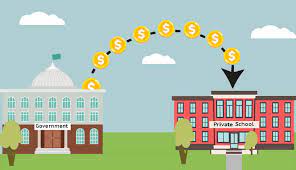
You’ve no doubt seen the stories about parents using voucher money to purchase dune buggies and Oscar Mayer hot dog machines and looking for a curriculum to teach their children the “flat earth theory”. Any reasonable person would realize that Arizona’s voucher program must be made more accountable to safeguard taxpayer dollars and ensure students are taught what they need to know to be productive citizens. 

Reasonability is probably not a word ordinarily associated with the Goldwater Institute though, as is indicated by their recently filed lawsuit against the state of Arizona. As reported by The Arizona Republic, this lawsuit is about “a recent change to the school voucher program that requires parents to tie supplemental materials, including books, pencils and calculators, to a curriculum”. The Goldwater Institute claims “The change has added ‘bureaucratic hoops’ and ‘arbitrary paperwork’ that bog down the reimbursement process”.

The voucher reform was introduced this year after AZ Attorney General Kris Mayes’ office began investigating allegations that the AZ Department of Education had approved illegal expenses under the program. Again, from The Republic,

“State law required textbooks and supplemental materials to relate to a curriculum, according to the Attorney General’s Office, but the official program handbook did not require families to prove such a connection.”

The Goldwater Institute filed the lawsuit on behalf of two Moms, Veila Aguirre and Rosemary McAtee. Aguirre was quoted in a Goldwater Institute news release as saying, “No other teacher in the state has to provide curriculum for purchasing things for their classroom”.

That might be because state standards dictate what must be taught in public school classrooms and district governing boards approve curriculum and textbooks. Teachers also must submit requests for supplemental materials purchase to the district office and governing board members must approve the vouchers detailing all those purchases right down to yes, pencils and erasers.

And I find it really rich that McAtee said, “All of a sudden we have a government telling us, ‘Here’s one more thing for the list’. She misses the point that she is taking taxpayer dollars that the government gives her so maybe they (we) should have the right to ask for accountability for those dollars.

This has been an ongoing theme for voucher parents. At the September State Board of Education meeting, parents claimed the longer delays required by the new rules have led to “missed academic opportunities for their kids”. 

I suspect many of Arizona’s currently 75,000 students now on vouchers are experiencing many “missed academic opportunities”, but not because the state is trying to introduce more accountability into the program. Rather, it is because there are no standards for what should be taught, nor is there any accountability to prove those students learned. And oh by the way, if voucher parents don’t have the time or willingness to prove our money will be well spent, maybe we shouldn’t be giving them our money.

More Budget Cuts are Coming

and one way or another, we will all feel the pain

At our last school board meeting, the superintendent of our small rural district reported that five students left to be homeschooled with vouchers in the past year. It isn’t the first time students have left to attend a charter or private school, but it is the largest number to leave in one year. 

I’ve been closely watching the impact vouchers are having on our state budget and have worried about the lack of accountability and the quality of education these voucher students are receiving. This is the first time though, that it hit home. It isn’t surprising that our students wanting to take advantage of vouchers are going to be homeschooled. The closest private school is about 25 miles away. So, homeschooling or microschooling (a group version of it) is probably the predominant way parents will use vouchers in our neck of the woods.

Mind you, the voucher recipient numbers are still dwarfed by the over 90 % of students who attend public schools (including charters), but they are a fast-growing group and so is the cost of the program. It isn’t just about the actual dollars lost by the districts, however, but also the uncharted nature of it all.

Education Week reported this week that “the proliferation of private school choice programs has injected uncertainty and volatility into the already-chaotic school budgeting process”. According to Ashlee Gabrysch, an analyst who helps analyze school district financial health for credit rating firm Fitch Ratings, “Even the existence of these programs introduces a lot of uncertainty into the K-12 school budgeting or district budgeting process, both for revenue this year and/or revenues next year and beyond”.

It also is incredibly inefficient, because fewer students don’t inherently mean lower costs. Fixed costs (those that do not vary with enrollment levels and that the district has little control over) are typically expenses such as utilities, building operations and maintenance, transportation, and technology. Even instruction is largely a fixed cost since the number of teachers and para pros cannot be reduced because one or two students, (from several grades), leave the school. 

Additionally, because voucher amounts are based on 90% of charter school funding, they are worth more than a district would receive for a typical student. According to the Joint Legislature Budget Committee

  • For large school districts that receive state aid, the per-pupil cost for Grades 1 through 8 in public schools was $700 less than the cost of an ESA.
  • For public high schools, the per-pupil cost was $900 lower than an ESA.

And, the vast number of students who have been taking the vouchers weren’t even in district public schools. They were already being homeschooled or attending private schools at their parent’s expense. Now they attend that private school at taxpayer expense. In addition, a voucher doesn’t ensure equal access for all students since 1) private schools do the “choosing” not the other way around (unlike district schools who must accept all students as long as they have room) and 2) many private schools cost more than the voucher funds. That can be no surprise to anyone who understands how capitalism works.

The real truth is that vouchers are not saving Arizona taxpayers money, as the AZ Daily Star noted,

Most funding for public schools comes from taxpayers who do not have school-age children. When special interests claim that voucher users are “reclaiming their tax dollars,” they ignore the fact that the average household in Arizona is only paying about $3,000 into the state general fund per year via sales and income taxes; only $1,300 (43%) goes to public schools, while vouchers cost at least $7,000 per child.

And yet, as of February 2024, 11 states offered universal vouchers, 12 states had expanded their program, and seven had passed new voucher programs. But Arizona was the first and continues to lead in offering school choice. Unfortunately, Arizona is also the Wild West of school choice, and according to NEA Today, “has one of the least accountable voucher programs in the nation”. Unlike many other states, there is no cap on the amount of vouchers that may be granted and for the 2023-2024 school year, the cost was close to $1 billion. Arizona also doesn’t require any testing or reporting for students on vouchers, whether they are being homeschooled or enrolled in parochial or private schools. Neither does it require any sort of disclosure on how these private schools spend our tax dollars.

Some states are paying attention to the Arizona debacle. In 2023, the Texas State Teachers Association was successful in repeatedly defeating Governor Abbot’s universal proposal. The Idaho Education Association also defeated seven voucher bills in their state legislature and Illinois became the first state to end its voucher program. Just recently, the South Carolina Supreme Court ruled vouchers unconstitutional.

Unfortunately, the AZ GOP-led Legislature is unwilling to do anything to reign in its voucher debacle. State budgets must be balanced each year; they can’t run a deficit like the federal government. When unexpected costs (such as what the runaway voucher program is producing) far exceed what was budgeted, the cuts have to come from somewhere. This year, that meant cuts such as those to colleges and universities, delayed road work and highway construction, and the elimination of funding for water system upgrades. As reported by 12News.com, the final agreement also included, ‘eliminating $37 million annually to K-12 school poverty funding and $24 million annually to the “Promise” low-income college scholarship program.’

The unfunded mandate of universal vouchers is unconscionable and unsustainable and it isn’t just our public schools that are at risk but critical programs across our state. As the Arizona Education Association President, Marisol Garcia warned, “If other states want to follow Arizona, well – be prepared to cut everything that’s in the state budget – health care, housing, safe water, transportation. All of it.” 

The worst part is, that we have no way of knowing what kind of return on our investment we are getting on vouchers for education. We simply do not know whether students on vouchers are learning what they need to know to be productive members of our society. In what universe can that be a good thing?

Dealing with Crazy is Exhausting

and there’s plenty of crazy in Arizona’s voucher program

After watching the Presidential Debate last night, one of my takeaways was that “dealing with crazy is exhausting”. This also describes how I feel about Arizona’s runaway voucher program. It isn’t just the bottomless pit of spending that continues to drain our state coffers and forced cutbacks this year in funding for roads, water, community colleges, universities, and K-12 schools. Even worse, is the fallout from children unprepared for their future and indoctrinated with misinformation and propaganda.

I’ve already written about how voucher parents are using AI to create curriculum that justifies purchases such as Oscar Mayer hot dog machines. And, you’ve no doubt heard about the dune buggy debacle. You know, the one where the parent purchased dune buggies for her kids with voucher funds. The Department of Education initially denied the expense and then approved it. In appealing that decision reported The Arizona Republic, ‘the parent got an occupational therapist to testify that her kids learn better after a trek through the desert, allowing them “to engage in movement before returning to more traditional learning environments.”’ I guess riding a bicycle or going to a playground just wasn’t good enough for this parent. Fortunately, the state Board of Education eventually rejected the parent’s appeal and the state is now trying to claw back the funds originally approved. Of course, parents can still buy $900 Lego sets, kayaks, luxury car driving lessons, and expresso machines.

Now, we see on a Facebook group for Arizona voucher families, a parent asking “Anyone know of a flat earth curriculum”? Others in the group provided interesting responses as you can see below.

Yes, this is real. As the first contributor says, “some people believe in flat earth and some don’t. Ya’ll don’t want to try to discuss how gravity is only a theory. Let this mom teach her kids her way.” Seriously? Are these people stuck in the 3rd century BC? 

When did we become a nation that believes people are not only entitled to their own opinions but their own facts? Maybe about the same time we began to greatly expand Arizona’s voucher program without any guardrails to ensure our children would learn what they needed to be productive citizens.

I decided to try ChatGPT to see what kind of curriculum it would write to support the flat earth theory. It only took about 10 seconds for ChapGPT to write the below. Please note the second sentence that states, 

“The overwhelming scientific evidence supports a spherical Earth, and promoting the Flat Earth theory in an educational setting would be misleading and potentially harmful to students’ understanding of science”. 

Please also note the last paragraph that states “Students should receive accurate, evidenced-based education and develop critical thinking skills”. 

Unfortunately, there are no standards in place in Arizona to ensure students on vouchers receive accurate, evidence-based education”. As stated on SOSAZNetwork.org

Arkansas, Iowa, Indiana, and Florida all require voucher students to either sit for state testing or take a nationally norm-referenced assessment. Utah and West Virginia allow students to submit a portfolio showcasing their academic progress in lieu of an assessment, but crucially still require some form of proof of academic progress. In Arizona, there is zero requirement for voucher students to show they are meeting state standards or even learning at all.

Arizona’s lack of academic oversight is compounded by its failure to approve  voucher-funded private schools, unlike Iowa, Florida, Utah, and West Virginia, which require schools participating in their state voucher programs to register with the state and meet certain standards of accreditation. In Utah, private schools with a potential for financial troubles are explicitly prohibited from joining the program. 

No such vetting exists in Arizona. Any fly-by-night for-profit private school or microschool can open anywhere (even in unsafe garages, living rooms, or strip mall buildings) and accept ESA voucher student funding without any proof of accreditation or quality.” 

The unmitigated malfeasance exercised by Arizona’s GOP in not only supporting but steadfastly pushing forward this unaccountable voucher program is astonishing. From 2011 through 2021, they expanded the program to categories of students they thought they could justify. Then in 2022, they pushed through universal vouchers against the will of the people of Arizona who voted “NO” (by a 2 to 1 margin) to the program in 2018. All this without any real accountability to ensure our tax dollars were well spent and our children were well educated.

The only way to fix this problem is to elect different state legislators in November. The GOP has proven time and again that they have no intention of introducing common-sense accountability measures such as an annual cap on voucher expenditures or a requirement to provide information on student progress to include math and reading test scores, and promotion, graduation, and dropout rates. Why not? The only plausible reason is they don’t want us to know we are not getting our money’s worth with the voucher program…not even close.

This November, help curb the crazy and vote for pro-public education candidates. Learn who those candidates are at Vote 4 Public Ed.

Beatings Will Continue Until Morale Improves

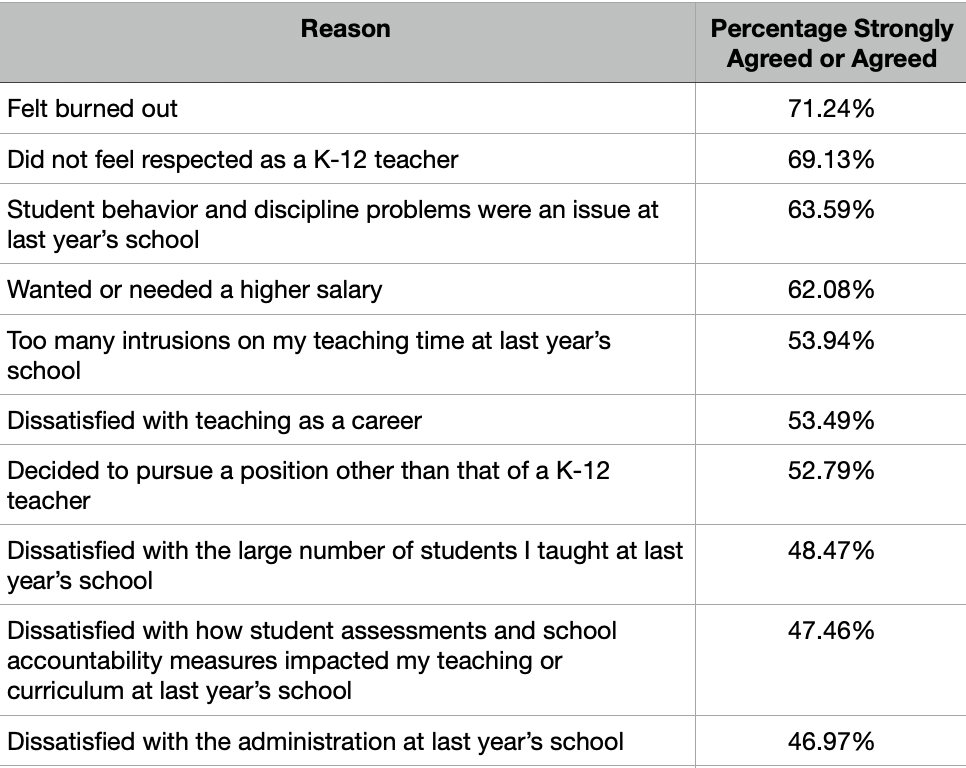
Although not politically correct, the title of this post is a saying sometimes used in the military to describe decisions by senior leadership that seemed extra harsh and detrimental to troop morale. This saying came to mind when I read of Arizona’s Superintendent of Public Instruction Tom Horne’s response to an AZ Department of Education survey of teachers who chose not to return to the classroom for the 2024-2025 school year. The results were released earlier this week and the top four reasons for teachers leaving included: burnout, lack of respect, student behavior and discipline, and low salaries. 

Almost 2,500 of the 5,900 teachers not returning responded to the survey, but 1,500 of the responses were removed for reasons such as those teachers were retiring, promoted to administration, or had accepted a monitoring job. The thousand or so remaining responses most often “strongly agreed” or “agreed” to the following:

Of course, Superintendent Tom Horne honed in on “student behavior and discipline problems” (ignoring burnout and lack of respect) as the significant contributing factor for teachers leaving their jobs. This then, provided him more justification to further push proposed legislation to link school letter grades to a tougher stance on discipline. The AZ Daily Star reported SB 1459 would have required “the state Board of Education to lower a school’s letter grade if it did not implement disciplinary actions in at least 75% of the total number of student discipline referrals submitted by teachers in a single year”. 

The bill was passed in the Senate, but two Republicans in the House refused to vote for it, killing the bill in this session. Of their vote, Horne said “Shame on the legislators who voted against it” claiming it is simply a way to incentivize district support for teachers regarding discipline.

Rep. Nancy Gutierrez, D-Tucson, saw an ulterior motive for the proposal. During the debate on the House floor, she said, 

“It is my opinion that this bill has been put forward in order not to support teachers but in order to make it so that there’s an easier way to have more public schools with D and F grades to support some of the rhetoric that we hear that public schools are failing our students”. 

This of course is just another way for Horne and GOP legislators to push parents toward vouchers and other privatization efforts. Representative Judy Schwiebert, D-Phoenix, agreed and blamed the Legislature for contributing to the teacher retention problems by funding Arizona schools at one of the lowest per-pupil rates in the nation. Schwiebert went on to say that, 

“The job of our local schools and boards is to make direct decisions that apply most specifically to their schools,” she said. “We see the legislature criticizing public schools when we are not doing our job. Arizona ranks 49th in the nation in per pupil funding. We’re pointing our finger at public schools, blaming them for problems that we have created because of too large class sizes, failure to pay teachers enough, failure to provide support staff.”

A Forbes.com article titled, “No More Teachers: The Epic Crisis Facing Education in 2024” agreed, stating that low pay is the biggest reason for the declining numbers of new teachers. In 2022, says veteran teacher and author Jay Schroder, “teachers made on average 26.4% less than other similarly educated professionals”. 

‘Schroder contends that the low pay, combined with high stress and a strong sense of disrespect from some outspoken sections of society, make the job of teaching unattractive to many college graduates. “If this were just a PR problem, it would be easier to solve,” he says. “The truth is that the pay is low and the stress is high.”’

According to K12Dive.com, the Educators for Excellence (E4E) 7th annual Voices from the Classroom survey of teachers this May, highlighted the crisis by reporting that, 

“A mere 19% of teachers believe the profession is sustainable, with only 16% of teachers recommending the profession to others, and less than half expressing commitment to staying in it for the long haul.”

We have been headed for a real crisis regarding teacher shortages; one that has only been exacerbated by the pandemic. And while the trailblazing Arizona Teachers Academy (ATA), passed with bipartisan support in 2018 was working to address our state’s crisis, lawmakers cut $14 million from the program’s budget this year. According to AZCentral.com, the program had expanded in 2023, to serve 3,255 aspiring teachers with an average scholarship of $8,555. The cuts made to the program this year, mean that some 1,700 fewer students will be working their way through a proven pipeline. In the past, ATA has also provided funding for mentors to support new teachers and National Board Certification for experienced teachers.

Turning around teacher dissatisfaction won’t be easy, but neither does it seem super complicated. It boils down to treating them as the professionals they are, not “beating down” them, their administrators, or their schools. Competitive compensation, autonomy to do the jobs they were trained for, an adequate support structure, a collaborative environment, and quality school leadership are some of the more important tools. Also important though, is a recognition by the public and those we elect to represent us, that quality teachers are a most worthy investment critical to the future of our communities, our country, and our world. 

As Anatole France, a French poet, journalist, and best-selling novelist, once said, “Nine-tenths of education is encouragement”. That applies to both students in the classroom and all the professionals who teach them. In my experience as a leader in the Air Force, the carrot is almost always mightier than the stick, but that approach does require a more confident and skilled leader. I guess it is just easier for Superintendent Horne to continue to try the “beatings” approach.

What is Horne’s End Game?

because it doesn’t seem to be to support our public schools

Anyone who has watched Arizona public education for any time knows that the Superintendent of Public Instruction Tom Horne is not a friend of our state’s public schools. This, even though he served for 24 years as a member of the Paradise Valley Unified School District board.

Horne also served two terms as a member of the AZ House of Representatives and then was elected to his first term as Superintendent of Public Instruction in 2003 where he also served two terms. During that time, according to AZCentral.com, “he worked to dismantle ethnic studies in Tucson Unified School District and limit bilingual instruction for English language learners”. He was then elected Arizona’s attorney general, taking office in 2011, and defending the state in the federal government’s challenge to SB 1070 immigration law. In 2017, he was found to have misused the attorney general’s office staff to work on his re-election effort.

This self-described anti-racist who was born in Quebec, fell back on divisive racial politics when he ran for Superintendent again in 2022. He promised to remove critical race theory (CRT) from Arizona schools and start a hotline for reporting educators thought to be teaching it. He also promised to end bilingual education for English language learners, discourage the use of social-emotional learning that encourages students to learn interpersonal skills and self-control, and more aggressive discipline in classrooms. No matter that CRT is a university-level concept not taught in K-12, that some experts tout bilingual education as more supportive, that social-emotional learning helps head off discipline problems, and that his “more aggressive discipline” idea seems to rely mostly on more suspensions as the answer.

Horne is now under fire for losing $29 million in federal school funding because his department failed to spend the money before the September 30, 2023 deadline to use it. AZMirror.com reported that Governor Hobbs and legislative Democrats are calling for a special audit of the federal school improvement grants that should have gone to the 150-200 district and charter high-need schools. This funding was slated to pay for extra staff, professional development, and training. 

The AZ DOE didn’t even know they had missed the deadline for six months according to Horne’s Associate Superintendent. In the meantime, schools all over the state were left struggling to figure out how to make do with the cuts. In early August, the U.S. Department of Education contacted AZ DOE to offer a waiver that would allow the state to recoup the money. According to KJZZ.org, this was a result of reporters from the Arizona Republic and KJXX News contacting the U.S. Department of Education to inquire whether the state could request an extension. 

I try not to traffic in conspiracy theories, but in this case, it seems Horne is either out-of-touch, incompetent, or purposefully wanting to deny funding for some of our highest-need schools. After all, as the Superintendent of Public Instruction, he has no problem with running high-cost ads during the Olympics for the expansion of universal vouchers. Is his real end-game the destruction of our public district schools?

Whatever the end game, it is clear he is stoking culture wars to distract us from the real issues. As reported on PhoenixNew Times.com, The AZ Department of Education recently posted a photo of Horne and three “self-proclaimed Grandmas from Sun City West” on X, stating they were meeting to “talk about making schools better and protecting women and girls from changes to federal Title IX. In response, Beth Lewis, Executive Director of Save Our School AZ, responded by questioning “Why do Tom Horne and these Grandmas care who my kids are sharing a bathroom with??? Seriously?! My kids and their peers accept each other — gay, straight, lesbian, trans, bi, they DON’T CARE!”

A week after Lewis’ post, Horne blasted Lewis in a press release on the AZ Department of Education website stating, ‘“Save Our Schools” leader Beth Lewis owes her membership and Arizona educators an explanation for her support of having biological boys with male genitalia shower in girls’ locker rooms and using girls’ restrooms.’ Lewis responded on X by calling Horne “a weirdo who is publicly obsessing over kids’ genitals.”

It is bad enough Horne is so focused on issues like who uses which potty, that he can’t be bothered to ensure proper oversight of 29 million dollars to help students in high-need schools. The fact that he is also using governmental resources to attack and silence a private citizen is all the more egregious. Horne will appear before a legislative audit committee next month, but I’m not optimistic his feet will be held to the fire by GOP leaders. Our only real hope for policy and action that truly supports all Arizona’s public school students is to flip the Legislature in November.

The Point of Vouchers

Improving Educational Outcomes is Not the Point of Vouchers. In 2017, I wrote a post on RestoreReason.com titled “Vouchers: Some Common Sense Questions” that supported this fact. I’ve included some of the original post below. My updated comments, now six years later are included in italics below.

Just for a few moments, I’d like to ask you to please forget whether or not you believe school choice and vouchers are the answer to “Make American Education Great Again.” Forget all the hype and promises, just ask yourself which of these scenarios makes more sense?

Accountability and Transparency

Which is more accountable and transparent to parents, the taxpayers, and voters, and therefore less likely to experience less fraud, waste, and abuse? #1 Hint to the answer. #2 Hint to the answer. #3 Hint to the answer.
a. District schools that must report every purchase, competitively bid out purchases over a certain amount, have all purchases scrutinized by a locally elected governing board, undergo an extensive state-run audit each year, and are publicly reported on for performance efficiency and student achievement by the AZ Auditor General’s office each year?
b. A voucher system that puts the onus on recipient parents to submit proof of expenditures to an understaffed AZ Department of Education office responsible for monitoring the $37 million ($99.7 million from 2011 to 2017) in voucher expenditures for 4,102 different students?

Arizona’s ESA voucher program had over 50,000 recipients in March 2023 and is now costing the state over $500 million annually, with less oversight than ever. In fact, Superintendent of Public Instruction Tom Horne bragged earlier this year that his office had approved 22,500 expenditures for reimbursement ($22 million worth), in a single day. And, the State Board of Education recently approved Horne’s new ESA Parent Handbook which actually decreases accountability.

Student Achievement

Which is more likely to be held accountable for student achievement and thereby taxpayer return on investment? Hint to the answer.
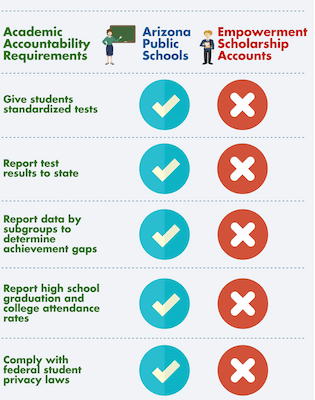
a. A district school where students are given a standardized state test with scores rolled up to the state and made public, where data is reported (following federal guidelines for data protection) by subgroups to determine achievement gaps, and where high school graduation and college attendance rates are reported?
b. A private school that does not provide any public visibility to test results and where the state (per law) has no authority to request or require academic progress from voucher recipients or the school?

Horne’s new ESA parent handbook (which previously stated a bachelor’s degree was required) now only requires a high school diploma instead of subject-matter degrees or certification. This move provides parents no guarantee that their child’s teachers have the knowledge or skill to teach core subjects. 

In addition, special education students desiring vouchers were previously required to be evaluated by a public school and receive a plan detailing their specific educational needs. Now, those students can be assessed by a doctor or psychologist, or at a private school. Keep in mind though, that, unlike public schools, private schools can refuse any student they don’t want to accept.

Funding for Public Schools

Which is more likely regarding the portability (with no impact) of per-student funding when students leave their district schools?
a. When a student leaves a district school with their education funding in their backpack, they take all associated expenses with them?
b. That there are fixed costs left behind (approx. 19%) that the school is required to still fund such as teachers and other staff that cannot be eliminated just because a couple of students left a classroom, or a bus route that can’t be done away with just because one student is no longer taking that bus, or a building air conditioner that can’t be turned off because the occupancy in the classrooms is down by three students. What the “drain” causes instead, is larger class sizes, fewer support services, less variety in the curricula, etc.?

The good news (if there is any), is that 75% of the students now taking vouchers, did not attend a public school before they qualified for a voucher. In other words, the vast majority were already attending private schools and therefore did not cause a massive drain of students from public schools. The bad news is that the cost to the state fund for the voucher program is unsustainable and if it doesn’t bankrupt the state, it will reduce funding for public education.

Are Vouchers Helping Disadvantaged Students?

Which is more likely to serve disadvantaged students — the ones most in need of our help? Hint to the answer.
a. A district school, where the vast majority of educational expenses are covered by the taxpayer, where students are transported from their home to school, where free and reduced lunches are provided, and which must accept all comers?
b. A $5,200 voucher to a private or parochial school that has total control over which students they accept, does not provide transportation, and costs an average of $6,000 for elementary schools in 2016-17?

ESA vouchers in Arizona now provide approximately $7,000 per student, regardless of household income. Not surprisingly, the cost of private school tuition has also gone up to an average of $9,576 per year for elementary school and $13,902 for high school. After all, why wouldn’t private school operators raise tuition when the voucher amount increases? 

Obviously, the most disadvantaged students will have a hard time finding their way to private schools considering the $2,500 to $7,000 out-of-pocket expense just for tuition. That doesn’t even take into account the requirement for parents to provide transportation and, the lack of any sort of free or reduced meal program. 

When it comes to transparency, accountability, and equity, district schools outperform private schools. I’d also like to make the unequivocal claim that district schools also (across the board) produce more achievement than private schools, but they don’t report their results so I don’t know that for sure.

Are Vouchers Producing Better Academic Outcomes?

National education expert Diane Ravitch recently reported that “new evaluations of vouchers in Washington, D.C., Indiana, Louisiana, and Ohio show some of the largest test score drops ever seen in the research record–between -0.15 and -0.50 standard deviations of learning loss.” If you aren’t a professional educator, those numbers might not mean much to you. Let’s just say that the learning loss was similar to that experienced during the COVID-19 pandemic and larger than what Hurricane Katrina did to New Orleans academics. 

Ravitch goes on to say that this is happening because “elite private schools with strong academics and large endowments often decline to participate in voucher plans. Instead, the typical voucher school is a financially distressed, sub-prime private provider often jumping at the chance for a tax bailout to stay open a few extra years.”

No matter how much sugar the privatizers try to coat vouchers with, they are still just a vehicle for siphoning tax dollars away from our district community schools to private and parochial (religious) schools with no accountability or transparency. For every person who says “parents have the right to use their child’s education tax dollars as they see fit”, I say, “and taxpayers have the right to know the return on investment for their tax dollars.” The former right in no way “trumps” the latter.

Every Family for Themselves

Peter Greene, a well-recognized education blogger, recently wrote a post on his blog “Curmudgucation”, titled “Vouchers are About Abandoning Public Education, Not Freeing Parents”. He says we should think of vouchers this way,

“The state announces, ‘We are dismantling the public education system. You are on your own. You will have to shop for your child’s education, piece by piece, in a marketplace bound by very little oversight and very few guardrails. In this new education ecosystem, you will have to pay your own way. To take some of the sting out of this, we’ll give you a small pocketful of money to help defray expenses. Good luck.’

It’s not a voucher system. It’s a pay your own way system. It’s a you’re on your own system. The voucher is not the point of the system; it’s simply a small payment to keep you from noticing that you’ve just been cut loose.

Freedom and empowerment will come, as always, in direct proportion to the amount of money you have to spend.”

Greene warns that “the voucher amount will dwindle” as public schools are left with those students who don’t have any other option. “Vouchers,” he says, are “the tail, not the dog. They are the public-facing image of privatization– and not just privatization of the “delivery” of education. Voucherization is also about privatizing the responsibility for educating children, about telling parents that education is their problem, not the community’s.”

Improving educational outcomes is not the point of vouchers. The point, my friends, is to reduce the power of the people, by reducing the size of government and diminishing our voice. The point is to dismantle the public square and the common good, leaving us all to fend for ourselves in a sort of hunger games that only the game masters (the rich and powerful) win. 
T and A: #1 Benefit of Public Schools

I’ve no doubt raised a few eyebrows with the title of this post. Get your mind out of the gutter people, I’m talking about transparency and accountability!

Let me be clear…I believe America’s public schools are what made our country great. They ensured all children had the opportunity to learn and they coalesced our communities and all the different types of people within them. But, in terms of today’s school choice landscape, the number one benefit offered by public district schools over all other choices, is transparency and accountability.

Of course, in this alternate universe the GOP has created, up is down, left is right, black is white, and private school choice options (private, religious, and home schools) are the more transparent and accountable schools for parents and taxpayers. Nothing could be further from the truth. District schools, with publicly elected school board members and the requirement to follow Open Meeting Law (at least in Arizona), are by far the most transparent and accountable. Yes, our charter schools are also public schools, but they don’t have publicly elected boards. Rather, charter school board members may not even live in the same state, let alone in the same town. But as public schools, both district and charter schools have myriad transparency requirements private school choice options don’t. These include the need to follow Open Meeting Law, ensuring the public’s right to witness the discussion, deliberation, and decision-making done in its name. They also must: accept all students; comply with stringent requirements for reporting, procurement, and auditing; and allow parents the right to review all instructional material and intercede in their child’s education where they believe it is necessary. There are many more differences in transparency and accountability, but you get the idea.

And yet, those advocating for school privatization have managed to convince many parents (especially in today’s highly partisan environment), that public schools (especially district schools) are trying to indoctrinate their children with values and ideology that are different than their own.

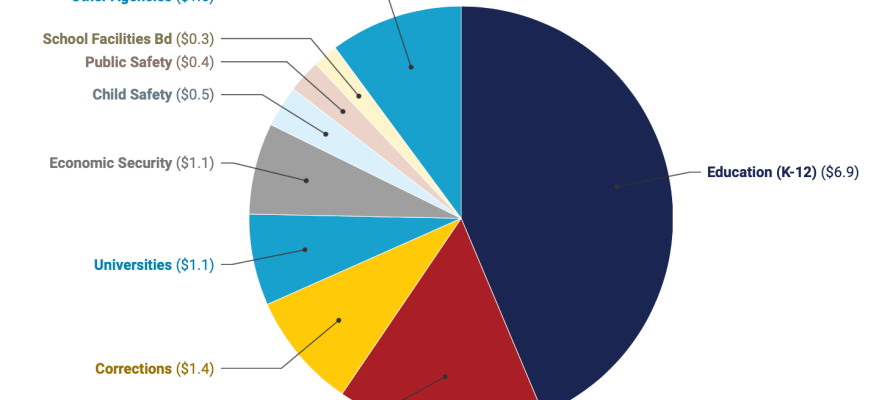
What it is really about though, as pointed out by fellow education blogger Jan Resseger in her recent post, is money and power. After all, the total bill for K-12 education in the U.S. in 2018-2019 school year was already $800B. In Arizona this year, K-12 education constitutes almost 44% of the state budget. Privatizing public education is a lucrative triple-play for the rich and powerful and those lawmakers they keep in office. Privatization allows the reduction of the need for taxation, it offers the opportunity for corporations to profit directly from the education industry, and it reduces the voice of the people making it easier to ignore their will. As Resseger points out, Gordon Lafer, in “The One-Percent Solution”, said,

(F)or those interested in lowering citizens’ expectations of what we have a right to demand from government, there is no more central fight than around public education. In all these ways, then, school reform presents something like the perfect crystallization of the corporate legislative agenda.”

The brilliancy of packaging school privatization was convincing parents that their “right to choose”, was what was important. Resseger also quoted Benjamin Barber, in his book “Consumed”, who deftly makes the point that this ability to choose, however, is not the real power.

We are seduced into thinking that the right to choose from a menu is the essence of liberty, but with respect to relevant outcomes the real power, and hence the real freedom, is in the determination of what is on the menu. The powerful are those who set the agenda, not those who choose from the alternatives it offers. We select menu items privately, but we can assure meaningful menu choices only through public decision-making.

In other words, you are either at the table, or on the menu. In fact, I previously wrote a post with this same title back in 2014. With public schools, parents, voters and taxpayers are at the table (if they exercise their rights the way they should). Unfortunately, it takes work to exercise our rights and hold our elected officials accountable. But then, that’s what is meant by “of the people, by the people, and for the people”. “We the people”, must do our part if we want our government and its institutions to reflect our values. At least in public schools, we have that opportunity.

Drowning Public Education in the Bathtub

Those of you who’ve been around a while will remember lobbyist Grover Norquist, who founded Americans for Tax Reform in 1985. This was during the Reagan years when government was seen as a drag on the free market. Norquist is probably best known for this quote in 2001: “I don’t want to abolish government. I simply want to reduce it to the size where I can drag it into the bathroom and drown it in the bathtub”

It has been obvious for many years that Arizona Republican lawmakers want to drown our district schools since the budget for K-12 education makes up almost 44% of the state budget. But then, the predominant responsibilities of the AZ state government are to provide for public safety and public education, so…it stands to figure that education would comprise a large portion of the budget.

If you’ve listened to the AZ Republican lawmakers’ talking points over the last few years, you’d tend to believe that public education has been showered with funding. The truth however is quite another story. In fact, adjusting for inflation, K-12 funding per public school student hasn’t increased in 21 years and leaves us still 48th in the nation. In 2001, districts were provided $8,824 per student, and now, only $8,770. The high-water mark in 2007 of $10,182 per student was under Democratic Governor Janet Napolitano. This was actually $1,412 more than in 2022.

You see, pretty much all the GOP has been doing over the last few years is to reinstate funding they took away to begin with. And to add insult to injury, they’ve been chipping away at the amount available to district schools by the continuous expansion of privatization options.

Guess you’d have to be living under a rock to have missed the battle over vouchers (Empowerment Scholarship Accounts) during the past decade. ESAs were enacted in 2011 and GOP lawmakers have been steadily expanding these vouchers over the years. In 2022, (I’m really cutting to the chase here), they were finally successful in enacting a universal expansion. Not only are students no longer required to have previously attended a district school to qualify for a voucher, but there are no guardrails or caps and no transparency or accountability for private schools. And, only two months into the new law, AZ DOE had received nearly 30,000 filings for the vouchers, totaling an immediate hit to the state fund of $210M. The Joint Legislative Budget Committee only budgeted $33M for the program for the 2022-23 school year, but some now estimate the bill could approach as much as $500M.

Student Tuition Organizations (STOs) are another vehicle to poke holes in the district funding life raft. They allow taxpayers to take a dollar-for-dollar reduction in their state taxes when they give to an approved STO which provides scholarship funding to children attending grades K-12 at qualified private schools in Arizona. These STOs basically serve as a pass-through for tax credit donations to private schools while keeping 10 percent for themselves. STOs have also seen tremendous expansion over the years with the individual tax credit amount now at $1,306 which is over six times that which taxpayers can give to district schools. There are also two types of tax credits corporations can take and the combined cap for those is now up to $141M.

Just introduced last week by Representative Livingston, is HB 2014 which seeks to expand the aggregate dollar amount of STO tax credits from $6M in 2021-22 to $10M in 2022-23, to $15M in 2023-24, and to $20M in 2024-25. It also would eliminate the need for recipients of a corporate, low-income scholarship to have attended a district school prior to receiving the scholarship. Keep in mind that removing the requirement to have first attended a district school prior to receiving STO or ESA monies, accommodates students already in private school or being homeschooled, at their parent’s expense. In fact, that was the case for 80% of the filings for the universal expansion last year. And, when a student taking an ESA or STO scholarship was never in a district school, there is zero reduction in cost to that district school and ultimately, taxpayers.

These schemes are chipping away at the foundation of our district (community) schools so that eventually, they can be “drowned in the bathtub”. This is not by accident, but rather, by design. There are those in the Legislature, who do not believe in equal opportunity to learn and thrive, but rather, in survival of the fittest. And, they are hell-bent on deciding who the “fittest” are. Privatizing public education primarily serves those who “have” at the expense of those who “have not”. This continued war on public education will continue to weaken our communities and our democracy as it solidifies power and influence with those at the very top.

Want to fight back? Go to SOSArizona.org.

#1 Way to Build Back Better

I am a currently serving school governing board member of nine years and the past president of the Arizona School Boards Association (ASBA). As such, I have been closely following the stories of school board meetings, especially in Arizona, that have become especially contentious.

The ugliness probably shouldn’t be surprising in the uber-polarized environment we now find ourselves. As Michelle Cottle (editorial board member) points out in the New York Times,

while the drama may feel bound up in the angry, ugly, polarized politics of the moment, it is nothing new. Public schools have long been an irresistible battleground for America’s culture warriors. On issues ranging from sex education to desegregation, public prayer to evolution to the Pledge of Allegiance, cultural cage matches are frequently fought on the backs of local schools, with board members, educators and students too often caught in the fray.

And that my friends, is the saddest part of what we see being played out – students caught in the fray. Even those who have never been parents understand that children learn from our actions, as well as our words. What does it say to our students when parents show up to their school to threaten, harass, and vilify teachers, administrators and school board members? Director of ASBA’s governmental relations, Chris Kotterman, described it well when he said,

Threatening public officials for advancing policy you don’t agree with is fundamentally opposed to the behavior we expect from our students. It sends the message when we aren’t getting what we want or we disagree, the thing to do is to try and intimidate the opposition into compliance. That’s a terrible example to set.

Cottle gives plenty of examples of school board meeting protestors around the country being incredibly ugly and scary, screaming profanity and threats like ““You will never be allowed in public again!” one raged. “We know who you are,” another warned. “You can leave freely, but we will find you!” and after another school board passed a mask mandate, another saying, “you made Dr. Mengele proud” (while giving the Nazi salute). Even locally though, we’ve had protestors in Vail try to elect a new school board outside the board meeting and blocking staff members from leaving the building shouting obscenities at them and saying, “You’re surrounded. You can’t leave.”

It is not okay to treat each other this way and the lack of respect shown each other at the most fundamental level – as human beings – is sorely lacking these days. I personally know of an administrator who was called a “cunt” by a grandmother of a student. And again, this shouldn’t surprise me when we just suffered through four years with a U.S. President who normalized all sorts of actions and words that wouldn’t have been acceptable before his time.

Let me just point out though, that at least in Arizona, school board members don’t get paid for their service. In fact, this is true for most school board members around the country. And yet, during my travels all around Arizona and to national conferences with ASBA, I met countless dedicated school board members who really care about their students and work hard to improve their educational experience. Yes, just like in every other endeavor on the planet, there are those few who either have agendas that aren’t focused on the kids or don’t take their roles seriously enough, but they are the rare exception, not the rule.

And although I can understand how the current climate would discourage good people from wanting to serve on school boards, it is exactly the time that they must. Otherwise, the bad guys win. What we’ll end up with is school board members who thrive on hateful discourse and self-destructive environments. We’ll end up with an exodus of good school board members, good administrators, and good teachers. Eventually, we’ll end up with a system of public education that is circling the drain.

I don’t think of myself as a conspiracy theorist, but neither do I think we should be so naive, to think that all this is happening organically. Of the April Vail protests for example, Superintendent Carruth said,

“There was a handful of people – I don’t know exactly how many – who either don’t have kids in the school district, don’t live in the school district, don’t live in the county, who came with the express purpose of whipping up that group.”

Yes, around the country, administrators and school board members have suspected outsiders of coming in to school board meetings to wreak havoc for political purposes. This is not a new strategy, as conservative strategist Ralph Reed, (former executive director of the Christian Coalition), once said he would “exchange the presidency for 2,000 school seats”. But the current political climate and ease message spreading via social media has whipped it into a frenzy.

For those who are shocked at how low we’ve sunk at a country, and are committed to do their part to “Build Back Better”, there is almost no better place to start than to serve on your local school board. Ensuring our students are prepared to build a better future is why I first ran for the school board in 2012, and why I continue to serve. I can assure you that the other side is feverishly working to ensure they win this battle for hearts and minds and they’ve been very successful thus far in using school board seats as stepping stones to higher political offices.

Elections happen every two years and the paperwork to run is usually due in the summer of election year. Our kids need you, will you step up in 2022? For more information about running for school governing boards, please contact the office of your County Schools Superintendent (Pima and Pinal), or the Arizona School Boards Association.

WTF Pinal County Board of Supervisors?

In a 3/2 vote on this past Wednesday, the Pinal County Board of Supervisors voted to reject a $3.4 million federal grant for improving vaccine equity. Supervisor Kevin Cavanaugh (District 1), led the charge to deny the funding, questioning whether Pinal County had a need for a “vaccine equity coordinator”, which the grant mandated be established. The grant also funded vaccination efforts like mobile vaccine clinics. County Public Health Services District employees were stunned by the move with the director, Dr. Tascha Spears, saying “I just simply would like to note that our public health team is deeply disappointed”.

According to The Arizona Republic, the grant would have come from federal COVID-19 relief funds provided to the state health department. County health services employees commented that the $3.4 million would have funded efforts (over three years) to educate underserved populations about the COVID-19 vaccine and help provide vaccines in underserved communities.

During the hearing this past Wednesday, Cavanaugh asked Spears whether or not her office sought the grant or did they see the grant available and look for a problem? He went on to say that “The questions I’m getting from my constituents are, you know, we have Walgreens, Walmart, (uh, no…don’t believe there is a Walmart in your district Kevin), everybody knows that there are free vaccines”. Dr. Spears responded that Pinal County has many rural areas where folks are farther away from bigger chains like Walmart. Of course, Cavanaugh was not however, swayed by this logic, nor did he obviously care about how the homeless or disabled might access these commercial providers.

Although appearing surprised by Cavanaugh’s move in the hearing, supervisors Jeff McClure and Jeff Serdy voted with him to reject the funding. The chairman of the Board, Steve Miller and vice chair Mike Goodman voted against the rejection.

“It made no sense to turn this down” was the response former Arizona state health director Will Humble (now executive director of the Arizona Public Health Association), provided when asked about the Board’s action. As both Spears and Humble pointed out, the county qualified for the grant due to its social vulnerability index which included factors such as “the proportion of people with disabilities, unemployment rates and the number of single parent households”.

Cavanaugh though, was set on making this about disdain for the federal government saying, “The federal government, the best job they do, is wasting money”. He went on to say that, “this $3.4 million dollar grant would have provided one public health official here in Pinal County, a nurse. And the rest largely would have largely gone to some as yet unknown unnamed contractor”.

Well, let’s hope Kevin, that the the contractor is yet unknown and unnamed because I would expect government procurement rules would have been followed had the grant been accepted. Per A.R.S. 41-2533, that contracts must be decided via competitive sealed bidding (those under $100,000 in value have exceptions). Per A.R.S. 41-2561, Bid specifications are required to “promote overall economy for the purposes intended and encourage competition in satisfying this state’s needs and shall not be unduly restrictive”. Furthermore, under the competitive sealed bidding procedures, a state governmental unit must award a contract to the “lowest responsible and responsive bidder whose bid conforms in all material respects to the requirements and evaluation criteria” set forth in the invitation for bids. There are similar rules in federal procurement.

As a county supervisor, Cavanaugh should be very familiar with state procurement rules and therefor know it is disingenuous to make it sound like there would be no accountability for the grant funding if the Board had accepted it. There would of course be, unless Cavanaugh and his buddies didn’t properly fulfill their duties.

Speaking of fulfilling their duties, what were Supervisors Jeff McClure and Jeff Serdy thinking in voting with Cavanaugh to reject the $3.4 million? In an email afterwards, Serdy told AZFamily.com that he voted to reject the funding “in order to retain local control.” He went on to write “I’m not too concerned that our citizens don’t have access to the vaccine if they want it because it is now widely available for free”. McClure did not respond to the Arizona’s Family request for comment, nor did he respond to an email I sent him on the matter.

I should mention here, that I served on a school board with Jeff McClure for eight years and although there was much we didn’t agree on, I thought he was concerned about doing the right thing for our students and staff. His decision to reject this funding to improve Pinal County’s vaccination rate however, is definitely not doing the right thing for the people of Pinal County, which lags the state, at 56.3% and national at 61.5%, averages for vaccination with only 48.1% of those 12 and older fully vaccinated as of the Board’s vote.

And, according to former state health director Dr. Cara Christ, some of the federal vaccine dollars could go toward encouraging the continuance of routine school vaccinations that declined during the pandemic. “While we’re using that funding to ensure we are vaccinating in an equitable manner, we can use that funding to improve health equity in other arenas as well”, Christ told The Arizona Republic in July.

I don’t for a second believe Supervisors Cavanaugh, McClure and Serdy rejected the $3.4 million because it was the right thing to do for the people of Pinal County. Rather, I believe it was a purely political decision meant to appeal to their voting base. After all, when booster shots are authorized, or children under the age of 12 are approved to receive the vaccine, where will the money come from to help implement those additional protections?

Again, Pinal County Health Services District Director Dr. Tascha Spears said,

In Pinal County there are some communities who are underserved, who don’t have access to COVID-19 vaccines. So this is specifically to facilitate that, so that communities everywhere truly do have a choice about whether they would like to receive the vaccine or not.

That’s the thing see. If you don’t know what your choices are, or you can’t access the choice you’ve made, you have no choice at all.