The Point of Vouchers

Improving Educational Outcomes is Not the Point of Vouchers. In 2017, I wrote a post on RestoreReason.com titled “Vouchers: Some Common Sense Questions” that supported this fact. I’ve included some of the original post below. My updated comments, now six years later are included in italics below.

Just for a few moments, I’d like to ask you to please forget whether or not you believe school choice and vouchers are the answer to “Make American Education Great Again.” Forget all the hype and promises, just ask yourself which of these scenarios makes more sense?

Accountability and Transparency

Which is more accountable and transparent to parents, the taxpayers, and voters, and therefore less likely to experience less fraud, waste, and abuse? #1 Hint to the answer. #2 Hint to the answer. #3 Hint to the answer.
a. District schools that must report every purchase, competitively bid out purchases over a certain amount, have all purchases scrutinized by a locally elected governing board, undergo an extensive state-run audit each year, and are publicly reported on for performance efficiency and student achievement by the AZ Auditor General’s office each year?
b. A voucher system that puts the onus on recipient parents to submit proof of expenditures to an understaffed AZ Department of Education office responsible for monitoring the $37 million ($99.7 million from 2011 to 2017) in voucher expenditures for 4,102 different students?

Arizona’s ESA voucher program had over 50,000 recipients in March 2023 and is now costing the state over $500 million annually, with less oversight than ever. In fact, Superintendent of Public Instruction Tom Horne bragged earlier this year that his office had approved 22,500 expenditures for reimbursement ($22 million worth), in a single day. And, the State Board of Education recently approved Horne’s new ESA Parent Handbook which actually decreases accountability.

Student Achievement

Which is more likely to be held accountable for student achievement and thereby taxpayer return on investment? Hint to the answer.
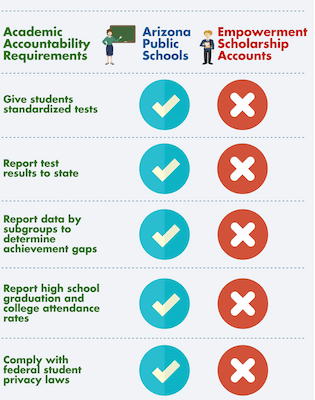
a. A district school where students are given a standardized state test with scores rolled up to the state and made public, where data is reported (following federal guidelines for data protection) by subgroups to determine achievement gaps, and where high school graduation and college attendance rates are reported?
b. A private school that does not provide any public visibility to test results and where the state (per law) has no authority to request or require academic progress from voucher recipients or the school?

Horne’s new ESA parent handbook (which previously stated a bachelor’s degree was required) now only requires a high school diploma instead of subject-matter degrees or certification. This move provides parents no guarantee that their child’s teachers have the knowledge or skill to teach core subjects. 

In addition, special education students desiring vouchers were previously required to be evaluated by a public school and receive a plan detailing their specific educational needs. Now, those students can be assessed by a doctor or psychologist, or at a private school. Keep in mind though, that, unlike public schools, private schools can refuse any student they don’t want to accept.

Funding for Public Schools

Which is more likely regarding the portability (with no impact) of per-student funding when students leave their district schools?
a. When a student leaves a district school with their education funding in their backpack, they take all associated expenses with them?
b. That there are fixed costs left behind (approx. 19%) that the school is required to still fund such as teachers and other staff that cannot be eliminated just because a couple of students left a classroom, or a bus route that can’t be done away with just because one student is no longer taking that bus, or a building air conditioner that can’t be turned off because the occupancy in the classrooms is down by three students. What the “drain” causes instead, is larger class sizes, fewer support services, less variety in the curricula, etc.?

The good news (if there is any), is that 75% of the students now taking vouchers, did not attend a public school before they qualified for a voucher. In other words, the vast majority were already attending private schools and therefore did not cause a massive drain of students from public schools. The bad news is that the cost to the state fund for the voucher program is unsustainable and if it doesn’t bankrupt the state, it will reduce funding for public education.

Are Vouchers Helping Disadvantaged Students?

Which is more likely to serve disadvantaged students — the ones most in need of our help? Hint to the answer.
a. A district school, where the vast majority of educational expenses are covered by the taxpayer, where students are transported from their home to school, where free and reduced lunches are provided, and which must accept all comers?
b. A $5,200 voucher to a private or parochial school that has total control over which students they accept, does not provide transportation, and costs an average of $6,000 for elementary schools in 2016-17?

ESA vouchers in Arizona now provide approximately $7,000 per student, regardless of household income. Not surprisingly, the cost of private school tuition has also gone up to an average of $9,576 per year for elementary school and $13,902 for high school. After all, why wouldn’t private school operators raise tuition when the voucher amount increases? 

Obviously, the most disadvantaged students will have a hard time finding their way to private schools considering the $2,500 to $7,000 out-of-pocket expense just for tuition. That doesn’t even take into account the requirement for parents to provide transportation and, the lack of any sort of free or reduced meal program. 

When it comes to transparency, accountability, and equity, district schools outperform private schools. I’d also like to make the unequivocal claim that district schools also (across the board) produce more achievement than private schools, but they don’t report their results so I don’t know that for sure.

Are Vouchers Producing Better Academic Outcomes?

National education expert Diane Ravitch recently reported that “new evaluations of vouchers in Washington, D.C., Indiana, Louisiana, and Ohio show some of the largest test score drops ever seen in the research record–between -0.15 and -0.50 standard deviations of learning loss.” If you aren’t a professional educator, those numbers might not mean much to you. Let’s just say that the learning loss was similar to that experienced during the COVID-19 pandemic and larger than what Hurricane Katrina did to New Orleans academics. 

Ravitch goes on to say that this is happening because “elite private schools with strong academics and large endowments often decline to participate in voucher plans. Instead, the typical voucher school is a financially distressed, sub-prime private provider often jumping at the chance for a tax bailout to stay open a few extra years.”

No matter how much sugar the privatizers try to coat vouchers with, they are still just a vehicle for siphoning tax dollars away from our district community schools to private and parochial (religious) schools with no accountability or transparency. For every person who says “parents have the right to use their child’s education tax dollars as they see fit”, I say, “and taxpayers have the right to know the return on investment for their tax dollars.” The former right in no way “trumps” the latter.

Every Family for Themselves

Peter Greene, a well-recognized education blogger, recently wrote a post on his blog “Curmudgucation”, titled “Vouchers are About Abandoning Public Education, Not Freeing Parents”. He says we should think of vouchers this way,

“The state announces, ‘We are dismantling the public education system. You are on your own. You will have to shop for your child’s education, piece by piece, in a marketplace bound by very little oversight and very few guardrails. In this new education ecosystem, you will have to pay your own way. To take some of the sting out of this, we’ll give you a small pocketful of money to help defray expenses. Good luck.’

It’s not a voucher system. It’s a pay your own way system. It’s a you’re on your own system. The voucher is not the point of the system; it’s simply a small payment to keep you from noticing that you’ve just been cut loose.

Freedom and empowerment will come, as always, in direct proportion to the amount of money you have to spend.”

Greene warns that “the voucher amount will dwindle” as public schools are left with those students who don’t have any other option. “Vouchers,” he says, are “the tail, not the dog. They are the public-facing image of privatization– and not just privatization of the “delivery” of education. Voucherization is also about privatizing the responsibility for educating children, about telling parents that education is their problem, not the community’s.”

Improving educational outcomes is not the point of vouchers. The point, my friends, is to reduce the power of the people, by reducing the size of government and diminishing our voice. The point is to dismantle the public square and the common good, leaving us all to fend for ourselves in a sort of hunger games that only the game masters (the rich and powerful) win. 
(Update) A Crack in the Privatization Movement?

The BASIS Tucson North charter in Oro Valley voted to unionize this past Wednesday night. By a 2 to 1 margin, teachers voted to found a local union chapter of the Arizona Alliance of Charter Teachers and Staff. This charter is now the first in Arizona to have staff join a union, an affiliate of the nation’s second-largest teacher labor union, the American Federation of Teachers.

Say it is not so! Teachers at BASIS felt the need to form a union to ensure more money for hiring and retaining teachers. What has the world come to when we can’t rely on businesses to do the right thing and take care of their employees without some pesky union getting in the way?

Trudi Connolly, a member of the union organizing committee explained the rationale for unionizing.

“The union was needed because we were losing teachers and the essence of the school’s culture at an unbelievable rate. We want to protect the aspirations we’ve always had for our school. Under current circumstances, we can’t retain enough teachers to educate our students, let alone provide them with the dept of intellectual experience and support they deserve. Teachers, indeed like all kinds of workers all over the country, are coming together to make sure they have a real voice in what the future of our workplaces looks like. In our case, we want our workplace to be one where teachers thrive and students get the education they deserve.”

Teachers and administrators of public school districts across the state share this sentiment. But, Arizona is a “right to work” state. This means an employer is prohibited from denying a person the opportunity to be hired or retained because they are not a member of a labor organization.

The Arizona Education Association, (and its local district chapters), represents 20,000 members.

The AEA can lobby for employees at the Legislature. They can also represent them in negotiation efforts such as “meet and confer”, a board-adopted policy to ensure both sides negotiate in good faith in a sincere effort to be heard and reach a consensus. They can also represent employees in “interest-based bargaining”, enabling negotiators to act more like joint problem-solvers. The AEA may not, however, engage in “collective bargaining” for the employees.   And, district employees are prevented from going on strike and if they do, they can be fired and replaced.

For further clarification, I reached out to a lawyer friend of mine who has extensive Arizona education policy experience. He said Arizona does not allow for collective bargaining but that doesn’t mean employees can’t unionize. It does, however, mean they can’t be required to join the union as a condition of employment (the “right to work” part). Just because the employer is not obligated to engage in collective bargaining, doesn’t mean some representation and organizing can’t occur.

Most school districts “meet and confer” with their employees.

Although school districts aren’t obligated to “meet and confer” with their employees, many do. Partly because some Boards require it and because there is some connection between being elected by the public and being responsive to the staff. That same dynamic would likely not be present in a charter like BASIS. In fact, according to PublicCharters.org, Arizona law provides that all charter schools are their own legal entity and thus are not required to abide by any outside agreements. It will be interesting then, to see what becomes of this new union’s efforts to bargain on behalf of its members at the BASIS school.

Did unions create charters?

I thought it ironic that unions were gaining a foothold in charter schools since a common narrative was that unions played a part in creating charters, to begin with. Additional research, however, proved this narrative suspect. Rachel Cohen, in DemocracyJournal.org, wrote in 2017 that legendary AFT president Albert Shanker played a much smaller role in creating the charter concept than he has been credited with. Rather, she claims,

“At its outset, the real power in the charter coalition was what might be termed the ‘technocratic centrists’: business leaders, moderate Republicans, and DLC members looking for Third Way solutions that couldn’t be labeled big-government liberalism.”

She goes on to say,

“The mythological origin story of charter schools—the Shanker myth—has served an important role in keeping the charter coalition together. The idea that charters come from unions lends a certain weight-of-history inevitability to school reform. It suggests that everyone has agreed that change must come, and the only question is from who, and what it’ll look like in the end.”

Cohen posited that the “Shanker tale” may have “helped undermine progressive school choice advocates, who find themselves chasing a vision that has never played a major role in the inner circles of school reform”. Most charters she writes,

“Are more segregated than traditional public schools, are non-union, and when charter educators do mount union campaigns, they almost always face tremendous opposition. If the promise of unionized, integrated, teacher-centered charters has proven devilishly difficult to fulfill, it may be, in part, because the movement’s leaders never took it very seriously to begin with.”

A movement is afoot.

That was in 2017 and now, approximately 12% of U.S. charter schools have unionized. BASIS union organizer Duncan Hasman believes a movement is underway saying “A win in Arizona is a signifier that charter school teachers are ready to start making their voices heard across the nation”. A union press release stated, they will work towards, “additional accountability, administrative transparency, and more resources and time to effectively identify and address student needs”.

I reached out to AFT prior to publishing this article and they asked Duncan to get in touch with me. He did and told me he has (along with the organizing committee) been working on unionizing for a couple of years. The decision to organize wasn’t due to a “straw that broke the camel’s back”, but rather, resulted from recognition of a structural problem. There just wasn’t a mechanism for teacher considerations or recommendations to be heard. And, there wasn’t any strength in individual negotiation.

I asked Duncan how Arizona’s “right to work” law and prohibition against collective bargaining affected the union’s ability to organize and their bargaining efforts. He said they did have to reassure teachers that organizing and forming a union was still possible despite state laws. The OC addressed their concerns and now their approach, informed by data and an understanding of how the system works, will amplify teachers’ voices and give strength to power.

When I asked him if he worries about what the AZ Legislature will do to try to negate this victory, he said that, “As an organizer, you know what you have control over and you know what you don’t. Our group of teachers has control over what they say and do, but we can’t control the Legislature”. 

Time will tell how successful their efforts will be in a state whose Legislature is way more business-friendly than teacher-friendly, regardless of the type of school. BASIS Eighth-grade algebra teacher Justine Sleator explained her hopes for the effort,

“Our union will allow us to reprioritize the needs of our students. We will be able to protect new teachers from burnout and retain high-quality educators, as BASIS has been known for.”

That need is universal, especially in this time of ever-increasing pressures placed on our public schools and educators. Really, why would anyone want to be a teacher these days with our lawmakers constantly looking for ways to make their jobs even more demanding? The bottom line for Duncan Hasman is that teachers at his school “needed a voice”. There was no structural way for teachers to come together and share their experiences and needs with either management or the community they serve. 

Ultimately, privatization is not about “giving power to the people”. Rather, it is about giving power to “The Man” (business). Maybe this win at BASIS will act as a small crack in the privatization movement. At the very least, it will likely show that although BASIS has a reputation for student achievement, it comes at a cost. It will be interesting to see how that bill is paid. 

T and A: #1 Benefit of Public Schools

I’ve no doubt raised a few eyebrows with the title of this post. Get your mind out of the gutter people, I’m talking about transparency and accountability!

Let me be clear…I believe America’s public schools are what made our country great. They ensured all children had the opportunity to learn and they coalesced our communities and all the different types of people within them. But, in terms of today’s school choice landscape, the number one benefit offered by public district schools over all other choices, is transparency and accountability.

Of course, in this alternate universe the GOP has created, up is down, left is right, black is white, and private school choice options (private, religious, and home schools) are the more transparent and accountable schools for parents and taxpayers. Nothing could be further from the truth. District schools, with publicly elected school board members and the requirement to follow Open Meeting Law (at least in Arizona), are by far the most transparent and accountable. Yes, our charter schools are also public schools, but they don’t have publicly elected boards. Rather, charter school board members may not even live in the same state, let alone in the same town. But as public schools, both district and charter schools have myriad transparency requirements private school choice options don’t. These include the need to follow Open Meeting Law, ensuring the public’s right to witness the discussion, deliberation, and decision-making done in its name. They also must: accept all students; comply with stringent requirements for reporting, procurement, and auditing; and allow parents the right to review all instructional material and intercede in their child’s education where they believe it is necessary. There are many more differences in transparency and accountability, but you get the idea.

And yet, those advocating for school privatization have managed to convince many parents (especially in today’s highly partisan environment), that public schools (especially district schools) are trying to indoctrinate their children with values and ideology that are different than their own.

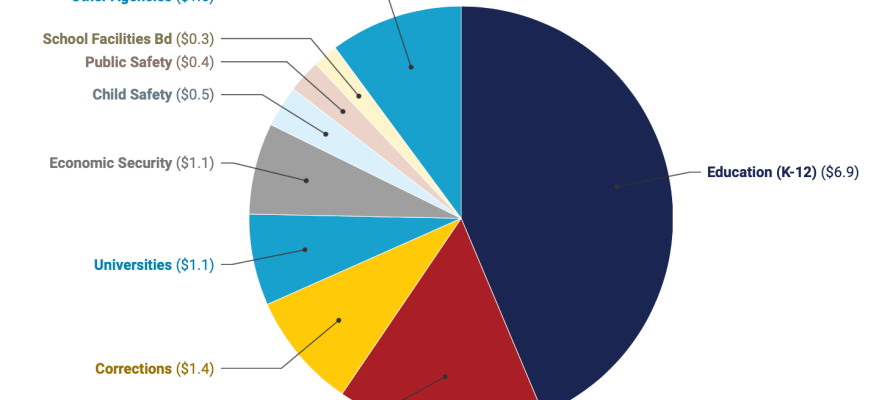
What it is really about though, as pointed out by fellow education blogger Jan Resseger in her recent post, is money and power. After all, the total bill for K-12 education in the U.S. in 2018-2019 school year was already $800B. In Arizona this year, K-12 education constitutes almost 44% of the state budget. Privatizing public education is a lucrative triple-play for the rich and powerful and those lawmakers they keep in office. Privatization allows the reduction of the need for taxation, it offers the opportunity for corporations to profit directly from the education industry, and it reduces the voice of the people making it easier to ignore their will. As Resseger points out, Gordon Lafer, in “The One-Percent Solution”, said,

(F)or those interested in lowering citizens’ expectations of what we have a right to demand from government, there is no more central fight than around public education. In all these ways, then, school reform presents something like the perfect crystallization of the corporate legislative agenda.”

The brilliancy of packaging school privatization was convincing parents that their “right to choose”, was what was important. Resseger also quoted Benjamin Barber, in his book “Consumed”, who deftly makes the point that this ability to choose, however, is not the real power.

We are seduced into thinking that the right to choose from a menu is the essence of liberty, but with respect to relevant outcomes the real power, and hence the real freedom, is in the determination of what is on the menu. The powerful are those who set the agenda, not those who choose from the alternatives it offers. We select menu items privately, but we can assure meaningful menu choices only through public decision-making.

In other words, you are either at the table, or on the menu. In fact, I previously wrote a post with this same title back in 2014. With public schools, parents, voters and taxpayers are at the table (if they exercise their rights the way they should). Unfortunately, it takes work to exercise our rights and hold our elected officials accountable. But then, that’s what is meant by “of the people, by the people, and for the people”. “We the people”, must do our part if we want our government and its institutions to reflect our values. At least in public schools, we have that opportunity.

Drowning Public Education in the Bathtub

Those of you who’ve been around a while will remember lobbyist Grover Norquist, who founded Americans for Tax Reform in 1985. This was during the Reagan years when government was seen as a drag on the free market. Norquist is probably best known for this quote in 2001: “I don’t want to abolish government. I simply want to reduce it to the size where I can drag it into the bathroom and drown it in the bathtub”

It has been obvious for many years that Arizona Republican lawmakers want to drown our district schools since the budget for K-12 education makes up almost 44% of the state budget. But then, the predominant responsibilities of the AZ state government are to provide for public safety and public education, so…it stands to figure that education would comprise a large portion of the budget.

If you’ve listened to the AZ Republican lawmakers’ talking points over the last few years, you’d tend to believe that public education has been showered with funding. The truth however is quite another story. In fact, adjusting for inflation, K-12 funding per public school student hasn’t increased in 21 years and leaves us still 48th in the nation. In 2001, districts were provided $8,824 per student, and now, only $8,770. The high-water mark in 2007 of $10,182 per student was under Democratic Governor Janet Napolitano. This was actually $1,412 more than in 2022.

You see, pretty much all the GOP has been doing over the last few years is to reinstate funding they took away to begin with. And to add insult to injury, they’ve been chipping away at the amount available to district schools by the continuous expansion of privatization options.

Guess you’d have to be living under a rock to have missed the battle over vouchers (Empowerment Scholarship Accounts) during the past decade. ESAs were enacted in 2011 and GOP lawmakers have been steadily expanding these vouchers over the years. In 2022, (I’m really cutting to the chase here), they were finally successful in enacting a universal expansion. Not only are students no longer required to have previously attended a district school to qualify for a voucher, but there are no guardrails or caps and no transparency or accountability for private schools. And, only two months into the new law, AZ DOE had received nearly 30,000 filings for the vouchers, totaling an immediate hit to the state fund of $210M. The Joint Legislative Budget Committee only budgeted $33M for the program for the 2022-23 school year, but some now estimate the bill could approach as much as $500M.

Student Tuition Organizations (STOs) are another vehicle to poke holes in the district funding life raft. They allow taxpayers to take a dollar-for-dollar reduction in their state taxes when they give to an approved STO which provides scholarship funding to children attending grades K-12 at qualified private schools in Arizona. These STOs basically serve as a pass-through for tax credit donations to private schools while keeping 10 percent for themselves. STOs have also seen tremendous expansion over the years with the individual tax credit amount now at $1,306 which is over six times that which taxpayers can give to district schools. There are also two types of tax credits corporations can take and the combined cap for those is now up to $141M.

Just introduced last week by Representative Livingston, is HB 2014 which seeks to expand the aggregate dollar amount of STO tax credits from $6M in 2021-22 to $10M in 2022-23, to $15M in 2023-24, and to $20M in 2024-25. It also would eliminate the need for recipients of a corporate, low-income scholarship to have attended a district school prior to receiving the scholarship. Keep in mind that removing the requirement to have first attended a district school prior to receiving STO or ESA monies, accommodates students already in private school or being homeschooled, at their parent’s expense. In fact, that was the case for 80% of the filings for the universal expansion last year. And, when a student taking an ESA or STO scholarship was never in a district school, there is zero reduction in cost to that district school and ultimately, taxpayers.

These schemes are chipping away at the foundation of our district (community) schools so that eventually, they can be “drowned in the bathtub”. This is not by accident, but rather, by design. There are those in the Legislature, who do not believe in equal opportunity to learn and thrive, but rather, in survival of the fittest. And, they are hell-bent on deciding who the “fittest” are. Privatizing public education primarily serves those who “have” at the expense of those who “have not”. This continued war on public education will continue to weaken our communities and our democracy as it solidifies power and influence with those at the very top.

Want to fight back? Go to SOSArizona.org.

#1 Way to Build Back Better

I am a currently serving school governing board member of nine years and the past president of the Arizona School Boards Association (ASBA). As such, I have been closely following the stories of school board meetings, especially in Arizona, that have become especially contentious.

The ugliness probably shouldn’t be surprising in the uber-polarized environment we now find ourselves. As Michelle Cottle (editorial board member) points out in the New York Times,

while the drama may feel bound up in the angry, ugly, polarized politics of the moment, it is nothing new. Public schools have long been an irresistible battleground for America’s culture warriors. On issues ranging from sex education to desegregation, public prayer to evolution to the Pledge of Allegiance, cultural cage matches are frequently fought on the backs of local schools, with board members, educators and students too often caught in the fray.

And that my friends, is the saddest part of what we see being played out – students caught in the fray. Even those who have never been parents understand that children learn from our actions, as well as our words. What does it say to our students when parents show up to their school to threaten, harass, and vilify teachers, administrators and school board members? Director of ASBA’s governmental relations, Chris Kotterman, described it well when he said,

Threatening public officials for advancing policy you don’t agree with is fundamentally opposed to the behavior we expect from our students. It sends the message when we aren’t getting what we want or we disagree, the thing to do is to try and intimidate the opposition into compliance. That’s a terrible example to set.

Cottle gives plenty of examples of school board meeting protestors around the country being incredibly ugly and scary, screaming profanity and threats like ““You will never be allowed in public again!” one raged. “We know who you are,” another warned. “You can leave freely, but we will find you!” and after another school board passed a mask mandate, another saying, “you made Dr. Mengele proud” (while giving the Nazi salute). Even locally though, we’ve had protestors in Vail try to elect a new school board outside the board meeting and blocking staff members from leaving the building shouting obscenities at them and saying, “You’re surrounded. You can’t leave.”

It is not okay to treat each other this way and the lack of respect shown each other at the most fundamental level – as human beings – is sorely lacking these days. I personally know of an administrator who was called a “cunt” by a grandmother of a student. And again, this shouldn’t surprise me when we just suffered through four years with a U.S. President who normalized all sorts of actions and words that wouldn’t have been acceptable before his time.

Let me just point out though, that at least in Arizona, school board members don’t get paid for their service. In fact, this is true for most school board members around the country. And yet, during my travels all around Arizona and to national conferences with ASBA, I met countless dedicated school board members who really care about their students and work hard to improve their educational experience. Yes, just like in every other endeavor on the planet, there are those few who either have agendas that aren’t focused on the kids or don’t take their roles seriously enough, but they are the rare exception, not the rule.

And although I can understand how the current climate would discourage good people from wanting to serve on school boards, it is exactly the time that they must. Otherwise, the bad guys win. What we’ll end up with is school board members who thrive on hateful discourse and self-destructive environments. We’ll end up with an exodus of good school board members, good administrators, and good teachers. Eventually, we’ll end up with a system of public education that is circling the drain.

I don’t think of myself as a conspiracy theorist, but neither do I think we should be so naive, to think that all this is happening organically. Of the April Vail protests for example, Superintendent Carruth said,

“There was a handful of people – I don’t know exactly how many – who either don’t have kids in the school district, don’t live in the school district, don’t live in the county, who came with the express purpose of whipping up that group.”

Yes, around the country, administrators and school board members have suspected outsiders of coming in to school board meetings to wreak havoc for political purposes. This is not a new strategy, as conservative strategist Ralph Reed, (former executive director of the Christian Coalition), once said he would “exchange the presidency for 2,000 school seats”. But the current political climate and ease message spreading via social media has whipped it into a frenzy.

For those who are shocked at how low we’ve sunk at a country, and are committed to do their part to “Build Back Better”, there is almost no better place to start than to serve on your local school board. Ensuring our students are prepared to build a better future is why I first ran for the school board in 2012, and why I continue to serve. I can assure you that the other side is feverishly working to ensure they win this battle for hearts and minds and they’ve been very successful thus far in using school board seats as stepping stones to higher political offices.

Elections happen every two years and the paperwork to run is usually due in the summer of election year. Our kids need you, will you step up in 2022? For more information about running for school governing boards, please contact the office of your County Schools Superintendent (Pima and Pinal), or the Arizona School Boards Association.

Protecting Children Violates Parental Rights?

Okay, let me get this right. Governor Ducey is threatening to withhold federal COVID funding from Arizona districts who have mandated masks. Where do I begin with all the things wrong with that?

First of all, a Maricopa County Superior Court judge has already determined the school districts are not breaking the law, because it does not go into effect until September 29, 2021. Secondly, COVID funding ($163 million) was provided to the school districts by the Federal government, to mitigate the effects of…wait for it…YES, COVID relief!! Thirdly, according to all the real experts, masks have been proven to reduce transmission of COVID, even the Delta variant. Fourthly, when COVID first hit in 2020, Ducey and the AZ Legislature, were more than happy to initially leave mitigation strategies up to district school boards. It was a heavy responsibility, but school board members shouldered it because they cared about their students, their staffs, and their communities.

Now that school boards have proven their ability to ensure the safety of their students and staffs, Ducey has taken away their right to local control, just to appease his base for political gain.

As reported in today’s AZ Daily Star, Ducey said,

there’s nothing wrong, legally or otherwise, with his decision to provide new education funding only to K-12 schools that don’t require students and staff to wear masks. He said those dollars are reserved for schools interested in teaching, which for him, includes obeying state law.

For Governor Ducey to infer that districts worried about the safety of their students aren’t interested in teaching is absolutely ludicrous. Has he never heard of Maslow’s Hierachy of Needs which stipulates that before human beings can focus on love and belonging, esteem, and self-actualization, their basic physiological and safety needs must be met. These physiological needs include things such as food, water and breathing while the basic safety needs are are financial security, health and wellness, and safety against accidents and injury.

The school districts he’s threatening of course, are those who believe in science and facts, not political talking points. After all, the latest Center for Disease Control (CDC) guidance for masking in schools says, “Due to the circulating and highly contagious Delta variant, CDC recommends universal indoor masking by all students (age 2 and older), staff, teachers, and visitors to K-12 schools, regardless of vaccination status.” Likewise, on July 18, 2021, the American Academy of Pediatrics (AAP), issued a universal school masking recommendation which said, All students older than 2 years and all school staff should wear face masks at school (unless medical or developmental conditions prohibit use).

When asked point blank whether he believes schools that require masks aren’t serious about education, Ducey responded with another GOP talking point, “I’m saying a parent can make that choice and I believe we ought to trust parents.” This, my readers, is where I really start to lose it. What part of (according to CDC research) “wearing multi-layered masks keeps around 95% of aerosols that may be infected from spreading” doesn’t he understand? Thing is, I’m sure he does understand it, he just doesn’t care because it doesn’t fit his political messaging.

The fact is,(yes, there are still facts) there have been multiple studies showing that when most people in a community mask up, rates of transmission slow down. According to the CDC, community masking leads to fewer diagnosed cases and reduces contraction likelihood by over 70% in high-risk areas. It just makes common sense that masks lessen the virus-laden particles people can transmit to other people. Isn’t that why parents teach their children to cover their mouth when they cough or sneeze? And, although the CDC was first promoting mask wearing to protect others, there is new evidence that wearing even a cloth mask can “reduce the amount of infectious droplets inhaled by the wearer”, thereby protecting them as well.

But enough with the facts already, we know that’s not what Ducey’s threats are about. They are rather, about Ducey’s personal political future as well as that of the AZ GOP. I mean come on…even Walmart, (whose net favorability leans GOP) has mandated masks for their employees. The science is good enough for Wally World employees but not for our children?

And for those who say it should be up to the parents? Following the logic (I know, I know, that’s a four (five)-letter word), makes me want to ask what about seat belts and child car seats? We don’t leave the decision to use these up to the parent. Why? Because their proper use saves lives. So does vaccination and masking for COVID.

Then there are those who claim they just don’t know who and what to believe anymore. They cite the changing guidance from the CDC as validation of their doubt. Yes, the CDC is due some of the hits it has taken. But keep in mind that Trump was hell-bent on discrediting them from the start and, instantaneous updates on the latest research results from both legitimate sources, and speculation from those not so much, keep us guessing about what’s real. Remember, the only thing that can refute science, is new science. Not opinion, feelings, hunches, etc. What we know about COVID continues to evolve — as it should — and smart people respond to the new science accordingly.

The Biden Administration is now looking at the launching civil rights probes to fight back against governors banning mask mandates. They should also be looking at clawing back the funding those states were given for COVID relief if that funding is going to used for political retribution. Here in Arizona, a group of education and children’s advocates including the Arizona School Boards Association (ASBA), Arizona Education Association and Children’s Action Alliance filed a lawsuit this week against the state law prohibiting school mask mandates. The lawsuit claims the Legislature violated the legislative process laid out by the Arizona Constitution whereby laws passed can cover only one subject and their contents must be properly noticed in the title of the bill. This process wasn’t followed to pass legislation prohibiting school mask mandates. In speaking on the lawsuit, Dr. Sheila Harrison-Williams, executive director of ASBA, said, “ASBA stands for local control; we do not want to mandate masks for all Arizona school districts; we simply want those districts and their locally elected school board to be able to decide what’s best for their students and staff”.

You would think that’s what the majority of Arizonans want. Local control over decisions that affect him or her, not being told what to do or think by some big city politician in Phoenix or Washington D.C. But, I continue to be surprised and dismayed by the direction we are heading and the speed with which we are getting there. PLEASE someone find the brakes!

Ooops, there it is!

We knew it was coming and awaited it with dread. And, drumroll please…crash goes the cymbal! Yes, here it is, this year’s attempt to exponentially expand Arzona’s voucher (Empowerment Scholarship Accounts, or ESA) program. Of course, the American Legislative Exchange Council’s (ALEC) chief water carrier for Arizona, Senator Debbie Lesko, R-Peoria, is the one proposing the expansion. Lesko claims the expansion of ESAs will “not lead to a mass exodus of children from public schools.” I, for the most part, agree with that statement since Arizona parents have made it clear district schools are their choice with 80% of students attending district schools and another almost 15% in charter schools.

But, to infer a massive voucher expansion will have no negative impact on district schools is disingenuous at best. No matter how slowly students may attrit from district schools, each student’s departure leaves behind a 19% budget shortfall. That’s because there are numerous fixed costs (teacher salaries, facility maintenance, utilities, buses, etc.) that cannot be reduced student by student. The siphoning of dollars from our district schools has been steadily increasing and just exacerbates an already inadequately resourced system.

This isn’t the first year the Legislature has attempted to expand the voucher program. In fact, they’ve been successful in expansions every year since the ESA program was launched in 2011. This isn’t even the first time a full expansion has been attempted, with a very similar proposal going down in flames last year due to public outcry and a perceived conflict with securing voter approval of Prop. 123. This year though, Lesko has sweetened the deal by requiring the testing of students attending private schools on vouchers. She says she “doesn’t personally think this requirement is necessary,” but obviously is trying to defuse the argument from voucher opponents that there is no accountability or return on investment for vouchered students.

She is right about one thing, district education advocates want more accountability and transparency where taxpayer dollars are spent on the myriad of school choice options. As the only schools governed by locally elected school boards and with annual efficiency reports published by the Office of the AZ Attorney General, district schools are the only schools fully accountable and transparent to the taxpayers. Pro-choice advocates tout that parents should have the right to choose where they send their child to school at government expense. As a taxpayer, I maintain I have the right to know the return on investment of my tax dollars. Their right should not trump mine.

Senator Lesko also infers that vouchers will save money because the average voucher amount for students without special needs is $5,200, yet it costs $9,529 to educate Arizona’s average student in public schools. This is misleading because she is comparing apples and oranges and she knows it. The $9,529 figure she quotes is a total of all funding sources, federal, state and local (bonds and overrides) while the $5,200 is only state funding. So, if a student transfers from a district where state funding is offset by locally supported funding (due to the equalization formula), that student’s voucher will actually cost the state general fund more than if that student had remained in their district school. Lesko also notes that vouchers and school choice are a national trend as evidenced by President Trump’s nomination of Betsy DeVos as Secretary of Education.

Oh no, she did NOT go there! Trying to sell vouchers as mainstream by pointing to Trump’s nomination of DeVos is akin to denying global warming by citing colder temperatures in parts of the country. After all, DeVos’ success with promoting school choice in Michigan has been dismal. In the two-plus decades she has championed this crusade (those knowledgeable about DeVos will understand my choice of that word), she has purchased legislative influence to expand charters and greatly reduce accountability. She has also worked hard to introduce vouchers in the state, but thus far, the voters have prevailed to keep those “wolves” at bay. And the improvements she has promised haven’t materialized with scores on the National Assessment of Educational Progress (NAEP) for 4th graders declining from 28th in reading and 27th in math in 2003, to 41st in reading and 42nd in math in 2015.

According to the Arizona Capitol Times, the American Federation for Children (AFC) is pushing vouchers nationwide. I’m only going to give you three guesses as to who the chair of AFC is, and the first two don’t count. Yep, none other than Betsy DeVos. In addition to pushing for school choice and vouchers around the country, AFC has spent big bucks on rewarding those legislators working to expand privatization and punishing those who try to stand up for the 90% of students attending our nation’s districts schools. As reported by Richard Gilman on his website BringingUpArizona.com, AFC is a 501(c)4 free to pour dark money into political campaigns. And pour they have. Gilman writes, “Since its inception in 2010, the organization has poured nearly three-quarters of a million dollars into Arizona elections in a largely successful effort to sway the makeup of the Legislature.” The state’s “demonstrated appetite for school choice” is what AFC cites for its focus on Arizona. Of course, common causes make “strong” bedfellows and Gilman tracks AFC’s interest in Arizona back to Clint Bolick (once Vice President of Litigation at the Goldwater Institute and now AZ Supreme Court Justice.) Bolick served as the first president and general counsel for the Alliance for School Choice (AFC’s predecessor.)

But, I digress. The point is that no matter what snake oil the corporate reformers try to sell us, there is an incredibly well-funded, high-powered effort to have two school systems in Arizona. One is the commercial system of charters, private, parochial, virtual and homeschools that serve the whiter and wealthier students, and the other is the district schools, starved for resources, that will have the poorer, browner, and more challenged students to educate. According to recent polls, this is not what the vast majority of Arizonan voters want. But, until Arizonans clearly draw the nexus between voting for Legislators who don’t support our public district schools (most of them with an “R” after their name), and the fact that our district schools are way under resourced, nothing will change. If we want something different, we have to do something different. To continue doing the same thing and expecting different results, is as you know…the definition of insanity.

Graham Keegan is “Very Pleased” With DeVos…What a Shock!

I started reading Thomas Friedman’s latest book this morning, “Thank You for Being Late, An Optimist’s Guide to Thriving in the Age of Accelerations.” I’m only in the second chapter, but in it he credits Craig Mundy, former Chief of Strategy and Research at Microsoft, with using the terms “disruption” and “dislocation” when speaking about the effect of acceleration. Mundy defines “disruption” as, “what happens when someone does something clever that makes you or your company look obsolete. “Dislocation” is the next step — “when the rate of change exceeds the ability to adapt.

I argue the education reform movement has been working hard for some time now to disrupt truly public education; to find “something clever” that makes district education look obsolete. Unfortunately for them, the results haven’t quite matched up to the rhetoric. While school choice advocates like to promote the “magic of the marketplace thinking,” they just don’t have a good track record of improving overall student achievement. And yet, Lisa Graham Keegan, Executive Director of A for Arizona & Glenn Hamer, President & CEO of the Arizona Chamber of Commerce & Industry fall all over themselves in an exuberant support piece for Trump’s Secretary of Education (SecED) nominee, Betsy DeVos. They are “very pleased with her nomination” writing that it, “signals a shift in the conversation around education policy in exactly the right way.” Let’s be real. What they are really hoping is that if confirmed, Betsy DeVos will propel the commercialization of district community schools at a “rate of change” that “exceeds the ability to adapt”, i.e., that it will cause “dislocation.”

Tulane University’s Douglas Harris argues though that, “The DeVos nomination is a triumph of ideology over evidence that should worry anyone who wants to improve results for children.” That’s because the evidence from DeVos’ backyard is far from pro-commercialization. Michigan has become a Mecca for school choice over the past 23 years and its charters are among the most-plentiful and least-regulated in the nation. Approximately 80% of Michigan’s 300 publicly funded charters are operated by for-profit companies, more than any other state. Yet, a 2015 federal review of Michigan’s charters found an ‘unreasonably high’ percentage that were underperforming. In response, DeVos and friends successfully defeated state legislation “that would have prevented failing charter schools from expanding or replicating.” By doing so, they enabled the doubling of charter schools on the list of lowest performing and the competition she’s driven has district and charter schools fighting over students, ensuring no one thrives. Randi Weingarten, President of the American Federation of Teachers,  writes that DeVos has long been, “working in Michigan to undermine public schools and to divide communities. And now—she’s poised to swing her Michigan wrecking ball all across America.”

DeVos’ “wrecking ball” isn’t just about using charters to do the “disrupting and dislocating”, but virtual schools and vouchers as well. In fact, Rachel Tabachnick, a researcher, writer and speaker on the impact of the Religious Right on policy and politics, calls her “the four star general of the voucher movement.” Tabachnick, no doubt like many others, is concerned that DeVos will gleefully work to make good on Trump’s promise of $20 billion for school choice, by siphoning off Title I funds designed to help the most vulnerable kids to the benefit of wealthy families for private and religious schools. There are real doubts among many though, that even if the money were available, Trump’s voucher idea (had typed “plan”, but I don’t think Trump is big on those) just won’t work. Current SecED John King said, “Vouchers, I don’t think, are a scalable solution to the challenges that we face in public education, and I think (they) have the potential to distract us from focusing on how we strengthen public education.” Teacher and writer Retired Professor and writer, Joseph Natoli writes, “Unless we deconstruct the narrative that privatized schools somehow have uncovered the secret to how humans learn and have a monopoly on the most effective ways to implement that knowledge, we are allowing false assertions to stand.” Natoli also writes, “Weakening public education to the point that privatization looks like rescue is accomplished by funding that is decreased when tax funds are siphoned off to for-profit charter [or private] schools.”

Most of us also understand, as Steven M Singer, blogger at gadflyonthewallblog writes, that school choice “privileges the choice of some and limits the choices of others.” This is bad he posits, because district schools “pool all the funding for a given community in one place. By doing so, they can reduce the cost and maximize the services provided.” Adding parallel systems increases the costs thereby providing less for the same money. “Public [district] schools are designed to educate. Corporate schools are designed to profit” Singer notes, and eloquently writes, “Instead of fixing the leak in our public school system, advocates prescribe running for the lifeboats. We could all be sailing on a strong central cruise-liner able to meet the demands of a sometimes harsh and uncaring ocean together. Instead we’re told to get into often leaky escape craft that even under the best of circumstances aren’t as strong as the system we’re abandoning.”

Mitchell Robinson at ecletablog.com, believes DeVos’ “ultimate goal, appears to be a two-tiered educational system.” One, a system of well-funded elite private and religious schools with highly qualified teachers and a rich curriculum for wealthy whites and another of “fly by night” virtual and for-profit charters with little to no regulation or oversight, and a bare bones, “back to basics” curriculum delivered by unqualified and uncertified “teachers”.

Back in Arizona though, Graham Keegan and Hamer write that DeVos is not a “gradual improvement” kind of leader, but a “true reformer who believes in immediate transformation of lives through quality education because she sees it happening. (One might ask where, since it ain’t in her home state of Michigan.) Of course, they follow that up with ”we’re optimistic that under Mrs. DeVos’ leadership we can take a national break from seeking to impose improvement from on high…” Her soon to be boss though, doesn’t seem to want to give up the bully pulpit to affect change saying, “There’s no failed policy more in need of urgent change than our government-run education monopoly. ”It is time to break up that monopoly.” His words are of course, hyperbolic and untrue, as government is not the sole provider of K-12 education, nor is competition prohibited by law.

What is not hyperbole, is that DeVos and other elites understand that truly public education helps make the American Dream possible. That’s why they are fighting so hard to dismantle it. “Educator Stan Karp argued that what is ultimately at stake in school reform debates is ”whether the right to a free public education for all children is going to survive as a fundamental democratic promise in our society, and whether the schools and districts needed to provide it are going to survive as public institutions, collectively owned and democratically managed – however imperfectly by all of us as citizens. Or will they be privatized and commercialized by the corporate interests that increasingly dominate all aspects of our society?”

This fight is not just about what kind of schools America’s children attend and who pays for it. It is also about weakening the power of our Democracy and its people. Will we continue to be a nation “of the people, by the people, for the people” or will the oligarchy turn us into a caste or feudal system where only a few have a say and the rest of us serve? If you want to continue to have a say in our Democracy, exercise it today by clicking here to contact your U.S. Senators today and tell them to vote “NO” on the confirmation of Betsy DeVos as America’s next SecEd. Then stand at the ready, because the cause is just and the fight is far from over.

NOTE: For those of you who may know me as a member of the Oracle School District Governing Board, I want to make it clear that these views are my own and do not represent the views of the Governing Board of the Oracle School District.

Our Kids Have Given Enough!

God, I’m tired of the whole district versus commercial (private and charter) school debate.  But, I feel strongly that district schools should be our Nation’s first choice to educate the majority of our children. I will therefore, continue to fight for not only their survival, but also success.

Usually, that means I’m at odds with school choice proponents. Today though, I read a blog post by Robin J. Lake and found myself agreeing with much of what she wrote. Ms. Lake is the Director of the Center on Reinventing Public Education at the University of Washington. In her piece titled “Will the New Administration Love School Choice to Death?” she writes “Our study of Detroit’s current choice environment, now at 50 percent charter schools, offers an important caution: choice alone is no panacea. In fact, ”School choice“, she writes, ”presented as a panacea is dangerous, both rhetorically and as policy.” She points out that in Detroit, charter schools slightly outperform district schools [I found dissenting stories about this], but their students are still some of the lowest-performing in the nation. Detroit school management is dysfunctional to say the least. There are a dozen different government agencies sponsoring schools without any coordination. This results in a parental nightmare with no one managing transportation, no one taking responsibility for closing low-performing schools, and no one making sure special needs students are well served.

Providing the complete package is one of the things district schools generally do well. They transport your child to and from school and they feed him or her breakfast, lunch and maybe even during the summer if need be. They provide both special need and advanced placement education, usually some sort of tutor support where required, and have a full range of programs such as sports, band, art, and much, much, more. And, most importantly, they take all comers, regardless of their socio-economic status, special needs, ethnicity, etc.

The real truth I have come to believe, is that no matter what school option (including district schools) one looks at, it takes sufficient funding, quality administrators and teachers, engaged parents and high expectations to produce real, positive results. It also takes an environment where if the child starts at a disadvantage in school and life, he or she can get help (especially if there is none at home) to rise above it. I once heard a presentation making the point how just one caring adult can make a huge difference in a child’s life. It struck me as incredibly sad to think that some children don’t even have that. That’s right…some children don’t even have one adult that cares about them.

When adults do care, good things usually happen. But, the more focused attention to a problem, the more likely the solution will be successful. Ms. Lake writes, “Choice is a powerful force, but it must be accompanied by thoughtful government oversight and supports for quality. There must be mechanisms to ensure that schools of choice serve the most challenging students. And there must be coordinated efforts across localities to empower parents with information, transportation, and other support systems. Without these efforts, families most often end up with a lot of choice and very little in the way of better options.” If there’s one clear lesson she has gleaned from the last 25 years of charter school implementation, she writes, it’s that “choice and competition are necessary but by no means sufficient to dramatically improve outcomes for students.”

I couldn’t agree more with Ms. Lake that, “To avoid choice becoming permanently polarized…scholars and advocates need to fight new programs that don’t promote quality and accountability.” They must advocate for policies that promote collaboration among school providers, ALL school providers, both district and commercial. They also must address equitable access for students with disabilities and other special needs and, maximize the effectiveness and accountability of any private voucher/scholarship and education savings account proposals.

And to her statement that “The new Department of Education should invest in strategies to prevent harm to students in districts facing major enrollment losses”, I say AMEN! Instead of fighting each other over who has the best answer, just imagine what we could do if we recognized there is good in all options and worked together for the best overall solution. Unfortunately, the pie is only so big and with the GOP fixation on tax cuts, it is getting smaller all the time. As long as the various school choice options are pitted against each other for resources, it is hard to see how we can work together for a better outcome. Something though, has to give and it damn well shouldn’t be our district school kids and their teachers. They’ve given enough.

Partisan? You bet! My party is Public Education.

I am a big believer in the two-party system. Our system of government works best when all sides are heard and considered. That is most likely to happen when the power is balanced, forcing legislators to negotiate and compromise. Our founding fathers purposefully designed many checks and balances into our system and I believe our two-party system helps in that regard.

In Arizona, the Democrats must gain only two additional seats in the State Senate to reach parity with the Republicans and in my opinion that would be a very good thing. Then, our senators from both parties would be forced to work together in finding good compromises to solve the problems facing our state.

One of the biggest problems facing our state is the inadequate resources provided our district schools. Arizona is one of the nation’s leaders in promoting school choice and although 80-plus percent of our students choose district schools, resources continue to be siphoned away from these schools in favor of other options. Many of our legislators, largely the Democrats, get this. Several Republicans are also on board.

Friends of ASBA, a sister organization of the Arizona School Boards Association, publishes an annual voting record of our legislators. This “Friends of ASBA Educating Arizona” report shows how every Arizona legislator voted on high priority K-12 education bills in 2016. The bills are grouped into three focus areas: funding, vouchers and local control, and the voting record is based on whether the legislators voted with, or against the ASBA position.

I encourage you to click here for the report to get the entire story. As you go through the report, you’ll note 56 legislators received “extra credit” for their behind the scenes efforts on behalf of public education. This credit is noted by + signs and the maximum extra credit points awarded were +++. Below, I show the Republican legislators who voted with ASBA’s position more than two-thirds of the time. I’d like the percentages to be even higher, but 33 Republican legislators didn’t even have a score higher than 50%. I should note that four Democratic legislators, Rep Sally Ann Gonzales (57%), Rep Jennifer Benally (43%), Rep Albert Hale (57%), and Rep Juan Mendez (57%) did not meet my “two-thirds of the time voting with ASBA” threshold.

LD Senator % Representative % Representative %
1 Steve Pierce++ 67 Karen Fann+ 71 Noel Campbell 71
2 Christopher Ackerley++ 71
8 TJ Shope+ 71
15 Heather Carter++ 71
16 Doug Coleman++ 100
18 Jeff Dial++ 67 Jill Norgaard 63 Bob Robson++ 71
20 Paul Boyer++ 63
21 Rick Gray+ 63
28 Adam Driggs++ 89 Kate Brophy McGee++ 71

The legislators in the chart above have at times taken brave stances on behalf of our district school students. Those I’ve actually met with seemed sincerely intent on doing the right thing for our students. They have earned my respect.

It is never a good idea to be closed to the opinions and ideas of others, nor is it smart to vote straight party line without regard to the issues and how candidates lean on those issues. For incumbents, the voting record tells us where they stand on public education. For candidates who haven’t ever been elected, it is our duty to read and listen to what they say about where they stand. And oh by the way, it is not good enough for a candidate to say he/she is “for education.” If you want to be sure they support the efforts of the schools educating over 80 percent of our students, they must say they are “for public education.” Of course, this leaves the door open for them to be staunchly pro-charter, but at least there is a modicum of transparency and accountability for the taxpayer dollars provided charter schools unlike with private options.

No matter what problems you most want solved, there can be no doubt that the more our students are prepared to deal with them, the better off we will all be. In my opinion, locally elected, governing board-led, public school districts offer the best chance we have to ensure every student has every opportunity to succeed. That’s why I am passionately pro-public education and why that’s the “party” that most matters to me.