The Point of Vouchers

Improving Educational Outcomes is Not the Point of Vouchers. In 2017, I wrote a post on RestoreReason.com titled “Vouchers: Some Common Sense Questions” that supported this fact. I’ve included some of the original post below. My updated comments, now six years later are included in italics below.

Just for a few moments, I’d like to ask you to please forget whether or not you believe school choice and vouchers are the answer to “Make American Education Great Again.” Forget all the hype and promises, just ask yourself which of these scenarios makes more sense?

Accountability and Transparency

Which is more accountable and transparent to parents, the taxpayers, and voters, and therefore less likely to experience less fraud, waste, and abuse? #1 Hint to the answer. #2 Hint to the answer. #3 Hint to the answer.
a. District schools that must report every purchase, competitively bid out purchases over a certain amount, have all purchases scrutinized by a locally elected governing board, undergo an extensive state-run audit each year, and are publicly reported on for performance efficiency and student achievement by the AZ Auditor General’s office each year?
b. A voucher system that puts the onus on recipient parents to submit proof of expenditures to an understaffed AZ Department of Education office responsible for monitoring the $37 million ($99.7 million from 2011 to 2017) in voucher expenditures for 4,102 different students?

Arizona’s ESA voucher program had over 50,000 recipients in March 2023 and is now costing the state over $500 million annually, with less oversight than ever. In fact, Superintendent of Public Instruction Tom Horne bragged earlier this year that his office had approved 22,500 expenditures for reimbursement ($22 million worth), in a single day. And, the State Board of Education recently approved Horne’s new ESA Parent Handbook which actually decreases accountability.

Student Achievement

Which is more likely to be held accountable for student achievement and thereby taxpayer return on investment? Hint to the answer.
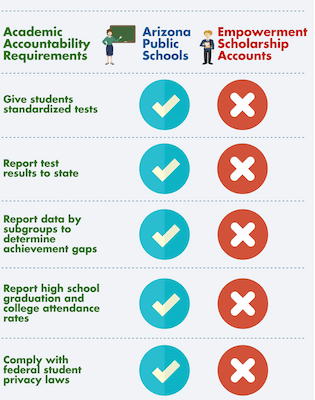
a. A district school where students are given a standardized state test with scores rolled up to the state and made public, where data is reported (following federal guidelines for data protection) by subgroups to determine achievement gaps, and where high school graduation and college attendance rates are reported?
b. A private school that does not provide any public visibility to test results and where the state (per law) has no authority to request or require academic progress from voucher recipients or the school?

Horne’s new ESA parent handbook (which previously stated a bachelor’s degree was required) now only requires a high school diploma instead of subject-matter degrees or certification. This move provides parents no guarantee that their child’s teachers have the knowledge or skill to teach core subjects. 

In addition, special education students desiring vouchers were previously required to be evaluated by a public school and receive a plan detailing their specific educational needs. Now, those students can be assessed by a doctor or psychologist, or at a private school. Keep in mind though, that, unlike public schools, private schools can refuse any student they don’t want to accept.

Funding for Public Schools

Which is more likely regarding the portability (with no impact) of per-student funding when students leave their district schools?
a. When a student leaves a district school with their education funding in their backpack, they take all associated expenses with them?
b. That there are fixed costs left behind (approx. 19%) that the school is required to still fund such as teachers and other staff that cannot be eliminated just because a couple of students left a classroom, or a bus route that can’t be done away with just because one student is no longer taking that bus, or a building air conditioner that can’t be turned off because the occupancy in the classrooms is down by three students. What the “drain” causes instead, is larger class sizes, fewer support services, less variety in the curricula, etc.?

The good news (if there is any), is that 75% of the students now taking vouchers, did not attend a public school before they qualified for a voucher. In other words, the vast majority were already attending private schools and therefore did not cause a massive drain of students from public schools. The bad news is that the cost to the state fund for the voucher program is unsustainable and if it doesn’t bankrupt the state, it will reduce funding for public education.

Are Vouchers Helping Disadvantaged Students?

Which is more likely to serve disadvantaged students — the ones most in need of our help? Hint to the answer.
a. A district school, where the vast majority of educational expenses are covered by the taxpayer, where students are transported from their home to school, where free and reduced lunches are provided, and which must accept all comers?
b. A $5,200 voucher to a private or parochial school that has total control over which students they accept, does not provide transportation, and costs an average of $6,000 for elementary schools in 2016-17?

ESA vouchers in Arizona now provide approximately $7,000 per student, regardless of household income. Not surprisingly, the cost of private school tuition has also gone up to an average of $9,576 per year for elementary school and $13,902 for high school. After all, why wouldn’t private school operators raise tuition when the voucher amount increases? 

Obviously, the most disadvantaged students will have a hard time finding their way to private schools considering the $2,500 to $7,000 out-of-pocket expense just for tuition. That doesn’t even take into account the requirement for parents to provide transportation and, the lack of any sort of free or reduced meal program. 

When it comes to transparency, accountability, and equity, district schools outperform private schools. I’d also like to make the unequivocal claim that district schools also (across the board) produce more achievement than private schools, but they don’t report their results so I don’t know that for sure.

Are Vouchers Producing Better Academic Outcomes?

National education expert Diane Ravitch recently reported that “new evaluations of vouchers in Washington, D.C., Indiana, Louisiana, and Ohio show some of the largest test score drops ever seen in the research record–between -0.15 and -0.50 standard deviations of learning loss.” If you aren’t a professional educator, those numbers might not mean much to you. Let’s just say that the learning loss was similar to that experienced during the COVID-19 pandemic and larger than what Hurricane Katrina did to New Orleans academics. 

Ravitch goes on to say that this is happening because “elite private schools with strong academics and large endowments often decline to participate in voucher plans. Instead, the typical voucher school is a financially distressed, sub-prime private provider often jumping at the chance for a tax bailout to stay open a few extra years.”

No matter how much sugar the privatizers try to coat vouchers with, they are still just a vehicle for siphoning tax dollars away from our district community schools to private and parochial (religious) schools with no accountability or transparency. For every person who says “parents have the right to use their child’s education tax dollars as they see fit”, I say, “and taxpayers have the right to know the return on investment for their tax dollars.” The former right in no way “trumps” the latter.

Every Family for Themselves

Peter Greene, a well-recognized education blogger, recently wrote a post on his blog “Curmudgucation”, titled “Vouchers are About Abandoning Public Education, Not Freeing Parents”. He says we should think of vouchers this way,

“The state announces, ‘We are dismantling the public education system. You are on your own. You will have to shop for your child’s education, piece by piece, in a marketplace bound by very little oversight and very few guardrails. In this new education ecosystem, you will have to pay your own way. To take some of the sting out of this, we’ll give you a small pocketful of money to help defray expenses. Good luck.’

It’s not a voucher system. It’s a pay your own way system. It’s a you’re on your own system. The voucher is not the point of the system; it’s simply a small payment to keep you from noticing that you’ve just been cut loose.

Freedom and empowerment will come, as always, in direct proportion to the amount of money you have to spend.”

Greene warns that “the voucher amount will dwindle” as public schools are left with those students who don’t have any other option. “Vouchers,” he says, are “the tail, not the dog. They are the public-facing image of privatization– and not just privatization of the “delivery” of education. Voucherization is also about privatizing the responsibility for educating children, about telling parents that education is their problem, not the community’s.”

Improving educational outcomes is not the point of vouchers. The point, my friends, is to reduce the power of the people, by reducing the size of government and diminishing our voice. The point is to dismantle the public square and the common good, leaving us all to fend for ourselves in a sort of hunger games that only the game masters (the rich and powerful) win. 
(Update) A Crack in the Privatization Movement?

The BASIS Tucson North charter in Oro Valley voted to unionize this past Wednesday night. By a 2 to 1 margin, teachers voted to found a local union chapter of the Arizona Alliance of Charter Teachers and Staff. This charter is now the first in Arizona to have staff join a union, an affiliate of the nation’s second-largest teacher labor union, the American Federation of Teachers.

Say it is not so! Teachers at BASIS felt the need to form a union to ensure more money for hiring and retaining teachers. What has the world come to when we can’t rely on businesses to do the right thing and take care of their employees without some pesky union getting in the way?

Trudi Connolly, a member of the union organizing committee explained the rationale for unionizing.

“The union was needed because we were losing teachers and the essence of the school’s culture at an unbelievable rate. We want to protect the aspirations we’ve always had for our school. Under current circumstances, we can’t retain enough teachers to educate our students, let alone provide them with the dept of intellectual experience and support they deserve. Teachers, indeed like all kinds of workers all over the country, are coming together to make sure they have a real voice in what the future of our workplaces looks like. In our case, we want our workplace to be one where teachers thrive and students get the education they deserve.”

Teachers and administrators of public school districts across the state share this sentiment. But, Arizona is a “right to work” state. This means an employer is prohibited from denying a person the opportunity to be hired or retained because they are not a member of a labor organization.

The Arizona Education Association, (and its local district chapters), represents 20,000 members.

The AEA can lobby for employees at the Legislature. They can also represent them in negotiation efforts such as “meet and confer”, a board-adopted policy to ensure both sides negotiate in good faith in a sincere effort to be heard and reach a consensus. They can also represent employees in “interest-based bargaining”, enabling negotiators to act more like joint problem-solvers. The AEA may not, however, engage in “collective bargaining” for the employees.   And, district employees are prevented from going on strike and if they do, they can be fired and replaced.

For further clarification, I reached out to a lawyer friend of mine who has extensive Arizona education policy experience. He said Arizona does not allow for collective bargaining but that doesn’t mean employees can’t unionize. It does, however, mean they can’t be required to join the union as a condition of employment (the “right to work” part). Just because the employer is not obligated to engage in collective bargaining, doesn’t mean some representation and organizing can’t occur.

Most school districts “meet and confer” with their employees.

Although school districts aren’t obligated to “meet and confer” with their employees, many do. Partly because some Boards require it and because there is some connection between being elected by the public and being responsive to the staff. That same dynamic would likely not be present in a charter like BASIS. In fact, according to PublicCharters.org, Arizona law provides that all charter schools are their own legal entity and thus are not required to abide by any outside agreements. It will be interesting then, to see what becomes of this new union’s efforts to bargain on behalf of its members at the BASIS school.

Did unions create charters?

I thought it ironic that unions were gaining a foothold in charter schools since a common narrative was that unions played a part in creating charters, to begin with. Additional research, however, proved this narrative suspect. Rachel Cohen, in DemocracyJournal.org, wrote in 2017 that legendary AFT president Albert Shanker played a much smaller role in creating the charter concept than he has been credited with. Rather, she claims,

“At its outset, the real power in the charter coalition was what might be termed the ‘technocratic centrists’: business leaders, moderate Republicans, and DLC members looking for Third Way solutions that couldn’t be labeled big-government liberalism.”

She goes on to say,

“The mythological origin story of charter schools—the Shanker myth—has served an important role in keeping the charter coalition together. The idea that charters come from unions lends a certain weight-of-history inevitability to school reform. It suggests that everyone has agreed that change must come, and the only question is from who, and what it’ll look like in the end.”

Cohen posited that the “Shanker tale” may have “helped undermine progressive school choice advocates, who find themselves chasing a vision that has never played a major role in the inner circles of school reform”. Most charters she writes,

“Are more segregated than traditional public schools, are non-union, and when charter educators do mount union campaigns, they almost always face tremendous opposition. If the promise of unionized, integrated, teacher-centered charters has proven devilishly difficult to fulfill, it may be, in part, because the movement’s leaders never took it very seriously to begin with.”

A movement is afoot.

That was in 2017 and now, approximately 12% of U.S. charter schools have unionized. BASIS union organizer Duncan Hasman believes a movement is underway saying “A win in Arizona is a signifier that charter school teachers are ready to start making their voices heard across the nation”. A union press release stated, they will work towards, “additional accountability, administrative transparency, and more resources and time to effectively identify and address student needs”.

I reached out to AFT prior to publishing this article and they asked Duncan to get in touch with me. He did and told me he has (along with the organizing committee) been working on unionizing for a couple of years. The decision to organize wasn’t due to a “straw that broke the camel’s back”, but rather, resulted from recognition of a structural problem. There just wasn’t a mechanism for teacher considerations or recommendations to be heard. And, there wasn’t any strength in individual negotiation.

I asked Duncan how Arizona’s “right to work” law and prohibition against collective bargaining affected the union’s ability to organize and their bargaining efforts. He said they did have to reassure teachers that organizing and forming a union was still possible despite state laws. The OC addressed their concerns and now their approach, informed by data and an understanding of how the system works, will amplify teachers’ voices and give strength to power.

When I asked him if he worries about what the AZ Legislature will do to try to negate this victory, he said that, “As an organizer, you know what you have control over and you know what you don’t. Our group of teachers has control over what they say and do, but we can’t control the Legislature”. 

Time will tell how successful their efforts will be in a state whose Legislature is way more business-friendly than teacher-friendly, regardless of the type of school. BASIS Eighth-grade algebra teacher Justine Sleator explained her hopes for the effort,

“Our union will allow us to reprioritize the needs of our students. We will be able to protect new teachers from burnout and retain high-quality educators, as BASIS has been known for.”

That need is universal, especially in this time of ever-increasing pressures placed on our public schools and educators. Really, why would anyone want to be a teacher these days with our lawmakers constantly looking for ways to make their jobs even more demanding? The bottom line for Duncan Hasman is that teachers at his school “needed a voice”. There was no structural way for teachers to come together and share their experiences and needs with either management or the community they serve. 

Ultimately, privatization is not about “giving power to the people”. Rather, it is about giving power to “The Man” (business). Maybe this win at BASIS will act as a small crack in the privatization movement. At the very least, it will likely show that although BASIS has a reputation for student achievement, it comes at a cost. It will be interesting to see how that bill is paid. 

T and A: #1 Benefit of Public Schools

I’ve no doubt raised a few eyebrows with the title of this post. Get your mind out of the gutter people, I’m talking about transparency and accountability!

Let me be clear…I believe America’s public schools are what made our country great. They ensured all children had the opportunity to learn and they coalesced our communities and all the different types of people within them. But, in terms of today’s school choice landscape, the number one benefit offered by public district schools over all other choices, is transparency and accountability.

Of course, in this alternate universe the GOP has created, up is down, left is right, black is white, and private school choice options (private, religious, and home schools) are the more transparent and accountable schools for parents and taxpayers. Nothing could be further from the truth. District schools, with publicly elected school board members and the requirement to follow Open Meeting Law (at least in Arizona), are by far the most transparent and accountable. Yes, our charter schools are also public schools, but they don’t have publicly elected boards. Rather, charter school board members may not even live in the same state, let alone in the same town. But as public schools, both district and charter schools have myriad transparency requirements private school choice options don’t. These include the need to follow Open Meeting Law, ensuring the public’s right to witness the discussion, deliberation, and decision-making done in its name. They also must: accept all students; comply with stringent requirements for reporting, procurement, and auditing; and allow parents the right to review all instructional material and intercede in their child’s education where they believe it is necessary. There are many more differences in transparency and accountability, but you get the idea.

And yet, those advocating for school privatization have managed to convince many parents (especially in today’s highly partisan environment), that public schools (especially district schools) are trying to indoctrinate their children with values and ideology that are different than their own.

What it is really about though, as pointed out by fellow education blogger Jan Resseger in her recent post, is money and power. After all, the total bill for K-12 education in the U.S. in 2018-2019 school year was already $800B. In Arizona this year, K-12 education constitutes almost 44% of the state budget. Privatizing public education is a lucrative triple-play for the rich and powerful and those lawmakers they keep in office. Privatization allows the reduction of the need for taxation, it offers the opportunity for corporations to profit directly from the education industry, and it reduces the voice of the people making it easier to ignore their will. As Resseger points out, Gordon Lafer, in “The One-Percent Solution”, said,

(F)or those interested in lowering citizens’ expectations of what we have a right to demand from government, there is no more central fight than around public education. In all these ways, then, school reform presents something like the perfect crystallization of the corporate legislative agenda.”

The brilliancy of packaging school privatization was convincing parents that their “right to choose”, was what was important. Resseger also quoted Benjamin Barber, in his book “Consumed”, who deftly makes the point that this ability to choose, however, is not the real power.

We are seduced into thinking that the right to choose from a menu is the essence of liberty, but with respect to relevant outcomes the real power, and hence the real freedom, is in the determination of what is on the menu. The powerful are those who set the agenda, not those who choose from the alternatives it offers. We select menu items privately, but we can assure meaningful menu choices only through public decision-making.

In other words, you are either at the table, or on the menu. In fact, I previously wrote a post with this same title back in 2014. With public schools, parents, voters and taxpayers are at the table (if they exercise their rights the way they should). Unfortunately, it takes work to exercise our rights and hold our elected officials accountable. But then, that’s what is meant by “of the people, by the people, and for the people”. “We the people”, must do our part if we want our government and its institutions to reflect our values. At least in public schools, we have that opportunity.

Yeah, Let’s Focus on Our Students!

In a recent Scientific American article, a U.S. Department of Education spokesperson for Betsy DeVos said “The secretary believes that when we put the focus on students, and not buildings or artificially constructed boundaries, we will be on the right path to ensuring every child has access to the education that fits their unique needs.” As good as that sounds, it is total bullshit.

Here’s the deal. As much as its proponents try to tell us otherwise, school choice does NOT put the focus on students, because the “choice” is largely that of the commercial school, not the student. We know for example that private schools have total control over what students they accept, irrespective of the students’ funding sources (taxpayer-funded vouchers included.) Charter schools are by law required to accept all, but we also know they enroll much lower percentages of special needs students, those of color, and those in poverty.

As for the secretary’s belief that we should put the “focus on students, and not buildings or artificially constructed boundaries,” puhleeeeeeeaaasssee! This is just a thinly veiled swipe at community district schools. In Arizona, over 80% of our students attend these district schools where facility maintenance and repair is severely underfunded and there are no “artificially constructed boundaries” since we’ve had open enrollment since 1994.

Incidentally, “ensuring every child has access” is not the same as “providing every child….” Access refers to “the right or opportunity to use or benefit from something.” But, it takes more than the right or opportunity, it takes the means not only to get into the school, but to get to the school and survive the school. That’s not how it works in a district school which takes all comers, and works to provide each student what they need to succeed. And, they continue to serve the student even if that student’s test scores don’t make the school look good.

The piece de resistance in the DOE statement though, is “that fits their unique needs.” Wow! Isn’t that a great sound bite? Unfortunately, it is totally undoable and DeVos knows it.

In America, one in five children live in poverty. This reality, not inadequately funded schools and under appreciated teachers, is their major hurdle to a good education. What these students need is more than district schools are charged with, or have the capacity to provide. There is just no way commercial schools will do better at bridging that gap.

It amazes me how adept the privatization advocates have been at messaging. They’ve convinced parents that school choice is the answer and that “voting with their feet” is empowering. But as a fellow blogger pointed out recently, when parents “vote with their feet” to leave district schools for greener grass, all they are really doing is relinquishing influence. There is no school choice option (aside from homeschooling) that provides a parent as much say in their child’s education as does the district school with its locally-elected governing board. Parents and taxpayers alike have the right to be heard at public board meetings and, if their elected governing board members are not responsive to parent’s concerns, they can be recalled or replaced via elections.

Yes, we should all be focused on the students. So let’s do that, okay? Let’s properly fund our local community district schools where over 80% of our students are, instead of reaching for the shiny object being dangled to distract us. Let’s demand our tax dollars are spent where there is full accountability and transparency with locally-elected governing boards responsible for producing a good return on our investment. Let’s demand our teachers are adequately compensated and treated like professionals. Let’s in other words…put our money where our mouth is. The bottom line is that parents shouldn’t have to make a choice about where to send their kids. Every public school should be a high quality one.


Something Borrowed, Something Blue

Let me be clear from the onset that I am “borrowing” this article. In fact unless the words are in bold italics, they are hers, not mine. I’m hoping the author, Athens Banner-Herald columnist Myra Blackmon, a resident of Washington, Ga., sees my “borrowing” as the “sincerest form of flattery. I chose to use her piece titled “School vouchers raise too many questions,” because I found it both very well written and remarkable in that I needed only change the state name and some of the numbers to make it apply to Arizona.

With the confirmation of Betsy DeVos as U.S. secretary of education, we can expect to see a flurry of new “initiatives” designed to address the so-called education problem in our country. For the moment, let’s set aside the relationship of poverty and poor academic achievement. Ignore for a moment the fact that our schools are actually performing pretty well.

We will likely see a renewed push for voucher programs, where parents can supposedly take the tax money allocated for their children and use it to enroll them in private, religious or charter schools, many of which are combinations of those categories.

If I believed vouchers would improve educational outcomes for Arizona’s poorest children, I would be the first to jump on that bandwagon. The reality is that even vouchers aren’t likely to improve the lives of the 421,000 Arizona children who live in poor or low-income families, despite efforts of reformers to convince us otherwise.

First, the average worth of  $5,600 for mainstream students that vouchers provide just isn’t enough to fully fund private school tuition. I chose not to spend an hour looking at websites (as Myra did) of private schools in all parts of the state to determine the range of tuition, but did find a school in Phoenix that charges $24,000 a year, and the average school tuition is almost $6,000 for elementary, and $18,000 for high school. Does this even seem possible for a disadvantaged child, even if a scholarship is available?

Second, not all non-public schools are open to all children. The majority of private schools in Arizona are religious schools, many of which set very strict standards for admission that have little or nothing to do with academic potential. They would exclude children from families of same-sex couples, or families whose moral standards are, in the judgment of the school, not consistent with the school’s values. That might exclude children whose parents are not married, or who were behavioral problems at their previous school.

Third, few private schools provide special education. Of those that do, many limit that special education to mild learning disabilities, or limit them to mild ADHD or other learning differences. Many private special education schoolsdon’t address severe or complex disabilities. Only public schools are required to meet all those needs. In fact, when Arizona parents pull their children out of district schools to educate them with a voucher, they must waive their rights under federal special education  law.”

Fourth, even if a voucher covered tuition at a private school, it would be almost impossible to include allowances for additional fees that would allow the poorest children to attend. Lab fees, textbooks, materials fees and technology fees add up. I found more than one school where those items quickly totaled more than $1,000 a year. And that didn’t include trips – sometimes mission trips in religious schools – or athletic fees, which also ran into the thousands of dollars. What about these costs?

Fifth, about 10 percent of Arizona’s schools are rural schools…with some children on buses more than 60 minutes each way every day. And those are the public schools. Private schools can be even more distant. For public schools, transportation is provided. Bus fees for private schools could run several hundred dollars a year. Who covers this?

And what about homeless students? According to New Leaf, a mesa non-profit human services organization, about 3 percent of Arizona students – nearly 30,000 children – were homeless in 2016. In fact, the National Center on Family Homelessness ranks Arizona as worst for risk of child homelessness. Do you really see these children as able to take advantage of vouchers?

Seventh, I found listings for many private religious schools that enroll fewer than 100 students and have only two or three teachers. Would a voucher to such a school improve a student’s chances over even the most poorly resourced public school? I doubt it.

The bottom line is that vouchers help middle-class families who can almost-but-not-quite afford private school tuition. Those are also the children who score best on standardized tests.

Vouchers help segregate those families from the poor and different in their communities. They isolate students from daily contact with needy families or children from unusual families. Some charge their students for “mission” work, which is a completely different dynamic in relationships with people different from us.

I simply do not see how vouchers for private schools, unregulated and not accountable to any elected officials, can do anything but set up our public schools as the place for the poorest, neediest and most severely disabled students.

That is wrong. I know it. You know it. Yes we do Myra, and that’s what the “something blue” in the title of this post refers to. This kind of misery shouldn’t have any kind of company. 

Ooops, there it is!

We knew it was coming and awaited it with dread. And, drumroll please…crash goes the cymbal! Yes, here it is, this year’s attempt to exponentially expand Arzona’s voucher (Empowerment Scholarship Accounts, or ESA) program. Of course, the American Legislative Exchange Council’s (ALEC) chief water carrier for Arizona, Senator Debbie Lesko, R-Peoria, is the one proposing the expansion. Lesko claims the expansion of ESAs will “not lead to a mass exodus of children from public schools.” I, for the most part, agree with that statement since Arizona parents have made it clear district schools are their choice with 80% of students attending district schools and another almost 15% in charter schools.

But, to infer a massive voucher expansion will have no negative impact on district schools is disingenuous at best. No matter how slowly students may attrit from district schools, each student’s departure leaves behind a 19% budget shortfall. That’s because there are numerous fixed costs (teacher salaries, facility maintenance, utilities, buses, etc.) that cannot be reduced student by student. The siphoning of dollars from our district schools has been steadily increasing and just exacerbates an already inadequately resourced system.

This isn’t the first year the Legislature has attempted to expand the voucher program. In fact, they’ve been successful in expansions every year since the ESA program was launched in 2011. This isn’t even the first time a full expansion has been attempted, with a very similar proposal going down in flames last year due to public outcry and a perceived conflict with securing voter approval of Prop. 123. This year though, Lesko has sweetened the deal by requiring the testing of students attending private schools on vouchers. She says she “doesn’t personally think this requirement is necessary,” but obviously is trying to defuse the argument from voucher opponents that there is no accountability or return on investment for vouchered students.

She is right about one thing, district education advocates want more accountability and transparency where taxpayer dollars are spent on the myriad of school choice options. As the only schools governed by locally elected school boards and with annual efficiency reports published by the Office of the AZ Attorney General, district schools are the only schools fully accountable and transparent to the taxpayers. Pro-choice advocates tout that parents should have the right to choose where they send their child to school at government expense. As a taxpayer, I maintain I have the right to know the return on investment of my tax dollars. Their right should not trump mine.

Senator Lesko also infers that vouchers will save money because the average voucher amount for students without special needs is $5,200, yet it costs $9,529 to educate Arizona’s average student in public schools. This is misleading because she is comparing apples and oranges and she knows it. The $9,529 figure she quotes is a total of all funding sources, federal, state and local (bonds and overrides) while the $5,200 is only state funding. So, if a student transfers from a district where state funding is offset by locally supported funding (due to the equalization formula), that student’s voucher will actually cost the state general fund more than if that student had remained in their district school. Lesko also notes that vouchers and school choice are a national trend as evidenced by President Trump’s nomination of Betsy DeVos as Secretary of Education.

Oh no, she did NOT go there! Trying to sell vouchers as mainstream by pointing to Trump’s nomination of DeVos is akin to denying global warming by citing colder temperatures in parts of the country. After all, DeVos’ success with promoting school choice in Michigan has been dismal. In the two-plus decades she has championed this crusade (those knowledgeable about DeVos will understand my choice of that word), she has purchased legislative influence to expand charters and greatly reduce accountability. She has also worked hard to introduce vouchers in the state, but thus far, the voters have prevailed to keep those “wolves” at bay. And the improvements she has promised haven’t materialized with scores on the National Assessment of Educational Progress (NAEP) for 4th graders declining from 28th in reading and 27th in math in 2003, to 41st in reading and 42nd in math in 2015.

According to the Arizona Capitol Times, the American Federation for Children (AFC) is pushing vouchers nationwide. I’m only going to give you three guesses as to who the chair of AFC is, and the first two don’t count. Yep, none other than Betsy DeVos. In addition to pushing for school choice and vouchers around the country, AFC has spent big bucks on rewarding those legislators working to expand privatization and punishing those who try to stand up for the 90% of students attending our nation’s districts schools. As reported by Richard Gilman on his website BringingUpArizona.com, AFC is a 501(c)4 free to pour dark money into political campaigns. And pour they have. Gilman writes, “Since its inception in 2010, the organization has poured nearly three-quarters of a million dollars into Arizona elections in a largely successful effort to sway the makeup of the Legislature.” The state’s “demonstrated appetite for school choice” is what AFC cites for its focus on Arizona. Of course, common causes make “strong” bedfellows and Gilman tracks AFC’s interest in Arizona back to Clint Bolick (once Vice President of Litigation at the Goldwater Institute and now AZ Supreme Court Justice.) Bolick served as the first president and general counsel for the Alliance for School Choice (AFC’s predecessor.)

But, I digress. The point is that no matter what snake oil the corporate reformers try to sell us, there is an incredibly well-funded, high-powered effort to have two school systems in Arizona. One is the commercial system of charters, private, parochial, virtual and homeschools that serve the whiter and wealthier students, and the other is the district schools, starved for resources, that will have the poorer, browner, and more challenged students to educate. According to recent polls, this is not what the vast majority of Arizonan voters want. But, until Arizonans clearly draw the nexus between voting for Legislators who don’t support our public district schools (most of them with an “R” after their name), and the fact that our district schools are way under resourced, nothing will change. If we want something different, we have to do something different. To continue doing the same thing and expecting different results, is as you know…the definition of insanity.

Graham Keegan is “Very Pleased” With DeVos…What a Shock!

I started reading Thomas Friedman’s latest book this morning, “Thank You for Being Late, An Optimist’s Guide to Thriving in the Age of Accelerations.” I’m only in the second chapter, but in it he credits Craig Mundy, former Chief of Strategy and Research at Microsoft, with using the terms “disruption” and “dislocation” when speaking about the effect of acceleration. Mundy defines “disruption” as, “what happens when someone does something clever that makes you or your company look obsolete. “Dislocation” is the next step — “when the rate of change exceeds the ability to adapt.

I argue the education reform movement has been working hard for some time now to disrupt truly public education; to find “something clever” that makes district education look obsolete. Unfortunately for them, the results haven’t quite matched up to the rhetoric. While school choice advocates like to promote the “magic of the marketplace thinking,” they just don’t have a good track record of improving overall student achievement. And yet, Lisa Graham Keegan, Executive Director of A for Arizona & Glenn Hamer, President & CEO of the Arizona Chamber of Commerce & Industry fall all over themselves in an exuberant support piece for Trump’s Secretary of Education (SecED) nominee, Betsy DeVos. They are “very pleased with her nomination” writing that it, “signals a shift in the conversation around education policy in exactly the right way.” Let’s be real. What they are really hoping is that if confirmed, Betsy DeVos will propel the commercialization of district community schools at a “rate of change” that “exceeds the ability to adapt”, i.e., that it will cause “dislocation.”

Tulane University’s Douglas Harris argues though that, “The DeVos nomination is a triumph of ideology over evidence that should worry anyone who wants to improve results for children.” That’s because the evidence from DeVos’ backyard is far from pro-commercialization. Michigan has become a Mecca for school choice over the past 23 years and its charters are among the most-plentiful and least-regulated in the nation. Approximately 80% of Michigan’s 300 publicly funded charters are operated by for-profit companies, more than any other state. Yet, a 2015 federal review of Michigan’s charters found an ‘unreasonably high’ percentage that were underperforming. In response, DeVos and friends successfully defeated state legislation “that would have prevented failing charter schools from expanding or replicating.” By doing so, they enabled the doubling of charter schools on the list of lowest performing and the competition she’s driven has district and charter schools fighting over students, ensuring no one thrives. Randi Weingarten, President of the American Federation of Teachers,  writes that DeVos has long been, “working in Michigan to undermine public schools and to divide communities. And now—she’s poised to swing her Michigan wrecking ball all across America.”

DeVos’ “wrecking ball” isn’t just about using charters to do the “disrupting and dislocating”, but virtual schools and vouchers as well. In fact, Rachel Tabachnick, a researcher, writer and speaker on the impact of the Religious Right on policy and politics, calls her “the four star general of the voucher movement.” Tabachnick, no doubt like many others, is concerned that DeVos will gleefully work to make good on Trump’s promise of $20 billion for school choice, by siphoning off Title I funds designed to help the most vulnerable kids to the benefit of wealthy families for private and religious schools. There are real doubts among many though, that even if the money were available, Trump’s voucher idea (had typed “plan”, but I don’t think Trump is big on those) just won’t work. Current SecED John King said, “Vouchers, I don’t think, are a scalable solution to the challenges that we face in public education, and I think (they) have the potential to distract us from focusing on how we strengthen public education.” Teacher and writer Retired Professor and writer, Joseph Natoli writes, “Unless we deconstruct the narrative that privatized schools somehow have uncovered the secret to how humans learn and have a monopoly on the most effective ways to implement that knowledge, we are allowing false assertions to stand.” Natoli also writes, “Weakening public education to the point that privatization looks like rescue is accomplished by funding that is decreased when tax funds are siphoned off to for-profit charter [or private] schools.”

Most of us also understand, as Steven M Singer, blogger at gadflyonthewallblog writes, that school choice “privileges the choice of some and limits the choices of others.” This is bad he posits, because district schools “pool all the funding for a given community in one place. By doing so, they can reduce the cost and maximize the services provided.” Adding parallel systems increases the costs thereby providing less for the same money. “Public [district] schools are designed to educate. Corporate schools are designed to profit” Singer notes, and eloquently writes, “Instead of fixing the leak in our public school system, advocates prescribe running for the lifeboats. We could all be sailing on a strong central cruise-liner able to meet the demands of a sometimes harsh and uncaring ocean together. Instead we’re told to get into often leaky escape craft that even under the best of circumstances aren’t as strong as the system we’re abandoning.”

Mitchell Robinson at ecletablog.com, believes DeVos’ “ultimate goal, appears to be a two-tiered educational system.” One, a system of well-funded elite private and religious schools with highly qualified teachers and a rich curriculum for wealthy whites and another of “fly by night” virtual and for-profit charters with little to no regulation or oversight, and a bare bones, “back to basics” curriculum delivered by unqualified and uncertified “teachers”.

Back in Arizona though, Graham Keegan and Hamer write that DeVos is not a “gradual improvement” kind of leader, but a “true reformer who believes in immediate transformation of lives through quality education because she sees it happening. (One might ask where, since it ain’t in her home state of Michigan.) Of course, they follow that up with ”we’re optimistic that under Mrs. DeVos’ leadership we can take a national break from seeking to impose improvement from on high…” Her soon to be boss though, doesn’t seem to want to give up the bully pulpit to affect change saying, “There’s no failed policy more in need of urgent change than our government-run education monopoly. ”It is time to break up that monopoly.” His words are of course, hyperbolic and untrue, as government is not the sole provider of K-12 education, nor is competition prohibited by law.

What is not hyperbole, is that DeVos and other elites understand that truly public education helps make the American Dream possible. That’s why they are fighting so hard to dismantle it. “Educator Stan Karp argued that what is ultimately at stake in school reform debates is ”whether the right to a free public education for all children is going to survive as a fundamental democratic promise in our society, and whether the schools and districts needed to provide it are going to survive as public institutions, collectively owned and democratically managed – however imperfectly by all of us as citizens. Or will they be privatized and commercialized by the corporate interests that increasingly dominate all aspects of our society?”

This fight is not just about what kind of schools America’s children attend and who pays for it. It is also about weakening the power of our Democracy and its people. Will we continue to be a nation “of the people, by the people, for the people” or will the oligarchy turn us into a caste or feudal system where only a few have a say and the rest of us serve? If you want to continue to have a say in our Democracy, exercise it today by clicking here to contact your U.S. Senators today and tell them to vote “NO” on the confirmation of Betsy DeVos as America’s next SecEd. Then stand at the ready, because the cause is just and the fight is far from over.

NOTE: For those of you who may know me as a member of the Oracle School District Governing Board, I want to make it clear that these views are my own and do not represent the views of the Governing Board of the Oracle School District.

Warning: School Choice Can be Hazardous to Your Community

Carol Burris, Executive Director of the Diane Ravitch’s Network for Public Education, recently wrote about the direction President-Elect Trump appears headed with education. “There are clear indications” she said, “that President Obama’s Race to the Top will be replaced with something that could be called ‘Race to the Bank’, as the movement to privatize education seems certain to accelerate.” Trump’s promise to redirect $20 billion in federal funds (most likely in Title I monies), is a good indication of that desire to accelerate. Of the redirect, Trump himself said, “Not only would this empower families, but it would create a massive education market that is competitive and produces better outcomes, and I mean far better outcomes.” Recent studies though, just don’t bear out those “far better outcomes” and although Congress previously considered redirecting Title I funds, they scrapped it with the Every Student Succeeds Act.

Nonetheless, Trump seems determined to press ahead as indicated today by his pick of Betsy DeVos, a forceful advocate for private school voucher programs nationwide, as his Secretary of Education.  And although his website claims that school choice is “the civil rights issue of our time”, the Nation’s leading public education advocate, Diane Ravitch writes, “school choice is not the civil rights issue of our time, as its proponents claim; it is the predictable way to roll back civil rights in our time.” Her words are born out by the fact that segregation in the United States is now the highest it has been since the early 1960s. And to that point, the Arizona Republic writes that vouchers, tax credits and charters are used “by those who least need help”, “siphon money from traditional district schools”, and “are thinly disguised workarounds that wealthy parents can use to keep their kids out of the district schools where students of color are in the majority.” Jeff Bryant, on educationopportunitynetwork.org, writes, “it’s hard to see how a system based on school choice – that so easily accentuates the advantages of the privileged – is going to benefit the whole community, especially those who are the most chronically under-served.” After all, we all know there are plenty of disadvantaged families who will likely never be able to access school choice options, partially because it really is schools’ choice. This reality plays out every day when commercial schools either don’t admit those students they don’t want or, weed them out early on.  The desire to not call attention to that truth may be part of the reason we’ve begun to see the rebranding of “school choice” to “parental choice.”

The real problem though is much more than semantics, but what school choice is actually doing to not only our district schools, but our communities as well. Julie Vassilatos, on chicagonow.com, writes that “choice” “quietly diminishes the real power of our democratic voice while it upholds the promise of individual consumer preferences above all else.” (It’s all about me.)  The picture she paints of school choice is this: no schoolmates in neighborhoods, children traveling several hours a day to/from school, and “very little political and residential investment in the heart of neighborhood communities.” The school choice model she contends, is “fracturing and breaking down local bonds among families and within neighborhoods.” Could it be that “divide and conquer” is what this is really about? Vassilatos seems to think so contending that, “Democracies require stable communities with strong institutions that are of, by, and for the community. Democracies are built on strong, stable localities.” School choice she claims, is gutting our communities and robbing our voices.

Meanwhile, Carol Burris points out that our Vice President-Elect, Mike Pence, shepherded such a time of gutting and robbing while Governor of Indiana. His voucher program created $53 million in school spending deficits in the last school year alone and the damage continues to this day. If school choice proponents get their way she warns, we could be looking at the same sort of disastrous full-frontal school choice implementation both Chile and Sweden are now trying to dig themselves out of.

We, as a nation, Burris says, need to ask ourselves two important questions. First, do we want to “build our communities, or fracture them?” Second, do we believe “in a community of learners in which kids learn from and with others of different backgrounds”, or do we want to further segregate our schools by race, income and religion. She contends that we cannot have both and that “true community public schools cannot survive school choice.” I agree with Carol, but it isn’t because the district schools can’t compete. Rather, it is because the deck is stacked against them and politicians and profiteers continue to pile on.

Robin Lake, of the Center on Reinventing Public Education, which supports many school choice initiatives, said she believe there needs to be a focus on quality: “My fear is [that] a big ideological push for choice as an end, not a means, is a dangerous prospect. It’s not only dangerous for getting schools started that may not be effective, but it’s also dangerous for long-term politics.” Noah Smith on bloomberg.net, basically agrees, if from a different angle. “The evidence is clear that vouchers are a policy with underwhelming potential” he writes, and “if the U.S. cares about academic success, policy makers should focus not on turning the school system into a marketplace, but on reforming existing schools to improve their quality.

As Arthur Camins points out on HuffingtonPost.com, “there are better choices than school choice to improve education.” Unfortunately, those choices are not the path of least resistance for our politicians and our short attention spans make expediency a winning strategy. Too bad those who have no voice are the ones who will ultimately suffer the most.

Predatory Privatization

Education reformers would have you believe the best way to improve the American public education is to privatize it.  Senator Al Melvin, candidate for Arizona Governor, thinks the solution is to give parents $9K for each of their children so they can choose where to send their child.  Never mind that there are over $1 million students in Arizona and the cost to implement this “voucher” system would be more than the entire state budget.

Nonetheless, let’s explore this idea that privatization is the best solution to provide services for the common good.  In Arizona, we turn to the business of incarcerating people, as this state is one of the leader’s in privatizing prisons.  In early 2012, the Arizona chapter of the American Friends Service Committee (AFSC) issued a report on the impact of private prisons in the state.  The report was called “Private Prisons: the Public’s Problem” and it concluded that between 2008 and 2010, Arizona overpaid for private prison services by about
$10 million, and the services it received were sub-par: malfunctioning alarm systems, fences with holes in them, staff who didn’t follow basic procedures and more.  In fact, the state’s auditor general found 157 serious security failings across five prisons that hold in-state prisoners.  At least 28 riots were also noted.[i]

How did we get here?  In 2012, Corrections Corporation of America (the largest for-profit private prison company in the country) sent a letter to 48 state governors offering to buy their public prisons in return for 20-year contracts.  These contracts would include a 90 percent occupancy rate guarantee for the entire term.  In Arizona, three for-profit prison contracts secured a staggering 100% quota, despite an analysis from 2012 by the Tucson Citizen that showed the company’s per-day charge for each prisoner increased an average of 13.9% over the life of the contracts.  In 1997, Arizona’s spent $409 million on prisons; the per-year cost is more than $1 billion today.  The state now has over 600 current contracts for incarceration related functions, but in fact, cost-effectiveness claims of private prisons just aren’t true.[ii]  According to both AFSC and the non-profit privatization resource center, In the Public Interest:  “in states across the country, private prisons have been plagued with a multitude of problems – major riots have exploded, inmates have died, and civil rights have been routinely violated. Private prisons have an economic motive to cut costs in every area of operations, resulting in lower-quality staff, higher employee turnover, and degrading prison conditions. These dismal conditions directly contribute to the decreased security and higher incidence of violence found at privatized prisons. As prison quality greatly suffers, there is little evidence that these private prisons save governments money.”

Surely this drove Arizona legislators to rethink their position on privatizing prisons, right?  Nope, instead of trying to right the ship, they just turned it into a submarine passing HB2860 which, in the words of AFSC, would “ensure that the public would have no way of knowing whether the state’s private prisons are saving money, rehabilitating prisoners, or ensuring public safety.”[iii]  Why would this be the case you ask?  Let’s just follow the money. Private prison companies like GEO Group and Corrections Corporation of America have made huge contributions to legislators from both major parties, but most of the funds have gone to Republicans.  These corporations have also played a very direct role in designing legislation good for business (such as SB 1070, the state’s notorious immigration bill, passed in 2010).   Florida on the other hand, made exactly the opposite choice with a bi-partisan bill to defeat a plan to privatize the state’s prisons.  The legislators who opposed the bill “argued that public education, like public safety, is a core mission of government that shouldn’t be outsourced to private vendors.”[iv]

As with the prison industry example, the incentives motivating those seeking privatization appear to be immune to the failures of vouchers to deliver on the promise of improved educational outcomes.[v]  The Arizona State Legislature has been working toward privatization of our public schools in a multitude of ways.  Tax credits for private schools and student tuition organizations wash money from public schools into private ones, often for students whose parents didn’t need the help to send their child to those schools.  Empowerment Scholarship Accounts (ESA) give parents 90% of what the state would have spent on their child with a wide range of how they can spend it, even to send their child to a private school.  Then there was also the pillaging of the public education budget that made Arizona the state with the highest per-pupil cuts to education from 2008 to 2012.  Court mandated funding of the owed inflation funding from Prop 301 has helped raise us to third highest in the nation now, but that still is a poor ranking.   Of course, it is important to understand that many of these voucher work-around programs get started as providing opportunity to students from poor families, children with disabilities or students in underperforming schools as with Arizona’s ESAs.  This however, is not the ultimate goal of the privatizers.  They are instead, a tactical means to a much larger strategic end of ending public education.[vi]

To what end you ask?  Again, follow the money.  Organizations like ALEC are promoting school choice and privatization, providing our legislators “camera ready” bills to implement across the country.  In addition, Right-wing organizations and donors laud Arizona as a leader in the school choice movement and are funneling big money into the state.

What is really ironic about this whole privatization movement is that the GOP has painted them self into this corner.  Their anti-government fanaticism, combined with tough stances on crime, immigration, etc., combined with a refusal to raise taxes, forces them to tout the benefits of privatization.  Unfortunately, the companies whom the services are farmed out to are interested much more in a desire to generate revenue than in any social obligation.  Think Halliburton and Backwater during the wars in Iraq and Afghanistan.

The bottom line is that business is in business to make money.  There is nothing wrong with that as long as the product or service they provide is not something that must be provided to everyone regardless of their ability to pay.  Every state constitution in the nation mandates the state provide a free public education – it was a requirement for their entry into the Union.  But, when public services have been outsourced to “for-profit” companies, it is very likely the contract will increase in cost over time, limit transparency, undermine good public policy and the democratic process, and that the drive to generate revenue over providing for the public good will eventually be more costly to the taxpayers.[vii]  The examples abound.  We should pay attention.  Public schools are not only our right as Americans, but they helped make us a great nation and, are important still very important to the health of our communities today.