Is Accountability Really Too Much to Ask?

It is, after all OUR money…

You’ve no doubt seen the stories about parents using voucher money to purchase dune buggies and Oscar Mayer hot dog machines and looking for a curriculum to teach their children the “flat earth theory”. Any reasonable person would realize that Arizona’s voucher program must be made more accountable to safeguard taxpayer dollars and ensure students are taught what they need to know to be productive citizens. 

Reasonability is probably not a word ordinarily associated with the Goldwater Institute though, as is indicated by their recently filed lawsuit against the state of Arizona. As reported by The Arizona Republic, this lawsuit is about “a recent change to the school voucher program that requires parents to tie supplemental materials, including books, pencils and calculators, to a curriculum”. The Goldwater Institute claims “The change has added ‘bureaucratic hoops’ and ‘arbitrary paperwork’ that bog down the reimbursement process”.

The voucher reform was introduced this year after AZ Attorney General Kris Mayes’ office began investigating allegations that the AZ Department of Education had approved illegal expenses under the program. Again, from The Republic,

“State law required textbooks and supplemental materials to relate to a curriculum, according to the Attorney General’s Office, but the official program handbook did not require families to prove such a connection.”

The Goldwater Institute filed the lawsuit on behalf of two Moms, Veila Aguirre and Rosemary McAtee. Aguirre was quoted in a Goldwater Institute news release as saying, “No other teacher in the state has to provide curriculum for purchasing things for their classroom”.

That might be because state standards dictate what must be taught in public school classrooms and district governing boards approve curriculum and textbooks. Teachers also must submit requests for supplemental materials purchase to the district office and governing board members must approve the vouchers detailing all those purchases right down to yes, pencils and erasers.

And I find it really rich that McAtee said, “All of a sudden we have a government telling us, ‘Here’s one more thing for the list’. She misses the point that she is taking taxpayer dollars that the government gives her so maybe they (we) should have the right to ask for accountability for those dollars.

This has been an ongoing theme for voucher parents. At the September State Board of Education meeting, parents claimed the longer delays required by the new rules have led to “missed academic opportunities for their kids”. 

I suspect many of Arizona’s currently 75,000 students now on vouchers are experiencing many “missed academic opportunities”, but not because the state is trying to introduce more accountability into the program. Rather, it is because there are no standards for what should be taught, nor is there any accountability to prove those students learned. And oh by the way, if voucher parents don’t have the time or willingness to prove our money will be well spent, maybe we shouldn’t be giving them our money.

More Budget Cuts are Coming

and one way or another, we will all feel the pain

At our last school board meeting, the superintendent of our small rural district reported that five students left to be homeschooled with vouchers in the past year. It isn’t the first time students have left to attend a charter or private school, but it is the largest number to leave in one year. 

I’ve been closely watching the impact vouchers are having on our state budget and have worried about the lack of accountability and the quality of education these voucher students are receiving. This is the first time though, that it hit home. It isn’t surprising that our students wanting to take advantage of vouchers are going to be homeschooled. The closest private school is about 25 miles away. So, homeschooling or microschooling (a group version of it) is probably the predominant way parents will use vouchers in our neck of the woods.

Mind you, the voucher recipient numbers are still dwarfed by the over 90 % of students who attend public schools (including charters), but they are a fast-growing group and so is the cost of the program. It isn’t just about the actual dollars lost by the districts, however, but also the uncharted nature of it all.

Education Week reported this week that “the proliferation of private school choice programs has injected uncertainty and volatility into the already-chaotic school budgeting process”. According to Ashlee Gabrysch, an analyst who helps analyze school district financial health for credit rating firm Fitch Ratings, “Even the existence of these programs introduces a lot of uncertainty into the K-12 school budgeting or district budgeting process, both for revenue this year and/or revenues next year and beyond”.

It also is incredibly inefficient, because fewer students don’t inherently mean lower costs. Fixed costs (those that do not vary with enrollment levels and that the district has little control over) are typically expenses such as utilities, building operations and maintenance, transportation, and technology. Even instruction is largely a fixed cost since the number of teachers and para pros cannot be reduced because one or two students, (from several grades), leave the school. 

Additionally, because voucher amounts are based on 90% of charter school funding, they are worth more than a district would receive for a typical student. According to the Joint Legislature Budget Committee

  • For large school districts that receive state aid, the per-pupil cost for Grades 1 through 8 in public schools was $700 less than the cost of an ESA.
  • For public high schools, the per-pupil cost was $900 lower than an ESA.

And, the vast number of students who have been taking the vouchers weren’t even in district public schools. They were already being homeschooled or attending private schools at their parent’s expense. Now they attend that private school at taxpayer expense. In addition, a voucher doesn’t ensure equal access for all students since 1) private schools do the “choosing” not the other way around (unlike district schools who must accept all students as long as they have room) and 2) many private schools cost more than the voucher funds. That can be no surprise to anyone who understands how capitalism works.

The real truth is that vouchers are not saving Arizona taxpayers money, as the AZ Daily Star noted,

Most funding for public schools comes from taxpayers who do not have school-age children. When special interests claim that voucher users are “reclaiming their tax dollars,” they ignore the fact that the average household in Arizona is only paying about $3,000 into the state general fund per year via sales and income taxes; only $1,300 (43%) goes to public schools, while vouchers cost at least $7,000 per child.

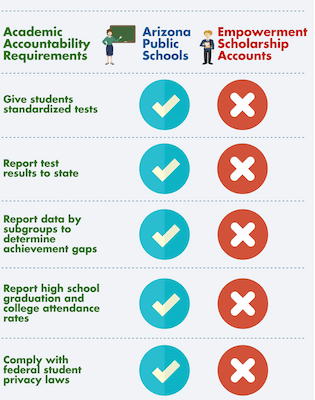
And yet, as of February 2024, 11 states offered universal vouchers, 12 states had expanded their program, and seven had passed new voucher programs. But Arizona was the first and continues to lead in offering school choice. Unfortunately, Arizona is also the Wild West of school choice, and according to NEA Today, “has one of the least accountable voucher programs in the nation”. Unlike many other states, there is no cap on the amount of vouchers that may be granted and for the 2023-2024 school year, the cost was close to $1 billion. Arizona also doesn’t require any testing or reporting for students on vouchers, whether they are being homeschooled or enrolled in parochial or private schools. Neither does it require any sort of disclosure on how these private schools spend our tax dollars.

Some states are paying attention to the Arizona debacle. In 2023, the Texas State Teachers Association was successful in repeatedly defeating Governor Abbot’s universal proposal. The Idaho Education Association also defeated seven voucher bills in their state legislature and Illinois became the first state to end its voucher program. Just recently, the South Carolina Supreme Court ruled vouchers unconstitutional.

Unfortunately, the AZ GOP-led Legislature is unwilling to do anything to reign in its voucher debacle. State budgets must be balanced each year; they can’t run a deficit like the federal government. When unexpected costs (such as what the runaway voucher program is producing) far exceed what was budgeted, the cuts have to come from somewhere. This year, that meant cuts such as those to colleges and universities, delayed road work and highway construction, and the elimination of funding for water system upgrades. As reported by 12News.com, the final agreement also included, ‘eliminating $37 million annually to K-12 school poverty funding and $24 million annually to the “Promise” low-income college scholarship program.’

The unfunded mandate of universal vouchers is unconscionable and unsustainable and it isn’t just our public schools that are at risk but critical programs across our state. As the Arizona Education Association President, Marisol Garcia warned, “If other states want to follow Arizona, well – be prepared to cut everything that’s in the state budget – health care, housing, safe water, transportation. All of it.” 

The worst part is, that we have no way of knowing what kind of return on our investment we are getting on vouchers for education. We simply do not know whether students on vouchers are learning what they need to know to be productive members of our society. In what universe can that be a good thing?

Dealing with Crazy is Exhausting

and there’s plenty of crazy in Arizona’s voucher program

After watching the Presidential Debate last night, one of my takeaways was that “dealing with crazy is exhausting”. This also describes how I feel about Arizona’s runaway voucher program. It isn’t just the bottomless pit of spending that continues to drain our state coffers and forced cutbacks this year in funding for roads, water, community colleges, universities, and K-12 schools. Even worse, is the fallout from children unprepared for their future and indoctrinated with misinformation and propaganda.

I’ve already written about how voucher parents are using AI to create curriculum that justifies purchases such as Oscar Mayer hot dog machines. And, you’ve no doubt heard about the dune buggy debacle. You know, the one where the parent purchased dune buggies for her kids with voucher funds. The Department of Education initially denied the expense and then approved it. In appealing that decision reported The Arizona Republic, ‘the parent got an occupational therapist to testify that her kids learn better after a trek through the desert, allowing them “to engage in movement before returning to more traditional learning environments.”’ I guess riding a bicycle or going to a playground just wasn’t good enough for this parent. Fortunately, the state Board of Education eventually rejected the parent’s appeal and the state is now trying to claw back the funds originally approved. Of course, parents can still buy $900 Lego sets, kayaks, luxury car driving lessons, and expresso machines.

Now, we see on a Facebook group for Arizona voucher families, a parent asking “Anyone know of a flat earth curriculum”? Others in the group provided interesting responses as you can see below.

Yes, this is real. As the first contributor says, “some people believe in flat earth and some don’t. Ya’ll don’t want to try to discuss how gravity is only a theory. Let this mom teach her kids her way.” Seriously? Are these people stuck in the 3rd century BC? 

When did we become a nation that believes people are not only entitled to their own opinions but their own facts? Maybe about the same time we began to greatly expand Arizona’s voucher program without any guardrails to ensure our children would learn what they needed to be productive citizens.

I decided to try ChatGPT to see what kind of curriculum it would write to support the flat earth theory. It only took about 10 seconds for ChapGPT to write the below. Please note the second sentence that states, 

“The overwhelming scientific evidence supports a spherical Earth, and promoting the Flat Earth theory in an educational setting would be misleading and potentially harmful to students’ understanding of science”. 

Please also note the last paragraph that states “Students should receive accurate, evidenced-based education and develop critical thinking skills”. 

Unfortunately, there are no standards in place in Arizona to ensure students on vouchers receive accurate, evidence-based education”. As stated on SOSAZNetwork.org

Arkansas, Iowa, Indiana, and Florida all require voucher students to either sit for state testing or take a nationally norm-referenced assessment. Utah and West Virginia allow students to submit a portfolio showcasing their academic progress in lieu of an assessment, but crucially still require some form of proof of academic progress. In Arizona, there is zero requirement for voucher students to show they are meeting state standards or even learning at all.

Arizona’s lack of academic oversight is compounded by its failure to approve  voucher-funded private schools, unlike Iowa, Florida, Utah, and West Virginia, which require schools participating in their state voucher programs to register with the state and meet certain standards of accreditation. In Utah, private schools with a potential for financial troubles are explicitly prohibited from joining the program. 

No such vetting exists in Arizona. Any fly-by-night for-profit private school or microschool can open anywhere (even in unsafe garages, living rooms, or strip mall buildings) and accept ESA voucher student funding without any proof of accreditation or quality.” 

The unmitigated malfeasance exercised by Arizona’s GOP in not only supporting but steadfastly pushing forward this unaccountable voucher program is astonishing. From 2011 through 2021, they expanded the program to categories of students they thought they could justify. Then in 2022, they pushed through universal vouchers against the will of the people of Arizona who voted “NO” (by a 2 to 1 margin) to the program in 2018. All this without any real accountability to ensure our tax dollars were well spent and our children were well educated.

The only way to fix this problem is to elect different state legislators in November. The GOP has proven time and again that they have no intention of introducing common-sense accountability measures such as an annual cap on voucher expenditures or a requirement to provide information on student progress to include math and reading test scores, and promotion, graduation, and dropout rates. Why not? The only plausible reason is they don’t want us to know we are not getting our money’s worth with the voucher program…not even close.

This November, help curb the crazy and vote for pro-public education candidates. Learn who those candidates are at Vote 4 Public Ed.

Books in the Library Before Dune Buggies in the Driveway

Public Tax dollars Should Fund Accountable and Transparent Public Schools!


EducationNext.org
, according to SourceWatch.org, “is a propaganda outlet for corporate education reform policies such as charter schools, school vouchers, and merit pay”. That helps explain the “opposing” views below on vouchers for all by Derrell Bradford and Michael J. Petrilli. 

Bradford advocates for vouchers for all (including the rich), because,

“If the rich are not in your coalition, you have a weak coalition. If they don’t benefit from your policy, you have a policy that will be difficult to maintain. It is just that simple.”

This may be somewhat true, but it is also cynical and a sad statement about our democracy and commitment to supporting the common good. Public schools, often the hubs of their communities, are a quintessential common good. Rich people may not send their children to many of these schools, but they too benefit when public schools succeed. When students are prepared to be responsible citizens who not only support themselves but contribute to society, everyone wins.

Bradford though, seeks to denigrate public schools as the choice serving the wealthy’s interests,

‘The public schools have the rich in their coalition, and they pay handsomely for them with a noxious policy concoction that secures their backing. The proposition works like this: “Support us and we will give you a publicly subsidized school, but it won’t be open to the public at large. It will, instead, only be available to you and your neighbors or a small group of students who can afford to pay tuition to attend, if we allow them to enroll. We will draw an attendance boundary around the school to ensure its exclusivity, and we will fine, arrest, or prosecute anyone who violates that boundary by lying about their address or through other trickery. You will also get to thump your chest and describe yourself as a ‘public school parent,’ which may be of great use to you in certain social circles. Finally, in the greatest subsidy available, your housing value will appreciate as a function of this exclusivity. In return, you’ll oppose schools or methods of school finance that would break the link between you, the house, the school, the boundary, and us.”’

Bradford’s assertion is dishonest. Forty-three states had some form of open enrollment policy as of 2023 according to EducationNext. Some of these states, such as Arizona, have policies that require students to be allowed to enroll in any public school in the state. Others, require students to be allowed to enroll in any school in the district of residence. 

He also makes it sound like the public school apparatus” (whatever that is) has diabolically plotted to focus on the wealthy to the detriment of those with less, 

“The well-off are a powerful constituency, and the public school apparatus has offered them an educational and financial package so lucrative that few people could (or do) say no, whether they reside in red states or blue. Thus, in building a “diverse” constituency to ballast themselves politically, the public schools have appealed not in a targeted way to the needy, but broadly and most beneficially to those who need very little. And, to date, this strategy of subsidizing the rich has worked brilliantly for the system.”

Don’t know about you, but when I think of a “diverse constituency” that is ballasting itself politically”, it is the pro-choice crowd, not public schools that comes to mind. Diversity is part of this constituency, but only as a means to an end. The school choice movement is incredibly well-financed and has powerful forces behind it. I believe their primary objective is to reduce the power of the people. And yet, no voucher issue has, thus far, survived the ballot box. That’s not because of some “public school apparatus”, but because voters understand the importance of public schools to our communities and our nation. 

Our founding fathers also understood that importance. They believed an educated populace was key to preserving our democracy and “recognized that educating people for citizenship would be difficult to accomplish without a more systematic approach to schooling”. Early on, schools were funded in a variety of ways and many charged tuition. Then in 1785 and 1787, federal laws trusted large amounts of federal lands to new states entering the union, as long as they agreed to use at least some of the lands for the support of public schools. This strategy helped build stable communities across America and showed the value our founding fathers “placed on education as [a] positive element of nation-building.

Are today’s public schools supported by local tax dollars? Yes, but also by state and federal. The current strategy for funding public schools wasn’t developed by the “public school apparatus”, but rather, by lawmakers who often make choices about education funding not based on the best outcome, but on what will support their reelection. 

How about we commit to properly resourcing our public schools instead of diluting the available funding? What makes more sense? Allowing a family with one child to purchase a piano with a voucher, or a public school purchasing a piano for its music program enjoyed by numerous students? Of course, what voucher recipient wouldn’t appreciate buying dune buggies or an Oscar Mayer hot dog machine on the taxpayer’s dime? Yes, these are real examples of voucher purchases.

And yet, the GOP continues to be all in for unaccountable universal school choice with Arizona serving as the model. This is despite the fact, that the universal voucher program in Arizona ballooned from an estimated $65 million last year to roughly $332 million according to ProPublica. This year, vouchers are expected to cost $429 million. This unbudgeted spending has necessitated cuts to critical water infrastructure projects, highway expansion and repair projects in congested areas, community colleges, and much more.

In a lukewarm rebuttal, Petrilli begins by agreeing with Bradford,

“It’s long past time for schools to be subject to the same competitive forces as other goods and services. And in our huge, diverse society, it makes sense to embrace a pluralistic school system that allows all families to find educational institutions that match their values, hopes, and goals for their children.”

Whoa! Our public schools are not a Big Mac or a drive-thru car wash. They are an investment in the future of our nation. Making them subject to the “same competitive forces as other goods and services” is often not effective nor efficient, especially when the rules of the game are not the same for everyone. Yes, some amount of competition for students can encourage schools to step up their game. But, the lack of accountability and transparency with vouchers, for example, makes it impossible to compare return on investment. 

But he goes on to admit that the savings voucher advocates claim just haven’t panned out, 

“But when the government starts to subsidize students already enrolled in private schools, it incurs a brand-new public expense. Those kids weren’t already attending school with taxpayer assistance. And with about 9 percent of students attending private schools—and those children coming disproportionately from wealthy families—adding them to the public rolls can add up fast. Maybe bringing these families into the school choice coalition has some political benefit—but surely it also exacts a political cost as taxpayers watch millions of dollars flow to prosperous elites who don’t need the money.”

He also disagrees with Bradford about including the wealthy in taxpayer-supported school choice options:

“But in general, state governments don’t spend much on educating the richest children. So it should be with school choice programs.”

Government (public) funds for education, at all levels, should first fund public schools that provide a quality education for all children. If parents with means want to send their children to private schools, that’s their right. It is our right to demand that we know how our tax dollars are spent and the return on investment. Our public schools offer the greatest amount of accountability and transparency and are still the choice for some 80 percent of America’s children. They must though, be resourced to get the job done. Unfortunately, as Save Our Schools Arizona executive director Beth Lewis told ProPublica.org,

“Spending hundreds of millions of dollars on vouchers to help kids who are already going to private school keep going to private school won’t just sink the budget, Lewis said. It’s funding that’s not going to the public schools, keeping them from becoming what they could and should be.”

So…What’s the Real Deal with Vouchers?

Hint: It’s not about improving educational outcomes for disadvantaged children

I was reminded by someone today that back in the 1970s, Arizona public schools were 19th in the nation for funding. Now, they rank 49th. This didn’t occur in a vacuum, nor was it by accident. Rather, it has been, and is, a concerted effort to wrest power from the people by defunding the common good and destroying our sense of community. 

One of the most effective routes to this end is to privatize public education and Arizona has been the pace car. From being the first state to allow charter schools in 1994, to leading the effort to offer dollar-for-dollar tax credits to fund private school scholarships in 1997, Arizona has leaned into the school privatization effort. Although the path hasn’t always been a straight line, (an initial voucher attempt was ruled unconstitutional and the first try at universal expansion was successfully killed by a Save Our Schools AZ ballot initiative), AZ GOP lawmakers finally succeeded in passing universal vouchers in 2022.

Of course, those lawmakers didn’t do it on their own. The American Federation for Children (Betsy DeVos), Americans for Prosperity (Koch Brothers), American Legislative Exchange Council (national conservative bill mill), and the Goldwater Institute were all behind the voucher expansion here in Arizona and elsewhere. According to the Arizona Center for Investigative Reporting (AZCIR), Arizona’s Goldwater Institute has said, “It won’t stop until parents in every state in the nation are empowered to decide what education path truly meets their children’s needs”. 

What, I would ask, about the rest of our needs? These programs, despite proponent’s claims, have not saved taxpayers money. Rather, they’ve diverted and diluted the funding available to our district schools, where 80% of our students are educated. In an analysis of state education spending, Columbia University researchers found from 2008 to 2019, “Arizona was one of the few states where public school spending declined even as enrollment increased. Per-pupil public school spending dropped by 5.7% during that period, according to the analysis, while spending on voucher and tax-credit programs climbed by 270%”. According to the Arizona Department of Education, the total annual ESA awards for students enrolled in Quarter 3 of this year is $735 million this year. And to those who claim that there is a direct cost reduction to public schools when students take a voucher, that is only true if the student was attending a public school when they took the voucher. In FY 2023, only 21% of those taking vouchers were in public schools at the time indicating families are likely using vouchers to subsidize expenses they had formerly covered. As of March 2024, AZ DOE claimed the number has risen to 61.5%. Regardless, when a public school student leaves to take a voucher, there are always fixed costs that the public school can’t reduce when one or a handful of students leave (bus routes, number of teachers required, utility consumption, etc.”). In the meantime, tightened funding hampers our public school leaders in ensuring facilities are well-maintained, and that transportation, technology, and other needs are addressed.

These programs also offer us no real accountability. Private schools aren’t required to participate in state or national testing, nor to publicly report the efficacy of their educational efforts with indicators such as grades and graduation rates. This might have been okay when parents self-funded their children’s private education, but it is not when taxpayers foot the bill. We have a right to know how those tax dollars are spent and whether or not we are getting an adequate return on our investment. Instead, the GOP-led Legislature has resisted any attempts to introduce more accountability into the voucher program. 

Of course, this is all by design. If schools (whether it be private schools, homeschools, micro-schools, or religious schools) accepting vouchers aren’t required to report on academic progress, they can’t be compared to public schools. This allows voucher proponents to make claims that can’t be supported with data. And, the more funding that is cut from our public schools, the harder it is for them to succeed. As Maria Polletta from the Arizona Center for Investigative Reporting writes, “The harder you make it for public schools to succeed, the easier it is to sell the alternatives. And, plenty of well-financed conservative groups are working to do just that”. This leaves us to ask ourselves what’s in it for them.

I’d argue that the desire to maintain and grow their power and wealth is driving privatization proponents. We already have proof that vouchers work better for well-resourced students than lower-income ones. This dynamic, (according to Professor Derek Black who specialized in the intersection of constitutional law and public education), “will continue to exacerbate segregation and create a fragmented educational landscape”. Black goes on to say, “The people who propose these types of things, in my mind, are either highly ignorant of or highly dismissive of a 200-year commitment to public education with the understanding that democracy itself rests upon it.” Or maybe, just maybe, they know exactly what they are doing…

The Indispensability of Community Public Schools

Merriam-Webster’s dictionary defines indispensable as “absolutely necessary” and “not subject to being set aside or neglected”. I can think of no better word to describe how important our public schools have been, and are, to our communities and country. Unfortunately, the GOP has made it clear they want to privatize and defund public schools. They are working very hard to “set aside and neglect” our community (real) public schools at the risk of great peril to our nation.

Yesterday, U.S. public education advocate #1, Diane Ravitch, published a blog post titled “Inclusion: the key to public school’s value” from Stephen Owens on his blog Common Grace, Common Schools. I hadn’t read anything from Owens before but found his writing both powerful and spot-on. Owens has a Ph.D. in education policy from the University of Georgia and is Director of Education at the Georgia Budget and Policy Institute. His truth-to-power straight talk aimed (at least in this post) at white people and Christians, is all the more powerful because he is himself, an evangelical Christian.

“Not only” writes Owens, “are parts of American public schooling unique, but reflect central tenets of the Christian faith.” Three of the tenets he cites are inclusion, equity, and accountability. I’ve written plenty about accountability before and in fact, believe the lack of accountability is the number one problem (or at least in the top three) facing our society today.

As for inclusion and equity, our community public schools promise to educate all, and helped make our nation the powerhouse it is. “Meanwhile”, writes Anya Kamenetz in the New York Times, “a well-funded, decades-old movement that wants to do away with public school as we know it is in ascendance.” Kamenetz is a longtime education reporter and author of “The Stolen Year: How Covid Changed Children’s Lives, and Where We Go Now”. She maintains the extended school closures during the COVID pandemic “effectively broke the social compact of universal, compulsory schooling. Sad but true, parents with means did what could ensure their kids continued to learn and the rest made do with what they had. Increasingly now, students are being home-schooled, attending private schools, or are otherwise absent from their community schools. Teacher shortages are at a crisis level, with many who are still teaching experiencing intense burnout.

Pro-choice advocates are no doubt, rejoicing at this manna dropped from heaven (or maybe pushed up from hell). Undermining our community public schools and the dedicated educators that toil in them has never been easier. Their gains, however, tear at the fabric of our communities, especially in rural locations where the school maybe not only the major employer but also the hub of the community. This is largely true because community schools, regardless of parents’ ability to pay, ensure students are educated, transported to and from school, fed, given medical attention as needed, and provided specialized help when their circumstances warrant. And, let’s be honest, they are often the source of free child care for families.

As much as we’d like to believe our society is a true meritocracy writes Owens, the “brutal truth of schooling in the U.S. is that parental income is strongly predictive of educational outcomes. The real difference in who makes it or not, he says, “is whether your parents have enough money to provide 1) security (food and housing), 2) accountability, 3) targeted support and 4) social capital.” Of course, the GOP continues to push the notion that all the supposed “disadvantaged” need to do is “pull themselves up by their bootstraps”, totally ignoring the fact that this isn’t even physically possible, even if it were true.

As for what is painfully true, many in the GOP want to go back to the “Leave it to Beaver” days. You know, when the neighborhood was all white and comfortably middle class. When Dad went off to work and Mom stayed home and cleaned the house and cooked in her dress, high heels, and pearls. Concern for the common good evidently was much easier in a homogenous society with similar values and understandings. Remember when we used to all watch Walter Cronkite at 5pm to learn about “the way that it was” for each day? That shared understanding of the news, fairly void of opining, provided us common ground upon which to stand.

Likewise, our community schools brought us together to increase our understanding of each other as we became (hopefully) productive members of society. “Without public education delivered as a public good,” writes Kamenetz, “the asylum seeker in detention, the teenager in jail, not to mention millions of children growing up in poverty, will have no realistic way to get the instruction they need to participate in democracy or support themselves”.

Of course, it isn’t just the disadvantaged that suffer, but all of us as evidenced by our extremely high level of polarization. There can be no doubt as to social media’s influence on our polarization, particularly those attacks from our enemies on the global stage (China and Russia for example). But, it is the efforts to rob our community schools of critical funding, dedicated teachers, and the ability to teach the truth, that are most insidious. As Kamenezt points out, “students of privilege will stay confined in their bubbles. Americans will lose the most powerful social innovation that helps us construct a common reality and try, imperfectly, to understand one another.” “In the eyes of conservative activists,” she says, “public education is the enemy of the people, alongside the deep state and the mainstream media, and they are working hard to make the American people believe it too.”

And their tactics are working on a swath of America. According to Phi Delta Kappan (a professional organization for educators) poll from 2020, 53% of Americans support using public tax dollars to pay for private school tuition (48% for religious schools). This should not be entirely surprising as the GOP has worked this very hard for at least 40 years when President Reagan promised to eliminate the U.S. Department of Education and Grover Nordquist advocated drowning the government in the bathtub.

As part of their Machiavellian scheme, the GOP has managed to market private school choice options as the ones that offer parents the most control. The truth is the exact opposite (what a shock). Public schools are the only school choice option that offers parents total accountability and transparency. Other school choice options offer virtually none of either.

I once thought GOP stood for “Grand Old Party”, but now I think maybe it is “Gaslighters or Prevaricators”. Ain’t tryin’ to be hatin’ on those on the Right. I understand they are not a monolithic group. Would just really like to see the party stand for something again instead of just spouting negative ideology. We need a strong two-party system to find good solutions to the many problems our country faces. And, we need to set a good example for our children so they can lead into the future they will inherit. One where the common good is again good and common and…it really matters to all of us.

T and A: #1 Benefit of Public Schools

I’ve no doubt raised a few eyebrows with the title of this post. Get your mind out of the gutter people, I’m talking about transparency and accountability!

Let me be clear…I believe America’s public schools are what made our country great. They ensured all children had the opportunity to learn and they coalesced our communities and all the different types of people within them. But, in terms of today’s school choice landscape, the number one benefit offered by public district schools over all other choices, is transparency and accountability.

Of course, in this alternate universe the GOP has created, up is down, left is right, black is white, and private school choice options (private, religious, and home schools) are the more transparent and accountable schools for parents and taxpayers. Nothing could be further from the truth. District schools, with publicly elected school board members and the requirement to follow Open Meeting Law (at least in Arizona), are by far the most transparent and accountable. Yes, our charter schools are also public schools, but they don’t have publicly elected boards. Rather, charter school board members may not even live in the same state, let alone in the same town. But as public schools, both district and charter schools have myriad transparency requirements private school choice options don’t. These include the need to follow Open Meeting Law, ensuring the public’s right to witness the discussion, deliberation, and decision-making done in its name. They also must: accept all students; comply with stringent requirements for reporting, procurement, and auditing; and allow parents the right to review all instructional material and intercede in their child’s education where they believe it is necessary. There are many more differences in transparency and accountability, but you get the idea.

And yet, those advocating for school privatization have managed to convince many parents (especially in today’s highly partisan environment), that public schools (especially district schools) are trying to indoctrinate their children with values and ideology that are different than their own.

What it is really about though, as pointed out by fellow education blogger Jan Resseger in her recent post, is money and power. After all, the total bill for K-12 education in the U.S. in 2018-2019 school year was already $800B. In Arizona this year, K-12 education constitutes almost 44% of the state budget. Privatizing public education is a lucrative triple-play for the rich and powerful and those lawmakers they keep in office. Privatization allows the reduction of the need for taxation, it offers the opportunity for corporations to profit directly from the education industry, and it reduces the voice of the people making it easier to ignore their will. As Resseger points out, Gordon Lafer, in “The One-Percent Solution”, said,

(F)or those interested in lowering citizens’ expectations of what we have a right to demand from government, there is no more central fight than around public education. In all these ways, then, school reform presents something like the perfect crystallization of the corporate legislative agenda.”

The brilliancy of packaging school privatization was convincing parents that their “right to choose”, was what was important. Resseger also quoted Benjamin Barber, in his book “Consumed”, who deftly makes the point that this ability to choose, however, is not the real power.

We are seduced into thinking that the right to choose from a menu is the essence of liberty, but with respect to relevant outcomes the real power, and hence the real freedom, is in the determination of what is on the menu. The powerful are those who set the agenda, not those who choose from the alternatives it offers. We select menu items privately, but we can assure meaningful menu choices only through public decision-making.

In other words, you are either at the table, or on the menu. In fact, I previously wrote a post with this same title back in 2014. With public schools, parents, voters and taxpayers are at the table (if they exercise their rights the way they should). Unfortunately, it takes work to exercise our rights and hold our elected officials accountable. But then, that’s what is meant by “of the people, by the people, and for the people”. “We the people”, must do our part if we want our government and its institutions to reflect our values. At least in public schools, we have that opportunity.

State Sponsored Discrimination

Some parents don’t know best. There. I said it. Let’s face it, some parents aren’t present, some are abusive, and some are drug addicts. Then there are those who are trying their damnedest to provide for their children but their minimum wage jobs (without benefits) just don’t pay enough to make ends meet. Bottom line is, not all parents know how, or care enough to provide, the best they can for their children. Where that is the case, or, when hard working parents need a little help, it is up to all of us in a civil society, to ensure all children are safe and that their basic needs are met. As education reformer John Dewey said over a century ago, “What the best and wisest parent wants for his child, that must we want for all the children of the community. Anything less is unlovely, and left unchecked, destroys our democracy.”

Secretary of Education Betsy DeVos evidently doesn’t agree. In recent testimony to Congress, no matter what question she was asked about how far states would be allowed to go in discriminating against certain types of students, she kept deflecting to “states rights” and “parental rights,” failing to say at any point in the testimony that she would ensure states receiving federal dollars would not discriminate. From watching her testimony, if she had been the Secretary of Education with Donald Trump as President back in the early 1960s, the Alabama National Guard would undoubtedly never have been called up to integrate the schools.

This should surprise no one. After all, the entire school reform agenda is really about promoting survival of the fittest. Those who “have” and already do well, will be set up for even more success while those dealing with the challenges poverty presents, will continue to suffer. As far as Betsy DeVos is concerned, the U.S. Department of Education has no responsibility to protect students from discrimination based on race, ethnicity, religion, sexual preference, gender identity. The hell with Brown vs. Board of Education, she will not step in to ensure states do the right thing for their students. As Jack Covey wrote recently to Diane Ravitch, to Betsy, “choice” is everything and parents should be able to send their children to a black-free, LGBT-free, or Muslim-free school on the taxpayer’s dime if they want to.

Does that EVEN sound remotely like America to you? How can it be okay for our tax dollars to promote blatant discrimination? This is essentially state-sponsored discrimination. Yes, discrimination has always occurred via self-funded choice. The wealthy have always been able to keep their children away from the rest of us but, it was on their own dime. As it has always been with parents who stretched budgets to live in neighborhoods with the “best” school district as a way to ensure their child had the best chance.

And despite some attempts to even out the inequity inherent in the system, it persists. Texas superintendent and public school advocate John Kuhn recently wrote about “a phenomenon called ‘inequitable equilibrium’ wherein states are forced by judges to adjust school spending to make it more fair but then, over time, without fail, the state legislatures pass new laws and find workarounds to return to socially acceptable maximum level of school funding inequity.” John goes on to write that, “Voters in centers of power and influence are able to ignore something as esoteric as inequity so long as it only affects relatively voiceless populations in inner cities, border towns, and fading farm towns.”

Now though, we are saying that taxpayers must pay for the right for parents to segregate their children from those they consider less desirable. Today’s narrative is “the hell with ensuring all kids have equal opportunity, you only have to care about your kid and the taxpayer will help you.” Kuhn writes about “voting majorities in Texas primaries [who] nominate candidates who are religious but not moral, who play-act as righteous representatives of the people’s hearts and values but who, in the crucible of leadership, more and more of the time reveal themselves to be really pretty bad people who are effectively incapable of moral leadership.” John may be talking about Texan candidates and lawmakers, but I’ve seen plenty of the same at the Arizona Capitol. And when he writes that Texan voters “keep electing carnival show barkers who are better at sound bites than sane decisions,” you have to admit you can recognize how that applies to Arizona voters as well. I also find myself identifying with his statement that “Governance has devolved into something like pro wrestling, but it’s school children in underfunded schools who are getting hit with folding chairs.” Of course here in Arizona, I would add that “teachers are getting hit with those folded chairs too.”

Then, as Kuhn points out, legislators require schools be graded with “uniform criteria while refusing to fund schools uniformly.” This system then ensure schools in poorer communities are branded as bad schools, driving down property values, making it harder to raise local funds for schools or attract new businesses or jobs. “Test-based school accountability combined with inequitable school funding” John says, “is state-sponsored sabotage of cities.”

It is a sign of the times I am afraid, that it is acceptable to “pick on the little guy” and to “kick a guy when he is down.” It is acceptable for those in power to decide who “wins” and who “loses” and for our nation therefore to be moving toward a caste system where many will never ever have a shot at the American Dream no matter how hard they study and work.

I’ve been streaming “The Handmaid’s Tale” and find it very disturbing. If you haven’t watched it, you should. It is a clear commentary on how accepting the previously unacceptable, no matter how small and seemingly insignificant, can eventually result in horrific consequences no one would have ever believed could come to pass. Prior to the past year, it would never have crossed my mind that something like “The Handmaid’s Tale” could happen in America. Now, I’m not so sure.

Happy Valentines Day…NOT!

On this Valentine’s Day, I thought I’d ask, when it comes to our public schools students in Arizona, “who loves you baby?”  Yesterday, I was listening in on the AZ House Education Committee meeting. There were many bills on the agenda, but I was primarily interested in HB 2394; empowerment scholarship accounts [ESAs]; expansion; phase-in. I wasn’t hopeful the bill would die, as its companion bill SB 1431, had already been given a due-pass by the Senate Education Committee. As expected, HB 2394 followed suit on a 6–5 vote as did HB 2465, which will allow all students eligible for an ESA account to remain on the program until age 22 and for up to $2,000 a year to be put into a 529 savings account.

The passage of these bills, along with the companion ones in the Senate, demonstrate the disdain many GOP legislators have for our district schools and, for the underpaid educators who toil within. This, because ESAs divert more general fund revenue per student to private schools than district schools receive. As reported by the Arizona School Boards Association, an ESA student, on average, costs the state general fund $1,083 more in grades K–8, and $1,286 more in grades 9–12 than a district student. This is in part because there are many school districts that enjoy a fair amount of locally controlled support in the way of overrides and bonds. The state therefore, is relieved of providing equalization funding to them, but when students leave to go to private schools, all the funding must come from the state general fund. ESA students also receive charter additional assistance funding of roughly $1,200 per student, which district schools do not receive. Turns out that the claim of voucher proponents that they save the state money, is not just “alternative facts” but totally untrue. And, although voucher proponents love to claim there is no harm to district schools when students take their funding and leave, the truth is that about 19 percent of a districts costs are fixed (teacher salaries, transportation, facility repair and maintenance, utilities) and can’t be reduced with each student’s departure.

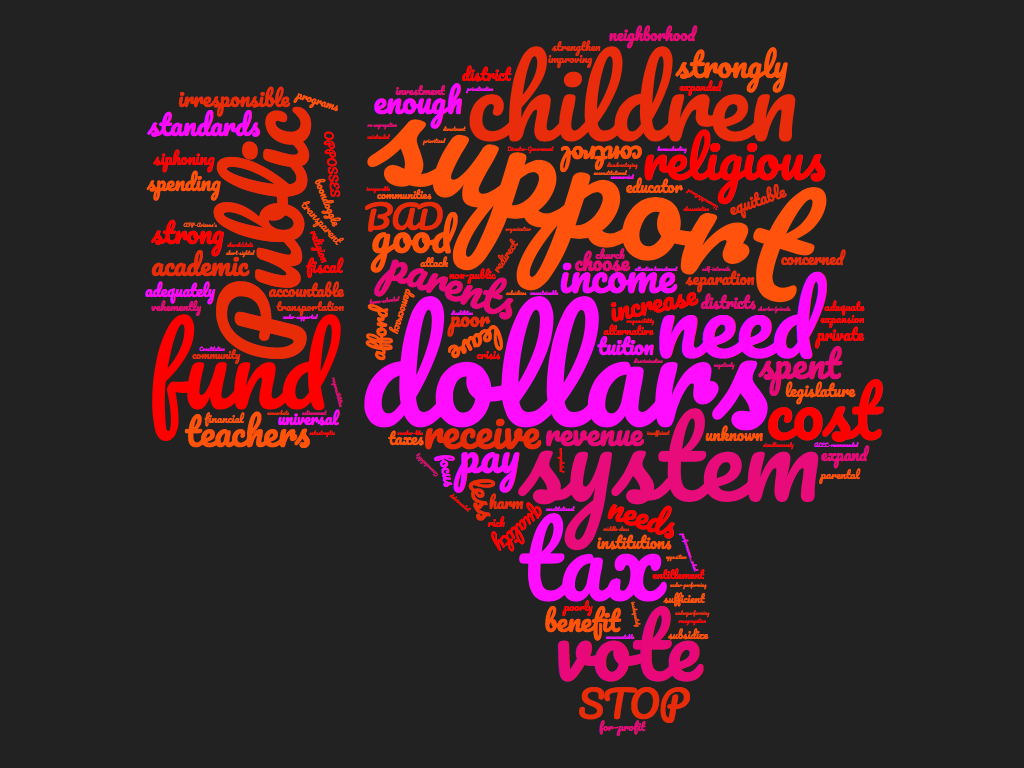
I am slightly encouraged though by the two Republican members on the House Education Committee who had the courage to stand up and do the right thing. Huge kudos to Representatives Doug Coleman and Michelle Udall who voted against the voucher expansion! I encourage each of you to email them and let them know how much you appreciate their show of support for the one million public school students in Arizona’s district schools. What also gives me hope, is the 400 plus people and their almost seven pages of 10-font, single spaced comments made against the bill in the Arizona Legislature’s Request to Speak System. Here’s a word cloud of the comments:

esa-wordcloud

This is compared to the 30 people who signed in to Request to Speak in favor of the bill. The vast majority of whom represent organizations in favor of commercialization of district schools such as The Goldwater Institute, Americans for Prosperity, Center for Arizona Policy, AZ Catholic Conference, AZ Chamber of Commerce and the American Federation for Children.

So, why these organizations? Well, let’s see. According to its website, the Goldwater Institute is a “national leader for constitutionally limited government.” Corporate reformers love to paint district schools as “government” schools, making them just another one of the targets to shrink the government, or as Grover Norquist said, “get it down to the size where we can drown it in the bathtub.” The Goldwater Institute also works closely with the corporate bill mill, the American Legislative Exchange Council (ALEC) to promote conservative corporate agendas (such as commercialization of district schools) in Arizona.

Cathi Herrod and her Center for Arizona Policy (CAP) have long pushed school choice. CAP’s website states the belief that, “Religious freedom is affirmed and protected, free from government interference.” Of course, they are for vouchers. They would love for every student in Arizona to attend religious schools on the taxpayer’s dime.

Americans for Prosperity is a conservative political advocacy group funded by the Koch brothers. On their website they write, “at the very top of AFP-Arizona’s 2017 legislative agenda is the expansion of our state’s program of parental choice Empowerment Scholarship Accounts (ESAs).” They also encourage their supporters to thank Senators Flake and McCain for voting to confirm Betsy DeVos.

It should be no surprise to anyone that the AZ Catholic Conference is also interested in fully expanding voucher eligibility. Around the nation, Catholic schools have been closing at rapid rate, from 13,000 schools enrolling 12 percent of U.S. school children in the mid–1960s, to about 7,000 schools enrolling five percent in 2012. In 2015 alone, 88 Catholic schools closed. But, a tax credit program highly favorable to private and parochial schools has helped stem previous losses in Arizona but charters are still causing them much competition for students. There are now 73 Roman Catholic private schools in Arizona and six of them are among the most expensive private schools in the Phoenix area charging from $13,300 to $17,712 per year in tuition. A $5,200 voucher obviously won’t help poor students get into these schools, but it will be a nice offset for those wealthy enough to afford the schools irrespective of the help. The average cost for private schools in Arizona by the way is about $6,000 at the elementary level and $18,000 at the high school level.

As for the Arizona Chamber of Commerce, let’s not forget how their President and CEO, Glenn Hamer, recently characterized teachers as “crybabies” for wanting adequate pay. This, when our teachers are the lowest paid in the nation and 53 percent of Arizona’s teaching positions were vacant or filled by uncertified personnel at the beginning of this year. Study after study shows a high-quality teacher is critical to student success. What does that say about the commitment of Hamer and his chamber to our students in Arizona?

Finally, let’s not forget that until she was confirmed as Secretary of Education, Betsy Devos was the Chairwoman of the American Federation for Children (AFC). AFC is a huge proponent of school choice and vouchers and has invested millions in purchasing legislators favorable to their causes. Since 2010 in fact, it has contributed some $750,000 to pro school choice legislative candidates in Arizona.

Looking at the list and knowing the resources at their disposal (just think of the Koch brothers and DeVos alone), it is easy to assume most of them have invested heavily in legislative outcomes in Arizona and around the country. Does anyone really believe these organizations have Arizona’s district school students, 56 percent of whom qualify for free and reduced lunch (an indication of their low socio-economic status) children at heart?

We all know when we read something, especially these days, we must consider the source. Well, when looking at the support for voucher expansion in Arizona, I highly encourage you to do the same. This fight against the full expansion of vouchers is far from over. Those pushing for it are no doubt emboldened by pro-voucher stance of the new POTUS and his SecED. But, the people of Arizona understand district COMMUNITY schools are the key to not only achievement for all our students, but also to the health of our communities, and the preservation of our Democracy. We must not sit on the sidelines and watch these bills get signed into law. Much too much is at stake. Want to know more about how to plug-in? Comment on this post and I’ll be in touch. Please don’t let it be said we let our students get sold out!

Ooops, there it is!

We knew it was coming and awaited it with dread. And, drumroll please…crash goes the cymbal! Yes, here it is, this year’s attempt to exponentially expand Arzona’s voucher (Empowerment Scholarship Accounts, or ESA) program. Of course, the American Legislative Exchange Council’s (ALEC) chief water carrier for Arizona, Senator Debbie Lesko, R-Peoria, is the one proposing the expansion. Lesko claims the expansion of ESAs will “not lead to a mass exodus of children from public schools.” I, for the most part, agree with that statement since Arizona parents have made it clear district schools are their choice with 80% of students attending district schools and another almost 15% in charter schools.

But, to infer a massive voucher expansion will have no negative impact on district schools is disingenuous at best. No matter how slowly students may attrit from district schools, each student’s departure leaves behind a 19% budget shortfall. That’s because there are numerous fixed costs (teacher salaries, facility maintenance, utilities, buses, etc.) that cannot be reduced student by student. The siphoning of dollars from our district schools has been steadily increasing and just exacerbates an already inadequately resourced system.

This isn’t the first year the Legislature has attempted to expand the voucher program. In fact, they’ve been successful in expansions every year since the ESA program was launched in 2011. This isn’t even the first time a full expansion has been attempted, with a very similar proposal going down in flames last year due to public outcry and a perceived conflict with securing voter approval of Prop. 123. This year though, Lesko has sweetened the deal by requiring the testing of students attending private schools on vouchers. She says she “doesn’t personally think this requirement is necessary,” but obviously is trying to defuse the argument from voucher opponents that there is no accountability or return on investment for vouchered students.

She is right about one thing, district education advocates want more accountability and transparency where taxpayer dollars are spent on the myriad of school choice options. As the only schools governed by locally elected school boards and with annual efficiency reports published by the Office of the AZ Attorney General, district schools are the only schools fully accountable and transparent to the taxpayers. Pro-choice advocates tout that parents should have the right to choose where they send their child to school at government expense. As a taxpayer, I maintain I have the right to know the return on investment of my tax dollars. Their right should not trump mine.

Senator Lesko also infers that vouchers will save money because the average voucher amount for students without special needs is $5,200, yet it costs $9,529 to educate Arizona’s average student in public schools. This is misleading because she is comparing apples and oranges and she knows it. The $9,529 figure she quotes is a total of all funding sources, federal, state and local (bonds and overrides) while the $5,200 is only state funding. So, if a student transfers from a district where state funding is offset by locally supported funding (due to the equalization formula), that student’s voucher will actually cost the state general fund more than if that student had remained in their district school. Lesko also notes that vouchers and school choice are a national trend as evidenced by President Trump’s nomination of Betsy DeVos as Secretary of Education.

Oh no, she did NOT go there! Trying to sell vouchers as mainstream by pointing to Trump’s nomination of DeVos is akin to denying global warming by citing colder temperatures in parts of the country. After all, DeVos’ success with promoting school choice in Michigan has been dismal. In the two-plus decades she has championed this crusade (those knowledgeable about DeVos will understand my choice of that word), she has purchased legislative influence to expand charters and greatly reduce accountability. She has also worked hard to introduce vouchers in the state, but thus far, the voters have prevailed to keep those “wolves” at bay. And the improvements she has promised haven’t materialized with scores on the National Assessment of Educational Progress (NAEP) for 4th graders declining from 28th in reading and 27th in math in 2003, to 41st in reading and 42nd in math in 2015.

According to the Arizona Capitol Times, the American Federation for Children (AFC) is pushing vouchers nationwide. I’m only going to give you three guesses as to who the chair of AFC is, and the first two don’t count. Yep, none other than Betsy DeVos. In addition to pushing for school choice and vouchers around the country, AFC has spent big bucks on rewarding those legislators working to expand privatization and punishing those who try to stand up for the 90% of students attending our nation’s districts schools. As reported by Richard Gilman on his website BringingUpArizona.com, AFC is a 501(c)4 free to pour dark money into political campaigns. And pour they have. Gilman writes, “Since its inception in 2010, the organization has poured nearly three-quarters of a million dollars into Arizona elections in a largely successful effort to sway the makeup of the Legislature.” The state’s “demonstrated appetite for school choice” is what AFC cites for its focus on Arizona. Of course, common causes make “strong” bedfellows and Gilman tracks AFC’s interest in Arizona back to Clint Bolick (once Vice President of Litigation at the Goldwater Institute and now AZ Supreme Court Justice.) Bolick served as the first president and general counsel for the Alliance for School Choice (AFC’s predecessor.)

But, I digress. The point is that no matter what snake oil the corporate reformers try to sell us, there is an incredibly well-funded, high-powered effort to have two school systems in Arizona. One is the commercial system of charters, private, parochial, virtual and homeschools that serve the whiter and wealthier students, and the other is the district schools, starved for resources, that will have the poorer, browner, and more challenged students to educate. According to recent polls, this is not what the vast majority of Arizonan voters want. But, until Arizonans clearly draw the nexus between voting for Legislators who don’t support our public district schools (most of them with an “R” after their name), and the fact that our district schools are way under resourced, nothing will change. If we want something different, we have to do something different. To continue doing the same thing and expecting different results, is as you know…the definition of insanity.