Beatings Will Continue Until Morale Improves

Although not politically correct, the title of this post is a saying sometimes used in the military to describe decisions by senior leadership that seemed extra harsh and detrimental to troop morale. This saying came to mind when I read of Arizona’s Superintendent of Public Instruction Tom Horne’s response to an AZ Department of Education survey of teachers who chose not to return to the classroom for the 2024-2025 school year. The results were released earlier this week and the top four reasons for teachers leaving included: burnout, lack of respect, student behavior and discipline, and low salaries. 

Almost 2,500 of the 5,900 teachers not returning responded to the survey, but 1,500 of the responses were removed for reasons such as those teachers were retiring, promoted to administration, or had accepted a monitoring job. The thousand or so remaining responses most often “strongly agreed” or “agreed” to the following:
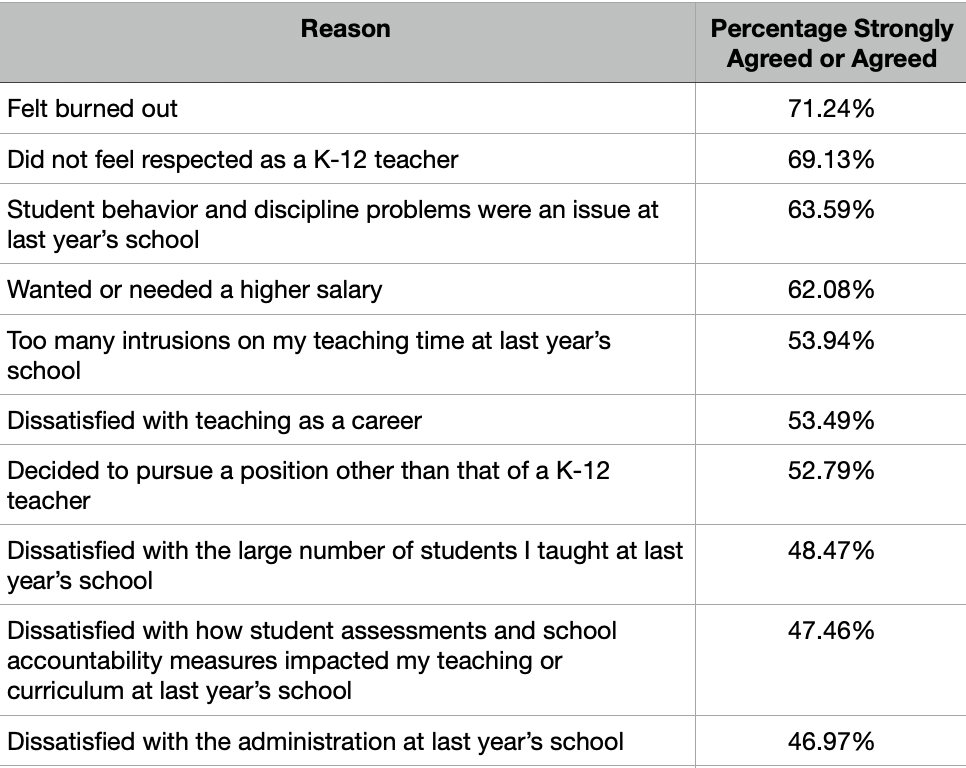
Of course, Superintendent Tom Horne honed in on “student behavior and discipline problems” (ignoring burnout and lack of respect) as the significant contributing factor for teachers leaving their jobs. This then, provided him more justification to further push proposed legislation to link school letter grades to a tougher stance on discipline. The AZ Daily Star reported SB 1459 would have required “the state Board of Education to lower a school’s letter grade if it did not implement disciplinary actions in at least 75% of the total number of student discipline referrals submitted by teachers in a single year”. 

The bill was passed in the Senate, but two Republicans in the House refused to vote for it, killing the bill in this session. Of their vote, Horne said “Shame on the legislators who voted against it” claiming it is simply a way to incentivize district support for teachers regarding discipline.

Rep. Nancy Gutierrez, D-Tucson, saw an ulterior motive for the proposal. During the debate on the House floor, she said, 

“It is my opinion that this bill has been put forward in order not to support teachers but in order to make it so that there’s an easier way to have more public schools with D and F grades to support some of the rhetoric that we hear that public schools are failing our students”. 

This of course is just another way for Horne and GOP legislators to push parents toward vouchers and other privatization efforts. Representative Judy Schwiebert, D-Phoenix, agreed and blamed the Legislature for contributing to the teacher retention problems by funding Arizona schools at one of the lowest per-pupil rates in the nation. Schwiebert went on to say that, 

“The job of our local schools and boards is to make direct decisions that apply most specifically to their schools,” she said. “We see the legislature criticizing public schools when we are not doing our job. Arizona ranks 49th in the nation in per pupil funding. We’re pointing our finger at public schools, blaming them for problems that we have created because of too large class sizes, failure to pay teachers enough, failure to provide support staff.”

A Forbes.com article titled, “No More Teachers: The Epic Crisis Facing Education in 2024” agreed, stating that low pay is the biggest reason for the declining numbers of new teachers. In 2022, says veteran teacher and author Jay Schroder, “teachers made on average 26.4% less than other similarly educated professionals”. 

‘Schroder contends that the low pay, combined with high stress and a strong sense of disrespect from some outspoken sections of society, make the job of teaching unattractive to many college graduates. “If this were just a PR problem, it would be easier to solve,” he says. “The truth is that the pay is low and the stress is high.”’

According to K12Dive.com, the Educators for Excellence (E4E) 7th annual Voices from the Classroom survey of teachers this May, highlighted the crisis by reporting that, 

“A mere 19% of teachers believe the profession is sustainable, with only 16% of teachers recommending the profession to others, and less than half expressing commitment to staying in it for the long haul.”

We have been headed for a real crisis regarding teacher shortages; one that has only been exacerbated by the pandemic. And while the trailblazing Arizona Teachers Academy (ATA), passed with bipartisan support in 2018 was working to address our state’s crisis, lawmakers cut $14 million from the program’s budget this year. According to AZCentral.com, the program had expanded in 2023, to serve 3,255 aspiring teachers with an average scholarship of $8,555. The cuts made to the program this year, mean that some 1,700 fewer students will be working their way through a proven pipeline. In the past, ATA has also provided funding for mentors to support new teachers and National Board Certification for experienced teachers.

Turning around teacher dissatisfaction won’t be easy, but neither does it seem super complicated. It boils down to treating them as the professionals they are, not “beating down” them, their administrators, or their schools. Competitive compensation, autonomy to do the jobs they were trained for, an adequate support structure, a collaborative environment, and quality school leadership are some of the more important tools. Also important though, is a recognition by the public and those we elect to represent us, that quality teachers are a most worthy investment critical to the future of our communities, our country, and our world. 

As Anatole France, a French poet, journalist, and best-selling novelist, once said, “Nine-tenths of education is encouragement”. That applies to both students in the classroom and all the professionals who teach them. In my experience as a leader in the Air Force, the carrot is almost always mightier than the stick, but that approach does require a more confident and skilled leader. I guess it is just easier for Superintendent Horne to continue to try the “beatings” approach.
The GOP Plan for Education – 2

What It Means For Arizona – Part 2

Below is part 2 on the GOP promises for education in the 2024 RNC Platform. The first part dealt with promises one through three. This one reviews promises four through six.

4. Safe, Secure, and Drug-Free Schools: Republicans will support overhauling standards on school discipline, advocate for immediate suspension of violent students, and support hardening schools to help keep violence away from our places of learning.

Arizona has been losing a net of 3,300 teachers per year according to Superintendent Horne and although 67% of them left the profession last year due to low pay, 61% said a lack of support in dealing with student behavior and discipline was also to blame. His predecessor, Kathy Hoffman, tapped into Federal Recovery Act dollars to add hundreds of school counselors. But in the 2022-2023 school year, we still had only one counselor for every 667 students, almost double the national average. 

Now, federal funding is running out and lawmakers are looking for less expensive solutions. HB 2460, passed in the Legislature and signed by the governor in 2023, retracted previous legislation allowing kindergarten through fourth-grade students to be suspended. This year, Horne proposed Senate Bill 1459 which would have reduced a school’s letter grade if disciplinary action was not taken in at least 75% of teacher referrals. It had significant opposition and was eventually held in the House.

There is plenty of evidence though, that punitive discipline is not the best solution. As reported in ChalkBeat.org, “Students who get suspended tend to have lower test scores and higher dropout rates, and students who attend schools with high suspension rates are more likely to be arrested and incarcerated as adults — what advocates call the school-to-prison pipeline.” Morgan Craven, national policy director at education civil rights group IDRA says, “if lawmakers want to make schools safer, they should ensure that students have access to mental health services and programs that teach positive behaviors. “Our response should not be”, she added: “OK, let’s just find faster, easier ways to simply kick them out.” As reported on KAWC.org, Rep. Jennifer Pawlik, D-Chandler, a former school teacher, said “A lot of people are leaving right now because classroom behaviors have accelerated,” Pawlik said. “And it’s really hard to be a teacher right now.” The answer though she added, is not to put in “punitive measures”, but rather, to consider class size, mentors for new teachers, and “appropriate staffing of our schools that includes mental health providers and paraprofessionals” (trained aides that support teachers).

I’d like to see the GOP deal with the cause for the need to harden our schools, but I’m not holding my breath. I’m also not holding my breath for the funding to harden our campuses. The reality is that not only do Arizona’s schools not have funding to “harden” their campuses, they don’t even have sufficient funding to ensure basic maintenance. A trial finally began in June of this year, on a lawsuit filed in 2017 on behalf of several school districts and the Arizona School Boards Association, which claims “Arizona’s funding model puts low-income schools at a disadvantage and violates the state’s constitution”. An Arizona Supreme Court ruling in 1994 prompted the state legislature to pass the Students FIRST law funded at $1.3 billion to provide emergency funding for capital projects. However, the Legislature has cut at least $4.56 billion from education funding since 2009, and according to 12News.com, “rural districts are at a greater disadvantage because they can’t raise enough money from bonds and overrides and their property tax wealth is limited.” 

5. Restore Parental Rights: Republicans will restore Parental Rights in Education, and enforce our Civil Rights Laws to stop schools from discriminating on the basis of Race. We trust Parents!

I am SO tired of this parental empowerment and parental rights language. First of all, parents are not the only stakeholders in the education of their children. In a well-functioning civil society, we all have a stake in ensuring children are taught a full curriculum that enables them to think for themselves and become productive citizens. And oh by the way, if you take my tax dollars to educate your child in a private school setting, I should have a say in what that education consists of. 

Just try to think of another publicly funded service where the public has no say in how that good or service is provided. Why do we tolerate it in education? As previously pointed out, Arizona vouchers require very little accountability from parents using them. And, there is no reporting of educational outcomes required by the schools. Therefore, we the voters, have no idea how it is going and can’t then, hold our lawmakers responsible for their decisions to support them.

Sorry if I don’t believe the GOP’s desire to “enforce our Civil Rights Laws”, is genuine, at least not for any person other than a white male. After all, Project 2025 wants to scale back the federal government’s ability to enforce civil rights laws like Title IX, which prohibits sex-based discrimination, and Title VI, which prohibits race-based discrimination, by any entity accepting Federal monies.

6. Knowledge and Skills, Not CRT and Gender Indoctrination: Republicans will ensure children are taught fundamentals like Reading, History, Science, and Math, not Leftwing propaganda. We will defund schools that engage in inappropriate political indoctrination of our children using Federal Taxpayer Dollars.

Arizona’s public district schools teach what is required by law, and there is very little time in the schedule or funding to do otherwise. School curriculum is dictated by law via the Arizona Academic Standards spelled out by the Department of Education. School success in teaching these standards is reported via the annual Arizona Academic Standards Assessment. However, students who take vouchers and Student Tuition Scholarships to attend homeschools, micro-schools, religious schools, or other private schools, as provided by the AZ GOP-led Legislature, do not participate in these assessments and the schools are not required to report any assessment data.

The hypocrisy behind “we will defund schools that engage in inappropriate political indoctrination” is staggering. The Arizona Legislature hasn’t yet followed Oklahoma in requiring the Bible to be taught in our public schools or Louisiana in requiring the Ten Commandments to be posted in the classroom, but the Arizona Department of Education and multiple AZ GOP lawmakers have been working with the controversial conservative group PragerU to offer new lesson plans on what they call “American Values”.  State Superintendent Horne wants this curriculum offered in Arizona classrooms as an alternative to the “extreme left side [that] has been presented”. Save our Schools Arizona Director Beth Lewis disagrees and calls PragerU content “dangerous. I’m in classrooms all over the state. I see what educators are teaching,” Lewis said. “The things they’re being accused of are not happening. They’re teaching accurate, truthful science and history.”

So, in fulfilling these three promises, the GOP would deliver more punitive discipline measures which will likely reduce protections for girls and children of color, and continue to feed the school-to-prison pipeline. Oh, by the way, six of Arizona’s 10 prisons are already privately owned. Just sayin’…

The GOP Plan for Education – 1

What It Means for Arizona – Part 1

First of all, what IS the GOP plan for education? Great question. According to the New York Times, the Republican National Committee (RNC) Platform was meticulously prepared by Team Trump and passed at the convention with “ruthless efficiency… that squelched, silenced or steamrolled any forces who might oppose” it. It is the “official” plan but by design, is short and vague, because according to Zack Beauchamp writing on Vox.com, “[Trump] wanted nothing in the platform that would give Democrats an opening to attack him”. Project 2025 from the conservative Heritage Foundation, provides many more details but Trump now disavows any knowledge of it despite plenty of evidence to the contrary. “The now-infamous document puts meat on the platform’s bones” writes Beauchamp, “It details a set of proposals for how to take the RNC’s vague Trumpy principles and turn them into actual, concrete policy. In essence, it is serving as the policy shot for a party uninterested in doing its own homework.” 

In reading the plans for education in both documents, The Republican National Committee platform looks to be the “Cliff Notes” for Project 2025 which wants to eliminate the U.S. Department of Education and according to Newsweek, “seeks to unravel decades-long efforts to cultivate equitable learning spaces and systems. If implemented, it would unwind critical protections for American schoolchildren…and erase any effort from the federal government to improve America’s schools.” 

The RNC Platform itself initially sounds less innocuous, but the devil is definitely in the details. The chapter on education begins with the heading “Cultivate Great K-12 Schools Leading to Great Jobs and Great Lives for Young People.” Then it provides a paragraph called “Our Commitment” which states: 

“Republicans offer a plan to cultivate great K-12 schools, ensure safe learning environments free from political meddling, and restore Parental Rights. We commit to an Education System that empowers students, supports families, and promotes American Values. Our Education System must prepare students for successful lives and well-paying jobs.” 

It then provides nine promises. In this three-part post, I’ll at times use points from Project 2025 to help explain what the GOP Platform might intend, and what it means for Arizona. Yes, it is a leap. But, I would argue, not a huge one and, because of the potential danger of another Trump Administration’s impact on public K-12 education, one worth taking. 

1. Great Principals and Great Teachers: Republicans will support schools that focus on Excellence and Parental Rights. We will support ending Teacher Tenure, adopting Merit pay, and allowing various publicly supported Educational models.

Arizona’s version of teacher tenure is called “continuing status” and is granted to teachers who have not been rated as “ineffective” for the major portion of more than three years. All other teachers have “probationary” status. Continuing status, simply means these teachers cannot be terminated without adequate notice and the opportunity to correct ineffective performance. 

Eliminating teacher tenure would make it even harder for Arizona to attract and retain good teachers who accept lower pay (than other comparable career fields) for a more secure and stable job. Just a few weeks into the last school year, Arizona had “2,229 teaching vacancies across 131 districts”, according to a survey by the Arizona School Personnel Administration Association. Part of the problem is an average teacher salary of $9,000 less than the national average, but it is also about teachers feeling unvalued, unsupported, and overworked. Jay Schroder, a veteran teacher, and author, “contends that the low pay, combined with high stress and a strong sense of disrespect from some outspoken sections of society, make the job of teaching unattractive to many college graduates”. “If this were just a PR problem, it would be easier to solve,” he says. “The truth is that the pay is low and the stress is high.” Eliminating teacher tenure would only increase that stress, and make the low pay even less desirable for even the most passionate professionals. 

Merit pay refers to any system in which compensation is partly based on an evaluation of the employee’s job performance. Arizona statutes already require that district governing boards prescribe specific procedures for the teacher performance evaluation system that include an annual evaluation of each teacher by a qualified evaluator. This evaluation must include two classroom observations at least 60 days apart, and quantitative data on the academic progress of the teacher’s students, (which accounts for 20 to 33 percent of the overall evaluation). The statutes provide exceptions to some of these rules (such as omitting the second classroom observation) where teachers are proven high performers. 

2. Universal School Choice: Republicans believe families should be empowered to choose the best Education for their children. We support Universal School Choice in every State in America. We will expand 529 Education Savings Accounts and support Homeschooling Families equally.

Arizona has offered open enrollment (allowing parents to enroll their child in any district school that has openings), and charter schools since 1994. Additionally, family-funded homeschooling and private school attendance have always been options, but with the universal voucher (Empowerment Scholarship Accounts) expansion, the AZ GOP pushed through the Legislature in 2022 (voters rejected them two-to-one in 2018), we all must now foot the bill. Unfortunately, the voucher program requires almost no accountability and the AZ GOP-led legislature hasn’t been interested in introducing even common-sense checks and balances. This prevents us from measuring their return on investment and holding anyone accountable for results; exactly opposite to our requirements for our public district schools.

As for homeschooling, Arizona couldn’t make it any easier. Homeschoolers must only send a letter (Affidavit of Intent) to their county school superintendent stating they will homeschool and can now get vouchers to cover their costs. Arizona statutes require the curriculum to include reading, grammar, math, social studies, and science, but there are no teacher qualifications or assessment requirements to help ensure quality learning takes place. 

The GOP didn’t spell out how they plan to expand 529 Education Savings Accounts but Project 2025 could give us a clue. According to Education Week, Project 2025 proposes phasing out Title I funds for educating disadvantaged or underserved children over the next decade. Until then, it states that Title I funds should be transitioned to “no-strings-attached” block grants administered by state education departments. This could allow funds to flow directly to parents in the form of 529 education savings accounts for private school and other education expenses. It also discusses doing the same for special education funds from the Individuals with Disability Education Act (IDEA). Arizona already fully supports and promotes 529 accounts to pay for qualified postsecondary education and apprenticeship program expenses. AZ529.gov states that it “offers a tax deduction each year ($2,000 per beneficiary per tax filer) for investing in the Arizona 529 Plan or any state’s 529 plan” and that “There is no limit on the number of beneficiaries Arizona residents can make contributions to in a tax year.”

3. Prepare Students for Jobs and Careers: Republicans will emphasize Education to prepare students for great jobs and careers, supporting project-based learning and schools that offer meaningful work experience. We will expose politicized education models and fund proven career training programs.

The Arizona Legislature enacted statutes that allowed public school districts to form Career and Technical Education Districts (CTED) in 1990. We now have 14 CTEDs across the state with almost 161,000 students receiving career and technical education.These students learn skills required to be aircraft mechanics, dental assistants, firefighters, graphic designers, plumbers, vet techs, welders, and much more. The results of the program speak for themselves with students in CTE courses statewide graduating at a rate of 97% versus 81% of those students in traditional track programs. Not only that, but they are prepared for high-paying positions in their chosen fields. 

So in fulfilling these first three promises, the GOP would likely exacerbate our teacher shortages and export Arizona’s runaway and unaccountable voucher program to the rest of the country. Please stay tuned for the rest of their plan.

Are We Strong and Determined?

Our Public Schools and Common Good Depend on It

According to the New York Times, Project 2025 suggests that the federal Department of Education should be “eliminated”. The Republican Party’s 2024 platform shares this idea and although Trump has been trying to distance himself from it, there is plenty of proof that he has endorsed it in the past. Not only that, but his positions are even weirder.

It is not surprising, that Trump’s position on education is low on content and high on red meat. He promises “the direct election of school principals by the parents” and to cut “federal funding for any school or program pushing critical race theory, gender ideology or other inappropriate racial, sexual or political content to our children”. To counter the threat he says is posed by the “Marxists” and “pink-haired Communists teaching our kids”, he’ll “create a new credentialing body” (the “world’s gold standard”), “to certify teachers who embrace patriotic values, support our way of life and understand that their job is not to indoctrinate children but very simply to educate them.” Wait, whaaaaaaat?

Firstly, under our current laws, he can’t make good on his promise to allow parents to directly elect principals. And, why do they need to? Parents (and other voters) already elect governing board members responsible for oversight of district administration. If parents aren’t happy with the way the school is run, they have the power to address it. Secondly, just so I understand, teaching kids the true history of America as a multi-cultural melting pot that has promised, but not always delivered, liberty and justice for all is indoctrination. But, teachers embracing patriotic values (as defined by the right-wing) and supporting our way of life (assuming “our” refers to white, heterosexual, Christians with children) is not indoctrination. Good to know.

What is also good to know, is that these issues were those of the last election, not of this one. As reported in The74, “an online survey of 1,300 likely 2024 voters – including parents of school-age children, found Americans now care about different issues related to public education: safety, high-quality teaching, and literacy. Or as The74 puts it, safe schools and kids who can read.

The truth is, Trump and his GOP cronies aren’t out to improve academic outcomes for all America’s children. They are out to keep the rich and powerful ensconced in their ivory towers by dividing the rest of us. This is why they promote the privatization of our public schools and couch (maybe I should have used a different word here) it as school choice and parental empowerment. The truth is that where vouchers have gone on the ballot, voters have rejected them. Voters know that our public schools are the hubs of our communities. They bring us together and help bond us in a shared identity. There is power in this shared identity.

We can though, fight back. We must vote for lawmakers who will legislate for the next generation versus the next election. We must recognize that America’s public schools have always been a big part of our success as a nation and are our best solution to ensure the “educated citizenry” Thomas Jefferson wrote was “a vital requisite for our survival as a free people”.

I am no pedagogical expert, but I learned a long time ago that people care how much you care, long before they care how much you know. So, let’s just start with really caring. That would mean we no longer accept firearms as the number one cause of death for children in the U.S. killing more children each year than car accidents, drug poisoning, drowning, and suffocation. Everytown.com reports that in 2024, there were at least 124 incidents of gunfire on school grounds, resulting in 34 deaths and 71 injuries nationally. It is inexcusable that school shootings are now just a way of life in classrooms around our country and lockdown kits are yet something else schools need along with locked single entry points, metal detectors, cameras, and active shooter drills. If we continue to allow the carnage, we just don’t care enough and that simply IS who we are.

A second step is for all of us to understand education is an investment, not an expense. The future is only as bright as the children who inherit it and we can’t give them what they need without a serious commitment of time and resources. Those resources include high-quality teachers and support staff, a full curriculum, and well-fed “butts in seats”. The GOP’s Project 2025 may call Federal school meals an entitlement program inferring it a bad thing, but students focus better when they are fed and we should care more about them being fed than about who does the feeding. We also need them to attend school. As the New York Times reported, “an estimated 26% of students were considered chronically absent (missing around 18 days) in 2023. Increased discipline problems are intertwined with absenteeism and both are holding back progress in our schools.

In a 2017 New York Times magazine article titled “Have We Lost Sight of the Promise of Public Education?” Author Nikole Hannah-Jones discusses how American public institutions and systems have long struggled with the ideal of serving the common good against the strong influence of the private market economy. She wrote, “If there is hope for a renewal of our belief in public institutions and the common good, it may reside in public schools”. I believe it does reside in our public schools, but only if we fight for them. It’s just sad that in the seven years since her article, the forces fighting back seem stronger, or at least more determined, than ever. Are we?

We Invest In That We Value

The recently released ASU Morrison Institute report titled “Finding & Keeping Educators for Arizona’s Classrooms”, offers a myriad of interesting insights into Arizona’s teacher shortage. Like the fact that 22% of new teachers hired in AZ between 2013 and 2015 left after their first year on the job and of the new teachers hired in 2013, 42% were not in the AZ Department of Education (ADE) database by 2016.

We know teacher attrition rates – about 8% over the past decade in the U.S. versus 3–4% in high-achieving nations like Finland and Singapore – are a problem. Our national price tag for teacher turnover is in fact, estimated to be $8 billion per year. With the rate ranging from under 9% in Utah to the high of 24% in Arizona, it is clear our state owns a higher than average share of this cost. But, cost isn’t the only factor as “High teacher turnover rates have been found to negatively affect the achievement of all students in a school, not just students in a new teacher’s classroom.”

A 50th ranking for elementary teacher salaries obviously has much to do with this. And although wages for all occupations across the nation actually rose by 2% between 2001 and 2016, teacher salaries have remained flat. In Arizona, elementary school teachers are actually now paid 11% less and high school teachers 10% less than in 2001. This dearth isn’t helped by our state’s low cost of living either. Although we are “only” 49th in secondary teacher pay, when compared to Oklahoma’s lower cost of living, Arizona drops to 50th.

It should have been no surprise to anyone then, that one month into the 2016–17 school year, our state had over 2,000 classrooms without a teacher and another 2,000 with an uncertified one. This despite the fact districts recruit from other states and even other countries to attract qualified candidates. According to the Morrison Report, many graduates from Midwestern colleges come to Arizona to gain two or three years of experience so they can return to their home state and get a teaching job. It appears that increasingly, “Rural Arizona districts may be importing inexperienced teachers and then exporting high-value veteran teachers back to the Midwest.” States surrounding Arizona have also been busy addressing their own teacher shortages by luring away ours. The median salary for California teachers is $30,000 more than in Arizona (even adjusted for the higher costs of living in California) and $10,000 to $15,000 higher in Nevada and New Mexico, making it enticing for AZ teachers to either move to those states or just work across the borders.

Of course, the competition has only become more fierce in light of dropping teacher education enrollments across the country. Between 2009 and 2014, institutions saw a 35% reduction in these enrollments. And, although Arizona prepares almost double the number of teachers as compared to its total teacher workforce of other states, it still isn’t enough. In 2015, there were 1,601 bachelor’s of education degrees granted by the three state universities, yet 8,358 teachers left the ADE teacher database that year. The shortfall is only exacerbated by an increase of district school enrollment of 53,000 over the last five years. In addition, a full 24% of Arizona’s current teachers are eligible to retire by June 2018, so this problem isn’t going away.

What is really sad, is that we know what needs to be done, we just don’t have the political will to do it. The truth is, that in America, we invest in that which we value. If we aren’t paying teachers what they are worth, we are telling them they aren’t worth much. That’s just the bottom line. But it isn’t just about money as teachers also report that working conditions like class sizes, competent and supportive leadership, a school’s testing and accountability environment, and teacher autonomy are also important factors. In the Morrison Report, one rural elementary teacher said, “While an increase in pay would help, I feel a lighter workload and more respect from the community, students, and political leaders would be more beneficial.” I ask you, is that REALLY too much to ask?

Throughout history, K–12 teachers have probably rarely entered the profession for the money, and ironically, that has likely worked against them. Willing to work for less — because of their commitment to their students — has made some value them less. And yet, these are the very people responsible for our precious children a large portion of each day. How’s that for irony?

Misogynistic Malfeasance

What is going on with K–12 teachers in Arizona’s district education systems is nothing short of malfeasance on the part of the state and ultimately, on the part of the people. We have allowed our teachers to be disregarded and undervalued to the point that one must question why anyone would care to be a teacher. Truth is, today very few are choosing that route.

Four weeks into the 2016–2017 school year, Arizona saw 53 percent of its district classrooms without a certified teacher; over 2,000 had no teacher and another 2,000 had an uncertified person at the head of the class. Part of the problem is recruitment and retention. In fact, an upcoming report from ASU’s Morrison Institute for Public Policy, states that 85% of rural school and 77% of urban administrators say hiring new teachers is somewhat or extremely difficult. The report also states that Arizona is losing more teachers than bachelor of education degrees produced by its three state universities. Turnover is high, with 22% of teachers not teaching in state after one year and 42% of them leaving the profession within three years.

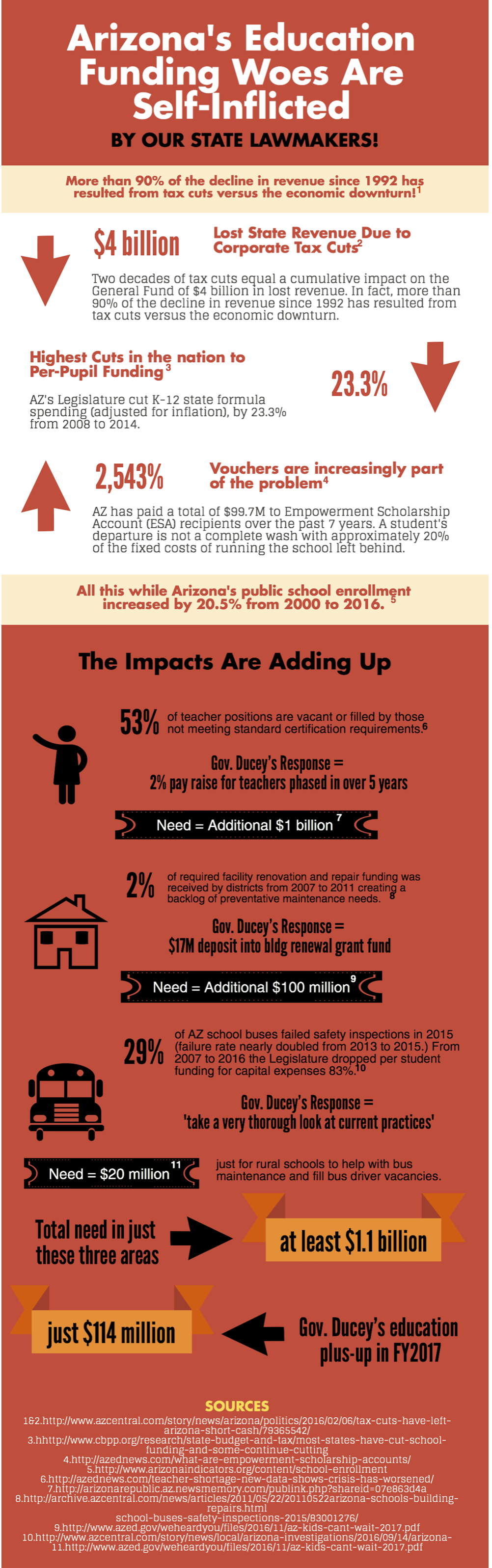
Probably one of the biggest problem is teacher pay that is rock bottom lowest (50th) in the nation. In fact, elementary school teachers here are paid 14% less than in 2001 and secondary teachers are paid 11% less. Governor Ducey’s response for next year’s budget is to give teachers a 0.4 percent pay raise amounting to $187 extra next year on an average salary of $46,384 in 2016. I don’t know about you, but an extra $187 per year wouldn’t convince me to do anything I hadn’t already decided to do.

This paltry teacher raise isn’t the only funding boost to education Ducey is recommending, as he’s proposed a total of $113.6 million for K–12 education next year. But, in light of the fact that per pupil funding is $1,365 less than it was in 2008 (adjusting for inflation) that amount is not even a drop in the bucket compared to the $1.43 billion that has been cut.

The Legislature (including some Republicans) is going a step further in proposing a one percent raise for teachers, which would amount to an additional $430 per year at a total cost of $31 million. Democratic legislators and AZ Schools Now, a coalition of education groups, are advocating for a four percent raise which would give the average teacher an annual boost of $1,720 by freezing corporate tax cuts. Even this amount though, would still leave Arizona teachers $8,616 short of the U.S. average annual salary for teachers.

Why this isn’t something all of us are screaming bloody murder about is, I’m sure, multi-faceted. The most obvious is it doesn’t support the agenda of school choice proponents. After all, from Betsy DeVos and her American Federation for Children, to Michael and Olga Block and their BASIS empire, to Senator Yarbrough and his cash cow School Tuition Organization, raising the salaries of Arizona’s district teachers just isn’t a high priority. But, there is likely a more insidious reason, one that most people probably never think of, and that is the fact that most K–12 teachers are, and traditionally have been, women.

Back in 2014, a teacher in Portland named Nikki Suydam, penned a guest opinion published by the Oregonian on oregonlive.com. In it, Ms. Suydam pointed out that “blaming women for society’s problems is as old as the story of Eve in the Garden of Eden, or Pandora and her box of woes, or every medieval witch hunt spurred on by crop failure or plague outbreak.” “Contemporary education reformers” she wrote “have launched a similar witch hunt to root out ”rotten apples“ from a profession still more than 75 percent female.”

She goes on to make the point that “No similar reform movement targets doctors (65 percent male) for our nation’s spiraling obesity epidemic. America’s dentists (78 percent male) are not held responsible for their patients’ tooth decay. Law enforcement officers (80 percent male) are not blamed for crime statistics. Nor are engineers (78 percent male) ‘held accountable’ for the crumbling U.S. infrastructure.”

And yet, teachers (three-fourths of whom are women) are often vilified for any lack of success in today’s public district schools. This, despite the fact that 20 percent of Arizona’s children live in poverty and the vast majority of these children attend district schools. This despite the fact that Arizona is 48th in the nation in per pupil spending. This despite the fact that our Governor and Legislature continue to push for ways to siphon more tax dollars away from our district schools.

Let’s face it. Whether we are talking about homemakers, or nurses, or teachers; professions traditionally filled by women just don’t earn the same respect and salaries of those dominated by men. We really should get past this old paradigm though, and not look at who does the work, but what work is done. After all, for most people, their child is their most precious “possession” and they turn over the care of this precious possession to a teacher for six to eight hours each day. Shouldn’t we want these teachers to be highly skilled, appropriately valued, and sufficiently compensated?

Numerous studies have looked at teachers’ impact on student achievement. A 2012 research study by the RAND Corporation, found that “among school-related factors, teachers matter most.” The study also found “When it comes to student performance on reading and math tests, a teacher is estimated to have two to three times the impact of any other school factor, including services, facilities, and even leadership.” Steve Seleznow, President and CEO of Arizona Community Foundation and a former school administrator said, “Teacher pay and support is a proxy for how highly we think of students and their education…If we value the education our children receive, we must provide teachers compensation commensurate with those values.”

Every parent knows that children are sponges and they are really good at picking up on the dissonance between our words and our actions. When we undervalue our teachers, on some level, our children know we are undervaluing them as well. And that my friends, is a really, really sad state of affairs.

Money matters, maybe it’s just public education that doesn’t?

Maureen Downey, on her blog getschooled.blog.myajc.com writes, “I have never understood the disagreement over whether money matters in education.” After all she points out, “top private schools – the ones that cater to the children of highly educated parents – charge tuition two to three times higher than the average per pupil spending at the local public schools. And these private schools serve students with every possible learning advantage, kids nurtured to excel from the first sonogram. The elite schools charge $17,000 to $25,000 a year in tuition and hit parents up for donations on a regular basis.”

I get where she is coming from, but also think she is taking literary license in writing she doesn’t understand the disagreement. I suspect just like me, she does understand, because it really isn’t that complicated. The “disagreement” is stoked by a myriad of those who would stand to gain from continued underfunding of public education. These include state lawmakers, who would rather divert public education funding to other special interests; commercial profiteers who look to get their piece of the nation’s $700 billion K–12 education market, and the wealthy who want to keep their piece of the pie as big as possible and not have it eaten up by more taxes to pay for “those children’s” education.

One of the most common refrains I hear from the “money doesn’t matter” crowd is “just look at how much they spend in Washington D.C. yet their schools continue to underperform.” Of course, those of us “in the know”, know that where there is concentrated poverty, there are a myriad of challenges presented that are very difficult for schools alone to overcome. We also know that how the money is spent is a key factor in how well it works. No, money is not the only answer, but there is plenty of proof that it does matter.

As reported by Rutgers professor Bruce Baker in an Albert Shanker Institute report, “On average, aggregate measures of per-pupil spending are positively associated with improved or higher student outcomes.” He goes on to write, “Clearly, there are other factors that may moderate the influence of funding on student outcomes, such as how that money is spent. In other words, money must be spent wisely to yield benefits. But, on balance, in direct tests of the relationship between financial resources and student outcomes, money matters.” Plain and simple, the things that cost money “(smaller class sizes, additional supports, early childhood programs and more competitive teacher compensation) are positively associated with student outcomes.” A study by “Jackson, Johnson & Persico in 2015, evaluated long-term outcomes of children exposed to court-ordered school finance reforms, finding that “a 10 percent increase in per-pupil spending each year for all twelve years of public school leads to 0.27 more completed years of education, 7.25 percent higher wages, and a 3.67 percentage-point reduction in the annual incidence of adult poverty; effects are much more pronounced for children from low-income families.” Likewise, a study of Kansas school finance reforms in the 1990s found that “a 20 percent increase in spending was associated with a 5 percent increase in the likelihood of students going on to postsecondary education. “There is” writes schoolfinance101wordpress.com, “a sizeable and growing body of rigorous empirical literature validates that state school finance reforms can have substantive, positive effects on student outcomes, including reductions in outcome disparities or increases in overall outcome levels.”

Of course, I’ve no doubt the “money doesn’t matter” crowd can dig up some “facts” of their own. But, I ask you to forget all the facts (after all, they don’t matter anyway, right?) and just think about what makes common sense?
– Is the critical shortage of teachers in Arizona classrooms good for student achievement? (Average AZ teacher salaries are the 48th lowest in the nation.)
– Can students learn as well when the ratio of students to teachers is 23:1 versus having 7 less children in the classroom? (Nationwide, the average number of students per teacher was 16:1 in the 2013–14 school year.)
– Can students concentrate in a classroom that is too hot or too cold, or where water leaks into it when it rains, or where lighting is insufficient? (From 2008 to 2012, districts received only two cents of every dollar they should have received for facility maintenance and renewal and a pending new lawsuit is evidence the trend isn’t improving.)school-funding-011817
So, we know that money can make a difference, and wealthy parents that pay big bucks for their children to attend elite private schools know that it matters. Small class sizes, highly qualified teachers, beautiful facilities and campuses all make a difference and that’s why parents with significant means are willing to pay for those things.

Arizonans are willing to pay more for education as well, as indicated by recent polling which shows 70% think we need to plus-up education spending and with 61% willing to pay higher taxes to do it. “Read my lips” Governor Ducey though, is determined not only to not raise taxes, but cut them every year he is in office while also continuing his steadfast committment to corporate welfare in the form of tax cuts. The $114 million he has proposed for the FY 2018 budget isn’t nothing (and it is new money as opposed to that which already belongs to education), but it also isn’t nearly enough. As David Safier points out in TucsonWeekly.com, it moves us all the way from 49th in per student spending to well…49th. And, this is just the Governor’s proposal, the Legislature is the entity actually charged with passing the budget. In addition, it isn’t just that our districts are currently underfunded, but that the funding continues to be siphoned away by commercial schools’ choice. The impacts of a “leaking bucket” with an insufficient stream of water to keep ahead of the losses are really starting to stack up. Money matters alright, maybe its just public education that doesn’t (at least to our Legislature.)

Open letter to those opposed to Prop. 123

Cross-posted by Christine Marsh, Arizona’s 2016 Teacher of the Year:

To all of the folks who are voting “No” on Prop. 123,

In case people don’t read to the end (but read to the end), if you are voting against Prop. 123, contact your legislators and the governor and tell them why. If Prop. 123 fails, the false narrative from our legislators and the governor will likely be something along the lines of this: “SEE?! We knew that the public didn’t care about public education. And this proves it.”

As a teacher in the trenches, I have to wonder where the public has been for the past six years. Education—students, teachers, parents, support staff—has been left to languish in the bottom of the nation for many years. We have the worst funding in the entire nation, and we’re over $3000 per student per year below the national average (we’re about $15,000 below the states that fund their public education the best/highest).

We also have the lowest administrative costs in the nation, the highest class sizes in the nation, and we’re in the bottom four states for what we pay teachers.

We already have a teacher shortage, and with roughly 30% of our state’s teachers retiring in the next five year, we’re reaching crisis proportions. In many districts, it’s already a crisis.

As a teacher, I feel abandoned by the public. You can say, “I didn’t cause this. I’ve voted for education-friendly people.” But that doesn’t change the fact that the majority of the voting public has continued to elect legislators and other politicians who simply do not care about public education.

Now, when we have a bit of light (meaning—yes—money) coming our way, the public that has essentially abandoned us for the past many years wants to extinguish it by killing Prop. 123.

You do realize that we’re in this mess because of the way Arizonans voted (or apathetically skipped voting) in 2014, right?

You also realize that the plaintiffs (representing the schools) have been fighting for this money since 2010, right? Where were you then? Why didn’t you vocalize your support?

You hopefully also realize that as much as we want to, we can’t force the legislature to pay. And, apparently, we can’t throw them in jail for their refusal to pay, either (although, I wish we could). It’s ironic that we can throw “deadbeat dads” in jail, but not deadbeat legislators and that Ducey is going after deadbeat dads.

If you vote this down, what’s your plan? The fact is that we have a legislative majority that doesn’t value public education, so the chances of them paying are slim to none. You can’t claim that they “should” pay and that the money exists without raiding the trust land, because what “should” happen doesn’t matter. The facts matter, and the fact is that they won’t pay. They’ve already proven that they won’t. So if Prop. 123 doesn’t pass, we won’t see the money for many years, if ever. (Remember “Flores Vs. Arizona”? It took over 20 years to settle that case).

So if you vote this down, do you have a plan?

Are you going to as aggressively fight to elect new legislators as you are fighting to defeat Prop. 123?

Or are you going to kill this one chance at light and abandon public schools again? Again??

Please, have a plan if you kill this.

Because with this particular legislature, we won’t be seeing any other funds any time soon.

Our Vote is The Only Power We Have Left

I was privileged to spend some quality time yesterday with Rebecca, a middle school teacher in southern Arizona.   She had taken the afternoon off from teaching to go to the state Capitol to protest proposed funding cuts to public education. In the past, she admitted to being careful about advocating, but she felt she just couldn’t stay silent any longer. She commented that if she didn’t speak up now, there might not any job to protect.

This teacher has been teaching in the same school district for 16 years, and brings home only $900 every two weeks, despite normally working about 10 hours per day. Her husband is also a teacher and between the two of them, they barely make it. They have two children, an 11 year-old girl and an 8 year-old boy. I asked her what her daughter wants to be when she grows up. She said she has talked about being a veterinarian, but time will tell. But, she did tell her daughter that if she chooses to be a teacher, Rebecca wouldn’t pay for her college. This surprised me so I asked her why. Rebecca’s response was should make all of us sad. She said she didn’t want her daughter to have to deal with the lack of respect, low pay and insufficient resources that come with being a teacher.

This teacher confirmed my suspicions that what is driving teachers out is not the low pay, but the lack of respect for the profession and the continual changes that don’t result in positive outcomes. As much as Rebecca loves teaching and loves her students, she doesn’t want her daughter to work in a profession that is undervalued, underpaid, and overwhelmed. How sad.

But, Rebecca hasn’t given up. She wants to fight for her kids, her school, and our future. Problem is, she is just one person and just one vote.

The job of a teacher is not to advocate for resources for their students. The job of teachers is to teach their students. They need the rest of us to step up and speak out. Many credit Albert Einstein with saying “the definition of insanity is doing the same thing over and over again and expecting different results.” If the greater “we” doesn’t get out and vote, we can’t expect anything other than what we’ve got in our elected representatives. Our vote is likely the only power any of us has left and if we abdicate that, we’ve given up. Get motivated, get registered, get informed and VOTE! It is the only way we’ll make a real change for the better!!

The Truth About Common Core

First of all, let’s set the record straight.  The Common Core Standards are not a curriculum.  They are a clear set of shared goals and expectations for what knowledge and skills will help our students succeed. The workplace is very different than it was even ten years ago and teachers today must prepare students for a world of possibilities that may not yet exist. The ability to effectively communicate, collaborate, and adapt to situations will be critical to ensuring we remain competitive in a highly globalized market.[i]  Local teachers, principals, superintendents and others are critical to making this happen and will decide how the standards are to be met. Teachers will continue to devise lesson plans and tailor instruction to the individual needs of the students in their classrooms.

Image

Secondly, they were not developed by the Federal government or the current administration, but by the nation’s governors and education commissioners, through their representative organizations the National Governors Association (NGA) and the Council of Chief State School Officers (CCSSO).  The education reform movement began in 1996 when the nation’s governors and corporate leaders founded Achieve, Inc. as a bi-partisan organization to raise academic standards, graduation requirements, improve assessments, and strengthen accountability in all 50 states.  This led to the launch of the American Diploma Project (ADP) in 2005, the initial motivation for development of the Common Core Standards.[ii]  Teachers, parents, school administrators and experts from across the country together with state leaders provided input into the development of the standards.[iii]  In fact, our very own Dr. McCallum, head of the Department of Mathematics at the University of Arizona, was a lead author of the Common Core Math Standards.[iv]

There can be no doubt that one of the reasons the United States rose quickly to its super power status is our commitment to providing every citizen a public education.  This was a new concept that helped us make the most of our most valuable resource…our people.  It is also what helped make the American Dream a reality for so many.  Unfortunately, that dream is now no longer a given – studying and working hard no longer guarantee that you’ll be better off than your parents were.

Fear mongering over “the Obama administration federal take-over of education” is simply that, and diverts focus away from the real threats to our public education system.  Instead, we should be concerned about the corporate influence in the form of venture philanthropy as opposed to the more traditional philanthropy.  The difference of course being that the traditional philanthropists supported the work of others and the venture philanthropists view their giving as entryways into that work.  The 1983 report by the Reagan administration, A Nation at Risk, set the stage for the business elite to look at public education as a profit center.  The leading venture philanthropies are now pushing charter-school growth, school choice, and education privatization in general; alternative routes of teacher and administrator certification; and curriculum and test development.  Unfortunately, all this drives a transition from public deliberation by elected officials to decisions of individuals with no accountability to the public.[v]

Opportunity, that most fundamental American value, is now at risk for so many.  It is at risk, not because of some imagined plot to nationalize education, but because we are refusing to deal with the real threats – poverty and a lack of respect for our teaching professionals whom I believe can fix what’s wrong if we’ll just give them what they need and get out of their way.  Learn more at www.azed.gov/azcommoncore.