Beatings Will Continue Until Morale Improves

Although not politically correct, the title of this post is a saying sometimes used in the military to describe decisions by senior leadership that seemed extra harsh and detrimental to troop morale. This saying came to mind when I read of Arizona’s Superintendent of Public Instruction Tom Horne’s response to an AZ Department of Education survey of teachers who chose not to return to the classroom for the 2024-2025 school year. The results were released earlier this week and the top four reasons for teachers leaving included: burnout, lack of respect, student behavior and discipline, and low salaries. 

Almost 2,500 of the 5,900 teachers not returning responded to the survey, but 1,500 of the responses were removed for reasons such as those teachers were retiring, promoted to administration, or had accepted a monitoring job. The thousand or so remaining responses most often “strongly agreed” or “agreed” to the following:
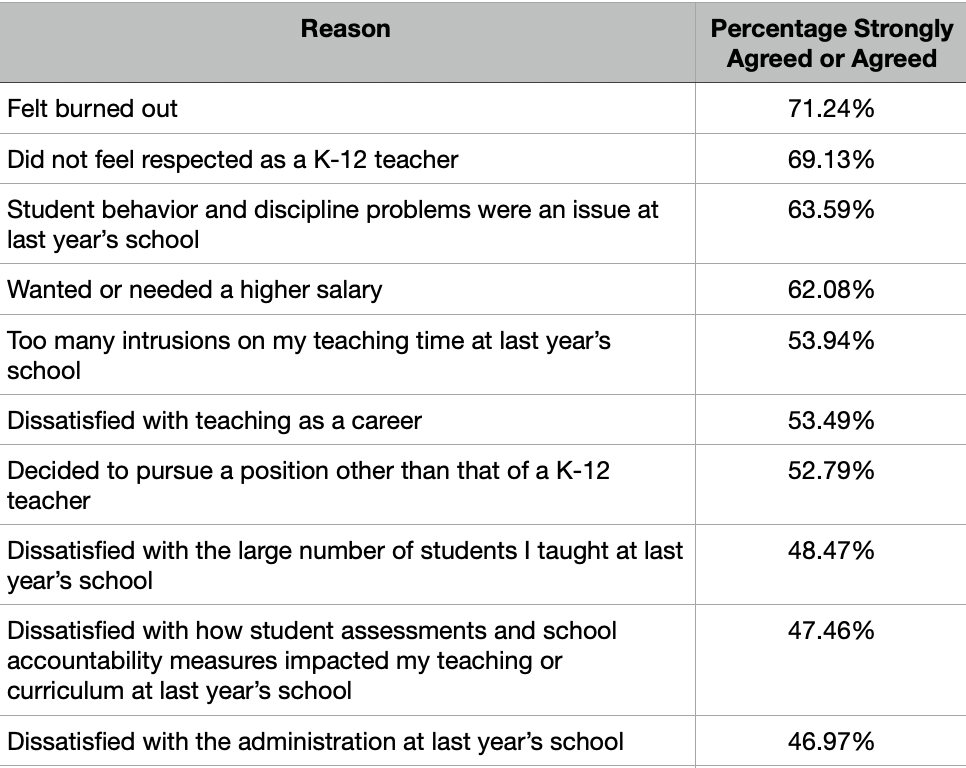
Of course, Superintendent Tom Horne honed in on “student behavior and discipline problems” (ignoring burnout and lack of respect) as the significant contributing factor for teachers leaving their jobs. This then, provided him more justification to further push proposed legislation to link school letter grades to a tougher stance on discipline. The AZ Daily Star reported SB 1459 would have required “the state Board of Education to lower a school’s letter grade if it did not implement disciplinary actions in at least 75% of the total number of student discipline referrals submitted by teachers in a single year”. 

The bill was passed in the Senate, but two Republicans in the House refused to vote for it, killing the bill in this session. Of their vote, Horne said “Shame on the legislators who voted against it” claiming it is simply a way to incentivize district support for teachers regarding discipline.

Rep. Nancy Gutierrez, D-Tucson, saw an ulterior motive for the proposal. During the debate on the House floor, she said, 

“It is my opinion that this bill has been put forward in order not to support teachers but in order to make it so that there’s an easier way to have more public schools with D and F grades to support some of the rhetoric that we hear that public schools are failing our students”. 

This of course is just another way for Horne and GOP legislators to push parents toward vouchers and other privatization efforts. Representative Judy Schwiebert, D-Phoenix, agreed and blamed the Legislature for contributing to the teacher retention problems by funding Arizona schools at one of the lowest per-pupil rates in the nation. Schwiebert went on to say that, 

“The job of our local schools and boards is to make direct decisions that apply most specifically to their schools,” she said. “We see the legislature criticizing public schools when we are not doing our job. Arizona ranks 49th in the nation in per pupil funding. We’re pointing our finger at public schools, blaming them for problems that we have created because of too large class sizes, failure to pay teachers enough, failure to provide support staff.”

A Forbes.com article titled, “No More Teachers: The Epic Crisis Facing Education in 2024” agreed, stating that low pay is the biggest reason for the declining numbers of new teachers. In 2022, says veteran teacher and author Jay Schroder, “teachers made on average 26.4% less than other similarly educated professionals”. 

‘Schroder contends that the low pay, combined with high stress and a strong sense of disrespect from some outspoken sections of society, make the job of teaching unattractive to many college graduates. “If this were just a PR problem, it would be easier to solve,” he says. “The truth is that the pay is low and the stress is high.”’

According to K12Dive.com, the Educators for Excellence (E4E) 7th annual Voices from the Classroom survey of teachers this May, highlighted the crisis by reporting that, 

“A mere 19% of teachers believe the profession is sustainable, with only 16% of teachers recommending the profession to others, and less than half expressing commitment to staying in it for the long haul.”

We have been headed for a real crisis regarding teacher shortages; one that has only been exacerbated by the pandemic. And while the trailblazing Arizona Teachers Academy (ATA), passed with bipartisan support in 2018 was working to address our state’s crisis, lawmakers cut $14 million from the program’s budget this year. According to AZCentral.com, the program had expanded in 2023, to serve 3,255 aspiring teachers with an average scholarship of $8,555. The cuts made to the program this year, mean that some 1,700 fewer students will be working their way through a proven pipeline. In the past, ATA has also provided funding for mentors to support new teachers and National Board Certification for experienced teachers.

Turning around teacher dissatisfaction won’t be easy, but neither does it seem super complicated. It boils down to treating them as the professionals they are, not “beating down” them, their administrators, or their schools. Competitive compensation, autonomy to do the jobs they were trained for, an adequate support structure, a collaborative environment, and quality school leadership are some of the more important tools. Also important though, is a recognition by the public and those we elect to represent us, that quality teachers are a most worthy investment critical to the future of our communities, our country, and our world. 

As Anatole France, a French poet, journalist, and best-selling novelist, once said, “Nine-tenths of education is encouragement”. That applies to both students in the classroom and all the professionals who teach them. In my experience as a leader in the Air Force, the carrot is almost always mightier than the stick, but that approach does require a more confident and skilled leader. I guess it is just easier for Superintendent Horne to continue to try the “beatings” approach.

The GOP Plan for Education – 2

What It Means For Arizona – Part 2

Below is part 2 on the GOP promises for education in the 2024 RNC Platform. The first part dealt with promises one through three. This one reviews promises four through six.

4. Safe, Secure, and Drug-Free Schools: Republicans will support overhauling standards on school discipline, advocate for immediate suspension of violent students, and support hardening schools to help keep violence away from our places of learning.

Arizona has been losing a net of 3,300 teachers per year according to Superintendent Horne and although 67% of them left the profession last year due to low pay, 61% said a lack of support in dealing with student behavior and discipline was also to blame. His predecessor, Kathy Hoffman, tapped into Federal Recovery Act dollars to add hundreds of school counselors. But in the 2022-2023 school year, we still had only one counselor for every 667 students, almost double the national average. 

Now, federal funding is running out and lawmakers are looking for less expensive solutions. HB 2460, passed in the Legislature and signed by the governor in 2023, retracted previous legislation allowing kindergarten through fourth-grade students to be suspended. This year, Horne proposed Senate Bill 1459 which would have reduced a school’s letter grade if disciplinary action was not taken in at least 75% of teacher referrals. It had significant opposition and was eventually held in the House.

There is plenty of evidence though, that punitive discipline is not the best solution. As reported in ChalkBeat.org, “Students who get suspended tend to have lower test scores and higher dropout rates, and students who attend schools with high suspension rates are more likely to be arrested and incarcerated as adults — what advocates call the school-to-prison pipeline.” Morgan Craven, national policy director at education civil rights group IDRA says, “if lawmakers want to make schools safer, they should ensure that students have access to mental health services and programs that teach positive behaviors. “Our response should not be”, she added: “OK, let’s just find faster, easier ways to simply kick them out.” As reported on KAWC.org, Rep. Jennifer Pawlik, D-Chandler, a former school teacher, said “A lot of people are leaving right now because classroom behaviors have accelerated,” Pawlik said. “And it’s really hard to be a teacher right now.” The answer though she added, is not to put in “punitive measures”, but rather, to consider class size, mentors for new teachers, and “appropriate staffing of our schools that includes mental health providers and paraprofessionals” (trained aides that support teachers).

I’d like to see the GOP deal with the cause for the need to harden our schools, but I’m not holding my breath. I’m also not holding my breath for the funding to harden our campuses. The reality is that not only do Arizona’s schools not have funding to “harden” their campuses, they don’t even have sufficient funding to ensure basic maintenance. A trial finally began in June of this year, on a lawsuit filed in 2017 on behalf of several school districts and the Arizona School Boards Association, which claims “Arizona’s funding model puts low-income schools at a disadvantage and violates the state’s constitution”. An Arizona Supreme Court ruling in 1994 prompted the state legislature to pass the Students FIRST law funded at $1.3 billion to provide emergency funding for capital projects. However, the Legislature has cut at least $4.56 billion from education funding since 2009, and according to 12News.com, “rural districts are at a greater disadvantage because they can’t raise enough money from bonds and overrides and their property tax wealth is limited.” 

5. Restore Parental Rights: Republicans will restore Parental Rights in Education, and enforce our Civil Rights Laws to stop schools from discriminating on the basis of Race. We trust Parents!

I am SO tired of this parental empowerment and parental rights language. First of all, parents are not the only stakeholders in the education of their children. In a well-functioning civil society, we all have a stake in ensuring children are taught a full curriculum that enables them to think for themselves and become productive citizens. And oh by the way, if you take my tax dollars to educate your child in a private school setting, I should have a say in what that education consists of. 

Just try to think of another publicly funded service where the public has no say in how that good or service is provided. Why do we tolerate it in education? As previously pointed out, Arizona vouchers require very little accountability from parents using them. And, there is no reporting of educational outcomes required by the schools. Therefore, we the voters, have no idea how it is going and can’t then, hold our lawmakers responsible for their decisions to support them.

Sorry if I don’t believe the GOP’s desire to “enforce our Civil Rights Laws”, is genuine, at least not for any person other than a white male. After all, Project 2025 wants to scale back the federal government’s ability to enforce civil rights laws like Title IX, which prohibits sex-based discrimination, and Title VI, which prohibits race-based discrimination, by any entity accepting Federal monies.

6. Knowledge and Skills, Not CRT and Gender Indoctrination: Republicans will ensure children are taught fundamentals like Reading, History, Science, and Math, not Leftwing propaganda. We will defund schools that engage in inappropriate political indoctrination of our children using Federal Taxpayer Dollars.

Arizona’s public district schools teach what is required by law, and there is very little time in the schedule or funding to do otherwise. School curriculum is dictated by law via the Arizona Academic Standards spelled out by the Department of Education. School success in teaching these standards is reported via the annual Arizona Academic Standards Assessment. However, students who take vouchers and Student Tuition Scholarships to attend homeschools, micro-schools, religious schools, or other private schools, as provided by the AZ GOP-led Legislature, do not participate in these assessments and the schools are not required to report any assessment data.

The hypocrisy behind “we will defund schools that engage in inappropriate political indoctrination” is staggering. The Arizona Legislature hasn’t yet followed Oklahoma in requiring the Bible to be taught in our public schools or Louisiana in requiring the Ten Commandments to be posted in the classroom, but the Arizona Department of Education and multiple AZ GOP lawmakers have been working with the controversial conservative group PragerU to offer new lesson plans on what they call “American Values”.  State Superintendent Horne wants this curriculum offered in Arizona classrooms as an alternative to the “extreme left side [that] has been presented”. Save our Schools Arizona Director Beth Lewis disagrees and calls PragerU content “dangerous. I’m in classrooms all over the state. I see what educators are teaching,” Lewis said. “The things they’re being accused of are not happening. They’re teaching accurate, truthful science and history.”

So, in fulfilling these three promises, the GOP would deliver more punitive discipline measures which will likely reduce protections for girls and children of color, and continue to feed the school-to-prison pipeline. Oh, by the way, six of Arizona’s 10 prisons are already privately owned. Just sayin’…

The GOP Plan for Education – 1

What It Means for Arizona – Part 1

First of all, what IS the GOP plan for education? Great question. According to the New York Times, the Republican National Committee (RNC) Platform was meticulously prepared by Team Trump and passed at the convention with “ruthless efficiency… that squelched, silenced or steamrolled any forces who might oppose” it. It is the “official” plan but by design, is short and vague, because according to Zack Beauchamp writing on Vox.com, “[Trump] wanted nothing in the platform that would give Democrats an opening to attack him”. Project 2025 from the conservative Heritage Foundation, provides many more details but Trump now disavows any knowledge of it despite plenty of evidence to the contrary. “The now-infamous document puts meat on the platform’s bones” writes Beauchamp, “It details a set of proposals for how to take the RNC’s vague Trumpy principles and turn them into actual, concrete policy. In essence, it is serving as the policy shot for a party uninterested in doing its own homework.” 

In reading the plans for education in both documents, The Republican National Committee platform looks to be the “Cliff Notes” for Project 2025 which wants to eliminate the U.S. Department of Education and according to Newsweek, “seeks to unravel decades-long efforts to cultivate equitable learning spaces and systems. If implemented, it would unwind critical protections for American schoolchildren…and erase any effort from the federal government to improve America’s schools.” 

The RNC Platform itself initially sounds less innocuous, but the devil is definitely in the details. The chapter on education begins with the heading “Cultivate Great K-12 Schools Leading to Great Jobs and Great Lives for Young People.” Then it provides a paragraph called “Our Commitment” which states: 

“Republicans offer a plan to cultivate great K-12 schools, ensure safe learning environments free from political meddling, and restore Parental Rights. We commit to an Education System that empowers students, supports families, and promotes American Values. Our Education System must prepare students for successful lives and well-paying jobs.” 

It then provides nine promises. In this three-part post, I’ll at times use points from Project 2025 to help explain what the GOP Platform might intend, and what it means for Arizona. Yes, it is a leap. But, I would argue, not a huge one and, because of the potential danger of another Trump Administration’s impact on public K-12 education, one worth taking. 

1. Great Principals and Great Teachers: Republicans will support schools that focus on Excellence and Parental Rights. We will support ending Teacher Tenure, adopting Merit pay, and allowing various publicly supported Educational models.

Arizona’s version of teacher tenure is called “continuing status” and is granted to teachers who have not been rated as “ineffective” for the major portion of more than three years. All other teachers have “probationary” status. Continuing status, simply means these teachers cannot be terminated without adequate notice and the opportunity to correct ineffective performance. 

Eliminating teacher tenure would make it even harder for Arizona to attract and retain good teachers who accept lower pay (than other comparable career fields) for a more secure and stable job. Just a few weeks into the last school year, Arizona had “2,229 teaching vacancies across 131 districts”, according to a survey by the Arizona School Personnel Administration Association. Part of the problem is an average teacher salary of $9,000 less than the national average, but it is also about teachers feeling unvalued, unsupported, and overworked. Jay Schroder, a veteran teacher, and author, “contends that the low pay, combined with high stress and a strong sense of disrespect from some outspoken sections of society, make the job of teaching unattractive to many college graduates”. “If this were just a PR problem, it would be easier to solve,” he says. “The truth is that the pay is low and the stress is high.” Eliminating teacher tenure would only increase that stress, and make the low pay even less desirable for even the most passionate professionals. 

Merit pay refers to any system in which compensation is partly based on an evaluation of the employee’s job performance. Arizona statutes already require that district governing boards prescribe specific procedures for the teacher performance evaluation system that include an annual evaluation of each teacher by a qualified evaluator. This evaluation must include two classroom observations at least 60 days apart, and quantitative data on the academic progress of the teacher’s students, (which accounts for 20 to 33 percent of the overall evaluation). The statutes provide exceptions to some of these rules (such as omitting the second classroom observation) where teachers are proven high performers. 

2. Universal School Choice: Republicans believe families should be empowered to choose the best Education for their children. We support Universal School Choice in every State in America. We will expand 529 Education Savings Accounts and support Homeschooling Families equally.

Arizona has offered open enrollment (allowing parents to enroll their child in any district school that has openings), and charter schools since 1994. Additionally, family-funded homeschooling and private school attendance have always been options, but with the universal voucher (Empowerment Scholarship Accounts) expansion, the AZ GOP pushed through the Legislature in 2022 (voters rejected them two-to-one in 2018), we all must now foot the bill. Unfortunately, the voucher program requires almost no accountability and the AZ GOP-led legislature hasn’t been interested in introducing even common-sense checks and balances. This prevents us from measuring their return on investment and holding anyone accountable for results; exactly opposite to our requirements for our public district schools.

As for homeschooling, Arizona couldn’t make it any easier. Homeschoolers must only send a letter (Affidavit of Intent) to their county school superintendent stating they will homeschool and can now get vouchers to cover their costs. Arizona statutes require the curriculum to include reading, grammar, math, social studies, and science, but there are no teacher qualifications or assessment requirements to help ensure quality learning takes place. 

The GOP didn’t spell out how they plan to expand 529 Education Savings Accounts but Project 2025 could give us a clue. According to Education Week, Project 2025 proposes phasing out Title I funds for educating disadvantaged or underserved children over the next decade. Until then, it states that Title I funds should be transitioned to “no-strings-attached” block grants administered by state education departments. This could allow funds to flow directly to parents in the form of 529 education savings accounts for private school and other education expenses. It also discusses doing the same for special education funds from the Individuals with Disability Education Act (IDEA). Arizona already fully supports and promotes 529 accounts to pay for qualified postsecondary education and apprenticeship program expenses. AZ529.gov states that it “offers a tax deduction each year ($2,000 per beneficiary per tax filer) for investing in the Arizona 529 Plan or any state’s 529 plan” and that “There is no limit on the number of beneficiaries Arizona residents can make contributions to in a tax year.”

3. Prepare Students for Jobs and Careers: Republicans will emphasize Education to prepare students for great jobs and careers, supporting project-based learning and schools that offer meaningful work experience. We will expose politicized education models and fund proven career training programs.

The Arizona Legislature enacted statutes that allowed public school districts to form Career and Technical Education Districts (CTED) in 1990. We now have 14 CTEDs across the state with almost 161,000 students receiving career and technical education.These students learn skills required to be aircraft mechanics, dental assistants, firefighters, graphic designers, plumbers, vet techs, welders, and much more. The results of the program speak for themselves with students in CTE courses statewide graduating at a rate of 97% versus 81% of those students in traditional track programs. Not only that, but they are prepared for high-paying positions in their chosen fields. 

So in fulfilling these first three promises, the GOP would likely exacerbate our teacher shortages and export Arizona’s runaway and unaccountable voucher program to the rest of the country. Please stay tuned for the rest of their plan.