Something Borrowed, Something Blue

Let me be clear from the onset that I am “borrowing” this article. In fact unless the words are in bold italics, they are hers, not mine. I’m hoping the author, Athens Banner-Herald columnist Myra Blackmon, a resident of Washington, Ga., sees my “borrowing” as the “sincerest form of flattery. I chose to use her piece titled “School vouchers raise too many questions,” because I found it both very well written and remarkable in that I needed only change the state name and some of the numbers to make it apply to Arizona.

With the confirmation of Betsy DeVos as U.S. secretary of education, we can expect to see a flurry of new “initiatives” designed to address the so-called education problem in our country. For the moment, let’s set aside the relationship of poverty and poor academic achievement. Ignore for a moment the fact that our schools are actually performing pretty well.

We will likely see a renewed push for voucher programs, where parents can supposedly take the tax money allocated for their children and use it to enroll them in private, religious or charter schools, many of which are combinations of those categories.

If I believed vouchers would improve educational outcomes for Arizona’s poorest children, I would be the first to jump on that bandwagon. The reality is that even vouchers aren’t likely to improve the lives of the 421,000 Arizona children who live in poor or low-income families, despite efforts of reformers to convince us otherwise.

First, the average worth of  $5,600 for mainstream students that vouchers provide just isn’t enough to fully fund private school tuition. I chose not to spend an hour looking at websites (as Myra did) of private schools in all parts of the state to determine the range of tuition, but did find a school in Phoenix that charges $24,000 a year, and the average school tuition is almost $6,000 for elementary, and $18,000 for high school. Does this even seem possible for a disadvantaged child, even if a scholarship is available?

Second, not all non-public schools are open to all children. The majority of private schools in Arizona are religious schools, many of which set very strict standards for admission that have little or nothing to do with academic potential. They would exclude children from families of same-sex couples, or families whose moral standards are, in the judgment of the school, not consistent with the school’s values. That might exclude children whose parents are not married, or who were behavioral problems at their previous school.

Third, few private schools provide special education. Of those that do, many limit that special education to mild learning disabilities, or limit them to mild ADHD or other learning differences. Many private special education schoolsdon’t address severe or complex disabilities. Only public schools are required to meet all those needs. In fact, when Arizona parents pull their children out of district schools to educate them with a voucher, they must waive their rights under federal special education  law.”

Fourth, even if a voucher covered tuition at a private school, it would be almost impossible to include allowances for additional fees that would allow the poorest children to attend. Lab fees, textbooks, materials fees and technology fees add up. I found more than one school where those items quickly totaled more than $1,000 a year. And that didn’t include trips – sometimes mission trips in religious schools – or athletic fees, which also ran into the thousands of dollars. What about these costs?

Fifth, about 10 percent of Arizona’s schools are rural schools…with some children on buses more than 60 minutes each way every day. And those are the public schools. Private schools can be even more distant. For public schools, transportation is provided. Bus fees for private schools could run several hundred dollars a year. Who covers this?

And what about homeless students? According to New Leaf, a mesa non-profit human services organization, about 3 percent of Arizona students – nearly 30,000 children – were homeless in 2016. In fact, the National Center on Family Homelessness ranks Arizona as worst for risk of child homelessness. Do you really see these children as able to take advantage of vouchers?

Seventh, I found listings for many private religious schools that enroll fewer than 100 students and have only two or three teachers. Would a voucher to such a school improve a student’s chances over even the most poorly resourced public school? I doubt it.

The bottom line is that vouchers help middle-class families who can almost-but-not-quite afford private school tuition. Those are also the children who score best on standardized tests.

Vouchers help segregate those families from the poor and different in their communities. They isolate students from daily contact with needy families or children from unusual families. Some charge their students for “mission” work, which is a completely different dynamic in relationships with people different from us.

I simply do not see how vouchers for private schools, unregulated and not accountable to any elected officials, can do anything but set up our public schools as the place for the poorest, neediest and most severely disabled students.

That is wrong. I know it. You know it. Yes we do Myra, and that’s what the “something blue” in the title of this post refers to. This kind of misery shouldn’t have any kind of company. 
Happy Valentines Day…NOT!

On this Valentine’s Day, I thought I’d ask, when it comes to our public schools students in Arizona, “who loves you baby?”  Yesterday, I was listening in on the AZ House Education Committee meeting. There were many bills on the agenda, but I was primarily interested in HB 2394; empowerment scholarship accounts [ESAs]; expansion; phase-in. I wasn’t hopeful the bill would die, as its companion bill SB 1431, had already been given a due-pass by the Senate Education Committee. As expected, HB 2394 followed suit on a 6–5 vote as did HB 2465, which will allow all students eligible for an ESA account to remain on the program until age 22 and for up to $2,000 a year to be put into a 529 savings account.

The passage of these bills, along with the companion ones in the Senate, demonstrate the disdain many GOP legislators have for our district schools and, for the underpaid educators who toil within. This, because ESAs divert more general fund revenue per student to private schools than district schools receive. As reported by the Arizona School Boards Association, an ESA student, on average, costs the state general fund $1,083 more in grades K–8, and $1,286 more in grades 9–12 than a district student. This is in part because there are many school districts that enjoy a fair amount of locally controlled support in the way of overrides and bonds. The state therefore, is relieved of providing equalization funding to them, but when students leave to go to private schools, all the funding must come from the state general fund. ESA students also receive charter additional assistance funding of roughly $1,200 per student, which district schools do not receive. Turns out that the claim of voucher proponents that they save the state money, is not just “alternative facts” but totally untrue. And, although voucher proponents love to claim there is no harm to district schools when students take their funding and leave, the truth is that about 19 percent of a districts costs are fixed (teacher salaries, transportation, facility repair and maintenance, utilities) and can’t be reduced with each student’s departure.

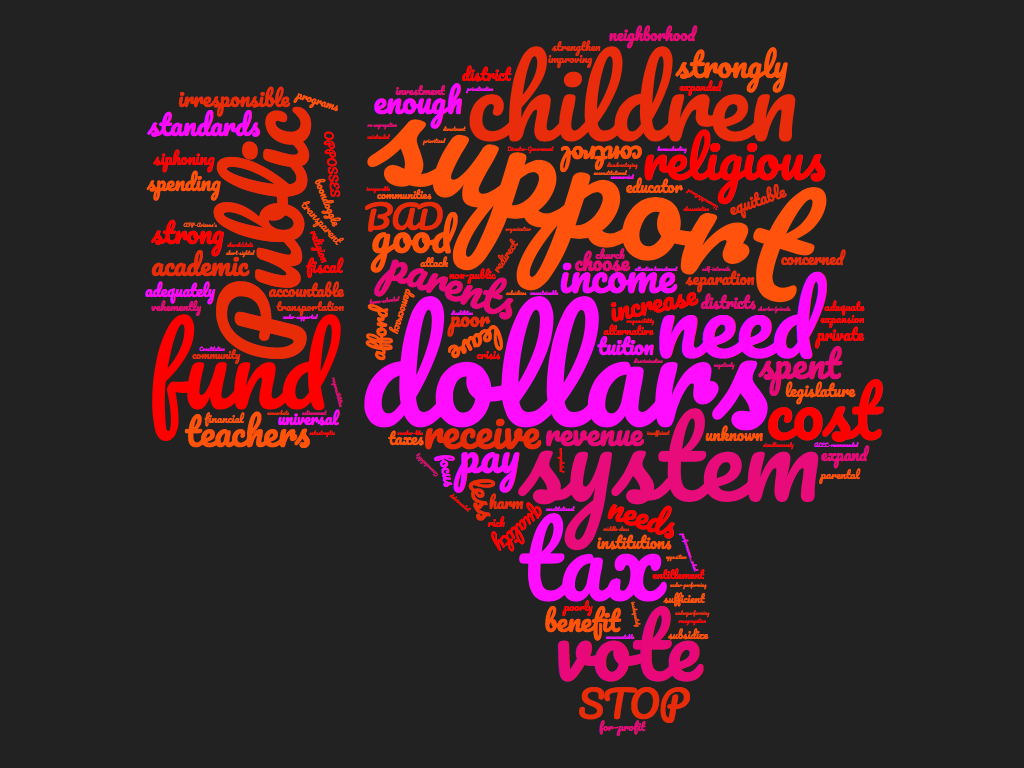
I am slightly encouraged though by the two Republican members on the House Education Committee who had the courage to stand up and do the right thing. Huge kudos to Representatives Doug Coleman and Michelle Udall who voted against the voucher expansion! I encourage each of you to email them and let them know how much you appreciate their show of support for the one million public school students in Arizona’s district schools. What also gives me hope, is the 400 plus people and their almost seven pages of 10-font, single spaced comments made against the bill in the Arizona Legislature’s Request to Speak System. Here’s a word cloud of the comments:

esa-wordcloud

This is compared to the 30 people who signed in to Request to Speak in favor of the bill. The vast majority of whom represent organizations in favor of commercialization of district schools such as The Goldwater Institute, Americans for Prosperity, Center for Arizona Policy, AZ Catholic Conference, AZ Chamber of Commerce and the American Federation for Children.

So, why these organizations? Well, let’s see. According to its website, the Goldwater Institute is a “national leader for constitutionally limited government.” Corporate reformers love to paint district schools as “government” schools, making them just another one of the targets to shrink the government, or as Grover Norquist said, “get it down to the size where we can drown it in the bathtub.” The Goldwater Institute also works closely with the corporate bill mill, the American Legislative Exchange Council (ALEC) to promote conservative corporate agendas (such as commercialization of district schools) in Arizona.

Cathi Herrod and her Center for Arizona Policy (CAP) have long pushed school choice. CAP’s website states the belief that, “Religious freedom is affirmed and protected, free from government interference.” Of course, they are for vouchers. They would love for every student in Arizona to attend religious schools on the taxpayer’s dime.

Americans for Prosperity is a conservative political advocacy group funded by the Koch brothers. On their website they write, “at the very top of AFP-Arizona’s 2017 legislative agenda is the expansion of our state’s program of parental choice Empowerment Scholarship Accounts (ESAs).” They also encourage their supporters to thank Senators Flake and McCain for voting to confirm Betsy DeVos.

It should be no surprise to anyone that the AZ Catholic Conference is also interested in fully expanding voucher eligibility. Around the nation, Catholic schools have been closing at rapid rate, from 13,000 schools enrolling 12 percent of U.S. school children in the mid–1960s, to about 7,000 schools enrolling five percent in 2012. In 2015 alone, 88 Catholic schools closed. But, a tax credit program highly favorable to private and parochial schools has helped stem previous losses in Arizona but charters are still causing them much competition for students. There are now 73 Roman Catholic private schools in Arizona and six of them are among the most expensive private schools in the Phoenix area charging from $13,300 to $17,712 per year in tuition. A $5,200 voucher obviously won’t help poor students get into these schools, but it will be a nice offset for those wealthy enough to afford the schools irrespective of the help. The average cost for private schools in Arizona by the way is about $6,000 at the elementary level and $18,000 at the high school level.

As for the Arizona Chamber of Commerce, let’s not forget how their President and CEO, Glenn Hamer, recently characterized teachers as “crybabies” for wanting adequate pay. This, when our teachers are the lowest paid in the nation and 53 percent of Arizona’s teaching positions were vacant or filled by uncertified personnel at the beginning of this year. Study after study shows a high-quality teacher is critical to student success. What does that say about the commitment of Hamer and his chamber to our students in Arizona?

Finally, let’s not forget that until she was confirmed as Secretary of Education, Betsy Devos was the Chairwoman of the American Federation for Children (AFC). AFC is a huge proponent of school choice and vouchers and has invested millions in purchasing legislators favorable to their causes. Since 2010 in fact, it has contributed some $750,000 to pro school choice legislative candidates in Arizona.

Looking at the list and knowing the resources at their disposal (just think of the Koch brothers and DeVos alone), it is easy to assume most of them have invested heavily in legislative outcomes in Arizona and around the country. Does anyone really believe these organizations have Arizona’s district school students, 56 percent of whom qualify for free and reduced lunch (an indication of their low socio-economic status) children at heart?

We all know when we read something, especially these days, we must consider the source. Well, when looking at the support for voucher expansion in Arizona, I highly encourage you to do the same. This fight against the full expansion of vouchers is far from over. Those pushing for it are no doubt emboldened by pro-voucher stance of the new POTUS and his SecED. But, the people of Arizona understand district COMMUNITY schools are the key to not only achievement for all our students, but also to the health of our communities, and the preservation of our Democracy. We must not sit on the sidelines and watch these bills get signed into law. Much too much is at stake. Want to know more about how to plug-in? Comment on this post and I’ll be in touch. Please don’t let it be said we let our students get sold out!

Open Letter to Senators Flake and McCain

Dear Senators Flake and McCain,

First of all, let me thank you for your service to our state and our country. I realize your job is not an easy one, but hope you understand this is also not an easy time to be an engaged patriot. Millions of us are incredibly anxious about the future of our country and our world. At this time, more than almost anytime in my adult life, we need real leadership.

As a school board member, I am really worried about President Trump’s and his SecED nominee’s intentions with K–12 education. He thinks our nation’s current education system is “flush with cash” and that our children are “deprived of all knowledge.” For Arizona at least, both of these statements are ridiculous. Our per pupil funding is 48th in the nation and our teachers the 47th lowest paid. Even so, our student’s National Assessment of Educational Progress (NAEP) scores continue to rise and we led the nation in growth on the science test from 2009 to 2015.

If however, Betsy DeVos is confirmed, she will no doubt try to do for the nation what she did for Michigan. There she pushed for vouchers (even though she could never “sell” them in her home state) and for-profit publicly funded charters with as little accountability and transparency as possible. The results speak for themselves, with Michigan’s 4th grader scores on the NAEP from 2003 to 2015 declining from 28th to 41st in reading and from 27th to 42nd in math. This is not a formula for success.

I understand the pressure you are under to toe the party line, but the people of Arizona and our nation need you to look deep inside yourselves and determine what is really best for our country? Truly public education, that which is governed by locally elected boards, is the bedrock of our democracy and built the greatest middle class in the history of the world. It also taught us yes, we are all different, but there is strength in those differences. It can continue to support the American Dream, or, we can just give up on that dream and sell out to the highest bidder. We are at a tipping point and you have the ability to pull us back from the edge or propel us over the cliff. Please cast your vote in favor of our democracy and say NO to DeVos and her privatization agenda. We (the people) are counting on you!

Vouchers: Some Common Sense Questions

Unless you’ve been living under a rock for the last few years, you know corporate reformers are anxious to implement vouchers as a way to expand school choice. The secret sauce they say, is that the dollars follow the student because parents know best about what is best for their child’s education.

Just for a few moments though, I’d like to ask you to please forget whether or not you believe school choice and vouchers are the answer to “Make American Education Great Again.” Forget all the hype and promises, just ask yourself which of these scenarios makes more sense?

  1. Which is more accountable and transparent to parents, the taxpayers and voters and therefore less likely to experience less fraud, waste and abuse? #1 Hint to the answer. #2 Hint to the answer. #3 Hint to the answer.
    a. District schools that must report every purchase, competitively bid out purchases over a certain amount, have all purchases scrutinized by a locally elected governing board, undergo an extensive state-run audit each year, and are publicly reported on for performance efficiency and student achievement by the AZ Auditor General’s office each year?
    b. A voucher system which puts the onus on recipient parents to submit proof of expenditures to an understaffed AZ Department of Education office responsible for monitoring the $37 million ($99.7 million since 2011) in voucher expenditures for 4,102 different students?
  2. Which is more likely to be held accountable for student achievement and thereby taxpayer return on investment? Hint to the answer.
    a. A district school where students are given a standardized state test with scores rolled up to the state and made public, where data is reported (following federal guidelines for data protection) by subgroups to determine achievement gaps, and where high school graduation and college attendance rates are reported?
    b. A private school that does not provide any public visibility to test results and where the state (per law) has no authority to request or require academic progress from voucher recipients or the school?
  3. Which is more likely regarding the portability (with no impact) of per student funding when students leave their district schools?
    a. When a student leaves a district school with their education funding in their backpack, they take all associated expenses with them?
    b. That there are fixed costs left behind (approx. 19%) that the school is required to still fund such as teachers and other staff that cannot be eliminated just because a couple of students left a classroom, or a bus route that can’t be done away with just because one student is no longer taking that bus, or a building air conditioner that can’t be turned off because the occupancy in the classrooms is down by three students. That what the “drain” causes instead, is larger class sizes, less support services, less variety in the curricula, etc.?
  4. Which is more likely to serve disadvantaged students — the ones most in need of our help? Hint to the answer.
    a. A district school, where the vast majority of educational expenses are covered by the taxpayer, where students are transported from their home to school, where free and reduced lunches are provided and which must accept all comers?
    b. A $5,200 voucher to a private or parochial school which has total control over which students they accept, does not provide transportation and according to PrivateSchoolReview.com costs an average of $6,000 for elementary schools and $18,000 for high schools in 2016-17?

I hope you came to the same conclusions I did some time ago, that when it comes to transparency, accountability and equity, district schools outperform private schools. I’d also like to make the unequivocal claim that district schools also (across the board) produce more achievement than private schools, but as you can see, they don’t report their results so I don’t know that for sure.

And yet, the Arizona Legislature continues to push expansion of vouchers in our state. A push for full expansion last year by Debbie Lesko (Peoria-R) was killed, largely due to its potentially negative impact on the passage of Proposition 123, but she has revived the effort this year in the form of SB 1431. This bill, which would fully expand vouchers to ALL 1.1 million Arizona students by the 2020-2021 school year has been assigned to the Senate Education and Rules Committees and is scheduled to be heard by the Senate Ed Cmte on 2/9/17. Senator Steve Smith (Maricopa-R) has sponsored an associated bill, SB 1281, that requires the AZ DOE to contract with an outside firm (I’m sure that’s much better…just like private prisons) to help administer the ESA program, and makes various changes to the program. The bill stipulates that AZ DOE may request (not MUST request) confirmation toward graduation from high school or completion of a GED. This is obviously an attempt to defuse the argument there is insufficient accountability in the AZ voucher programAZEDNEWS also reports that Lesko supports adding a requirement to her bill to track achievement of ESA students, but that requirement would be only to report test results to parents, not the AZ DOE.

No matter how much sugar the commercializers try to coat vouchers with, they are still just a vehicle for siphoning tax dollars away from our district community schools to private and parochial (religious) schools with no accountability or transparency. For every person who says “parents have the right to use their child’s education tax dollars as they see fit”, I say, “and taxpayers have the right to know the return on investment for their tax dollars.” The former right in no way “trumps” the latter.

We must stop this terrible legislation. If you are signed up for the Legislature’s Request to Speak system, please click here to log in today and leave a comment for the Senate Education Committee about why you oppose SB 1431 and SB 1281. If you aren’t signed up, please leave me a comment to this post and I will get you signed up and ensure you are trained to use it. The system allows you to comment on pending legislation from your home computer or mobile device, you don’t have to go to the Legislature and speak in person unless you want to.

If you don’t want to use RTS, please call or email the members of the Senate Education Committee (listed below) and your district legislators (click here to find out who they are) to let them know how you feel. There is strength in numbers and the people do have the power, we just have to exercise it!

Senate Education Committee Members

Sylvia Allen, Chairman – 602.926.5409

David Bradley – 602.926.5262

Kate Brophy McGee – 602.926.4486

Catherine Miranda – 602.926.4893

Steve Montenegro, Vice-Chairman – 602.926.5955

Steve Smith – 602.926.5685

Kimberly Yee – 602.926.3024


Graham Keegan is “Very Pleased” With DeVos…What a Shock!

I started reading Thomas Friedman’s latest book this morning, “Thank You for Being Late, An Optimist’s Guide to Thriving in the Age of Accelerations.” I’m only in the second chapter, but in it he credits Craig Mundy, former Chief of Strategy and Research at Microsoft, with using the terms “disruption” and “dislocation” when speaking about the effect of acceleration. Mundy defines “disruption” as, “what happens when someone does something clever that makes you or your company look obsolete. “Dislocation” is the next step — “when the rate of change exceeds the ability to adapt.

I argue the education reform movement has been working hard for some time now to disrupt truly public education; to find “something clever” that makes district education look obsolete. Unfortunately for them, the results haven’t quite matched up to the rhetoric. While school choice advocates like to promote the “magic of the marketplace thinking,” they just don’t have a good track record of improving overall student achievement. And yet, Lisa Graham Keegan, Executive Director of A for Arizona & Glenn Hamer, President & CEO of the Arizona Chamber of Commerce & Industry fall all over themselves in an exuberant support piece for Trump’s Secretary of Education (SecED) nominee, Betsy DeVos. They are “very pleased with her nomination” writing that it, “signals a shift in the conversation around education policy in exactly the right way.” Let’s be real. What they are really hoping is that if confirmed, Betsy DeVos will propel the commercialization of district community schools at a “rate of change” that “exceeds the ability to adapt”, i.e., that it will cause “dislocation.”

Tulane University’s Douglas Harris argues though that, “The DeVos nomination is a triumph of ideology over evidence that should worry anyone who wants to improve results for children.” That’s because the evidence from DeVos’ backyard is far from pro-commercialization. Michigan has become a Mecca for school choice over the past 23 years and its charters are among the most-plentiful and least-regulated in the nation. Approximately 80% of Michigan’s 300 publicly funded charters are operated by for-profit companies, more than any other state. Yet, a 2015 federal review of Michigan’s charters found an ‘unreasonably high’ percentage that were underperforming. In response, DeVos and friends successfully defeated state legislation “that would have prevented failing charter schools from expanding or replicating.” By doing so, they enabled the doubling of charter schools on the list of lowest performing and the competition she’s driven has district and charter schools fighting over students, ensuring no one thrives. Randi Weingarten, President of the American Federation of Teachers,  writes that DeVos has long been, “working in Michigan to undermine public schools and to divide communities. And now—she’s poised to swing her Michigan wrecking ball all across America.”

DeVos’ “wrecking ball” isn’t just about using charters to do the “disrupting and dislocating”, but virtual schools and vouchers as well. In fact, Rachel Tabachnick, a researcher, writer and speaker on the impact of the Religious Right on policy and politics, calls her “the four star general of the voucher movement.” Tabachnick, no doubt like many others, is concerned that DeVos will gleefully work to make good on Trump’s promise of $20 billion for school choice, by siphoning off Title I funds designed to help the most vulnerable kids to the benefit of wealthy families for private and religious schools. There are real doubts among many though, that even if the money were available, Trump’s voucher idea (had typed “plan”, but I don’t think Trump is big on those) just won’t work. Current SecED John King said, “Vouchers, I don’t think, are a scalable solution to the challenges that we face in public education, and I think (they) have the potential to distract us from focusing on how we strengthen public education.” Teacher and writer Retired Professor and writer, Joseph Natoli writes, “Unless we deconstruct the narrative that privatized schools somehow have uncovered the secret to how humans learn and have a monopoly on the most effective ways to implement that knowledge, we are allowing false assertions to stand.” Natoli also writes, “Weakening public education to the point that privatization looks like rescue is accomplished by funding that is decreased when tax funds are siphoned off to for-profit charter [or private] schools.”

Most of us also understand, as Steven M Singer, blogger at gadflyonthewallblog writes, that school choice “privileges the choice of some and limits the choices of others.” This is bad he posits, because district schools “pool all the funding for a given community in one place. By doing so, they can reduce the cost and maximize the services provided.” Adding parallel systems increases the costs thereby providing less for the same money. “Public [district] schools are designed to educate. Corporate schools are designed to profit” Singer notes, and eloquently writes, “Instead of fixing the leak in our public school system, advocates prescribe running for the lifeboats. We could all be sailing on a strong central cruise-liner able to meet the demands of a sometimes harsh and uncaring ocean together. Instead we’re told to get into often leaky escape craft that even under the best of circumstances aren’t as strong as the system we’re abandoning.”

Mitchell Robinson at ecletablog.com, believes DeVos’ “ultimate goal, appears to be a two-tiered educational system.” One, a system of well-funded elite private and religious schools with highly qualified teachers and a rich curriculum for wealthy whites and another of “fly by night” virtual and for-profit charters with little to no regulation or oversight, and a bare bones, “back to basics” curriculum delivered by unqualified and uncertified “teachers”.

Back in Arizona though, Graham Keegan and Hamer write that DeVos is not a “gradual improvement” kind of leader, but a “true reformer who believes in immediate transformation of lives through quality education because she sees it happening. (One might ask where, since it ain’t in her home state of Michigan.) Of course, they follow that up with ”we’re optimistic that under Mrs. DeVos’ leadership we can take a national break from seeking to impose improvement from on high…” Her soon to be boss though, doesn’t seem to want to give up the bully pulpit to affect change saying, “There’s no failed policy more in need of urgent change than our government-run education monopoly. ”It is time to break up that monopoly.” His words are of course, hyperbolic and untrue, as government is not the sole provider of K-12 education, nor is competition prohibited by law.

What is not hyperbole, is that DeVos and other elites understand that truly public education helps make the American Dream possible. That’s why they are fighting so hard to dismantle it. “Educator Stan Karp argued that what is ultimately at stake in school reform debates is ”whether the right to a free public education for all children is going to survive as a fundamental democratic promise in our society, and whether the schools and districts needed to provide it are going to survive as public institutions, collectively owned and democratically managed – however imperfectly by all of us as citizens. Or will they be privatized and commercialized by the corporate interests that increasingly dominate all aspects of our society?”

This fight is not just about what kind of schools America’s children attend and who pays for it. It is also about weakening the power of our Democracy and its people. Will we continue to be a nation “of the people, by the people, for the people” or will the oligarchy turn us into a caste or feudal system where only a few have a say and the rest of us serve? If you want to continue to have a say in our Democracy, exercise it today by clicking here to contact your U.S. Senators today and tell them to vote “NO” on the confirmation of Betsy DeVos as America’s next SecEd. Then stand at the ready, because the cause is just and the fight is far from over.

NOTE: For those of you who may know me as a member of the Oracle School District Governing Board, I want to make it clear that these views are my own and do not represent the views of the Governing Board of the Oracle School District.

They can have their own opinions, but not their own facts

The first session of the 53rd Legislature began yesterday and as we public education advocates “batten down the hatches” and plan our “assaults”, I thought it a good time to provide what I believe are some of the most salient facts about the state of education in Arizona today.

  1. Educational Achievement. The Annie E. Casey Foundation’s Kids Count 2016 report ranks us 44th in the nation, Education Week’s Quality Counts 2016 ranks us 45th, and WalletHub 48th. Might there be a nexus to our other rankings provided below?
  2. Per Pupil Funding. Our K–12 state formula spending (inflation-adjusted), was cut 14.9% from 2008 to 2016 leaving us 48th in the nation.
  3. Propositions. The $3.5 billion Prop. 123 provides over 10 years (only 70% of what voters approved and the courts adjudicated) disappears in 2026. Prop. 301, which includes a 0.6% state sales tax, raises about $600 million per year for schools and self-destructs in 2021. There is now talk of increasing the tax to a full cent which would bring in around $400 million more per year or, adding an additional penny which would up it $1 billion.
  4. Teacher Shortage. We have a critical shortage of teachers willing to work in the classroom with 53% of teacher positions either vacant or filled by an individual who does not meet standard state teacher certification requirements. With 25% of the state’s teachers eligible for retirement by 2020, this problem is only going to get worse. Pay is just one of the reasons teachers are opting out, but with Arizona ranking 45th in terms of teacher salaries against the national average, it is real. In fact, “Arizona’s teachers earn just 62.8% of the salary that other college degree-holders do in the state – the lowest ratio nationwide. WalletHub scored the state the third-worst for teachers in terms of ”job opportunity and competition“ and ”academic & work environment.” Providing them a $10,000 raise (more in line with national averages) would cost the state an additional $600 million.
  5. Voter Support. In a December 2016 poll of Arizona voters, 77% said the state should spend more on education and 61% said they’d be willing to pay higher taxes to do so.
  6. Double-Down Ducey. Our Governor has promised not to raise taxes but to propose a tax cut every year he is in office. This, on top of two decades of tax cuts that equal a cumulative impact on the 2016 general fund of $4 billion in lost revenue. In fact, more than 90% of the decline in revenue since 1992 has resulted from tax cuts versus economic downturn–our troubles ARE NOT a result of the great recession. And, Arizona ranks in the bottom third of states in terms of tax rates.
  7. Good Ideas With No Way to Implement Is Called Philosophy. In her 2017 AZ Kids Can’t Wait plan, Superintendent of Public Instruction Diane Douglas has recommended an additional $680 million in common-sense, no frills funding for public schools but points out it is not her job to appropriate funds and the Governor’s Classrooms First Council spent over a year studying how to modernize the school funding formula only to determine that just rearranging the deck chairs won’t be enough…more money must be provided.
  8. They Owe, They Owe, So Off To Court We Go. Over 20 years ago, the AZ Supreme Court voided the system under which districts were responsible for capital costs because of the “gross inequities” created. The Legislature agreed to have the state assume responsibility for building and maintaining schools but that vanished under Governor Brewer’s time as a budget-saving maneuver leaving us back where we started. In fact from 2008 to 2012, districts only received about 2% of the funding they needed for renovations and repair of school facilities and the problem continues. A new lawsuit is in the works.
  9. It’s For The Poor Kids…NOT! Arizona’s educational tax credit (individual and corporate) and the Student Tuition Organizations (STOs) that funnel the monies to private and parochial schools will deny the AZ General Fund of almost $67 million in revenue in 2016/17 (the maximum allowed.) Due to a 20% allowable increase each year, the cap for corporate tax credits will be $662 million by 2030. By way of comparison, the total corporate income tax revenue for FY 2015 was only $663 million. And yet, even in 2011, As many as two-thirds of Arizona corporations paid almost no state income tax partially as a result of the program which predominantly serves students whose parents could afford the private schools without taxpayer assistance. Just for the original individual tax credit for example, 8 STOs awarded over half of their scholarship funding in 2014 to students whose families had incomes above $80,601. By the same token, Arizona’s voucher program (Empowerment Scholarship Accounts) is billed as the way for disadvantaged students in failing schools to have more opportunity. Truth is, in the 2015/16 school year ESAs drained $20.6 million from  district schools rated “A” or “B”are and only $6.3 million from schools rated C or D. Besides, the mere existence of school choice in whatever form it takes does not in itself provide access and opportunity. As Charles Tack, spokesman for AZ Department of Education said, “The economic situation of a family will always factor in.”
  10. Want A Voice? Stick With Where You Have a Vote! Parental and taxpayer oversight and voice is vastly greater in district schools with locally-elected governing boards, annual state-run audits, annual Auditor General reports on school efficiencies, AzMERIT test score results, and other required reporting. Commercial schools (charters and privates) do not have the same requirements for certified teachers and transparency and accountability; nor are they required to provide taxpayers any information regarding return on investment.
  11. Apples and Oranges. Commercial schools do not – across the board – perform better than do our district schools. Yes, there are pockets of excellence, but those exist in district schools as well. Comparisons are difficult to make because the playing field is not level, with commercial schools often managing to pick the cream of the crop while district schools take all comers. A key point to note though, is that charter schools spend double the amount on administration than districts.
  12. A Great Start Is Critical For All Kids. Full-day kindergarten is essential to ensure every child (especially those who are disadvantaged) has a more equal footing on which to start their education. In today’s fast paced, global economy, preschool is also critical and has been proven to provide as much return on investment as $7 for every $1 spent. Restoring all-day kindergarten statewide would cost an additional $240 million. We’ve had it before incidentally. In 2006, Napolitano made a deal with legislative leadership for all-day kindergarten in exchange for a 10% cut in individual income tax. Four years later, the Legislature cut full-day kindergarten but the reduction in taxes still exists.
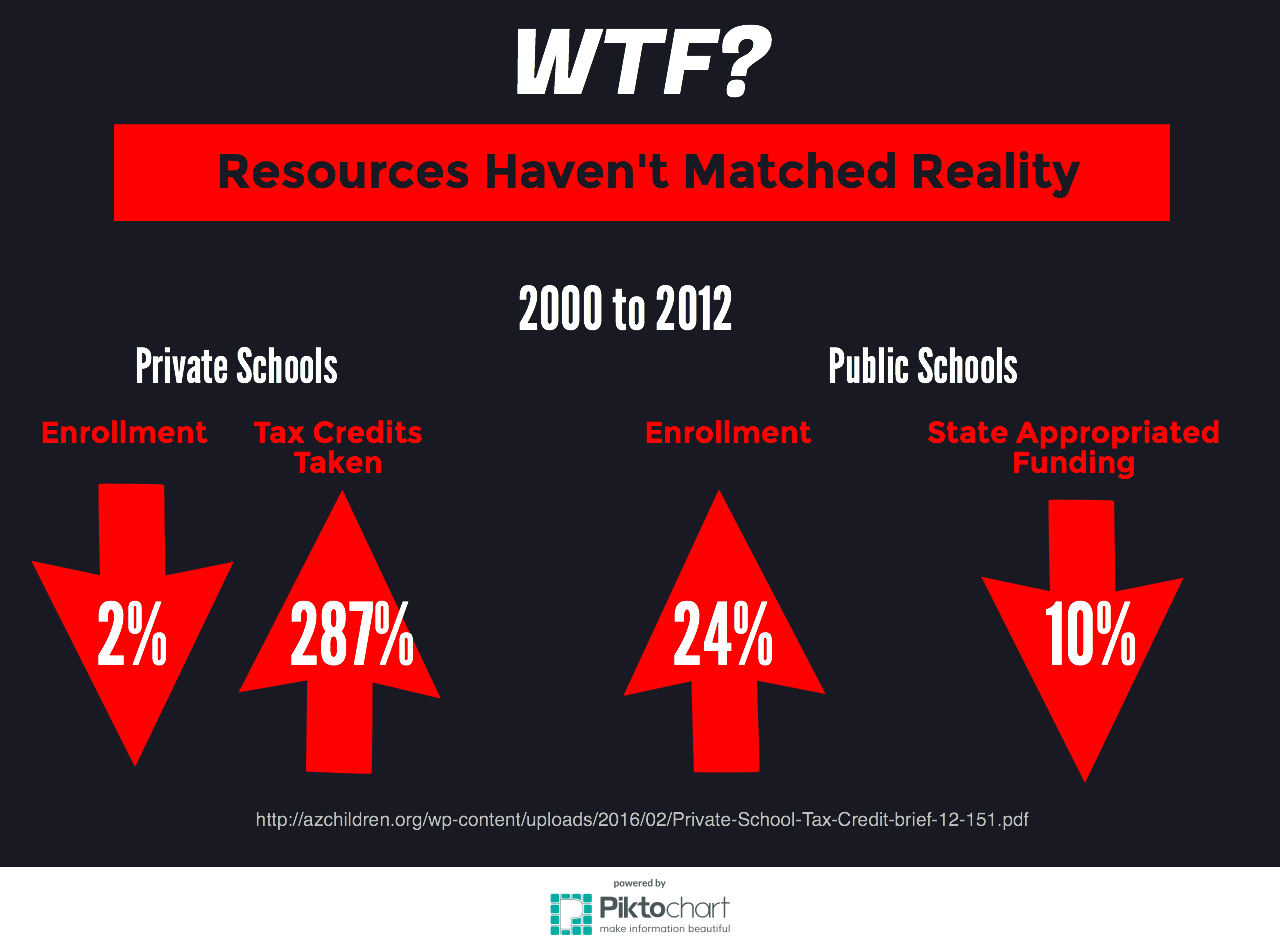
  13. District Schools and School Choice Cannot Co-Exist. When students trickle out to commercial schools, almost 1/5 of the expense associated with educating them remains despite the district’s total loss of the revenue. And while private school enrollment dropped two percent from 2000 to 2012, tax credits claimed for the students has increased by 287%. This, while public school enrollment increased 24.1% during that same time but state appropriations (from General Fund, State Land Funprivate-public-school-fundingds, and Prop. 301 monies) decreased by 10%.

It is clear there are several current and looming crises in Arizona K–12 education. And yet, Senator Debbie Lesko (R), has been quoted as saying, “Balancing the budget is always the most important work of the state legislature.” Really? That’s why the people of Arizona elect our state lawmakers? I don’t think so. Rather, I think we want them to ensure our children receive a quality education, that our roads are safe to drive and our water is safe to drink, and that our police and other first responders protect us from danger. In short, we want the Legislature to ensure appropriate capability to provide for the common good and we send them to Phoenix to figure out how to do that. Yes, they are mandated to balance the budget but, I would argue, that isn’t their raison d’être.

Arizona voters have made it clear they are willing to pay higher taxes to provide more funding to our public schools unfortunately, not enough have made the connection between a lack of funding for public education and the legislators they elect that are causing that problem. Yes, the prohibition to raising the required revenue is pain self-inflicted by our Governor and GOP-led Legislature. And, we need only look to Kansas to see that cutting taxes to attract companies to our state is a race to the bottom. I guarantee over the long haul, quality companies prefer a well-educated workforce and good quality of life for their employees over tax cuts.

In his State of the State address yesterday, Governor Ducey said, “I have a commitment our educators can take to the bank: starting with the budget I release Friday, I will call for an increased investment in our public schools – above and beyond inflation – every single year I am governor.” What is notable about this statement is his reference to “public schools” and, the fact that he followed it up with the statement that “we won’t raise taxes.” Promising support for public schools isn’t the same thing as promising it for district schools. In fact, some lawmakers now equate the term “public schools” to mean any school that accepts taxpayer dollars.

Let me be clear. I believe any promise to provide significant additional monies to public education without a willingness to raise additional revenue, is total bullshit. The pie is only so big and there are only four basic ways to significantly increase its size. Either corporate tax cuts are curtailed, additional taxes are levied, funding meant for other purposes is siphoned off or, important programs are cut. Senator Steve Smith (LD11-R) who sits on the Senate’s education committee, suggested funding could be found by moving money away from state programs “that may not be working so well.” Perhaps he was thinking of Child Protective Services which has continued to flounder and endanger children (primarily because sufficient resources have not been provided) even after Governor Ducey promised fixes when he first took office in 2015?

Arizona simply cannot move the educational needle without a significant additional investment in our district schools. These schools are where close to 85% of Arizona’s students are receiving their education, doesn’t it make sense that this is where we should dedicate the majority of our funding and efforts?

Partisan? You bet! My party is Public Education.

I am a big believer in the two-party system. Our system of government works best when all sides are heard and considered. That is most likely to happen when the power is balanced, forcing legislators to negotiate and compromise. Our founding fathers purposefully designed many checks and balances into our system and I believe our two-party system helps in that regard.

In Arizona, the Democrats must gain only two additional seats in the State Senate to reach parity with the Republicans and in my opinion that would be a very good thing. Then, our senators from both parties would be forced to work together in finding good compromises to solve the problems facing our state.

One of the biggest problems facing our state is the inadequate resources provided our district schools. Arizona is one of the nation’s leaders in promoting school choice and although 80-plus percent of our students choose district schools, resources continue to be siphoned away from these schools in favor of other options. Many of our legislators, largely the Democrats, get this. Several Republicans are also on board.

Friends of ASBA, a sister organization of the Arizona School Boards Association, publishes an annual voting record of our legislators. This “Friends of ASBA Educating Arizona” report shows how every Arizona legislator voted on high priority K-12 education bills in 2016. The bills are grouped into three focus areas: funding, vouchers and local control, and the voting record is based on whether the legislators voted with, or against the ASBA position.

I encourage you to click here for the report to get the entire story. As you go through the report, you’ll note 56 legislators received “extra credit” for their behind the scenes efforts on behalf of public education. This credit is noted by + signs and the maximum extra credit points awarded were +++. Below, I show the Republican legislators who voted with ASBA’s position more than two-thirds of the time. I’d like the percentages to be even higher, but 33 Republican legislators didn’t even have a score higher than 50%. I should note that four Democratic legislators, Rep Sally Ann Gonzales (57%), Rep Jennifer Benally (43%), Rep Albert Hale (57%), and Rep Juan Mendez (57%) did not meet my “two-thirds of the time voting with ASBA” threshold.

LD Senator % Representative % Representative %
1 Steve Pierce++ 67 Karen Fann+ 71 Noel Campbell 71
2 Christopher Ackerley++ 71
8 TJ Shope+ 71
15 Heather Carter++ 71
16 Doug Coleman++ 100
18 Jeff Dial++ 67 Jill Norgaard 63 Bob Robson++ 71
20 Paul Boyer++ 63
21 Rick Gray+ 63
28 Adam Driggs++ 89 Kate Brophy McGee++ 71

The legislators in the chart above have at times taken brave stances on behalf of our district school students. Those I’ve actually met with seemed sincerely intent on doing the right thing for our students. They have earned my respect.

It is never a good idea to be closed to the opinions and ideas of others, nor is it smart to vote straight party line without regard to the issues and how candidates lean on those issues. For incumbents, the voting record tells us where they stand on public education. For candidates who haven’t ever been elected, it is our duty to read and listen to what they say about where they stand. And oh by the way, it is not good enough for a candidate to say he/she is “for education.” If you want to be sure they support the efforts of the schools educating over 80 percent of our students, they must say they are “for public education.” Of course, this leaves the door open for them to be staunchly pro-charter, but at least there is a modicum of transparency and accountability for the taxpayer dollars provided charter schools unlike with private options.

No matter what problems you most want solved, there can be no doubt that the more our students are prepared to deal with them, the better off we will all be. In my opinion, locally elected, governing board-led, public school districts offer the best chance we have to ensure every student has every opportunity to succeed. That’s why I am passionately pro-public education and why that’s the “party” that most matters to me.

Just rearranging the deck chairs ain’t gonna cut it

Representing the AZSchools Now Coalition, Arizona’s 2016 Teacher of the Year Christine Marsh and I recently attended and spoke at a Classrooms First Initiative Council meeting in Phoenix. The Coalition consists of the Arizona Associations of: Education, Business and Education, School Boards, Superintendents, and Parent and Teachers. Also part of the coalition are the Children’s Action Alliance, Valley Interfaith Project, and Support Our Schools AZ. It was formed post-Prop 123 to provide focus to reinvesting in public schools as a way to boost student achievement.

The Classrooms First Initiative Council was established by Governor Ducey in January 2015 and charged with modernizing the school finance formula to ensure adequate funding is available for teachers and classroom instruction. The first of the two main events of this latest meeting was a presentation by Expect More Arizona on the Education Progress Meter. This meter has been accepted by virtually every education group, numerous community and municipality organizations, and 26 major business entities. It measures Arizona’s progress in eight areas to include teacher pay, preschool enrollment, 3rd grade reading, 8th grade math, high school graduation, opportunity youth, college going, and post-secondary attainment.

The other main discussion was about the proposals submitted by education groups for the Council’s consideration. In speaking for the AZSchools Now proposal, I advocated for additional resources to attract and retain high quality teachers in light of the both the current shortage as well as the some 26,000 eligible for retirement starting in 2018. Not only is the shortage critical, but teacher turnover is disruptive and expensive, costing as much as $50,000 to find and contract a new one. ADE reports we have almost 93,000 certified teachers in Arizona, but only 67,000 of them are working in the profession. Many of those who left would love to still be teaching, but were forced to seek employment that would better support their families. (According to the Bureau of Labor Statistics, the median Arizona elementary school teacher salary is $40,590 while the national median is $54,120. Starting salaries are much lower, often in the $30,000-per-year range.) Even so, one of the changes under consideration by the Council is to eliminate the Teacher Experience Index. As you might guess, this index helps keep experienced teachers in our AZ classrooms and the Coalition believes eliminating it will only exacerbate the problem. If we want to ensure high-quality education, we must have high-quality teachers and that can’t be done on the cheap. With fewer teachers entering the pipeline and over 26,000 eligible to retire by 2018, merely “rearranging the deck chairs on Titanic” I said, won’t do anything to keep this “boat from sinking.”

I also spoke about the Coalition’s recommendation to consider adding a B-weight for poverty to the school finance formula. This is critical because statewide, 58 percent of our K-12 students are eligible for free and reduced meals and many deal with a multitude of poverty related challenges at home, greatly affecting their preparedness to learn at school. That’s why the Coalition believes it is one of the most significant steps needed to make the school finance formula more equitable and fair. We know these students typically face barriers relating to transportation, housing, and levels of support in their communities and families for which additional resources are needed to help them achieve success.

Christine also made a case for additional funding, but her impassioned plea was focused on ensuring reasonable classroom sizes so that no students fall between the cracks. She told of average student loads for AZ high school teachers of 170 students and said that makes it tough for teachers to give each student the individualized attention they deserve. (The National Center for Education Statistics’ reports Arizona has 1.1 million K-12 students, and just 48,358 full-time teachers making our student-teacher ratio almost 23:1 compared to the national average of 16:1. According to WalletHub, only California and Utah are worse.)

She also pointed out that a future President of the United States is in a K-12 classroom somewhere, and current events highlight the importance of our getting this right. Stating that yes, salary is an important factor to encourage teachers to stay in their profession, Christine said it is also important that teachers feel they have what they need to really make a difference. And although she wanted to focus on the needs of students, not teachers, she noted the reality of workloads on the ability to do the job. Even if, she said, she only assigns three writing assignments per week to her 160 students, and each of those papers only takes five minutes to grade, that can amount to over 40 hours of grading time per week, and that takes place outside of the classroom. As if illustrating this point, after she spoke to the Council Christine resumed grading the stack of student papers she had brought with her.

Chris Thomas, Lead Council for the Arizona School Bards Association, said Arizona has one of the most equitable funding formulas in the nation, but is not adequately funding the formula. He highlighted the need for reinstating the cost analysis for special education funding as a way to ensure costs to provide service to these students are adequately funded while not pulling funding away from other programs. Chris also made the point that in considering a new funding formula, transparency should be ensured for the use of all public funds. Sarah Ellis, a Flagstaff Governing Board member, spoke during public comments, reiterating the need for locally controlled funding and the continuation of desegregation funding. For the Flagstaff Unified School District she said, the desegregation funds exceed that received from Prop. 123.

I was encouraged by the questions asked by members of the Council as well as the number of attendees in the audience. There was standing room only and attendees had come from all over the state to participate. I was pleased to hear some Council members voice their concerns that viable solutions to the finance formula would not be possible without additional resources, including the Chair, Jim Swanson. One member did note the reality of convincing the state legislature of this reality, but Swanson indicated he is ready to take on those who may not agree with the Council’s eventual recommendations.

Overall, I was encouraged by the meeting. Although I would have liked the membership of the Council to be more representative of the K-12 population in our state (majority Hispanic), I found them to be actively listening and serious about finding the best solutions. I am also very encouraged about the AZSchools Now coalition. One of the Coalition members, Support Our Schools AZ and its subsidiary the Arizona Parents Network, is an example of the grassroots efforts that has blossomed during and since the post-Prop 123 battle. What is especially important about this development is that it involves mostly parents who are naturally fierce advocates for their children.

One such fierce parent is Alana Brussin, whose My Turn” op-ed titled Tying school success to vouchers is a sham was recently published by the Arizona Republic. Her piece highlights the reasons community district schools are the overwhelming choice of Arizona families, in spite of the best efforts of state leaders and other school privatization advocates.

Just as Mothers Against Drunk Driving turned the tide on the public’s acceptance of drinking and driving, I’m confident our fierce parents can turn the tide on the assault on community district schools and ultimately the students they serve. Every child deserves every opportunity to succeed and when that happens, we all succeed. It really is that simple.

Educated Workforce = State Prosperity

Okay. Let me get this right. Daniel Scarpinato, Press Aide to Governor Doug Ducey says Arizona schools are the 4th worst in the nation because school choice siphons taxpayer dollars out of community (district) schools into private and parochial schools, leaving those community schools underresourced. Okay, those weren’t his exact words, but that is what he intimated. His intent was of course, to invalidate the WalletHub study because it only looked at our public schools and not private schools. So, he thinks the study is invalid because it ONLY pertains to 96 percent of Arizona’s K-12 students?

WalletHub looked at 17 key metrics and found that Arizona is: 49th for pupil to teacher ratio; near the bottom in average ACT score; and below average for low-income student high school graduation rate. Even though these types of rankings are nothing new for Arizona and, he doesn’t dispute the numbers, Scarpinato called the study “baloney.” Rather, he went on to deflect the blame by citing Arizona’s rapidly increasing population as part of the problem for low per-pupil funding and sidestepped whether this meant funding should be increased to keep up with that growth. He also dismissed the idea of halting corporate tax cuts. His justification – Arizona needs to remain competitive with other states in its efforts to cut corporate taxes. The Economic Policy Institute (EPI) says “cutting taxes to capture private investment from other states is a race-to-the-bottom state economic development strategy that undermines the ability to invest in education.” We need only look at Kansas to see how this strategy works.

EPI research shows “income is higher in states where the workforce is well-educated and thus more productive.” There is, the Institute says, “a clear and strong correlation between the educational attainment of a state’s workforce and median wages in the state.” Those workers then pay more taxes to boost state budgets. The best companies know they need to go where they can get the kind of educated workforce they need, where their current employees will find good communities with high quality schools, and where the infrastructure can support their business model. That’s why states like Massachusetts (ranked #1) see education as an investment, not an expense.

Unfortunately, the AZ Legislature seems hell-bent on pushing the privatization of our community school system and will continue down this path until the voters boot them out of office. We need lawmakers who understand there can be no significant progress for our state over the long haul unless we ensure all our children are given the tools to grow and prosper. Community schools remain the schools of choice for the vast majority of our students and must be our first priority for state resources. Yes, school choice has its place in our overall educational system, but it shouldn’t be first place.

“Someone to Shine Our Shoes”

In a recent article titled “Chartered Cruise” on knpr.org, the author Hugh Jackson wrote: “Today’s charter industry, much like Nevada’s voucher plan, reflects a chronic civic defeatism. Echoing the perverse social Darwinism of more than a century ago, faith in free-market education is surrender to pessimism. Society really isn’t incapable of providing a fair educational opportunity to every citizen. Some people are doomed to fail, that’s just the way it is, so best to segregate those with promise, the achievers, in separate schools. As for everyone else, well, too bad for them.” Of course, this attitude isn’t confined to only Nevada; I have a real life example of it right here in Arizona. Three or so years ago, an acquaintance of mine asked an Arizona Senator whether or not he supported public education. He replied, “of course I do, we need someone to shine our shoes.”

It’s bad enough the Senator thought this, let alone that he said it out loud to a public education advocate. That says as much about the voter contempt some of our lawmakers hold (especially when the voter is from a different party) as it does what they think of public education. As the primary water carrier for the American Legislative Exchange Council’s (ALEC), the Arizona Legislature has led the nation in efforts to offer school choice options. Proponents tout school choice as the way to help disadvantaged children, but truth is, they’ve already written these children off. Instead, school choice is really about resegregation (the highest we’ve seen since the mid 1960s) and profiteering.

The school choice and education privatization movement gives me great pause because:

  1. The vast majority of our students (85%) are attending significantly underfunded district schools;
  2. Taxpayer dollars are increasingly being siphoned off to profiteers with very little (if any) accountability and transparency;
  3. The claim of school choice proponents that school choice provides much better results, either isn’t backed up by facts, or is an oranges and pineapple comparison;
  4. Voucher and charter schools actually provide parents less choice than district schools.

Allow me to explain. By now, most Arizonans probably know our state is 48th in per pupil funding. Even if the $3.5 billion infusion from Prop 123 is approved by voters this month, it won’t move us from 48th place in overall per pupil funding. To move up just one notch (above Oklahoma), we’d have to give out districts twice that much. That’s how far behind Arizona is.

As for the lack of accountability and transparency in Arizona’s school choice programs, for-profit companies dominate the charter school movement.  These companies do not have school boards, let alone locally elected boards and are not required to disclose the details of their business operations. As for private schools that take Empowerment Scholarship Account (voucher) or Student Tuition Organization tax credit dollars, there is no way for taxpayers to determine funding efficacy. Private school students are not required to take state assessments nor provide any academic results. Neither are private schools required to disclose any information regarding their business operations.

Then, there’s the apple and oranges comparison. Irrespective of the law requiring charter schools to accept all students, it is a well documented fact that most manage to steer clear of special needs and English language learning students and that they manage to attrit (at incredibly high rates) students of color or those on the lower end of the socio-economic scale. Of course, when these students return to the district schools, it is often after the 100th day of the school year, when the average daily attendance has been calculated and the charter school has cemented the funding for the year for that student. The district school is forced to absorb that same student for the rest of the year with no compensation.

Finally, district schools are run by locally elected governing boards that are accountable to the community. School district residents have the right to be present at board meetings and have their voice heard. They also have a right to know how their tax money is spent. Charters and private schools are run by executive boards not accountable and often not responsive to parents. If you aren’t happy with the way they are being run, your only recourse is to withdraw your child.

The myth perpetuated by those bent on destroying pubic district education is that district schools are failing and that privatization in various forms is the answer. The reality says that school choice will never be the answer for the vast majority. The evidence also shows despite charters and private schools being much more selective of their students, most charters and almost all cyber charters do worse than their district schools. We don’t really know how private schools do since they aren’t required to provide any information about results.

The movement to privatize public education is straight from the GOP playbook on reducing government. As President Reagan said in his first inaugural address: “Government is not the solution to our problem; government is the problem.” That might have been a good sound bite for the right, but I believe concentrated, unchecked power is the problem. Our system works best when we have a balance of power that ensures all sides are heard and produces compromises to come up with the best possible solution. It also works best when government provides for the public good and checks and balances are put in place to ensure efficiencies and effectiveness of both the public and private sectors where taxpayer dollars are involved. Those checks and balances are lacking in school choice options and taxpayers are paying the price. Examples abound of virtual (on-line) school scams, greedy charter school operators, and even illegal purchases with voucher dollars. No, district schools are not entirely immune from fraud, but at least they have locally elected school boards responsible to the taxpayer for oversight and the state conducts annual audits. Neither of these happens when taxpayer dollars fund school choice options.

The original intent of charter schools was to provide teachers greater flexibility to experiment with new ways to educate students. Charters were not meant to compete with or replace district schools, but rather complement them. Now, charters and vouchers have become a way for state legislatures to deflect their responsibility to provide a quality public education for all. When funding follows the child, it becomes the parent’s responsibility to ensure a quality education. School choice also allows our lawmakers to obfuscate the real problem, poverty and all the challenges it brings to our district schools.  Of course, the focus on school choice creates demand which causes funding loss in districts, making it harder for them to excel and reinforces the message that they are failing. The truth is, that despite significant funding shortfalls, severe teacher shortages and crumbling infrastructure, our district schools continue to do well. It makes one wonder what miracles could be achieved if they received the funding and support currently being siphoned off to charters and private schools.

The one thing I know for sure is that until we elect new pro-public education candidates, nothing is going to change. We will continue to see efforts to take the brakes off vouchers, create laws more favorable to charter schools, and attempts to de-professionalize the teaching profession. We have the power to create change; the only question that remains is do we have the will? Prop 123 has raised the level of attention to the challenges of our district schools. Many have been vocal on both sides of the issue. Let’s come together on May 19th at 4 pm for a Pro-Public Education Rally to tell our Legislature that enough is enough, we are done with them short-changing our kids and our state’s future! #ItStartsNow #YouPlusOne #RememberInNovember