Trash, by any other name, still stinks!
Trash, by any other name, still stinks!
On this Valentine’s Day, I thought I’d ask, when it comes to our public schools students in Arizona, “who loves you baby?” Yesterday, I was listening in on the AZ House Education Committee meeting. There were many bills on the agenda, but I was primarily interested in HB 2394; empowerment scholarship accounts [ESAs]; expansion; phase-in. I wasn’t hopeful the bill would die, as its companion bill SB 1431, had already been given a due-pass by the Senate Education Committee. As expected, HB 2394 followed suit on a 6–5 vote as did HB 2465, which will allow all students eligible for an ESA account to remain on the program until age 22 and for up to $2,000 a year to be put into a 529 savings account.
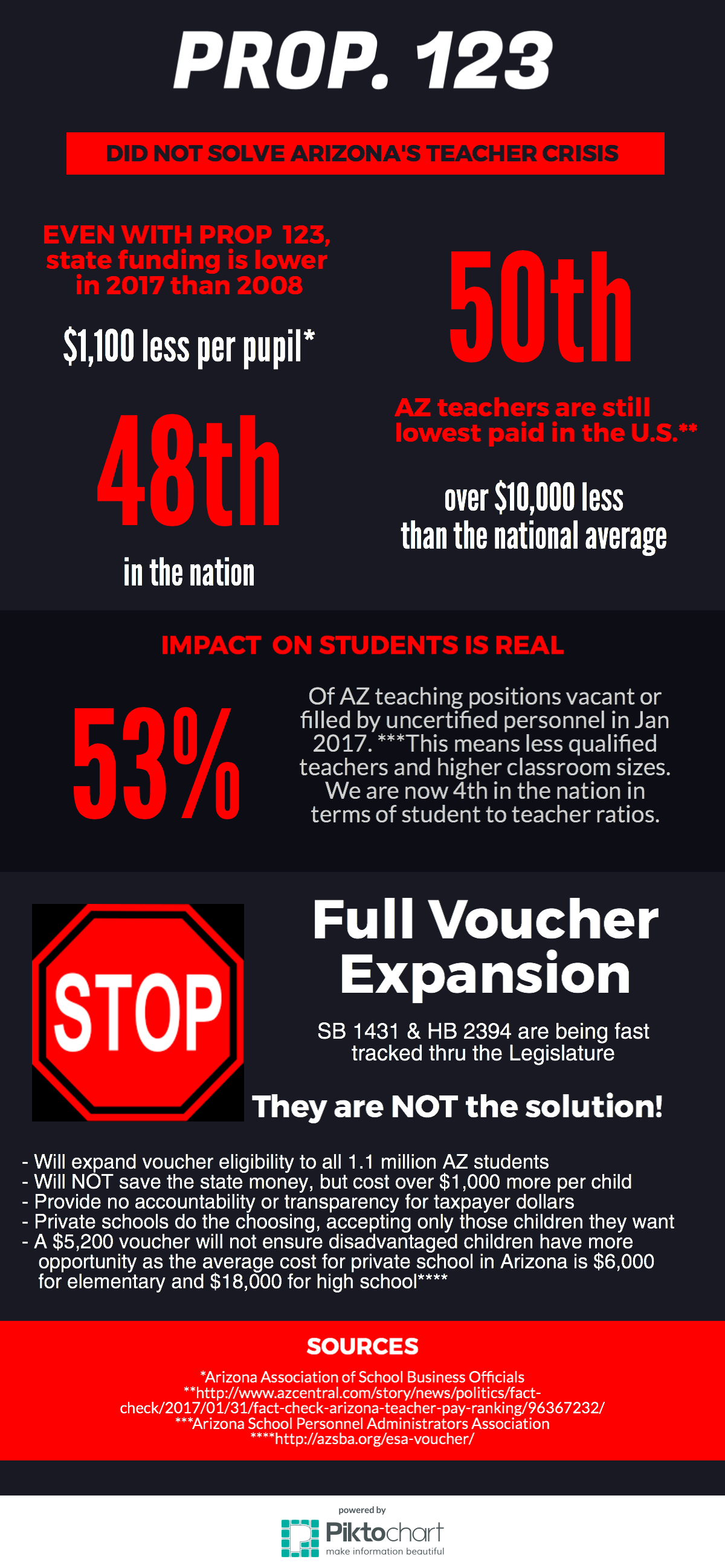
The passage of these bills, along with the companion ones in the Senate, demonstrate the disdain many GOP legislators have for our district schools and, for the underpaid educators who toil within. This, because ESAs divert more general fund revenue per student to private schools than district schools receive. As reported by the Arizona School Boards Association, an ESA student, on average, costs the state general fund $1,083 more in grades K–8, and $1,286 more in grades 9–12 than a district student. This is in part because there are many school districts that enjoy a fair amount of locally controlled support in the way of overrides and bonds. The state therefore, is relieved of providing equalization funding to them, but when students leave to go to private schools, all the funding must come from the state general fund. ESA students also receive charter additional assistance funding of roughly $1,200 per student, which district schools do not receive. Turns out that the claim of voucher proponents that they save the state money, is not just “alternative facts” but totally untrue. And, although voucher proponents love to claim there is no harm to district schools when students take their funding and leave, the truth is that about 19 percent of a districts costs are fixed (teacher salaries, transportation, facility repair and maintenance, utilities) and can’t be reduced with each student’s departure.
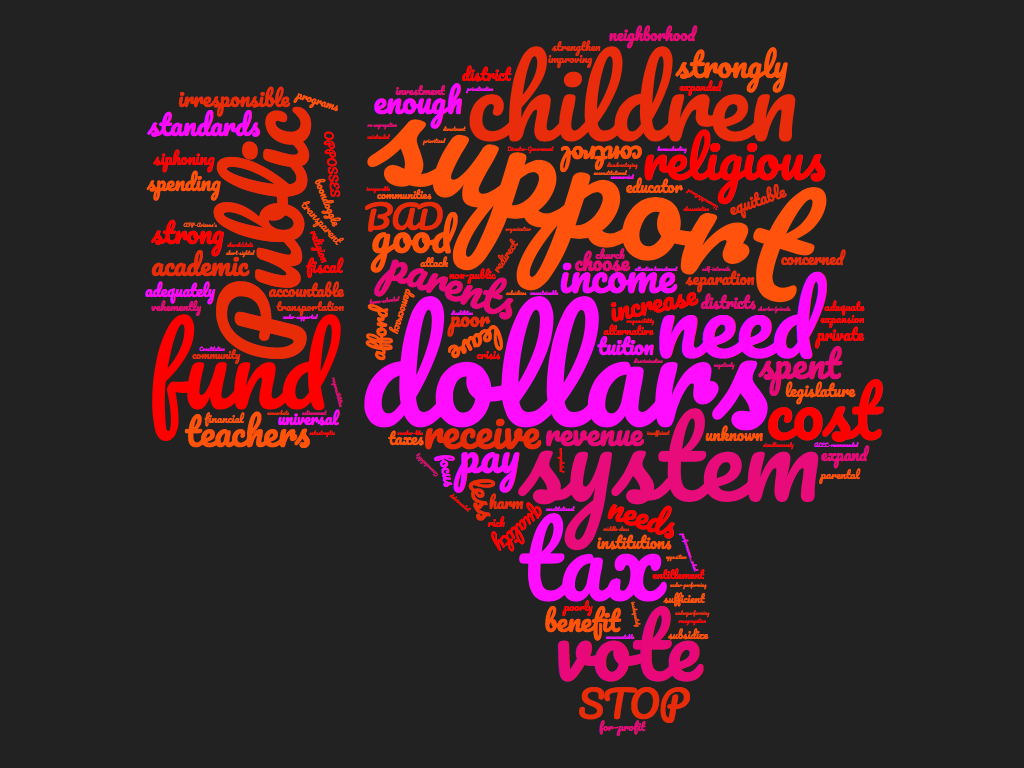
I am slightly encouraged though by the two Republican members on the House Education Committee who had the courage to stand up and do the right thing. Huge kudos to Representatives Doug Coleman and Michelle Udall who voted against the voucher expansion! I encourage each of you to email them and let them know how much you appreciate their show of support for the one million public school students in Arizona’s district schools. What also gives me hope, is the 400 plus people and their almost seven pages of 10-font, single spaced comments made against the bill in the Arizona Legislature’s Request to Speak System. Here’s a word cloud of the comments:
This is compared to the 30 people who signed in to Request to Speak in favor of the bill. The vast majority of whom represent organizations in favor of commercialization of district schools such as The Goldwater Institute, Americans for Prosperity, Center for Arizona Policy, AZ Catholic Conference, AZ Chamber of Commerce and the American Federation for Children.
So, why these organizations? Well, let’s see. According to its website, the Goldwater Institute is a “national leader for constitutionally limited government.” Corporate reformers love to paint district schools as “government” schools, making them just another one of the targets to shrink the government, or as Grover Norquist said, “get it down to the size where we can drown it in the bathtub.” The Goldwater Institute also works closely with the corporate bill mill, the American Legislative Exchange Council (ALEC) to promote conservative corporate agendas (such as commercialization of district schools) in Arizona.
Cathi Herrod and her Center for Arizona Policy (CAP) have long pushed school choice. CAP’s website states the belief that, “Religious freedom is affirmed and protected, free from government interference.” Of course, they are for vouchers. They would love for every student in Arizona to attend religious schools on the taxpayer’s dime.
Americans for Prosperity is a conservative political advocacy group funded by the Koch brothers. On their website they write, “at the very top of AFP-Arizona’s 2017 legislative agenda is the expansion of our state’s program of parental choice Empowerment Scholarship Accounts (ESAs).” They also encourage their supporters to thank Senators Flake and McCain for voting to confirm Betsy DeVos.
It should be no surprise to anyone that the AZ Catholic Conference is also interested in fully expanding voucher eligibility. Around the nation, Catholic schools have been closing at rapid rate, from 13,000 schools enrolling 12 percent of U.S. school children in the mid–1960s, to about 7,000 schools enrolling five percent in 2012. In 2015 alone, 88 Catholic schools closed. But, a tax credit program highly favorable to private and parochial schools has helped stem previous losses in Arizona but charters are still causing them much competition for students. There are now 73 Roman Catholic private schools in Arizona and six of them are among the most expensive private schools in the Phoenix area charging from $13,300 to $17,712 per year in tuition. A $5,200 voucher obviously won’t help poor students get into these schools, but it will be a nice offset for those wealthy enough to afford the schools irrespective of the help. The average cost for private schools in Arizona by the way is about $6,000 at the elementary level and $18,000 at the high school level.
As for the Arizona Chamber of Commerce, let’s not forget how their President and CEO, Glenn Hamer, recently characterized teachers as “crybabies” for wanting adequate pay. This, when our teachers are the lowest paid in the nation and 53 percent of Arizona’s teaching positions were vacant or filled by uncertified personnel at the beginning of this year. Study after study shows a high-quality teacher is critical to student success. What does that say about the commitment of Hamer and his chamber to our students in Arizona?
Finally, let’s not forget that until she was confirmed as Secretary of Education, Betsy Devos was the Chairwoman of the American Federation for Children (AFC). AFC is a huge proponent of school choice and vouchers and has invested millions in purchasing legislators favorable to their causes. Since 2010 in fact, it has contributed some $750,000 to pro school choice legislative candidates in Arizona.
Looking at the list and knowing the resources at their disposal (just think of the Koch brothers and DeVos alone), it is easy to assume most of them have invested heavily in legislative outcomes in Arizona and around the country. Does anyone really believe these organizations have Arizona’s district school students, 56 percent of whom qualify for free and reduced lunch (an indication of their low socio-economic status) children at heart?
We all know when we read something, especially these days, we must consider the source. Well, when looking at the support for voucher expansion in Arizona, I highly encourage you to do the same. This fight against the full expansion of vouchers is far from over. Those pushing for it are no doubt emboldened by pro-voucher stance of the new POTUS and his SecED. But, the people of Arizona understand district COMMUNITY schools are the key to not only achievement for all our students, but also to the health of our communities, and the preservation of our Democracy. We must not sit on the sidelines and watch these bills get signed into law. Much too much is at stake. Want to know more about how to plug-in? Comment on this post and I’ll be in touch. Please don’t let it be said we let our students get sold out!
I don’t remember my parents being political at all. My Step-Dad was an Army Green Beret and my Mom a naturalized American citizen via Germany. I’m sure they voted, but it wasn’t like we sat around the dinner table discussing geopolitics. Neither of them had attended college while I was still living at home and being politically active wasn’t really congruent with my Dad’s military service.
After I joined the Air Force, that was also the case for me, especially when I became a commander. After retirement though, it was a different story. Since moving to Tucson in 2008, I ran for and won a seat on my local school board and worked on three Arizona campaigns, two Senate and one House, and supported various other campaigns in one way or another. It has been my service as a school board member though, that really led to my activism. Public K–12 education and the children it serves, (as it turns out) is my new passion.
Our recent Presidential election was traumatic for many and some people are totally shell-shocked. In my mind, much of the consternation is not about partisanship, but rather about the values we collectively subscribe to as a nation. Do we as stated in our Declaration of Independence, “hold these truths to be self-evident, that all Men are created equal, that they are endowed by their Creator with certain unalienable Rights, that among these are Life, Liberty, and the Pursuit of Happiness”? Or rather, do we believe that (as with the Citizen’s United decision), corporations are people and should have as much say in our nation’s governance as “the people?” Do we still aspire to be Ronald Reagan’s “shining city on the hill” (words originally spoken in a sermon by Puritan John Winthrop), that serves as a beacon of democracy to the rest of the world or, do we only care about ourselves; about “America First”…and last.
I had for the most part managed to have a more pragmatic perspective about the recent turn of events until about two weeks ago when I visited our Nation’s Capitol. Seeing the multitude of protestors everywhere, in many cases controlled more tightly by increased police presence, brought home to me the very real shift in our national direction. Then yesterday morning, I had a contentious conversation with my Mom about politics (whom I once could talk to about anything) and it occurred to me that what we are now experiencing is the New Civil War.
As with America’s original Civil War, this one is pitting family members against family members, friends against friends, and neighbors against neighbors. Don’t get me wrong, I don’t at all mean to minimize the 620,000 lives lost in the original Civil War, to this date the deadliest in our nation’s history. But, this New Civil War has the potential to be just as fractious to our country. It may be a war of words versus guns; but the divisions surrounding economics, equal rights, freedom of speech, state’s rights, and free trade vs. protectionism, all with a dose of nationalism mixed in, are every bit as real.
And just like the original Civil War, this one is comprised of “battles” of significance. The fight over Betsy DeVos is one. It was well-fought on the part of public education advocates, but in the end, they were out-gunned by the corporate reformers and the lawmakers they purchased. It would appear the Dakota Pipeline is another battle where “the people” have lost to corporate interests. There will be many more battles such as the one over the Muslim travel ban currently underway. I’m guessing we are going to have at least four years of such battles. It is tiring to contemplate.
Wars are often though, contests of attrition. The side that remains better resourced in terms of troops and weapons and the intelligence and supplies to support them, is usually the victor. There are numerous examples however, of a grass-roots resistance (because it is supported by the hearts and minds of the people), that achieves victory against all odds.
If our nation is to remain a democracy, one which is “of the people, by the people and for the people”, we must all (each of us), remain engaged and vigilant. I understand it would be easier just to bow out and ride the “ignorance is bliss train,” until it jumps off the tracks. Believe me when I say I’ve considered that option more than once. But, as the American educator and author (born in 1899) Robert M. Hutchins said, “The death of democracy is not likely to be an assassination from ambush. It will be a slow extinction from apathy, indifference, and undernourishment.”
To those who care about our democracy and our right to life, liberty and the pursuit of happiness, I implore you to not let current events discourage you or detour your resolve. Now, more than ever, we must keep our heads in the game. After all, (as attributed to Edmund Burke) “All it takes for the triumph of evil is for good men to do nothing.” Let it not be said that was our course.
Dear Senators Flake and McCain,
First of all, let me thank you for your service to our state and our country. I realize your job is not an easy one, but hope you understand this is also not an easy time to be an engaged patriot. Millions of us are incredibly anxious about the future of our country and our world. At this time, more than almost anytime in my adult life, we need real leadership.
As a school board member, I am really worried about President Trump’s and his SecED nominee’s intentions with K–12 education. He thinks our nation’s current education system is “flush with cash” and that our children are “deprived of all knowledge.” For Arizona at least, both of these statements are ridiculous. Our per pupil funding is 48th in the nation and our teachers the 47th lowest paid. Even so, our student’s National Assessment of Educational Progress (NAEP) scores continue to rise and we led the nation in growth on the science test from 2009 to 2015.
If however, Betsy DeVos is confirmed, she will no doubt try to do for the nation what she did for Michigan. There she pushed for vouchers (even though she could never “sell” them in her home state) and for-profit publicly funded charters with as little accountability and transparency as possible. The results speak for themselves, with Michigan’s 4th grader scores on the NAEP from 2003 to 2015 declining from 28th to 41st in reading and from 27th to 42nd in math. This is not a formula for success.
I understand the pressure you are under to toe the party line, but the people of Arizona and our nation need you to look deep inside yourselves and determine what is really best for our country? Truly public education, that which is governed by locally elected boards, is the bedrock of our democracy and built the greatest middle class in the history of the world. It also taught us yes, we are all different, but there is strength in those differences. It can continue to support the American Dream, or, we can just give up on that dream and sell out to the highest bidder. We are at a tipping point and you have the ability to pull us back from the edge or propel us over the cliff. Please cast your vote in favor of our democracy and say NO to DeVos and her privatization agenda. We (the people) are counting on you!
Unless you’ve been living under a rock for the last few years, you know corporate reformers are anxious to implement vouchers as a way to expand school choice. The secret sauce they say, is that the dollars follow the student because parents know best about what is best for their child’s education.
Just for a few moments though, I’d like to ask you to please forget whether or not you believe school choice and vouchers are the answer to “Make American Education Great Again.” Forget all the hype and promises, just ask yourself which of these scenarios makes more sense?
I hope you came to the same conclusions I did some time ago, that when it comes to transparency, accountability and equity, district schools outperform private schools. I’d also like to make the unequivocal claim that district schools also (across the board) produce more achievement than private schools, but as you can see, they don’t report their results so I don’t know that for sure.
And yet, the Arizona Legislature continues to push expansion of vouchers in our state. A push for full expansion last year by Debbie Lesko (Peoria-R) was killed, largely due to its potentially negative impact on the passage of Proposition 123, but she has revived the effort this year in the form of SB 1431. This bill, which would fully expand vouchers to ALL 1.1 million Arizona students by the 2020-2021 school year has been assigned to the Senate Education and Rules Committees and is scheduled to be heard by the Senate Ed Cmte on 2/9/17. Senator Steve Smith (Maricopa-R) has sponsored an associated bill, SB 1281, that requires the AZ DOE to contract with an outside firm (I’m sure that’s much better…just like private prisons) to help administer the ESA program, and makes various changes to the program. The bill stipulates that AZ DOE may request (not MUST request) confirmation toward graduation from high school or completion of a GED. This is obviously an attempt to defuse the argument there is insufficient accountability in the AZ voucher program. AZEDNEWS also reports that Lesko supports adding a requirement to her bill to track achievement of ESA students, but that requirement would be only to report test results to parents, not the AZ DOE.
No matter how much sugar the commercializers try to coat vouchers with, they are still just a vehicle for siphoning tax dollars away from our district community schools to private and parochial (religious) schools with no accountability or transparency. For every person who says “parents have the right to use their child’s education tax dollars as they see fit”, I say, “and taxpayers have the right to know the return on investment for their tax dollars.” The former right in no way “trumps” the latter.
We must stop this terrible legislation. If you are signed up for the Legislature’s Request to Speak system, please click here to log in today and leave a comment for the Senate Education Committee about why you oppose SB 1431 and SB 1281. If you aren’t signed up, please leave me a comment to this post and I will get you signed up and ensure you are trained to use it. The system allows you to comment on pending legislation from your home computer or mobile device, you don’t have to go to the Legislature and speak in person unless you want to.
If you don’t want to use RTS, please call or email the members of the Senate Education Committee (listed below) and your district legislators (click here to find out who they are) to let them know how you feel. There is strength in numbers and the people do have the power, we just have to exercise it!
Senate Education Committee Members
Sylvia Allen, Chairman – 602.926.5409
David Bradley – 602.926.5262
Kate Brophy McGee – 602.926.4486
Catherine Miranda – 602.926.4893
Steve Montenegro, Vice-Chairman – 602.926.5955
Steve Smith – 602.926.5685
Kimberly Yee – 602.926.3024
Glenn Hamer, President of the Arizona Chamber of Commerce, said, “It’s amazing to me that the teachers unions are out there like a bunch of crybabies screaming about the difficult of getting additional pay to teachers.” His comment was in response to why teachers union should support reforms to the initiative process.
There are so many things wrong with this comment, I don’t even know where to start. First of all, Hamer makes about six times the amount the average Arizona teacher makes. After all, Arizona’s teachers are the 47th lowest paid in the nation with the average teacher pay falling nationally 1.6 percent over the past decade, but 7.6 percent in Arizona. The low pay is a big part of the reason 53 percent of Arizona teacher positions were either vacant or filled by uncertified personnel in January 2017. And oh by the way, teacher colleges enrollment is down and 25 percent of AZ teachers will be eligible for retirement by 2020, further exacerbating the problem.
Secondly, just what teachers’ unions is he talking about? Arizona is a “right to work” state (which basically means workers have no rights.) This means that our teachers don’t enjoy the collective bargaining power a union would afford. The Arizona Education Association (AEA) advocates for support of our public schools and works to improve the professional lives of teachers and school staff members.
Thirdly, if education advocacy organizations like AEA aren’t “out there…screaming…for additional teacher pay,” who will ensure our teachers are paid enough so they can feed their families on their teaching salaries. Teachers don’t teach to get rich. They do it because they love their students. They don’t want to be out advocating for pay raises, they want to be in the classroom teaching our kids. Teachers earn just 62.8 percent of the salary that other college degree-holders do in the state – the lowest nationwide. Wallethub scored the state the third-worst for teachers in terms of “job opportunity and competition” and academic & work environment.” To bring all our teachers up to more in line with national averages, it would cost about $600 million ($10K per teacher.)
Hamer no doubt has an agenda. He recently teamed up with Lisa Graham Keegan to publish an exuberant support piece for Betsy DeVos on the website “A for Arizonahttp://www.aforaz.org/blog/two-enthusiastic-thumbs-up-for-education-secretary-pick-betsy-devos.” In it, they wrote, they are “very pleased with her nomination” writing that it, “signals a shift in the conversation around education policy in exactly the right way.” That “right way” no doubt is the full-steam ahead commercialization of our district community schools.
You’ve no doubt seen the national backlash to President Trump’s nomination of Betsy DeVos for Secretary of Education. You also probably saw at least snippets of her confirmation hearings. She has proven herself entirely unqualified by her lack of credentials and experience with public education, her responses to questions during her hearings and the total lack of positive results she affected on education in Michigan. And yet, Glenn Hamer sings her praises.
But let me return to where I began, and that is with Hamer calling Arizona teachers “crybabies” for asking they be paid a wage that allows them to stay in the classroom AND feed their families. I don’t think that is asking too much and according to recent polling, most Arizonans (77 percent) think our schools need more funding with teacher pay a high priority. If you, like me, would like to send a message to Hamer that he doesn’t speak for most Arizonans who value our teachers and want them properly compensated, click here to link to the corporate members page on the Arizona Chamber of Commerce. I encourage you to look through the various levels of membership and note those companies that belong. Then click on a few of their logos or links to get their contact info and let them know you do not appreciate their Chamber President’s words. You can also click here to go to the Chamber’s contact page to express your displeasure with Mr. Hamer himself.We DO have power, we just need to use it!
This week is National School Choice Week and not surprisingly, there is a fair amount of confusion about just what school choice is. Maybe because even in Arizona, (the state the American Legislative Exchange Council (ALEC) rates as #1 for its school choice policies), over 80% of Arizona students actually “choose” their community district schools and therefore don’t pay much attention to the school choice debate. But, that percentage may be at risk since corporate profiteers are well-funded and persistent and continue to purchase influence with lawmakers who chip away at district resources and ease the way for the commercialization of our community schools.
This commercialization has been fed by a lucrative $700 billion education market and the Conservative mantra that all human endeavors placed in the hands of private enterprise succeed, whereas those run by the government do poorly. President Reagan famously quipped after all, “Government is not the solution to our problems; government is the problem.”
I believe though, there are some services that government is best suited for. These include those that provide for our security, safety such as our military, fire and police services, and yes, those whose mission is to ensure the education of ALL children. Can private entities provide these services? Yes, but from my 22 year experience in the military, they are likely to cost more (contract creep), less likely to serve all equitably, and more likely to be concerned about making a profit than focused on meeting the needs of those they are hired to served.
One thing the private sector does very well though, is spin and marketing and when it comes to privatizing education, they have spin in spades. But facts still matter, and the facts are that: 1) charter schools produce no better results (across the board) than district schools, 2) we don’t know how private schools are performing because they don’t have to tell us (even when they accept taxpayer dollars), and 3) high-quality district schools and widespread, aggressive school choice cannot co-exist; the pie is only so big.
That latter point means that those of us who believe district schools are critical to ensuring every student has equal opportunity, must understand what we are up against. In my advocacy work, I often see we have much work to do in that regard. So, I provide the list of definitions below to further the conversation. If we are to successfully battle the powerful forces attacking our district schools, we must first ensure we are equipped with the right intelligence to strategically bring our limited resources to bear.
Hopefully these definitions have clarified for you, some of the issues surrounding school choice. If you don’t agree with any of my definitions or, you have additional ones I should add to the list, I’d love to hear from you. If you care about truly public (district) education, the time to show it is now, more than ever. Now, before what Betsy DeVos espouses for educations shifts the Overton Window, (a term coined by the Mackinac Center for Public Policy, a conservative think tank she supports), on what is acceptable to the public. Now, before the bedrock of our democracy, that which once built the greatest middle class in the world, is auctioned off brick by brick and student by student. Now, before it is too late.
We knew it was coming and awaited it with dread. And, drumroll please…crash goes the cymbal! Yes, here it is, this year’s attempt to exponentially expand Arzona’s voucher (Empowerment Scholarship Accounts, or ESA) program. Of course, the American Legislative Exchange Council’s (ALEC) chief water carrier for Arizona, Senator Debbie Lesko, R-Peoria, is the one proposing the expansion. Lesko claims the expansion of ESAs will “not lead to a mass exodus of children from public schools.” I, for the most part, agree with that statement since Arizona parents have made it clear district schools are their choice with 80% of students attending district schools and another almost 15% in charter schools.
But, to infer a massive voucher expansion will have no negative impact on district schools is disingenuous at best. No matter how slowly students may attrit from district schools, each student’s departure leaves behind a 19% budget shortfall. That’s because there are numerous fixed costs (teacher salaries, facility maintenance, utilities, buses, etc.) that cannot be reduced student by student. The siphoning of dollars from our district schools has been steadily increasing and just exacerbates an already inadequately resourced system.
This isn’t the first year the Legislature has attempted to expand the voucher program. In fact, they’ve been successful in expansions every year since the ESA program was launched in 2011. This isn’t even the first time a full expansion has been attempted, with a very similar proposal going down in flames last year due to public outcry and a perceived conflict with securing voter approval of Prop. 123. This year though, Lesko has sweetened the deal by requiring the testing of students attending private schools on vouchers. She says she “doesn’t personally think this requirement is necessary,” but obviously is trying to defuse the argument from voucher opponents that there is no accountability or return on investment for vouchered students.
She is right about one thing, district education advocates want more accountability and transparency where taxpayer dollars are spent on the myriad of school choice options. As the only schools governed by locally elected school boards and with annual efficiency reports published by the Office of the AZ Attorney General, district schools are the only schools fully accountable and transparent to the taxpayers. Pro-choice advocates tout that parents should have the right to choose where they send their child to school at government expense. As a taxpayer, I maintain I have the right to know the return on investment of my tax dollars. Their right should not trump mine.
Senator Lesko also infers that vouchers will save money because the average voucher amount for students without special needs is $5,200, yet it costs $9,529 to educate Arizona’s average student in public schools. This is misleading because she is comparing apples and oranges and she knows it. The $9,529 figure she quotes is a total of all funding sources, federal, state and local (bonds and overrides) while the $5,200 is only state funding. So, if a student transfers from a district where state funding is offset by locally supported funding (due to the equalization formula), that student’s voucher will actually cost the state general fund more than if that student had remained in their district school. Lesko also notes that vouchers and school choice are a national trend as evidenced by President Trump’s nomination of Betsy DeVos as Secretary of Education.
Oh no, she did NOT go there! Trying to sell vouchers as mainstream by pointing to Trump’s nomination of DeVos is akin to denying global warming by citing colder temperatures in parts of the country. After all, DeVos’ success with promoting school choice in Michigan has been dismal. In the two-plus decades she has championed this crusade (those knowledgeable about DeVos will understand my choice of that word), she has purchased legislative influence to expand charters and greatly reduce accountability. She has also worked hard to introduce vouchers in the state, but thus far, the voters have prevailed to keep those “wolves” at bay. And the improvements she has promised haven’t materialized with scores on the National Assessment of Educational Progress (NAEP) for 4th graders declining from 28th in reading and 27th in math in 2003, to 41st in reading and 42nd in math in 2015.
According to the Arizona Capitol Times, the American Federation for Children (AFC) is pushing vouchers nationwide. I’m only going to give you three guesses as to who the chair of AFC is, and the first two don’t count. Yep, none other than Betsy DeVos. In addition to pushing for school choice and vouchers around the country, AFC has spent big bucks on rewarding those legislators working to expand privatization and punishing those who try to stand up for the 90% of students attending our nation’s districts schools. As reported by Richard Gilman on his website BringingUpArizona.com, AFC is a 501(c)4 free to pour dark money into political campaigns. And pour they have. Gilman writes, “Since its inception in 2010, the organization has poured nearly three-quarters of a million dollars into Arizona elections in a largely successful effort to sway the makeup of the Legislature.” The state’s “demonstrated appetite for school choice” is what AFC cites for its focus on Arizona. Of course, common causes make “strong” bedfellows and Gilman tracks AFC’s interest in Arizona back to Clint Bolick (once Vice President of Litigation at the Goldwater Institute and now AZ Supreme Court Justice.) Bolick served as the first president and general counsel for the Alliance for School Choice (AFC’s predecessor.)
But, I digress. The point is that no matter what snake oil the corporate reformers try to sell us, there is an incredibly well-funded, high-powered effort to have two school systems in Arizona. One is the commercial system of charters, private, parochial, virtual and homeschools that serve the whiter and wealthier students, and the other is the district schools, starved for resources, that will have the poorer, browner, and more challenged students to educate. According to recent polls, this is not what the vast majority of Arizonan voters want. But, until Arizonans clearly draw the nexus between voting for Legislators who don’t support our public district schools (most of them with an “R” after their name), and the fact that our district schools are way under resourced, nothing will change. If we want something different, we have to do something different. To continue doing the same thing and expecting different results, is as you know…the definition of insanity.
First, let me be absolutely clear. I will applaud any modicum of success Donald Trump realizes as POTUS. It’s currently hard to envision, but if it does happen, I will give credit where credit is due. My bottom line is that I want our country to succeed and flourish.
Second, although I didn’t vote for him, I don’t believe President Trump is the worst threat to our democracy. He is just the most visible symptom…the metaphorical “pus” that oozes from the infected wound. Yes, part of reason he was elected is that middle America is tired of being ignored and wants change. I get that. I wish our system had offered them better choices. But, he was also propelled to victory because of the “bacteria” of racism and hatred, fed by the “talking heads” and Internet content of questionable veracity. Over time, this bacteria infected the wound, generating the “pus” which indicated a problem.
What was the original wound? Well, it depends on how far back you want to go. In my lifetime, I think it would have to be the denial of civil rights that led to the civil rights movement that led to resentments (that I believe were unjustified) that so significantly wounded our national psyche. Please don’t get me wrong. President Lyndon Johnson was absolutely right to sign the Civil Rights Act in 1964. It helped right many of the wrongs that had permeated for too long against way too many. Unfortunately, the change in law was, in some ways, just a band-aid that masked the wound. It helped the healing begin, but did not deliver the antibiotics to cure the sickness. No doubt, the antibiotics (eradicate poverty, fix the criminal justice system, win the war on drugs) were huge pills that we weren’t willing to swallow. As a result, the wound never properly healed.
The more optimistic part of me says, “at least now the hatred and resentment is out in the open. At least now we can see the extent of the sickness and begin to deal with it.” Problem is, it will now take even more powerful and costly antibiotics to heal the wound, assuming we could even agree what the wound is.
A couple of days ago, I was listening to NPR’s “On Point.” The discussion was about President Obama’s legacy and a caller said he was really glad Obama was gone because of “the hate he sowed.” The show’s host was obviously incredulous and asked the caller why he thought this. The caller said, “when Trayvon Martin was killed, Obama immediately came out with a statement about how ‘it could have been my son.’” The host said he didn’t think there wasn’t anything racist in that statement, rather, President Obama was trying to empathize with Trayvon’s family. The caller though seemed undeterred. I don’t think he was trying to be inflammatory, but sincerely believed Obama was stoking racism. Try as I might, I can’t begin to understand how he came to that conclusion and it makes me really sad for our country and our democracy. Day after day, especially since Trump’s election, I encounter viewpoints from neighbors and acquaintances that are 180 degrees different from mine on a myriad of issues. How did we get to this place and more importantly, what are we going to do about it?
Obviously there were a combination of factors that brought us here. First, the choice of “news” sources we now enjoy ensures there is much less homogeny in our perspectives than when Walter Cronkite told all of us “that’s the way it is” at the end of each day. Not only that, but algorithmed social media continually feeds us “news” that only serves to ingrain the beliefs we already hold. This is compounded by the “echo chambers” “that allow us to promote our favorite narratives, form polarized groups and resist information that doesn’t conform to our beliefs.”
Second, some of us have lost the true meaning of patriotism. I contend patriotism is not about symbolism such as wearing a flag pin or flying the flag. In fact, George Washington implored Americans to “Guard against the impostures of pretended patriotism.” Rather, as John F. Kennedy said, patriotism is about asking “what we can do for our country” versus what “our country can do for us.” Patriotism is also, as Republican President Theodore Roosevelt said, “to stand by the country. It does not mean to stand by the president or any other public official, save exactly to the degree in which he himself stands by the country. It is patriotic to support him insofar as he efficiently serves the country. It is unpatriotic not to oppose him to the exact extent that by inefficiency or otherwise he fails in his duty to stand by the country. In either event, it is unpatriotic not to tell the truth, whether about the president or anyone else.” Our nations’ newest President would do well to heed the words of his 26th predecessor who was after all, immortalized on Mt. Rushmore for being one of the most popular and important of our Presidents.
Third, is our “me-first” attitude at the expense of any concern for the common good. Government is evil and should be reduced in size “where we can drown it in the bathtub” said Grover Norquist. And yet, government is us. It is our collective voice. It is the entity that we elect to ensure the safety and security of our citizens and the education of our children. In fact, our lack of national committment to a well-rounded, well-resourced, and truly public, educational system is a great example of the “me-first” attitude. The school choice movement, pushed by corporate profiteers, is cleverly devised to take advantage of this. It is not about ensuring ALL children have every opportunity to succeed, just “my” kid. It IS about resegregating our society by socio-economic status thereby over the long-term, ensuring wealth inequity is only exacerbated. It is also about reducing the people’s voice in our democracy and funneling as much of the $700 billion education market to the private sector as possible. It should be no surprise this is the goal of the rich and powerful. After all, as Dr. Martin Luther King Jr., said, “The function of education is to teach one to think intensively and to think critically.” The less we all think it seems, the more our leaders can…well…“stink”, without us calling them on it.
Last, is our collective laziness surrounding the exercise of our civic duties. “Somebody” we say, should vote, should call, should march, should write letters, should run for office. Truth is, all of us should do most of those things. Charles de Montesquieu, a French philosopher who lived in the 17th and 18th century, said, “The tryanny of a prince in an oligarchy is not so dangerous to the public welfare as the apathy of a citizen in a democracy.” A democracy simply must have an engaged citizenry to be successful. I believe one of the important ways to be engaged is for each of us to pay our fair share of taxes. Author Alain de Botton eloquently said, “Paying tax should be framed as a glorious civic duty worthy of gratitude – not a punishment for making money.” Performing jury service or signing up for the draft are two other ways we fulfill our civic duties. The important point is that each of us realizes that the freedoms we enjoy don’t come free.
As for what we can do to turn things around, well therein lies the rub, right? I’m pretty sure that it starts with listening to each other again. As the saying goes, “that’s why God gave us two ears and one mouth.” It’s not just enough to listen though, we must actually hear and respond with compassion because even though it doesn’t seem like it now, we really are all in this together. If we could just find some common ground, we could start to rebuild. This rebuilding would initially look like tolerance of each other but hopefully would work its way up to acceptance. It would require respect for one another’s right to life, liberty and the pursuit of happiness; and that each of us strive to develop a “more perfect union.” Of course, to truly be a “more perfect union” we must understand that there are blue states and red states, white people and people of color, Christians and Muslims, men and women, etc. We must understand that our diversity doesn’t “ruin” America, it is what makes us great. It is what has always made us great. United we stand, divided we fall. Words to live by, now more than ever.
Maureen Downey, on her blog getschooled.blog.myajc.com writes, “I have never understood the disagreement over whether money matters in education.” After all she points out, “top private schools – the ones that cater to the children of highly educated parents – charge tuition two to three times higher than the average per pupil spending at the local public schools. And these private schools serve students with every possible learning advantage, kids nurtured to excel from the first sonogram. The elite schools charge $17,000 to $25,000 a year in tuition and hit parents up for donations on a regular basis.”
I get where she is coming from, but also think she is taking literary license in writing she doesn’t understand the disagreement. I suspect just like me, she does understand, because it really isn’t that complicated. The “disagreement” is stoked by a myriad of those who would stand to gain from continued underfunding of public education. These include state lawmakers, who would rather divert public education funding to other special interests; commercial profiteers who look to get their piece of the nation’s $700 billion K–12 education market, and the wealthy who want to keep their piece of the pie as big as possible and not have it eaten up by more taxes to pay for “those children’s” education.
One of the most common refrains I hear from the “money doesn’t matter” crowd is “just look at how much they spend in Washington D.C. yet their schools continue to underperform.” Of course, those of us “in the know”, know that where there is concentrated poverty, there are a myriad of challenges presented that are very difficult for schools alone to overcome. We also know that how the money is spent is a key factor in how well it works. No, money is not the only answer, but there is plenty of proof that it does matter.
As reported by Rutgers professor Bruce Baker in an Albert Shanker Institute report, “On average, aggregate measures of per-pupil spending are positively associated with improved or higher student outcomes.” He goes on to write, “Clearly, there are other factors that may moderate the influence of funding on student outcomes, such as how that money is spent. In other words, money must be spent wisely to yield benefits. But, on balance, in direct tests of the relationship between financial resources and student outcomes, money matters.” Plain and simple, the things that cost money “(smaller class sizes, additional supports, early childhood programs and more competitive teacher compensation) are positively associated with student outcomes.” A study by “Jackson, Johnson & Persico in 2015, evaluated long-term outcomes of children exposed to court-ordered school finance reforms, finding that “a 10 percent increase in per-pupil spending each year for all twelve years of public school leads to 0.27 more completed years of education, 7.25 percent higher wages, and a 3.67 percentage-point reduction in the annual incidence of adult poverty; effects are much more pronounced for children from low-income families.” Likewise, a study of Kansas school finance reforms in the 1990s found that “a 20 percent increase in spending was associated with a 5 percent increase in the likelihood of students going on to postsecondary education. “There is” writes schoolfinance101wordpress.com, “a sizeable and growing body of rigorous empirical literature validates that state school finance reforms can have substantive, positive effects on student outcomes, including reductions in outcome disparities or increases in overall outcome levels.”
Of course, I’ve no doubt the “money doesn’t matter” crowd can dig up some “facts” of their own. But, I ask you to forget all the facts (after all, they don’t matter anyway, right?) and just think about what makes common sense?
– Is the critical shortage of teachers in Arizona classrooms good for student achievement? (Average AZ teacher salaries are the 48th lowest in the nation.)
– Can students learn as well when the ratio of students to teachers is 23:1 versus having 7 less children in the classroom? (Nationwide, the average number of students per teacher was 16:1 in the 2013–14 school year.)
– Can students concentrate in a classroom that is too hot or too cold, or where water leaks into it when it rains, or where lighting is insufficient? (From 2008 to 2012, districts received only two cents of every dollar they should have received for facility maintenance and renewal and a pending new lawsuit is evidence the trend isn’t improving.)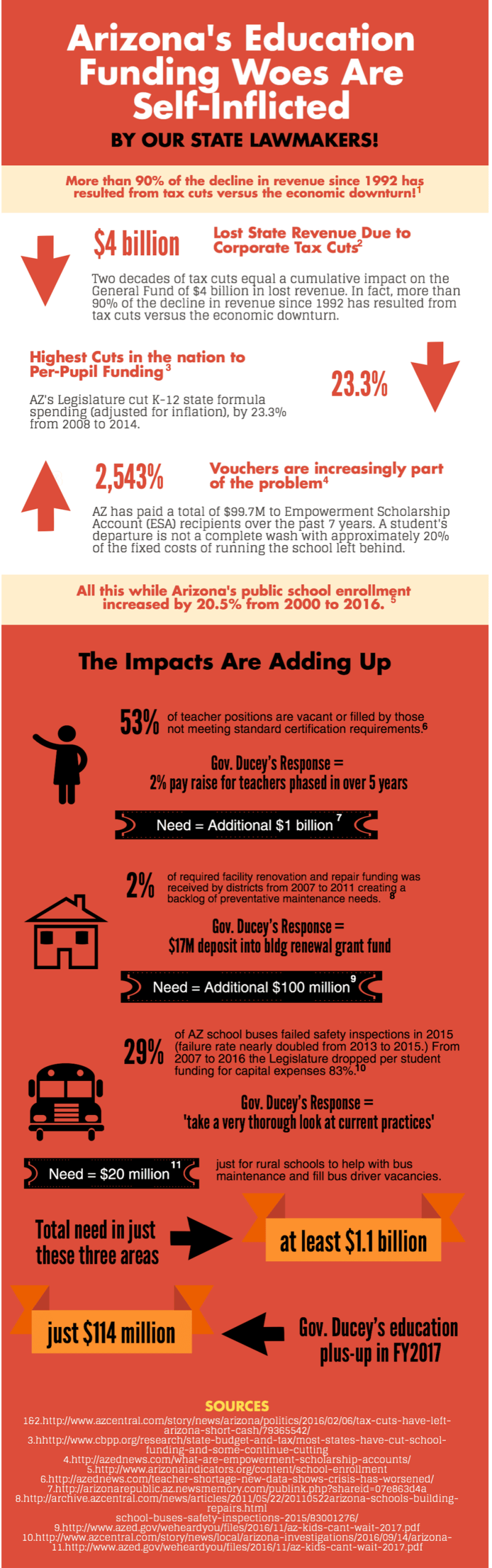
So, we know that money can make a difference, and wealthy parents that pay big bucks for their children to attend elite private schools know that it matters. Small class sizes, highly qualified teachers, beautiful facilities and campuses all make a difference and that’s why parents with significant means are willing to pay for those things.
Arizonans are willing to pay more for education as well, as indicated by recent polling which shows 70% think we need to plus-up education spending and with 61% willing to pay higher taxes to do it. “Read my lips” Governor Ducey though, is determined not only to not raise taxes, but cut them every year he is in office while also continuing his steadfast committment to corporate welfare in the form of tax cuts. The $114 million he has proposed for the FY 2018 budget isn’t nothing (and it is new money as opposed to that which already belongs to education), but it also isn’t nearly enough. As David Safier points out in TucsonWeekly.com, it moves us all the way from 49th in per student spending to well…49th. And, this is just the Governor’s proposal, the Legislature is the entity actually charged with passing the budget. In addition, it isn’t just that our districts are currently underfunded, but that the funding continues to be siphoned away by commercial schools’ choice. The impacts of a “leaking bucket” with an insufficient stream of water to keep ahead of the losses are really starting to stack up. Money matters alright, maybe its just public education that doesn’t (at least to our Legislature.)
 Restore Reason