The color of accountability

I wasn’t surprised by The Republic’s recent findings that during the 2015-16 school year, the vast majority of funding ($20.6 million) for vouchers was taken from public schools rated A or B, but only $6.3 million was taken from schools rated C or D. I’d previously seen a statistic that in 2012, about 92 percent of students taking advantage of the voucher (Empowerment Scholarship Account) program would have attended private schools anyway regardless of voucher availability. Let’s face it; this was never about helping the poor, disadvantaged minority child. The reality is that vouchers were never for poorer Arizonans who can’t cover the average private-school tuition costs of $10,421 when a voucher provides only $5,200.

And yet, the AZ Legislature is pushing two bills to fully open the floodgates on voucher availability, making every student in Arizona eligible for vouchers for homeschooling, tutoring, private school, or to save for college. This, despite the fact that there is little accountability in the program. Yes, recipients must provide quarterly reports of their spending, but DOE staffing for oversight is reportedly insufficient and the schooling options that vouchers pay for have no responsibility for reporting any kind of results. The taxpayer then, has no way to determine return on investment.

Here’s where I start to get confused. The GOP nay, Teapublican-led Arizona Legislature, loves to tout the need for accountability of taxpayer dollars. They are great however, at picking and choosing their targets for applying this accountability. [Please read on, this post isn’t really about vouchers.]

In 2015 for example, Representative Mark Finchem, R-LD11, basically accused both the Phoenix Union High School (PUHSD) and Tucson Unified (TUSD) school districts of using desegregation (deseg) funding for purposes other than what they were intended for. TUSD Superintendent H.T. Sanchez said he was not aware of any misuse, citing the fact that there is a strict review process for every deseg dollar spent. In fact, oversight of this funding is provided by the plaintiffs in a deseg suit against the district, the DOJ, a federal judge and the special master, a deseg expert overseeing the district’s efforts all get to weight in on how deseg funds can be used. Finchem though was undeterred and demanded forensic audits that the schools would have to pay for because “these are taxpayer dollars and we want to make sure those dollars are being spent wisely, that they’re not being misappropriated. And I think that’s an obligation this body has to see to it that those dollars are spent that way.”

Fortunately, SB 1120 failed. Senator Steve Farley, D-LD9, who had a child in TUSD, said, “Finchem represents no part of the Tucson Unified School District.” Finchem never took the time to discuss the issue first with Sanchez, meet with district officials or review audits already done according to Farley.

So, why don’t AZ Legislators care about accountability when it comes to vouchers, but are all over it when it comes to desegregation funds? Could it just have something to do with the socio-economic status and color of most voucher (private school) students versus those who are beneficiaries of deseg funds? Just sayin’…

I must admit I hadn’t really taken the time to learn the details about deseg funding (my district doesn’t get any) until a recent email exchange with Representative Vince Leach, R-LD11. In his email, he intimated that “districts continue to violate civil rights after billions of dollars have been spent to fix the problem” and asked, “Where is the accountability in that?” Again, that whole accountability thing. Yet, when I asked him to please vote no on the voucher expansion, citing in part the lack of accountability, he said “I think you know I am going to vote for them.”

So yes, I took the time to learn more about desegregation funding. The issue dates back to at least 1974 when two families filed separate lawsuits against TUSD and the court found TUSD “had acted with segregative intent” and failed to fix the problem. In 1979, the U.S. Department of Education’s Office for Civil Rights (OCR) launched an investigation against PUHSD and a lawsuit was filed in 1982 for allegedly engaging in segregation practices. Problems were also found in the Tempe Elementary School District to include deliberately segregating minority and non-English speaking students, assigning minority teachers to the district’s poorest schools and placing a disproportionate number of English language learners in special education classrooms. Schools in wealthier parts of the District also had full-day kindergarten, nurses and librarians, but the others did not.

In 1985, Arizona enacted legislation to allow districts under federal court orders or OCR agreements to bring racial and ethnic balance to their schools and provide equal access to high quality education, to levy property taxes above their revenue control limit. As a result, those districts were able to levy a limited amount of higher local property taxes without voter approval. Although there were some problems along the way, in 2005, PUHSD gained “unitary status” followed by TUSD in 2009. This status meant that these districts had formally fulfilled their desegregation court order. Plaintiffs in the TUSD suit disagreed the problem was fixed, filed an appeal of the District’s unitary status designation and in 2011; the Appeals Court reversed the decision and appointed a highly paid special master (in Massachusetts) to help TUSD develop a new “road map.” This road map outlines required activities including student assignment, transportation, faculty and staff assignment, quality of education, discipline, family engagement, access to facilities and technology and transparency and accountability.

There are now 19 school districts with almost 250,000 students (about 23% of the total) around Arizona that receive $211 million for racial and ethnic discrimination remediation (unchanged since 2009.) Since 1986, the total comes to $4.3 billion, with 97 percent going to Phoenix and Tucson Schools. Only PUHSD and TUSD actually receive “desegregation funding”, the other 16 districts have administrative agreements with OCR. Two bills in the AZ Legislature, seek to reduce and eventually eliminate all this funding (within 5 years for those with OCR agreements and 10 years for those in unitary status.) SB 1125 (a follow-on to last session’s unsuccessful 1371), sponsored by AZ Senator Debbie Lesko, R-LD21, passed by the Senate Finance committee on 2/11/16 and claims state property tax rate caps require the general fund to make up some $23 million in 2015 in desegregation funding garnered at the local level. HB 2401 sponsored by Representatives Vince Leach and Mark Finchem is a companion bill which has been retained on the calendar as of 2/23/16.

Of her bill, Lesko said “That’s money from all over the state that shouldn’t just go to a couple districts.” She thinks that rather then relying on deseg funding, districts should ask voters to approve budget overrides. According to the Senate Fact Sheet for SB1125 however, although the state funded this “cap gap” through FY 2015, the Legislature has now capped the state’s cost of the 1 percent cap program to $1 million per county, i.e., the state passed on a portion of the cost for the gap to the counties (who must then pass these costs on to the taxpayer.) Irrespective of the caps however, affected districts contend they would be violating a federal agreement and a lawsuit will ensue if the funding is discontinued. Additionally, according to a recent analysis by The Republic, districts receiving desegregation funding did not spend more per pupil than all others in 2014. This is because there are many different funding sources for schools including varying amounts of federal dollars, bonds and overrides.

For PUHSD, the largest in the state with over 27,000 students, the loss of deseg funding would translate to about $53 million and would require closing four high schools with a loss of 702 teaching and staff jobs (estimates put the state-wide loss of jobs at about 2,500.) The superintendent, Dr. Chad Gestson, says, “The proposed elimination of desegregation funding is simply a huge tax cut on the backs of our poorest students.” He goes on to say that the ramifications go beyond public education and will affect property values, crime rates, reduced tax base, more burden on the city, county and state and a lower quality of life. Superintendent Robbie Koerperich of Holbrook Unified School District says “we all deserve it…we [shouldn’t] bring Holbrook [down] to the same level as similar school districts, but we should fund the other districts to bring them up.”

Proponents of the funding however say the results speak for themselves with the graduation rate at PUHSD at 80 percent up from 55 percent 15 years ago. Same thing with dropout rates that went from 15 percent over 20 years ago to 3.4 percent today. The Districts grads are also earning more scholarships for college than only six years ago, $50 million now, versus $13 million then.

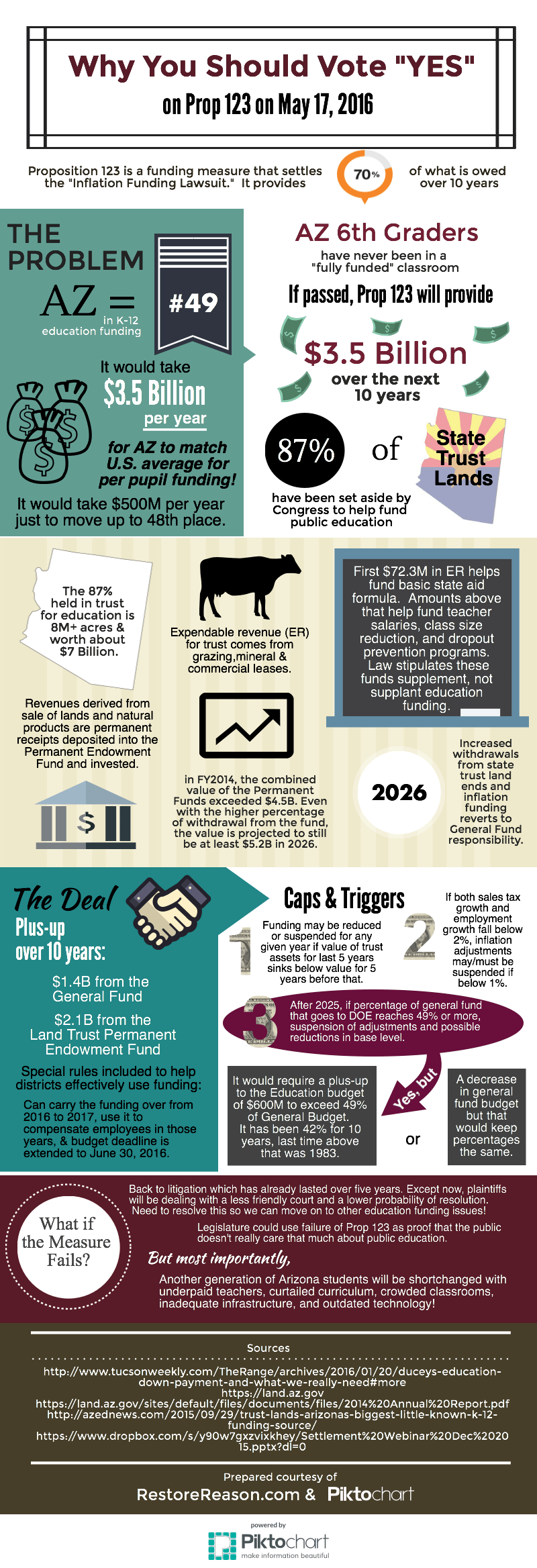
The $211 million currently spent in deseg funding works out to an average of $844 per student. The question we should be asking isn’t “is it unfair for the 19 districts under deseg orders or with OCR agreements to receive this funding”, but what is the appropriate level of funding for all our students. Arizona k-12 education saw the highest cuts in per pupil funding in the Nation from 2008 to 2014 and to move up to even 45th place, we would need to spend $1 billion more, or almost $950 per pupil. Of course, other than the badly needed Prop 123 monies, our Legislature isn’t talking about education plus-ups, only cuts. (Sorry, but the recent restoration of all but $2 million of JTED funding doesn’t count, that was just about rectifying the bad decision made in last year’s budget.)

To the Arizona Legislature I say, the voters are waking up to your pretension that you give a damn about All Arizona’s children. To the voters, I say NOTHING speaks louder than your vote.


Screw you, I’ve got mine

Now that it looks like the AZ Legislature will be successful in finally opening the floodgates on vouchers (empowerment scholarship accounts) for K-12 education, I’ve got some other ideas they should consider. After all, the Legislature has made it clear that taxpayers are the ones best equipped to decide where their tax dollars go and that transparency and accountability don’t matter. Other than quarterly reports on spending, there is virtually no accountability in the voucher program; students aren’t even required to test and private schools don’t need to report any kind of results so there is no way for taxpayers to determine if their tax dollars were well spent.

Since I don’t have any children or grandchildren, I’ve been thinking about how I can take advantage of the Legislature’s privatization fixation. My first idea is one of safety and security. We don’t live in an incorporated township, so we rely on the county sheriff’s department to ensure our safety and security. The service provided is adequate, but I really think I can do better by looking to a private security firm to meet my needs. After all, surely a private security firm can do a better job right? That Blackwater firm was just an anomaly, right? So, I’m not sure what percentage of my tax dollars support the county sheriff’s office, but I want the state to give that back to me and I’ll hire my own guys. I’ll probably have to pay extra for the private solution, but it will be worth it.

While I’m at it, think I’ll look at the taxes I pay for maintenance of roads. After all, what do I care about roads in other parts of the state? I want the roads I drive each and every day to be in pristine condition. Maybe the state should just turn every road into a toll road and then I would only pay for those roads on which I drive. What? There would be many cases where there isn’t enough traffic to support maintenance of roads in remote areas? Too bad, so sad, not my problem.

Oh, and I live within a half mile of a fire department so I don’t think I should have to pay as much in taxes as those who live further away. After all, if there is a fire at my house, the department will save money in fuel and travel time to deal with it.

Obviously, I provide the above to make a point. When did we descend into this “screw you, I’ve got mine” mentality? No matter what proponents claim, vouchers are NOT the solution for the vast majority of Arizona’s children. What they are, is a way to: 1) redistribute our tax dollars from the greater good to those who LEAST need the help; 2) bolster the private education industry and; 3) relieve the state Legislature of the responsibility for ensuring and providing for education. The two major jobs of the state are to provide for public safety and public education. Once these voucher bills pass, legislators will no doubt feel they can wash their hands of the responsibility to “provide for the establishment and maintenance of a general and uniform public school system.” Truth is, they will have just done the very thing that drives a stake in the heart of their ability to ensure a “uniform” system.

Make no mistake; this is NOT about providing parents a choice. What it is about, and has always been about, is the corporate “reform” of public education or in other words, taking the “public” out of public education. Vouchers are also not ensuring the best for ALL our students. With every student exits their district school on a voucher, the fixed costs of running that district must be born by a smaller budget, which means the students left in are increasingly short-changed. The nature of the beast is that these students will invariably be those with the most challenges such as English Language Learners, special needs students, or just those lowest on the socio-economic ladder. Unlike district and charter schools, private schools can choose whom they wish to admit. They also don’t provide transportation and their tuition commonly exceeds the $5,200 parents receive with the voucher. It is not hard to see why many of Arizona’s parents will continue to choose to send their children to their community district schools and yet, these schools will increasingly be abandoned in terms of state support.

I’ve made it known that I am for the approval of Prop. 123 to get more funding into our schools now! Is it the way I would want to do it? NO!! I want to Arizona to stop giving corporate handouts and if necessary, to raise taxes to fund the type of schools our students needs for the future we all want. After all, Arizonans largely support this. If this opening of the floodgates on vouchers passes though, I may have to rethink my position. It is bad enough that the Legislature has thumbed it’s nose at the will of the voters, the decisions of the court and has finally agreed to pay our schools only 70 percent of what they owe with money that is already technically theirs. I can’t stomach the thought of this money getting siphoned off by those who could largely afford to go to private schools without the voucher money.

If you agree, you can’t just sit silently by and let this happen. If you want things to be different, you MUST ACT. Call your legislator, send them an email and make comments in the Legislature’s “Request to Speak” program. If you aren’t signed up for the program, please email me and I’ll personally go to the Capitol and sign you up (you must be signed up through the kiosk at the Capitol to be able to actually comment on bills.) Then you can, from the comfort of your home, tell the Legislature just what you think about the bills they are considering and, your comments will become part of the permanent record.

Ultimately though, the only long-term solution is to elect pro-public education legislators to replace those who aren’t acting in our students’ or our state’s best interest. Please ACT NOW. Our kids are counting on you and they can’t wait any longer for us to come to their rescue.


The real trick to making America great again

There is a path to getting America back on track, but it has nothing to do with whom we elect to be our next president. The singular most significant action each of us can take this year is to demand the members of Congress put the good of the country ahead of partisan gamesmanship and special interests. And, if they don’t, vote them out of office!

Here’s the deal. Experts agree the best way to get out economy moving again is for the Federal government to invest big in repairing the country’s infrastructure. It is up to the government to do it because of what Nobel Prize-winning economist Joseph Stiglitz calls “a deficiency of aggregate demand, brought on by a combination of growing inequality and a mindless wave of fiscal austerity.” Basically, no matter how much they spend, the wealthy just can’t spend enough to adequately stimulate the economy. At the same time, as of the second quarter of 2015, corporate America had more cash on-hand that the economies of Belgium and Sweden combined ($1.43 trillion for S&P companies excluding those in the financial sector.) Tech companies are especially cash rich with Microsoft having $96 billion in cash, Google $70 billion and Cisco $60 billion. Although this hoarding means companies are positioned to weather tough economic times, it hurts the economy (especially since most of this money is held in off-shore accounts to reduce tax liability.)

We are all aware that our country’s infrastructure is in bad shape. Are roads are pothole laden and our bridges are structurally unsound.   The most recent Infrastructure Report Card from the Americans Society of Civil Engineers (ASCE) gives our Nation’s infrastructure a D+, and states that we need to invest $3.6 trillion by 2020 just to get it up to standard. The number one solution toward beginning to raise the grade according to ASCE is to “increase leadership in infrastructure renewal” and the organization maintains, “America’s infrastructure needs bold leadership and a compelling vision at the national level.

Such leadership and vision was provided by President Franklin Roosevelt in his establishment of the Works Progress Administration (WPA.) He designed the public works program “to put more men back to work, both directly on the public works themselves, and indirectly in the industries supplying the materials for these public works,” because “no country, however rich, can afford the waste of its human resources.” 2014 marked the 80th anniversary of the WPA, a Federal government program that provided 8 million Americans jobs during the Great Depression. According to the Smithsonian, “the WPA built, improved or renovated 39,370 schools; 2,550 hospitals; 1,074 libraries; 2,700 firehouses; 15,100 auditoriums, gymnasiums and recreational buildings; 1,050 airports, 500 water treatment plants, 12,800 playgrounds, 900 swimming pools; 1,200 skating rinks, plus many other structures. It also dug more than 1,000 tunnels; surfaced 639,000 miles of roads and installed nearly 1 million miles of sidewalks, curbs and street lighting, in addition to tens of thousands of viaducts, culverts and roadside draining ditches.” The San Antonio River Walk, the development of the park which paved the way for St. Louis’ Gateway Arch, and Camp David in Maryland are also just a few amazing products of the WPA.

Unfortunately, attempts to start even mildly ambitious efforts today have gone nowhere. Ray LaHood, who says, “our infrastructure is on life support”, was the secretary of transportation during Obama’s first administration. He is now co-chairman of Building America’s Future, a bipartisan coalition of current and former elected officials urgently pushing for more spending on infrastructure. In an interview on 60 Minutes, LaHood talked about the federal Highway Trust Fund, which gets its revenue from the federal gas tax of 18 cents per gallon which will be broke in 2016 unless something is done. The last time we raised the gas tax (how we funded the interstate system) was in 1993 said LaHood and spending on infrastructure has fallen to its lowest level since 1947. This reality he said, has caused us to fall from having the best infrastructure in the world, to being ranked 16th according to the World Economic Forum.

Big business recognizes the dire need to find solutions and has been vocal about sounding the alarm. In 2015, the conservative U.S. Chamber of Commerce voiced strong support for raising the gas tax for the first time in 20 years. It isn’t just roads and bridges that they are worried about. Our shortage of airport runways and outmoded air traffic control systems have made US air travel the most congested in the world, only two of our 14 major ports will soon be able to handle the biggest cargo ships, and although there are 14,000 miles of high speed rail around the world, none of it is in the US. ASCE says “by failing to invest in our vital transportation systems by 2020, businesses would pay an extra $430 billion in transportation costs, household incomes would fall by $7,000 and U.S. exports would fall by $28 billion.”

Former Pennsylvania Governor Rendell says, “The cost of inaction is greater than the cost of doing something. It’s become this literally crazed idea that spending money is bad. Federal governments and state governments have to spend money on certain things that are important.” In fact, just to maintain infrastructure as it is, an expert panel at the University of Virginia determined we need to spend $134 to $194 billion more each year through 2035. Total cost estimates to modernize top $2.3 trillion plus over the next decade, just for our transportation, energy and water infrastructure needs. Unfortunately, our infrastructure investment, currently at 2.4 percent of GDP, is only half of what it was 50 years ago.

Continuing to kick this can down the road only means there’s going to be hell to pay. There are over 240,000 water main breaks each year and rail congestion caused Midwest farmers to lose over $500 million in 2013 and 2014 in rail delays. The average ages of bridges and roads exceed 45 years and the average elementary school is 45 years old. “Our substandard roads, for example, cost urban motorists $700 to $1,000 per driver in repairs, wear and tear, and fuel. This doesn’t count the lost time involved in lower speeds and detours.”

And, with the U.S. Treasury’s ability to borrow at essentially zero (low interest rates offset by inflation), this is the perfect time to make the necessary investments in our infrastructure. Even if we only invested $18 billion per year, according to the Economic Policy Institute, it would produce a $29 billion increase in GDP and a net addition of 216,000 jobs within the first year. Of course, our real needs in terms of infrastructure investment are over $1 trillion, so the jobs eventually created could easily top one million.

So why won’t Congress get off the dime on infrastructure spending? There are a number of reasons, but I believe it basically boils down to the exact opposite of “it would be amazing how much we could get done if no one cares who gets the credit” and, the desire to starve the beast that is the Federal government. So, once again, ideology and partisan gridlock is keeping our Nation, and the rest of the world by association, from moving forward. Want to do your part to drive the required action? Use the only power many of us have left. VOTE!

Stay tuned for a subsequent discussion about Arizona’s infrastructure story.

The Real Super Bowl

Capitol Media Services reported this morning that a “New deal could restore $28M, keep JTEDs alive.” Even though Governor Ducey has said he won’t support any bill that doesn’t keep the budget balanced, a Legislative veto-proof majority organized by Senator Don Shooter might save the day. That is of course, unless Senate President Andy Biggs refuses to have the bill considered. Biggs has said that although JTED started out as a good idea, it “has become a way for schools to get extra tax dollars for programs that really do not qualify for as CTE.” Shooter’s bill however, includes a requirement for audits and will include a new grading system, and Bigg’s has indicated these changes will help.

I predict the bill will pass given wide support by both the education and business communities and the fact that for the most part, the Legislature knows they made a dumb mistake in cutting the program in the first place. Or, I could give them credit for being really smart and cutting the program last year without the cuts taking affect until next year so they could be big heroes in restoring it this year if the voters put up a fuss. Nah…let’s stick with the first scenario. The bigger issue to me though, is the duplicity with which our state leaders are dealing with education. After all, they have no problem with exponentially expanding the amount of taxpayer dollars that go to private schools (92% of which are religious), but absolutely can’t stomach districts schools trying to improve their programs and ensure sustainability.

I’ve written before how CTE is a win-win-win, so I won’t belabor that point again. If the Legislature wants to place more rules on uses for JTED funds, that’s one thing. But it is entirely hypocritical for them to have cut the funds in the first place when the districts are just following the established rules. That reminds me of how districts followed the rules to create their own charter schools and then the legislature changed the law to prevent them from doing so.

It’s like this. Imagine the Super Bowl this Sunday isn’t between the Panthers and Broncos but between the Districts (underfunded district schools) and the Privates (well supported private schools.) Both sides have been training as hard as they can with the resources available to them. Unfortunately, the Privates have several advantages not afforded the Districts. First, the Privates were able to have all their first picks in the draft before the Districts could weigh in. Second, the Privates aren’t required to divulge any information about their team or their strategy whereas the Districts must divulge all, to include their playbook. Third, the Privates have unlimited potential for funding which allows them to hire and hold on to good coaches and trainers while the Districts struggle to recruit and retain sufficient numbers of each. Fourth, the Privates are flown to the game in first class style aboard their private jet. The Districts however, can’t afford a jet and they make the day long trip via bus to the game location. Fifth, the night before the game, the Privates are treated to a steak dinner at Ruth’s Chris Steak house while the Districts have a meal at McDonalds. Finally, the morning of the game, the Privates prepare in a luxurious locker room with all the amenities, while the Districts crowd into one of the stadium restrooms. Finally, to cinch the deal, the Privates have lobbied for government subsidies designed to lure players from the Districts. Of course, the costs for the Districts to maintain their team infrastructure remains fairly constant despite the attrition of players, so the funding they have left makes it even tougher for them to compete.

Who do you think would win the game? Not hard to figure it out is it? And yet, the Districts do more than their fair share of winning. As I have said before, I am not anti-choice. I just believe that the choice should be made with all the cards on the table. Corporate reformers have managed to sell the narrative that public schools aren’t working and the only way to save American education is to turn it over to the private sector. Truth is though, it is easy for the privatized schools to claim they work when they make the choice about who they admit, what rules they follow and what results, if any, they divulge. As many have said, it seems like school choice is more about choice for the schools than choice for the students or their parents.

I say let parents make the choice, but let’s demand both teams play by the same rules, particularly when it comes to return on taxpayer investment. More importantly, let’s all of us ensure that our overall system of education is producing the results needed for our students, our state and our Nation. To achieve the right result, we must focus on the right goal, that which made our country great. A free public education for all provided the fuel that allowed our economy to thrive and inspired the American Dream. It is too bad that keeping that dream alive isn’t the real Super Bowl that captures our attention.  The path we are on now will only serve to exacerbate income inequality and the death of that dream. It is about choice…a choice that is ours to make. It is our duty to make it wisely.

New contributor to Restore Reason blog

Bill Maki is another southern Arizona resident who writes about a variety of issues on his blog, skyislandscriber.com. He will be contributing posts here on the Restore Reason blog as well and is graciously allowing me to cross-post on his blog. Welcome Bill.

AZ again at bottom in “50 States Report”

The Network for Public Education (NPE), a public education advocacy group headed by the Nation’s preeminent public education expert and advocate, Diane Ravitch, released their “A 50 State Report Card” today. As the name indicates, the report card grades the 50 states and the District of Columbia on six criteria: No High Stakes Testing, Professionalization of Teaching, Resistance to Privatization, School Finance, Spend Taxpayer Resources Wisely, and Chance for Success. Letter grades from “A” to “F” were then averaged to create the overall GPA and letter grade for each state.

I was proud to note the study was conducted with the help of Francesca Lopez, Ph.D. and her student research team at the University of Arizona. They assisted in the identification of 29 measurable factors that guided the ratings of the six criteria and created a 0-4 scale for ratings and then evaluated each state on the 29 factors. The graders were tough, with only 5 states earning an “A” grade and no state’s overall grade exceeding a “C.”

Not surprising to anyone who keeps up with Arizona public education, the state ranked 48th, but I assume only because Arizona begins with an “A.”   Arizona’s grade of 0.67 earned it an overall “F”, numerically tying it with Idaho and Texas (in 49th and 50th place), just above Mississippi.

The first criterion evaluated was “High Stakes Testing” which according to NPE has caused “the narrowing of the curriculum and excessive classroom time devoted to preparing for tests.” The organization also points to peer-reviewed studies highlighting “the potentially negative impacts of this practice, including the dismissal of quality teachers and the undermining of morale.” Five states received an “A” grade for their rejection of the use of exit exams to determine high school graduation, the use of test results to determine student promotion, and educator evaluation systems that include test results. Arizona received a grade of “C” in this area.

The second criterion evaluated was “Professionalization of Teaching”, because “many of the current popular American reforms give lip service to the professionalization of teaching while displaying an appalling lack of understanding of what professionalization truly means.” NPE points to research that “shows that experience matters and leads to better student outcomes, including increased learning, better attendance and fewer disciplinary referrals.” High grades were given to states that exhibited a commitment to teaching as a profession. Unfortunately, no states were awarded an “A” in this area and only two states, Iowa and New York received a “B.” Arizona received a grade of “F” which goes a long way towards explaining our state’s critical shortage of teachers.

In the area of “Resistance to Privatization”, seven states received an “A” grade. The evaluation of this criterion was centered on school choice policies that “move control of schools from democratic, local control to private control.” Market-based approaches (vouchers, charters and parent trigger laws) reports NPE, “take the governance of schools out of the hands of democratically elected officials and the local communities they serve, and place it in the hands of a few individuals – often elites or corporations with no connections to the community.” Such policies drain resources from neighborhood schools and don’t overall, produce better results in general. NPE writes “they also serve to undermine the public’s willingness to invest in the education of all children while creating wider inequities across the system as a whole.” Since NPE believes in strengthening community schools, they evaluated states on whether they have laws, policies and practices that support and protect their neighborhood schools. As an early leader in school choice, Arizona more than earned the “F” grade it was awarded.

Since the level of poverty in a school is the single best predictor of average student performance, “School Finance” was another criterion evaluated. NPE looked at whether states adequately and fairly funded their schools noting that “resources like smaller class sizes and more support staff lead to significantly higher achievement and graduation rates – especially for poor and minority students.” Only one state, New Jersey, received an “A” grade in this area. This is not surprising since in the past decade, the gap in spending between rich and poor districts has grown by 44%. NPE calls for states to sufficiently fund public education and implement progressive financial polices that “provide the most funds to districts that demonstrate the greatest need.” The factors used to determine a state’s grade were: per-pupil expenditure adjusted for poverty, wages and district size/density; resources spent on education in relation to the state’s ability to pay based on gross product; and increased proportion of aid given to high-poverty districts than to low-poverty. Once again, Arizona received an “F” grade in this area.

In evaluating the criterion of “Spend Taxpayer Resources Wisely”, NPE looked at how states’ education dollars are spent. As research shows the significant benefit of early childhood education, high quality pre-school and all-day Kindergarten were a significant factor in the evaluation as were lower class sizes and the rejection of virtual schools.   In this area, Arizona received a “D” grade, with no states receiving an “A” and only Montana receiving a “B” grade.

“Chance for Success” was the final criterion evaluated. It looked at state policies directly affecting the income, living conditions and support received by students and their parents/guardians. NPE says that residential segregation is largely responsible for school segregation. However, the organization says, “state policies that promote school choice typically exacerbate segregation and charters often isolate students by race and class.” The states that had fewer students living in or near poverty, and have the most integrated schools received the highest grades. No states received an “A” grade, but 10 received a grade of “B.” In this final area, Arizona received a grade of “D.”

It can be no coincidence that Arizona continues to finish last, or close to last, in the vast majority of every report on state public education performance. In fact, the only report I’ve found it to be rated better than at the bottom is from the American Legislative Exchange Council’s (ALEC) Report Card on American Education. Not surprising from this highly conservative “bill mill” for the Koch Brothers and the GOP, which works to develop model legislation favorable to its corporate members and provide it to legislators for implementation in their states. It speaks volumes about ALEC’s focus when even though Arizona ranked 47th on the 2013 National Assessment of Educational Progress (NAEP), they gave the state an overall B- on education policy. That’s because ALEC values states’ support of charter schools, embrace of home schools and private school choice programs, teacher quality (as defined by the National Council on Teacher Quality) and digital learning. For the most part, the positions ALEC takes on education policy are the exact opposite of NPE’s positions. ALEC pushes school choice and the privatization of public education and in Arizona, the Goldwater Institute does it’s part to support ALEC in it’s efforts to kill public education. What’s in it for ALEC, the Goldwater Institute, their legislators, donors and corporate members? As is often the case, it’s all about money in the form of campaign donations for legislators, profits for those in the for-profit charter and private school business, increased tax breaks for donors and welfare for corporate members. You might ask how privatizing education can lead to increased corporate welfare when such privatization will undoubtedly lead to increased costs? (Think privatization of prisons.) Easy, when the state’s cost for “public” education is passed on to those taking advantage of the privatized option via vouchers and charters. It is well known that both often cost more than the state provided funding covers and parents must pick up the tab.

I attended the first NPE Conference held in 2013 in Austin, Texas where I was privileged to meet and hear Diane and numerous other leaders in the effort to save public education. I, like them, believe (as Diane writes in the NPE report) “educating all children is a civil responsibility, not a consumer good.” And although the phrase “civil rights issue of our time” is way overused, I deeply believe it rings true when, (as Diane writes) it refers to “sustaining our system of free, equitable and democratically-controlled public schools that serve all children.”  I’ve quoted him before, but John Dewey’s words bear repeating until we, as a nation “get it”: “What the best and wisest parent wants for his child, that must we want for all the children of the community. Anything less is unlovely, and left unchecked, destroys our democracy.” Yes, we should act on public education as our very democracy is at stake, because it is!

The needs of the many…

Spoiler Alert: I am really glad I didn’t drive to Phoenix today for the House Ways and Means Committee meeting during which they considered HB 2842, Empowerment Scholarship Accounts (ESAs); Expansion; Phase-In. I’m glad I stayed home because I’m sure my presence would have made no difference. Instead, I watched live streaming of the meeting and gleaned from the testimony that ESAs are lacking in accountability and transparency and serve the few at the expense of the majority.

The first “against” speaker I viewed was Ms. Stacey Morley from the Arizona Education Association. She talked about how when the full cap is reached, 5,500 students could have accepted ESAs at a cost of $13M to the state. Tory Anderson, from the Secular Coalition of Arizona expressed her organization’s opposition to any use of taxpayer dollars to fund religious schools. An AZ Department of Education representative said DOE is neutral on the bill, but wants to ensure they get their full 5% portion of the ESA funds for ensuring accountability. These funds are prescribed by law, but haven’t always been fully included in the budget. He talked about the importance of adequate oversight and referred to the 700 to 1 ratio currently in place for program liaisons that work with families to provide that oversight. As high as that number is, he wanted to ensure further budget cuts don’t make the challenge even tougher.

Mike Barnes, from the Arizona Superintendent’s Association talked about how ESAs make it very difficult for districts to determine their potential enrollment and therefore the impact on their budget. He said he doesn’t see how under this structure, the state doesn’t end paying for students that were going to attend private school anyway. He mentioned that the funds given in an ESA equal about $5,200 which is $600 more than is given to a district, but $600 less than what a charter costs. Representative Bruce Wheeler asked him if we knew how many of those students who take ESA have parents that make in excess of $100K. He said he did not.

The next speaker was Julie Horwin, a grandparent of two children who attend private schools. I assumed she was going to advocate for ESAs but that was not the case. She opened by saying that ESAs mean we are paying with two separate school systems with public funds. She then relayed a story of a private school principal who is paid $40K per year and found out that his board members each get paid $150K per year with public monies. She finished by saying that this bill will not help the greater majority of our students.

Janice Palmer from the Arizona School Boards Association (ASBA) said school choice is robust and noted that ASBA was the first school boards association to participate in National School Choice Week. She said the bill is disconcerting because in a competitive environment, it is important to be fair. Parents she said, definitely need to have the largest voice in their children’s education but when public dollars are involved, taxpayers also need to be part of the equation. Finally, she noted that this is not a zero sum game. If we choose to press ahead with the expansion of ESAs, but refuse to increase taxes, other programs will suffer to cover the additional expenses to the state budget.

The “for” speakers were three parents or grandparents of special needs children and Michael Hunter from the Goldwater Institute. Those who spoke regarding the value of ESAs for their special needs students were eloquent and convincing. There could be no doubt that the ESA program has provided them options they might not have otherwise had. But, the option for special needs students already exists in the law the expansion of HB 2842 is well beyond just them, but ultimately for all students in Arizona. Michael Hunter of the Goldwater Institute pointed out that changes like this are always met with resistance. First, there was open enrollment and then charter schools, both which were touted by opponents as being detrimental to district schools. He said that instead of looking at the impact on district schools, we should look at each family’s situation. Representative Reginald Bolding went back and forth with him a couple of times trying to pin him down (with little avail) about the difference in accountability and transparency, especially with regard to academic standards, but in the end Bolding was left to make his points on his own.

When the committee members voted, only Representative Bruce Wheeler and Reginald Bolding explained their votes. Wheeler called it subsidization of the rich and voted no and Bolling said he just wanted to ensure we have good schools for all our students and he was worried that individuals who might benefit from the program wouldn’t know about it. In the end, the vote was not surprisingly, along party lines and the measure passed (5-3-1.) The vote was predictable, but still depressing. I am convinced it will do nothing to improve education in Arizona and will do very little to help those who most need it. The Senate Education Committee meets this Thursday, February 4th at 9:00 am in Senate Hearing Room 1 and will be considering SB 1279, also about ESA expansion. If you are registered in the Request to Speak system, please make a request to speak on this bill and if not, please email or call your legislators to let them know you do not support it. Anyway you look at it, ESAs are vouchers and, they are siphoning valuable taxpayer dollars to private (to include religious) schools. Register your concerns and let your voice be heard. In this case, the needs of the many, must take precedence over the needs of the few.


A Tale of Two States

As a kid, one of my favorite authors was Charles Dickens. In his 1859 novel, A Tale of Two Cities, he “depicts the plight of the French peasantry demoralized by the French aristocracy in the years leading up to the revolution.” Hmm, peasantry demoralized by the aristocracy…that reminds me of something…wait, I’ll think of it. Maybe, it is the fact that the 62 richest people in the world now own more than the poorest half? In fact, their wealth has increased 44% since 2010 while the bottom half’s has dropped by 41%. And in the U.S., the wealth inequity is now worse than at any time since the Great Depression. The Walton family alone owns more wealth than 42% of American families combined and CEO-to-worker pay-ratio is 354-to-1. Americans haven’t taken to the streets with pitchforks (the “Occupy” movement aside) to demand “off with their heads” yet because for the most part, they still believe in the American Dream. That is if one works hard enough, they can move up the economic ladder. The truth is more like comedian George Carlin joked: “the reason they call it the American Dream is because you have to be asleep to believe it.”

Although reference to the concept of the American Dream was made as early as the 1600s by those who came to America from England for the chance of a better life, it was most likely “codified” in the Declaration of Independence, which proclaims that “all men are created equal” with the right to “Life, Liberty and the pursuit of Happiness.” Part of this right and critical to achieving the dream are the opportunities to receive a good education and work that provides at least a living wage. But, the game is now stacked. Stacked in favor of the wealthy, stacked in favor of corporations, stacked against the middle class who is increasingly squeezed, and stacked against children who don’t come from a family of means.

Of course, everyone has a different idea about how to “unstack” the deck. In fact, as I mentioned earlier, some don’t even see the deck as unfairly stacked. I am firmly in the “”deck is stacked” camp and believe if we don’t start to make progress at turning the tide, pitchforks may be in our future. In Arizona, Governor Ducey thinks the way to move our economy forward is vouchers and charter schools, no individual state income tax and very little tax on the corporate side, and oh yeah, the “sharing economy.” Really, a “sharing economy”? Could it be that Ducey and I agree on something? I mean, I think it would be great if we would all share equally in our economy. After all, when Arizona’s top 1% pays only 4.6% of their income in state and local taxes while the bottom 20% pays 12.5%, we could really use some sharing. What you say? He was referring to “sharing” type businesses like Über and Lyft where the services are cheap and convenient, but the workers have no rights or benefits? Oh, okay, that sounds more like current Arizona leadership.

Just for kicks, let’s look at another state’s version of the way forward. Interestingly, Massachusetts has almost exactly the same population as Arizona, 6.8 million. Both states also have the Tea Party in common although with Massachusetts, it is mostly in their past (as in Boston in 1772) and in Arizona it is very much in the present.

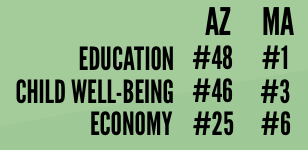
Politically, Arizona is GOP led with no statewide Democratic leaders and both the state senate and house under GOP control. Massachusetts conversely, is almost entirely led by Democrats with the exception of their governor who is a Republican. Given the political parties’ priorities, it should be no surprise then that MAZ vs MAassachusetts ranks much better in education and child well being than Arizona. What may surprise some though, is that while Arizona’s economy ranks 25th in the Nation, Massachusetts’ comes in at #6.  

Why might you ask? Well, I have a few theories and as you can imagine, the state’s prioritization of public education is at the top of my list. Take Career Technical Education (CTE) for example. It produces significantly higher graduation rates than traditional district high school programs, often provides living wage jobs to graduates, and helps provide skilled workers for the employers who so badly need them. It is, by all accounts, a win-win-win. Massachusetts Governor Charlie Baker obviously gets this as indicated by his recent proposal to add an additional $83.5M for vocational education.   Included in this is a $75 million five-year capital program to finance grants for school equipment and expansion an additional $8.5 million for grants for “school-to-career connecting activities.

At the same time, we have Governor Ducey objecting to restoring the $29 million in cuts to CTE made in last year’s budget. Instead of embracing the AZ Legislature’s veto-proof coalition to restore the funding, Ducey wants to only restore one-third of the funding for only three years and, attach a variety of strings to the money including a requirement for business matching of the funds. This despite a plea for repeal of the cuts signed by 32 business and education leaders as to the importance of CTE.

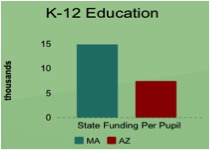
Maybe Governor Baker just had better advice than Governor Ducey. Tim Murray, a regional chamber of commerce president who toured 64 votech and agriculture education programs when he was the Lieutenant Governor of Massachusetts, said “the single biggest need” of the business community “regardless of the size of the company, regardless of the sector” is a “pipeline” of available workers. Surveys of 352 employers and 475 parents recently conducted by The Dukakis Center in Massachusetts revealed that 90% of employers see a need to increase CTE graduates, while 96% of parents had a favorable opinion of the CTE programs they children attend.K-12 az ma

But wait, there’s more. I believe one of the best determinants of the value someone or an entity places on something is what they are willing to pay for it. Massachusetts obviously values education. I know there are those of you ready to say: “there are plenty of examples of more money not producing better results.” Yes, that is true. But in almost every case, I’d be willing to bet where money doesn’t help, there are significant social issues outside of the schools that keep students from learning and achieving. It is obvious, by Massachusetts’ #1 ranking in education achievement, that their money is well spent.

Of course, as mentioned earlier, we know there are factors outside of the school that determine how children do in school. Massachusetts has lower unemployment, their residents earn higher salaries and they are less likely due to lose their homes to foreclosure. Their residents are also better educated, safer, and healthier. They also have fewer disabilities, likely from the better health care they experience. It should be no surprise that Arizona also has four times the adults in state prison as does Massachusetts, spending hundreds of millions more in this area. Yet, Arizonans are no safer with over double the murder rate.

Some claim that Massachusetts is more successful in some areas because society is more homogenous with 74.3% of its residents being white as opposed to only 56.2% in Arizona. There may be some truth to that since unfortunately in the U.S. today, socioeconomic status often has to do with the color of one’s skin. But, Arizona is doing little to address this issue even though our state’s share of white K-12 students dropped below 50% in 2004 and Latin@s K-12 students are on the cusp of breaking 50%. One example of this blind eye toward the problem is new HB 2401 sponsored by Vince Leach-R SaddleBrooke. The bill, titled “Schools; Desegregation Funding; Phase-Down” phases out funding for desegregation expenses, a cut of about $211 million dollars. These funds will hit some of our most vulnerable children, about 22,500 English Language Learners (ELL) and leave high performing magnet schools, such as Phoenix Union’s Metro Tech High School, without their primary source of funding. It is in two words, extremely shortsighted. Learning English is critical to these student’s future success and by extension, that of our state. They will either be contributing members of our society or drains on it. This is a clear example of “you can pay me now, or you can pay me later.”

So let’s recap. Massachusetts performs better than Arizona in education, child welfare, health and safety, the economy and many other areas. Yes, taxes are a little higher ($1,706 per person in 2013), but look what you get for your money! I’m well aware of course that this line of reasoning will fall on many a deaf ear that think the only good government is a starved one. It can’t be said enough though that taxes are not bad or good, they are the price of living in a well-functioning society with a decent quality of life. There are many things such as education for all and safety that are best provided by the government. It our duty (the voters) to determine our priorities for our hard earned tax dollars and then elect candidates that will ensure those priorities are provided for and secured. That is how we keep ourselves free.


Accountability in Arizona…not so much

Two headlines in the AZ Star caught my attention this morning: “Plan adds state cash for private education” and “Veto-proof majority backs repeal of JTED cuts.” The first one is about Representative Justin Olson’s bill to remove any limits on Empowerment Scholarship Accounts (ESAs.)  The second is about the Legislature’s plan to reinstate the $30 million in JTED cuts they made last year. Evidently the Legislature is now saying “my bad” about the 7.5% cut (about $400 per student) to charters and districts with students enrolled in JTED. According to Diane McCarthy at West-MEC, legislators weren’t really aware of what they were doing. “After the fact, some legislators said they didn’t understand what the impact of that (cut) was,” McCarthy said. “There’s a lot of talk about how do we fix it.”

I’m really glad the Legislature has come to its senses and intends to restore the funding, since 96% of Arizona students enrolled in CTE graduate from high school, 21% above those who don’t. Most CTE graduates also go on to post-secondary education and jobs and they score higher on standardized tests. CTE really is a win-win-win as the recent letter to the AZ Legislature signed by 32 business and education entities made clear. What really caught my eye about the JTED article was a quote from Senator Don Shooter who introduced the legislation to repeal the cuts. In response to Senate President Andy Bigg’s accusation that the program has insufficient oversight, Shooter said one key is “transparency.” Thanks for the segue Don.

Don Shooter is correct that transparency leads to more accountability, but evidently he and his fellow GOP legislators don’t understand that concept when it comes to ESAs (basically vouchers by another name.) As of mid-April 2014, approximately $17 million had been handed out through ESAs. That is a lot of money to be handed out without any way to ascertain return on investment. Unlike district school students, ESA recipients are exempted from all state assessments so there is no way to know whether the money was well spent.  Although there is a quarterly spending report required from ESA recipients, parents must only provide proof of spending 25% of the funding they receive each year. The money they don’t spend can be saved from year to year and can even be used for college. If the money isn’t spent, does it mean the parent was efficient with their child’s education or does it mean they skimped? Also, the vast majority of ESA funding goes to private schools (92% in 2012) and at least in Arizona, 70% of private schools are religious. I know this has been deemed constitutional because the money is given to parents who then give it to the schools, but sorry if it looks like a rose and smells like a rose…

The ESA program has been expanded little by little, (students: with disabilities, wards of the court or those that were, students of active duty military members or those killed while serving on active duty, those who had attended a D or F school the prior year, siblings of students currently in the program, and students who reside within the boundaries of an Indian reservation) but it has always been the intention of the GOP-led Legislature to open up the program to all. So far, pro-public legislators and those who believe in good stewardship of government dollars have been able to keep the wolves at bay. Make no mistake however; this legislation is much more about privatizing public education than it is about opportunities for disadvantaged children. Proponents say we need to transition from financing schools to funding students. Problem is, when students accept an ESA and leave the district school, they take all the funding with them, but none of the costs of running the school. A certain amount of overhead costs are fairly independent of student count and schools are incapable of rapidly adjusting their operating expenses with each student lost.

School choice is alive and well in Arizona and still a full 85% of Arizona’s students choose district schools.   The Legislature can pretend they care about these kids, but the truth is that they have a stranglehold on the necks of our district schools and as they continue to restrict the flow of resources to these schools, our kids are the losers. The more they encourage parents to look for greener grass outside our district schools, the more likely it is that resources will be pulled away from these schools making it harder for them to continue to educate the majority of students who remain.

If the Legislature really cares about Arizona students, why not just support our district schools why not just support what we know works: great teachers, small class sizes, infrastructure that supports learning and curriculum that is rich and challenging. We also know that schools can’t do it on their own. Many of our children face obstacles outside of school that affect their ability to learn inside school.

I am incredibly tired of our children being used as a political football. It is time for all good people to say enough is enough. We must stand up and speak for those who have no voice and no power to save themselves. It will be hard to make Arizona public education the envy of the Nation. But, it is possible and that possibility gives me hope.