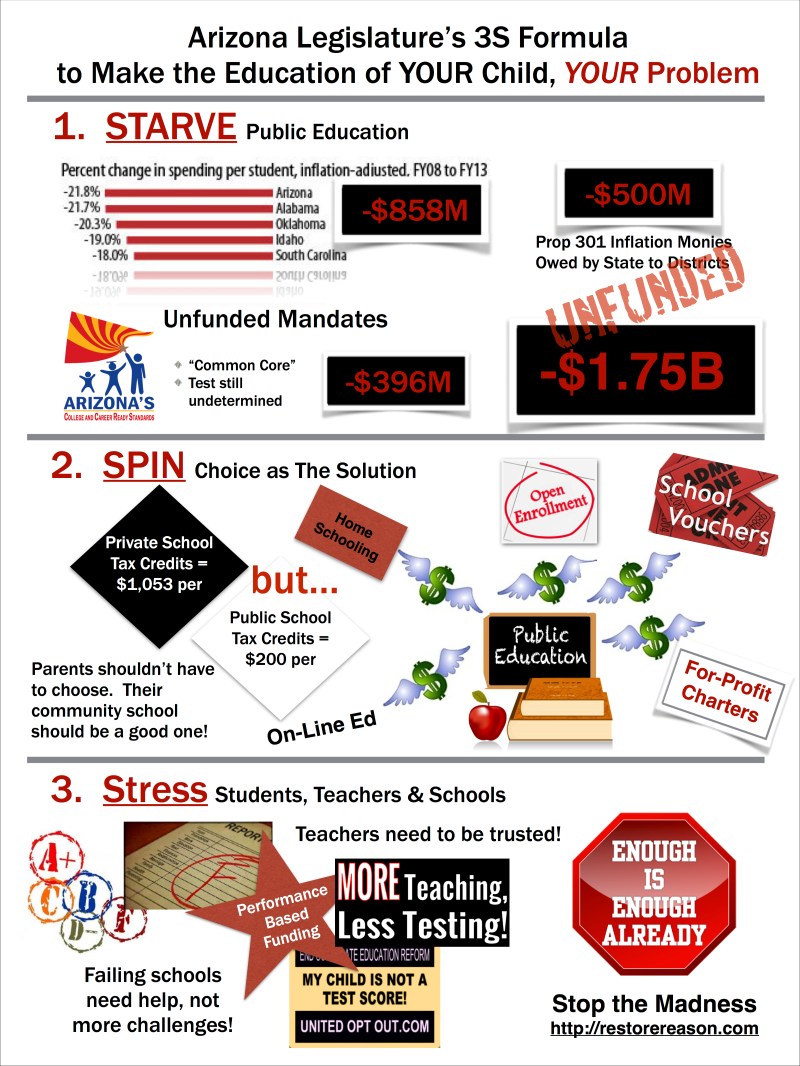
Arizona Legislature’s 3S Formula to Make the Education of Your Child, YOUR Problem
Somewhat unbelievable, but reason prevailed today in Arizona. Against all odds, the latest grand attempt to expand vouchers failed 31 to 27. HB2291, as amended, would have expanded eligibility for vouchers to any student living within qualified zip codes (as defined by the average household income is below 185% of the federal poverty level for a family of four) regardless of family income. If passed and signed into law by the Governor, this bill would have expanded eligibility to 112,000 and exponentially increased costs for the program.
I watched a live feed of the Arizona House Committee of the Whole discuss this bill, HB 2291, Empowerment Scholarships Accounts; Expansion, sponsored by Rep Debbie Lesko (R). Some great points were made on the part of those against the bill and the same Rep. Ontondo (D), a former teacher said that in her legislative district, there are people who earn $300,000 and others who make $15,000. If you average this out, she said, it probably is about 40,000 so those who don’t need the “vouchers” to afford the private schools will get taxpayer dollars anyway. She also expressed the concern about the lack of transparency and oversight and referred to the fact that 21% of the ESA funding has been banked by parents and therefore not used for the education of their children. She said that taxpayers deserve to know how their dollars are being spent. Another representative (D) said that if we want great outcomes, we need to keep money in public education and stop choking our public schools. Another (D) said we’ve had choice in Arizona since the early 1990s and what has it done to improve our public education. If we can’t get everyone a voucher, we shouldn’t be doing it.
Rep Hale (D), from the Navajo Nation, asked Rep Lesko (the AZ Chair for the American Legislative Exchange Council, or ALEC) several questions to subtly make his points. The first was whether she was aware of the income levels on the Navajo Nation and whether she knows how many private schools there are on the Navajo Nation. She said she did not know the answer to his questions. He replied that there are no private schools. She said ESAs don’t only offer funding for private schools, but for on-line learning or tutoring as well. He then asked if she was aware of how few people had access to the Internet on the Navajo Nation and she said she was not. I was impressed with how he led her down the path to divulging how ignorant she was about some of the state’s most needy children.
Rep Wheeler (D) provided information about the funding issues of this bill. He said recent changes to ESAs ensure funding at 90% of charter versus public, to the amount of $1007 per pupil more. He said that under the current basic state funding, a non-disabled student gets $5,400 as opposed to $5,800 per student (90% of $6,400 for vouchers.) This alone, according to the AZ Joint Budget Legislative Committee (JBLC), will increase costs of this program by $950K this fiscal year. He also said that if there were 600K students on ESAs, it would cost $3.6B and if there were 800K, it would cost $4.8B. Currently he said, there are 150K students eligible. With this bill, and addition of free or reduced, the increase in 2017 would be by 485K and cost another $2.19B. He also said that the cap of 5,400 per year meant nothing as it could easily be raised.
In a surprise to me, Rep Goodale (R) said she voted no because 100K expansion is too much at this time for the ESA program to absorb.
Finally, I’m quickly becoming a fan of Rep Heather Carter. She is a Republican, but first of all, she is a rationale representative of the people and, a strong advocate for public education. She was an articulate advocate for public education today and made some great arguments. When Rep Kavanaugh (R) referred to the district charters as faux charters, she called him on it. She pointed out that the laws allowing districts to convert their schools to charters had been on the books for 20 years. If the districts followed the rules, why change the rules now? All Kavanaugh could say was that “the timing was suspect.” When the bill proponents praised charters, she pointed out it is the 20th anniversary of charters and how the AZ Legislature just voted to remove the option of charters from the toolbox of our school districts. She pointed out how this is entirely against the purported goal of offering competition to improve achievement. She also said that the choice policies not going to help rural districts if we don’t put local options of choice in place.
In explaining her vote, she said she supported ESA accounts the way they were originally marketed, which was to provide academic opportunities who had unmet needs in our public schools. She said there were good public policy reasons why certain students’ needs were not met and it was marketed that ESAs would save the state money. Recent changes to allow ESAs to get additional charter assistance however, changed all that and now, ESAs cost more. She eloquently discussed what choice means to her: the choice of whether to send her daughter to public, charter, or private school, or to home school her. What this bill was really talking about though, was putting the AZ public education budget on a debit card. She pointed out that we lead the country in choice policy and have had open enrollment since 1994. If parents really want to send their children to another school, they can do that. Choice is different than the funding issue. This bill confuses the dollars we spend in AZ with school choice. It is the job of the legislature to fund public schools and they need to do it!
The last speaker before the vote was Rep Lesko, the sponsor of the bill. She made one last-ditch effort to get her colleagues to support her bill, but her arguments just weren’t compelling. She said the bill gives low-income students the opportunity to improve their situation and yet, Rep Hale had already pointed out it won’t help those on the Navajo Nation. She pointed out that although the bill would make 112K students eligible, the current cap in only about 5,400 per year so what is everyone worried about? Rep Wheeler pointed out during the debate that the cap means nothing because it can always be raised. Lesko also claimed that the program will actually save over $3,000 per year per student, but as the AZ JLBC noted, costs are now higher for ESAs than for educating a student in public schools.
Yes, the bill was defeated today, but I’m not going to rest easy because it is crazy (okay, craziest) time at the AZ Legislature. In addition to Rep Mesnard (R) changing his vote for a likely reconsideration on HB2291, there are several other anti-public education bills working their way to the Governor’s office. Here’s a quick rundown:
People often ask me what the hell the AZ Legislature is thinking with regard to the actions they are taking against public education. I tell them they know exactly what they are thinking and doing. I believe they are out to destroy public education and turn over tax payer dollars for such to the privateers to expand their profits. We must remain vigilant and keep up the pressure. For our students, for our public schools, for our communities and for our future!
UGH! Right on the heels of my last post about why school vouchers are a bad idea, comes the Arizona Supreme Court ruling yesterday that private-school vouchers are legal. Okay, so there goes my belief that we had at least one sane decision making body in Phoenix! In fact, they ruled without comment, refusing to override a Court of Appeals decision which said empowerment scholarship accounts “do not run afoul of a state constitutional provision that bars public funds from being used to subsidize private and parochial schools since parents decide where the money goes, not state officials.
This logic reminds me of another disastrous Supreme Court (the real one) decision that rule corporations are people and allowed unprecedented influence in our electoral system by the über-wealthy. I mean really? Because parents decide where the money goes, my tax dollars can be used to pay for private or parochial schools? What happened to separation of church and state? Why even the Arizona constitution states it is illegal to use tax dollars for religious worship or instruction. In his ruling, appellate Judge Jon Thompson said nothing in the program amounts to the state providing funds for religious worship or instruction. He wrote: “The ESA students are pursuing a basic secondary education consistent with state standards, they are not pursuing a course of religious study.” Wow! That’s an amazing leap of faith (no pun intended) since lawmakers have continually fought any attempt to attach any kind of accountability to the ESAs and private and parochial schools already aren’t held to the same kind of accountability and transparency requirements as public schools. That’s like the US Supreme Court’s statement about Citizens United that they had no reason to believe declaring corporations people would adversely affect elections.
This latest court ruling now clears the way for legislation currently working its way through the full House that would boost eligibility to 800,000 students in Arizona. This, despite the fact that the Joint Legislative Budget Committee (JLBC) said this plan would cost more than the current budget ($12.5 million by 2019) for education because vouchers would be available to kindergartners who might otherwise have attended private schools anyway at parental expense.
I am livid! Why does a parent’s right to choose override my right to ensure my tax dollars are well spent and produce the right results? As a school board member, I am directly engaged in governance at the local level. Our Board meetings are open to the public and their comment is encouraged. Together, in a spirit of transparency and cooperation, we work to ensure our student’s best interests are paramount. When a child attends a private or parochial school on my taxpayer dime, I won’t know what he or she is being taught, how well he or she learned it, or what percentage of my money actually went directly to their education. In that the funding can also be used for curriculum, testing, tutors (without any certification), special needs services or therapies, or even seed money for college, there is zero accountability for ensuring the public’s interests are represented in ensuring a well-educated electorate. That is why the Arizona School Boards Association has strongly opposed vouchers and fought this court battle.
This is a bad decision which will produce bad results. It will most certainly do what proponents are intending for it to do – accelerate the death of our public schools, at the very least, accentuating a two-tiered system of haves and have-nots. And that, I believe, will lead to the eventual liquidation of our democracy. Don’t believe me? Just sit back, do nothing and watch the destruction.
Our state legislature has been busy introducing bills to redistribute taxpayer dollars designated for public education to private sources. At last count, there were seven bills (HB 2150, 2036, 2256, 2291 and SB 1236 and 1237) on voucher expansion including one “strike everything” bill (HB 2139) slipped in at the last second.
When vouchers (aka Empowerment Scholarship Accounts) were first introduced in 2011, only children with disabilities were eligible. That has now expanded to include children: who’s parent’s are in the armed forces, are a ward of the juvenile court, who attend a school or district assigned a D or F grade, are eligible to attend kindergarten, and who received a School Tuition Organization scholarship. This session, expansion efforts include those whose siblings receive ESAs, all first responder’s children and (HB 2291) children currently eligible for free or reduced lunch percent. HB 2291 also seeks to further raise the income threshold of those who qualify by 15 percent ever year going forward.
ESA funds can be used for curriculum, testing, private school tuition, tutors, special needs services or therapies, or even seed money for college. The program however, requires parents to waive their child’s right to a public education…a right that is guaranteed under the state constitution, in order to receive the benefits.
Vouchers are not about school choice, that’s just the smokescreen. They are about the redistribution of our taxpayer dollars from transparent, accountable, locally-led community public schools to private and religious schools not accountable to anyone. It is a zero-sum game. Every student who receives a voucher, pulls an average of $5,400 directly out of the budget from the public school he or she left. The vast majority of private schools cost more than what vouchers will provide and only those with means will be able to take advantage of them. Yes, that’s right. Those who don’t need the help will get it and those who are desperate for the help will just get more desperate, stuck in public schools starved for resources.
It should be no surprise to public education supporters that any attempt by pro-public education legislators to attach accountability amendments for these vouchers has been met with fierce resistance from the pro-privatization club. In fact, one bill was held rather than risk having it pass with accountability measures attached to it.
Over 85 percent of Arizona students still attend public schools. They shouldn’t have to make a choice. The state should take care of their fundamental responsibility to properly fund and support these community public schools so that every school is a good school. But then, this ideal isn’t just a political sound bite, nor is it a simple matter of just moving money around. Ensuring our public schools have what they need would take a concerted effort and great political will. Reminds me of a quote by James Freeman Clark: “a politician thinks of the net election, a statesman [leader] of the next generation.”
The Arizona House voted to expand Empowerment Scholarship Accounts (vouchers) again yesterday and just about every Representative felt compelled to explain their vote. Wait, could there have been a television reporter in the house? Why yes, there was. The votes were along party lines, and predictably, the Democrats spoke to the damage the voucher movement will continue to do to our public schools, where 84 percent of Arizona’s student still attend. Representative Hale, representing parts of the Navajo nation, spoke passionately about the unique challenges in educating children on the reservation and how taking educational funding away from them to give to areas where there are plenty of options is just wrong. On the Republican side, it was all about parental choice and that parents know best, but no discussion about increased transparency and accountability. Once again in fact, Representative Meyer’s amendment to HB2139 (a “strike everything bill”), was defeated although it merely would have ensured accountability for results when taxpayer dollars are diverted to private schools via the ESAs.
I was up at the AZ Capitol yesterday with a group of pro-public education supporters who rode the Bus4Ed sponsored by the Holt for AZ Senate Campaign. Several of the participants were dismayed at the arguments made by Republicans in support of the vouchers. One, a teacher in an accommodation school, couldn’t believe the non-sensical, hypocritical justifications made in favor of the vouchers.
Of course, the actions of the GOP in the AZ Legislature with regard to education don’t make sense only if you believe they are working to improve public education. If you are more realistic and understand the ALEC and corporate reformer driven privatization agenda for public education. One of the arguments for vouchers presented by a GOP representative was that “only 752 Arizona children were on ESAs at this time so what’s the big deal?” Well, the big deal is that we know from experience and from what is currently on the table that the end game for the AZ GOP it to make every child eligible for the vouchers. First, the expansion was for those students attending a school or district assigned a D or F grade, then all children who are eligible to attend kindergarten, then a child of a parent in the armed forces, a child who is a ward of the juvenile court, then a child who is the sibling of a current or previous voucher recipient. Then, there was the attempt to expand to all first responder’s children which eventually turned into include all those who are eligible for free or reduced lunch programs and finally, to all students in a Title 1 school. In Arizona, that number equals about 73% of our students, or about 900,000.
Vouchers are not about school choice, that’s just the smokescreen. They are about the redistribution of our taxpayer dollars to transparent, accountable, locally-led community public schools to private schools that are not accountable to anyone. It is a zero-sum game. The vast majority of private schools cost more than what the vouchers will provide and only those with means will be able to take advantage of them. Yes, that’s right. Those who don’t need the help will get it and those who are desperate for the help will just get more desperate, stuck in public schools starved for resources.
Nope, not referring to North Korea or Iran, but the American Legislative Exchange Council (ALEC), The Goldwater Institute and The Center for Arizona Policy led by Cathi Herrod. All of Arizona’s GOP legislators are or have recently been members of ALEC. Led by Representative Debbie Lesko, ALEC’s Arizona Chair, they have introduced no less than 20 ALEC model bills including those that:
SB1062, the so-called religious freedom (but really about state-sanctioned discrimination against gays and others) bill that Governor Brewer vetoed last week, was being pushed by Cathi Herrod and her Center for Arizona Policy. The veto was a fairly significant setback for Herrod, but don’t worry, she has plenty of other tricks up her sleeve. On next week’s House Education Committee agenda, is SB1237, which passed the Senate on a party line vote. This bill expands the amount of this private school voucher to include the charter school additional assistance weight as well as 90% of the base support level funding the student would have otherwise received if they had attend a school district. This is a significant dollar increase as the additional assistance amount is $1,684 for K-8 and $1,962 for high school.
This bill is totally about increasing the diversion of public school funding to unaccountable private schools. Not only is our GOP-led legislature taking orders from Cathi Herrod, but our State Superintendent of Public Instruction recently robocalled public school families to entice them to take state (taxpayer) funding to attend private schools. When questioned about this, Huppenthal retorted that he is “the Superintendent of Public Instruction, not of Public Schools.”
Vouchers, by any other name, is model ALEC legislation. “Wherever you see states expanding vouchers, charters, and other forms of privatization, wherever you see states lowering standards for entry into the teaching profession, wherever you see states opening up new opportunities for profit-making entities, wherever you see the expansion of for-profit online charter schools, you are likely to find legislation that echoes the ALEC model.”
It is important for people to understand that one can’t be pro community public schools while also being pro vouchers and school choice. Despite what the privatization advocates are touting, school choice, and the various methods for providing options (empowerment scholarship accounts [vouchers], student tuition organizations, etc.), do not generally produce better results, especially when comparing similar populations. In addition, this is a zero sum game. When money is taken from public schools and diverted to for-profit charters, private and parochial schools, it begins a downward spiral that is very difficult for public schools to recover from. In addition, open enrollment promotes competition over collaboration not just between schools, but also on the part of parents who act in the interest of their child without concern for all children.
The bottom line is that community public schools perform a huge public good. In many cases, they are the thread that binds communities together. They helped put America on the path to greatness and they are still where 85 percent of Arizona students are educated. We don’t talk about how fire and police departments should be run by like a business or compete with one another for their raw product. Public community schools should be treated no differently. They are entrusted with an awesome responsibility, staffed by dedicated professionals, take all children who come through their doors and work against all odds to achieve their mission. They need you on-board advocating for their success. Please contact the members of the House Education Committee prior to Monday, March 10th and tell them to fail SB1237. It is not in the best interest of our students or our state and will only serve to enrich those who would make profit on our public education dollars.
I traveled to Austin this past weekend for the first-ever #NPEConference. This organization was founded by Diane Ravitch, who is an education historian, educational policy analyst, was an Assistant Secretary of Education under President George H.W. Bush and is currently the nation’s number one advocate for public education.
The conference was awesome as Diane wasn’t the only education rock star in the house. Karen Lewis, President of the Chicago Teacher’s Union spoke openly and honestly on a variety of subjects. One of the statements she made was that “we are in dangerous times when the Chicago Tribune tells teachers to “shut up and sit down, schools are not a democracy!”
John Kuhn, the superintendent of the Perrin-Whitt Independent School District in Texas also spoke. He originally burst onto the national state a year ago at the national Save Our Schools rally in Washington, D.C. John spoke with an energy and passion that only comes from experience. He said that “anything that weakens the public schools in America weakens our Nation.” He also said that “public education is our trust fund and our nest egg.” Both of these speakers obviously spoke to the frustrations of the 400 conference attendees, but also gave hope that standing together, we can make a difference.
The only criticism I have of the conference is that too many interesting breakout sessions were scheduled at the same time. On Saturday, I attended sessions on “Educators Organizing Resistance”, “Framing Our Message”, and Education Blogger Network. I was especially impressed with a young African American woman, Sabrian Joy Stevens, who is the Executive Director of Integrity in Education. During one of the sessions, she said: “people complain to the void as if there is a justice fairy. We are the government and must take responsibility.”
On Sunday, we heard an expert panel discuss the Common Core Standards. Panel members included Randi Weingarten, President of the American Federation of Teachers and Mercedes Schneider, a Louisiana public school teacher and education activist who holds a PH.D in applied statistics and research methods. A very lively debate ensued on the part of all the panelists. Randi Weingarten pulled no punches when she said: “If we’re going to have a Pub Ed system, we need standards & sufficient support where every child can achieve.” She also said: “We HAVE to be about saving middle class & kid’s ability to achieve. That should be the REAL conversation.” Probably the most poignant comment for me though was: “We need to get cmty on our side to defeat big $.” Is #commoncore mostly distraction to take our eyes off prize? I agree with Randi. I think the corporate reformers are using #commoncore to divert us from the real problem; the liquidation of our democracy.
As a professional educator, Mercedes Schneider shared her frustration: “Common Core completely ignores my independent professional judgement – that’s my main problem with it.” Randi Weingarten finished off with: “The conversation needs to be about public ed and the ladder of opportunity that fights poverty.”
 It was obvious when Diane Ravitch entered the auditorium. She was immediately mobbed by people who wanted to meet her and get her to sign their copy of her book, Reign of Error. When Diane spoke, her main message was one of optimism. She said “we are going to win because everything corporate reformers are doing is failing. You can’t fail your way to success.” She also said “when there’s a race, it goes to the swift and strong, not the weak and needy. DOE is not supporting equity.” At the end of her speech, Diane said “be not afraid, be strong. Retired teachers must step up. Get political, get involved. Be there for the kids.” ll the panel members. Randi Weingarten said: “if we’re going to have a Public Education system, we need standards and sufficient support where every child can achieve. She also said: “We have to be about saving middle class and kid’s ability to achieve. That should be the real conversation” and “the conversation needs to be about public education and the ladder of opportunity that fights poverty. As a current educator, Mercedes Schneider said “Common Core completely ignores my independent professional judgement – that’s my main problem with it.” Paul Horton, teacher of history at the University of Chicago Lab School, said “schools are the incubators of public discourse and democracy.”
The final session I attended was a meeting of the Education Bloggers’ Network. Jonathan Pelto announced that the network currently consists of 123 bloggers, but they are looking to expand and were hoping to gain more folks contributing. There was a lot of energy in the room with all the bloggers who’ve been shedding light on the work that needs to be done to save public education. I hope to be one of those contributing to the cause.
I am so glad I attended this conference! I believe it was historic and represents a formalization of the movement to save locally controlled, community centered, public education. In fact, after the conference the NPE called on Congress to hold hearings about the over-testing of our K-12 students. I met numerous teachers, administrators, and advocates who only want the best for our students and our nation. I am honored to be a small part of this movement and look forward to supporting it however I can.
 It is no surprise Arizona Legislators continue to seek expansion of Empowerment Scholarship Accounts AKA, vouchers. The concept is model legislation for the American Legislative Exchange Council (ALEC) and has been introduced in numerous states around the country. ALEC is the organization corporations pay big bucks to belong to so they can work together to develop model legislation to hand state legislators for introduction in their respective states. ALEC claims it is non-partisan, but in 2012 it had only Democrat of 104 legislators in leadership positions. In fact, every Republican legislator in Arizona is currently, or was recently, a member of ALEC. The pipeline for the ALEC agenda in Arizona is the Goldwater Institute and Jonathan Butcher; Education Director from the Goldwater Institute is the “Private Chair” of ALEC’s Education Task Force. Mr. Butcher has been collaborating with Rep Debbie Lesko, R-Peoria, ALEC’s Arizona State Chairman to expand Education Savings Accounts in Arizona. Even the Arizona Superintendent of Public Instruction, John Huppenthal, has actively promoted this private voucher program with a robocall directing parents to a Goldwater Institute website to pull their kids out of public school and send them to private school on the taxpayer’s dime, with no accountability.
Empowerment Scholarship Accounts were first introduced in Arizona in 2011 as a workaround to the state’s Supreme Court decision in 2009 that state school-voucher programs were unconstitutional because they violate a ban against appropriating public money for private or religious schools. In Niehaus V. Huppenthal the Arizona Supreme Court determined ESAs were not the same as vouchers because the specified object of the ESA is the beneficiary families, not private or sectarian schools. This decision is under appeal by the Arizona School Board Association and others.
ESA funds can be used for curriculum, testing, private school tuition, tutors, special needs services or therapies, or even seed money for college. The program however, requires parents to waive their child’s right to a public education…a right that is guaranteed under the state constitution, in order to receive the benefits.
The original ESA bill, SB 1553, was signed into law April 12, 2011 and at that time, qualified students were only those eligible to received disability related services from a school district, or had been identified as disabled either by the school district or under federal guidelines. Since then, we’ve seen expansions or at least attempted expansions, every year. In 2012, the legislature attempted to expand the law with HB 2626, to include those attending a school or district that had been assigned a letter grade of D or F, previous recipient of a scholarship, child of a parent or guardian who is a member of the Armed Forces, child who is a ward of the court, or who has been identified as a gifted pupil. Governor Brewer vetoed this bill on April 4, 2012. In 2013, SB1363 was introduced to expand to all those categories above, and increased funding provided to 90% of the sum of the base support level and Additional Assistance if the student were attending a charter school. Governor Brewer signed this bill into law on June 20, 2013.
Now, in its 51st Legislative Session, the Arizona Legislature is working fast and furious to further expand the state’s voucher program. Here’s a list of what’s on the docket per the Arizona Legislature website:
| Bill | Purpose | Status |
| HB 2291 & SB1236 | Expands students eligible to those whose parents are police, fire, or EMT, as well as any child who has a sibling who is already receiving an ESA. Also extends eligibility to any student on free or reduced-price lunch programs and increases the household income threshold eligibility by 15% each year thereafter. Would make a potential 881,000 students, or 73 percent of the total public-school population, qualified for the ESA program. The program is currently capped at 5,500 students until 2019 (per Legislative Report 2/26 AZ Capitol Reports.) | House bill up for House vote 3/6/14. Senate bill waiting to get on Senate Rules Cmte agenda. |
| HB2150 | Allows children whose parents are an active-duty member of the armed forces to immediately enroll in a private school using vouchers and retain 25% of each voucher amount per student | Ready for a floor vote |
| HB 2139 | Expands eligibility to a sibling of a current or previous ESA recipient and those eligible to enroll in a program for preschool children with disabilities. | Passed by House Approp Cmte |
| SB1237 | Expands funding for ESAs to include the charter school additional assistance weight as well as 90% of the base support level funding the student would have otherwise received if they had attended a public school. Significant dollar increase, as the additional assistance amount is $1,684 for K-8 and $1,962 for high school. | Passed the Senate along party lines |
| HB2036 | Failed after Representative Eric Meyer added an amendment to the bill to require any student who uses the voucher to take the same assessment as public school students. Representatives Allen and Boyer specifically mentioned they were voting against the bill because the testing language was added to it. (per AEA) | Defeated in House Education Committee |
Pro-voucher folks argue that such programs level the playing field—low-income students can have the same educational options as their wealthier counterparts. In fact, they like to infer, if not outright state, that it is all about ensuring those low-income students are not stuck in bad schools. Really? Only 362 students in Arizona had ESAs in 2012, but 92 percent of ESA funds went to private schools, in many cases for children whose parents could afford the schools without the assistance. For students without special needs, the program provides from $3,000 to $3,500 a year. As this is not nearly sufficient to cover the cost of tuition to a private school (which can be as much as $10,000), the program is unlikely to benefit students from low-income families. Additionally, according to William J. Mathis, managing director at the National Education Policy Center, the best private schools often aren’t interested in participating in voucher programs, so voucher programs end up supporting lower quality alternatives. On top of all this, opponents of vouchers argue that the policy doesn’t improve educational outcomes or performance.
ESAs are really just another way for Arizona legislators to make the education of YOUR child, YOUR problem. After all, under the Arizona constitution, “The legislature shall enact such laws as shall provide for the establishment and maintenance of a general and uniform public school system.” This is one of the primary responsibilities of the state of Arizona. When state funding for educating is passed on to parents however, so will be the responsibility for that education. After all, when you make a choice where to send their children, it won’t be your legislator’s fault you made the wrong choice. Of course, ESAs are also good for those desiring to profit from the privatization of public education. For-profit companies now run most charter schools and the lack of transparency and public oversight of charters and private schools will ensure profits can be maximized without repercussion.
Make no mistake about it; this push for vouchers is not in the best interest of the majority of Arizonans. Over 85 percent of Arizona’s school children still attend public community schools. Each time a student leaves with a voucher, schools lose the funding they would otherwise have received. Yet their overhead costs—for things like salaries and infrastructure—don’t go decrease just because a handful of kids left. Jeremy Calles, the Kyrene School District chief financial officer, said “the state continues to use tax dollars and tax credits to make private school more affordable for the approximately 5 percent of the Arizona student population that makes the choice to attend those schools, while causing significant damage to the education of the 95 percent of students who are choosing to attend public schools.” Representative Eric Meyer added that supporting public education should be a priority of anyone at the Legislature who is interested in investing in the economic security of the state. “Legislation that undermines the public school system in our state is incredibly detrimental to our economic future,” Meyer said. “These vouchers use tax dollars to subsidize schools that are not subject to state testing standards. We need our kids in schools that can be held accountable for preparing them for the workforce. By starving public schools of resources, we are affecting the very foundation of our economy.”

Make no mistake about it, there is a full-blown war underway for public education funding.
Corporate reformers (who bill themselves as “education reformers”) are totally focused on their mission to access the over $600 Billion spent each year on educating America’s K-12 students. Forget about wanting improved outcomes for our students. The only improved outcomes corporate reformers are after is that of their profits and portfolios.
What public education advocates must realize is that this truly is a full-blown battle for the hearts and minds of parents and taxpayers. The corporate reformers have been clever. How else to describe their ability to sell “school choice” as something parents should want. Forget about expecting our state legislators to do their primary job of ensuring a quality public education for all. Forget about transparency, local control and concern for the common good. It’s survival of the fittest, dog eat dog, and every student for themselves. After all, as long as MY kid is taken care of, what does it matter?
Problem is, none of us lives in a bubble. We must rely on each other for a well-functioning, civil society. The purpose of education can’t be just to make a child college and career ready. Thomas Jefferson said: “Educate and inform the whole mass of the people… They are the only sure reliance for the preservation of our liberty.”
So ultimately, this is more than a war to save public education. It is really a battle to save our Nation. No, I am not overstating this. If we really want to continue to be self-governing, where each of us has say as well as a shot at the American Dream, we must win this war.
The Corporate Reformers are right…this is the civil rights issue of our time. But, their definition of the “this” is tied to school choice and that is absolutely the wrong focus. The real civil rights issue of our time is whether or not we believe EVERY child has the right to equal opportunity to succeed or, if we are going to only focus on those with the resources to buy the opportunity to succeed.
A commitment to public education is what made America the greatest nation on earth. Yes, we must win the hearts and minds and we must win this war.
RE: Senator Melvin SB 1062 “True liberty is where you are free to do what you want to do.”[i]
I am tired of radical right-wingers like Senator Melvin waiving the flag and touting liberty when I know he isn’t for my liberty. I

believe everyone has a right to life, liberty and the pursuit of happiness. That means I want my partner (of 12 years) and I to be able to marry in our state and enjoy equal rights.
We are volunteers in our community, pay our taxes and SaddleBrooke homeowner dues, and are both retired military members with 48 years of total service. We are proud Americans, registered Democrats, and fly our flag almost every single day. This act doesn’t define us as patriots, that lies in our hearts just as does our belief in individual liberties, the strength our diversity brings to our nation, and, the responsibility we all have for each other and the common good.
I don’t believe true liberty means you can do whatever you want. That leads to anarchy. True liberty means you may live your life the way you want as long as it doesn’t hurt others’ or infringe on their liberty. It may be politically convenient for Melvin to pursue his liberty and ignore mine, but it is not patriotic.
 Restore Reason