#YouPlusOne

It appears the Arizona Legislature finally has a budget for the coming year . The $9.58B package includes Governor Ducey’s $8 million tax cut for businesses (due to double to $16 million in FY 2018), but does not restore the KidsCare health care program for 30,000 low-income children. Arizona is the only state in the nation that does not provide this program for its poorer children, even though it would cost the state and its taxpayers…wait for it…NOTHING! The deal also doesn’t restore the $116 million in cuts made last year to K-12 funding and it doesn’t delay the move to current year funding for our Districts, originally slated to cost them $31 million. What it does, is provide funding to mitigate the cuts: 1) associated with the move to current year funding; 2) approved last year to district-sponsored charter schools (saving these schools $1.1 million); and 3) to smaller charter schools (that would have cost them about $6.5 million.) Finally, it eliminates a change that determines how certain schools qualify for new construction (which would have cost them funding.)

The Arizona Republic reported that “lawmakers heaped praise on House Appropriations Committee Chairman Justin Olson, R-Mesa, for brokering and agreement” that reversed cuts to public schools. Don’t know about you, but I see a recurring theme here and don’t think it is worth any praise. Our Republican-controlled Legislature makes a bunch of cuts to programs important to the majority of Arizonans so they can provide tax breaks to their corporate buddies. When the people get wind of it and complain, they restore some of the cuts and claim they are heroes for their hard work to restore the funding. Here’s an idea…how’s about you just don’t cut these programs in the first place? How’s about you realize the investment in education is the way forward to a brighter future for Arizona? How’s about you show you care more about children than corporations?

Unfortunately, we don’t get the government we need; we get the government we elect. Doug Ducey promised tax cuts every year, he was subsequently elected and is now doing what he promised. That’s the thing with elected officials, they generally do that which what keeps them in office. That’s why unless the voters of Arizona wake up and elect new representatives, we’ll see all these same cuts and more come back next legislative session. This despite the fact that Arizona is:

A 2008 report titled “Preparing for an Arizona of 10 Million People” prepared by ASU’s W.P. Carey School of Business, recognized how critical an investment education is:

“Yet, the acquisition of knowledge and skills is one of the most important factors for attaining economic prosperity in a knowledge-based economy. Without a quality education infrastructure in Arizona, the standard of living of Arizona residents may lag behind. Enrollments rising slightly faster than population growth, pressures resulting in increasing costs such as higher salaries for quality teachers, and catching up from the state’s low rate of investment will add to future costs.”

This report was written eight years ago and is even more salient today. Arizona’s GOP lawmakers act as if public education is a hungry beast that must be killed rather than a real investment in the future of our people and our state. It is abundantly clear that the only counter to this very wrong thinking is the power of the people with the votes they cast. If we want different results, we must take different actions. We can wail and gnash our teeth all we want, but until we elect candidates that are committed to the future of all our people and our state, we will continue to lead in all the wrong areas. How’s about this? In addition to ensuring you vote in November, promise to get one other new voter to cast their ballot for a better Arizona. Then do it. #YouPlusOne

Liars Figure and Figures Lie

The Office of Arizona Auditor General just released its 2015 “Dollars in the Classroom.” The report makes it clear that Arizona continues to struggle to adequately fund district schools while trying to stay consistent with classroom dollars and keep administrative costs below the national average.

The report also highlights the lower teacher salaries and larger classes which translate into fewer dollars for teaching and learning. But, what isn’t clear in the report is that the definition of “classroom” has changed. In last year’s budget, “classroom” was redefined as instruction, instructional support and student support. This change was made to more accurately reflect all the costs that go into classroom instruction, such as: physical and occupational therapists; reading and math intervention specialists; media specialists/librarians; counselors and social workers. The Auditor General’s Report doesn’t reflect that change for 2015.

Even so, the report shows school district classroom spending at 53.6%, whereas the AZ Superintendent of Public Instruction’s report shows charter school classroom spending at 50.8%. Likewise, a recent report showed that AZ charter schools spend more than twice the amount school districts do in administration (costing taxpayers an extra $128 million). Charter schools may be public schools, but they are not included for analysis in the Auditor General’s Dollars in the Classroom Report (surprise, surprise.)

Although Arizona spends less on administration than any other state and is far below the national average, it’s classroom spending continues to be low. There are multiple reasons for this such as: low-overall funding (48th in nation); students poorer than the national average who require additional support services (ELL instruction; meal assistance; tutoring; etc.); higher plant operation due to temperature extremes; higher costs per square footage due to aging and inadequate funding for maintenance; and higher transportation costs due to vast rural and remote areas.

Dr. Tim Ogle, Executive Director of the Arizona School Boards Association, writes that “We continue to stand by the fact that the “dollars in the classroom” measure is an outmoded way of benchmarking how Arizona supports student success. It does not describe effective use of dollars dedicated to teaching, learning and graduating students that are equipped with the skills to succeed in the real world. The real issue should be student achievement.”

Ah yes, but true achievement is hard to track, measure, and compile. True achievement is tracked by teachers in their classrooms, and parents in their homes. True achievement comes when the environment surrounding a student is conducive to learning, and when the adults at every stage of the process, are student focused.


Screw you, I’ve got mine

Now that it looks like the AZ Legislature will be successful in finally opening the floodgates on vouchers (empowerment scholarship accounts) for K-12 education, I’ve got some other ideas they should consider. After all, the Legislature has made it clear that taxpayers are the ones best equipped to decide where their tax dollars go and that transparency and accountability don’t matter. Other than quarterly reports on spending, there is virtually no accountability in the voucher program; students aren’t even required to test and private schools don’t need to report any kind of results so there is no way for taxpayers to determine if their tax dollars were well spent.

Since I don’t have any children or grandchildren, I’ve been thinking about how I can take advantage of the Legislature’s privatization fixation. My first idea is one of safety and security. We don’t live in an incorporated township, so we rely on the county sheriff’s department to ensure our safety and security. The service provided is adequate, but I really think I can do better by looking to a private security firm to meet my needs. After all, surely a private security firm can do a better job right? That Blackwater firm was just an anomaly, right? So, I’m not sure what percentage of my tax dollars support the county sheriff’s office, but I want the state to give that back to me and I’ll hire my own guys. I’ll probably have to pay extra for the private solution, but it will be worth it.

While I’m at it, think I’ll look at the taxes I pay for maintenance of roads. After all, what do I care about roads in other parts of the state? I want the roads I drive each and every day to be in pristine condition. Maybe the state should just turn every road into a toll road and then I would only pay for those roads on which I drive. What? There would be many cases where there isn’t enough traffic to support maintenance of roads in remote areas? Too bad, so sad, not my problem.

Oh, and I live within a half mile of a fire department so I don’t think I should have to pay as much in taxes as those who live further away. After all, if there is a fire at my house, the department will save money in fuel and travel time to deal with it.

Obviously, I provide the above to make a point. When did we descend into this “screw you, I’ve got mine” mentality? No matter what proponents claim, vouchers are NOT the solution for the vast majority of Arizona’s children. What they are, is a way to: 1) redistribute our tax dollars from the greater good to those who LEAST need the help; 2) bolster the private education industry and; 3) relieve the state Legislature of the responsibility for ensuring and providing for education. The two major jobs of the state are to provide for public safety and public education. Once these voucher bills pass, legislators will no doubt feel they can wash their hands of the responsibility to “provide for the establishment and maintenance of a general and uniform public school system.” Truth is, they will have just done the very thing that drives a stake in the heart of their ability to ensure a “uniform” system.

Make no mistake; this is NOT about providing parents a choice. What it is about, and has always been about, is the corporate “reform” of public education or in other words, taking the “public” out of public education. Vouchers are also not ensuring the best for ALL our students. With every student exits their district school on a voucher, the fixed costs of running that district must be born by a smaller budget, which means the students left in are increasingly short-changed. The nature of the beast is that these students will invariably be those with the most challenges such as English Language Learners, special needs students, or just those lowest on the socio-economic ladder. Unlike district and charter schools, private schools can choose whom they wish to admit. They also don’t provide transportation and their tuition commonly exceeds the $5,200 parents receive with the voucher. It is not hard to see why many of Arizona’s parents will continue to choose to send their children to their community district schools and yet, these schools will increasingly be abandoned in terms of state support.

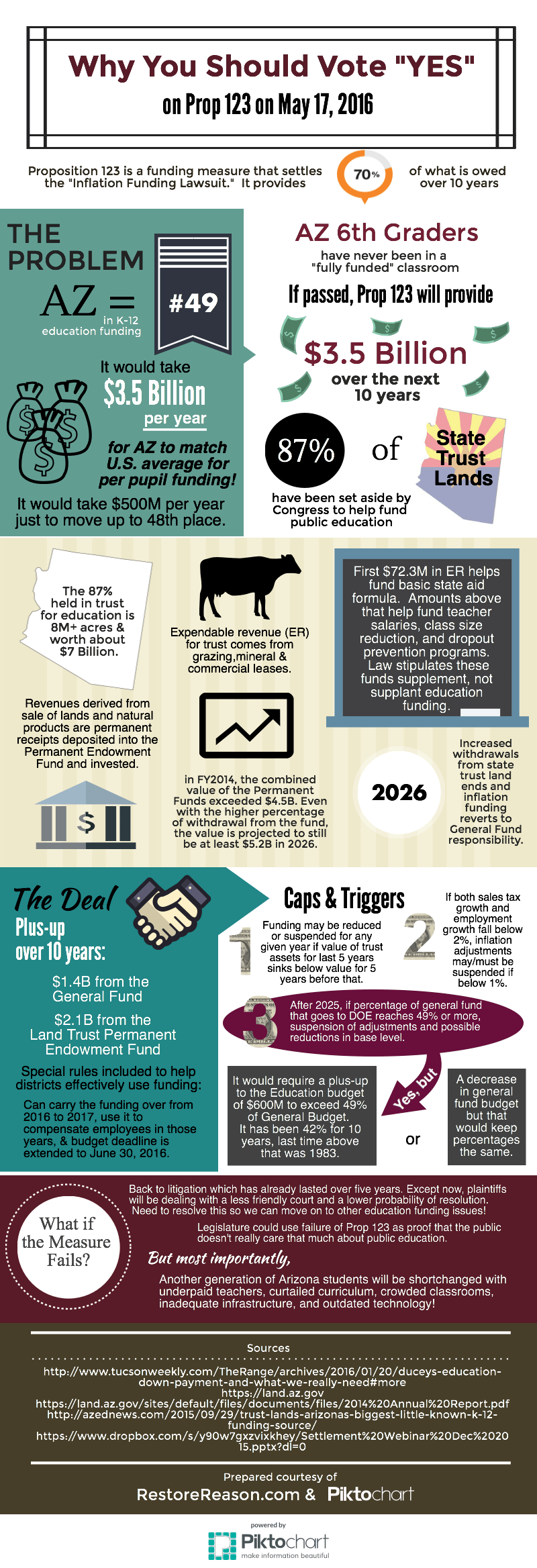
I’ve made it known that I am for the approval of Prop. 123 to get more funding into our schools now! Is it the way I would want to do it? NO!! I want to Arizona to stop giving corporate handouts and if necessary, to raise taxes to fund the type of schools our students needs for the future we all want. After all, Arizonans largely support this. If this opening of the floodgates on vouchers passes though, I may have to rethink my position. It is bad enough that the Legislature has thumbed it’s nose at the will of the voters, the decisions of the court and has finally agreed to pay our schools only 70 percent of what they owe with money that is already technically theirs. I can’t stomach the thought of this money getting siphoned off by those who could largely afford to go to private schools without the voucher money.

If you agree, you can’t just sit silently by and let this happen. If you want things to be different, you MUST ACT. Call your legislator, send them an email and make comments in the Legislature’s “Request to Speak” program. If you aren’t signed up for the program, please email me and I’ll personally go to the Capitol and sign you up (you must be signed up through the kiosk at the Capitol to be able to actually comment on bills.) Then you can, from the comfort of your home, tell the Legislature just what you think about the bills they are considering and, your comments will become part of the permanent record.

Ultimately though, the only long-term solution is to elect pro-public education legislators to replace those who aren’t acting in our students’ or our state’s best interest. Please ACT NOW. Our kids are counting on you and they can’t wait any longer for us to come to their rescue.


AZ again at bottom in “50 States Report”

The Network for Public Education (NPE), a public education advocacy group headed by the Nation’s preeminent public education expert and advocate, Diane Ravitch, released their “A 50 State Report Card” today. As the name indicates, the report card grades the 50 states and the District of Columbia on six criteria: No High Stakes Testing, Professionalization of Teaching, Resistance to Privatization, School Finance, Spend Taxpayer Resources Wisely, and Chance for Success. Letter grades from “A” to “F” were then averaged to create the overall GPA and letter grade for each state.

I was proud to note the study was conducted with the help of Francesca Lopez, Ph.D. and her student research team at the University of Arizona. They assisted in the identification of 29 measurable factors that guided the ratings of the six criteria and created a 0-4 scale for ratings and then evaluated each state on the 29 factors. The graders were tough, with only 5 states earning an “A” grade and no state’s overall grade exceeding a “C.”

Not surprising to anyone who keeps up with Arizona public education, the state ranked 48th, but I assume only because Arizona begins with an “A.”   Arizona’s grade of 0.67 earned it an overall “F”, numerically tying it with Idaho and Texas (in 49th and 50th place), just above Mississippi.

The first criterion evaluated was “High Stakes Testing” which according to NPE has caused “the narrowing of the curriculum and excessive classroom time devoted to preparing for tests.” The organization also points to peer-reviewed studies highlighting “the potentially negative impacts of this practice, including the dismissal of quality teachers and the undermining of morale.” Five states received an “A” grade for their rejection of the use of exit exams to determine high school graduation, the use of test results to determine student promotion, and educator evaluation systems that include test results. Arizona received a grade of “C” in this area.

The second criterion evaluated was “Professionalization of Teaching”, because “many of the current popular American reforms give lip service to the professionalization of teaching while displaying an appalling lack of understanding of what professionalization truly means.” NPE points to research that “shows that experience matters and leads to better student outcomes, including increased learning, better attendance and fewer disciplinary referrals.” High grades were given to states that exhibited a commitment to teaching as a profession. Unfortunately, no states were awarded an “A” in this area and only two states, Iowa and New York received a “B.” Arizona received a grade of “F” which goes a long way towards explaining our state’s critical shortage of teachers.

In the area of “Resistance to Privatization”, seven states received an “A” grade. The evaluation of this criterion was centered on school choice policies that “move control of schools from democratic, local control to private control.” Market-based approaches (vouchers, charters and parent trigger laws) reports NPE, “take the governance of schools out of the hands of democratically elected officials and the local communities they serve, and place it in the hands of a few individuals – often elites or corporations with no connections to the community.” Such policies drain resources from neighborhood schools and don’t overall, produce better results in general. NPE writes “they also serve to undermine the public’s willingness to invest in the education of all children while creating wider inequities across the system as a whole.” Since NPE believes in strengthening community schools, they evaluated states on whether they have laws, policies and practices that support and protect their neighborhood schools. As an early leader in school choice, Arizona more than earned the “F” grade it was awarded.

Since the level of poverty in a school is the single best predictor of average student performance, “School Finance” was another criterion evaluated. NPE looked at whether states adequately and fairly funded their schools noting that “resources like smaller class sizes and more support staff lead to significantly higher achievement and graduation rates – especially for poor and minority students.” Only one state, New Jersey, received an “A” grade in this area. This is not surprising since in the past decade, the gap in spending between rich and poor districts has grown by 44%. NPE calls for states to sufficiently fund public education and implement progressive financial polices that “provide the most funds to districts that demonstrate the greatest need.” The factors used to determine a state’s grade were: per-pupil expenditure adjusted for poverty, wages and district size/density; resources spent on education in relation to the state’s ability to pay based on gross product; and increased proportion of aid given to high-poverty districts than to low-poverty. Once again, Arizona received an “F” grade in this area.

In evaluating the criterion of “Spend Taxpayer Resources Wisely”, NPE looked at how states’ education dollars are spent. As research shows the significant benefit of early childhood education, high quality pre-school and all-day Kindergarten were a significant factor in the evaluation as were lower class sizes and the rejection of virtual schools.   In this area, Arizona received a “D” grade, with no states receiving an “A” and only Montana receiving a “B” grade.

“Chance for Success” was the final criterion evaluated. It looked at state policies directly affecting the income, living conditions and support received by students and their parents/guardians. NPE says that residential segregation is largely responsible for school segregation. However, the organization says, “state policies that promote school choice typically exacerbate segregation and charters often isolate students by race and class.” The states that had fewer students living in or near poverty, and have the most integrated schools received the highest grades. No states received an “A” grade, but 10 received a grade of “B.” In this final area, Arizona received a grade of “D.”

It can be no coincidence that Arizona continues to finish last, or close to last, in the vast majority of every report on state public education performance. In fact, the only report I’ve found it to be rated better than at the bottom is from the American Legislative Exchange Council’s (ALEC) Report Card on American Education. Not surprising from this highly conservative “bill mill” for the Koch Brothers and the GOP, which works to develop model legislation favorable to its corporate members and provide it to legislators for implementation in their states. It speaks volumes about ALEC’s focus when even though Arizona ranked 47th on the 2013 National Assessment of Educational Progress (NAEP), they gave the state an overall B- on education policy. That’s because ALEC values states’ support of charter schools, embrace of home schools and private school choice programs, teacher quality (as defined by the National Council on Teacher Quality) and digital learning. For the most part, the positions ALEC takes on education policy are the exact opposite of NPE’s positions. ALEC pushes school choice and the privatization of public education and in Arizona, the Goldwater Institute does it’s part to support ALEC in it’s efforts to kill public education. What’s in it for ALEC, the Goldwater Institute, their legislators, donors and corporate members? As is often the case, it’s all about money in the form of campaign donations for legislators, profits for those in the for-profit charter and private school business, increased tax breaks for donors and welfare for corporate members. You might ask how privatizing education can lead to increased corporate welfare when such privatization will undoubtedly lead to increased costs? (Think privatization of prisons.) Easy, when the state’s cost for “public” education is passed on to those taking advantage of the privatized option via vouchers and charters. It is well known that both often cost more than the state provided funding covers and parents must pick up the tab.

I attended the first NPE Conference held in 2013 in Austin, Texas where I was privileged to meet and hear Diane and numerous other leaders in the effort to save public education. I, like them, believe (as Diane writes in the NPE report) “educating all children is a civil responsibility, not a consumer good.” And although the phrase “civil rights issue of our time” is way overused, I deeply believe it rings true when, (as Diane writes) it refers to “sustaining our system of free, equitable and democratically-controlled public schools that serve all children.”  I’ve quoted him before, but John Dewey’s words bear repeating until we, as a nation “get it”: “What the best and wisest parent wants for his child, that must we want for all the children of the community. Anything less is unlovely, and left unchecked, destroys our democracy.” Yes, we should act on public education as our very democracy is at stake, because it is!

A Tale of Two States

As a kid, one of my favorite authors was Charles Dickens. In his 1859 novel, A Tale of Two Cities, he “depicts the plight of the French peasantry demoralized by the French aristocracy in the years leading up to the revolution.” Hmm, peasantry demoralized by the aristocracy…that reminds me of something…wait, I’ll think of it. Maybe, it is the fact that the 62 richest people in the world now own more than the poorest half? In fact, their wealth has increased 44% since 2010 while the bottom half’s has dropped by 41%. And in the U.S., the wealth inequity is now worse than at any time since the Great Depression. The Walton family alone owns more wealth than 42% of American families combined and CEO-to-worker pay-ratio is 354-to-1. Americans haven’t taken to the streets with pitchforks (the “Occupy” movement aside) to demand “off with their heads” yet because for the most part, they still believe in the American Dream. That is if one works hard enough, they can move up the economic ladder. The truth is more like comedian George Carlin joked: “the reason they call it the American Dream is because you have to be asleep to believe it.”

Although reference to the concept of the American Dream was made as early as the 1600s by those who came to America from England for the chance of a better life, it was most likely “codified” in the Declaration of Independence, which proclaims that “all men are created equal” with the right to “Life, Liberty and the pursuit of Happiness.” Part of this right and critical to achieving the dream are the opportunities to receive a good education and work that provides at least a living wage. But, the game is now stacked. Stacked in favor of the wealthy, stacked in favor of corporations, stacked against the middle class who is increasingly squeezed, and stacked against children who don’t come from a family of means.

Of course, everyone has a different idea about how to “unstack” the deck. In fact, as I mentioned earlier, some don’t even see the deck as unfairly stacked. I am firmly in the “”deck is stacked” camp and believe if we don’t start to make progress at turning the tide, pitchforks may be in our future. In Arizona, Governor Ducey thinks the way to move our economy forward is vouchers and charter schools, no individual state income tax and very little tax on the corporate side, and oh yeah, the “sharing economy.” Really, a “sharing economy”? Could it be that Ducey and I agree on something? I mean, I think it would be great if we would all share equally in our economy. After all, when Arizona’s top 1% pays only 4.6% of their income in state and local taxes while the bottom 20% pays 12.5%, we could really use some sharing. What you say? He was referring to “sharing” type businesses like Über and Lyft where the services are cheap and convenient, but the workers have no rights or benefits? Oh, okay, that sounds more like current Arizona leadership.

Just for kicks, let’s look at another state’s version of the way forward. Interestingly, Massachusetts has almost exactly the same population as Arizona, 6.8 million. Both states also have the Tea Party in common although with Massachusetts, it is mostly in their past (as in Boston in 1772) and in Arizona it is very much in the present.

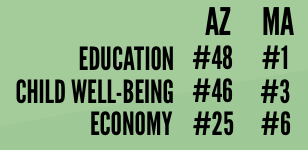
Politically, Arizona is GOP led with no statewide Democratic leaders and both the state senate and house under GOP control. Massachusetts conversely, is almost entirely led by Democrats with the exception of their governor who is a Republican. Given the political parties’ priorities, it should be no surprise then that MAZ vs MAassachusetts ranks much better in education and child well being than Arizona. What may surprise some though, is that while Arizona’s economy ranks 25th in the Nation, Massachusetts’ comes in at #6.  

Why might you ask? Well, I have a few theories and as you can imagine, the state’s prioritization of public education is at the top of my list. Take Career Technical Education (CTE) for example. It produces significantly higher graduation rates than traditional district high school programs, often provides living wage jobs to graduates, and helps provide skilled workers for the employers who so badly need them. It is, by all accounts, a win-win-win. Massachusetts Governor Charlie Baker obviously gets this as indicated by his recent proposal to add an additional $83.5M for vocational education.   Included in this is a $75 million five-year capital program to finance grants for school equipment and expansion an additional $8.5 million for grants for “school-to-career connecting activities.

At the same time, we have Governor Ducey objecting to restoring the $29 million in cuts to CTE made in last year’s budget. Instead of embracing the AZ Legislature’s veto-proof coalition to restore the funding, Ducey wants to only restore one-third of the funding for only three years and, attach a variety of strings to the money including a requirement for business matching of the funds. This despite a plea for repeal of the cuts signed by 32 business and education leaders as to the importance of CTE.

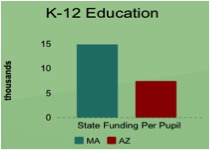
Maybe Governor Baker just had better advice than Governor Ducey. Tim Murray, a regional chamber of commerce president who toured 64 votech and agriculture education programs when he was the Lieutenant Governor of Massachusetts, said “the single biggest need” of the business community “regardless of the size of the company, regardless of the sector” is a “pipeline” of available workers. Surveys of 352 employers and 475 parents recently conducted by The Dukakis Center in Massachusetts revealed that 90% of employers see a need to increase CTE graduates, while 96% of parents had a favorable opinion of the CTE programs they children attend.K-12 az ma

But wait, there’s more. I believe one of the best determinants of the value someone or an entity places on something is what they are willing to pay for it. Massachusetts obviously values education. I know there are those of you ready to say: “there are plenty of examples of more money not producing better results.” Yes, that is true. But in almost every case, I’d be willing to bet where money doesn’t help, there are significant social issues outside of the schools that keep students from learning and achieving. It is obvious, by Massachusetts’ #1 ranking in education achievement, that their money is well spent.

Of course, as mentioned earlier, we know there are factors outside of the school that determine how children do in school. Massachusetts has lower unemployment, their residents earn higher salaries and they are less likely due to lose their homes to foreclosure. Their residents are also better educated, safer, and healthier. They also have fewer disabilities, likely from the better health care they experience. It should be no surprise that Arizona also has four times the adults in state prison as does Massachusetts, spending hundreds of millions more in this area. Yet, Arizonans are no safer with over double the murder rate.

Some claim that Massachusetts is more successful in some areas because society is more homogenous with 74.3% of its residents being white as opposed to only 56.2% in Arizona. There may be some truth to that since unfortunately in the U.S. today, socioeconomic status often has to do with the color of one’s skin. But, Arizona is doing little to address this issue even though our state’s share of white K-12 students dropped below 50% in 2004 and Latin@s K-12 students are on the cusp of breaking 50%. One example of this blind eye toward the problem is new HB 2401 sponsored by Vince Leach-R SaddleBrooke. The bill, titled “Schools; Desegregation Funding; Phase-Down” phases out funding for desegregation expenses, a cut of about $211 million dollars. These funds will hit some of our most vulnerable children, about 22,500 English Language Learners (ELL) and leave high performing magnet schools, such as Phoenix Union’s Metro Tech High School, without their primary source of funding. It is in two words, extremely shortsighted. Learning English is critical to these student’s future success and by extension, that of our state. They will either be contributing members of our society or drains on it. This is a clear example of “you can pay me now, or you can pay me later.”

So let’s recap. Massachusetts performs better than Arizona in education, child welfare, health and safety, the economy and many other areas. Yes, taxes are a little higher ($1,706 per person in 2013), but look what you get for your money! I’m well aware of course that this line of reasoning will fall on many a deaf ear that think the only good government is a starved one. It can’t be said enough though that taxes are not bad or good, they are the price of living in a well-functioning society with a decent quality of life. There are many things such as education for all and safety that are best provided by the government. It our duty (the voters) to determine our priorities for our hard earned tax dollars and then elect candidates that will ensure those priorities are provided for and secured. That is how we keep ourselves free.


Top Five – Discouraged but Hopeful

So hopefully you already read my Bottom Five – Discouraged but Hopeful, here’s the rest of the story. First, the rest of what gets me really discouraged:

5.  The Legislature seems intent on killing the CTE/JTED, a critical program for our state. Career and Technical Education (CTE) offered by Joint Technical Education Districts (JTED), includes a variety of “votech” programs for which students earn high school credit, and in some cases, may earn college credit, industry certifications, and/or a state license through combination of hands-on training and classroom instruction. Since 2011, the Arizona Legislature has cut CTE funding by more than 53%. Some $30 million will leave the program next year and Districts will also take a 7.5% cut to their per-pupil funding for their students who participate. These cuts are stupid for Arizona! As I’ve previously written, CTE is a win-win-win. It has proven to decrease dropouts by as much as 72% and the Alliance for Excellent Education estimates that “if half of Arizona’s 24,700 high school dropouts in 2010 had instead graduated from high school, the economic impact on Arizona would include $91 million in increased earnings and $7 million in increased state tax revenue.” The Phoenix Business Journal also made a great case for CTE: “By destroying one of Arizona’s most successful education initiatives – one with real economic returns – the state will not be able to provide the skilled workforce that companies demand before they relocate or expand operations here. That means we can expect reduced workforce development, fewer young people escaping poverty and achieving economic independence, and higher social services costs.” There is still time to help. Please click here to sign a petition to restore CTE/JTED funding.

4.  Arizona’s teacher shortage. Actually, Arizona doesn’t have as much a teacher shortage as it has a shortage of certified professionals willing to work for salaries that won’t pay the bills. As of December of last year (according to the AZ Daily Star), 84 districts in Arizona had more than 1,200 teaching position open and 700 of those occurred during this school year. The state also had at least 1,000 vacant teacher positions to fill before the start of the current school year. The Arizona Educator Recruitment & Retention Task Force reported in January 2015 that there is a 7% decrease in teacher prep program enrollment, that Arizona loses 24% of first year and 20% of second year teachers and that 24% of the current education workforce is eligible to retire within the next four years. We have a huge problem that is only going to get worse and I haven’t even mentioned the school administrator shortage that is right around the corner.

3.  Proposition 123. Okay, so earlier I said I had hope because a settlement was reached in the inflation-funding lawsuit. Unfortunately, we are a long way from actually getting the requisite funding to our schools. First, the voters must approve it in a special election on May 17th  and those against the settlement filed almost 50 statements in opposition. There is also the matter that the state Treasurer is against the deal but he hasn’t been able to get much traction on his fight. That fact, combined with the $1.75 million proponents have raised to sell the prop to the public will probably carry the day. I do though, worry about the long-term impact to education funding and, I don’t really don’t like Governor Ducey and his buddies claiming a victory on this one. An example is Ducey’s “hay making” tweet on December 30, 2015:

ducey tweet


Sorry Guv, but no, you really just paid 70% of what the people mandated and the courts adjudicated and technically, you are paying the schools with their own money. You’ll be “shifting the trend line upward” when you plus up the K-12 public education budget this year. After all, its not like we don’t have the money. Arizona realized $150.5 million more revenue than expected in October and November of 2015 after ending the fiscal year with $266 million more in the bank than expected. Add that to a $460 million in the state’s rainy day fund and you’re starting to talk real money. And, Arizona voters are pretty clear about what they want done with that money. A recent poll of Arizona voters showed 72% believe investing in public schools should be a priority for this surplus. If the Legislature and Governor were listening to the citizens of Arizona (who are the “boss of them”), they would give some of this funding to public education and truly begin to reverse the trend, instead of following the abysmal fiscal example of Governor Brownback in Kansas by reducing taxes and giving more corporate handouts.

2.  Voting records of our legislature when it comes to support for public education. I already talked about this in a previous post but it bears repeating. The bottom line is that on average, Arizona’s Democratic legislators scored 48 percentage points higher for voting in accord with ASBA’s position, than the Republicans. There are of course, anomalies, but it is clear that in general, the GOP-led legislature is anti-public education. Want support for public education? Vote more pro-public education candidates into office. Some suggestions of those running for the first time are: Jesus Rubalcava running in LD4, Courtney Frogge in LD10, Corin Hammond in LD11, and Larry Herrera in LD20. I’m sure there are many more but I know all these individuals personally and they are young up and comers…just what we need to lead Arizona forward.

1.  ALEC’s influence on Arizona legislation, especially where it affects public education. The American Legislative Exchange Council’s (ALEC) agenda to privatize public education includes the promotion of charter schools (corporate charters and virtual schools specifically), private school vouchers, anti-union measures, “parent trigger” laws, increasing testing, reducing or eliminating the power of local school boards and limiting the power of public school districts. Anyone tuned into Arizona education or politics knows that ALEC has also had significant influence in our state. The Goldwater Institute acts, as ALEC’s “Mini-Me” in Arizona and AZ Senator Debbie Lesko, as the AZ ALEC chair, has been the organization’s chief water carrier. Half of our state Senators and one-third of our representatives are known members of ALEC and there may be more.  Corporations fund their trips to ALEC Conference where model legislation is handed out for Legislators to take back to their states for implementation. The organization awarded Arizona a “B-” grade in education policy for 2015. The state’s charter school laws and school choice programs were awarded “A” grades, teacher quality and policies were graded “C-.” This most certainly means we’ll see more ALEC-drafted bills coming down the pike.

Now, for what most gives me hope:

5.  Superintendent Douglas finally seems to be focusing on the education of our kids. It’s been a tough year for the Superintendent, much of it apparently of her own making. But, she went on not one, but two listening tours around the state and evidently, really listened. Her “AZ Kids Can’t Afford to Wait” plan is focused on how to make things better for Arizona’s students, much of it revolving around improving teacher support to include increased salaries. This report shows that at least she understands what needs to be done. She survived the attempt to recall her; time will tell whether she can lead real change.   Current leadership aside though, I share Representative Randy Friese’s question as to why the Superintendent of Public Instruction is an elected position. After all, Arizona is one of only 13 states where this is the case and, the position is basically just an administrator who is only one member on the state Board of Education which is responsible for exercising general supervision over and regulating the conduct of the public schools system. AZCentral.com reported this week that Representative Friese intends to introduce a bill to make the change.

4.  Christine Marsh, Arizona’s Teacher of the Year, is really, really impressive. She is poised, articulate, and passionate and when she talks about public education, she takes no prisoners. In a recent article published AZCentral.com, she said that giving each individual student an equal chance to succeed is the point of public school education.   She pointed out that over 26% of Arizona’s children live in poverty, 4% more than the national average. “People need to understand the impact of poverty on students…and when we discuss school funding, we need to understand the impact our decisions have on each student,” she said. “[We need to] make sure that our policies and funding formulas don’t contribute to the problems they are supposed to be helping.” It is clear this outstanding teacher won’t be shy about speaking “truth to power.” Of course, I’m sure Christine would be the first to say that there are many, many more teachers just like her out there. I’m hopeful because of all of the great teachers serving Arizona’s students and am so very grateful for their service.

3.  District schools are still the school of choice for 85% of Arizona’s students. Despite having open enrollment and charter schools since 1994 and Empowerment Scholarship Accounts (basically vouchers) since 2011, almost one million students still attend district schools. The primary reason is that district schools are community schools with locally elected leadership that is responsive to the needs of the community. Charter schools and voucher provided alternatives will never serve the majority of students, that’s just not realistic. As members of the more than 240 school boards govern to improve achievement for the almost one million students in their care, they work to ensure the bedrock of our democracy/republic, “an educated citizenry” according to Thomas Jefferson, is realized.

2.  Arizona’s education advocates are really getting their act together, literally! The Arizona School Boards Association (ASBA), the Arizona Education Association (AEA) and the Arizona Association of School Business Officials (AASBO) worked together to craft a palatable compromise to settle the inflation-funding lawsuit. I know many are not happy about the settlement, but these three organizations worked tirelessly for five years to get Arizona districts the funding they were due. Yes, it is only two-thirds of what was owed, but two-thirds is better than nothing and nothing was a distinct possibility. This is especially true with Governor Ducey’s appointment of Clint Bollick to the Arizona Supreme Court. Had this issue come before him, it most certainly would have died a quick death. Another public education advocate, Support Our Schools AZ (SOSAZ), saw its “Arizona Parent Network” grow wings and take flight. In October, the organization hosted the first-ever Education Excellence Expo at Salt River Fields with 26 districts from all over the state showing off the excellence in Arizona’s public schools.

1.  Maybe, just maybe, Arizona voters are waking up. 2015 saw some encouraging upticks in support for public education. In early March, two mothers sparked a day of peaceful protest at the state Capitol. Close to 1,000 parents, students, teachers, and community members showed up to protest Governor Ducey’s proposed education budget cuts. I was there, and it was exciting to be a part of a genuine grass-roots movement that helped bring education to the forefront. That renewed focus no doubt aided in the successful passage of so many bonds and overrides such as in Maricopa County, where 23 of 26 districts had successful ballot measures. Results elsewhere were not as good such as in Pinal County, where only half of the measures passed, but overall, the numbers were up and that bodes well for public education in general.

What this exercise made me realize is that I really am more optimistic than pessimistic about public education’s future. I had to work harder to come up with the “what’s discouraging” than “what gives me hope.” Maybe that’s who I am, or maybe, I just believe that ultimately, “good” wins. “Good” in public education is that which serves the majority of our children; that which recognizes each of them deserves equal opportunity to be the best they can be; and that which best serves our communities, our state and our nation.   I believe that “good” in public education is that which is transparent, accountable, and dedicated to helping each child achieve their full potential. Anything else is so very much less than good – it is just plain evil.
 

Bottom Five List – Discouraged but Hopeful

A recent article in The Atlantic magazine featured experts on K-12 education who offered their reasons for hope and despair with regard to education. It was an interesting read and prompted me to come up with my own list for Arizona. In this first of two posts, I share my “Bottom Five” list of what discourages me and what I’m hopeful about. First, what discourages me:

10. The extremely well funded efforts of the corporate “reformers.” Make no mistake about it, the effort by the corporate “reformers” to make sweeping changes to the Nation’s public education system is as much about making a profit as it is an interest in making a difference. The exact number is up for debate, but The Nation magazine says the American K-12 public education market is worth almost $800 billion. Now, everyone from basketball players to Turkish billionaires want a piece of the pie. It is no accident that the Koch brothers backed, corporate bill mill ALEC is pushing many of the reforms, and the technology magnates Bill Gates and Mark Zuckenberg are heavily involved in the “reforming.” All you have to do is follow the money and the intent becomes clear.

9.  The apathy of Arizona voters. I worked on three Arizona Legislative campaigns in the past few years and although I mostly enjoyed talking to voters, I was beyond dismayed when I learned that in 2014, not even half of the LD11 voters with mail-in ballots bothered to mail them in. These are people who are registered to vote and are on the Permanent Early Voters List (PEVL). They are mailed their ballots and can fill them out in the comfort of their home. They don’t even have to put a stamp on them, postage is pre-paid. These votes should have been the “low-hanging fruit.” Combined with the overall Arizona voter turnout of 27%, this is pathetic by anyone’s definition.

8.  The fact that Arizona leads in all the wrong metrics. Does Arizona care about children? Let me count the ways maybe not so much. According to the Annie E. Casey’s “Kids Count Databook”, Arizona ranks: 46th in overall child well-being, 42nd in economic well-being, 44th in education achievement, and 42nd in children’s health. The Databook also reports that 26% of Arizona’s children live in poverty, 4% more than the nationwide average. The personal finance website WalletHub reports much the same, ranking Arizona 49th for child welfare which shouldn’t surprise anyone given the dysfunction in our Department of Child Safety. I don’t know about you, but these statistics disgust me and should absolutely drive what our Legislature spends our taxpayer dollars on. It is about defining what kind of people we are, it is about helping those who can’t help themselves and it is about the future of our state.

7.  Some seem to think the path to success is to lower the bar. Even though there are people whose opinions I value that think Senator Sylvia Allen will do a good job as the Chair of the Senate Education Committee, I remain hopeful but have my doubts. Call me crazy, but I think the legislator with the most sway over what education bills see the light of day should actually have more than a high school education. Along those same lines, Arizona Representative Mark Finchem (LD11-Republican) evidently doesn’t think teaching experience is valuable for our county schools superintendents. He has already submitted House Bill 2003 for this legislative session, which seeks to delete the requirement for county schools superintendents to have a teaching certificate. Instead, it will require only a bachelor’s degree in any subject, or an associate’s degree in business, finance or accounting. I know some would ask why should county schools superintendents have certificates when the state superintendent of public instruction doesn’t require one. Well, I’d rather see us make it a condition of both jobs.

6.  The polarization of our county makes it seem impossible to come together to find real, workable solutions. I was recently speaking to a friend of mine who I’ve known for over 25 years. We started talking about education and he started railing about how all public schools do is waste money. He talked about the fancy new high school in his town that was built (in his opinion) much more ostentatious than necessary. “Why do the kids need that to learn” he asked? “Why not just give them a concrete box?” Really?? Where do I begin? Truth is, I didn’t even try because I knew he wouldn’t listen. He knew what he knew and no amount of fact was going to sway him.

But all is not lost and I am more optimistic than pessimistic about Arizona’s public education. Here’s what makes me hopeful:

10.  Across the Nation, more and more charter school scandals come to light every day highlighting the need for more transparency and accountability. I’m not glad there are charter school scandals, but I am glad the public are learning more about the dangers of a profit-making focus with inadequate oversight. That’s one of the reasons district schools have rules and controls; they are after all, dealing with taxpayer dollars. And oh by the way, it’s no longer just charter schools we need to watch. The continuous expansion of vouchers exponentially broadens the potential for abuse and requires the same kind of public oversight. There just is no magic pill to student achievement. It takes resources, dedicated professionals, and hard work. Short cuts in other words, don’t cut it.

9.  The fact that we still have dedicated professionals willing to teach in our district schools. Despite low pay, higher class sizes than the national average, insufficient supplies, inadequate facilities, and ever-changing mandates, Arizona still has close to 50,000 district teachers willing to be in our classrooms because they love the kids and they love their work. They are underappreciated and sometimes even vilified, but they know their work is important. Now, if only our Legislature acted like they knew this too.

8.  Recognition is growing that early childhood education is really important. Even Governor Ducey said in April 2015: “Research shows that a quality early childhood education experience can yield significant long-term benefits on overall development of a child. It’s the most profitable investment we can make in their future.” A recent review of 84 preschool programs showed an average of a third of a year of additional learning across language, reading and math skills. Preschool has also been shown to have as much as a seven-fold return on dollars spent over the life of the child. The public is starting to “get it” and support for preschool funding is growing.

7.  Speaking of Common Core, it seems to be working okay. Yes, I saw the recently released AzMERIT results, but we knew they would be low. That’s what happens when you raise the bar. Despite no additional funding or resources to implement Common Core (oops, I mean Arizona College and Career Standards), our districts made it happen and the numerous teachers and administrators I’ve talked to say our students are now learning more. Efforts are underway to determine what should be changed about the Arizona standards, but my guess is that they will be minor.

6.  If nothing else, the passage of the Every Student Succeeds Act (ESSA) saves us from the really bad legislation that was No Child Left Behind. Everything I’ve read about the new ESSA touts it an improvement over its predecessor. It reduces what some considered Federal overreach and provides states more flexibility in implementing their K-12 education programs. Which, oh by the way, makes me concerned our state legislature will look to relax requirements where it serves them, at the expense of those children who most need our help. At least now though, they won’t be able to blame everything on “the Feds”, to include whatever version of the Common Core standards we end up with.

Please stay tuned, still to come are the top five reasons I’m discouraged and hopeful.

We need leaders, not politicians

AZ Senate President Andy Biggs claims more funding doesn’t produce better educational outcomes and points to Washington D.C. as proof. Wow, way to deflect Andy. The truth is, places with high poverty, crime and unemployment often require high per pupil funding to try to deal with these various intersecting complications. We have those places in Arizona too. But, I’m not sure how a subpar return on investment in D.C. education excuses Arizona’s ranking for the lowest per pupil funding in the nation. I also don’t buy that more funding doesn’t make a difference.

Bruce D. Baker, a professor in the Department of Educational Theory, Policy, and Administration in the Graduate School of Education at Rutgers University, says we know the strategies that help close achievement gaps: lower class sizes, a broad curriculum, and the attraction and retention of highly qualified teachers. But, he says, “we can’t get there without stable, adequate, and equitable funding” and claims that approach to closing achievement gaps is “one we’ve never really tried.”[i] Too often, he says, promising efforts are abandoned after the next election cycle. Great sounding campaign promises after all, are much easier to make than real results are to deliver.

Governor Ducey and other Arizona GOP leadership claim they have solutions to provide additional education funding. But, tax increases are definitely not among them. Governor Ducey wants to take money from the sell of state trust lands to generate about $300 more per child. His plan, if approved by voters in 2016, would begin to help in 2017, but only for ten years and some fear it will draw down the trust land monies available for future use. Biggs and House Speaker David Gowan propose asking voters to shift funds from early childhood education programs to K-12 education. They claim that could generate an additional $500 per student on top of the $4,300 the state now provides.[ii]

I am open to learning more about Governor Ducey’s idea, but on the surface it seems like a quick fix that we’ll have to pay for over the long term. Tucson education blogger David Safier points out that Ducey’s roadmap for additional education funding has numerous winding roads with plenty of roadblocks built in.[iii] Let’s just say I don’t plan to hold my breath waiting for this idea to come to fruition. But, you have to admit; it does kind of make the Governor look like he really cares about helping Arizona’s K-12 school children.

As for shifting money from early childhood education programs to K-12, that is a dead on arrival idea for me. Arizona has already cut kindergarten funding in half requiring school districts to fund the other half “out of hide” if they want to provide full-day programs. The state provides zero funding for preschool, despite all the evident that shows it is absolutely critical to improving educational outcomes and success in life. Preschool has been shown results in adults with better jobs, less drug abuse and fewer arrests.[iv] In fact, children who attend preschool, are almost 50 percent less likely to end up in jail or prison by age 40. One researcher at the University of Minnesota said the average cost per child for 18 months of preschool in 2011 was $9,000, but his cost-benefit analysis suggested that led to at least $90,000 in benefits per child in terms of increased earnings, tax revenue, less criminal behavior, reduced mental health costs and other measures.[v] Or, put another way, when it comes to funding preschool, you can pay me now, or pay me later. And believe me, the interest is pretty steep.

As for the idea of going back to the voters to approve either of these plans, let’s just review recent history. The Arizona Legislature referred Proposition to the voters in 2001. The voters approved the proposition and the inflation funding that went with it. The Legislature indicated they understood the voter mandate when they initially appropriated the required funding, but when the recession hit in 2008, they decided to opt out of that pesky little part of the law. Now, the courts have told the Legislature that may not opt out and yet…wait for it….the Legislature still refuses to comply. This, despite a voter mandate, despite court orders, and despite surplus revenue.

Mr. Biggs claims that increased funding is not the answer, and asks “how much is enough?” To answer his question, I say I’m not sure, “but I’ll know it when I see it.” Well, I don’t see it in a per pupil funding of $7,208 (from all sources) against a national average of $10,700. I don’t see it in our having made the highest cuts to per pupil funding since 2008. I don’t see it in our critical teacher shortage, and I don’t see it in facility maintenance and renewal fund that provided school districts only two percent of what were due from 2008 to 2013.[vi]

Finally, to Bigg’s claim that “some schools are excelling, doing an incredibly great job, even with current funding”, yes, our dedicated administrators and educators are doing all they can to do more with less. The situation reminds me of our military troops who would do whatever it took, with whatever they had, to accomplish the mission. Make no mistake, there is eventually a price to be paid. Just like a car can run for a long time without an oil change, problems will develop over time and eventually, the engine will seize up. In our Arizona public school districts, that price is now presenting itself in the form of a critical teacher shortage. With a counselor to student ratio of four times that recommended, it could also come in the form of more serious student behavioral incidents. These are just two examples, there are many more.

Governor Ducey and his GOP led Legislature continue to kick the can down the road while Arizona’s students (through the 6th grade) have never been in a fully funded classroom. Every year the funding is denied is one more year our students are not fully equipped to succeed. And if they aren’t fully equipped to succeed, neither is our state. Whether today’s K-12 students are ready or not, they will be leading tomorrow’s Arizona. Well, unless they had to move out of state to get a decent job because quality companies were too smart to relocate to a state that prioritizes private prisons over preschool. None of this is rocket science, we know what to do. The question is, do our elected leaders have the will to do the right thing and will we hold them to it? Maybe we should all remember this quote by James Freeman Clarke: “A politician thinks of the next election; a leader, the next generation.”

[i] http://educationvotes.nea.org/2015/08/25/5-unavoidable-truths-about-school-funding/?utm_source=EdVotes&utm_medium=email&utm_content=SchoolFunding&utm_campaign=082915EdVotesEmail

[ii] http://tucson.com/news/local/education/coalition-urges-arizona-to-use-budget-surplus-for-education/article_07e0b3d2-98b9-53b3-8221-99f9434c66c9.html

[iii] http://www.tucsonweekly.com/TheRange/archives/2015/09/03/ducey-i-choose-the-school-funding-plan-behind-door-number-two

[iv] http://www.huffingtonpost.com/2011/06/10/preschool-better-jobs-arrests_n_875036.html

[v] http://www.huffingtonpost.com/2011/06/10/preschool-better-jobs-arrests_n_875036.html

[vi] http://www.azcentral.com/news/articles/arizona-schools-funding-debated.html

#AZEDSpring

When it comes to Arizona funding for public education, I just don’t get why the public body isn’t in the streets with pitchforks. Please walk down memory lane with me on the matter of voter mandated inflationary funding for school districts:

2000

  • AZ voters mandated (Proposition 301) the state sales tax be raised by 0.6 percent and that the money be spent on annual inflation increases for schools.

2009

  • Lawmakers quit providing the annual boosts for inflation.
  • The Arizona School Board Association (ASBA) and the Arizona Education Association (AEA) offered to “move on” if the Legislature would only begin to comply, but they refused.
  • Several school districts, ASBA and AEA filed a lawsuit to force compliance.

2011

  • A Superior Court Judge ruled Prop 301 did not require the Arizona legislature to annually inflate education funding for Arizona’s public schools.
  • The plaintiffs filed an appeal.

2013

  • AZ Court of Appeals reversed the lower court.
  • AZ Supreme Court ruled with the Court of Appeals that the inflationary increases must be paid.  The decision emphasized that the Voter Protection Act limits the legislature’s power to modify voter initiatives and referenda.
  • The legislature began paying the increases again in the 2013-2014 budget year.

2014

  • The trial court ordered the base level funding be reset to the level it would have been if it had been inflated properly over the last five years (estimated to be $1.6B over the next five years.)
  • The court also ordered an evidentiary hearing be held on whether the state should pay the $1.3 billion in inflationary funding not given the districts from 2010 to 2012.[i]
  • The parties in the lawsuit agreed to mediation in an attempt to resolve the matter.[ii]

So where are we now, seven months after the ruling the monies must be paid? Yep, that’s right, nowhere. Not only has the Legislature refused to comply with law and judicial order, but they continue to further cut the public education budget. This legislative session, three new expansions of voucher eligibility have passed their committees of origin as has a bill to make it even harder for Districts to pass bonds and overrides. In addition, Governor Ducey is proposing a five percent reduction to “non-classroom” expenses.

Then yesterday, the House Education Committee gave a “due pass” to basically dump the Arizona College and Career Ready Standards “common core.” This, after our school districts have spent huge amounts of financial and human capital since 2010 to implement these standards. Statewide, the costs are estimated to have been $156M just for the 2013-2014 school year, and that doesn’t consider the turmoil caused by changing course yet again.[iii]

Okay, so to recap, the Legislature has refused to comply with both the people’s mandate and with judiciary orders for the same. In addition, they are working on legislation to divert even more taxpayer dollars from public education to private providers and, the Governor’s budget looks to cut another $113.5M from district budgets across the board, as with a sequestration.[iv]

Are you kidding me? It is beyond time for us to demand our representatives listen to us. I’m calling for an Arizona Education (AZED) Spring . Yes, that’s a play on the Arab Spring. Of course, I’m not looking to start a real revolution; I’ll leave anything to do with guns to our legislature to obsess over. What I do hope for though, is for the public body to wake up after a very long hibernation that has allowed our representatives to continue to ignore the will of the people and the rule of law. I’d love to hear what you think.

[i] http://www.azcentral.com/story/news/politics/2015/01/11/arizona-school-funding-lawsuit-settlement-talks/21590417/

[ii] http://azcapitoltimes.com/news/2015/01/23/schools-legislature-agree-to-use-appeals-court-to-resolve-inflation-funding-suit/

[iii] http://www.azsba.org/advocacy/resource-center/

[iv] http://www.bizjournals.com/phoenix/news/2015/01/16/ducey-melts-tourism-education-budgets-proposes.html