The needs of the many…

Spoiler Alert: I am really glad I didn’t drive to Phoenix today for the House Ways and Means Committee meeting during which they considered HB 2842, Empowerment Scholarship Accounts (ESAs); Expansion; Phase-In. I’m glad I stayed home because I’m sure my presence would have made no difference. Instead, I watched live streaming of the meeting and gleaned from the testimony that ESAs are lacking in accountability and transparency and serve the few at the expense of the majority.

The first “against” speaker I viewed was Ms. Stacey Morley from the Arizona Education Association. She talked about how when the full cap is reached, 5,500 students could have accepted ESAs at a cost of $13M to the state. Tory Anderson, from the Secular Coalition of Arizona expressed her organization’s opposition to any use of taxpayer dollars to fund religious schools. An AZ Department of Education representative said DOE is neutral on the bill, but wants to ensure they get their full 5% portion of the ESA funds for ensuring accountability. These funds are prescribed by law, but haven’t always been fully included in the budget. He talked about the importance of adequate oversight and referred to the 700 to 1 ratio currently in place for program liaisons that work with families to provide that oversight. As high as that number is, he wanted to ensure further budget cuts don’t make the challenge even tougher.

Mike Barnes, from the Arizona Superintendent’s Association talked about how ESAs make it very difficult for districts to determine their potential enrollment and therefore the impact on their budget. He said he doesn’t see how under this structure, the state doesn’t end paying for students that were going to attend private school anyway. He mentioned that the funds given in an ESA equal about $5,200 which is $600 more than is given to a district, but $600 less than what a charter costs. Representative Bruce Wheeler asked him if we knew how many of those students who take ESA have parents that make in excess of $100K. He said he did not.

The next speaker was Julie Horwin, a grandparent of two children who attend private schools. I assumed she was going to advocate for ESAs but that was not the case. She opened by saying that ESAs mean we are paying with two separate school systems with public funds. She then relayed a story of a private school principal who is paid $40K per year and found out that his board members each get paid $150K per year with public monies. She finished by saying that this bill will not help the greater majority of our students.

Janice Palmer from the Arizona School Boards Association (ASBA) said school choice is robust and noted that ASBA was the first school boards association to participate in National School Choice Week. She said the bill is disconcerting because in a competitive environment, it is important to be fair. Parents she said, definitely need to have the largest voice in their children’s education but when public dollars are involved, taxpayers also need to be part of the equation. Finally, she noted that this is not a zero sum game. If we choose to press ahead with the expansion of ESAs, but refuse to increase taxes, other programs will suffer to cover the additional expenses to the state budget.

The “for” speakers were three parents or grandparents of special needs children and Michael Hunter from the Goldwater Institute. Those who spoke regarding the value of ESAs for their special needs students were eloquent and convincing. There could be no doubt that the ESA program has provided them options they might not have otherwise had. But, the option for special needs students already exists in the law the expansion of HB 2842 is well beyond just them, but ultimately for all students in Arizona. Michael Hunter of the Goldwater Institute pointed out that changes like this are always met with resistance. First, there was open enrollment and then charter schools, both which were touted by opponents as being detrimental to district schools. He said that instead of looking at the impact on district schools, we should look at each family’s situation. Representative Reginald Bolding went back and forth with him a couple of times trying to pin him down (with little avail) about the difference in accountability and transparency, especially with regard to academic standards, but in the end Bolding was left to make his points on his own.

When the committee members voted, only Representative Bruce Wheeler and Reginald Bolding explained their votes. Wheeler called it subsidization of the rich and voted no and Bolling said he just wanted to ensure we have good schools for all our students and he was worried that individuals who might benefit from the program wouldn’t know about it. In the end, the vote was not surprisingly, along party lines and the measure passed (5-3-1.) The vote was predictable, but still depressing. I am convinced it will do nothing to improve education in Arizona and will do very little to help those who most need it. The Senate Education Committee meets this Thursday, February 4th at 9:00 am in Senate Hearing Room 1 and will be considering SB 1279, also about ESA expansion. If you are registered in the Request to Speak system, please make a request to speak on this bill and if not, please email or call your legislators to let them know you do not support it. Anyway you look at it, ESAs are vouchers and, they are siphoning valuable taxpayer dollars to private (to include religious) schools. Register your concerns and let your voice be heard. In this case, the needs of the many, must take precedence over the needs of the few.


A Tale of Two States

As a kid, one of my favorite authors was Charles Dickens. In his 1859 novel, A Tale of Two Cities, he “depicts the plight of the French peasantry demoralized by the French aristocracy in the years leading up to the revolution.” Hmm, peasantry demoralized by the aristocracy…that reminds me of something…wait, I’ll think of it. Maybe, it is the fact that the 62 richest people in the world now own more than the poorest half? In fact, their wealth has increased 44% since 2010 while the bottom half’s has dropped by 41%. And in the U.S., the wealth inequity is now worse than at any time since the Great Depression. The Walton family alone owns more wealth than 42% of American families combined and CEO-to-worker pay-ratio is 354-to-1. Americans haven’t taken to the streets with pitchforks (the “Occupy” movement aside) to demand “off with their heads” yet because for the most part, they still believe in the American Dream. That is if one works hard enough, they can move up the economic ladder. The truth is more like comedian George Carlin joked: “the reason they call it the American Dream is because you have to be asleep to believe it.”

Although reference to the concept of the American Dream was made as early as the 1600s by those who came to America from England for the chance of a better life, it was most likely “codified” in the Declaration of Independence, which proclaims that “all men are created equal” with the right to “Life, Liberty and the pursuit of Happiness.” Part of this right and critical to achieving the dream are the opportunities to receive a good education and work that provides at least a living wage. But, the game is now stacked. Stacked in favor of the wealthy, stacked in favor of corporations, stacked against the middle class who is increasingly squeezed, and stacked against children who don’t come from a family of means.

Of course, everyone has a different idea about how to “unstack” the deck. In fact, as I mentioned earlier, some don’t even see the deck as unfairly stacked. I am firmly in the “”deck is stacked” camp and believe if we don’t start to make progress at turning the tide, pitchforks may be in our future. In Arizona, Governor Ducey thinks the way to move our economy forward is vouchers and charter schools, no individual state income tax and very little tax on the corporate side, and oh yeah, the “sharing economy.” Really, a “sharing economy”? Could it be that Ducey and I agree on something? I mean, I think it would be great if we would all share equally in our economy. After all, when Arizona’s top 1% pays only 4.6% of their income in state and local taxes while the bottom 20% pays 12.5%, we could really use some sharing. What you say? He was referring to “sharing” type businesses like Über and Lyft where the services are cheap and convenient, but the workers have no rights or benefits? Oh, okay, that sounds more like current Arizona leadership.

Just for kicks, let’s look at another state’s version of the way forward. Interestingly, Massachusetts has almost exactly the same population as Arizona, 6.8 million. Both states also have the Tea Party in common although with Massachusetts, it is mostly in their past (as in Boston in 1772) and in Arizona it is very much in the present.

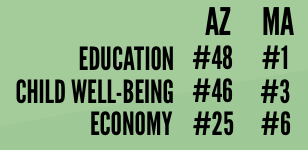
Politically, Arizona is GOP led with no statewide Democratic leaders and both the state senate and house under GOP control. Massachusetts conversely, is almost entirely led by Democrats with the exception of their governor who is a Republican. Given the political parties’ priorities, it should be no surprise then that MAZ vs MAassachusetts ranks much better in education and child well being than Arizona. What may surprise some though, is that while Arizona’s economy ranks 25th in the Nation, Massachusetts’ comes in at #6.  

Why might you ask? Well, I have a few theories and as you can imagine, the state’s prioritization of public education is at the top of my list. Take Career Technical Education (CTE) for example. It produces significantly higher graduation rates than traditional district high school programs, often provides living wage jobs to graduates, and helps provide skilled workers for the employers who so badly need them. It is, by all accounts, a win-win-win. Massachusetts Governor Charlie Baker obviously gets this as indicated by his recent proposal to add an additional $83.5M for vocational education.   Included in this is a $75 million five-year capital program to finance grants for school equipment and expansion an additional $8.5 million for grants for “school-to-career connecting activities.

At the same time, we have Governor Ducey objecting to restoring the $29 million in cuts to CTE made in last year’s budget. Instead of embracing the AZ Legislature’s veto-proof coalition to restore the funding, Ducey wants to only restore one-third of the funding for only three years and, attach a variety of strings to the money including a requirement for business matching of the funds. This despite a plea for repeal of the cuts signed by 32 business and education leaders as to the importance of CTE.

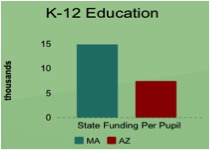
Maybe Governor Baker just had better advice than Governor Ducey. Tim Murray, a regional chamber of commerce president who toured 64 votech and agriculture education programs when he was the Lieutenant Governor of Massachusetts, said “the single biggest need” of the business community “regardless of the size of the company, regardless of the sector” is a “pipeline” of available workers. Surveys of 352 employers and 475 parents recently conducted by The Dukakis Center in Massachusetts revealed that 90% of employers see a need to increase CTE graduates, while 96% of parents had a favorable opinion of the CTE programs they children attend.K-12 az ma

But wait, there’s more. I believe one of the best determinants of the value someone or an entity places on something is what they are willing to pay for it. Massachusetts obviously values education. I know there are those of you ready to say: “there are plenty of examples of more money not producing better results.” Yes, that is true. But in almost every case, I’d be willing to bet where money doesn’t help, there are significant social issues outside of the schools that keep students from learning and achieving. It is obvious, by Massachusetts’ #1 ranking in education achievement, that their money is well spent.

Of course, as mentioned earlier, we know there are factors outside of the school that determine how children do in school. Massachusetts has lower unemployment, their residents earn higher salaries and they are less likely due to lose their homes to foreclosure. Their residents are also better educated, safer, and healthier. They also have fewer disabilities, likely from the better health care they experience. It should be no surprise that Arizona also has four times the adults in state prison as does Massachusetts, spending hundreds of millions more in this area. Yet, Arizonans are no safer with over double the murder rate.

Some claim that Massachusetts is more successful in some areas because society is more homogenous with 74.3% of its residents being white as opposed to only 56.2% in Arizona. There may be some truth to that since unfortunately in the U.S. today, socioeconomic status often has to do with the color of one’s skin. But, Arizona is doing little to address this issue even though our state’s share of white K-12 students dropped below 50% in 2004 and Latin@s K-12 students are on the cusp of breaking 50%. One example of this blind eye toward the problem is new HB 2401 sponsored by Vince Leach-R SaddleBrooke. The bill, titled “Schools; Desegregation Funding; Phase-Down” phases out funding for desegregation expenses, a cut of about $211 million dollars. These funds will hit some of our most vulnerable children, about 22,500 English Language Learners (ELL) and leave high performing magnet schools, such as Phoenix Union’s Metro Tech High School, without their primary source of funding. It is in two words, extremely shortsighted. Learning English is critical to these student’s future success and by extension, that of our state. They will either be contributing members of our society or drains on it. This is a clear example of “you can pay me now, or you can pay me later.”

So let’s recap. Massachusetts performs better than Arizona in education, child welfare, health and safety, the economy and many other areas. Yes, taxes are a little higher ($1,706 per person in 2013), but look what you get for your money! I’m well aware of course that this line of reasoning will fall on many a deaf ear that think the only good government is a starved one. It can’t be said enough though that taxes are not bad or good, they are the price of living in a well-functioning society with a decent quality of life. There are many things such as education for all and safety that are best provided by the government. It our duty (the voters) to determine our priorities for our hard earned tax dollars and then elect candidates that will ensure those priorities are provided for and secured. That is how we keep ourselves free.


Accountability in Arizona…not so much

Two headlines in the AZ Star caught my attention this morning: “Plan adds state cash for private education” and “Veto-proof majority backs repeal of JTED cuts.” The first one is about Representative Justin Olson’s bill to remove any limits on Empowerment Scholarship Accounts (ESAs.)  The second is about the Legislature’s plan to reinstate the $30 million in JTED cuts they made last year. Evidently the Legislature is now saying “my bad” about the 7.5% cut (about $400 per student) to charters and districts with students enrolled in JTED. According to Diane McCarthy at West-MEC, legislators weren’t really aware of what they were doing. “After the fact, some legislators said they didn’t understand what the impact of that (cut) was,” McCarthy said. “There’s a lot of talk about how do we fix it.”

I’m really glad the Legislature has come to its senses and intends to restore the funding, since 96% of Arizona students enrolled in CTE graduate from high school, 21% above those who don’t. Most CTE graduates also go on to post-secondary education and jobs and they score higher on standardized tests. CTE really is a win-win-win as the recent letter to the AZ Legislature signed by 32 business and education entities made clear. What really caught my eye about the JTED article was a quote from Senator Don Shooter who introduced the legislation to repeal the cuts. In response to Senate President Andy Bigg’s accusation that the program has insufficient oversight, Shooter said one key is “transparency.” Thanks for the segue Don.

Don Shooter is correct that transparency leads to more accountability, but evidently he and his fellow GOP legislators don’t understand that concept when it comes to ESAs (basically vouchers by another name.) As of mid-April 2014, approximately $17 million had been handed out through ESAs. That is a lot of money to be handed out without any way to ascertain return on investment. Unlike district school students, ESA recipients are exempted from all state assessments so there is no way to know whether the money was well spent.  Although there is a quarterly spending report required from ESA recipients, parents must only provide proof of spending 25% of the funding they receive each year. The money they don’t spend can be saved from year to year and can even be used for college. If the money isn’t spent, does it mean the parent was efficient with their child’s education or does it mean they skimped? Also, the vast majority of ESA funding goes to private schools (92% in 2012) and at least in Arizona, 70% of private schools are religious. I know this has been deemed constitutional because the money is given to parents who then give it to the schools, but sorry if it looks like a rose and smells like a rose…

The ESA program has been expanded little by little, (students: with disabilities, wards of the court or those that were, students of active duty military members or those killed while serving on active duty, those who had attended a D or F school the prior year, siblings of students currently in the program, and students who reside within the boundaries of an Indian reservation) but it has always been the intention of the GOP-led Legislature to open up the program to all. So far, pro-public legislators and those who believe in good stewardship of government dollars have been able to keep the wolves at bay. Make no mistake however; this legislation is much more about privatizing public education than it is about opportunities for disadvantaged children. Proponents say we need to transition from financing schools to funding students. Problem is, when students accept an ESA and leave the district school, they take all the funding with them, but none of the costs of running the school. A certain amount of overhead costs are fairly independent of student count and schools are incapable of rapidly adjusting their operating expenses with each student lost.

School choice is alive and well in Arizona and still a full 85% of Arizona’s students choose district schools.   The Legislature can pretend they care about these kids, but the truth is that they have a stranglehold on the necks of our district schools and as they continue to restrict the flow of resources to these schools, our kids are the losers. The more they encourage parents to look for greener grass outside our district schools, the more likely it is that resources will be pulled away from these schools making it harder for them to continue to educate the majority of students who remain.

If the Legislature really cares about Arizona students, why not just support our district schools why not just support what we know works: great teachers, small class sizes, infrastructure that supports learning and curriculum that is rich and challenging. We also know that schools can’t do it on their own. Many of our children face obstacles outside of school that affect their ability to learn inside school.

I am incredibly tired of our children being used as a political football. It is time for all good people to say enough is enough. We must stand up and speak for those who have no voice and no power to save themselves. It will be hard to make Arizona public education the envy of the Nation. But, it is possible and that possibility gives me hope.

Part 2 – Why Ducey’s Promise to Lower Taxes is a Lie

In my previous post, I showed why Governor Ducey’s focus on tax reduction is a disastrous recipe for our state. Now let’s look at how those tax reductions we’ve been seeing aren’t really helping the average Arizonan. Instead, we continue to see the tax burden transferred from those who have, to those who can least afford.

Governor Ducey is intent on eliminating income tax in Arizona. Why might you ask? Because, for this Governor and others like him, it is ALL about business. And although corporate tax breaks are good for large business, 97% of the employers in Arizona are small businesses like S-corporations, LLCs and partnerships. These businesses amount to over 40% of the private workforce and are currently taxed by the state via income tax. I’m not sure whether ASU’s Center for the Study of Economic Liberty 2015 policy report by Stephen Slivinski is the “policy roadmap to elimination of the Arizona income tax” as it claims, or, if it was written to support Governor Ducey’s tax reduction plan. At any rate, Slivinski concludes in the report that: “The best hope Arizona policymakers have to eliminate the income tax is to phase it out over a number of years while maintaining budget balance.” He also makes the point that now that the state is on “surer fiscal footing”; it is time for Arizona policymakers “to look at important and necessary reforms over the next couple of years.” Waiting longer he claims, “may result in losing a golden opportunity.” Sounds like a Ducey talking point commercial to me.

Arizona already has though, the 13th-lowest individual income tax and the 10th-lowest combined state and local income tax in the Nation. Additionally, according to an article in Business Insider in August 2014, Arizona’s economy was ranked the 4th fastest growing in the US after Colorado, California and Texas. Of course, we also have the 4th highest poverty rate in the US with one in five Arizonans living in poverty. Obviously, there are winners and losers in Arizona’s current economy and Governor Ducey’s insistence on eliminating the state income tax and shifting state revenue collection to increased sales tax will do nothing to help those who most need it. Although sales tax is said to be a less volatile form of revenue than income tax, it also is the most regressive, hitting the poorest the hardest.

Of course, income and sales taxes are just two ways a state can tax its residents, there are a multitude of others. Here’s just a few examples of how we continue to be “taxed” all the while Governor Ducey claims he is reducing our tax burden.

 1.  The highest per-pupil cuts in K-12 education funding in the Nation from 2008 to 2012 caused Arizona school districts to seek more locally controlled funding as a way to survive. The number of districts asking their communities for funding through bonds and overrides in 2015 was up 150 percent since 2008. The good news for districts is that the voters recognized the need for the funding and the approval rate for these measures was also high. The bad news is that this was no reduction in taxes, but just a shifting from the state to the local level. Unfortunately, often the communities with districts most in need have the least amount of capacity to help.

2.  Another solution many districts were forced to try in order to make ends meet was to reduce their school week from five days to four. As of May 2015, 43 districts (most in rural communities) in Arizona have already gone this route with many others considering following suit.  Arizona districts make up one-third of all four-day week districts in the Nation. There is debate over whether this move really produces the touted savings in the long run, but parents certainly don’t come out on top.  Rather, a four-day school week often requires parents to find childcare or, reduce the hours they work in order to care for their children when they are not in school. It also results in decreased wages for cafeteria workers and bus drivers. These people (especially in rural areas) may not have any real options to make up the difference.

3.  The state’s push of school choice via charters and Empowerment Scholarship Accounts (essentially vouchers) has been another way to transfer education costs to the local level. Charters usually require parents to transport their children to the school, do not offer any free and reduced lunch programs, and often require donations of parents. Schools in the Great Hearts Academy schools for example, “recommend parents contribute at least $1,200 to $1,500 per year per child to the school. There are also a variety of fees that are either not charged at all in district schools, or are much lower than what the charters charge.

4.  Even before Governor Ducey and the Legislature cut $99 million from our state universities and $19 million from our community colleges, Arizona had the deepest cuts in the Nation to higher-education spending. Those cuts drove the significant fee hikes and steepest tuition hikes as well, rising 83.6% since 2008.

5.  The Highway User Revenue Fund (HURF) which includes several taxes and fees such as the gasoline and vehicle license tax, was established to maintain roads, bridges and other transportation needs in the state. The Legislature swept about $860 million from this fund from 2000 to 2014 for other priorities. This forced local government to try to keep up with a more than $455 million in backlogs (with only 70% of cities reporting) for construction, repair, and maintenance of municipal streets. This isn’t just a double tax on Arizona residents (pay taxes to maintain the roads, then pay for car repairs after unmaintained roads cause damage), but also translates into a significant loss of jobs that could employ Arizonans to repair infrastructure and ensures that if and when the repairs occur, they will cost significantly more than if we had just maintained the infrastructure to begin with.

6.  In 2015, the state shifted 25% of the cost (about $12 million) for housing juvenile offenders to the counties, based on total population of the county. The counties are now required to raise the funds for this bill either through increased taxes or reduced services.

7.  Also in 2015, the cost to pay the Arizona Department of Revenue to collect and distribute sales taxes was passed down from the state to cities and counties. The change is expected to cost cities and counties about $17 million. This change applied even in counties that don’t charge a sales tax (such as Pima whose share of this new bill is $1.6 million.)

8.  In the past, the state picked up most of the cost of presidential primary elections. In 2016 however, the cost for these elections will be pushed down to the counties who will pay more than $3 million extra to cover those costs.

There are countless examples of this shifting of real costs, and even more in lost opportunity costs. Local governments say the state merely balanced its budget on their backs and saddled them with a huge financial burden that will continue to result in layoffs, tax increases and crumbling roads. Governor Ducey’s office responded that it is up to local government leaders to make responsible decisions. Really? How can local government leaders make responsible decisions when budget expenses they had no part in approving, are forced upon them without any vote in the process? Leave it to Ducey and Company to not only make a really bad brown matter sandwich for local governments to eat, but then also blame them for complaining how it tastes.

In this, as with any debate, it is possible to find a source to support any point of view. For me it is really this simple…does it make sense that you would tax the poor more to provide tax relief for the rich? Does it make sense that corporations are lured to locate in a state so they can pay even less than the under one percent they generally pay in corporate taxes? Or, does it make more sense that corporations are savvy and look at a variety of indicators to determine where to locate such as the quality of local schools, availability of a quality workforce, or a solid infrastructure? One doesn’t need to be a genius to understand basic economic concepts, all it really takes is a little common sense. A strong middle class is the best path to prosperity for our communities and our nation and economic policies that support its growth are the solution. Our tax policies should incentivize the behavior we need for the health of our communities, states and nation, not for the enrichment of a few. Finally, business definitely has a critical role to play, but so does government. It should ensure we are provided the basic essentials of safety, security, infrastructure and education and our tax policies should ensure sufficient revenue to do that properly. And, it should do that at the right level so as to ensure proper oversight and economies of scale.

No one party has the right answer here and there is no one right solution. It takes a smart application of available tools, wise employment of lessons learned and yes, a whole lot of common sense. Alas, as Voltaire is credited with saying in the early 1700’s: “Common sense is not so common.”


Open Letter to Governor Ducey

It was fitting that your propaganda piece, “Arizona schools win big in my budget” was published in AZCentral.com’s “AZ I See It” column. After all, I understand this is your view of reality. But, the fact that it is your view, doesn’t make it factual.

You open your piece speaking of last year: “we protected priorities, like K-12 education…” Not sure how you can claim you protected K-12 education when in 2015, you cut $113.5 million from K-12 district schools and reduced charter additional assistance funding by $10.3 million. This year, you claim credit for “an historic $3.5 billion funding package for schools.” Yeah Governor, you are just a regular education philanthropist, digging deep into the schools own coffers (state trust lands revenues set aside for education funding) to give our schools the money they’ve been owed since 2009. You offered this deal to take additional monies from state trust lands, despite Arizona ending last fiscal year with an extra $312 million in the bank and being on-track to end FY2017 with $621 million. To add insult to injury, you now plan to pad the states’ rainy day fund with an additional $10 million to bring the balance to $470 million. I have to wonder how many corporate tax breaks will that fund?

 Despite your largely unearned grandstanding, I’m going to hold my nose and vote for Prop. 123, because I think it is the only way we will get any significant additional funding for our schools anytime soon. Rest assured though that education advocates throughout the state are going into this eyes wide open. We know there are caps and triggers in the deal that could allow the legislature to cheat our kids yet again. Just know that we will be more vigilant than ever and that “Hell hath no fury” like advocates scorned after negotiating in good faith.

Of course, taking credit for new funding when you are really just restoring it seems to be a trend for you. You claim to be targeting high-need employment sectors with a “new”, $30 million investment in career and technical education (CTE.) Give me a break! This is the same $30 million the Legislature cut from CTE in 2015. It is definitely not a “new” investment and you aren’t even proposing to give it all back at once. Rather, you: plan to give only $10 million per year over three years; only want it spent on certain kinds of programs; and are requiring matching funds from business. House Minority Leader Eric Meyer said “two thirds of the JTEDS across the state will disappear under this plan, it will create havoc.” He went on to question “why we are ‘fixing’ this program that already works so well to train our kids for the workforce.” These programs are proven to produce higher graduation rates, provide job skills for those not necessarily destined for college, and provide employers the skilled workers they so badly need. The reduced funding won’t only hurt JTEDs, but also district schools who get funding for their students participating in the job training programs.

Speaking of reduced funding in district schools, I noticed you didn’t mention that FY2017 will see the implementation of last year’s legislation to change the district funding model to “current year funding” versus the “prior year funding they’ve been using for the past 30 plus years. Essentially, this will immediately cheat our district schools out of one year’s worth of funding totaling $40 million across 64% of Arizona’s districts. And, while you claim this year’s budget proposal makes new investments in our universities, you failed to mention that your “plus-up” is really only $8 million, less than 10% of the $99 million cut in the 2015 budget. As for our community colleges, I note you also didn’t mention restoring any of the state funding you entirely eliminated from Maricopa and Pima colleges in 2015.

I do thank you for inviting all Arizonans to read your budget and join the conversation about it. You do, after all, work for us and we absolutely should give you feedback on the job you are doing. You can bet I’ll visit azgovernor.gov/budget, read your budget in detail, and comment. I wholeheartedly encourage all my fellow Arizonans to do the same.

Respectfully, Linda Lyon


$82,996 is low income…REALLY?

Kudos to Arizona Representative Doug Coleman, R-Apache Junction, who has introduced HB 2063 to cap the limit for corporate donations to School Tuition Organizations. His bill looks to cap the “year-over-year limit at 2 percent or inflation for the Phoenix metropolitan area” for corporate donations. 501(c)(3) tax-exempt organizations, these STOs allocate at least 90% of their annual revenue to tuition awards for students to use to attend qualified schools. Proponents claim STOs allow underprivileged students the opportunity to attend private schools they would otherwise not have access to. Critics however, note that these corporate credits don’t truly serve the “low-income” population.

According to Arizona law, the current definition of “low-income” for this credit is a “family of four with an annual income of $82,996.” Given that the median household income for an Arizona family of four in 2014 was $50,068, that annual income really can’t be legitimately defined as “low income.” Jonathan Butcher, of the Goldwater Institute, said: “The eligibility is set up to help students no matter where they are in their life and where their family is,” he said. “The scholarships seem to be pretty modest, often around $2,000. Families can use the scholarships to get close to where tuition may be.”

Problem is, tuition at many private schools is much more than the scholarship amounts and parents are left to cover the rest. Senator Steve Farley, D-Tucson said “it’s almost impossible for someone who is poor to benefit because even if they get a scholarship, they still have to come up with the rest of the tuition.” For the 2013/2014 school year, limits were $4,900 for grades K-8 and $6,200 for grades 9-12. The average corporate tax credit scholarship for students at All Saints’ Episcopal Day School in Phoenix was $9,405. With the average private school tuition in Arizona for 2015 at $10,236, it is hard for low-income families to bridge the gap. And, there is no rule to preclude parents from getting multiple scholarships for their child from multiple tuition organizations. The state doesn’t track how common that is. Senator Steve Yarbrough, R-Chandler, (who profitably runs the Arizona Christian School Tuition Organization), “admits many of the scholarship recipients likely would go to private school without the financial help.” Unfortunately, it is almost impossible to prove these allegations since the STOs aren’t required to divulge information required to get to the truth.

Representative Coleman’s bill is meant to help ensure the program’s sustainability. Although Arizona lawmakers placed a statewide $10 million annual cap on the corporate credits, the law allows a 20% per year increase.   Next year, the cap for all private school tuition corporate tax credits will increase automatically to $62 million and by 2030; it will be ten times that amount. That number is especially significant when one considers that for the last budget year, Arizona’s corporate income tax collections were $663 million, and more than 7 percent of state tax revenues. One has to wonder where all this money is going and what the diversion away from the general fund does to the state’s ability to operate.

Senator Debbie Lesko, R-Peoria, is against the cap claiming it gives “needy” children opportunities they wouldn’t otherwise have. She also claims that more money in scholarships means less students in public schools and that ultimately, saves taxpayers money. This claim only holds water if a student started out in public school before switching to a private school. A 2009 Arizona Republic article reported that out of the 50,000 private school students, only 7,350 students had been added since the tax-credit program started [in 1998]. Not exactly an indication of resounding success. The more likely driver for Senator Lesko’s support of this program is the fact that she is the Arizona state chair for the American Legislative Exchange Council (ALEC.) This Koch brothers-backed, tax-exempt organization works with its corporate members to create model legislation favorable to their corporate interests. Then ALEC provides these model bills to state legislators to implement back in their home states. ALEC’s Education Task Force has pushed school choice, vouchers, charters, parent trigger laws and yes, education tax credits. Along with providing the template for the legislation titled “The Great Schools Tax Credit Program Act” ALEC provides recommendations to state legislators designed to help them “sell” the program to the public. They acknowledge the model legislation includes “students presently enrolled in a private school” and therefore “reward[s] many families already financing their child’s education.” They tell legislators to consider limiting “eligibility to students who attended a public school in the last year or are starting school in their state for the first time.” This, they point out, will likely produce “a savings for state taxpayers since a scholarship covering private school costs in many cases will be less than the cost of state support provided to students attending a public school.”

They also recommend to lawmakers that if they “decide to include a statewide tax credit cap in the legislation…language should be added to automatically allow the cap to increase by 25% in any year after 90 percent of the cap was reached in the previous year.” As for the contribution amount allowed, ALEC states that although a 50% cap is deemed more equitable, making a higher “percentage of a donor’s tax liability eligible” for a credit can make it easier to raise donations. Higher amounts though they acknowledge, “open the program up to charges that money is being diverted from non-education programs to support private schools.”

The dollar amounts are significant. For the 2008 tax year, nearly three-fourths of corporations (over 35,500) that filed income taxes in Arizona had the minimum tax liability of $50. In 2009, there were 54 corporations reducing their state income tax via the private school tuition tax credits, lowering their income tax by over $5.5 million with a carry forward of $1.2 million to reduce future taxes. Then In 2010, 63 corporations donated $11 million to private school tuition organizations, with 8 donating at least $500,000.

This, all the while corporate taxes have been shrinking in Arizona. At 9.3% in 1990, corporate income tax is currently at 6.968% and will phase down to 4.9% by 2017. When fully phased in, these cuts will cost the state about $270 million each year, that’s enough to restore full-day kindergarten across the state and much, much more. This doesn’t even include the commercial property tax rate, which has also been cut from 25% in 2005 down to 18% this year.

 In addition to the issue of sustainability, is the issue of which private schools are getting the corporate tax credit money. At least one-fourth of the 64 schools on the states approved list of School Tuition Organizations certified to receive donations for the corporate income tax credits are religious institutions. Yes, the Arizona Supreme Court has deemed this constitutional via what many believe are convoluted reasoning, but it still should give pause to the majority of taxpayers – those that support the separation of church and state. Additionally, I was unable to determine of the $11 million donated by corporations in 2011 and in subsequent years, how much was actually paid out? There are numerous questions about these school tuition organizations and the corporate tax credits that fund them. Unfortunately, laws designed to preclude transparency and accountability prevent these questions being answered. It is obvious to me that Representative Coleman’s bill makes total sense, which unfortunately means it will probably be a tough sell in the Arizona Legislature. Let’s hope against hope that reason prevails.


Ducey on Education…What’s he really saying?

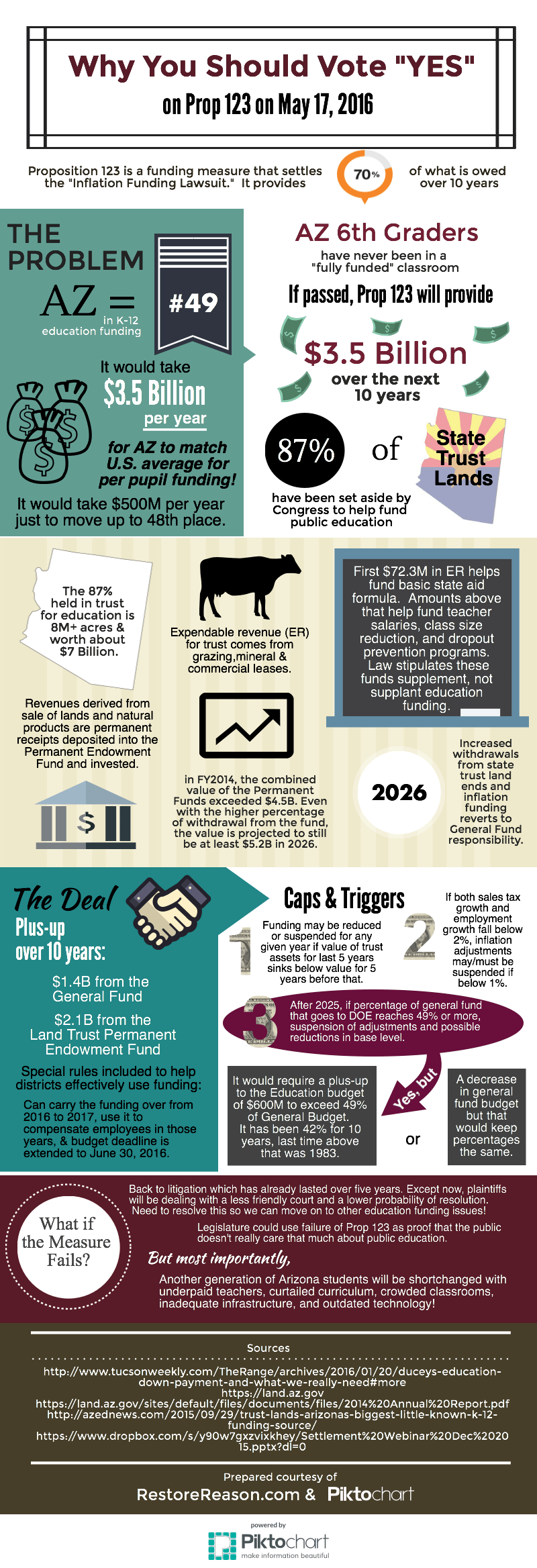
Governor Ducey’ State of the State address today at the AZ Legislature’s opening day was a fairly typical “state of” address. He talked about what he’s accomplished thus far and provided sound bites about what else he’ll do. He promised he’ll lower taxes each year and still invest in education. He claimed it doesn’t have to be either/or, it can be both. He did not of course, dilineate any specific plan to do this, but that isn’t really what a “state of the state” address is for. He provided examples of good things happening in public education, and stated that Prop 123 will give us opportunity to make substantial progress.” Have to inject here that although I am supporting Prop 123, it won’t really help us “make substantial progress.” Even if with the passage of Prop 123, Arizona won’t move up from 49th in per pupil funding. After all, it is only going to provide about $300 per student, still less than has been cut since the recession began. Not nothing, but not a game changer either.

Governor Ducey then made the prediction that: “In the years ahead, Arizona will be among the states investing the most new dollars in public education – all without raising taxes.” Just to be clear here, the Prop 123 monies aren’t “new monies”, they are monies that were already owed to our schools. Not sure the Governor sees it that way, but that is the truth. More funding, much more funding is needed and every bit will be welcome, but I just don’t see how we can make a dent in the need without raising taxes. I am positive we can’t do it by cutting taxes and giving our surplus away as corporate handouts. We just need to look at what Governor Brownback did to Kansas with his tax cuts.   When he took the reins in Kansas, he dropped the top income-tax rate by 25%, lowered sales taxes and created a huge exemption for business owners filing taxes as individuals. He claimed it would spur investment, create jobs and bolster the state’s coffers through faster growth, sound familiar? Now, five years after doubling down, his state lags in job creation, tax revenue is far short of expectations and bond and credit ratings have been downgraded. Rating agencies claimed the tax breaks were unsustainable and that the promised economic growth would be elusive. It is with great hubris this lesson would be ignored.

Ducey then touted the conservative mantra that more money doesn’t equal better education with “We know spending is not the measure of success. And it shouldn’t just be about the billions of dollars we are putting into public education; it must be about what our kids are getting out of their education.” He’s right, it shouldn’t be just about the spending. But again, just look at the schools wealthy people send their kids to. Those schools aren’t bargain basement…they cost big money because they have small class sizes, highly qualified teachers (some with PhDs from Harvard, Yale and Stanford), extensive curricula, fabulous facilities and the very latest in technology. Money is not the only solution, but it does matter.

Facts also matter, so I have to call a “not so fast” on the Governor’s reference to “until the thousands of kids on public school wait lists have access to our finest teachers and principals, our job isn’t done.” Firstly, although Ducey refers to “public school wait lists”, he means “charter school wait lists.” Yes, charter schools are technically public schools, but district schools don’t really have wait lists, they must take all who reside in their boundaries and also accept the vast majority of those students who apply via open enrollment. So how about those much touted charter school wait lists? Although the National Alliance for Public Charter Schools (NAPCS) claims that waiting lists for charters across the Nation would top one million for the first time in 2014, a May 2014 report by the National Education Policy Center (NEPC) gave nine reasons we should be skeptical of these numbers. Among the reasons were: students apply to multiple charter schools; waitlists can’t be confirmed and record-keeping is unreliable; charters accept applicants for students they have no intention of ever admitting; and many charter schools choose not to “back-fill” students who vacated during the school year (because accepting new students mid-year can create turmoil in the classroom), which would reduce their waiting list. Without the ability to verify the wait list data to determine its reliability, the NEPC study concluded that “policymakers would be wise to set aside NAPCS’ claims and wait for verifiable data.” After all, where charter schools are managed by for-profit corporations, the facilities built with taxpayer funding assistance eventually become property of the corporations. Paint me cynical, but when a governor cites waiting lists as the reason to expand these schools and says he is going to provide more dollars for this expansion, it is easy to see it is in the corporation’s interest to inflate those lists. He also though, talked about the “need to provide resources for aging schools to repair and rebuild their facilities for future students.” I’m hoping he is including district schools here since their facility maintenance and repair has been funded at only two percent of the need over a recent four year period.

Of course, Governor Ducey continues to want to reward those schools that are already succeeding. In his speech he spoke of “the need to reward schools that are helping kids reach their full potential…and that under our plan, schools that produce students who successfully complete AP-level, college-prep courses will be rewarded with more dollars.” Likewise, he said: “Schools in low-income areas – where educators and students face added challenges – will receive an even greater boost for helping kids beat the odds.” I totally understand his wanting to reward “good behavior”, but am concerned about a lack of concern about helping those schools and their students who are struggling. In my former Air Force life, higher-heaquarters inspection teams routinely visited bases to evaluate their performance. Where there were significant problems, “staff assistance teams” would be sent in to help fix them. Although the boss (wing commander) might be fired if the dysfunction was severe, the assistance provided after the fact was not punitive, but meant to help things get back on track. The vast majority of our struggling schools have administrators, teachers and staff working hard to make a difference. They need help, not punishment likely to accelerate their race to the bottom.

I was very happy to hear him acknowledge the importance of career technical education (CTE): “I know not every child plans to go to college – their K-12 experience also needs to prepare them for life. Which is why I’m targeting high-need employment sectors with a new focus on career and technical education. There is bipartisan support for this – so let’s get it done.” Of course, this wouldn’t be quite as critical this legislative session if it weren’t for the Legislative mandated cut of $30 million scheduled to go into effect next year. Nonetheless, he’s right, CTE is a win-win-win and the funding must be restored and hopefully, increased.

The Governor also gave note to the fact that “The state isn’t the only player in public education. Every day, philanthropic foundations in Arizona are investing in our schools. They are developing new school leaders, expanding educational opportunities for low-income children and funding the arts and sciences. I intend to partner with the heads of these foundations to provide an even greater opportunity and impact in our schools.” Good for you Governor! Just don’t forget that it isn’t the job of these philanthropic foundations to provide for public education. That, as outlined in the Arizona Constitution, is the primary job of the Legislature and you! Irrespective of how much you promote the growth of for-profit charter schools and the expansion of Empowerment Scholarship Accounts (essentially vouchers), the responsibility for the public education of Arizona’s one million plus students is still ultimately rests on your shoulders. I hear you saying many of the right things, I just hope your intent is pure and your commitment is real. Our students are not a talking point, they are young people who deserve every opportunity to succeed and reach their full potential.  Not only for themselves, but for the future of our State and our Nation.


Top Five – Discouraged but Hopeful

So hopefully you already read my Bottom Five – Discouraged but Hopeful, here’s the rest of the story. First, the rest of what gets me really discouraged:

5.  The Legislature seems intent on killing the CTE/JTED, a critical program for our state. Career and Technical Education (CTE) offered by Joint Technical Education Districts (JTED), includes a variety of “votech” programs for which students earn high school credit, and in some cases, may earn college credit, industry certifications, and/or a state license through combination of hands-on training and classroom instruction. Since 2011, the Arizona Legislature has cut CTE funding by more than 53%. Some $30 million will leave the program next year and Districts will also take a 7.5% cut to their per-pupil funding for their students who participate. These cuts are stupid for Arizona! As I’ve previously written, CTE is a win-win-win. It has proven to decrease dropouts by as much as 72% and the Alliance for Excellent Education estimates that “if half of Arizona’s 24,700 high school dropouts in 2010 had instead graduated from high school, the economic impact on Arizona would include $91 million in increased earnings and $7 million in increased state tax revenue.” The Phoenix Business Journal also made a great case for CTE: “By destroying one of Arizona’s most successful education initiatives – one with real economic returns – the state will not be able to provide the skilled workforce that companies demand before they relocate or expand operations here. That means we can expect reduced workforce development, fewer young people escaping poverty and achieving economic independence, and higher social services costs.” There is still time to help. Please click here to sign a petition to restore CTE/JTED funding.

4.  Arizona’s teacher shortage. Actually, Arizona doesn’t have as much a teacher shortage as it has a shortage of certified professionals willing to work for salaries that won’t pay the bills. As of December of last year (according to the AZ Daily Star), 84 districts in Arizona had more than 1,200 teaching position open and 700 of those occurred during this school year. The state also had at least 1,000 vacant teacher positions to fill before the start of the current school year. The Arizona Educator Recruitment & Retention Task Force reported in January 2015 that there is a 7% decrease in teacher prep program enrollment, that Arizona loses 24% of first year and 20% of second year teachers and that 24% of the current education workforce is eligible to retire within the next four years. We have a huge problem that is only going to get worse and I haven’t even mentioned the school administrator shortage that is right around the corner.

3.  Proposition 123. Okay, so earlier I said I had hope because a settlement was reached in the inflation-funding lawsuit. Unfortunately, we are a long way from actually getting the requisite funding to our schools. First, the voters must approve it in a special election on May 17th  and those against the settlement filed almost 50 statements in opposition. There is also the matter that the state Treasurer is against the deal but he hasn’t been able to get much traction on his fight. That fact, combined with the $1.75 million proponents have raised to sell the prop to the public will probably carry the day. I do though, worry about the long-term impact to education funding and, I don’t really don’t like Governor Ducey and his buddies claiming a victory on this one. An example is Ducey’s “hay making” tweet on December 30, 2015:

ducey tweet


Sorry Guv, but no, you really just paid 70% of what the people mandated and the courts adjudicated and technically, you are paying the schools with their own money. You’ll be “shifting the trend line upward” when you plus up the K-12 public education budget this year. After all, its not like we don’t have the money. Arizona realized $150.5 million more revenue than expected in October and November of 2015 after ending the fiscal year with $266 million more in the bank than expected. Add that to a $460 million in the state’s rainy day fund and you’re starting to talk real money. And, Arizona voters are pretty clear about what they want done with that money. A recent poll of Arizona voters showed 72% believe investing in public schools should be a priority for this surplus. If the Legislature and Governor were listening to the citizens of Arizona (who are the “boss of them”), they would give some of this funding to public education and truly begin to reverse the trend, instead of following the abysmal fiscal example of Governor Brownback in Kansas by reducing taxes and giving more corporate handouts.

2.  Voting records of our legislature when it comes to support for public education. I already talked about this in a previous post but it bears repeating. The bottom line is that on average, Arizona’s Democratic legislators scored 48 percentage points higher for voting in accord with ASBA’s position, than the Republicans. There are of course, anomalies, but it is clear that in general, the GOP-led legislature is anti-public education. Want support for public education? Vote more pro-public education candidates into office. Some suggestions of those running for the first time are: Jesus Rubalcava running in LD4, Courtney Frogge in LD10, Corin Hammond in LD11, and Larry Herrera in LD20. I’m sure there are many more but I know all these individuals personally and they are young up and comers…just what we need to lead Arizona forward.

1.  ALEC’s influence on Arizona legislation, especially where it affects public education. The American Legislative Exchange Council’s (ALEC) agenda to privatize public education includes the promotion of charter schools (corporate charters and virtual schools specifically), private school vouchers, anti-union measures, “parent trigger” laws, increasing testing, reducing or eliminating the power of local school boards and limiting the power of public school districts. Anyone tuned into Arizona education or politics knows that ALEC has also had significant influence in our state. The Goldwater Institute acts, as ALEC’s “Mini-Me” in Arizona and AZ Senator Debbie Lesko, as the AZ ALEC chair, has been the organization’s chief water carrier. Half of our state Senators and one-third of our representatives are known members of ALEC and there may be more.  Corporations fund their trips to ALEC Conference where model legislation is handed out for Legislators to take back to their states for implementation. The organization awarded Arizona a “B-” grade in education policy for 2015. The state’s charter school laws and school choice programs were awarded “A” grades, teacher quality and policies were graded “C-.” This most certainly means we’ll see more ALEC-drafted bills coming down the pike.

Now, for what most gives me hope:

5.  Superintendent Douglas finally seems to be focusing on the education of our kids. It’s been a tough year for the Superintendent, much of it apparently of her own making. But, she went on not one, but two listening tours around the state and evidently, really listened. Her “AZ Kids Can’t Afford to Wait” plan is focused on how to make things better for Arizona’s students, much of it revolving around improving teacher support to include increased salaries. This report shows that at least she understands what needs to be done. She survived the attempt to recall her; time will tell whether she can lead real change.   Current leadership aside though, I share Representative Randy Friese’s question as to why the Superintendent of Public Instruction is an elected position. After all, Arizona is one of only 13 states where this is the case and, the position is basically just an administrator who is only one member on the state Board of Education which is responsible for exercising general supervision over and regulating the conduct of the public schools system. AZCentral.com reported this week that Representative Friese intends to introduce a bill to make the change.

4.  Christine Marsh, Arizona’s Teacher of the Year, is really, really impressive. She is poised, articulate, and passionate and when she talks about public education, she takes no prisoners. In a recent article published AZCentral.com, she said that giving each individual student an equal chance to succeed is the point of public school education.   She pointed out that over 26% of Arizona’s children live in poverty, 4% more than the national average. “People need to understand the impact of poverty on students…and when we discuss school funding, we need to understand the impact our decisions have on each student,” she said. “[We need to] make sure that our policies and funding formulas don’t contribute to the problems they are supposed to be helping.” It is clear this outstanding teacher won’t be shy about speaking “truth to power.” Of course, I’m sure Christine would be the first to say that there are many, many more teachers just like her out there. I’m hopeful because of all of the great teachers serving Arizona’s students and am so very grateful for their service.

3.  District schools are still the school of choice for 85% of Arizona’s students. Despite having open enrollment and charter schools since 1994 and Empowerment Scholarship Accounts (basically vouchers) since 2011, almost one million students still attend district schools. The primary reason is that district schools are community schools with locally elected leadership that is responsive to the needs of the community. Charter schools and voucher provided alternatives will never serve the majority of students, that’s just not realistic. As members of the more than 240 school boards govern to improve achievement for the almost one million students in their care, they work to ensure the bedrock of our democracy/republic, “an educated citizenry” according to Thomas Jefferson, is realized.

2.  Arizona’s education advocates are really getting their act together, literally! The Arizona School Boards Association (ASBA), the Arizona Education Association (AEA) and the Arizona Association of School Business Officials (AASBO) worked together to craft a palatable compromise to settle the inflation-funding lawsuit. I know many are not happy about the settlement, but these three organizations worked tirelessly for five years to get Arizona districts the funding they were due. Yes, it is only two-thirds of what was owed, but two-thirds is better than nothing and nothing was a distinct possibility. This is especially true with Governor Ducey’s appointment of Clint Bollick to the Arizona Supreme Court. Had this issue come before him, it most certainly would have died a quick death. Another public education advocate, Support Our Schools AZ (SOSAZ), saw its “Arizona Parent Network” grow wings and take flight. In October, the organization hosted the first-ever Education Excellence Expo at Salt River Fields with 26 districts from all over the state showing off the excellence in Arizona’s public schools.

1.  Maybe, just maybe, Arizona voters are waking up. 2015 saw some encouraging upticks in support for public education. In early March, two mothers sparked a day of peaceful protest at the state Capitol. Close to 1,000 parents, students, teachers, and community members showed up to protest Governor Ducey’s proposed education budget cuts. I was there, and it was exciting to be a part of a genuine grass-roots movement that helped bring education to the forefront. That renewed focus no doubt aided in the successful passage of so many bonds and overrides such as in Maricopa County, where 23 of 26 districts had successful ballot measures. Results elsewhere were not as good such as in Pinal County, where only half of the measures passed, but overall, the numbers were up and that bodes well for public education in general.

What this exercise made me realize is that I really am more optimistic than pessimistic about public education’s future. I had to work harder to come up with the “what’s discouraging” than “what gives me hope.” Maybe that’s who I am, or maybe, I just believe that ultimately, “good” wins. “Good” in public education is that which serves the majority of our children; that which recognizes each of them deserves equal opportunity to be the best they can be; and that which best serves our communities, our state and our nation.   I believe that “good” in public education is that which is transparent, accountable, and dedicated to helping each child achieve their full potential. Anything else is so very much less than good – it is just plain evil.
 

Bottom Five List – Discouraged but Hopeful

A recent article in The Atlantic magazine featured experts on K-12 education who offered their reasons for hope and despair with regard to education. It was an interesting read and prompted me to come up with my own list for Arizona. In this first of two posts, I share my “Bottom Five” list of what discourages me and what I’m hopeful about. First, what discourages me:

10. The extremely well funded efforts of the corporate “reformers.” Make no mistake about it, the effort by the corporate “reformers” to make sweeping changes to the Nation’s public education system is as much about making a profit as it is an interest in making a difference. The exact number is up for debate, but The Nation magazine says the American K-12 public education market is worth almost $800 billion. Now, everyone from basketball players to Turkish billionaires want a piece of the pie. It is no accident that the Koch brothers backed, corporate bill mill ALEC is pushing many of the reforms, and the technology magnates Bill Gates and Mark Zuckenberg are heavily involved in the “reforming.” All you have to do is follow the money and the intent becomes clear.

9.  The apathy of Arizona voters. I worked on three Arizona Legislative campaigns in the past few years and although I mostly enjoyed talking to voters, I was beyond dismayed when I learned that in 2014, not even half of the LD11 voters with mail-in ballots bothered to mail them in. These are people who are registered to vote and are on the Permanent Early Voters List (PEVL). They are mailed their ballots and can fill them out in the comfort of their home. They don’t even have to put a stamp on them, postage is pre-paid. These votes should have been the “low-hanging fruit.” Combined with the overall Arizona voter turnout of 27%, this is pathetic by anyone’s definition.

8.  The fact that Arizona leads in all the wrong metrics. Does Arizona care about children? Let me count the ways maybe not so much. According to the Annie E. Casey’s “Kids Count Databook”, Arizona ranks: 46th in overall child well-being, 42nd in economic well-being, 44th in education achievement, and 42nd in children’s health. The Databook also reports that 26% of Arizona’s children live in poverty, 4% more than the nationwide average. The personal finance website WalletHub reports much the same, ranking Arizona 49th for child welfare which shouldn’t surprise anyone given the dysfunction in our Department of Child Safety. I don’t know about you, but these statistics disgust me and should absolutely drive what our Legislature spends our taxpayer dollars on. It is about defining what kind of people we are, it is about helping those who can’t help themselves and it is about the future of our state.

7.  Some seem to think the path to success is to lower the bar. Even though there are people whose opinions I value that think Senator Sylvia Allen will do a good job as the Chair of the Senate Education Committee, I remain hopeful but have my doubts. Call me crazy, but I think the legislator with the most sway over what education bills see the light of day should actually have more than a high school education. Along those same lines, Arizona Representative Mark Finchem (LD11-Republican) evidently doesn’t think teaching experience is valuable for our county schools superintendents. He has already submitted House Bill 2003 for this legislative session, which seeks to delete the requirement for county schools superintendents to have a teaching certificate. Instead, it will require only a bachelor’s degree in any subject, or an associate’s degree in business, finance or accounting. I know some would ask why should county schools superintendents have certificates when the state superintendent of public instruction doesn’t require one. Well, I’d rather see us make it a condition of both jobs.

6.  The polarization of our county makes it seem impossible to come together to find real, workable solutions. I was recently speaking to a friend of mine who I’ve known for over 25 years. We started talking about education and he started railing about how all public schools do is waste money. He talked about the fancy new high school in his town that was built (in his opinion) much more ostentatious than necessary. “Why do the kids need that to learn” he asked? “Why not just give them a concrete box?” Really?? Where do I begin? Truth is, I didn’t even try because I knew he wouldn’t listen. He knew what he knew and no amount of fact was going to sway him.

But all is not lost and I am more optimistic than pessimistic about Arizona’s public education. Here’s what makes me hopeful:

10.  Across the Nation, more and more charter school scandals come to light every day highlighting the need for more transparency and accountability. I’m not glad there are charter school scandals, but I am glad the public are learning more about the dangers of a profit-making focus with inadequate oversight. That’s one of the reasons district schools have rules and controls; they are after all, dealing with taxpayer dollars. And oh by the way, it’s no longer just charter schools we need to watch. The continuous expansion of vouchers exponentially broadens the potential for abuse and requires the same kind of public oversight. There just is no magic pill to student achievement. It takes resources, dedicated professionals, and hard work. Short cuts in other words, don’t cut it.

9.  The fact that we still have dedicated professionals willing to teach in our district schools. Despite low pay, higher class sizes than the national average, insufficient supplies, inadequate facilities, and ever-changing mandates, Arizona still has close to 50,000 district teachers willing to be in our classrooms because they love the kids and they love their work. They are underappreciated and sometimes even vilified, but they know their work is important. Now, if only our Legislature acted like they knew this too.

8.  Recognition is growing that early childhood education is really important. Even Governor Ducey said in April 2015: “Research shows that a quality early childhood education experience can yield significant long-term benefits on overall development of a child. It’s the most profitable investment we can make in their future.” A recent review of 84 preschool programs showed an average of a third of a year of additional learning across language, reading and math skills. Preschool has also been shown to have as much as a seven-fold return on dollars spent over the life of the child. The public is starting to “get it” and support for preschool funding is growing.

7.  Speaking of Common Core, it seems to be working okay. Yes, I saw the recently released AzMERIT results, but we knew they would be low. That’s what happens when you raise the bar. Despite no additional funding or resources to implement Common Core (oops, I mean Arizona College and Career Standards), our districts made it happen and the numerous teachers and administrators I’ve talked to say our students are now learning more. Efforts are underway to determine what should be changed about the Arizona standards, but my guess is that they will be minor.

6.  If nothing else, the passage of the Every Student Succeeds Act (ESSA) saves us from the really bad legislation that was No Child Left Behind. Everything I’ve read about the new ESSA touts it an improvement over its predecessor. It reduces what some considered Federal overreach and provides states more flexibility in implementing their K-12 education programs. Which, oh by the way, makes me concerned our state legislature will look to relax requirements where it serves them, at the expense of those children who most need our help. At least now though, they won’t be able to blame everything on “the Feds”, to include whatever version of the Common Core standards we end up with.

Please stay tuned, still to come are the top five reasons I’m discouraged and hopeful.