The NRA’s False Choice

I’ve been taking a bit of a break from writing, but this article written by Marine officers (there are no former Marines) is just too “on target” (please pardon the pun) not to share. I have nothing to add other than I agree entirely, especially with these two sentences:

“Indeed, true patriotism is not partisan, and the love of country and exercise of Constitutional rights is not the purview of any one group.”

“We renounce the false choice presented by the NRA that Americans need to pick a team between the First and Second Amendments.”

The NRA Has Entered the Province of Cowards
by Joe Plenzler, flipboard.com
As Marines, we fought to defend the U.S. and its freedoms. The NRA’s new video campaign is dedicated to a xenophobic policy of violent hatred and intolerance undermining freedom.

Over the past few weeks, the National Rifle Association has deployed several hyperbolic, incoherent, irresponsible, and divisive videos demonizing half of the American population in their efforts to recruit new members—beginning with Dana Loesch, followed by Greg Stenchfield, and most recently by U.S. Navy veteran Dom Raso.

Such fear-based incitements to hate and violence are the province of cowards.

These ads are official NRA TV products sponsored by Ruger and Kimber, both firearms manufacturers.

The NRA, founded by Union officers after the Civil War, was established as an organization dedicated to civilian marksmanship, gun safety, and Second Amendment rights.

However, this recent video campaign is a crescendo of increasingly partisan rhetoric on the part of the NRA, demonstrating that they are now dedicated to a xenophobic policy of violent hatred and intolerance that increases polarization and discord within American society.

In tone and content, the videos are eerily reminiscent of the thugs and bullies that have historically executed violence in support of authoritarian regimes.

These NRA ads are a clear and sophisticated effort that use well established propaganda tricks to appeal to scarcity, fear, and the basest of human emotions. For instance, the unnamed “they” at the beginning of Loesch’s video establishes a cognitive frame for the viewer to insert their own personal boogeyman.

Moreover, the videos conflate the American public’s right to peacefully assemble, protest, and criticize their government with the violent criminal behavior of a small number of rioters.

The NRA props up the Second Amendment by undermining and vilifying the protections afforded in the First, and paints everyone who may disagree with the current administration, our country’s justice system, or the NRA’s partisan political position with a very dark and unjust broad brush.

The NRA ads depict a dystopian, violent present whose danger can only be met by heavily armed citizens, when in fact a recent 2016 FBI report shows violent crime in the US to be at a 20-year low despite the more than 33,000 gun-related fatalities in our nation every year.

Additionally, the NRA’s use of stock riot footage misrepresents the character of the anti-administration protests. The data on the protests since the inauguration show that less than 0.5% of all protests have resulted in any property damage, and even fewer have resulted in physical injury.

To the NRA, we ask Qui Bono—to whose benefit? This fear-mongering certainly does not benefit the American people.

The truth is that the NRA is engaging in shameless fear tactics to increase membership so they can put more money into the pockets of politicians in Washington so firearms manufactures can increase sales resulting in profits and returns to shareholders.

They are selling a false narrative that there is only one right way to be a patriot.

This divisive rhetoric is amplified by their deafening silence on the killing of Phillando Castile, a law-abiding gun owner.

They are preying on a fearful public, and this is unethical.

While we would expect Loesch and Stinchfield to engage in such paid partisan hyperbole, we are embarrassed that a fellow veteran like Dom Raso would stoop to partisan fear-mongering and denigrate himself in the same manner.

We expect more from our veterans.

You see, while we have spent the past 16 years fighting real wars in Iraq and Afghanistan, extreme partisans on both sides of the political spectrum have been intent on waging a culture war at home.

It is time for this to stop.

During our combined 56 years in the United States Marine Corps, we served with Americans from every conceivable political, ideological, ethnic, religious, and socioeconomic background—including foreigners who joined our military and helped fight our wars so they could earn a shot at U.S. citizenship.

Our experiences serving in every clime and place have taught us to be grateful for our ever evolving experiment in democracy, and have also shown us that there is no one right way to be Americans.

Indeed, true patriotism is not partisan, and the love of country and exercise of Constitutional rights is not the purview of any one group.

Each of us who volunteer to serve swore an oath to defend the Constitution and all of its amendments for every American—even those we may disagree with.

While we deplore the riotous violence of a few—completely overblown by the NRA—we respect the rights of the people to peacefully assemble and protest. We also respect peaceful civil disobedience. These rights are the cornerstone of our democracy, codified as the First Amendment to ensure that we can disagree, protest, and express our views without resorting to the violence of the past.

We also reject the most recent phenomena of labeling anything disagreeable as false or fake news. We believe everyone is entitled to their opinions, but nobody is entitled to their own facts.

We renounce the false choice presented by the NRA that Americans need to pick a team between the First and Second Amendments.

We believe that the use of intimidation, fear-mongering, and threats of violence to crush the people’s right to peaceful assembly, redress grievances, and maintain a free press is the first step in the march towards authoritarianism.

We believe that ALL of our civil liberties are worth defending for ALL Americans—including protection from the use of excessive lethal force by those sworn to protect and serve our communities.

We reject extremism in all of its forms—both emanating from the right and the left.

We believe that the way forward to bring our Nation together does not come from a clenched fist, rather it comes from an extended hand and a commitment by sane, common-sense, and courageous people to meet in the center and work toward the common good.

We believe that veterans, given the military’s cultural emphasis on service, nation before self, and teamwork can be useful in encouraging respectful civil discourse to solve our nation’s toughest problems.

We strongly believe in the sentiment first expressed by Edmund Burke, that the only thing necessary for evil to triumph is for good men and women to do nothing.

We believe that the majority of NRA members deplore the hate and fear-based tactics of the NRA leadership yet their dues and donations continue to resource the NRA’s incitements to hate and violence.

The silence of these good men and women is deafening.

What will you do?

Craig Tucker is a retired Marine Corps Colonel and decorated 25-year combat veteran. His combat command of RCT–7 in Iraq spanned 14 months and included the first and second Battles of Fallujah, numerous smaller actions and a Purple Heart for wounds received in combat action north of Husaybah Iraq.

Kyleanne Hunter is an 11-year Marine Corps combat veteran and decorated AH–1W Cobra helicopter gunship pilot. She served combat tours in both Iraq and Afghanistan, as well as a tour as the Marine Corps’ Liaison Officer to the House of Representatives. She is a former NRA member.

Joe Plenzler is a retired Marine Corps lieutenant colonel and decorated 20-year combat veteran of Iraq and Afghanistan. He served from 2010 to 2015 as the spokesman, speechwriter, and staff group director for the 34th, 35th, and 36th Commandants of the Marine Corps. He is a former NRA member. ■

Stock in Concrete Companies?

As a leader in the military, I learned a long time ago that if something was easy to fix, someone would have already fixed it. President Trump evidently hadn’t learned that prior to his election, but since then, has time and again realized that uh, YEAH, this shit is hard!

Take the border wall for example. It might have been good “red meat” for his supporters, but there are three good reasons why there is not a finished border wall along our southern border: 1) it is a very complicated endeavor, 2) it is really, really expensive, and 3) it won’t solve the problem of illegal immigration. I mean, get real! Trump isn’t the first politician to try to make hay with this issue, but the rhetoric always slams into reality eventually.

I knew for example in 2011, that Arizona Senator Steve Smith wasn’t going to get anywhere with his “www.BuildTheBorderFence.com” initiative and I was right. Smith promised to raise some $50 million to build a 15 foot fence at busy border-crossing points and erect fences where there were no federal fences. After three years however, the project had only raise $265,000, not even one-tenth of the $2.8 million needed to build the first mile of fencing. As for the $265,000, last I could find the advisory committee assigned to do something with the funding were asking sheriffs how they would use it.

I also knew Trump would never get the wall built and he sure as hell wasn’t going to get Mexico to pay for it. Recent negotiations over the continuing resolution have proven Trump’s real lack of commitment to demand the $25 billion or so his wall is estimated to cost.

I have personal experience with the border wall – or more accurately, the lack of a working border surveillance system. After my retirement from the Air Force, I was hired by L–3 Communications as Deputy Program Manager for the Strategic Border Initiative, or SBInet. This “virtual fence” that would stop illegal immigrants at the border with a mix of guard towers, cameras, sensors and other infrastructure feeding data to a sophisticated IT system, was President George W. Bush’s answer to the problem in 2006. As a subcontractor to Boeing, L–3 was responsible for designing and building the towers and microwave system that was to provide electronic surveillance for the Border Patrol. I worked on the project for almost seven months, but eventually quit because I just couldn’t continue to be a part of the fleecing of the government that was occurring. On one of my trips to field test the system, I was at Playas, New Mexico. I recall being out in the desert with a colleague driving around in circles for hours so that the microwave could try to lock in on us. It didn’t work, and when I went to a meeting at Boeing where I felt like they were sitting around joking about how we weren’t making progress, I decided I just couldn’t handle it anymore. Not even my writing my Congressman (Webb – Virginia) with my concerns had helped, since he never responded. That’s when I knew for my own piece of mind, it was time to resign.

In February 2008, a Government Accountability Office report cited that “the radar information was too slow to appear on screens, and was being inappropriately triggered by rain and other weather phenomena. Camera resolutions was insufficient for targets beyond 3.1 miles and the stylus-controlled laptops mounted on moving vehicles were not rugged enough and were difficult to use.” No surprise to me that the project was killed in 2011, after about $1 billion in taxpayer dollars were flushed down the drain.

Eventually, Border Patrol officials decided to take a look at preexisting, tested technology and a $145 million contract was awarded to a U.S. based subsidiary of Israel’s Elbit Systems. As of 2016, the IFT system had been used successfully at one installation on the border.

Using technology (including drones) to monitor the border though, is way different than building an actual wall over the entire 1,989 mile United States – Mexico border. For starters, the terrain is very rough in some areas, much of the land is privately owned (either by individuals or Native tribes), there are hundreds of tunnels in use, there are significant detrimental impacts on wildlife migration and survival with endangered species laws causing complications, and where there is a will, there is a way. As former Arizona Governor Janet Napolitano once said, “You show me a 50-foot wall, and I’ll show you a 51-foot ladder.” In fact, I remember a story told me by a Border Patrol agent who said that they once watched Mexican drug smugglers, drive up to a section of the border wall, push a button on a remote control to raise the wall like a garage door, drive through, and then close the door again. When there is money to be made, or a desperation to make something happen, people will find a way.

All this aside, the U.S. does already have barriers along 653 miles of the southern border (mostly the western portion.) border barriersThese barriers range from 18-foot-tall iron fencing and corrugated metal to makeshift vehicle barriers and barbed wire. And “in 2015, the Border Patrol claimed an 81 percent success rate in apprehending or turning back people who attempted to cross illegally.” A large number of those trying to cross now though, are asylum seekers, who present themselves to border agents at legal ports of entry. The Department of Homeland Security also says that in FY2015, about 530,000 simply overstayed their legal visas after flying into the country, about 200,000 more than were caught at the border with Mexico. No amount of wall would have helped in these situations.

Oh by the way, the Mexican border isn’t the only one the U.S. shares and, the other one is twice as long. Wall proponents will often claim we must build it to keep out terrorists and weapons of mass destruction, but you almost never hear someone talking about our border with Canada. Because of the heavy forests and numerous bodies of water the two countries share, it is much easier to slip across undetected. If I was a terrorist, I know which border I’d pick to cross.

Finally, Bloomberg News reported in February 2017 that an August 2016 poll found that 61 percent of Americans are opposed to “building a wall along the entire border with Mexico,” and only 36 percent favored it. A Pew survey conducted in November-December 2016 revealed that only 40 percent of respondents thought building a wall was very important, or somewhat important. I suspect many of those who think the wall is important, live a long way away from the border and don’t really understand the issues at hand. Most of those who live along the border know building a wall is a fool’s folly as a separate poll in May 2016 of Southwest border city residents which found 72 percent of them opposed to it. What is really needed, says one, is a sensible immigration policy and enforcement of the laws intended to prevent U.S. companies from hiring undocumented immigrants. Supply and demand anyone?

Ah yes, but then that would hurt the corporations and we can’t have that, can we? Better to make American citizens fork over the $25 billion of their hard earned taxpayer dollars to build the almost 2,000-foot-long 40-foot-high concrete wall President Trump wants so he can keep a campaign promise that won’t fix the problem. Hmmmmm, wonder if 45 owns stock in any concrete companies?

The Voucher Expansion is Not About Our Kids!

After I started this post, it was somewhat overcome by events. The preamble below gives the latest and then I dive into my original thoughts.

As of this posting, the AZ Senate had voted for the full expansion of vouchers and the House was on the cusp of doing the same. To all those who voted against our kids, our system of public education, and the foundation of our democracy, just know that public district school parents and advocates will not forget your choice to be on the wrong side of this issue. November 2018 is right around the corner and despite all the dark money corporate profiteers have poured into this fight, we each still have our vote and will use it wisely!

In a futile effort this morning to shift the hearts and minds of my LD11 legislators, I sent the following email to Senator Steve Smith and Representatives Vince Leach and Mark Finchem.

Hello Gentlemen,
I implore you to reconsider your position on the full expansion of vouchers. There is plenty of evidence that they do not produce better results, they do not provide any info on return on investment, they will cost the state general fund more than student attendance at district schools, and 75% of ESAs are used by parents who could have sent their kids to the private schools without taxpayer help. Additionally, as a taxpayer, I object to my tax dollars being siphoned off to private and parochial schools without any information available on return on investment. PLEASE do the right thing and vote NO!

I appreciate Representative Finchem’s reply (his was the only), but have some real problems with much of his response, especially this part:

Thank you for writing to share your thoughts. I think we can all agree that we want to see a quality education for as many children as possible. What I find troublesome is the call for an overwhelming number of parents -as high as 70% according to some polls- who are demanding choices in education. The top reasons for these demands include such feedback as:
* Objectionable content taught ranging from sex ed to Islamic studies
* Poor quality instruction from teachers bent on injecting political ideology into their classrooms
* School district level insistence on adopting the Common Core Standards package

Firstly, I’m wondering if he is conflating his 70 percent statistic. The 70 percentile statistic I know is the Dec 2016 poll that showed 77 percent of Arizona voters believe we need to better fund our public schools. The poll also revealed that 61 percent of voters are willing to pay more in taxes to do that.

Again, not sure where he is getting his facts, but Arizona requires board and parental approval for district schools to teach sex ed, so parents have control of whether this is taught to their children. As for his reference to “poor quality instruction from teachers bent on injecting political ideology into their classroom”, I would love to see his data and learn where it is coming from. I’m sure there are parents who feel this way (Finchem would no doubt be one of them), but I refuse to believe there are a significant number of them.

Finally, his assertion that school districts have taken it upon themselves to adopt Common Core is ludicrous. The Legislature after all, originally mandated districts implement the Common Core before they renamed them the Arizona College and Career Ready Standards. They then essentially worked to rescind the mandate but districts had already fully implemented them. To change again, would have wasted resources and wreaked havoc on student learning.

Finchem then asked why aren’t parents choosing to stay at public schools? Well, actually, over 80 percent of Arizona students have chosen to stay in public district schools. This, despite a quarter century of charter schools in our state. He also surmised district schools are inattentive to the customer. District schools though, with their locally elected governing boards, are the only schools that are completely transparent and fully accountable to all their customers, i.e., parents, voters, taxpayers and community members. Additionally, he writes “Parents have been very clear that they do not want their children to be treated or referred to as ‘human capital’.” I have to say that I’ve never heard a student referred to as human capital, at least not in our district schools. The “churn and burn” environment of some “high performing, no excuses” for-profit charter chains might think of them this way, but district schools, who take all comers, want to educate each child.

Finchem also wrote:

“So again I have to ask the question that nobody is asking but for me, and it is a critical policy question, why aren’t parents rushing to public schools? If the matter is rooted in a call for competition to be the best, then ESA’s are one tool to draw public schools into the arena of excellence. I am interested in knowing your thoughts on how public schools can move away from delivering what parents know intuitively is wrong, and toward what parents expect? This is not a question of money; it is a question of performance.”

To the above, let me just say that I’ll concede some competition is good to help fine tune our districts, but ultimately competition is about producing winners and losers. Shouldn’t we want all our students to be winners? As for “Parents know what public schools are delivering is inherently wrong?” REALLY???. Who says? And on what parents expect from public schools, I think it looks something like: a safe environment; a full curriculum to include art, music, language, and physical education; highly effective teachers; sufficient support staff to meet student needs; reasonable class sizes; up-to-date technology; reliable buses; and well-maintained facilities conducive to learning. What parents know about what is wrong in district schools is that over 2,000 classrooms are without a teacher and another 2,000 are without a certified teacher; that being forced to rely more heavily on locally supported funding means some districts can’t afford music or art or physical education; and that maintenance and repair funding for infrastructure is woefully inadequate.

Finally, Finchem tries to make the point that this is not a question of money, but of performance. But, all of the above inadequacies are a result of inadequate funding. And that inadequate funding is due to decisions made by the Arizona Legislature. They are the ones after all, who affected the highest cuts in per pupil funding in the nation from 2008 to 2014. They are also the ones who seem to think that having an educational performance ranking between 38th and 44th (depending on who you ask) is a good enough return on investment for a 48th investment in per pupil funding and 50th in teacher salaries. But I really doubt the majority of parents think either the investment or the return is “good enough.”  I certainly don’t, nor do I think many of our legislators are…starting with Smith, Leach and Finchem. #TimeForChange


ESA (Voucher) Vote Tomorrow!

Arizona’s public district school children (all one million plus), need your help! Both chambers of the AZ Legislature are scheduled to vote on the full expansion of Empowerment Scholarship Accounts (ESAs) tomorrow and district school advocates aren’t sure we have enough votes to kill the bills (SB1431 and HB2394.)

Please act now to help! Here’s information on how from the Arizona School Boards Association:

This is It! ESAs Going to a Vote

SB1431 and HB294 empowerment scholarship accounts; phase in
 The ESA expansion bills are going to a vote tomorrow. ESAs may have the one vote they need to pass the Senate but we still have a chance to stop them in the House. If we can help the House hold strong, it will be a victory for education advocates. Below are our friends and potential supporters who should know their constituents are watching! Take a moment to call and/or email and let them know:

  • Arizona cannot afford universal ESAs
  • ESAs are not a savings and will take general fund dollars away from all other state priorities, not just education.
  • No amendments will make universal ESAs an acceptable use of public funds. Tax dollars are still diverted for private use
  • ASBA considers this a fundamental indication of which members truly support public education

Thank/Stay Strong/Continue Support

LD 15 Rep. Heather Carter hcarter@azleg.gov 602-926-5503

LD10 Rep. Todd Clodfelter tclodfelter@azleg.gov 602-926-4850

LD 5 Rep. Regina Cobb rcobb@azleg.gov 602-926-3126

LD 16 Rep. Doug Coleman dcoleman@azleg.gov 602-926-3160

LD14 Rep. Drew John djohn@azleg.gov 602-926-5154

LD25 Rep. Michelle Udall mudall@azleg.gov 602-926-4856

LD28 Sen. Kate Brophy-McGee kbrophymcgee@azleg.gov 602-926-4486

Potenial No Votes

LD13 Rep. Darrin Mitchell dmitchell@azleg.gov 602-926-5894

LD28 Rep. Maria Syms msyms@azleg.gov 602-926-4840

LD8 Rep. David Cook dcook@azleg.gov 602-926-5162

ASBA *can* help stop ESAs. These members need to know that they will be supported for doing the right thing! Call and/or email now!

Happy Valentines Day…NOT!

On this Valentine’s Day, I thought I’d ask, when it comes to our public schools students in Arizona, “who loves you baby?”  Yesterday, I was listening in on the AZ House Education Committee meeting. There were many bills on the agenda, but I was primarily interested in HB 2394; empowerment scholarship accounts [ESAs]; expansion; phase-in. I wasn’t hopeful the bill would die, as its companion bill SB 1431, had already been given a due-pass by the Senate Education Committee. As expected, HB 2394 followed suit on a 6–5 vote as did HB 2465, which will allow all students eligible for an ESA account to remain on the program until age 22 and for up to $2,000 a year to be put into a 529 savings account.

The passage of these bills, along with the companion ones in the Senate, demonstrate the disdain many GOP legislators have for our district schools and, for the underpaid educators who toil within. This, because ESAs divert more general fund revenue per student to private schools than district schools receive. As reported by the Arizona School Boards Association, an ESA student, on average, costs the state general fund $1,083 more in grades K–8, and $1,286 more in grades 9–12 than a district student. This is in part because there are many school districts that enjoy a fair amount of locally controlled support in the way of overrides and bonds. The state therefore, is relieved of providing equalization funding to them, but when students leave to go to private schools, all the funding must come from the state general fund. ESA students also receive charter additional assistance funding of roughly $1,200 per student, which district schools do not receive. Turns out that the claim of voucher proponents that they save the state money, is not just “alternative facts” but totally untrue. And, although voucher proponents love to claim there is no harm to district schools when students take their funding and leave, the truth is that about 19 percent of a districts costs are fixed (teacher salaries, transportation, facility repair and maintenance, utilities) and can’t be reduced with each student’s departure.

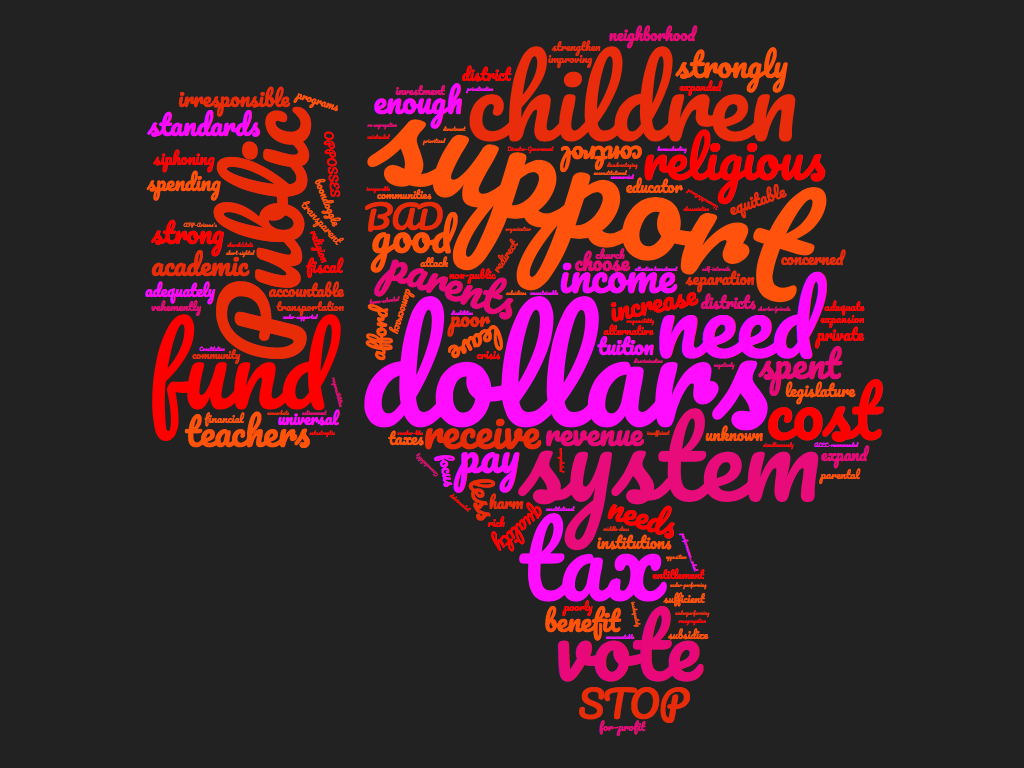
I am slightly encouraged though by the two Republican members on the House Education Committee who had the courage to stand up and do the right thing. Huge kudos to Representatives Doug Coleman and Michelle Udall who voted against the voucher expansion! I encourage each of you to email them and let them know how much you appreciate their show of support for the one million public school students in Arizona’s district schools. What also gives me hope, is the 400 plus people and their almost seven pages of 10-font, single spaced comments made against the bill in the Arizona Legislature’s Request to Speak System. Here’s a word cloud of the comments:

esa-wordcloud

This is compared to the 30 people who signed in to Request to Speak in favor of the bill. The vast majority of whom represent organizations in favor of commercialization of district schools such as The Goldwater Institute, Americans for Prosperity, Center for Arizona Policy, AZ Catholic Conference, AZ Chamber of Commerce and the American Federation for Children.

So, why these organizations? Well, let’s see. According to its website, the Goldwater Institute is a “national leader for constitutionally limited government.” Corporate reformers love to paint district schools as “government” schools, making them just another one of the targets to shrink the government, or as Grover Norquist said, “get it down to the size where we can drown it in the bathtub.” The Goldwater Institute also works closely with the corporate bill mill, the American Legislative Exchange Council (ALEC) to promote conservative corporate agendas (such as commercialization of district schools) in Arizona.

Cathi Herrod and her Center for Arizona Policy (CAP) have long pushed school choice. CAP’s website states the belief that, “Religious freedom is affirmed and protected, free from government interference.” Of course, they are for vouchers. They would love for every student in Arizona to attend religious schools on the taxpayer’s dime.

Americans for Prosperity is a conservative political advocacy group funded by the Koch brothers. On their website they write, “at the very top of AFP-Arizona’s 2017 legislative agenda is the expansion of our state’s program of parental choice Empowerment Scholarship Accounts (ESAs).” They also encourage their supporters to thank Senators Flake and McCain for voting to confirm Betsy DeVos.

It should be no surprise to anyone that the AZ Catholic Conference is also interested in fully expanding voucher eligibility. Around the nation, Catholic schools have been closing at rapid rate, from 13,000 schools enrolling 12 percent of U.S. school children in the mid–1960s, to about 7,000 schools enrolling five percent in 2012. In 2015 alone, 88 Catholic schools closed. But, a tax credit program highly favorable to private and parochial schools has helped stem previous losses in Arizona but charters are still causing them much competition for students. There are now 73 Roman Catholic private schools in Arizona and six of them are among the most expensive private schools in the Phoenix area charging from $13,300 to $17,712 per year in tuition. A $5,200 voucher obviously won’t help poor students get into these schools, but it will be a nice offset for those wealthy enough to afford the schools irrespective of the help. The average cost for private schools in Arizona by the way is about $6,000 at the elementary level and $18,000 at the high school level.

As for the Arizona Chamber of Commerce, let’s not forget how their President and CEO, Glenn Hamer, recently characterized teachers as “crybabies” for wanting adequate pay. This, when our teachers are the lowest paid in the nation and 53 percent of Arizona’s teaching positions were vacant or filled by uncertified personnel at the beginning of this year. Study after study shows a high-quality teacher is critical to student success. What does that say about the commitment of Hamer and his chamber to our students in Arizona?

Finally, let’s not forget that until she was confirmed as Secretary of Education, Betsy Devos was the Chairwoman of the American Federation for Children (AFC). AFC is a huge proponent of school choice and vouchers and has invested millions in purchasing legislators favorable to their causes. Since 2010 in fact, it has contributed some $750,000 to pro school choice legislative candidates in Arizona.

Looking at the list and knowing the resources at their disposal (just think of the Koch brothers and DeVos alone), it is easy to assume most of them have invested heavily in legislative outcomes in Arizona and around the country. Does anyone really believe these organizations have Arizona’s district school students, 56 percent of whom qualify for free and reduced lunch (an indication of their low socio-economic status) children at heart?

We all know when we read something, especially these days, we must consider the source. Well, when looking at the support for voucher expansion in Arizona, I highly encourage you to do the same. This fight against the full expansion of vouchers is far from over. Those pushing for it are no doubt emboldened by pro-voucher stance of the new POTUS and his SecED. But, the people of Arizona understand district COMMUNITY schools are the key to not only achievement for all our students, but also to the health of our communities, and the preservation of our Democracy. We must not sit on the sidelines and watch these bills get signed into law. Much too much is at stake. Want to know more about how to plug-in? Comment on this post and I’ll be in touch. Please don’t let it be said we let our students get sold out!

The Rest of the Story…

The editor of the Scottsdale Independent, Terrance Thornton, recently wrote, “the idea of choice has created a competitive public school marketplace.” I agree with his premise that school choice created competition, but add that competition is, by definition, a zero-sum game. For a charter school to “win” a student a district school has to “lose” both a student and the funding associated with that student.

Counter to what those who advocate for backpack funding would have you believe, the loss of a student is not without consequences for a district. This, since fixed costs (utilities, food, and transportation), consume almost 19 percent of per pupil funding in Arizona. In fact, Moody’s, the bond rating agency, just issued a report stating that “charter school expansion poses the risk that schools will not be able to adjust to the loss of revenue, since even if the student population drops at a district school, schools still must pay for costs like transportation and infrastructure.” And, oh by the way, don’t even get me started on the whole concept of “the funding belongs to the student.” I disagree vehemently and quote fellow blogger Peter Greene who writes, “the funding belongs to the taxpayer.” Amen brother!

In this competitive environment, district schools are forced to doing everything they can to well…compete, despite a funding level per-pupil that makes Arizona 48th in the Nation. That includes ensuring the public knows about their achievements. Even with the availability of social media, this takes money, which of course; district leaders would prefer to spend in the classroom. Unfortunately, marketing is one of the necessary “evils” of the competition forced on districts.

Thornton alleges that school board members “know very little about how the system works.” Not true. As a school board member, I am very aware of “how the system works” and I am continually impressed with fellow board members I meet from around the state. We take our elected but unpaid “jobs” very seriously and regularly attend training to keep up-to-date and learn more. The vast majority of board members are reelected to multiple terms by their constituents because they believe in the leadership they are providing.

I must say that some of the words Thornton chose seem to have a bias against district schools. For example, he wrote “established spending thresholds…allow a district to allocate funds…free from public scrutiny.” There is no expenditure of taxpayer dollars a district can legally make that is free from public scrutiny. Although at times the public must make official requests to see the information, transparency and accountability of taxpayer dollars is just one of the attributes that sets district schools apart from the commercial schools. In the case he described, the law was written to provide some procurement efficiencies (like a business would use) to ensure only those purchases above a certain level go through a public bidding process. He seems to imply that the use of commercial vendors to provide services to districts is a problem. That is though, exactly how a business would operate since usually, outsourcing a service that is not your core product is less expensive and more efficient than maintaining all those capabilities in-house.

Interestingly, commercial schools are often touted as being much less bureaucratic than district schools. It should of course, be easy to be less bureaucratic when there are very few, if any requirements to be transparent and accountable to the taxpayers. But, at least in the case of Arizona’s charter schools, their administrative expenses are double that of district schools. You read that right…charter schools in our state spend twice as much on administrative costs as district schools. How’s that for less bureaucracy?

As for the “hundreds of thousands of dollars” both Scottsdale and Paradise Valley Unified School Districts “allocate to [their] communications department[s]”, I offer two questions. First, what is the average marketing expense for a business with an operating budget equal to that of these districts? Second, how much of this funding for these districts’ “communications departments” is actually for advertisement of teacher job openings, or to fund the maintenance of the district website (primarily for the use of district parents), or for the safety of students in the form of emergency notification services (as Thornton points out in his article?) And, while we are on the subject of funding allotted to “communications departments”, it might be worth noting the amount per student of that funding. At Paradise Valley Unified (PVUSD), the “communications” costs work out to be about $5.50 per student, while Scottsdale BASIS spent about $37 per student on marketing expenses, almost seven times as much as PVUSD. This despite the BASIS.ED CEO’s contention that “effective social media campaigns have gone a long way in promoting” their schools and that “the key is word of mouth.”

Finally, yes, BASIS enjoys a fair amount of academic success but so do many district schools around the state. In fact, in the 2016 U.S. News and World Report, half were charter schools (three of them BASIS) and half were district schools. As a news professional, I am sure Thornton is well aware there is always much more to any story. Too bad he didn’t feel the need to share all sides in this one.


Wishing doesn’t make it so

Arizona’s Superintendent of Public Instruction Diane Douglas just released her 2017 “AZ Kids Can’t Wait” education plan calling for pay raises to teachers, repairing school facilities and buying new buses. At the same time, business leaders such as the CEOs of PetSmart, Goodman’s Interior Structures, and Empire Southwest Caterpillar, are proposing a five-year funding phase-in of full-day kindergarten.

These are both laudable pursuits. We know Arizona has a critical teacher shortage, our school facilities are in need of repair and upgrade, and our busses are beyond old. We also know how critical full-day kindergarten is the to the long-term success of our students both in school and beyond. But, understanding the problem is only half of the solution. The other half, is providing the funding to make it happen.

In terms of the AZ Kids Can’t Wait plan, the bill is $680 million. That’s $200 million without strings attached; $140 million to boost teacher salaries; $60 million to increase rural transportation funding and help with teacher recruitment; and $280 million to begin to address district capital funding requirements. There’s nothing wrong with Superintendent Douglas’ plan, districts desperately need this help. At a press conference where she announced it, Douglas made it clear it isn’t her job to find the funding. “I don’t appropriate money“she said, and went on to make the point that, “the state has about $450 million in it’s ‘rainy day’ fund” and it is up to the governor and lawmakers to decide to spend it on education.

Business leaders don’t appropriate state dollars either, but they are pushing full-day kindergarten because they know it is critical to moving Arizona out of 48th in quality of education. Prior to 2010, state lawmakers recognized that as well and were funding it. Then, when times got tough; the GOP-led Legislature cut $218 million from the program on the backs of some of our youngest students. That price tag was from 2010; today’s bill for reinstating full-day kindergarten is estimated at $240 million.

The total cost of funding these requirements is almost $1 billion. What’s the chances our state lawmakers will work to fund what amounts to only about $100 more per Arizona K-12 district student? I wouldn’t give odds on it. Governor Ducey has promised to reduce taxes every year he’s in office and so far, he’s on track ($8 million for business in 2016 alone.) And, cuts continue to be made to district budgets such as the move from prior-year funding to current year funding for districts, one that will cost districts statewide a total of $33 million. Then, there is the $380 million cut to District Additional Assistance funding (soft capital monies for items such as textbooks, curriculum, technology, school buses and some capital funding.) Additionally, the six-tenths of a cent per dollar sales tax provided by Prop. 301 is set to expire in 2020. If not renewed, that would be another $624 million (2015 collection) loss to our districts.

The Governor and Legislature have made it clear that raising additional tax revenue is not going to happen. Given their position, there are only two ways they can deliver any of the badly needed assistance identified above. Either they take the funding from some other part of the K-12 budget or other important program (Department of Child Safety perhaps), or they push the funding requirement down to the local level.

In the case of full-day kindergarten for example, they likely would mandate the districts fund it with the budgets they already have. Of course, many districts are already funding the program by underfunding something else because they’ve deemed it so critical to a student’s success. A mandate from state lawmakers absent additional funding does nothing to help districts and in some cases, would hurt. As far as pushing requirements down to the local level, it is a good thing that 75 percent of the bond and override measures passed this year because locally funded support has become increasingly critical as Arizona districts try to deal with the deepest cuts in the nation in K-12 per pupil funding from 2008 to 2014.

We, the voters, have culpability in this mis-match of funding to requirements. A poll of Arizonans taken after Proposition 123 passed showed that 74 percent of registered voters think the state is spending “too little” on K-12 education. Sixty-three percent also indicated they’d support extending the one percent sales tax to help pay for it.

But, politicians don’t usually respond to what voters say, they respond to how they vote and this year, as in many years past, Arizona voters have reelected legislators committed to not raising taxes. Arizona voters must realize a per pupil funding level that places us 48th in the nation, isn’t going to allow us to significantly move the achievement needle statewide. David Daugherty, Director of Research at ASU’s Morrison Institute said it well. “If Arizonans want a bright, successful, fiscally strong future for the state, a top-rate education system must be its primary investment.” If we fail in this regard, he said, “the future will be far less attractive and everyone will feel the effect.” Voters must elect legislators that believe education is an investment in our future and that have the political will to do what needs to be done to effect real change. The choice is ours, but pretending to care and then not acting in concert with that care, is duplicitous at best.

Death by a thousand cuts

A post-Prop. 123 election poll showed 74% of Arizonans support even more funding for our public schools. This, even though I suspect most of the general public has little idea about ALL the “death by a thousand cuts” our public school districts are experiencing. One of those amounts to an estimated loss of about $33 million statewide. In effect, districts will not be paid for the 2015-2016 school year due to the transition from prior-year, to current-year funding and in many cases it basically wipes out the gains districts made from Prop. 123.

Even as the voters “giveth” again via Prop. 123, the Legislature taketh away with the move last year to change the how “student count” is determined. Prior to the law change, district budgets were calculated using the 100th day average daily membership (ADM) count from the prior year. Now, districts are forced to base their budgets on an estimated number of students for the current year before school starts. Budgets are then adjusted during the year to reflect actual student enrollment. Unfortunately these adjustments are just on paper; they don’t fix the funding problem districts must then live with. If they overestimate, they’ll overspend their budgets and have state aid reduced times two the amount overspent. If they underestimate, they won’t have sufficient funding to operate for the current year. Either way, being forced to guess on student count can mean hiring freezes, delays in discretionary expenditures, postponing payments to vendors, teacher lay offs, and ultimately, the district being placed into receivership if they fail to create a solid repayment plan.

The difference to district budgets can be substantial. Balsz Unified for example, could see a $1 million reduction in their budget for 2017/2018. For TUSD, the estimated impact is $4.5 million. In addition to the resulting operational constraints, current year funding also impacts district ability to garner override and bond funds. AZCentral.com reported that if current-year funding had been the law in 2015 when Gilbert Public Schools passed their 10% override, the amount generated would have been about $300,000 less. Another consequence of the probable deficits or surpluses in ending-year cash balances is tax rates that may fluctuate drastically from one year.” That will surely please taxpayers, especially our retirees on a fixed income. Guess what block of voters are the most consistent in voting? Anyone? Anyone?…Bueller?

It is interesting that we’ve gone down this road, since we’ve traveled it before. In 1980, districts were allowed to build budgets with current year or prior year students counts. The process was changed because districts got in trouble with estimating student counts. They overspent budget capacities and miscalculated tax rates. School business officials and administrators are asking if it was a bad idea then, why is it a good idea now?

Bottom line is, it isn’t. Arizona is experiencing a critical shortage of teachers, especially highly effective ones, with many districts having numerous unfilled positions. This means substitutes are in many classrooms, classes are combined, or class sizes are larger than ever. Where there are teachers, their inexperience or turnover can have an impact on the achievement of students, especially for those in low-income and low-performing schools as well as at-risk students. Potentially exacerbating the situation, districts may be forced to (as ARS 14-544 allows) eliminate certificated teachers “to effectuate economies in the operation of the district or to improve the efficient conduct and administration of the schools of the school district.”

The projected savings from the change to current year funding is one-time and the model increases administrative burdens at a time when school districts are being directed to reduce administrative costs. It also comes when District Additional Assistance (used for soft capital costs such as classroom materials and supplies and capital funding such as facility maintenance, busses and technology) was estimated to be reduced by over $381 million. The perfect storm conditions were then made complete with the Arizona Department of Education’s transition to a new data collection system called AzEDS.

So why did the Legislature change the law? One anonymous source told me the Arizona Tax Research Association (ATRA), represented by their former Senior Research Analyst Justin Olson, pushed the change. In a February 2008 paper, ATRA advocated for: 1) moving from the “prior year plus growth” to current year funding to ensure districts are not paid for students who are now enrolled elsewhere, 2) ensuring districts student growth reports are legitimate and 3) eliminating or reduce rapid decline funding. Unfortunately, as a Prescott Schools Current Year Funding Concerns paper points out, “Current year funding will create unpredictability in ADM (average daily membership or student count), resulting in cash deficits or significant positive cash balances.” Yes, some districts experiencing student growth may receive additional funding, but it is largely offset by unpredictability that is counter-productive to employee morale.

 If the way student counts were determined was the problem, why aren’t current year numbers used for all school funding formulas? Chuck Essigs, Executive Director of the Arizona Association of School Business Officials) writes that “only the Base Support Level for both school districts and Joint Technical Education Districts will be based upon current year count,” the largest component in determining state aid and budget capacity. Other school funding components that use student count in the formulas are the Classroom Site Fund, Instructional Improvement Fund, small school exemption, tuition calculations and more.

Color me cynical, but it would appear this move is just one more step toward education privatization by the Arizona Legislature. The narrative goes like this: 1) decrease funding to district schools to make it harder for them to succeed, 2) introduce more instability to district school funding to make it harder for them to attract and retain the best teachers and 3) refuse to hold commercial schools (for-profit charters and private) to the same level of accountability and transparency to help them look better.

Want to change the narrative to one that works for 85% of Arizona’s children? Sure you do and, you know how. Let your vote be your voice on November 8th. Vote only for pro-public DISTRICT education candidates. They, like pro-district public education advocates, won’t kill charters, we recognize they have their place. We just don’t think it should be first place. What they will do, is ensure the priority for funding and support is on our district schools…the only schools that accept all students, are governed by locally elected school board members (your neighbors), are fully transparent, and are fully accountable for the taxpayer dollar!

Partisan? You bet! My party is Public Education.

I am a big believer in the two-party system. Our system of government works best when all sides are heard and considered. That is most likely to happen when the power is balanced, forcing legislators to negotiate and compromise. Our founding fathers purposefully designed many checks and balances into our system and I believe our two-party system helps in that regard.

In Arizona, the Democrats must gain only two additional seats in the State Senate to reach parity with the Republicans and in my opinion that would be a very good thing. Then, our senators from both parties would be forced to work together in finding good compromises to solve the problems facing our state.

One of the biggest problems facing our state is the inadequate resources provided our district schools. Arizona is one of the nation’s leaders in promoting school choice and although 80-plus percent of our students choose district schools, resources continue to be siphoned away from these schools in favor of other options. Many of our legislators, largely the Democrats, get this. Several Republicans are also on board.

Friends of ASBA, a sister organization of the Arizona School Boards Association, publishes an annual voting record of our legislators. This “Friends of ASBA Educating Arizona” report shows how every Arizona legislator voted on high priority K-12 education bills in 2016. The bills are grouped into three focus areas: funding, vouchers and local control, and the voting record is based on whether the legislators voted with, or against the ASBA position.

I encourage you to click here for the report to get the entire story. As you go through the report, you’ll note 56 legislators received “extra credit” for their behind the scenes efforts on behalf of public education. This credit is noted by + signs and the maximum extra credit points awarded were +++. Below, I show the Republican legislators who voted with ASBA’s position more than two-thirds of the time. I’d like the percentages to be even higher, but 33 Republican legislators didn’t even have a score higher than 50%. I should note that four Democratic legislators, Rep Sally Ann Gonzales (57%), Rep Jennifer Benally (43%), Rep Albert Hale (57%), and Rep Juan Mendez (57%) did not meet my “two-thirds of the time voting with ASBA” threshold.

LD Senator % Representative % Representative %
1 Steve Pierce++ 67 Karen Fann+ 71 Noel Campbell 71
2 Christopher Ackerley++ 71
8 TJ Shope+ 71
15 Heather Carter++ 71
16 Doug Coleman++ 100
18 Jeff Dial++ 67 Jill Norgaard 63 Bob Robson++ 71
20 Paul Boyer++ 63
21 Rick Gray+ 63
28 Adam Driggs++ 89 Kate Brophy McGee++ 71

The legislators in the chart above have at times taken brave stances on behalf of our district school students. Those I’ve actually met with seemed sincerely intent on doing the right thing for our students. They have earned my respect.

It is never a good idea to be closed to the opinions and ideas of others, nor is it smart to vote straight party line without regard to the issues and how candidates lean on those issues. For incumbents, the voting record tells us where they stand on public education. For candidates who haven’t ever been elected, it is our duty to read and listen to what they say about where they stand. And oh by the way, it is not good enough for a candidate to say he/she is “for education.” If you want to be sure they support the efforts of the schools educating over 80 percent of our students, they must say they are “for public education.” Of course, this leaves the door open for them to be staunchly pro-charter, but at least there is a modicum of transparency and accountability for the taxpayer dollars provided charter schools unlike with private options.

No matter what problems you most want solved, there can be no doubt that the more our students are prepared to deal with them, the better off we will all be. In my opinion, locally elected, governing board-led, public school districts offer the best chance we have to ensure every student has every opportunity to succeed. That’s why I am passionately pro-public education and why that’s the “party” that most matters to me.

Educated Workforce = State Prosperity

Okay. Let me get this right. Daniel Scarpinato, Press Aide to Governor Doug Ducey says Arizona schools are the 4th worst in the nation because school choice siphons taxpayer dollars out of community (district) schools into private and parochial schools, leaving those community schools underresourced. Okay, those weren’t his exact words, but that is what he intimated. His intent was of course, to invalidate the WalletHub study because it only looked at our public schools and not private schools. So, he thinks the study is invalid because it ONLY pertains to 96 percent of Arizona’s K-12 students?

WalletHub looked at 17 key metrics and found that Arizona is: 49th for pupil to teacher ratio; near the bottom in average ACT score; and below average for low-income student high school graduation rate. Even though these types of rankings are nothing new for Arizona and, he doesn’t dispute the numbers, Scarpinato called the study “baloney.” Rather, he went on to deflect the blame by citing Arizona’s rapidly increasing population as part of the problem for low per-pupil funding and sidestepped whether this meant funding should be increased to keep up with that growth. He also dismissed the idea of halting corporate tax cuts. His justification – Arizona needs to remain competitive with other states in its efforts to cut corporate taxes. The Economic Policy Institute (EPI) says “cutting taxes to capture private investment from other states is a race-to-the-bottom state economic development strategy that undermines the ability to invest in education.” We need only look at Kansas to see how this strategy works.

EPI research shows “income is higher in states where the workforce is well-educated and thus more productive.” There is, the Institute says, “a clear and strong correlation between the educational attainment of a state’s workforce and median wages in the state.” Those workers then pay more taxes to boost state budgets. The best companies know they need to go where they can get the kind of educated workforce they need, where their current employees will find good communities with high quality schools, and where the infrastructure can support their business model. That’s why states like Massachusetts (ranked #1) see education as an investment, not an expense.

Unfortunately, the AZ Legislature seems hell-bent on pushing the privatization of our community school system and will continue down this path until the voters boot them out of office. We need lawmakers who understand there can be no significant progress for our state over the long haul unless we ensure all our children are given the tools to grow and prosper. Community schools remain the schools of choice for the vast majority of our students and must be our first priority for state resources. Yes, school choice has its place in our overall educational system, but it shouldn’t be first place.