It’s Complicated

To my post on Blog for Arizona yesterday, former AZ Superintendent of Public Instruction, John Huppenthal posted the following comment:

“The 170,000 charter school students save taxpayers over 290 million dollars per year. The Peoria school district is projected to grow substantially over the next decade. With charter schools, they will not grow as much. They have enormous advantages, both financially and organizationally, over charter schools and if they can keep improving, they will actually be able [to] suck these students back into their school system from charter schools. I actually see this effect in the Chandler Unified school system. As Chandler has improved from 38% excellent rating to 75% excellent rating you can see certain charter school[s] dying on the vine. Meanwhile, public schools nationally have dropped from 36% excellent rating to 24%. Wrong direction. Competition and great leadership were both necessary for Chandler to get to where it is. We will see if Peoria is also the racehorse that responds to the challenge.”

As far as Huppenthal’s blog comments go, this is one of the more coherent ones and the statistics he cites made me want to dig in. Let’s look at a few: 

1.  170,000 charter school students – True. There are 170K or so charter school students in AZ – 170,700 at 556 schools during the 20015-16 school year to be exact.

2.  Charters save taxpayers over 290 million dollars per year – Misleading. According to the Joint Legislative Budget Committee in an overview prepared 6/22/2015, charter schools cost the state $1,232 per pupil more in Basic State Aid funding than district schools in FY 2014. Of course, that’s where it really starts to get interesting because district and charter schools each receive funding the other doesn’t. For example, districts can seek overrides and bonds and School Facilities Board funding for construction, emergency deficiency corrections and building renewal (of which there have been zero dollars for over the last three years.) Charter schools on the other hand, get “additional assistance” monies from the state general fund to compensate, and have much more flexibility in spending these monies. Charters can also get AZ Charter School Incentive Program funds to start new locations and charter land and buildings become capital assets of the charter holder regardless of whether taxpayer dollars were used to acquire said land or buildings. New this year, Governor Ducey included $100 million in the 2017 budget for the creation of an Arizona Public School Achievement District (PSAD) that will use taxpayer dollars to reduce bond borrowing costs for charter expansion or new builds. Unlike the funding provided through private investors (such as the Phoenix Industrial Development Authority enables), taxpayers are on the hook for PSAD monies if the charter holder defaults and I suspect (as with any charter bonds) the loan is ultimately repaid with taxpayer dollars.

For the actual numbers, I went to the 2014-15 AZ Superintendent’s Report, which shows that total revenues for districts exceeded those for charters by $1,278 per pupil. Given the students enrolled in each at that time, that amounts to a total amount of almost $206 million less spent on charters, not $290 million. But, only 86.57% of the total revenues for districts came from various in-state sources whereas 91.18% of charter’s revenues did. This means that in strictly “state” dollars, the district schools only cost the state $776 more per pupil for a total “savings” by charters of $125 million last year. Of course, I didn’t yet mention the $800 more per student in “small school funding” charters can get through legal, but creative accounting of their multiple locations. Oh by the way, it is also important to note that one reason district schools get more federal dollars than charters is because they educate significantly more special needs students, which are more expensive to educate and for which, districts almost never receive sufficient funds (from any source) to cover the costs.  (If I got all of this wrong, someone please correct me! I find it hard to believe charters save any substantial money over districts, maybe there’s funding I’m not counting.

Rather than focusing on who spends more though, shouldn’t we really be focusing on who uses the money more effectively? A report written this year by the Grand Canyon Institute, shows charters spend twice the amount ($1,403 vice $628 per pupil in 2014/15) on purely administrative costs than their district counterparts resulting in less money getting into the classroom. In fact, if the seven largest charter holders spent the same on administrative costs as districts, the state would save $54 million per year. BASIS Inc. alone, with 8,730 students, spent 30 times more on general administration than the six largest districts combined (225,000 students.)

3.  They have enormous advantages, both financially and organizationally – False.  If anything, charters have the advantage. From the beginning, Arizona’s charter laws were designed to free charter schools from most regulations and reporting requirements. They aren’t required for example, to follow the same procurement procedures as districts, which allows them to avoid getting competitive bids on major purchases. This lack of accountability/transparency has raised concerns about charter holders “double-dipping” for profit by procuring goods and services with their own companies. In addition, charter teachers aren’t required to be certified, nor are charters required to meet the minimum facilities standards set by the School Facilities Board (SFB) nor the requirement to provide transportation to school for their students. They also don’t have the same requirements for accountability and transparency with no locally elected governing boards and no requirement to be included in the annual AZ Auditor General’s (AG) School District Spending reports. The fact the AG does not compile, analyze spending, or make their review available to the public contributes to the overall lack of accountability we see with Arizona charter schools.

As for the improvement in Chandler “excellent” ratings or the national “excellent” ratings, I looked at the Arizona’s A-F accountability system and AIMS scores, the AzMerit scores, and the NAEP assessment, but was unable to verify the data. With regard to Huppenthal’s assertion that  “competition” was necessary for Chandler to improve, I don’t buy it. After all, Arizona has had “competition” between district schools since 1994 when “open enrollment” was first approved.  And, I find it offensive that he refers to Peoria as a racehorse that needs to “rise to the challenge.” As an “A” district they are one of the top 45 districts and charters in the state. I think they have more than already “risen to the challenge.” Besides, the education of Arizona’s children isn’t some sort of sports competition. It is important work critical to the successes of our communities, our state and our nation. The professional educators in our district schools get that, while some of the state’s charter holders laugh all the way to the bank.

Shining City on the Hill?

Yesterday, I was sitting on an American Airlines flight reflecting on my trip to our Nation’s Capitol. I was there to learn more about changes in federal laws impacting education, to network with other school board members from across the country and to advocate our members of Congress.

I had lived in D.C. twice previously, both times assigned there by the U.S. Air Force. This time though, I looked through a brand new lens. During my 22-year military career, I (appropriately) saw myself as a servant of the people. When I stood outside the White House grounds viewing the world’s most powerful leader’s residence, I felt a different call to duty. At that moment, I was reminded of our responsibility to ensure the right person sits in the Oval Office and is held accountable by each of us. Too much is at stake – from representing us to the rest of the world to controlling the launch of nuclear weapons. Not only do we have the right to vote, but a sacred duty to do so. Not primarily in our own interests, or to further our own ideology, but to ensure a more perfect union, a safer world, and a lasting legacy for all of our children.

To me, our visits to Capitol Hill highlighted the representative nature of our form of governance. At any given office we visited, there were often three groups in queue to advocate or lobby for their cause or industry. Sometimes those meetings were with the actual gracious lawmaker (as with Congresswoman Ann Kirkpatrick), but other times, we were relegated to a young staffer (as with Congressman Paul Gosar.) Either way, we and many others funneled through to influence and seek favors. But, since there will never be enough resources to accommodate all requests (many from opposite ends of the spectrum), winners and losers are assured and conflict is the natural by-product.

There were too, those visiting their nation’s Capitol to see democracy in action. Many of them school children with bar coded tour labels stuck to the front of their matching school logoed t-shirts. There was a man with a bullhorn whose message I didn’t quite get, but he was intent on exercising his first amendment rights even if no one cared to listen. I also noticed the youth that defines so many of those who live and work in the city. It occurred to me that although the average age of those in the U.S. Senate is 61 years old, the daily grind of running our country is in the hands of those with enough energy to meet the challenge.

So, what’s my takeaway? Am I more or less hopeful for the future? Guess I have to say I’m still somewhere in between. Spending time with fellow school board members – “volunteer” elected officials from around the country who had made the trip to D.C. to fight for their students – made be optimistic. Hearing their stories of the on-going war against public education in their states highlighted the hard fight still ahead. The countless young people everywhere I looked, made me optimistic. But, so were there signs everywhere that the world is becoming more dangerous by the minute with bollards, fences, metal detectors and armed law enforcement officers around every corner. Going to see the Senate in session, only to find them departed by the time I worked my way through all the security checkpoints, reminded me of a quote from Benjamin Franklin: “Those who sacrifice liberty for security deserve neither.”

The one thing I know for sure after my visit is that our democracy is sacred and must be safeguarded. President-Elect John F. Kennedy quoted John Winthrop in 1961 when he said: “We must always consider that we shall be as a city upon a hill – the eyes of all people are upon us.” I don’t think it is too extreme a stretch to say this year’s presidential election could decide whether that shine returns to its original luster, or is forever tarnished. It really is up to each of us, let’s hope we are up to the challenge.

A Must Read: The Great American Bathroom Controversy

Quote of the Day: “Have people who identify and look and dress and act like women, forced to go into a men’s room. Have people who identify and look and act and dress like men forced to go into a ladies room. Are you nuts?” Rep. Alan Grayson speaking to Congress about the recent North Carolina law.

Climate change. Crumbling infrastructure. Dark money in politics. Health care costs. Immigration policy. Foreign policies toward China, Russia, and the Middle East. Transgender use of bathrooms.

Yes, these are all pressing issues. That is, all but one.

I’ve blogged about this in the past, marveling at how the party of Lincoln has evolved from Boardroom Republicans to Bedroom Republicans to Bathroom Republicans. And they have found a new class of citizen to discriminate against.

And I’ve laid out the facts about transgendered people.. Here’s the short of it.

So the facts are these. Gender identity is a product of both biological and social factors. It is formed very early in life, and once formed, it is difficult, if not impossible, to change. Transgendered individuals are found in virtually every society on this planet and some societies even identify transgendered persons as a unique gender.

So Republican governors are full of s#!t when they claim that this is a “local” issue. It is not. It is a global fact.

Once again I have to ask: how in the hell did America manage to put use of gender-appropriate bathrooms on the same level as all the other issues facing our country. I’ll stick my (childhood) Lutheran neck out and claim that there is no biblical support for any of that discriminatory policy. Continuing, what kind of family values condone discrimination against someone unlike yourself? And I’ve already stuck my experimental scientist neck out on the matter of the facts (above); three-year olds do not make a conscious choice to be transgendered. Below is a lot more.

A couple of days ago Rep. Alan Grayson (D, Florida), candidate for US Senate, addressed the House of Representatives about what he calls the Great American BathRoom Controversy.

Following is the full text, in italics, of Grayson’s remarks (from an email message dated May14th, 2016). Grayson’s remarks are the most cutting and impassioned that I’ve seen on this sorry topic. It’s a long speech, but please read on. I wind up at the end with an update with a local theme from this morning’s Daily Star.

“I rise today to address the Great American bathroom controversy. This is a picture, on my right, of someone who may or may not be recognizable to many Americans today. I’ll say her name; the name may be more recognizable to some. Her name is Christine Jorgensen. y or may not be recognizable to many Americans today.

Christine was born in 1926; she grew up in the Bronx like I did. She went to Columbus High School, near the public housing where I grew up in the Bronx. In fact, my father taught history at Christopher Columbus High School. I don’t know whether he taught Christine or not. But it is possible.

In 1945, Christine was drafted and served in the U.S. military. Now that may be a puzzle to some of you listening to me right now, who say, ‘I didn’t realize that women were drafted in the 1940’s.’ Well, at that time, Christine’s name was George. George Jorgensen. That’s the name she was born with. She was, in fact — on her birth certificate — male. Something she struggled with greatly all through the time she was growing up, being a male. Something she struggled with, being in the military.

And then after leaving the military service in 1951, she heard about the possibility of changing her gender, so she went to Denmark and underwent three or more surgeries, plus a very substantial amount of estrogen treatments; she came back to the United States, and then forever thereafter, after 1953, was known as Christine Jorgensen. Christine Jorgensen was “out,” she was well known in America as someone who was transgender.

I knew about her story when I was growing up in the 1960’s and 1970’s. She made no effort to hide it. She didn’t feel any shame about it. She was proud of the fact that she’d been able to take advantage of what medicine had to offer, and live the life that she felt she would have been able to have, if at the beginning, she had had the proper gender.

She had some degree of fame. Republican Vice President Spiro Agnew referred to her once in a speech to mock one of his opponents. She performed both as a singer and as an actress all through the 1950’s, through the entire 1960’s, and well into the 1970’s. She was the most famous transgendered person in America, probably to this day.

Now, I have to tell you, I don’t know exactly where she went when she “had to go.” I don’t know exactly whether she went into a men’s room or ladies room, but here’s the interesting thing: Even though this was something new under the sun, even though America never had to address this issue before, no one ever even bothered to ask. I don’t remember anybody saying, ‘Christine Jorgensen, she ought to go to the men’s room, she was born a male.’ Or for that matter, ‘Christine Jorgensen, she identifies as a female, she should go to the ladies room.’ Isn’t it odd that America in the 1950’s seems to have shown a lot more maturity than America is showing today, with our great bathroom controversy right now — where the cisgender people of America try to dictate to the transgender people of America where they can go to the bathroom. Or at least, frankly, the more bigoted among us.

We had a law pass recently in North Carolina. I’m going to go out on a limb and say it passed almost exclusively with cisgendered Republican votes. They tried to dictate to which bathroom Christine Jorgensen would have to go, if she were alive today and had to relieve herself. And amazingly enough, they decided in their ‘wisdom’, that Christine Jorgensen, if she were alive today, like all other transgender brothers and sisters, Christine Jorgensen would have to go to the bathroom she didn’t identify as, but instead, the bathroom on her birth certificate.

This is particularly ironic. There was one form of discrimination that Christine Jorgensen did face in her lifetime. She was not allowed to get married. Not allowed to get married to a man because her birth certificate said that she was a male, and she was not issued a marriage license on account of the fact that a male was trying to marry a male.

My goodness! Here in America, just in the past 12 months or so, we finally managed to solve that problem, and Christine Jorgensen could get married today to her lover. Now we have a whole new problem. Now, thanks to Republicans, bigots in North Carolina, we have a law that would require Christine Jorgensen to go to the men’s room.

Think about that. Think about that.

In fact, the natural consequence of that law is what I’m about to show you right here.

Here Grayson includes a photo of two women using urinals in a men’s bathroom.

So you folks in North Carolina who are obsessed with where the transgender people go to the bathroom, this is the result you’ve come up with.

People who self-identify as women, people who look like women, people who act like women, they somehow are being driven into the men’s room. And the same thing is true of transgender people who identify as men. You’re going to force people who look like men, act like men, you’re going to force them into a ladies room.

My God, what’s wrong with you? That doesn’t make any sense at all.

More follows the break.

Continue reading

Biggs is a Neanderthal

In directing public school districts to let students use bathrooms and locker rooms consistent with their gender identity, President Obama’s administration recognized the need to provide top-down cover for a group of people that are routinely subjected to severe discrimination. They also recognized that assuring the civil rights (the right to receive equal treatment and ensure one’s ability to participate in civil life without discrimination or repression) of a minority couldn’t be left to the majority. That’s why Diane Douglas is wrong when she says “Every local community across Arizona is unique, and I know that the people who live in those communities should be making the decisions when it comes to this and many other education issues.” How well did “leaving it to communities” work for Black people in the deep South during the Jim Crow days?

Look, I get that many people are uneasy with the whole transgender issue. I managed Wingspan, (Arizona’s LGBT Community Center), for over a year and had more exposure than most to the transgender community. We had transgender people on staff (a couple of them were transitioning during the time I worked there) and we supported the Southern Arizona Gender Alliance (SAGA.) If I am totally honest, I still struggle with totally embracing this community. But, I have great respect for what transgender people go through just to be themselves. And I know beyond a shadow of a doubt, that no one would put themselves through the ridicule, discrimination and pain of transitioning unless they felt they had no other option. My bottom line is that I accept transgender people and respect their right to live freely and safely as equal members of our society.

Arizona Senate President Andy Biggs obviously doesn’t feel the same way. He said the Administration’s directive “has no place in the value system that we seek to instill in our children from their earliest age” and that “the rules and norms of modern society may change, but biology will not”. With this statement, Biggs demonstrates what a complete Neanderthal he is. First of all, the definition of biology is that it is a natural science concerned with the study of life and living organisms, including their structure, function, growth, EVOLUTION, distribution, identification and taxonomy. Biology, as the study of life and living organisms, is not static, but constantly changing. I read once that 100 species per day go extinct and that in 2011, scientists discovered nearly 20,000 new species. Obviously, biology DOES change and more importantly, the more we learn, the more our understanding of it changes.

Secondly, we can’t really “instill” gender identity in our children. We can try to get them to conform to “social expectations that may accompany a given gender role” “but this can exacerbate the disconnect transgender children feel. I have met very young children who absolutely know they weren’t born into the correct gender. The lucky ones have supportive parents who help them pave their own path. Those not so fortunate have a much tougher road to hoe, one that more often than not leads to multiple suicide attempts (if the first try doesn’t succeed.) The American Psychological Association corroborates that transgender children are more likely to experience harassment and violence in school and other group programs than other children. Transgender adults are at increased risk for stress, isolation, anxiety, depression, poor self-esteem and suicide. In fact, transgender people have an extremely high rate of suicide attempts, 41 percent versus a national average of 1.6 percent.

In addition, there are biological causes for the “gender dysphoria” or “gender identity disorder”(GID) many transgender people experience. “Evidence suggests that people who identify with a gender different from the one they were assigned at birth, may do so not just due to psychological or behavioral causes, but also biological ones related to their genetics, the makeup of their brains, or prenatal exposure to hormones.” Genetic variation, hormones, and difference in brain functioning and brain structures provide evidence for the biological cause of   In fact, twin studies indicate GID is 62% inheritable. (NOTE: gender identity has nothing to do with sexual preference and a transgender person may or may not have had any surgeries to bring their body in “conformance” with their gender identity.)

Ever notice how if Arizona lawmakers and administrators don’t want to deal with an issue, and it doesn’t detract from the ability of one of their supporters to make profit, it becomes something that should be dealt with at the local level? Just look at Douglas’ comment on AZCentral.com that she has“full confidence that government at its least and lowest level is most answerable to constituents on these matters.” Yet time and again t found these same people have found local government is incapable of making decisions about “life-altering” matters such as the use of plastic shopping bags, the admission of guns on school property, and the rights of pet shops to sell puppy mill dogs; all of which had significant lobbyist support for state lawmaker intervention.

As with any struggle for civil rights, this one will be tumultuous. The best approach is for communities to learn about the issue and have open discussions about the way forward. It cannot though, be left to individual communities to determine the “rightness” of the equality sought. That’s why the President’s directive is important. It is a validation of the “immortal declaration” in the Declaration of Independence that states: “We hold these truths to be self-evident, that all men are created equal, and that they are endowed by their Creator with certain unalienable Rights, that among these are Life, Liberty, and the Pursuit of Happiness. It really is that simple.


Our Nation Hangs in the Balance

Nine months ago, it was virtually impossible to imagine Donald Trump as the apparent nominee of any political party in the United States, let alone that of a major one. Yet here we are. And although I understand the seething sentiments behind his rise, I am still incredulous that his “shtick” has actually worked.

I recently had a conversation with my Dad about whom he was going to vote for in the primary. When he told me Trump, it took me back a little, but then I delved a little deeper. My Dad was a Green Beret and still lives, eats, and breathes his military service. When I asked him what he thought about Trump saying he would “force the U.S. military to commit war crimes”, he responded with “oh he’s just spouting off.”

This statement made me realize that there really is no making sense of those who vote for Trump. They like how he speaks his mind, but then when he goes overboard, they chalk it up to Trump being Trump (boys will be boys.) They like his toughness, so much so that those who have been abused at campaign rallies actually draw the ire of Trump supporters. They eat up the nonsense he spouts off because they want to believe America can return to a “simpler” timed.

At 84 years of age, my Dad has a solidly middle-class quality of life that is much better than he could have envisioned as a young man. Despite that, I suspect he longs for the “good old days” portrayed in Leave it to Beaver and the Andy Griffith show. Yes, life was simpler then and the American Dream was very much alive (at least for some people.) The truth is though, no matter who gets elected President, America will never be going back to those days. Our country is less homogenous and more complex than ever and that trend will only continue.

On MSNBC’s “Morning Joe” this morning, the director, Rob Reiner, said of Trump: “The words that have been flung out from his mouth are insane. If he was not a celebrity, if Donald Trump was not a celebrity, the words that come out of his mouth, you’d see a guy in a park, a lunatic in a park on a soapbox, and you’d walk right by him. But the fact that he is a celebrity, all of a sudden, we’re all interested.” (I actually think it also has to do with him being very wealthy.)

Then, when one of the show’s regulars, Willie Geist, basically asked how Reiner explains all the millions and millions of people who like what they hear from Trump and are voting for him? Reiner said “Well, there are a lot of people who are racist.”

Much has been made of the shocked reaction of the hosts and regulars to Reiner’s comment because after all, any reasonable person could easily conclude not only are some of Trump’s supporters racist, but that he himself is both a racist and a mysogynist. Trump is the one who said:

He also by the way, was the only presidential candidate endorsed by David Duke of the KKK.

The real shocker is that any thinking person would be remotely surprised that Trump is referred to as a racist, and I applaud Rob Reiner for saying what others haven’t. Reiner should “know one if he sees one” after all, he played Archie Bunker’s “Meathead” son-in-law on “All in the Family” for seven years. Come to think of it, Archie Bunker’s world is probably a place many of Trump’s supporters would like to revisit. Communities were less diverse, women didn’t work outside the home and deferred to their husbands, and political correctness wasn’t even a term yet.

The really depressing thing for me about the Trump candidacy is not the candidate himself; he’s just one delusional narcissist. What most has me down about the Trump phenomena is how many people have bought into his bullshit hook, line and sinker. Don’t get me wrong. I’m not saying that all Trump supporters are bad people. Many of them are probably just people who have been dealt some hard knocks in life and are tired of things not getting better. It is scary though that even if Trump loses, his supporters will still be around and they’ll likely be even more angry and vocal. This will pose a problem for the next president to deal with. We certainly don’t need a country more polarized than it is now.

In the final analysis though, those who truly believe Trump is the answer are probably on the fringe. Most of us know that no president has the power to fix all that ails us and ultimately we need a steady hand at the helm. Who shows up to vote though, will determine what the future holds. It brings to mind the Thomas Jefferson quote “We in America do not have government by the majority. We have government by the majority who participate.”

I’m advocating that for the November elections, you commit to voting and that you get one new voter to the polls. I’m calling it #YouPlusOne. The future of our nation likely hangs in the balance.

The dawn of the American 3-party system: What the failure of all the king’s horses and all the king’s men means for America

Cross-posted from SkyIslandScriber.com.

“Humpty Dumpty sat on a wall,
Humpty Dumpty had a great fall.
All the king’s horses and all the king’s men
Couldn’t put Humpty together again.” (from the Wiki entry)

What is unfolding in American politics has not been seen in over 100 years. And what is happening this year may never have been seen before. We are witnessing the division of one of our two major political parties with what amounts to a divorce between two factions. One is a traditionalist group (“establishment”) and the other is an awakened, psychologically distinct movement (“Authoritarians”). The distinction has its roots in psychological and political science research.

The summary of that research, the analysis and synthesis, has produced the most important document of this election year. The report, to be covered in some detail here, enlists fundamental social psychological research in service of our understanding of current political events. We will learn why “all the king’s horses and all the king’s men” — the Republican Royalty — have failed to contain the movement headed by Donald Trump. We will learn why that means that a major political party is fracturing in real time. If my assessment is correct, we are the audience in the theatre of history witnessing a centennial event.

Resistance to the rise of Donald Trump

Here is how the LA Times’ editorial leads off (Daily Star editorial this morning).

Donald Trump is not fit to be president of the United States. Many people have said it — politicians of both parties, economists, pundits, business leaders — but millions of GOP primary voters don’t seem to be listening.

Much of the Republican base has taken leave of its senses, a flight blamed alternately on inchoate anger, disgust with inside-the-Beltway candidates and misplaced affection for a plain-speaking cartoon character who often seems to utter whatever nonsense comes into his head.

In another op-ed in the Daily Star, Michael Gerson speculates about strategies before and during the Republican convention that would deny Trump the nomination.

The New York Times summarizes reactions of Trump supporters to attempts to block Trump’s nomination as the GOP candidate (specifically Mitt Romney’s speech).

Conservative talk radio shows lit up Friday with incensed callers who said they were “livid,” “mad” and “on the verge of tears” as they listened to Mr. Romney scoldingly describe what he called Mr. Trump’s misogyny, vulgarity and dishonesty, and urged them to abandon him.

“The Trumpists out there,” predicted Rush Limbaugh, “are going to feel like the establishment is trying to manipulate them, sucker them, and they’re just going to dig in deeper.”

They did.

Limbaugh’s analysis is incredibly important for understanding what is unfolding in 2016 and what it means for American politics in the long run. More on that below.

“take over the GOP or blow it up”

… Steve from Temecula, Calif., said he had a message for Mr. Romney: “The Republican electorate is not a bunch of completely ignorant fools.”

“We know who Donald Trump is,” he added, “and we’re going to use Donald Trump to either take over the G.O.P. or blow it up.

“the people want Trump”

Frustrated Republicans seized on Mr. Romney’s status as a party insider who was insulated from the realities, indignities and rage of average Americans headed to the polls this year. “He’s an establishment figure,” said Faith Sheptoski-Forbush of Romulus, Mich. “So that’s what you get.”

She called Mr. Romney’s diatribe against Mr. Trump “a desperate attempt” that left her deeply disappointed in him.

“What we need is the voice of the people,” Ms. Sheptoski-Forbush said. “The voice of the people want Trump.”

But there were positive reactions to Romney’s speech.

New Yorkers “offered their gratitude”

As Mr. Romney hopped between television stations on Friday, proclaiming his dismay over Mr. Trump’s crudeness, challenging his decency and questioning his integrity, he declared that his overtures were breaking through — though not necessarily to the audience he intended. In an interview conducted inside the headquarters of Bloomberg News in Manhattan, far from the crucial primary voting states that could decide Mr. Trump’s fate, he observed that Midtown office workers had offered their gratitude as he rode up to the studio.

“Just coming up the escalator, Mr. Romney said, people said, “ ‘Thanks for what you did yesterday.’ ”

Contrasting those reactions reveals a deep schism among Republican voters.

Why Humpty cannot be put together again

It is natural that during an election year that the focus is on the candidates. The media combs through the record to reveal their policy positions and their personal foibles. We hear about Sanders’ socialism and Clintons’s emails. We are forced to hear about Fiorina’s face and Trump’s hair. But this year, especially this year, the focus on individual candidates is not the main news.

The big story is the voters themselves. The assertion that “millions of GOP primary voters don’t seem to be listening” to “politicians of both parties, economists, pundits, business leaders” is flat-out wrong. They are listening and they do not like what they are hearing. The other assertion that “the Republican base has taken leave of its senses” is just as wrong. The part of the Republican base responsible for Trump’s lead in the polls and at the ballot box is perfectly sensible; they are just not well understood by the “politicians of both parties, economists, pundits, business leaders”. So who are those voters?

Of particular interest is that subset of mainly Republican voters who are called, for want of a better term, Authoritarians. They are not “Trumpist” and there is no “Trumpism” (even though I’ve used those terms myself). Those terms are candidate-centered and thus misleading about the underlying psychology. Those voters represent a movement that has gained voice through Trump. We are witnessing “The rise of American authoritarianism”. That’s the title of a review of research on Authoritarians by Amanda Taub at Vox.com (see also AZBlueMeanie’s review of related articles)

The quotes above from some of Trump’s supporters reflect a widening split between Republicans – between the Establishment (Elites, Traditionals) and the new Authoritarians. Research on the authoritarian personality suggests a new alignment in American politics. The more the Establishment leans on Trump, the more alienated and defensive his Authoritarian supporters become. Similarly, the more the Democratic candidates advocate for social change and a restrained military, the more threatened the Authoritarians become. The irony here is that both the Republican Establishment and the Democrats are sources of external threat which activates Authoritarian tendencies. Usually external threat tends to draw people together and reduce intra-group differences. But in this case the threat comes from within the Republican party, a party that increasingly seems fatally divided.

Some of the staunchest conservatives blanch at the ideas espoused by Trump. But those ideas, to the extent that he voices them, reflect the beliefs of the Authoritarians who support him. It is hard to see how those groups can be united given the mutual dislike and distrust. Even if they were to come together in 2016 to defeat the Democratic nominee, the schism will be a lingering, festering wound in the “Republican” “party”.

A précis of modern research on the Authoritarians

What do we know about Authoritarians? The answer is important because one of the puzzles of the rise of Trump has been why he attracted so many so quickly.

The following snippets are from Taub’s “The rise of American authoritarianism”.

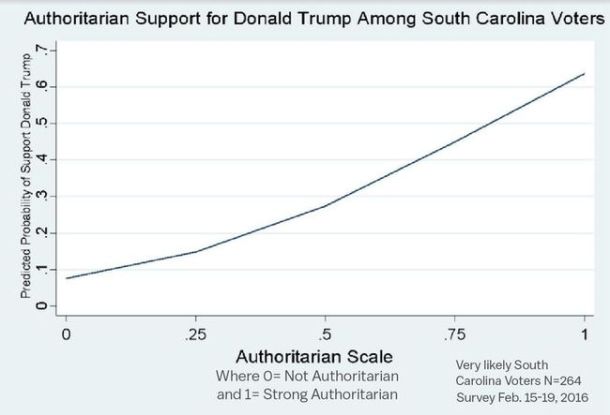
[Matthew MacWillians, a PhD student at U. Mass.] polled a large sample of likely voters, looking for correlations between support for Trump and views that align with authoritarianism. What he found was astonishing: Not only did authoritarianism correlate, but it seemed to predict support for Trump more reliably than virtually any other indicator. He later repeated the same poll in South Carolina, shortly before the primary there, and found the same results, which he published in Vox …

Here, in a single chart, is the principle result of MacWilliams’ research. Individuals who score highly on measures of Authoritarianism are also those who are most likely to support Trump.

[Another research group headed by] Hetherington and Weiler published a book about the effects of authoritarianism on American politics. Through a series of experiments and careful data analysis, they had come to a surprising conclusion: Much of the polarization dividing American politics was fueled not just by gerrymandering or money in politics or the other oft-cited variables, but by an unnoticed but surprisingly large electoral group — authoritarians.

Their book concluded that the GOP, by positioning itself as the party of traditional values and law and order, had unknowingly attracted what would turn out to be a vast and previously bipartisan population of Americans with authoritarian tendencies.

This trend had been accelerated in recent years by demographic and economic changes such as immigration, which “activated” authoritarian tendencies, leading many Americans to seek out a strongman leader who would preserve a status quo they feel is under threat and impose order on a world they perceive as increasingly alien.

These Americans with authoritarian views, they found, were sorting into the GOP, driving polarization. But they were also creating a divide within the party, at first latent, between traditional Republican voters and this group whose views were simultaneously less orthodox and, often, more extreme.

The field [of research on Authoritarians] has come to develop the contours of a grand theory of authoritarianism, culminating quite recently, in 2005, with [Karen] Stenner’s seminal The Authoritarian Dynamic — just in time for that theory to seemingly come true, more rapidly and in greater force than any of them had imagined, in the personage of one Donald Trump and his norm-shattering rise.

According to Stenner’s theory, there is a certain subset of people who hold latent authoritarian tendencies. These tendencies can be triggered or “activated” by the perception of physical threats or by destabilizing social change, leading those individuals to desire policies and leaders that we might more colloquially call authoritarian.

It is as if, the NYU professor [ and author of The Righteous Mind ] Jonathan Haidt has written, a button is pushed that says, “In case of moral threat, lock down the borders, kick out those who are different, and punish those who are morally deviant.”

But political scientists say this theory explains much more than just Donald Trump, placing him within larger trends in American politics: polarization, the rightward shift of the Republican Party, and the rise within that party of a dissident faction challenging GOP orthodoxies and upending American politics.

More than that, authoritarianism reveals the connections between several seemingly disparate stories about American politics. And it suggest that a combination of demographic, economic, and political forces, by awakening this authoritarian class of voters that has coalesced around Trump, have created what is essentially a new political party within the GOP — a phenomenon that broke into public view with the 2016 election but will persist long after it has ended.

Conclusions about Authoritarians in America’s politics

… Authoritarians may be a slight majority within the GOP, and thus able to force their will within the party, but they are too few and their views too unpopular to win a national election on their own.

And so the rise of authoritarianism as a force within American politics means we may now have a de facto three-party system: the Democrats, the GOP establishment, and the GOP authoritarians.

… although the latter two groups are presently forced into an awkward coalition, the GOP establishment has demonstrated a complete inability to regain control over the renegade authoritarians, and the authoritarians are actively opposed to the establishment’s centrist goals and uninterested in its economic platform.

For decades, the Republican Party has been winning over authoritarians by implicitly promising to stand firm against the tide of social change, and to be the party of force and power rather than the party of negotiation and compromise. But now it may be discovering that its strategy has worked too well — and threatens to tear the party apart.

Now, you can see, why I’ve capitalized Authoritarian. It is my way of elevating that group to the same status as Democrat and Republican.

Further reading: A linked table of contents

You owe it to your understanding of current events to read all of Taub’s article. Its target audience is you. Here are links to parts of her article that you can use to read it in manageable chunks.

I. What is American authoritarianism?
II. The discovery.
III. How authoritarianism works.
IV. What can authoritarianism explain?
V. The party of authoritarians.
VI. Trump, authoritarians, and fear.
VII. America’s changing social landscape.
VIII. What authoritarians want.
IX. How authoritarians will change American politics.

Whatever your reading preference, please, please read this article in its entirety. Now! History is happening and it will not wait for you.

Liars Figure and Figures Lie

The Office of Arizona Auditor General just released its 2015 “Dollars in the Classroom.” The report makes it clear that Arizona continues to struggle to adequately fund district schools while trying to stay consistent with classroom dollars and keep administrative costs below the national average.

The report also highlights the lower teacher salaries and larger classes which translate into fewer dollars for teaching and learning. But, what isn’t clear in the report is that the definition of “classroom” has changed. In last year’s budget, “classroom” was redefined as instruction, instructional support and student support. This change was made to more accurately reflect all the costs that go into classroom instruction, such as: physical and occupational therapists; reading and math intervention specialists; media specialists/librarians; counselors and social workers. The Auditor General’s Report doesn’t reflect that change for 2015.

Even so, the report shows school district classroom spending at 53.6%, whereas the AZ Superintendent of Public Instruction’s report shows charter school classroom spending at 50.8%. Likewise, a recent report showed that AZ charter schools spend more than twice the amount school districts do in administration (costing taxpayers an extra $128 million). Charter schools may be public schools, but they are not included for analysis in the Auditor General’s Dollars in the Classroom Report (surprise, surprise.)

Although Arizona spends less on administration than any other state and is far below the national average, it’s classroom spending continues to be low. There are multiple reasons for this such as: low-overall funding (48th in nation); students poorer than the national average who require additional support services (ELL instruction; meal assistance; tutoring; etc.); higher plant operation due to temperature extremes; higher costs per square footage due to aging and inadequate funding for maintenance; and higher transportation costs due to vast rural and remote areas.

Dr. Tim Ogle, Executive Director of the Arizona School Boards Association, writes that “We continue to stand by the fact that the “dollars in the classroom” measure is an outmoded way of benchmarking how Arizona supports student success. It does not describe effective use of dollars dedicated to teaching, learning and graduating students that are equipped with the skills to succeed in the real world. The real issue should be student achievement.”

Ah yes, but true achievement is hard to track, measure, and compile. True achievement is tracked by teachers in their classrooms, and parents in their homes. True achievement comes when the environment surrounding a student is conducive to learning, and when the adults at every stage of the process, are student focused.


Economic Inequality: The defining challenge of our times

Crossposted from SkyIslandScriber.com.

That’s what President Obama labeled economic inequality. Some writers went beyond and identified economic inequality as the central issue for the 2016 presidential election. To be sure, the death of Justice Scalia and the political battle it created seems to have usurped inequality as a central issue. But one way or another, the Supreme Court nomination and confirmation will be settled. Extreme economic inequality will remain. The gap between rich and poor continues to increase. It is the dividing issue between the two political parties. How inequality is approached distinguishes, if not divides, the two Democratic candidates.

Scriber thinks the issues reduce to three questions. (1) What does the electorate know about inequality? (2) What are its consequences? (3) What do we do about it?

What does the electorate believe about inequality?

This graphic is the best place to start. Take 5 minutes and watch the YouTube visual representation of inequality in America.

That graphic was based on the original report on the discrepancies between our ideal distribution of wealth, our guess about that distribution, and the reality. An article in Scientific American covers this and two additional research reports.

Here’s the abstract of a followup piece of research: “How Much (More) Should CEOs Make? A Universal Desire for More Equal Pay“.

Do people from different countries and different backgrounds have similar preferences for how much more the rich should earn than the poor? Using survey data from 40 countries (N = 55,238), we compare respondents’ estimates of the wages of people in different occupations—chief executive officers, cabinet ministers, and unskilled workers—to their ideals for what those wages should be. We show that ideal pay gaps between skilled and unskilled workers are significantly smaller than estimated pay gaps and that there is consensus across countries, socioeconomic status, and political beliefs. Moreover, data from 16 countries reveals that people dramatically underestimate actual pay inequality. In the United States—where underestimation was particularly pronounced—the actual pay ratio of CEOs to unskilled workers (354:1) far exceeded the estimated ratio (30:1), which in turn far exceeded the ideal ratio (7:1). In sum, respondents underestimate actual pay gaps, and their ideal pay gaps are even further from reality than those underestimates.

The disconnects between what we believe about inequality and the reality extend to our beliefs about the American dream, that is, mobility. Here’s the abstract of “Building a More Mobile America – One Income Quintile at a Time

A core tenet of the American ethos is that there is considerable economic mobility. Americans seem willing to accept vast financial inequalities as long as they believe that everyone has the opportunity to succeed. We examined whether people’s beliefs about the amount of economic mobility in the contemporary United States conform to reality. We found that: (1) people believe there is more upward mobility than downward mobility, (2) people overestimate the amount of upward mobility and underestimate the amount of downward mobility, (3) poorer individuals believe there is more mobility than richer individuals, and (4) political affiliation influences perceptions of economic mobility, with conservatives believing that the economic system is more dynamic—with more people moving both up and down the income distribution—than liberals do. We discuss how these findings can shed light on the intensity and nature of political debate in the United States on economic inequality and opportunity.

We may be free and brave but we sure are not equal. Scientific American continues.

We may not want to believe it, but the United States is now the most unequal of all Western nations. To make matters worse, America has considerably less social mobility than Canada and Europe.

By overemphasizing individual mobility, we ignore important social determinants of success like family inheritance, social connections, and structural discrimination. The three papers in Perspectives on Psychological Science indicate not only that economic inequality is much worse than we think, but also that social mobility is less than you’d imagine. Our unique brand of optimism prevents us from making any real changes.

George Carlin joked that, “the reason they call it the American Dream is because you have to be asleep to believe it.” How do we wake up?

The article in Scientific American was introduced this way.

In a candid conversation with Frank Rich last fall, Chris Rock said, “Oh, people don’t even know. If poor people knew how rich rich people are, there would be riots in the streets.” …

So societal upheaval is a possible outcome of the obscenely extreme gaps between rich and poor. That possibility is explored below.

What are the consequences of extreme inequality?

I posted two lengthy reports in the recent past so I will just provide the links and brief comments.

Societal upheaval is a possibility. Or maybe a certainty? The “pitchforks” article was written by a billionaire and addressed to his fellow 0.1%ers.

If we don’t do something to fix the glaring inequities in this economy, the pitchforks are going to come for us. No society can sustain this kind of rising inequality. In fact, there is no example in human history where wealth accumulated like this and the pitchforks didn’t eventually come out. You show me a highly unequal society, and I will show you a police state. Or an uprising. There are no counterexamples. None. It’s not if, it’s when.

I ended my post this way.

… if candidates do not take on the issue of economic inequality, the pitchforks will come. My fear is that the pitchforks will be assault weapons and their wielders, led by some demagogue, will be wrapped in the Stars and Stripes, carrying their bibles, and chanting Liberte’ and Christianite’.

Another certainty is that inequality has a variety of side effects, one being shorter life expectancies: “only the poor die young” was my title.

The NY Times has the report on a correlate of increasing wealth inequality: life expectancy. If you are at the bottom of the wealth ladder, you are likely to die sooner. And that trend in life expectancies of rich and poor, like wealth inequality, is on the increase. The numbers are stunning. …

Experts have long known that rich people generally live longer than poor people. But a growing body of data shows a more disturbing pattern: Despite big advances in medicine, technology and education, the longevity gap between high-income and low-income Americans has been widening sharply.

Below is a table based on research reported by the Times showing the differences between the top and bottom 10% brackets. The wealthiest are outliving the poorest and that difference is increasing.

Gender Born in 1920 Born in 1950
Men 6.0 years 14 years
Women 4.7 years 13 years

And because the wealthiest live longer they are disproportionately the beneficiaries of social network programs like Medicare and Social Security.

What can we do about it?

Nick Hannauer in the “pitchforks are coming” article calls for FDR-like policy changes, one of which could be a return to higher top tax rates. Paul Buchheit (commondreams.org) concurs and lists 5 Reasons the Top Tax Rate Should Be 80%.

Here is a sixth: “over two-thirds of Americans favor increased taxes on people making over a million dollars. The desire to reduce inequality is not extreme at all.” The evidence? Most Americans do not know how severe the inequality is but have reasonable views on the proper distribution of wealth..

Informed Americans understand that an economic war has been waged against the middle and lower classes. As a result, there are at least five good reasons why the tax rate on the upper classes should be MUCH higher.

(1) Massive Redistribution Has Occurred. Upward.

Total U.S. wealth increased by a stunning 60 percent since 2009, from $54 trillion to $86 trillion, but 3/4 of that massive increase went to the richest 10% of Americans.

(2) Subsidies to the Rich are SIX Times Greater Than Subsidies to the Poor

The cost of the entire Safety Net is only about ONE-SIXTH of the $2.2 trillion in tax expenditures, tax underpayments, tax havens, and corporate nonpayment, the great majority of which went to the richest Americans.

(3) The Super-Rich are the Main Beneficiaries of Our Nation’s Prosperity

… The wealthiest individuals and corporations are the main beneficiaries of tax laws, tax breaks, property rights, zoning rules, patent and copyright provisions, trade pacts, antitrust legislation, and contract regulations. …

… Businesses rely on roads and seaports and airports to ship their products, the FAA and TSA and Coast Guard and Department of Transportation to safeguard them, a nationwide energy grid to power their factories, communications towers and satellites to conduct online business, the Department of Commerce to promote and safeguard global markets, the U.S. Navy to monitor shipping lanes, and FEMA to clean up after them.

But instead of paying for all the taxpayer-funded benefits, S&P corporations have spent 95 percent of its profits on stock buybacks and dividend payouts to enrich their investors.

(4) Progressive Taxes Actually Work

The prominent economic team of Piketty and Saez and Stantcheva determined that “the top tax rate could potentially be set as high as 83%” before the highest earners are discouraged from attempting to earn more. The National Bureau of Economic Research goes further, proposing a top marginal rate of 90%, and even some conservative analysts concede that the optimal maximum may be at least 50%.

Since the 1970s libertarians and business leaders have rallied behind trickle-down theory. Thus a series of tax cuts for the rich. But evidence from numerous sources leads to the conclusion that there is no correlation between tax cuts and GDP growth, and that in fact the cuts cause governments (as common sense would dictate) to lose revenue.

(5) Higher Taxes Won’t Make Rich People Leave

During the Republican debates Chris Christie claimed that higher taxes caused wealthy New Jersey residents to leave the state. It’s not true. A Stanford study found that lower-income residents left New Jersey at approximately the same rate. “Overall,” said the authors, “higher income earners show greater residential stability and geographic embeddedness than do low income earners.”

Conclusion

When you pick and choose your candidates, try holding them to this, Scriber’s, standard: if our policy makers really want to “make America great again” they should be addressing wealth inequality and its consequences for public health. We need to fix this and fix it fast. Tweaking the edges is not likely to get it done.

New contributor to Restore Reason blog

Bill Maki is another southern Arizona resident who writes about a variety of issues on his blog, skyislandscriber.com. He will be contributing posts here on the Restore Reason blog as well and is graciously allowing me to cross-post on his blog. Welcome Bill.

AZ again at bottom in “50 States Report”

The Network for Public Education (NPE), a public education advocacy group headed by the Nation’s preeminent public education expert and advocate, Diane Ravitch, released their “A 50 State Report Card” today. As the name indicates, the report card grades the 50 states and the District of Columbia on six criteria: No High Stakes Testing, Professionalization of Teaching, Resistance to Privatization, School Finance, Spend Taxpayer Resources Wisely, and Chance for Success. Letter grades from “A” to “F” were then averaged to create the overall GPA and letter grade for each state.

I was proud to note the study was conducted with the help of Francesca Lopez, Ph.D. and her student research team at the University of Arizona. They assisted in the identification of 29 measurable factors that guided the ratings of the six criteria and created a 0-4 scale for ratings and then evaluated each state on the 29 factors. The graders were tough, with only 5 states earning an “A” grade and no state’s overall grade exceeding a “C.”

Not surprising to anyone who keeps up with Arizona public education, the state ranked 48th, but I assume only because Arizona begins with an “A.”   Arizona’s grade of 0.67 earned it an overall “F”, numerically tying it with Idaho and Texas (in 49th and 50th place), just above Mississippi.

The first criterion evaluated was “High Stakes Testing” which according to NPE has caused “the narrowing of the curriculum and excessive classroom time devoted to preparing for tests.” The organization also points to peer-reviewed studies highlighting “the potentially negative impacts of this practice, including the dismissal of quality teachers and the undermining of morale.” Five states received an “A” grade for their rejection of the use of exit exams to determine high school graduation, the use of test results to determine student promotion, and educator evaluation systems that include test results. Arizona received a grade of “C” in this area.

The second criterion evaluated was “Professionalization of Teaching”, because “many of the current popular American reforms give lip service to the professionalization of teaching while displaying an appalling lack of understanding of what professionalization truly means.” NPE points to research that “shows that experience matters and leads to better student outcomes, including increased learning, better attendance and fewer disciplinary referrals.” High grades were given to states that exhibited a commitment to teaching as a profession. Unfortunately, no states were awarded an “A” in this area and only two states, Iowa and New York received a “B.” Arizona received a grade of “F” which goes a long way towards explaining our state’s critical shortage of teachers.

In the area of “Resistance to Privatization”, seven states received an “A” grade. The evaluation of this criterion was centered on school choice policies that “move control of schools from democratic, local control to private control.” Market-based approaches (vouchers, charters and parent trigger laws) reports NPE, “take the governance of schools out of the hands of democratically elected officials and the local communities they serve, and place it in the hands of a few individuals – often elites or corporations with no connections to the community.” Such policies drain resources from neighborhood schools and don’t overall, produce better results in general. NPE writes “they also serve to undermine the public’s willingness to invest in the education of all children while creating wider inequities across the system as a whole.” Since NPE believes in strengthening community schools, they evaluated states on whether they have laws, policies and practices that support and protect their neighborhood schools. As an early leader in school choice, Arizona more than earned the “F” grade it was awarded.

Since the level of poverty in a school is the single best predictor of average student performance, “School Finance” was another criterion evaluated. NPE looked at whether states adequately and fairly funded their schools noting that “resources like smaller class sizes and more support staff lead to significantly higher achievement and graduation rates – especially for poor and minority students.” Only one state, New Jersey, received an “A” grade in this area. This is not surprising since in the past decade, the gap in spending between rich and poor districts has grown by 44%. NPE calls for states to sufficiently fund public education and implement progressive financial polices that “provide the most funds to districts that demonstrate the greatest need.” The factors used to determine a state’s grade were: per-pupil expenditure adjusted for poverty, wages and district size/density; resources spent on education in relation to the state’s ability to pay based on gross product; and increased proportion of aid given to high-poverty districts than to low-poverty. Once again, Arizona received an “F” grade in this area.

In evaluating the criterion of “Spend Taxpayer Resources Wisely”, NPE looked at how states’ education dollars are spent. As research shows the significant benefit of early childhood education, high quality pre-school and all-day Kindergarten were a significant factor in the evaluation as were lower class sizes and the rejection of virtual schools.   In this area, Arizona received a “D” grade, with no states receiving an “A” and only Montana receiving a “B” grade.

“Chance for Success” was the final criterion evaluated. It looked at state policies directly affecting the income, living conditions and support received by students and their parents/guardians. NPE says that residential segregation is largely responsible for school segregation. However, the organization says, “state policies that promote school choice typically exacerbate segregation and charters often isolate students by race and class.” The states that had fewer students living in or near poverty, and have the most integrated schools received the highest grades. No states received an “A” grade, but 10 received a grade of “B.” In this final area, Arizona received a grade of “D.”

It can be no coincidence that Arizona continues to finish last, or close to last, in the vast majority of every report on state public education performance. In fact, the only report I’ve found it to be rated better than at the bottom is from the American Legislative Exchange Council’s (ALEC) Report Card on American Education. Not surprising from this highly conservative “bill mill” for the Koch Brothers and the GOP, which works to develop model legislation favorable to its corporate members and provide it to legislators for implementation in their states. It speaks volumes about ALEC’s focus when even though Arizona ranked 47th on the 2013 National Assessment of Educational Progress (NAEP), they gave the state an overall B- on education policy. That’s because ALEC values states’ support of charter schools, embrace of home schools and private school choice programs, teacher quality (as defined by the National Council on Teacher Quality) and digital learning. For the most part, the positions ALEC takes on education policy are the exact opposite of NPE’s positions. ALEC pushes school choice and the privatization of public education and in Arizona, the Goldwater Institute does it’s part to support ALEC in it’s efforts to kill public education. What’s in it for ALEC, the Goldwater Institute, their legislators, donors and corporate members? As is often the case, it’s all about money in the form of campaign donations for legislators, profits for those in the for-profit charter and private school business, increased tax breaks for donors and welfare for corporate members. You might ask how privatizing education can lead to increased corporate welfare when such privatization will undoubtedly lead to increased costs? (Think privatization of prisons.) Easy, when the state’s cost for “public” education is passed on to those taking advantage of the privatized option via vouchers and charters. It is well known that both often cost more than the state provided funding covers and parents must pick up the tab.

I attended the first NPE Conference held in 2013 in Austin, Texas where I was privileged to meet and hear Diane and numerous other leaders in the effort to save public education. I, like them, believe (as Diane writes in the NPE report) “educating all children is a civil responsibility, not a consumer good.” And although the phrase “civil rights issue of our time” is way overused, I deeply believe it rings true when, (as Diane writes) it refers to “sustaining our system of free, equitable and democratically-controlled public schools that serve all children.”  I’ve quoted him before, but John Dewey’s words bear repeating until we, as a nation “get it”: “What the best and wisest parent wants for his child, that must we want for all the children of the community. Anything less is unlovely, and left unchecked, destroys our democracy.” Yes, we should act on public education as our very democracy is at stake, because it is!