Chair of AZ Senate Ed Cmte Needs Education

AZ Senator Sylvia Allen, Senate Education Committee Chair, recently asked, “When is it [funding for education] ever enough?” That depends on what kind of educational opportunities we want to offer our students. Additional funding alone can’t assure high quality schools, but it can provide a broader curriculum, more experienced teachers, smaller class sizes, better maintained facilities more conducive to learning, and much more.

It might be better to ask how much IS NOT enough. I believe there is not enough when: our educational performance is ranked 44th in the nation, our per pupil funding 48th, and our teacher salaries 50th; 2,000 of our classrooms are without a teacher and another 2,000-plus are filled by uncertified personnel; and our districts received only two percent of the facility repair and maintenance funding they needed from 2008 to 2012, creating a backlog impossible to clean up under current funding constraints.

Senator Allen refers to the Proposition 204 vote as proof Arizonans aren’t willing to pay higher taxes to support education. Well, that was five years ago, and polling data from December 2016 shows 77 percent of Arizonans believe the state should spend more on education and 61 percent (about the same percentage that defeated 204) support paying higher taxes to do just that. Yes, Proposition 123 was “creative”, but it didn’t provide enough to move us up even one place in per pupil funding and as the AZ Daily Sun points out, those in charge at the Capitol are “running out of non-tax gimmicks to tap.”

She also asks if people are willing to move funding from another area — should we let our roads deteriorate or sex offenders out of prison or reverse the millions spent on child safety? Bad examples in my mind since the AZ Legislature has consistently raided the HURF monies to fund the Department of Public Safety essentially causing residents to be taxed again when car repairs are forced by deteriorating roads, and private prisons cost us $4.60 per day per prisoner more than the public ones they replaced $4.60 per day per prisoner in 2010. Yes, this figure is dated, but a more current one is not available because the Legislature mandated the collection of that data be halted.

I’m guessing Senator Allen has her own ideas about how to better support the 80 percent of Arizona students in our district schools. Since she specifically asked for recommendations from readers, though, I will offer mine:
1. Curtail the tax cuts and credits for corporations;
2. Stop attempts to allow even more siphoning off of our district funds to private and religious schools via voucher (Empowerment Scholarship Accounts) expansions;
3. Close corporate loopholes in the tax code;
4. Renew Proposition 301 (which expires in 2020) and increase it to a full penny (currently at one-half cent). Sixty-five percent of the respondents to the December poll supported this idea which will bring in an estimated $400 million more per year; and
5. Convene stakeholder meetings to discuss recommendations from the Governor’s Classrooms First Council (which state additional funding was needed) and long-term funding solutions that include new revenue sources and an update of Proposition 301.

Senator Allen concludes by saying, “I understand as legislators we’re an easy target…”, As an Arizona taxpaying citizen, I would remind her that she and her colleagues get paid to ensure the state’s business is taken care of, including the constitutional mandate to provide for, maintain and enrich our public schools. President Teddy Roosevelt said, “Complaining about a problem without proposing a solution is called whining.” I’ve offered five realistic solutions to get our district schools the resources they need. How about you Senator Allen?

"AZ spends less in classrooms" awarded prize for best misleading headline

Cross-posted from SkyIslandScriber.com

The prize was awarded this morning by your Scriber. The headline was on the lead front page article in the paper version of the Daily Star. The on-line version had a similar title: Arizona spending in classrooms declines year over year. Both come from the report by Howard Fischer in the Arizona Capitol Times (subscription required): K–12 classroom spending reaches all-time low. All those headlines are correct. And all are misleading.

The short of it is that schools have two pots of money. One pot goes to cover costs of classroom instruction. The other pot goes to cover fixed costs of running a school: bus maintenance, physical facility upkeep, social workers, counselors, and, yes, administrators responsible for keeping all that from coming apart. If you cut the school’s budget, or let it functionally be cut by not keeping up with inflation, then the fixed costs consume a larger part of the budget and the classroom costs take a hit.

To be fair, Fischer explained this and more in his report. For example, he cites data showing that AZ schools are not particularly inefficient when compared to national averages. But that is not the take-away message from the headlines.

My beef is with the folks who write the headlines that are only partly correct. The voucher vultures are bound to swoop down to pick at the carcass of public schools while screeching about supposed inefficiencies and citing the misleading headlines.

The Presidential Poisoner

Cross-posted from skyislandscriber.com.

Alexander George, writing for the NY Times column The Stone, characterizes President Trump as Our Forger-in-Chief. Trump’s continual assault on the tools of rational thought and civil deliberation undermines our ability to distinguish fact from fiction and thus is a clear and present danger of the sort seen before only in authoritarian regimes such as Hitler’s Germany of the 1930s.

“Alexander George (@AlexanderGeorge) teaches philosophy at Amherst College. He runs Ask Philosophers, a website where anyone can pose questions to philosophers.” As such, he makes philosophical arguments about Trump’s “poisoning the well” of our sources of knowledge: science and the news media. I want to make the case differently. Please indulge my one-time, teen-age aspiration to be the Great American Novelist as I outline my crime thriller The Presidential Poisoner.

I would begin by researching what is known about the psychology of poisoners. A Psychological Profile of a Poisoner appeared in Psychology Today in 2012 with the subtitle Serial Murder By Subterfuge. Here are excerpts.

Killing someone with poison, by it’s very nature, requires careful planning and subterfuge, so it comes as no surprise that poisoners tend to be cunning, sneaky, and creative (they can design the murder plan in as much detail as if they were writing the script for a play). Male or female, they tend to avoid physical confrontation and, instead, rely on verbal and emotional manipulation to get what they want from others.

Convicted poisoners also tend to have a sense of inadequacy, for which they compensate through a scorn for authority, a strong need for control, wish-fulfillment fantasies, and a self-centered, exploitive interpersonal style. Often either spoiled as a child or raised in an unhappy home, some experts liken the poisoner’s personality to an incorrigible child whose immature desire for his/her own way leads him/her to try to control and manipulate the world. It’s as if the poisoner never grew up and is determined to take what s/he wants just as a child would from a candy store. Developmentally stunted, other people are viewed without empathy and the poisoner’s internal compass is guided instead by greed or lust rather than morals. And, because poison is often not detected initially, the power and control poisoners experience with success tends to increase his or her confidence in future endeavors.

Given that 1 out of 5 verified murders by poisoning is never solved, it’s hard to draw a definitive psychological profile of the typical poisoner. Those who’ve been caught and convicted give us some clues – clever, sneaky, emotionally immature, methodical, and self-centered. Many of them are amazingly skilled at pretending to be something they’re not – a doting husband, caring nurse, or devoted friend. Behind the mask, though, lies a psyche that is propelled by childish needs and unencumbered by moral restraints.

Then the task as novelist is to imagine a poisoner operating on a national and even international scale. Because the poisoner in this piece of fiction has a “psyche that is propelled by childish needs and unencumbered by moral restraints”, it is easy to imagine how such an individual would crave adulation and approval of the masses. It is just as easy to imagine how such an individual would be easily manipulated by some foreign power with motives inimical to our national security.

What could actually be poisoned on a national scale that could bring down our country? Try the food supply. We live almost day to day in dependence on the integrity of our production and distribution of food via grocery stores big and small, general and special. What if we collectively came to believe that all our food stuffs were no longer safe to consume? What nation-wide mayhem would ensue? You think lines at the gas pump were disturbing? Try hundreds of millions of people fighting for the last scrap of safe food on nearly empty shelves. And all this could be done just by an authority figure claiming that the food supply was unsafe – with no credible supporting evidence. You don’t have to poison a well in order to get people to avoid it.

And that brings us back to the present. Trump and his advisors and supporters are in the process of poisoning the well of our knowledge. If that well cannot be trusted, then the people will no longer drink from it. The foreign power, as in my novel, does not have to directly confront us to do us profound damage. That hideous strength just needs to make us believe that our well of knowledge is poison.

Alexander George, after his philosophical analysis, explains.

There is a lesson here about the lurking dangers of Donald Trump’s rhetoric and that of his minions. Citizens in a technologically advanced liberal democracy must rely on its scientific community to deliver disinterested information upon which to base their decisions about the policies they would have their elected representatives enact. Citizens are also highly dependent on a probing press to help them judge the performance of their elected representatives. Trump, first as a national candidate and now from the pulpit of the presidency, has not ceased to deny and denigrate the findings of scientific bodies concerning the rate and causes of climate change. In addition, he regularly calumnies individual members of the press and vilifies entire news organizations. They are dismissed as purveyors of “fake news” — a label Descartes’s skeptic might have been delighted to apply to the allegedly untrustworthy deliverances of our sense organs.

This behavior is not merely offensive and outrageous. The real problem is that it is dangerous: It poses an existential threat to our democracy. These attacks poison the wells of reasoned public discourse, a prerequisite for a functioning democracy. The problem is not merely that we are being fed a falsehood here, a lie there, though that would be problem enough. The issue is rather that by destroying the citizenry’s confidence in the institutions of science and the press, we risk being deprived of the tools needed to assess what to believe and want. If we cannot trust what vetted scientists or professional journalists tell us, then we will have been rendered rationally impotent. It is damaging to be fed falsehoods or to be outright lied to, but it is utterly debilitating to be deprived of the resources by which to sort fact from fiction.

Descartes’s skeptic is a traitor to knowledge: His threats are not directed piecemeal but instead to the entire enterprise of coming to know how things are. The assaults on science and the press by Trump and his followers are not local eruptions of deceit and mendacity but a well-poisoning assault on public rational discourse, a prerequisite for a healthy democracy.

Perhaps I should retitle my novel Putin’s Presidential Poisoner.

Notes and credits

New York Times: The Stone
A forum for contemporary philosophers and other thinkers on issues both timely and timeless. The series moderator is Simon Critchley, who teaches philosophy at The New School for Social Research.

From Wikipedia
That Hideous Strength “(subtitled A Modern Fairy-Tale for Grown-Ups) is a 1945 novel by C. S. Lewis, the final book in Lewis’s theological science fiction Space Trilogy. … The story involves an ostensibly scientific institute, the N.I.C.E., which is a front for sinister supernatural forces.” I recommend it as being still relevant 72 years later.

Something Borrowed, Something Blue

Let me be clear from the onset that I am “borrowing” this article. In fact unless the words are in bold italics, they are hers, not mine. I’m hoping the author, Athens Banner-Herald columnist Myra Blackmon, a resident of Washington, Ga., sees my “borrowing” as the “sincerest form of flattery. I chose to use her piece titled “School vouchers raise too many questions,” because I found it both very well written and remarkable in that I needed only change the state name and some of the numbers to make it apply to Arizona.

With the confirmation of Betsy DeVos as U.S. secretary of education, we can expect to see a flurry of new “initiatives” designed to address the so-called education problem in our country. For the moment, let’s set aside the relationship of poverty and poor academic achievement. Ignore for a moment the fact that our schools are actually performing pretty well.

We will likely see a renewed push for voucher programs, where parents can supposedly take the tax money allocated for their children and use it to enroll them in private, religious or charter schools, many of which are combinations of those categories.

If I believed vouchers would improve educational outcomes for Arizona’s poorest children, I would be the first to jump on that bandwagon. The reality is that even vouchers aren’t likely to improve the lives of the 421,000 Arizona children who live in poor or low-income families, despite efforts of reformers to convince us otherwise.

First, the average worth of  $5,600 for mainstream students that vouchers provide just isn’t enough to fully fund private school tuition. I chose not to spend an hour looking at websites (as Myra did) of private schools in all parts of the state to determine the range of tuition, but did find a school in Phoenix that charges $24,000 a year, and the average school tuition is almost $6,000 for elementary, and $18,000 for high school. Does this even seem possible for a disadvantaged child, even if a scholarship is available?

Second, not all non-public schools are open to all children. The majority of private schools in Arizona are religious schools, many of which set very strict standards for admission that have little or nothing to do with academic potential. They would exclude children from families of same-sex couples, or families whose moral standards are, in the judgment of the school, not consistent with the school’s values. That might exclude children whose parents are not married, or who were behavioral problems at their previous school.

Third, few private schools provide special education. Of those that do, many limit that special education to mild learning disabilities, or limit them to mild ADHD or other learning differences. Many private special education schoolsdon’t address severe or complex disabilities. Only public schools are required to meet all those needs. In fact, when Arizona parents pull their children out of district schools to educate them with a voucher, they must waive their rights under federal special education  law.”

Fourth, even if a voucher covered tuition at a private school, it would be almost impossible to include allowances for additional fees that would allow the poorest children to attend. Lab fees, textbooks, materials fees and technology fees add up. I found more than one school where those items quickly totaled more than $1,000 a year. And that didn’t include trips – sometimes mission trips in religious schools – or athletic fees, which also ran into the thousands of dollars. What about these costs?

Fifth, about 10 percent of Arizona’s schools are rural schools…with some children on buses more than 60 minutes each way every day. And those are the public schools. Private schools can be even more distant. For public schools, transportation is provided. Bus fees for private schools could run several hundred dollars a year. Who covers this?

And what about homeless students? According to New Leaf, a mesa non-profit human services organization, about 3 percent of Arizona students – nearly 30,000 children – were homeless in 2016. In fact, the National Center on Family Homelessness ranks Arizona as worst for risk of child homelessness. Do you really see these children as able to take advantage of vouchers?

Seventh, I found listings for many private religious schools that enroll fewer than 100 students and have only two or three teachers. Would a voucher to such a school improve a student’s chances over even the most poorly resourced public school? I doubt it.

The bottom line is that vouchers help middle-class families who can almost-but-not-quite afford private school tuition. Those are also the children who score best on standardized tests.

Vouchers help segregate those families from the poor and different in their communities. They isolate students from daily contact with needy families or children from unusual families. Some charge their students for “mission” work, which is a completely different dynamic in relationships with people different from us.

I simply do not see how vouchers for private schools, unregulated and not accountable to any elected officials, can do anything but set up our public schools as the place for the poorest, neediest and most severely disabled students.

That is wrong. I know it. You know it. Yes we do Myra, and that’s what the “something blue” in the title of this post refers to. This kind of misery shouldn’t have any kind of company. 

Payday Loan Elementary

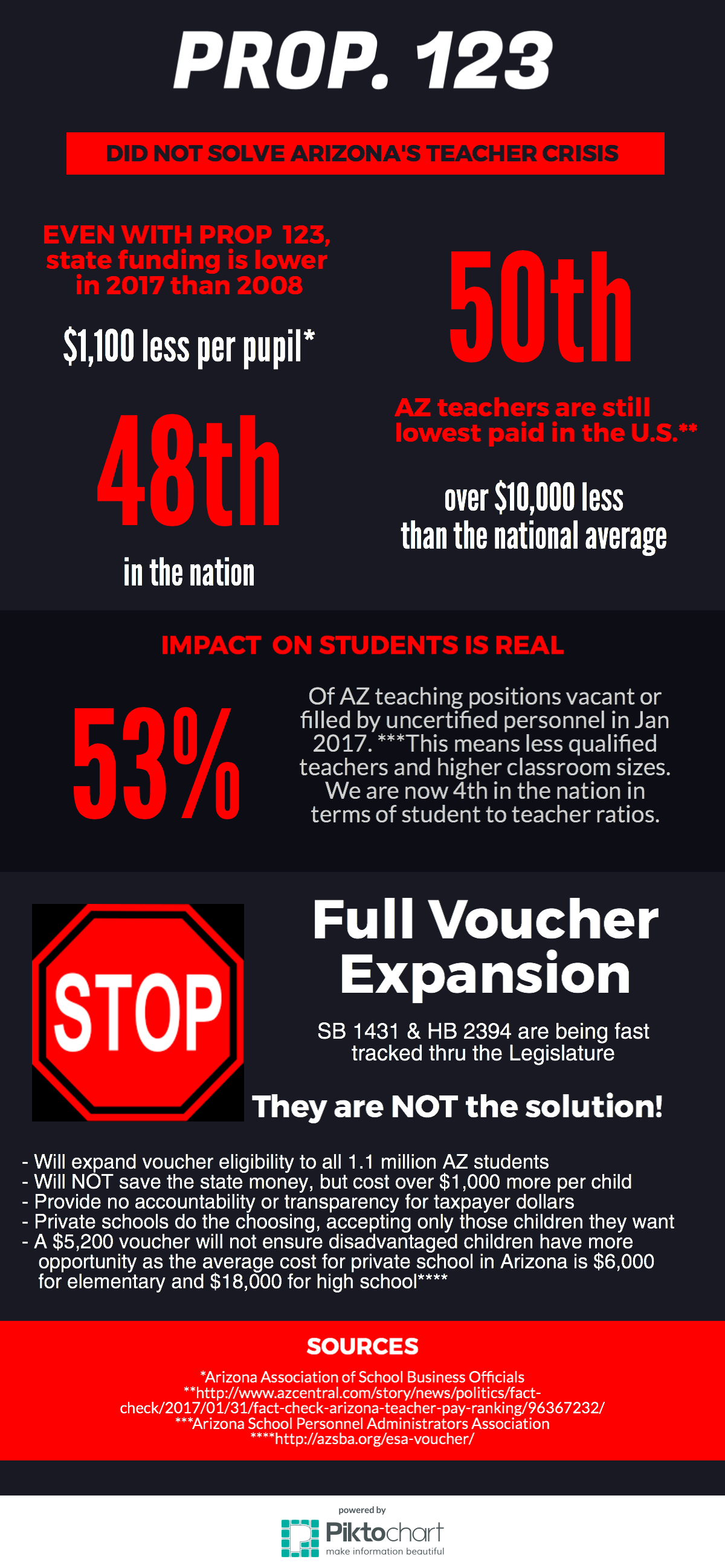
Once again, Arizona’s public education advocates find themselves in battle against those in the Legislature seeking to commercialize our district schools. The worst threat this year is a replay of last year’s failed attempt to fully expand Empowerment Scholarship Accounts (ESAs) to all Arizona students. This, despite the fact that vouchers will cost the state more…at least $1,000 more per student. This, despite the fact that according to the Pro-voucher Friedman Foundation, 58% of AZ ESA recipients have incomes ABOVE $57,000 (39% over $72,000 and 19% between $57,000 and $71,000.) And, only 15% of families that use vouchers have an income lower than $28,000. Not surprising actually, when the average private school in Arizona costs $6,000 at the elementary level and $18,000 at the high school level. A $5,200 to $5,900 voucher just doesn’t go far enough for those without means.

And, as if that isn’t enough, the New York Times (NYT) just reported, “a wave of new research has emerged suggesting that private school vouchers may harm students who receive them.” An examination of an Indiana voucher program which grew to tens of thousands of students under then Governor Pence, produced significant losses in achievement in mathematics on the part of voucher students who transferred to private schools. There was also no improvement in reading.

Then in Louisiana in early 2016, researchers found “large negative results in both reading and math” for those students on vouchers. The NYT quoted Martin West, a professor at the Harvard Graduate School of Education, as saying the negative voucher effects in Louisiana were, “as large as any I’ve seen in the literature.” He wasn’t just comparing voucher programs, but rather the Louisianna voucher experience against “the history of American education research.”

Likewise, in June of 2016, the Thomas B. Fordham Institute, a conservative think tank and school choice proponent, looked at a large voucher program in Ohio. They found that, “Students who use vouchers to attend private schools have fared worse academically compared to their closely matched peers attending public schools.”

Maybe the schools “were unusually bad and eager for revenue” posits the NYT, but that just shows that “exposing young children to the vagaries of private-sector competition is inherently risky. I love the NYT’s explanation of how ”the free market often does a terrible job of providing basic services to the poor – see, for instance, the lack of grocery stores and banks in many low-income neighborhoods.” Why should we expect it to be different for education? I can see it now. Gourmet grocery stores and boutique bank equivalent private schools in affluent areas and the Circle K and payday loan operation version of underfunded public schools where people have no other real option. I know there are plenty of people who see nothing wrong with this scenario (many of them work at the state Capitol), but it IS wrong and it is not in the best interest of our people, our communities, our state, or our nation.

Happy Valentines Day…NOT!

On this Valentine’s Day, I thought I’d ask, when it comes to our public schools students in Arizona, “who loves you baby?”  Yesterday, I was listening in on the AZ House Education Committee meeting. There were many bills on the agenda, but I was primarily interested in HB 2394; empowerment scholarship accounts [ESAs]; expansion; phase-in. I wasn’t hopeful the bill would die, as its companion bill SB 1431, had already been given a due-pass by the Senate Education Committee. As expected, HB 2394 followed suit on a 6–5 vote as did HB 2465, which will allow all students eligible for an ESA account to remain on the program until age 22 and for up to $2,000 a year to be put into a 529 savings account.

The passage of these bills, along with the companion ones in the Senate, demonstrate the disdain many GOP legislators have for our district schools and, for the underpaid educators who toil within. This, because ESAs divert more general fund revenue per student to private schools than district schools receive. As reported by the Arizona School Boards Association, an ESA student, on average, costs the state general fund $1,083 more in grades K–8, and $1,286 more in grades 9–12 than a district student. This is in part because there are many school districts that enjoy a fair amount of locally controlled support in the way of overrides and bonds. The state therefore, is relieved of providing equalization funding to them, but when students leave to go to private schools, all the funding must come from the state general fund. ESA students also receive charter additional assistance funding of roughly $1,200 per student, which district schools do not receive. Turns out that the claim of voucher proponents that they save the state money, is not just “alternative facts” but totally untrue. And, although voucher proponents love to claim there is no harm to district schools when students take their funding and leave, the truth is that about 19 percent of a districts costs are fixed (teacher salaries, transportation, facility repair and maintenance, utilities) and can’t be reduced with each student’s departure.

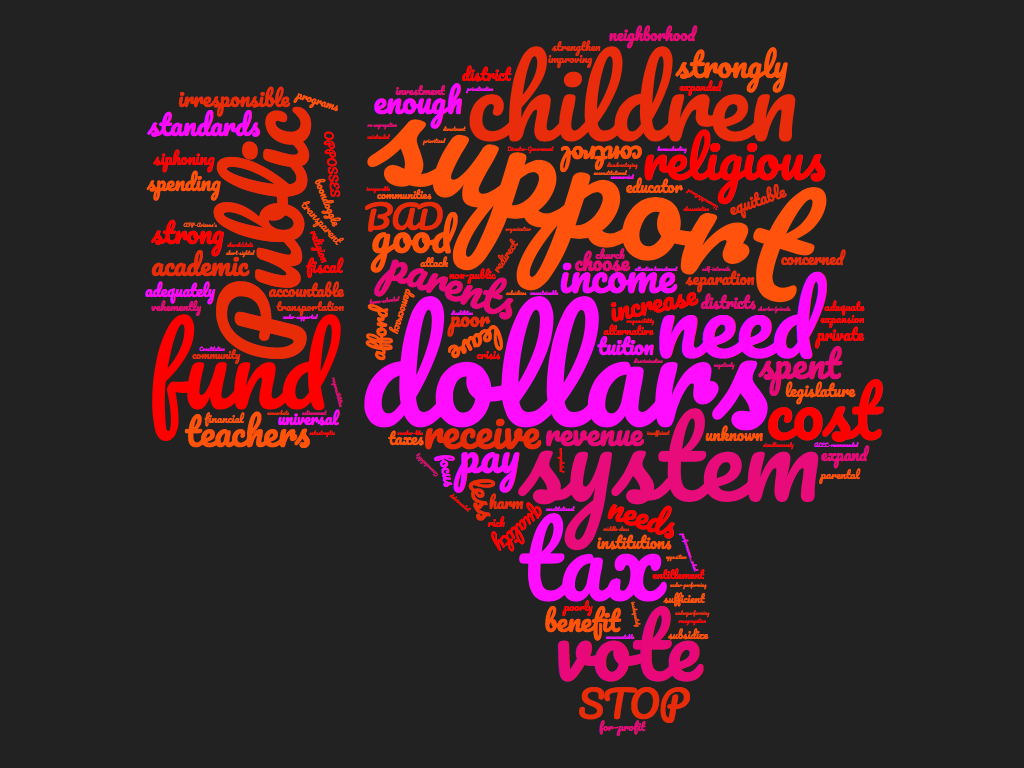
I am slightly encouraged though by the two Republican members on the House Education Committee who had the courage to stand up and do the right thing. Huge kudos to Representatives Doug Coleman and Michelle Udall who voted against the voucher expansion! I encourage each of you to email them and let them know how much you appreciate their show of support for the one million public school students in Arizona’s district schools. What also gives me hope, is the 400 plus people and their almost seven pages of 10-font, single spaced comments made against the bill in the Arizona Legislature’s Request to Speak System. Here’s a word cloud of the comments:

esa-wordcloud

This is compared to the 30 people who signed in to Request to Speak in favor of the bill. The vast majority of whom represent organizations in favor of commercialization of district schools such as The Goldwater Institute, Americans for Prosperity, Center for Arizona Policy, AZ Catholic Conference, AZ Chamber of Commerce and the American Federation for Children.

So, why these organizations? Well, let’s see. According to its website, the Goldwater Institute is a “national leader for constitutionally limited government.” Corporate reformers love to paint district schools as “government” schools, making them just another one of the targets to shrink the government, or as Grover Norquist said, “get it down to the size where we can drown it in the bathtub.” The Goldwater Institute also works closely with the corporate bill mill, the American Legislative Exchange Council (ALEC) to promote conservative corporate agendas (such as commercialization of district schools) in Arizona.

Cathi Herrod and her Center for Arizona Policy (CAP) have long pushed school choice. CAP’s website states the belief that, “Religious freedom is affirmed and protected, free from government interference.” Of course, they are for vouchers. They would love for every student in Arizona to attend religious schools on the taxpayer’s dime.

Americans for Prosperity is a conservative political advocacy group funded by the Koch brothers. On their website they write, “at the very top of AFP-Arizona’s 2017 legislative agenda is the expansion of our state’s program of parental choice Empowerment Scholarship Accounts (ESAs).” They also encourage their supporters to thank Senators Flake and McCain for voting to confirm Betsy DeVos.

It should be no surprise to anyone that the AZ Catholic Conference is also interested in fully expanding voucher eligibility. Around the nation, Catholic schools have been closing at rapid rate, from 13,000 schools enrolling 12 percent of U.S. school children in the mid–1960s, to about 7,000 schools enrolling five percent in 2012. In 2015 alone, 88 Catholic schools closed. But, a tax credit program highly favorable to private and parochial schools has helped stem previous losses in Arizona but charters are still causing them much competition for students. There are now 73 Roman Catholic private schools in Arizona and six of them are among the most expensive private schools in the Phoenix area charging from $13,300 to $17,712 per year in tuition. A $5,200 voucher obviously won’t help poor students get into these schools, but it will be a nice offset for those wealthy enough to afford the schools irrespective of the help. The average cost for private schools in Arizona by the way is about $6,000 at the elementary level and $18,000 at the high school level.

As for the Arizona Chamber of Commerce, let’s not forget how their President and CEO, Glenn Hamer, recently characterized teachers as “crybabies” for wanting adequate pay. This, when our teachers are the lowest paid in the nation and 53 percent of Arizona’s teaching positions were vacant or filled by uncertified personnel at the beginning of this year. Study after study shows a high-quality teacher is critical to student success. What does that say about the commitment of Hamer and his chamber to our students in Arizona?

Finally, let’s not forget that until she was confirmed as Secretary of Education, Betsy Devos was the Chairwoman of the American Federation for Children (AFC). AFC is a huge proponent of school choice and vouchers and has invested millions in purchasing legislators favorable to their causes. Since 2010 in fact, it has contributed some $750,000 to pro school choice legislative candidates in Arizona.

Looking at the list and knowing the resources at their disposal (just think of the Koch brothers and DeVos alone), it is easy to assume most of them have invested heavily in legislative outcomes in Arizona and around the country. Does anyone really believe these organizations have Arizona’s district school students, 56 percent of whom qualify for free and reduced lunch (an indication of their low socio-economic status) children at heart?

We all know when we read something, especially these days, we must consider the source. Well, when looking at the support for voucher expansion in Arizona, I highly encourage you to do the same. This fight against the full expansion of vouchers is far from over. Those pushing for it are no doubt emboldened by pro-voucher stance of the new POTUS and his SecED. But, the people of Arizona understand district COMMUNITY schools are the key to not only achievement for all our students, but also to the health of our communities, and the preservation of our Democracy. We must not sit on the sidelines and watch these bills get signed into law. Much too much is at stake. Want to know more about how to plug-in? Comment on this post and I’ll be in touch. Please don’t let it be said we let our students get sold out!
Unconstitutional vouchers for all bill clears Senate education committee

Cross-posted from skyislandscriber.com.

Lawmakers move Arizona closer to school-voucher option for all students writes Howard Fischer (Capitol Media Services) in the Daily Star.

A Senate panel agreed Thursday to open the door to allowing all 1.1 million students in Arizona schools to use state dollars to attend private or parochial schools, so that parents can choose.

The 4–3 vote by the Senate Education Committee followed hours of testimony from people who already get what lawmakers call “empowerment scholarship accounts,” detailing how they’ve helped their children. Eligible groups include children with special needs, those living on tribal reservations and those who attend schools rated D or F, among others.

Sen. Debbie Lesko, R-Peoria, sponsor of SB 1431, said vouchers save taxpayer money. She said schools get an average of $9,529 a year for each student while a typical voucher is in the $5,200 range.

But Chuck Essigs of the Arizona Association of School Business Officials said that’s misleading. He said the $9,529 figure includes federal aid to schools as well as locally raised dollars for bonds and overrides. Essigs said the actual amount paid in state aid to schools is an average of $1,100 less per student than a voucher for an elementary school child; for high schools the difference is $1,200 per child, he said.

Sen. Steve Smith, R-Maricopa, said there is no danger of a wholesale shifting of funds from public schools if SB 1431 is approved and all students are eligible for vouchers. He cited existing law that limits vouchers to no more than one-half of a percent of all students, a figure that computes to about 5,500 students.

What Smith did not say, though, is that the cap will end in 2019, removing all limits.

The actual cost may be substantially higher. Here are excerpts from the Senate fact sheet for SB1431.

Currently, ADE [AZ Department of Education] estimates there are 3,100 students enrolled in the ESA Program and approximately $46 million disbursed in FY 2017. Laws 2013, Chapter 250, caps the number of new ESAs approved by ADE at 0.5 percent of total public school enrollment through 2019, or approximately 5,500 new students annually.

There is a potential impact to the state General Fund associated with expanding eligibility in the ESA Program. The fiscal impact depends on the participation rate and where the students otherwise would have attended school.

Projecting the average disbursement ($46 million for 3,100 students) to all 1.1 million students shows that the cost to the state could be in the billions of dollars. Lesko is dead wrong in her claims about saving money.

[Scriber’s note: I can’t figure out why the Senate’s fact sheet seems to be at odds with the other per pupil amounts cited by Essigs above. Perhaps someone better schooled in education finance can comment and clarify.]

It does get worse. Lesko thinks hiding standardized test results from the public is good policy.

A key objection [to vouchers for all] has been lack of accountability. Hoping to address that, SB 1431 requires students in grades 3 through 12 who use vouchers to take a nationally recognized achievement test, advanced placement exam or any college admissions test that assesses reading and math.

But the results would not be made public — as they are for public schools — and would be provided only to parents. Lesko said that’s sufficient.

So any evidence that private schools are worse than (or even better than) public schools would not inform legislative actions. That is crappy public policy. Then again, this was never about making informed decisions.

But the bottom line on SB1431 is that it is unconstitutional.

Foes cited the high cost of private schools — some charge more than $10,000 a year — and said the vouchers become a subsidy of state dollars to parents whose children already are enrolled. For everyone else, said parent Sarah Stohr, the concept of school choice is an illusion.

“Single parents like me with no family support in this community have little true choice when it comes to choosing between my job and shuttling my child around town to a school that’s farther from my home,” she testified.

Stohr told lawmakers that if they really care about children, they would “finally choose to fully and adequately fund our public schools so that no parent feels like their neighborhood school isn’t an excellent choice for them.”

Tory Roberg of the Secular Coalition for Arizona said her objections relate to the idea of using tax dollars to help children go to parochial schools, saying it amounts to using public funds “for the purpose of religious indoctrination.”

AZBlueMeanie (Blog for Arizona) weighs on on how SB1431 violates the state constitution: Senate Tea-Publicans advance unconstitutional school ‘vouchers for all’ bill.

… The Arizona Constitution prohibits state funding to private and parochial schools:

Article 2, Section 12: “No public money or property shall be appropriated for or applied to any religious worship, exercise, or instruction, or to the support of any religious establishment.”

Article 11, Section 7: “No sectarian instruction shall be imparted in any school or state educational institution that may be established under this Constitution, and no religious or political test or qualification shall ever be required as a condition of admission into any public educational institution of the state, as teacher, student, or pupil;”

In Cain v. Horne (Cain II), 220 Ariz. 77, 202 P.3d 1178 (2009), the Arizona Supreme Court struck down the legislature’s previous attempt at a “vouchers for all” program as unconstitutional.

Any way you cut it, the vouchers for all push is money laundering in a rather obvious attempt to skirt these constitutional prohibitions against using state funds for private, religious schools. If by statute, A cannot give money to C, then A routes money to B which then gives the money to C. Plug into this formula state funds (A), parents (B), and religious schools (C), and SB 1431 reduces to money laundering.

The New Civil War

I don’t remember my parents being political at all. My Step-Dad was an Army Green Beret and my Mom a naturalized American citizen via Germany. I’m sure they voted, but it wasn’t like we sat around the dinner table discussing geopolitics. Neither of them had attended college while I was still living at home and being politically active wasn’t really congruent with my Dad’s military service.

After I joined the Air Force, that was also the case for me, especially when I became a commander. After retirement though, it was a different story. Since moving to Tucson in 2008, I ran for and won a seat on my local school board and worked on three Arizona campaigns, two Senate and one House, and supported various other campaigns in one way or another. It has been my service as a school board member though, that really led to my activism. Public K–12 education and the children it serves, (as it turns out) is my new passion.

Our recent Presidential election was traumatic for many and some people are totally shell-shocked. In my mind, much of the consternation is not about partisanship, but rather about the values we collectively subscribe to as a nation. Do we as stated in our Declaration of Independence, “hold these truths to be self-evident, that all Men are created equal, that they are endowed by their Creator with certain unalienable Rights, that among these are Life, Liberty, and the Pursuit of Happiness”? Or rather, do we believe that (as with the Citizen’s United decision), corporations are people and should have as much say in our nation’s governance as “the people?” Do we still aspire to be Ronald Reagan’s “shining city on the hill” (words originally spoken in a sermon by Puritan John Winthrop), that serves as a beacon of democracy to the rest of the world or, do we only care about ourselves; about “America First”…and last.

I had for the most part managed to have a more pragmatic perspective about the recent turn of events until about two weeks ago when I visited our Nation’s Capitol. Seeing the multitude of protestors everywhere, in many cases controlled more tightly by increased police presence,  brought home to me the very real shift in our national direction. Then yesterday morning, I had a contentious conversation with my Mom about politics (whom I once could talk to about anything) and it occurred to me that what we are now experiencing is the New Civil War.

As with America’s original Civil War, this one is pitting family members against family members, friends against friends, and neighbors against neighbors. Don’t get me wrong, I don’t at all mean to minimize the 620,000 lives lost in the original Civil War, to this date the deadliest in our nation’s history. But, this New Civil War has the potential to be just as fractious to our country. It may be a war of words versus guns; but the divisions surrounding economics, equal rights, freedom of speech, state’s rights, and free trade vs. protectionism, all with a dose of nationalism mixed in, are every bit as real.

And just like the original Civil War, this one is comprised of “battles” of significance. The fight over Betsy DeVos is one. It was well-fought on the part of public education advocates, but in the end, they were out-gunned by the corporate reformers and the lawmakers they purchased. It would appear the Dakota Pipeline is another battle where “the people” have lost to corporate interests. There will be many more battles such as the one  over the Muslim travel ban currently underway. I’m guessing we are going to have at least four years of such battles. It is tiring to contemplate.

Wars are often though, contests of attrition. The side that remains better resourced in terms of troops and weapons and the intelligence and supplies to support them, is usually the victor. There are numerous examples however, of a grass-roots resistance (because it is supported by the hearts and minds of the people), that achieves victory against all odds.

If our nation is to remain a democracy, one which is “of the people, by the people and for the people”, we must all (each of us), remain engaged and vigilant. I understand it would be easier just to bow out and ride the “ignorance is bliss train,” until it jumps off the tracks. Believe me when I say I’ve considered that option more than once. But, as the American educator and author (born in 1899) Robert M. Hutchins said, “The death of democracy is not likely to be an assassination from ambush. It will be a slow extinction from apathy, indifference, and undernourishment.”

To those who care about our democracy and our right to life, liberty and the pursuit of happiness, I implore you to not let current events discourage you or detour your resolve. Now, more than ever, we must keep our heads in the game. After all, (as attributed to Edmund Burke) “All it takes for the triumph of evil is for good men to do nothing.” Let it not be said that was our course.

Open letter to McSally, telephone town hall scheduled by McSally for today at 1:00

Cross-posted from skyislandscriber.com

Shooting survivor Suzi Hileman writes an open letter in the _Daily Star_: Dear Rep. McSally: Your gun vote disrespects me, other victims of Jan. 8, 2011. Here it is in full.

Dear Rep. Martha McSally:

Have you forgotten us, your constituents? We’re the ones who were standing on the corner of Ina and Oracle roads on Jan. 8, 2011, talking to our congresswoman, when a young man with an untreated serious mental illness and legal access to a 9mm Glock, and the ammunition to go with it, opened fire.

That young man was not on a national watch list, as the ruling to which you object would have placed him.

Your vote told me that doesn’t bother you.

That seat you hold? It belonged to U.S. Rep. Gabrielle Giffords.

Her shooter was described by his prison psychologist as “among the most disturbed individuals I have treated in my 23 years of work with this population.”

Your vote says that a meaningful background check is too much to ask in order to keep me safe as I participate in civic dialogue.

Sen. Chris Murphy, whose district includes the Sandy Hook Elementary School families in Connecticut, speaks loudly and eloquently about sensible gun legislation. I had hoped that you would be sensitive to the issue, too.

You represent me; your vote disrespects my experience. But it’s more than just me and mine; it’s you and yours, and you don’t seem to care. We had a way to fix this, and you just voted to remove it.

This vote strikes at the heart of what happened to Tucson, because rest assured, this happened to our whole town.

Your vote cuts through that connection like a sabre. It hurts.

It separates us from one another, and most important, it separates us from you.

For surely, if you had a heart, you could have explained to the leadership of your party that while you agree with the policy, you can’t, in good conscience, tell your constituents that you will do nothing to protect them from exactly what happened to them, that this is a deeply personal issue, an issue that has a profound resonance in your district, and that your ultimate loyalty is to us, your voters.

It’s not as if they needed your vote. 235–180 was the final tally. Would 234–181 have been so hard to live with?

Editors note: Suzi Hileman is a survivor of the Jan. 8, 2011, attempted assassination of Rep. Gabrielle Giffords by a young man with an untreated mental illness, which was known to the authorities but never included in a useful background check. Six Tucsonans were shot to death that morning and 13 were wounded. Hileman lives in Tucson.

I imagine some of you will want to react to McSally’s vote – one among the 100% Trump votes she has cast. Here is your chance. McSally is holding a telephone town hall today at 1:00 MST. (h/t Miriam Lindmeier)