HCR 2009 is the ultimate in gerrymandering: AIRC would become the ARC

Cross posted from SkyIslandScriber.com.

The Arizona voters established the Arizona Independent Redistricting Commission (AIRC) to provide for a better, less partisan means of redrawing district maps. A group of House GOPlins are out to destroy that commission by making it what amounts to the Arizona Republican Commission. Here’s the scoop (snippets quoted from HCR 2009 – emphases added).

What it is

HCR 2009

Introduced by Representatives Petersen, Townsend, Senator Farnsworth D

A CONCURRENT RESOLUTION

PROPOSING AN AMENDMENT TO THE CONSTITUTION OF ARIZONA; AMENDING ARTICLE IV, PART 2, SECTION 1, CONSTITUTION OF ARIZONA; RELATING TO THE INDEPENDENT REDISTRICTING COMMISSION.

What gets scratched

Everything! The original language, almost in total, establishing the AIRC is trashed. Here is an example of what HCR 2009 strikes out.

No more than two members of the independent redistricting commission shall be members of the same political party. Of the first four members appointed, no more than two shall reside in the same county. Each member shall be a registered Arizona voter who has been continuously registered with the same political party or registered as unaffiliated with a political party for three or more years immediately preceding appointment, who is committed to applying the provisions of this section in an honest, independent and impartial fashion and to upholding public confidence in the integrity of the redistricting process. Within the three years previous to appointment, members shall not have been appointed to, elected to, or a candidate for any other public office, including precinct committeeman or committeewoman but not including school board member or officer, and shall not have served as an officer of a political party, or served as a registered paid lobbyist or as an officer of a candidate’s campaign committee.

The rest of the original language is struck as well. That language provides for, and limits the character of, the pool of nominees to the AIRC and how they are chosen. The commission on appellate court appointments creates the pool of Democrats, Republicans, and Independents from which the House and Senate majority and minority leaders pick four. The resulting two Democratic and two Republican commissioners then select an Independent from the original pool.

I know that many folks see ways to improve this process, e.g., by expanding the number of commissioners. But HCR 2009 is absolutely the worst possible “fix.” So what does HCR 2009 do?

What is new

BEGINNING ON THE SECOND MONDAY IN JANUARY of each year that ends in one, an independent redistricting commission IS established to provide for the redistricting of congressional and state legislative districts. The independent redistricting commission shall consist of five members, EACH OF WHOM SHALL SERVE A TERM OF TEN YEARS. THE COMMISSION MEMBERS SHALL BE ELECTED AT THE REGULAR GENERAL ELECTION HELD IN EACH YEAR THAT ENDS IN ZERO, IN THE SAME MANNER AS OTHERWISE PROVIDED BY LAW FOR OTHER STATEWIDE OFFICES, AND SHALL MEET THE SAME ELIGIBILITY REQUIREMENTS AS PRESCRIBED IN THE CONSTITUTION AS FOR THE OFFICE OF GOVERNOR.

So the bottom line here is that whichever political party is in the majority in the state gets to win all five of the seats on the “independent” redistricting commission. This is another example of how the Tea-publican legislature is out to thwart the will of the electorate.

This one needs to be beaten to a pulp. Start your letter writing now.

P. S.

Not convinced? Here is one more limitation on the commission that is removed by HCR 2009. Nothing like permitting the commissioners to profit financially from their service. Only the Greedy Oligarchical Patriarchs could dream up this one.

A commissioner, during the commissioner’s term of office and for three years thereafter, shall be ineligible for Arizona public office or for registration as a paid lobbyist.

h/t Sandy Bahr via Michele Manos.

A Tale of Two States

As a kid, one of my favorite authors was Charles Dickens. In his 1859 novel, A Tale of Two Cities, he “depicts the plight of the French peasantry demoralized by the French aristocracy in the years leading up to the revolution.” Hmm, peasantry demoralized by the aristocracy…that reminds me of something…wait, I’ll think of it. Maybe, it is the fact that the 62 richest people in the world now own more than the poorest half? In fact, their wealth has increased 44% since 2010 while the bottom half’s has dropped by 41%. And in the U.S., the wealth inequity is now worse than at any time since the Great Depression. The Walton family alone owns more wealth than 42% of American families combined and CEO-to-worker pay-ratio is 354-to-1. Americans haven’t taken to the streets with pitchforks (the “Occupy” movement aside) to demand “off with their heads” yet because for the most part, they still believe in the American Dream. That is if one works hard enough, they can move up the economic ladder. The truth is more like comedian George Carlin joked: “the reason they call it the American Dream is because you have to be asleep to believe it.”

Although reference to the concept of the American Dream was made as early as the 1600s by those who came to America from England for the chance of a better life, it was most likely “codified” in the Declaration of Independence, which proclaims that “all men are created equal” with the right to “Life, Liberty and the pursuit of Happiness.” Part of this right and critical to achieving the dream are the opportunities to receive a good education and work that provides at least a living wage. But, the game is now stacked. Stacked in favor of the wealthy, stacked in favor of corporations, stacked against the middle class who is increasingly squeezed, and stacked against children who don’t come from a family of means.

Of course, everyone has a different idea about how to “unstack” the deck. In fact, as I mentioned earlier, some don’t even see the deck as unfairly stacked. I am firmly in the “”deck is stacked” camp and believe if we don’t start to make progress at turning the tide, pitchforks may be in our future. In Arizona, Governor Ducey thinks the way to move our economy forward is vouchers and charter schools, no individual state income tax and very little tax on the corporate side, and oh yeah, the “sharing economy.” Really, a “sharing economy”? Could it be that Ducey and I agree on something? I mean, I think it would be great if we would all share equally in our economy. After all, when Arizona’s top 1% pays only 4.6% of their income in state and local taxes while the bottom 20% pays 12.5%, we could really use some sharing. What you say? He was referring to “sharing” type businesses like Über and Lyft where the services are cheap and convenient, but the workers have no rights or benefits? Oh, okay, that sounds more like current Arizona leadership.

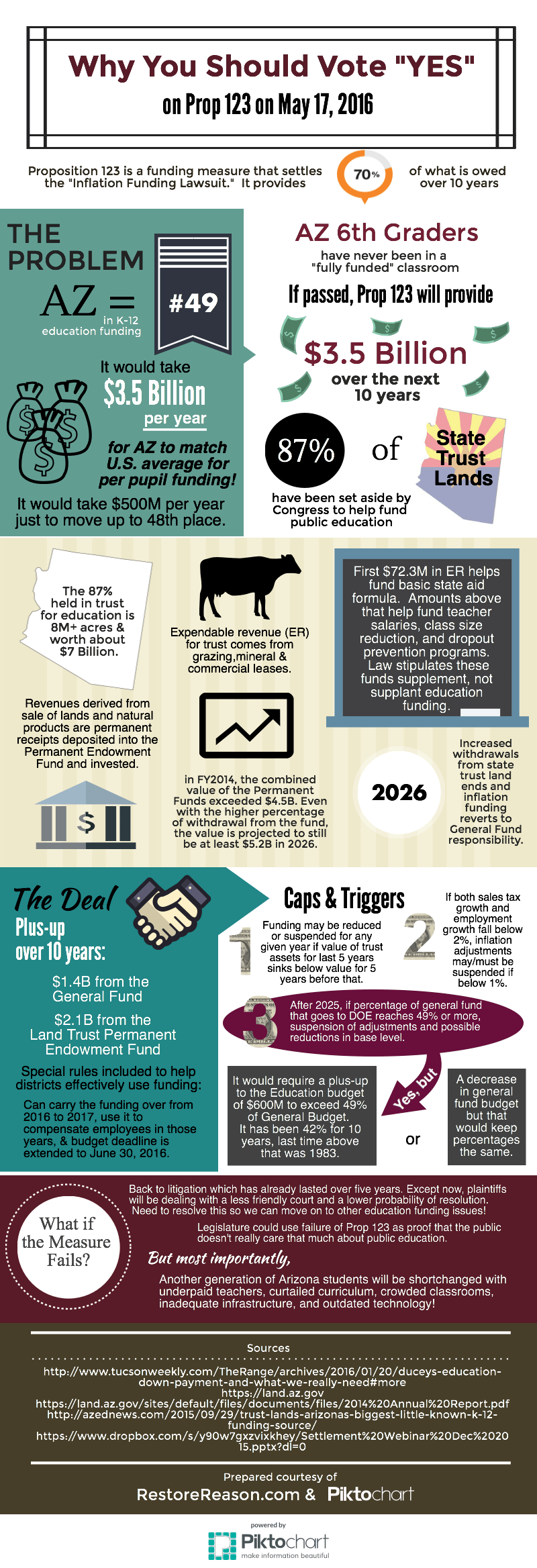
Just for kicks, let’s look at another state’s version of the way forward. Interestingly, Massachusetts has almost exactly the same population as Arizona, 6.8 million. Both states also have the Tea Party in common although with Massachusetts, it is mostly in their past (as in Boston in 1772) and in Arizona it is very much in the present.

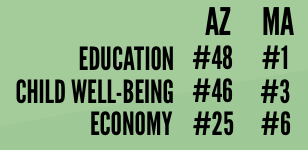
Politically, Arizona is GOP led with no statewide Democratic leaders and both the state senate and house under GOP control. Massachusetts conversely, is almost entirely led by Democrats with the exception of their governor who is a Republican. Given the political parties’ priorities, it should be no surprise then that MAZ vs MAassachusetts ranks much better in education and child well being than Arizona. What may surprise some though, is that while Arizona’s economy ranks 25th in the Nation, Massachusetts’ comes in at #6.  
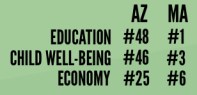
Why might you ask? Well, I have a few theories and as you can imagine, the state’s prioritization of public education is at the top of my list. Take Career Technical Education (CTE) for example. It produces significantly higher graduation rates than traditional district high school programs, often provides living wage jobs to graduates, and helps provide skilled workers for the employers who so badly need them. It is, by all accounts, a win-win-win. Massachusetts Governor Charlie Baker obviously gets this as indicated by his recent proposal to add an additional $83.5M for vocational education.   Included in this is a $75 million five-year capital program to finance grants for school equipment and expansion an additional $8.5 million for grants for “school-to-career connecting activities.

At the same time, we have Governor Ducey objecting to restoring the $29 million in cuts to CTE made in last year’s budget. Instead of embracing the AZ Legislature’s veto-proof coalition to restore the funding, Ducey wants to only restore one-third of the funding for only three years and, attach a variety of strings to the money including a requirement for business matching of the funds. This despite a plea for repeal of the cuts signed by 32 business and education leaders as to the importance of CTE.

Maybe Governor Baker just had better advice than Governor Ducey. Tim Murray, a regional chamber of commerce president who toured 64 votech and agriculture education programs when he was the Lieutenant Governor of Massachusetts, said “the single biggest need” of the business community “regardless of the size of the company, regardless of the sector” is a “pipeline” of available workers. Surveys of 352 employers and 475 parents recently conducted by The Dukakis Center in Massachusetts revealed that 90% of employers see a need to increase CTE graduates, while 96% of parents had a favorable opinion of the CTE programs they children attend.K-12 az ma
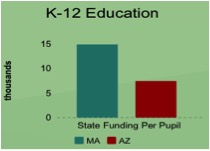
But wait, there’s more. I believe one of the best determinants of the value someone or an entity places on something is what they are willing to pay for it. Massachusetts obviously values education. I know there are those of you ready to say: “there are plenty of examples of more money not producing better results.” Yes, that is true. But in almost every case, I’d be willing to bet where money doesn’t help, there are significant social issues outside of the schools that keep students from learning and achieving. It is obvious, by Massachusetts’ #1 ranking in education achievement, that their money is well spent.

Of course, as mentioned earlier, we know there are factors outside of the school that determine how children do in school. Massachusetts has lower unemployment, their residents earn higher salaries and they are less likely due to lose their homes to foreclosure. Their residents are also better educated, safer, and healthier. They also have fewer disabilities, likely from the better health care they experience. It should be no surprise that Arizona also has four times the adults in state prison as does Massachusetts, spending hundreds of millions more in this area. Yet, Arizonans are no safer with over double the murder rate.

Some claim that Massachusetts is more successful in some areas because society is more homogenous with 74.3% of its residents being white as opposed to only 56.2% in Arizona. There may be some truth to that since unfortunately in the U.S. today, socioeconomic status often has to do with the color of one’s skin. But, Arizona is doing little to address this issue even though our state’s share of white K-12 students dropped below 50% in 2004 and Latin@s K-12 students are on the cusp of breaking 50%. One example of this blind eye toward the problem is new HB 2401 sponsored by Vince Leach-R SaddleBrooke. The bill, titled “Schools; Desegregation Funding; Phase-Down” phases out funding for desegregation expenses, a cut of about $211 million dollars. These funds will hit some of our most vulnerable children, about 22,500 English Language Learners (ELL) and leave high performing magnet schools, such as Phoenix Union’s Metro Tech High School, without their primary source of funding. It is in two words, extremely shortsighted. Learning English is critical to these student’s future success and by extension, that of our state. They will either be contributing members of our society or drains on it. This is a clear example of “you can pay me now, or you can pay me later.”

So let’s recap. Massachusetts performs better than Arizona in education, child welfare, health and safety, the economy and many other areas. Yes, taxes are a little higher ($1,706 per person in 2013), but look what you get for your money! I’m well aware of course that this line of reasoning will fall on many a deaf ear that think the only good government is a starved one. It can’t be said enough though that taxes are not bad or good, they are the price of living in a well-functioning society with a decent quality of life. There are many things such as education for all and safety that are best provided by the government. It our duty (the voters) to determine our priorities for our hard earned tax dollars and then elect candidates that will ensure those priorities are provided for and secured. That is how we keep ourselves free.
 

Divide and Conquer

Reading Jane Mayer’s “Dark Money.” Some thoughts are congealing, only to “jello” thus far. Capitalism requires competition. Competition means division to “sides.” That’s good for markets, but not for countries. We, as a nation, can only stay strong if we stay united. Those who tout capitalism as antithetical to government, are persuading us to compete with each other, at every level in the public square. Such divisions will only weaken us (“divide and conquer”) and make us easy prey for vulturous nations and extremists.

So, I ask, why do we have markets or governments? Ultimately, it is to make life better for people, through jobs, products, services, and safety?

Our governments, “of the people, by the people” must be strengthened “for the people.” That is NOT anti-capitalism. It IS democracy.

We need both. Capitalism, held to its purest possible form by an effective  people, i.e., government, will keep us strong and agile.  Government, challenged by capitalists who demand efficiency and deplore waste, builds the infrastructure and support that keep our people and our country united and safe.

What’s my point? Competition is good in the market place, but cooperation is better between local, county, state, and Federal governments. Governments are duty bound to ensure free markets stay free and competitive. Bloated corporations are just as harmful and wasteful as bloated governments, and no less efficient. Democratic republics must be effective, for the people and the markets, which demand maximum efficiency.

In this age of technology and connectedness, market competition is not as “pure” as true capitalism requires, especially among corporations that trade employees and buy ex-government officials with high-level contacts and influence. Companies, entreprenuers, and would-be entreprenuers who can’t afford to buy such influence are subverted by court rulings, budgets, and K Street firms that purchase laws favoring the large and influential. Therefore, it is encumbent upon governments, at all levels, to constrain those naturally recurring enemies of pure capitalism and purely competitive markets.

It is up to those markets, and the public who constitue governments and shop in the markets, to restrain the natural tendency for governments to bloat. The people must stay vigilant, with one eye on each at all times.

Our culture has placed too much value on competition between public services and governments, and not enough on market competition. States compete to host large, influence-purchasing corporations by reducing their taxes and offering them incentives. Then, they pass that public infrastructure and support price tag to small businesses, upstarts, and families that can’t thrive under the growing burden. Here’s a thought, why don’t the states all get together and figure out which are best places for what, in national interests? Because, keeping our public services/governments divided in competition is in the best interests of those corporations.

One of our few, truly shared values in America is still education. Yet, another example of public competition gone awry.   Do we, or do we not, share a belief that every child’s capabilities should be maximized, to the betterment of us all? Any child could be the one to cure cancer or lead us to colonize Mars. Ethnicity and socio-economic status don’t determine natural capability, only cultural boundaries and access to opportunities. Competition in education is fine, when it serves to keep schools lean and focussed. When it causes public schools to have advertising budgets instead of putting every penny into classroom instruction, it’s gone too far! When it reduces teacher compensation to levels so low that the profession (Yes! It is a profession.) is unsustainable, we damage future opportunities for our country, our communities, and our markets.

Ultimately, competition among public servants and services reduces access and opportunity for the same citizens who are paying for them. What’s next, DMV offices competing for customers and self-eliminating? Jane Mayer (I have never met the author, so I’m attributing very freely) might well lament that the Koch brothers don’t care how long you have to wait in line at the DMV.  They certainly don’t worry about getting drivers licenses.


Accountability in Arizona…not so much

Two headlines in the AZ Star caught my attention this morning: “Plan adds state cash for private education” and “Veto-proof majority backs repeal of JTED cuts.” The first one is about Representative Justin Olson’s bill to remove any limits on Empowerment Scholarship Accounts (ESAs.)  The second is about the Legislature’s plan to reinstate the $30 million in JTED cuts they made last year. Evidently the Legislature is now saying “my bad” about the 7.5% cut (about $400 per student) to charters and districts with students enrolled in JTED. According to Diane McCarthy at West-MEC, legislators weren’t really aware of what they were doing. “After the fact, some legislators said they didn’t understand what the impact of that (cut) was,” McCarthy said. “There’s a lot of talk about how do we fix it.”

I’m really glad the Legislature has come to its senses and intends to restore the funding, since 96% of Arizona students enrolled in CTE graduate from high school, 21% above those who don’t. Most CTE graduates also go on to post-secondary education and jobs and they score higher on standardized tests. CTE really is a win-win-win as the recent letter to the AZ Legislature signed by 32 business and education entities made clear. What really caught my eye about the JTED article was a quote from Senator Don Shooter who introduced the legislation to repeal the cuts. In response to Senate President Andy Bigg’s accusation that the program has insufficient oversight, Shooter said one key is “transparency.” Thanks for the segue Don.

Don Shooter is correct that transparency leads to more accountability, but evidently he and his fellow GOP legislators don’t understand that concept when it comes to ESAs (basically vouchers by another name.) As of mid-April 2014, approximately $17 million had been handed out through ESAs. That is a lot of money to be handed out without any way to ascertain return on investment. Unlike district school students, ESA recipients are exempted from all state assessments so there is no way to know whether the money was well spent.  Although there is a quarterly spending report required from ESA recipients, parents must only provide proof of spending 25% of the funding they receive each year. The money they don’t spend can be saved from year to year and can even be used for college. If the money isn’t spent, does it mean the parent was efficient with their child’s education or does it mean they skimped? Also, the vast majority of ESA funding goes to private schools (92% in 2012) and at least in Arizona, 70% of private schools are religious. I know this has been deemed constitutional because the money is given to parents who then give it to the schools, but sorry if it looks like a rose and smells like a rose…

The ESA program has been expanded little by little, (students: with disabilities, wards of the court or those that were, students of active duty military members or those killed while serving on active duty, those who had attended a D or F school the prior year, siblings of students currently in the program, and students who reside within the boundaries of an Indian reservation) but it has always been the intention of the GOP-led Legislature to open up the program to all. So far, pro-public legislators and those who believe in good stewardship of government dollars have been able to keep the wolves at bay. Make no mistake however; this legislation is much more about privatizing public education than it is about opportunities for disadvantaged children. Proponents say we need to transition from financing schools to funding students. Problem is, when students accept an ESA and leave the district school, they take all the funding with them, but none of the costs of running the school. A certain amount of overhead costs are fairly independent of student count and schools are incapable of rapidly adjusting their operating expenses with each student lost.

School choice is alive and well in Arizona and still a full 85% of Arizona’s students choose district schools.   The Legislature can pretend they care about these kids, but the truth is that they have a stranglehold on the necks of our district schools and as they continue to restrict the flow of resources to these schools, our kids are the losers. The more they encourage parents to look for greener grass outside our district schools, the more likely it is that resources will be pulled away from these schools making it harder for them to continue to educate the majority of students who remain.

If the Legislature really cares about Arizona students, why not just support our district schools why not just support what we know works: great teachers, small class sizes, infrastructure that supports learning and curriculum that is rich and challenging. We also know that schools can’t do it on their own. Many of our children face obstacles outside of school that affect their ability to learn inside school.

I am incredibly tired of our children being used as a political football. It is time for all good people to say enough is enough. We must stand up and speak for those who have no voice and no power to save themselves. It will be hard to make Arizona public education the envy of the Nation. But, it is possible and that possibility gives me hope.

Part 2 – Why Ducey’s Promise to Lower Taxes is a Lie

In my previous post, I showed why Governor Ducey’s focus on tax reduction is a disastrous recipe for our state. Now let’s look at how those tax reductions we’ve been seeing aren’t really helping the average Arizonan. Instead, we continue to see the tax burden transferred from those who have, to those who can least afford.

Governor Ducey is intent on eliminating income tax in Arizona. Why might you ask? Because, for this Governor and others like him, it is ALL about business. And although corporate tax breaks are good for large business, 97% of the employers in Arizona are small businesses like S-corporations, LLCs and partnerships. These businesses amount to over 40% of the private workforce and are currently taxed by the state via income tax. I’m not sure whether ASU’s Center for the Study of Economic Liberty 2015 policy report by Stephen Slivinski is the “policy roadmap to elimination of the Arizona income tax” as it claims, or, if it was written to support Governor Ducey’s tax reduction plan. At any rate, Slivinski concludes in the report that: “The best hope Arizona policymakers have to eliminate the income tax is to phase it out over a number of years while maintaining budget balance.” He also makes the point that now that the state is on “surer fiscal footing”; it is time for Arizona policymakers “to look at important and necessary reforms over the next couple of years.” Waiting longer he claims, “may result in losing a golden opportunity.” Sounds like a Ducey talking point commercial to me.

Arizona already has though, the 13th-lowest individual income tax and the 10th-lowest combined state and local income tax in the Nation. Additionally, according to an article in Business Insider in August 2014, Arizona’s economy was ranked the 4th fastest growing in the US after Colorado, California and Texas. Of course, we also have the 4th highest poverty rate in the US with one in five Arizonans living in poverty. Obviously, there are winners and losers in Arizona’s current economy and Governor Ducey’s insistence on eliminating the state income tax and shifting state revenue collection to increased sales tax will do nothing to help those who most need it. Although sales tax is said to be a less volatile form of revenue than income tax, it also is the most regressive, hitting the poorest the hardest.

Of course, income and sales taxes are just two ways a state can tax its residents, there are a multitude of others. Here’s just a few examples of how we continue to be “taxed” all the while Governor Ducey claims he is reducing our tax burden.

 1.  The highest per-pupil cuts in K-12 education funding in the Nation from 2008 to 2012 caused Arizona school districts to seek more locally controlled funding as a way to survive. The number of districts asking their communities for funding through bonds and overrides in 2015 was up 150 percent since 2008. The good news for districts is that the voters recognized the need for the funding and the approval rate for these measures was also high. The bad news is that this was no reduction in taxes, but just a shifting from the state to the local level. Unfortunately, often the communities with districts most in need have the least amount of capacity to help.

2.  Another solution many districts were forced to try in order to make ends meet was to reduce their school week from five days to four. As of May 2015, 43 districts (most in rural communities) in Arizona have already gone this route with many others considering following suit.  Arizona districts make up one-third of all four-day week districts in the Nation. There is debate over whether this move really produces the touted savings in the long run, but parents certainly don’t come out on top.  Rather, a four-day school week often requires parents to find childcare or, reduce the hours they work in order to care for their children when they are not in school. It also results in decreased wages for cafeteria workers and bus drivers. These people (especially in rural areas) may not have any real options to make up the difference.

3.  The state’s push of school choice via charters and Empowerment Scholarship Accounts (essentially vouchers) has been another way to transfer education costs to the local level. Charters usually require parents to transport their children to the school, do not offer any free and reduced lunch programs, and often require donations of parents. Schools in the Great Hearts Academy schools for example, “recommend parents contribute at least $1,200 to $1,500 per year per child to the school. There are also a variety of fees that are either not charged at all in district schools, or are much lower than what the charters charge.

4.  Even before Governor Ducey and the Legislature cut $99 million from our state universities and $19 million from our community colleges, Arizona had the deepest cuts in the Nation to higher-education spending. Those cuts drove the significant fee hikes and steepest tuition hikes as well, rising 83.6% since 2008.

5.  The Highway User Revenue Fund (HURF) which includes several taxes and fees such as the gasoline and vehicle license tax, was established to maintain roads, bridges and other transportation needs in the state. The Legislature swept about $860 million from this fund from 2000 to 2014 for other priorities. This forced local government to try to keep up with a more than $455 million in backlogs (with only 70% of cities reporting) for construction, repair, and maintenance of municipal streets. This isn’t just a double tax on Arizona residents (pay taxes to maintain the roads, then pay for car repairs after unmaintained roads cause damage), but also translates into a significant loss of jobs that could employ Arizonans to repair infrastructure and ensures that if and when the repairs occur, they will cost significantly more than if we had just maintained the infrastructure to begin with.

6.  In 2015, the state shifted 25% of the cost (about $12 million) for housing juvenile offenders to the counties, based on total population of the county. The counties are now required to raise the funds for this bill either through increased taxes or reduced services.

7.  Also in 2015, the cost to pay the Arizona Department of Revenue to collect and distribute sales taxes was passed down from the state to cities and counties. The change is expected to cost cities and counties about $17 million. This change applied even in counties that don’t charge a sales tax (such as Pima whose share of this new bill is $1.6 million.)

8.  In the past, the state picked up most of the cost of presidential primary elections. In 2016 however, the cost for these elections will be pushed down to the counties who will pay more than $3 million extra to cover those costs.

There are countless examples of this shifting of real costs, and even more in lost opportunity costs. Local governments say the state merely balanced its budget on their backs and saddled them with a huge financial burden that will continue to result in layoffs, tax increases and crumbling roads. Governor Ducey’s office responded that it is up to local government leaders to make responsible decisions. Really? How can local government leaders make responsible decisions when budget expenses they had no part in approving, are forced upon them without any vote in the process? Leave it to Ducey and Company to not only make a really bad brown matter sandwich for local governments to eat, but then also blame them for complaining how it tastes.

In this, as with any debate, it is possible to find a source to support any point of view. For me it is really this simple…does it make sense that you would tax the poor more to provide tax relief for the rich? Does it make sense that corporations are lured to locate in a state so they can pay even less than the under one percent they generally pay in corporate taxes? Or, does it make more sense that corporations are savvy and look at a variety of indicators to determine where to locate such as the quality of local schools, availability of a quality workforce, or a solid infrastructure? One doesn’t need to be a genius to understand basic economic concepts, all it really takes is a little common sense. A strong middle class is the best path to prosperity for our communities and our nation and economic policies that support its growth are the solution. Our tax policies should incentivize the behavior we need for the health of our communities, states and nation, not for the enrichment of a few. Finally, business definitely has a critical role to play, but so does government. It should ensure we are provided the basic essentials of safety, security, infrastructure and education and our tax policies should ensure sufficient revenue to do that properly. And, it should do that at the right level so as to ensure proper oversight and economies of scale.

No one party has the right answer here and there is no one right solution. It takes a smart application of available tools, wise employment of lessons learned and yes, a whole lot of common sense. Alas, as Voltaire is credited with saying in the early 1700’s: “Common sense is not so common.”


Why Ducey’s Promise to Lower Taxes is a Lie

During Governor Ducey’s inaugural address in 2015, he indicated that he would not support higher taxes with: “prosperity moves, and as taxes go up, it moves away. Gone as well are jobs, people and companies that found a better welcome someplace else.” Likewise, during his 2016 State of the State address, he bragged about lowering taxes and assured Arizonans that he will “lower taxes this year. Next year. And the year after.” Yes, he has been consistent about his promise to lower taxes and even to do away with the state income tax. He obviously subscribes to the GOP mantra of supply-side (some call it trickle-down) economics.

The basic theory of supply side economics is that marginal tax rates and less government regulation will help business expand and create more jobs. The Laffer Curve, named after Arthur Laffer, is a central theory of this philosophy and posits that lowering tax rates generates more economic activity eventually leading to more tax revenue. Proponents of this philosophy include the Koch-brothers-financed American Legislative Exchange Council (ALEC), Americans for Prosperity, and the Wall Street Journal’s editorial board. They claim that the nine states without personal income taxes are outperforming the rest of the states and that their success can be easily replicated in those states that abandon their income tax.   The non-partisan Institute on Taxation and Economic Policy (ITEP) however, says that Laffer focused on “blunt aggregate measure of economic growth” to support his contention. The truth says ITEP, is that states with personal income tax, even those with the highest rates, are experiencing as good, or better, economic conditions than those without. Still, there are plenty of examples of governors who insist on leading their states down the proverbial rabbit hole.

Take Governor Sam Brownback for example. When he took the reins in Kansas, he dropped the top income-tax rate by 25%, lowered sales taxes and created a huge exemption for business owners filing taxes as individuals. Now, five years after doubling down, his state lags in job creation, tax revenue is far short of expectations and bond and credit ratings have been downgraded.

In Oklahoma, Governor Mary Fallin and the GOP-led Legislature enacted a quarter-point reduction in the top income tax rate two years ago and corporate tax breaks when oil crude prices were riding high. Oklahoma’s Republican Treasurer Ken Miller, who advocates for revenue-neutral tax cuts, blamed his GOP colleagues for the now “self-inflicted” crisis. Miller said: “Common sense dictates that until the state proves it can live within its means, it really should stop reducing them, yet some ‘thinkers’ continue to advocate eliminating the state income tax – even arguing that the state’s largest funding source and be vanished without a replacement and still fund needed teacher pay raises.” To Arizonans I ask: “sound familiar?”

In Wisconsin, Governor Walker enacted several permanent tax cuts just as the national recession ended and state revenues began to climb. His speech this year to ALEC was all about how his “big, bold reforms took the power out of the hands of big government special interests.” What he didn’t say is that his reforms produced only about half of the jobs he promised and resulted in delayed debt payments and deep cuts to education to balance the budget.

In North Carolina, with all three branches of government now securely under GOP control, money saved from cutting safety net programs wasn’t reinvested into education, job training or infrastructure, but given to the wealthy and corporations in the form of tax breaks. In September, the NC legislature signed a budget into law that provides $400 million in income tax cuts to be offset by taxes on repair, installation and maintenance services.  Alexandra Sirota, who studies tax policy for the NC Justice Center said the affect of the lower taxes “is a huge revenue loser” and that “the revenue losses aren’t fully accounted for in the next few years.”

At the root of it all are ALEC’s questionable economic and fiscal assumptions and faulty analysis. Specifically, these policies include deep cuts in income taxes, particularly for affluent households and corporations; a repeal of state income and estate taxes; and a shift in state revenues from graduated-rate income taxes to sales taxes that are much higher than what exist today. They also include the end of various state-based tax credits for low-income working families; a Taxpayer Bill of Rights (TABOR) that would impose rigid constitutional limits on state revenues and spending; requirements that state legislatures garner two-thirds or other “super-majority” votes to raise any taxes or fees; and other mechanisms to reduce the funds available to finance public services. ALEC also pushes the repeal of state personal and corporate income taxes, which typically provide one-third to one-half of a state’s funding for schools, health care and other services. Finally, ALEC and its supporters fail to acknowledge that public services such as education or infrastructure are important to a state’s long-term prosperity.

Mainstream economic research though, shows that state taxes average less than one percent of a business’ total costs. Extensive economic research indicates that tax-funded public services like education, health, transportation, and public safety are more important for attracting businesses and jobs.  In fact, Paul O’Neill, former CEO of Alcoa and President George W. Bush’s first Secretary of Treasury said: “[As a businessman] I never made an investment decision based on the Tax Code…[I]f you are giving money away I will take it. If you want to give me inducements for something I am going to do anyway, I will take it. But good business people do not do things because of inducements, they do it because they can see that they are going to be able to earn the cost of capital out of their own intelligence and organization of resources.” Robert Ady, of Ady International has assisted in countless business site locations. He says that “subsidies cannot make a bad place good.” Good places are competitive because their long-term business basics (labor, materials, marketing, overhead, and transportation) are solid. As Greg LeRoy, founder and director of Good Jobs First, said in his book The Great American Jobs Scam, “any subsidies are icing on the cake, but the cake is already baked.”

Yet, Governor Ducey insists on following the ALEC playbook with his plan to eliminate state income tax. During his gubernatorial campaign, he promised not to postpone a $225 million corporate tax cut to be phased in over three years. To the Arizona Tax Research Association, Ducey bragged about signing legislation to index the state’s income tax brackets ensuring salary increases that don’t outpace inflation don’t bump earners into higher tax brackets. Ducey claimed it was “an important first step in our mission to reduce income taxes in the State of Arizona every year.”

Stay tuned for the second half of this post in which I’ll explain why I claim Governor Ducey’s promise to lower taxes is a lie. Small spoiler alert…he may be committed to reducing income taxes, but there is WAY more to this story.

Open Letter to Governor Ducey

It was fitting that your propaganda piece, “Arizona schools win big in my budget” was published in AZCentral.com’s “AZ I See It” column. After all, I understand this is your view of reality. But, the fact that it is your view, doesn’t make it factual.

You open your piece speaking of last year: “we protected priorities, like K-12 education…” Not sure how you can claim you protected K-12 education when in 2015, you cut $113.5 million from K-12 district schools and reduced charter additional assistance funding by $10.3 million. This year, you claim credit for “an historic $3.5 billion funding package for schools.” Yeah Governor, you are just a regular education philanthropist, digging deep into the schools own coffers (state trust lands revenues set aside for education funding) to give our schools the money they’ve been owed since 2009. You offered this deal to take additional monies from state trust lands, despite Arizona ending last fiscal year with an extra $312 million in the bank and being on-track to end FY2017 with $621 million. To add insult to injury, you now plan to pad the states’ rainy day fund with an additional $10 million to bring the balance to $470 million. I have to wonder how many corporate tax breaks will that fund?

 Despite your largely unearned grandstanding, I’m going to hold my nose and vote for Prop. 123, because I think it is the only way we will get any significant additional funding for our schools anytime soon. Rest assured though that education advocates throughout the state are going into this eyes wide open. We know there are caps and triggers in the deal that could allow the legislature to cheat our kids yet again. Just know that we will be more vigilant than ever and that “Hell hath no fury” like advocates scorned after negotiating in good faith.

Of course, taking credit for new funding when you are really just restoring it seems to be a trend for you. You claim to be targeting high-need employment sectors with a “new”, $30 million investment in career and technical education (CTE.) Give me a break! This is the same $30 million the Legislature cut from CTE in 2015. It is definitely not a “new” investment and you aren’t even proposing to give it all back at once. Rather, you: plan to give only $10 million per year over three years; only want it spent on certain kinds of programs; and are requiring matching funds from business. House Minority Leader Eric Meyer said “two thirds of the JTEDS across the state will disappear under this plan, it will create havoc.” He went on to question “why we are ‘fixing’ this program that already works so well to train our kids for the workforce.” These programs are proven to produce higher graduation rates, provide job skills for those not necessarily destined for college, and provide employers the skilled workers they so badly need. The reduced funding won’t only hurt JTEDs, but also district schools who get funding for their students participating in the job training programs.

Speaking of reduced funding in district schools, I noticed you didn’t mention that FY2017 will see the implementation of last year’s legislation to change the district funding model to “current year funding” versus the “prior year funding they’ve been using for the past 30 plus years. Essentially, this will immediately cheat our district schools out of one year’s worth of funding totaling $40 million across 64% of Arizona’s districts. And, while you claim this year’s budget proposal makes new investments in our universities, you failed to mention that your “plus-up” is really only $8 million, less than 10% of the $99 million cut in the 2015 budget. As for our community colleges, I note you also didn’t mention restoring any of the state funding you entirely eliminated from Maricopa and Pima colleges in 2015.

I do thank you for inviting all Arizonans to read your budget and join the conversation about it. You do, after all, work for us and we absolutely should give you feedback on the job you are doing. You can bet I’ll visit azgovernor.gov/budget, read your budget in detail, and comment. I wholeheartedly encourage all my fellow Arizonans to do the same.

Respectfully, Linda Lyon


$82,996 is low income…REALLY?

Kudos to Arizona Representative Doug Coleman, R-Apache Junction, who has introduced HB 2063 to cap the limit for corporate donations to School Tuition Organizations. His bill looks to cap the “year-over-year limit at 2 percent or inflation for the Phoenix metropolitan area” for corporate donations. 501(c)(3) tax-exempt organizations, these STOs allocate at least 90% of their annual revenue to tuition awards for students to use to attend qualified schools. Proponents claim STOs allow underprivileged students the opportunity to attend private schools they would otherwise not have access to. Critics however, note that these corporate credits don’t truly serve the “low-income” population.

According to Arizona law, the current definition of “low-income” for this credit is a “family of four with an annual income of $82,996.” Given that the median household income for an Arizona family of four in 2014 was $50,068, that annual income really can’t be legitimately defined as “low income.” Jonathan Butcher, of the Goldwater Institute, said: “The eligibility is set up to help students no matter where they are in their life and where their family is,” he said. “The scholarships seem to be pretty modest, often around $2,000. Families can use the scholarships to get close to where tuition may be.”

Problem is, tuition at many private schools is much more than the scholarship amounts and parents are left to cover the rest. Senator Steve Farley, D-Tucson said “it’s almost impossible for someone who is poor to benefit because even if they get a scholarship, they still have to come up with the rest of the tuition.” For the 2013/2014 school year, limits were $4,900 for grades K-8 and $6,200 for grades 9-12. The average corporate tax credit scholarship for students at All Saints’ Episcopal Day School in Phoenix was $9,405. With the average private school tuition in Arizona for 2015 at $10,236, it is hard for low-income families to bridge the gap. And, there is no rule to preclude parents from getting multiple scholarships for their child from multiple tuition organizations. The state doesn’t track how common that is. Senator Steve Yarbrough, R-Chandler, (who profitably runs the Arizona Christian School Tuition Organization), “admits many of the scholarship recipients likely would go to private school without the financial help.” Unfortunately, it is almost impossible to prove these allegations since the STOs aren’t required to divulge information required to get to the truth.

Representative Coleman’s bill is meant to help ensure the program’s sustainability. Although Arizona lawmakers placed a statewide $10 million annual cap on the corporate credits, the law allows a 20% per year increase.   Next year, the cap for all private school tuition corporate tax credits will increase automatically to $62 million and by 2030; it will be ten times that amount. That number is especially significant when one considers that for the last budget year, Arizona’s corporate income tax collections were $663 million, and more than 7 percent of state tax revenues. One has to wonder where all this money is going and what the diversion away from the general fund does to the state’s ability to operate.

Senator Debbie Lesko, R-Peoria, is against the cap claiming it gives “needy” children opportunities they wouldn’t otherwise have. She also claims that more money in scholarships means less students in public schools and that ultimately, saves taxpayers money. This claim only holds water if a student started out in public school before switching to a private school. A 2009 Arizona Republic article reported that out of the 50,000 private school students, only 7,350 students had been added since the tax-credit program started [in 1998]. Not exactly an indication of resounding success. The more likely driver for Senator Lesko’s support of this program is the fact that she is the Arizona state chair for the American Legislative Exchange Council (ALEC.) This Koch brothers-backed, tax-exempt organization works with its corporate members to create model legislation favorable to their corporate interests. Then ALEC provides these model bills to state legislators to implement back in their home states. ALEC’s Education Task Force has pushed school choice, vouchers, charters, parent trigger laws and yes, education tax credits. Along with providing the template for the legislation titled “The Great Schools Tax Credit Program Act” ALEC provides recommendations to state legislators designed to help them “sell” the program to the public. They acknowledge the model legislation includes “students presently enrolled in a private school” and therefore “reward[s] many families already financing their child’s education.” They tell legislators to consider limiting “eligibility to students who attended a public school in the last year or are starting school in their state for the first time.” This, they point out, will likely produce “a savings for state taxpayers since a scholarship covering private school costs in many cases will be less than the cost of state support provided to students attending a public school.”

They also recommend to lawmakers that if they “decide to include a statewide tax credit cap in the legislation…language should be added to automatically allow the cap to increase by 25% in any year after 90 percent of the cap was reached in the previous year.” As for the contribution amount allowed, ALEC states that although a 50% cap is deemed more equitable, making a higher “percentage of a donor’s tax liability eligible” for a credit can make it easier to raise donations. Higher amounts though they acknowledge, “open the program up to charges that money is being diverted from non-education programs to support private schools.”

The dollar amounts are significant. For the 2008 tax year, nearly three-fourths of corporations (over 35,500) that filed income taxes in Arizona had the minimum tax liability of $50. In 2009, there were 54 corporations reducing their state income tax via the private school tuition tax credits, lowering their income tax by over $5.5 million with a carry forward of $1.2 million to reduce future taxes. Then In 2010, 63 corporations donated $11 million to private school tuition organizations, with 8 donating at least $500,000.

This, all the while corporate taxes have been shrinking in Arizona. At 9.3% in 1990, corporate income tax is currently at 6.968% and will phase down to 4.9% by 2017. When fully phased in, these cuts will cost the state about $270 million each year, that’s enough to restore full-day kindergarten across the state and much, much more. This doesn’t even include the commercial property tax rate, which has also been cut from 25% in 2005 down to 18% this year.

 In addition to the issue of sustainability, is the issue of which private schools are getting the corporate tax credit money. At least one-fourth of the 64 schools on the states approved list of School Tuition Organizations certified to receive donations for the corporate income tax credits are religious institutions. Yes, the Arizona Supreme Court has deemed this constitutional via what many believe are convoluted reasoning, but it still should give pause to the majority of taxpayers – those that support the separation of church and state. Additionally, I was unable to determine of the $11 million donated by corporations in 2011 and in subsequent years, how much was actually paid out? There are numerous questions about these school tuition organizations and the corporate tax credits that fund them. Unfortunately, laws designed to preclude transparency and accountability prevent these questions being answered. It is obvious to me that Representative Coleman’s bill makes total sense, which unfortunately means it will probably be a tough sell in the Arizona Legislature. Let’s hope against hope that reason prevails.


Ducey on Education…What’s he really saying?

Governor Ducey’ State of the State address today at the AZ Legislature’s opening day was a fairly typical “state of” address. He talked about what he’s accomplished thus far and provided sound bites about what else he’ll do. He promised he’ll lower taxes each year and still invest in education. He claimed it doesn’t have to be either/or, it can be both. He did not of course, dilineate any specific plan to do this, but that isn’t really what a “state of the state” address is for. He provided examples of good things happening in public education, and stated that Prop 123 will give us opportunity to make substantial progress.” Have to inject here that although I am supporting Prop 123, it won’t really help us “make substantial progress.” Even if with the passage of Prop 123, Arizona won’t move up from 49th in per pupil funding. After all, it is only going to provide about $300 per student, still less than has been cut since the recession began. Not nothing, but not a game changer either.

Governor Ducey then made the prediction that: “In the years ahead, Arizona will be among the states investing the most new dollars in public education – all without raising taxes.” Just to be clear here, the Prop 123 monies aren’t “new monies”, they are monies that were already owed to our schools. Not sure the Governor sees it that way, but that is the truth. More funding, much more funding is needed and every bit will be welcome, but I just don’t see how we can make a dent in the need without raising taxes. I am positive we can’t do it by cutting taxes and giving our surplus away as corporate handouts. We just need to look at what Governor Brownback did to Kansas with his tax cuts.   When he took the reins in Kansas, he dropped the top income-tax rate by 25%, lowered sales taxes and created a huge exemption for business owners filing taxes as individuals. He claimed it would spur investment, create jobs and bolster the state’s coffers through faster growth, sound familiar? Now, five years after doubling down, his state lags in job creation, tax revenue is far short of expectations and bond and credit ratings have been downgraded. Rating agencies claimed the tax breaks were unsustainable and that the promised economic growth would be elusive. It is with great hubris this lesson would be ignored.

Ducey then touted the conservative mantra that more money doesn’t equal better education with “We know spending is not the measure of success. And it shouldn’t just be about the billions of dollars we are putting into public education; it must be about what our kids are getting out of their education.” He’s right, it shouldn’t be just about the spending. But again, just look at the schools wealthy people send their kids to. Those schools aren’t bargain basement…they cost big money because they have small class sizes, highly qualified teachers (some with PhDs from Harvard, Yale and Stanford), extensive curricula, fabulous facilities and the very latest in technology. Money is not the only solution, but it does matter.

Facts also matter, so I have to call a “not so fast” on the Governor’s reference to “until the thousands of kids on public school wait lists have access to our finest teachers and principals, our job isn’t done.” Firstly, although Ducey refers to “public school wait lists”, he means “charter school wait lists.” Yes, charter schools are technically public schools, but district schools don’t really have wait lists, they must take all who reside in their boundaries and also accept the vast majority of those students who apply via open enrollment. So how about those much touted charter school wait lists? Although the National Alliance for Public Charter Schools (NAPCS) claims that waiting lists for charters across the Nation would top one million for the first time in 2014, a May 2014 report by the National Education Policy Center (NEPC) gave nine reasons we should be skeptical of these numbers. Among the reasons were: students apply to multiple charter schools; waitlists can’t be confirmed and record-keeping is unreliable; charters accept applicants for students they have no intention of ever admitting; and many charter schools choose not to “back-fill” students who vacated during the school year (because accepting new students mid-year can create turmoil in the classroom), which would reduce their waiting list. Without the ability to verify the wait list data to determine its reliability, the NEPC study concluded that “policymakers would be wise to set aside NAPCS’ claims and wait for verifiable data.” After all, where charter schools are managed by for-profit corporations, the facilities built with taxpayer funding assistance eventually become property of the corporations. Paint me cynical, but when a governor cites waiting lists as the reason to expand these schools and says he is going to provide more dollars for this expansion, it is easy to see it is in the corporation’s interest to inflate those lists. He also though, talked about the “need to provide resources for aging schools to repair and rebuild their facilities for future students.” I’m hoping he is including district schools here since their facility maintenance and repair has been funded at only two percent of the need over a recent four year period.

Of course, Governor Ducey continues to want to reward those schools that are already succeeding. In his speech he spoke of “the need to reward schools that are helping kids reach their full potential…and that under our plan, schools that produce students who successfully complete AP-level, college-prep courses will be rewarded with more dollars.” Likewise, he said: “Schools in low-income areas – where educators and students face added challenges – will receive an even greater boost for helping kids beat the odds.” I totally understand his wanting to reward “good behavior”, but am concerned about a lack of concern about helping those schools and their students who are struggling. In my former Air Force life, higher-heaquarters inspection teams routinely visited bases to evaluate their performance. Where there were significant problems, “staff assistance teams” would be sent in to help fix them. Although the boss (wing commander) might be fired if the dysfunction was severe, the assistance provided after the fact was not punitive, but meant to help things get back on track. The vast majority of our struggling schools have administrators, teachers and staff working hard to make a difference. They need help, not punishment likely to accelerate their race to the bottom.

I was very happy to hear him acknowledge the importance of career technical education (CTE): “I know not every child plans to go to college – their K-12 experience also needs to prepare them for life. Which is why I’m targeting high-need employment sectors with a new focus on career and technical education. There is bipartisan support for this – so let’s get it done.” Of course, this wouldn’t be quite as critical this legislative session if it weren’t for the Legislative mandated cut of $30 million scheduled to go into effect next year. Nonetheless, he’s right, CTE is a win-win-win and the funding must be restored and hopefully, increased.

The Governor also gave note to the fact that “The state isn’t the only player in public education. Every day, philanthropic foundations in Arizona are investing in our schools. They are developing new school leaders, expanding educational opportunities for low-income children and funding the arts and sciences. I intend to partner with the heads of these foundations to provide an even greater opportunity and impact in our schools.” Good for you Governor! Just don’t forget that it isn’t the job of these philanthropic foundations to provide for public education. That, as outlined in the Arizona Constitution, is the primary job of the Legislature and you! Irrespective of how much you promote the growth of for-profit charter schools and the expansion of Empowerment Scholarship Accounts (essentially vouchers), the responsibility for the public education of Arizona’s one million plus students is still ultimately rests on your shoulders. I hear you saying many of the right things, I just hope your intent is pure and your commitment is real. Our students are not a talking point, they are young people who deserve every opportunity to succeed and reach their full potential.  Not only for themselves, but for the future of our State and our Nation.