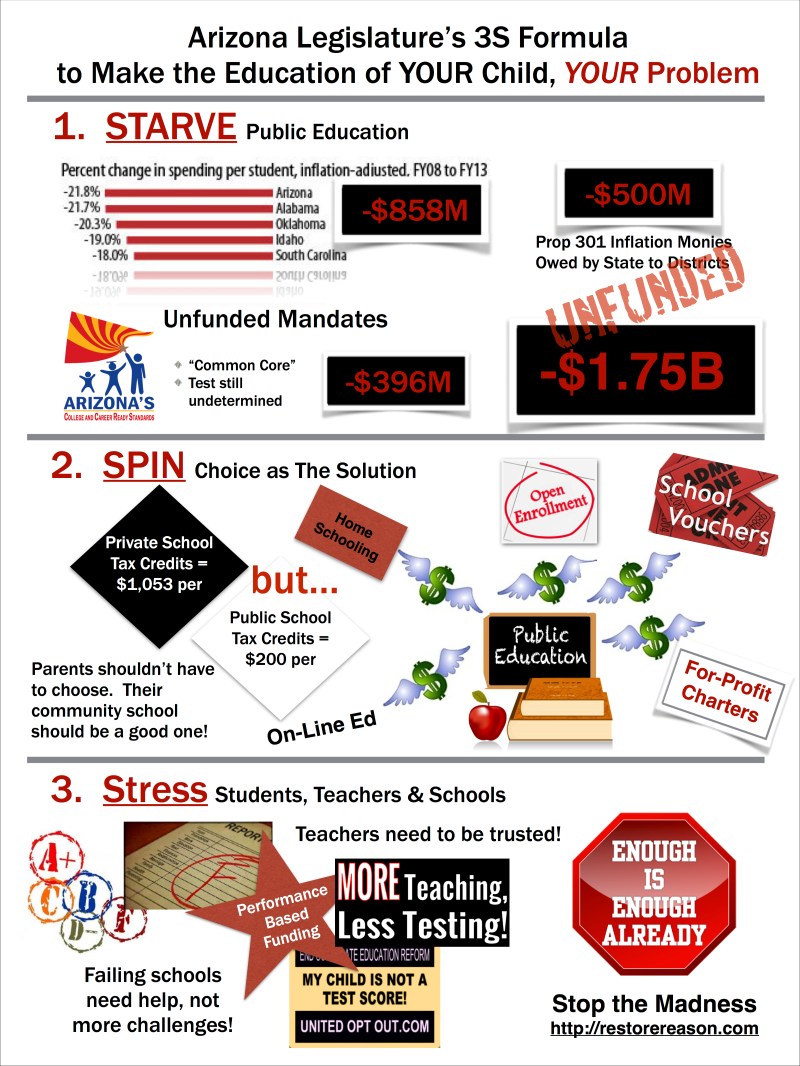
Arizona Legislature’s 3S Formula to Make the Education of Your Child, YOUR Problem
UGH! Right on the heels of my last post about why school vouchers are a bad idea, comes the Arizona Supreme Court ruling yesterday that private-school vouchers are legal. Okay, so there goes my belief that we had at least one sane decision making body in Phoenix! In fact, they ruled without comment, refusing to override a Court of Appeals decision which said empowerment scholarship accounts “do not run afoul of a state constitutional provision that bars public funds from being used to subsidize private and parochial schools since parents decide where the money goes, not state officials.
This logic reminds me of another disastrous Supreme Court (the real one) decision that rule corporations are people and allowed unprecedented influence in our electoral system by the über-wealthy. I mean really? Because parents decide where the money goes, my tax dollars can be used to pay for private or parochial schools? What happened to separation of church and state? Why even the Arizona constitution states it is illegal to use tax dollars for religious worship or instruction. In his ruling, appellate Judge Jon Thompson said nothing in the program amounts to the state providing funds for religious worship or instruction. He wrote: “The ESA students are pursuing a basic secondary education consistent with state standards, they are not pursuing a course of religious study.” Wow! That’s an amazing leap of faith (no pun intended) since lawmakers have continually fought any attempt to attach any kind of accountability to the ESAs and private and parochial schools already aren’t held to the same kind of accountability and transparency requirements as public schools. That’s like the US Supreme Court’s statement about Citizens United that they had no reason to believe declaring corporations people would adversely affect elections.
This latest court ruling now clears the way for legislation currently working its way through the full House that would boost eligibility to 800,000 students in Arizona. This, despite the fact that the Joint Legislative Budget Committee (JLBC) said this plan would cost more than the current budget ($12.5 million by 2019) for education because vouchers would be available to kindergartners who might otherwise have attended private schools anyway at parental expense.
I am livid! Why does a parent’s right to choose override my right to ensure my tax dollars are well spent and produce the right results? As a school board member, I am directly engaged in governance at the local level. Our Board meetings are open to the public and their comment is encouraged. Together, in a spirit of transparency and cooperation, we work to ensure our student’s best interests are paramount. When a child attends a private or parochial school on my taxpayer dime, I won’t know what he or she is being taught, how well he or she learned it, or what percentage of my money actually went directly to their education. In that the funding can also be used for curriculum, testing, tutors (without any certification), special needs services or therapies, or even seed money for college, there is zero accountability for ensuring the public’s interests are represented in ensuring a well-educated electorate. That is why the Arizona School Boards Association has strongly opposed vouchers and fought this court battle.
This is a bad decision which will produce bad results. It will most certainly do what proponents are intending for it to do – accelerate the death of our public schools, at the very least, accentuating a two-tiered system of haves and have-nots. And that, I believe, will lead to the eventual liquidation of our democracy. Don’t believe me? Just sit back, do nothing and watch the destruction.
Nope, not referring to North Korea or Iran, but the American Legislative Exchange Council (ALEC), The Goldwater Institute and The Center for Arizona Policy led by Cathi Herrod. All of Arizona’s GOP legislators are or have recently been members of ALEC. Led by Representative Debbie Lesko, ALEC’s Arizona Chair, they have introduced no less than 20 ALEC model bills including those that:
SB1062, the so-called religious freedom (but really about state-sanctioned discrimination against gays and others) bill that Governor Brewer vetoed last week, was being pushed by Cathi Herrod and her Center for Arizona Policy. The veto was a fairly significant setback for Herrod, but don’t worry, she has plenty of other tricks up her sleeve. On next week’s House Education Committee agenda, is SB1237, which passed the Senate on a party line vote. This bill expands the amount of this private school voucher to include the charter school additional assistance weight as well as 90% of the base support level funding the student would have otherwise received if they had attend a school district. This is a significant dollar increase as the additional assistance amount is $1,684 for K-8 and $1,962 for high school.
This bill is totally about increasing the diversion of public school funding to unaccountable private schools. Not only is our GOP-led legislature taking orders from Cathi Herrod, but our State Superintendent of Public Instruction recently robocalled public school families to entice them to take state (taxpayer) funding to attend private schools. When questioned about this, Huppenthal retorted that he is “the Superintendent of Public Instruction, not of Public Schools.”
Vouchers, by any other name, is model ALEC legislation. “Wherever you see states expanding vouchers, charters, and other forms of privatization, wherever you see states lowering standards for entry into the teaching profession, wherever you see states opening up new opportunities for profit-making entities, wherever you see the expansion of for-profit online charter schools, you are likely to find legislation that echoes the ALEC model.”
It is important for people to understand that one can’t be pro community public schools while also being pro vouchers and school choice. Despite what the privatization advocates are touting, school choice, and the various methods for providing options (empowerment scholarship accounts [vouchers], student tuition organizations, etc.), do not generally produce better results, especially when comparing similar populations. In addition, this is a zero sum game. When money is taken from public schools and diverted to for-profit charters, private and parochial schools, it begins a downward spiral that is very difficult for public schools to recover from. In addition, open enrollment promotes competition over collaboration not just between schools, but also on the part of parents who act in the interest of their child without concern for all children.
The bottom line is that community public schools perform a huge public good. In many cases, they are the thread that binds communities together. They helped put America on the path to greatness and they are still where 85 percent of Arizona students are educated. We don’t talk about how fire and police departments should be run by like a business or compete with one another for their raw product. Public community schools should be treated no differently. They are entrusted with an awesome responsibility, staffed by dedicated professionals, take all children who come through their doors and work against all odds to achieve their mission. They need you on-board advocating for their success. Please contact the members of the House Education Committee prior to Monday, March 10th and tell them to fail SB1237. It is not in the best interest of our students or our state and will only serve to enrich those who would make profit on our public education dollars.
 It is no surprise Arizona Legislators continue to seek expansion of Empowerment Scholarship Accounts AKA, vouchers. The concept is model legislation for the American Legislative Exchange Council (ALEC) and has been introduced in numerous states around the country. ALEC is the organization corporations pay big bucks to belong to so they can work together to develop model legislation to hand state legislators for introduction in their respective states. ALEC claims it is non-partisan, but in 2012 it had only Democrat of 104 legislators in leadership positions. In fact, every Republican legislator in Arizona is currently, or was recently, a member of ALEC. The pipeline for the ALEC agenda in Arizona is the Goldwater Institute and Jonathan Butcher; Education Director from the Goldwater Institute is the “Private Chair” of ALEC’s Education Task Force. Mr. Butcher has been collaborating with Rep Debbie Lesko, R-Peoria, ALEC’s Arizona State Chairman to expand Education Savings Accounts in Arizona. Even the Arizona Superintendent of Public Instruction, John Huppenthal, has actively promoted this private voucher program with a robocall directing parents to a Goldwater Institute website to pull their kids out of public school and send them to private school on the taxpayer’s dime, with no accountability.
Empowerment Scholarship Accounts were first introduced in Arizona in 2011 as a workaround to the state’s Supreme Court decision in 2009 that state school-voucher programs were unconstitutional because they violate a ban against appropriating public money for private or religious schools. In Niehaus V. Huppenthal the Arizona Supreme Court determined ESAs were not the same as vouchers because the specified object of the ESA is the beneficiary families, not private or sectarian schools. This decision is under appeal by the Arizona School Board Association and others.
ESA funds can be used for curriculum, testing, private school tuition, tutors, special needs services or therapies, or even seed money for college. The program however, requires parents to waive their child’s right to a public education…a right that is guaranteed under the state constitution, in order to receive the benefits.
The original ESA bill, SB 1553, was signed into law April 12, 2011 and at that time, qualified students were only those eligible to received disability related services from a school district, or had been identified as disabled either by the school district or under federal guidelines. Since then, we’ve seen expansions or at least attempted expansions, every year. In 2012, the legislature attempted to expand the law with HB 2626, to include those attending a school or district that had been assigned a letter grade of D or F, previous recipient of a scholarship, child of a parent or guardian who is a member of the Armed Forces, child who is a ward of the court, or who has been identified as a gifted pupil. Governor Brewer vetoed this bill on April 4, 2012. In 2013, SB1363 was introduced to expand to all those categories above, and increased funding provided to 90% of the sum of the base support level and Additional Assistance if the student were attending a charter school. Governor Brewer signed this bill into law on June 20, 2013.
Now, in its 51st Legislative Session, the Arizona Legislature is working fast and furious to further expand the state’s voucher program. Here’s a list of what’s on the docket per the Arizona Legislature website:
| Bill | Purpose | Status |
| HB 2291 & SB1236 | Expands students eligible to those whose parents are police, fire, or EMT, as well as any child who has a sibling who is already receiving an ESA. Also extends eligibility to any student on free or reduced-price lunch programs and increases the household income threshold eligibility by 15% each year thereafter. Would make a potential 881,000 students, or 73 percent of the total public-school population, qualified for the ESA program. The program is currently capped at 5,500 students until 2019 (per Legislative Report 2/26 AZ Capitol Reports.) | House bill up for House vote 3/6/14. Senate bill waiting to get on Senate Rules Cmte agenda. |
| HB2150 | Allows children whose parents are an active-duty member of the armed forces to immediately enroll in a private school using vouchers and retain 25% of each voucher amount per student | Ready for a floor vote |
| HB 2139 | Expands eligibility to a sibling of a current or previous ESA recipient and those eligible to enroll in a program for preschool children with disabilities. | Passed by House Approp Cmte |
| SB1237 | Expands funding for ESAs to include the charter school additional assistance weight as well as 90% of the base support level funding the student would have otherwise received if they had attended a public school. Significant dollar increase, as the additional assistance amount is $1,684 for K-8 and $1,962 for high school. | Passed the Senate along party lines |
| HB2036 | Failed after Representative Eric Meyer added an amendment to the bill to require any student who uses the voucher to take the same assessment as public school students. Representatives Allen and Boyer specifically mentioned they were voting against the bill because the testing language was added to it. (per AEA) | Defeated in House Education Committee |
Pro-voucher folks argue that such programs level the playing field—low-income students can have the same educational options as their wealthier counterparts. In fact, they like to infer, if not outright state, that it is all about ensuring those low-income students are not stuck in bad schools. Really? Only 362 students in Arizona had ESAs in 2012, but 92 percent of ESA funds went to private schools, in many cases for children whose parents could afford the schools without the assistance. For students without special needs, the program provides from $3,000 to $3,500 a year. As this is not nearly sufficient to cover the cost of tuition to a private school (which can be as much as $10,000), the program is unlikely to benefit students from low-income families. Additionally, according to William J. Mathis, managing director at the National Education Policy Center, the best private schools often aren’t interested in participating in voucher programs, so voucher programs end up supporting lower quality alternatives. On top of all this, opponents of vouchers argue that the policy doesn’t improve educational outcomes or performance.
ESAs are really just another way for Arizona legislators to make the education of YOUR child, YOUR problem. After all, under the Arizona constitution, “The legislature shall enact such laws as shall provide for the establishment and maintenance of a general and uniform public school system.” This is one of the primary responsibilities of the state of Arizona. When state funding for educating is passed on to parents however, so will be the responsibility for that education. After all, when you make a choice where to send their children, it won’t be your legislator’s fault you made the wrong choice. Of course, ESAs are also good for those desiring to profit from the privatization of public education. For-profit companies now run most charter schools and the lack of transparency and public oversight of charters and private schools will ensure profits can be maximized without repercussion.
Make no mistake about it; this push for vouchers is not in the best interest of the majority of Arizonans. Over 85 percent of Arizona’s school children still attend public community schools. Each time a student leaves with a voucher, schools lose the funding they would otherwise have received. Yet their overhead costs—for things like salaries and infrastructure—don’t go decrease just because a handful of kids left. Jeremy Calles, the Kyrene School District chief financial officer, said “the state continues to use tax dollars and tax credits to make private school more affordable for the approximately 5 percent of the Arizona student population that makes the choice to attend those schools, while causing significant damage to the education of the 95 percent of students who are choosing to attend public schools.” Representative Eric Meyer added that supporting public education should be a priority of anyone at the Legislature who is interested in investing in the economic security of the state. “Legislation that undermines the public school system in our state is incredibly detrimental to our economic future,” Meyer said. “These vouchers use tax dollars to subsidize schools that are not subject to state testing standards. We need our kids in schools that can be held accountable for preparing them for the workforce. By starving public schools of resources, we are affecting the very foundation of our economy.”
Education reformers would have you believe the best way to improve the American public education is to privatize it. Senator Al Melvin, candidate for Arizona Governor, thinks the solution is to give parents $9K for each of their children so they can choose where to send their child. Never mind that there are over $1 million students in Arizona and the cost to implement this “voucher” system would be more than the entire state budget.
Nonetheless, let’s explore this idea that privatization is the best solution to provide services for the common good. In Arizona, we turn to the business of incarcerating people, as this state is one of the leader’s in privatizing prisons. In early 2012, the Arizona chapter of the American Friends Service Committee (AFSC) issued a report on the impact of private prisons in the state. The report was called “Private Prisons: the Public’s Problem” and it concluded that between 2008 and 2010, Arizona overpaid for private prison services by about $10 million, and the services it received were sub-par: malfunctioning alarm systems, fences with holes in them, staff who didn’t follow basic procedures and more. In fact, the state’s auditor general found 157 serious security failings across five prisons that hold in-state prisoners. At least 28 riots were also noted.[i]
How did we get here? In 2012, Corrections Corporation of America (the largest for-profit private prison company in the country) sent a letter to 48 state governors offering to buy their public prisons in return for 20-year contracts. These contracts would include a 90 percent occupancy rate guarantee for the entire term. In Arizona, three for-profit prison contracts secured a staggering 100% quota, despite an analysis from 2012 by the Tucson Citizen that showed the company’s per-day charge for each prisoner increased an average of 13.9% over the life of the contracts. In 1997, Arizona’s spent $409 million on prisons; the per-year cost is more than $1 billion today. The state now has over 600 current contracts for incarceration related functions, but in fact, cost-effectiveness claims of private prisons just aren’t true.[ii] According to both AFSC and the non-profit privatization resource center, In the Public Interest: “in states across the country, private prisons have been plagued with a multitude of problems – major riots have exploded, inmates have died, and civil rights have been routinely violated. Private prisons have an economic motive to cut costs in every area of operations, resulting in lower-quality staff, higher employee turnover, and degrading prison conditions. These dismal conditions directly contribute to the decreased security and higher incidence of violence found at privatized prisons. As prison quality greatly suffers, there is little evidence that these private prisons save governments money.”
Surely this drove Arizona legislators to rethink their position on privatizing prisons, right? Nope, instead of trying to right the ship, they just turned it into a submarine passing HB2860 which, in the words of AFSC, would “ensure that the public would have no way of knowing whether the state’s private prisons are saving money, rehabilitating prisoners, or ensuring public safety.”[iii] Why would this be the case you ask? Let’s just follow the money. Private prison companies like GEO Group and Corrections Corporation of America have made huge contributions to legislators from both major parties, but most of the funds have gone to Republicans. These corporations have also played a very direct role in designing legislation good for business (such as SB 1070, the state’s notorious immigration bill, passed in 2010). Florida on the other hand, made exactly the opposite choice with a bi-partisan bill to defeat a plan to privatize the state’s prisons. The legislators who opposed the bill “argued that public education, like public safety, is a core mission of government that shouldn’t be outsourced to private vendors.”[iv]
As with the prison industry example, the incentives motivating those seeking privatization appear to be immune to the failures of vouchers to deliver on the promise of improved educational outcomes.[v] The Arizona State Legislature has been working toward privatization of our public schools in a multitude of ways. Tax credits for private schools and student tuition organizations wash money from public schools into private ones, often for students whose parents didn’t need the help to send their child to those schools. Empowerment Scholarship Accounts (ESA) give parents 90% of what the state would have spent on their child with a wide range of how they can spend it, even to send their child to a private school. Then there was also the pillaging of the public education budget that made Arizona the state with the highest per-pupil cuts to education from 2008 to 2012. Court mandated funding of the owed inflation funding from Prop 301 has helped raise us to third highest in the nation now, but that still is a poor ranking. Of course, it is important to understand that many of these voucher work-around programs get started as providing opportunity to students from poor families, children with disabilities or students in underperforming schools as with Arizona’s ESAs. This however, is not the ultimate goal of the privatizers. They are instead, a tactical means to a much larger strategic end of ending public education.[vi]
To what end you ask? Again, follow the money. Organizations like ALEC are promoting school choice and privatization, providing our legislators “camera ready” bills to implement across the country. In addition, Right-wing organizations and donors laud Arizona as a leader in the school choice movement and are funneling big money into the state.
What is really ironic about this whole privatization movement is that the GOP has painted them self into this corner. Their anti-government fanaticism, combined with tough stances on crime, immigration, etc., combined with a refusal to raise taxes, forces them to tout the benefits of privatization. Unfortunately, the companies whom the services are farmed out to are interested much more in a desire to generate revenue than in any social obligation. Think Halliburton and Backwater during the wars in Iraq and Afghanistan.
The bottom line is that business is in business to make money. There is nothing wrong with that as long as the product or service they provide is not something that must be provided to everyone regardless of their ability to pay. Every state constitution in the nation mandates the state provide a free public education – it was a requirement for their entry into the Union. But, when public services have been outsourced to “for-profit” companies, it is very likely the contract will increase in cost over time, limit transparency, undermine good public policy and the democratic process, and that the drive to generate revenue over providing for the public good will eventually be more costly to the taxpayers.[vii] The examples abound. We should pay attention. Public schools are not only our right as Americans, but they helped make us a great nation and, are important still very important to the health of our communities today.
[i] https://afsc.org/sites/afsc.civicactions.net/files/documents/Arizona_Prison_Report_Executive_Summary.pdf
[iv] Diane Ravitch, “Reign of Error”, September 17, 2013
[v] http://www.pfaw.org/rww-in-focus/predatory-privatization-exploiting-financial-hardship-enriching-1-percent-undermining-d
From 2008 to 2014, our state enjoyed the third highest change in K-12 per pupil spending (down 17 percent) in the nation.[i] Two out of three children don’t attend preschool, 27 percent live in poverty and three-quarters of fourth-graders aren’t proficient in reading. In fact, Arizona ranks 47th overall in the annual Kids Count survey.[ii]
Yet, our Legislature seems determined to destroy public education. In 2013, they expanded eligibility for Empowerment Scholarship Accounts (ESAs).[iii] These accounts allow parents to withdraw their eligible children from public schools and use 90 percent of the state money to pay for educational alternatives, including private school, tutoring, curricula, textbooks, online classes and tuition at Arizona’s public colleges.[iv] Senator Barbara McGuire moved to reconsider the bill after the Senate initially defeated it and then changing her vote to see it pass.[v] Arizona currently has 302 students with ESAs with $5.2 million taken from public education.[vi] This amount is only expected to grow, at the expense, of our public community schools. That’s one of the reasons passage of Oracle School District’s current budget override continuation is so important.
The $82 million per year in Prop 301 inflation monies the state has now been ordered to pay schools doesn’t event begin to close the gap.[vii] The Common Core Standards adopted by Arizona in 2010 are an unfunded mandate. The Arizona School Board Association estimates the cost of implementation in 2014-2015 alone at $156 million statewide and another $240 million in software/hardware upgrades and broadband expansion.[viii]
What can you do? Register for the Arizona Legislature’s “Request to Speak” system at http://www.azsba.org/advocacy/resource-center/. Once registered, you can comment on proposed legislation on-line and have it read into the record in Education Committee meetings. You can also call and email your representatives and of course, writing articles and letters to the editor is always a good idea. It is both your right and responsibility. Want to learn more? Email me at lthomas@osd2.org.
[i] http://www.usatoday.com/story/money/business/2013/09/25/7-states-slashing-education-spending/2866529/
[ii] http://datacenter.kidscount.org/data/tables/7288-kids-count-overall-rank?loc=4&loct=2#detailed/2/4/false/36,868/any/14344
[v] http://www.blogforarizona.com/blog/2013/07/no-barbara-mcguires-vote-for-vouchers-wasnt-a-surprise.html
In the past two years, LD11 Representative Steve Smith has made zero progress in his pledge to build the border fence other than raising a mere $275,000 (less than 10% of the GAO estimated cost to build one mile) and changing the name of his effort from Build America’s Fence to Secure America’s Border. In a August 16, 2013 Arizona Capital Times article, Smith said he hasn’t focused on fundraising but has devoted his attention to discussions with logistics and lawyers, which have taken up most of his time.[i]
One has to wonder just why Representative Smith is spending so much time on border security when the most southern point of LD11 is at least 75 miles from the border. In addition, the Tucson Metro Chamber of Commerce recently released their 51st Legislature Report Card showing Smith missing 27.4 percent of the votes, the worst record of any Southern Arizona legislator.[ii]
The priority bill votes he missed were HB2499, the JTED funding bill; HB2173, the unemployment insurance omnibus; HB2111, transaction privilege tax changes; and HB2608, defined contribution for EORP. Other votes he missed were assured water supply requirements exemption, school finance revisions, and new requirements for petition circulators.
LD11 has a myriad of important issues that we need our legislators to focus on. Border security is a federal government responsibility, Representative Smith needs to focus on the business of the people of LD11.
As a school board member and locally elected guardian of public education, I am concerned that those who would dismantle it are making headway. Senate Bill 1363 [empowerment scholarship accounts (ESAs)] currently working its way through the Arizona Legislature will siphon off even more funding from our public schools. It further expands the Arizona ESAs Program to kindergarteners and increases the amount available.[i] Both the Arizona Education Association (AEA) and Arizona School Board Association (ASBA) oppose the bill and are appealing a Maricopa District Judge ruling that taxpayer dollars may fund private schools. This, after the Arizona Supreme Court found in 2009 that two similar school voucher programs violated the Arizona Constitution’s ban on aid for religious or private schools.[ii]
A Casa Grande Dispatch article dated April 26, 2013 and titled “Gubernatorial race: Melvin’s bid shuffles the deck in District 11” contained a misleading statement. The sentence started with “Melvin’s education plan is built around giving every parent a voucher for $9,000…”
It is not true that the state provides close to $9K per pupil to public schools. Per the Joint Legislative Budget Committee[i], K-12 (M&O, Capital and All Other) funding per student (not adjusted for inflation) has been less than $5K every year since FY04. In FY11, the amount was $3,897 and the estimated amounts for FY12 and FY13 were even less that that. In fact, Arizona leads the nation in cuts to per pupil funding since 2008 – almost 22%.
Senator Melvin has oft lauded the Arizona legislature (himself included) for protecting total education funding at over $9K per student.[ii] Only half the funding however has come from the state. The rest of it has been federal (some of it stimulus funds which have now gone away) or local funding.
Funding alone won’t guarantee quality schools, but neither will starving our public schools of the basic funds they need to operate, let alone excel. In addition, our legislature hasn’t even begun to address (although the Governor has proposed $61M in her budget) the unfunded mandate to implement Common Core Standards ($156M for FY14 plus another $225M one-time cost statewide.) It is beyond time to face the real facts and take real action before it is too late.
[i] http://www.azleg.gov/jlbc/fiscal.htm (Education Spending, K-12 Funding Since 2004 (All Funding) (8/10/12
 April 9, 2013, the AZ Legislature unanimously adopted House Concurrent Resolution 2036[i] titled “Boy Scouts of America.” Eighty legislators sponsored this bi-partisan bill[ii] whose intent was allegedly to “honor the Boy Scouts of America for its contributions to the lives of our nation’s boys and young men.” I believe there is another intended message.
The resolution states the Boy Scouts “teaches respect for the beliefs of others” and “is a model for inclusiveness.” Excluding gay boys from membership is hardly “a model of inclusiveness” as it: 1) proudly excludes gay boys, thereby teaching boys that gays are lesser, unworthy people; 2) keeps gay boys ensconced in the closet damaging their self-worth; and 3) likely contributed to the methodical cover up of suspected child molesters.[iii]
The Boy Scouts recently reported its unanimous consensus for its “don’t ask, don’t tell” policy. They are way behind the power curve. The Supreme Court is currently considering the status of the Defense of Marriage Act and the Department of Defense has already ended its discriminatory “Don’t Ask, Don’t Tell” policy. As a retired Air Force Colonel who served 22 years and realized late in my career I was a lesbian, I can personally attest to the wasted energy expended by gay and lesbian service members to keep their true selves a secret. I know a retired Naval Captain who was assigned to the Pentagon in 2001. Having left her office for a meeting just seven minutes prior to the airplane impact, it was on this day she decided to retire from her 28-year career. She realized if she’d been killed, her partner of 11 years would have been the last to know about her death, as she had not listed her as “next of kin” for fear of being “outed”.[iv]
As a former Program Director of Wingspan, Southern Arizona’s LGBT Community Center, I learned 20 to 40% of homeless youth on the streets are LGBT[v] and about the pervasive bullying of gay children that still goes on in our schools by children and the adults they are entrusted to. LGBT youth are four times more likely to commit suicide than their heterosexual counterparts and nearly twice as likely to have been verbally harassed and/or physically assaulted as school while believing they have no adult they can talk to about personal problems. More than 45% of LGBT youth report that their state government is not accepting of LGBT people.[vi]
The Arizona Legislature has once again proven they do not represent all the people of Arizona. This resolution was an unnecessary piece of legislation intended to send a message of support to a discriminatory organization. After all, where is the concurrent resolution in support of the Girl Scouts who by the way don’t feel the need to exclude lesbian girls? I was a Girl Scout and am grateful for the experience it afforded me and wish for every child that same opportunity – to be the very best of who they are.
Diversity has always been one of our nation’s strengths. It is one of the reasons I am proud to be a citizen of these United States. Today however, I am not proud to be an Arizonan.
 Restore Reason