The Wall Street Journal thinks AZ Gov. Ducey is saving public ed

Wow! Talk about biased reporting and it’s not even from the “lame stream liberal” media, but a right-wing rag, The Wall Street Journal[i]. From the get go, it is clearly biased against education or, should I say, “the Education Spending Lobby.”

Jon Gabriel writes in the Wall Street Journal that Governor Doug Ducey “appears to have solved one of the hairiest problems in Arizona politics: How to give more money to teachers – without raising taxes – and settle a long-standing billion-dollar lawsuit filed against the Grand Canyon state by its own school districts.” Gabriel goes on to say that “Mr. Ducey, a former CEO of Col Stone Creamery, apparently knows how to wheel and deal.”

Give me a break! First of all, the money that Governor Ducey is “giving” the teachers already belongs to public education. The voters mandated this inflation funding be paid annually starting in 2001, and the AZ Legislature hasn’t paid it since 2009. Secondly, some school districts, along with the Arizona School Boards Association, Arizona Education Association and the Arizona Association of School Business Officials filed suit after trying to reason with the Legislature to no avail. Then the court agreed the Legislature owed Arizona school districts the money and they still didn’t pay up.[ii] Finally, after five years of lawsuits, the plaintiffs negotiated a deal that was acceptable albeit much less than ideal.

The Wall Street Journal article doesn’t talk about the amounts owed: $331M per year for failing to fully fund inflation and $1.3B in back pay and increased per pupil funding. It also doesn’t mention that increasing the state trust lands monies withdrawal rate from 2.5 percent to 6.9 percent will deplete future revenues for public education. Yes, AZ Treasurer DeWitt was originally concerned about exceeding 3.75 percent in withdrawals but then he said he could live with as much as a 5 percent withdrawal rate. Ducey wouldn’t budge from his proposed 6.9 percent however, leaving Dr. Randy Friese, LD 9 AZ Representative (D) to wonder if Ducey’s reason was that it would give him credit for the largest bump ever to public education.

Why did the plaintiffs agree to a deal that wasn’t ideal? That’s easy. It gets more money into district schools as early as late 2016. Arizona recently ranked dead last in the nation in public school spending per student a fact directly tied to the state’s performance in K-12 education.[iii] In addition, state “leadership” hasn’t exactly proven itself responsive to the voters, why should public education advocates have faith that would change? As for the WSJ article’s assertion that education funding was misspent because AZ had lower than national averages of classroom spending, that’s easy to explain. Yes, non-classroom spending (plant operations, food service, transportation, student and instruction support such as counselors, school nurses and librarians and administration) had increased as a percentage of overall spending. When less than two percent of what should have been funded for school facility maintenance and repair was paid, the costs for keeping old, rundown, less energy efficient facilities is naturally going to be higher.[iv] When bus fleets can’t be recapitalized, of course it costs more to maintain an aging fleet. And oh by the way, much of the so called “non-classroom spending” is fixed overhead costs which must be born no matter the level of overall funding. Naturally then, when the denominator decreases when the numerator stays the same, the percentage of the numerator increases.

Money is not the only answer to fixing public education, but it is definitely a part of the solution. At best (factoring in cost of living) Arizona teachers still make $12K less than the national average.[v] Class sizes also matter, that’s why it’s one of the first things private schools tout to attract students. Money does make a difference, that’s why wealthy parents will spare no expense in sending their children to the best that money can buy.

Sorry, I can’t buy in to Governor Ducey as the 2015 Public Education Hero of the Year. He has brokered a deal that pays the districts only 70 percent of what the voters mandated and the court validated was due. In addition, he is basically taking the money for that deal out of the public education’s own bank account. And oh by the way, the voters still have to say yes again in May 2016 for it to actually happen. Arizona has a rainy day fund of $460M on hand as well as a $325M budget surplus, some of which at least, could have been given to the districts now.[vi] No, I don’t think I’ll clap for the Governor just doing his job, sort of.

[i] http://www.wsj.com/articles/arizonas-end-run-around-the-education-spending-lobby-1448656992

[ii] http://azsba.org/?attachment_id=11411

[iii] http://www.azcentral.com/story/opinion/op-ed/laurieroberts/2015/09/28/arizona-teachers-rankings-wallethub-study/72982460/

[iv] http://www.azcentral.com/news/articles/2012/01/31/20120131arizona-school-funding-gap-grows.html

[v] http://tucson.com/news/local/education/study-tucson-teacher-pay-well-below-national-average/article_87eb5060-940a-5262-a791-8e32c35f7ca7.html

[vi] http://www.azcentral.com/story/news/arizona/politics/education/2015/09/16/jeff-dewit-doug-ducey-arizona-education-funding/72013722/?from=global&sessionKey=&autologin=
From the K-12 Public Education War Front in Arizona

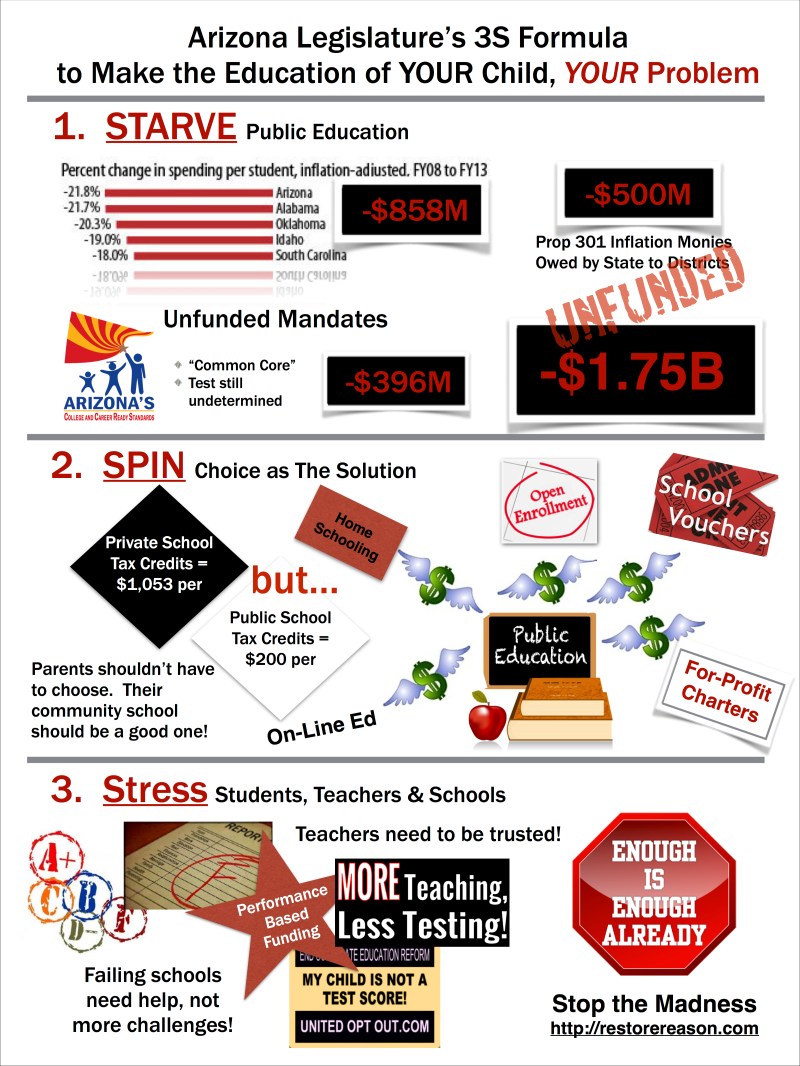
The war on public education has been waging for several years in Arizona, but this year has seen some especially heavy fighting. The attacks on public education by the first session of the 52nd Legislature (hereafter referred to as the ENEMY) have been asymmetrical and relentless. Recognizing that K-12 public education (hereafter referred to as FRIENDLY FORCES) can’t accomplish the mission unless well-resourced, General (Governor) Ducey has already signed a budget cutting $113M more from their budget. This, on top of the ENEMY’S continuing battle to deny FRIENDLY FORCES the people’s mandated and court adjudicated inflationary funding ($317M definitely owed with another $1.6B in question.) The ENEMY is also continuing the assault on the FRIENDLY FORCES’ supply lines with their attempts to exponentially expand vouchers, (Empowerment Scholarship Accounts) and corporate tax breaks for donations to private schools (Student Tuition Organization scholarships.) And, just to be sure it is as difficult as possible for the FRIENDLY FORCES to communicate their resource needs to the public (hereafter referred to as ALLIES), the ENEMY continues to try to mandate additional language in bond and override descriptions to obfuscate and in fact, mislead the ALLIES. Of course, there are also bills to dump Common Core since renaming the controversial standards the Arizona College and Career Standards didn’t really fool the ALLIES. The ENEMY believes this is an important battle to fight so they can keep the FRIENDLY FORCES in a constant state of instability and uncertainty and continue to win the hearts and minds of the fringe that supports them.

Up until recently however, FRIENDLY FORCES were able to communicate to their ALLIES ramifications of the ENEMY’S strategy and intent. Now though, the ENEMY has countered with Senate Bill 1172 to totally cut the FRIENDLY FORCES’ lines of communication. Initially, this bill was written to prohibit school districts and charters from releasing directory information for the purpose of political activity, which would limit the ability of local parent and community organizations from engaging other parents on district bond or override issues. In a last minute change to their strategy, the bill has now been amended to also fine an employee of a school district or charter school $5,000 for distributing written or electronic materials to influence the outcome of an election or to advocate support for or opposition to pending or proposed legislation.

On one level, this tells me the FRIENDLY FORCES are gaining ground in this war on public education. Surely, if the ENEMY feels the need to “gag” the FRIENDLY FORCES, they must be making headway. Perhaps the showing of over 1,000 FRIENDLY FORCES and ALLIES at the Capitol in early March to protest General Ducey’s cuts to public education gave the ENEMY pause. The FRIENDLY FORCES cannot however, underestimate the ENEMY’S objective to seize, retain, and exploit their initiative to kill public education and turn it over to private profiteers. They will not be happy until all the FRIENDLY FORCES are subdued and the economically safe (largely white) students are safely ensconced in private schools and the socio-economically disadvantaged students (largely students of color) are stuck in pathetically underfunded and therefore underperforming schools.

Make no mistake. This isn’t a matter of the ENEMY not understanding the needs of the FRIENDLY FORCES and those they are charged to protect and serve. This is a matter of not caring about them. The ENEMY is backed by the AXIS OF EVIL (corporate money, American Legislative Exchange Council, and ideological fanatics) and is committed to victory in this fight. FRIENDLY FORCES must recognize we are at war and employ the strategies and principles thereof to win the fight.

Disingenuous Ducey

Governor Ducey called for a 5 percent reduction in non-classroom spending for district schools and a 3.5 percent reduction in additional assistance for charters . He claims the goals of the reduction are to 1) reduce the size of school administration and 2) refocus on students and teachers.

Politicians know a call to “cut administration costs and ensure more money ends up in the classroom” sells to the masses because “administration costs” is often heard as “salaries for superintendents, principals and office staffs.” In reality, these “nonclassroom dollars” refer to administration, plant operations, food service, transportation, student support, and instruction support.

Ducey realizes these are critical functions and that’s why he recommends requiring superintendents (or CEOs) and the school finance officer to certify the reductions will not affect the classroom. I can’t imagine how a superintendent in good conscience could do this since counselors, transportation, librarians, food service, and speech therapists are critical to a teacher’s ability to teach. One in four children in Arizona live in poverty and they bring a host of challenges with them to school. Challenges teachers can’t deal with on their own, especially with larger classes.

As a 22-year Air Force (AF) veteran, I know that flying operations are generally considered the premier “mission essential” functions. But, AF leaders recognized flying operations couldn’t happen without support functions like food service, personnel, security, transportation, etc. Ultimately, the airman fueling the plane is just as critical to mission accomplishment as the pilot flying it. Yes, classrooms are where the main learning occurs, but classroom teachers can’t do their magic without the right kind of support. When the Governor talks about cutting non-classroom funds by five percent, no mater how he spins it, that equates to cutting K-12 education by five percent.

The Governor’s also wants to take $23.9M from the Student Success Fund to create the “Access Our Best Public Schools Fund” to expand existing charter facilities/construct new ones. He claims this is because of the high waiting lists at best performing charters. Unfortunately these waiting lists are virtually impossible to validate because their for-profit corporations refuse to provide the transparency required of district schools.

Is there a correlation between Arizona’s bottom ten in funding for K-12 education , and 47th in performance ? I am of the thought that to a certain extent, you get what you pay for. Close to 90 percent of Arizona’s students still attend community district schools and yet our state leadership continues to focus on creating more opportunities for profit on the backs of our children, to include making it easier and easier to funnel tax payer dollars to private schools. If Governor Ducey really cared about K-12 education, he would focus on the schools we already have versus building new ones and he’d provide our schools real funding versus just reallocation via a shell game. In the end, claiming charter and private schools do better (a stretch), while starving our district schools of funding, becomes a self-licking ice cream cone which serves those best who don’t need the help to begin with. Maybe that’s the plan.

Definition of Insanity

I recently found myself thinking about the whole idea of “trickle down” economics. Aside from the discussion about whether or not it works, I wondered how the American public ever bought into the idea that we would be satisfied with the crumbs that drop from the table.  Of course, when the term was coined, we were in a time of general economic well-being. In other words, we were all living the good life, so it was easy to convince us the theory worked.

But it doesn’t work. It hasn’t worked in the past and it won’t work in the future. According to Wikipedia, this theory, (also referred to as supply-side economics to make it more palatable to the masses), was referred to in the 1890s by economist John Kenneth Galbraith as the “horse and sparrow” theory. This name came from the idea that “if you fed the horse enough oats, some would pass through to the road for the sparrows.” In other words, forget the crumbs from the table, the masses will only get what’s leftover after processing, and it doesn’t smell good.

Politico Magazine recently published an article by Nick Hanauer called “the Pitchforks Are Coming… For Us Plutocrats. Mr. Hanauer is one of those very wealthy one percenters who calls himself a proud and unapologetic capitalist. He credits much of his success to “a tolerance for risk and an intuition about what will happen in the future.” That intuition served him well when he invested very early on with Jeff Bezos, the founder of Amazon.com. The crux of his article is that rich people don’t have any “divine” right to all the spoils and that if they don’t recognize that severe wealth inequity is bad for all, revolution may be inevitable.

Hanauer makes the point that today, the wealthiest are “thriving beyond the dreams of any plutocrats in history” and the “divide between the haves and have-nots is getting worse really, really fast. Since 1950, CEO-to-worker pay ratio has increased 1,000 percent with CEOs earning 500 times the median wage as opposed to 30 times back then.  Robert Reich’s movie Inequality for All points out that since 1978, 1 percenters’ earnings have gone from eight times that of the average male U.S. Worker to 33 times more. Reich also points out that the “wealthiest 400 people in the country today have more money than the bottom 150 million Americans combined.”

Hanauer goes on to say that “these idiotic trickle-down policies are destroying [his] customer base and that the model for “rich guys” like him should be Henry Ford who figured that if he raised the wages for his employees, they’d be able to afford to buy his Model Ts. Yes, employees are also customers, what a concept! The CEO of COSTCO realizes this and that’s why he pays his employees a living wage as opposed to Wal-Mart who expects the rest of us to pick up the tab for their employees who don’t make enough to live without government assistance. When Hanauer wrote an article called “The Capitalist’s Case for a $15 Minimum Wage in June 2013, Forbes called it a “near insane proposal.” Now though, an analysis at the Center for Economic and Policy Research reports that states that raised their minimum wages are experiencing faster job growth. Business people may “love our customers rich and our employees poor” as Hanauer quips, but a growing economy loves more people with money to spend.

Instead of the failed trickle-down theory, Hanauer advocates “middle-out” economics which refers to the “much more accurate idea of an economy as a complex ecosystem made up of real people who are dependent on one another.” Rich business people aren’t the true job creators he says, but rather, middle-class consumers. Unfortunately, trickle-down economics has shrunk the middle-class so much now that there just isn’t enough purchasing power out there to move our economy forward at a reasonable pace. Rich people just can’t buy enough clothes, cars, houses, etc. to make up for the lack of purchasing power in a robust middle-class.

Honing in on what’s been going on in Arizona over the last several years, it is obvious our political leaders are advocates of trickle-down. The GOP has been in control of the legislature for the past 40 years and their approach has resulted in regressive tax policy or what I’ll refer to as trickle-down budgeting. Yes, instead of the “riches” trickling down to the little people, our legislature has worked hard to ensure the bills do. This is what happens when the state relies heavily on sales tax. This is what happens when the state underfunds public education so that locally controlled funding and contributions must try to make up the difference. This is also what happens when the state sweeps Highway User Revenue funds (HURF) to give corporations tax breaks instead of fixing roads. In the case of bad roads, we pay a double tax. We first pay a tax to maintain the roads and when the money is siphoned-off to be used for other reasons, we pay to get our cars fixed.

AZ Daily Star recently reported that Aruna Murthy, director of economic analysis for the state Department of Administration, called the state’s projected job growth “stagnant, slow, and subpar.” Yet, the 51st Legislature bragged about balancing the budget. Maybe so, but at what cost?  What they really did, was rob Peter to pay Paul, such as when   “they took $53 million from other accounts, like gasoline taxes and vehicle registration fees normally earmarked for road construction and maintenance, to help fill the gap. That money will be gone by the end of the coming fiscal year, but the looming budget hole did not stop lawmakers from cutting taxes in the name of economic development.

This, at a time when Arizonans are earning less than they were prior to the recession. Yet, under Governor Brewer, lawmakers voted to cut corporate income tax rates by 30 percent. The full impact of those cuts won’t even hit until 2018, when, according to budget analysts, the net loss to the state will be $270 million a year. Economist Dennis Hoffman, of the W.P. Carey School of Business at Arizona State University, said “if tax cuts were the key to prosperity, we would be swimming in a pool of prosperity right now.  We have clearly maximized on the tax-cut train.” Someone please relay that message to the current pool of AZ GOP governor candidates who are vowing to do away with state income tax if elected.

Albert Einstein once said that “Insanity is doing the same thing over and over again and expecting different results.” It is way beyond time for us to demand better than the tired old ideas that don’t work. Two candidates for the Arizona Legislature in LD 11, Jo Holt for the Senate and Holly Lyon for the House, understand we need a new direction. They believe we must begin to invest in Arizona’s long-term health in areas such as public education and infrastructure. These are critical investments that will pay off over the long-term for both Arizona’s citizens as well as quality companies who would consider bringing good paying jobs to our state.

In my experience, if it seems to good to be true, it probably is. Arizona simply cannot continue to cut its way to prosperity. In its 2013 Kids Count Databook, the Annie E. Casey Foundation ranked Arizona 47th in the nation for our children’s welfare which included factors such as economic well-being, education, health and family and community. Not only is it obvious that going down the “trickle-down” rabbit hole is keeping our economy from recovering, but is also ensuring our next generation is handicapped from the get-go.

This November, we’ll get the chance to once again weigh in on what direction Arizona heads. Let’s make informed decisions with the long-term health of our state in mind. You owe it to yourself and to all future generations of Arizonans.

Why Huppenthal’s gotta go

OMG! Where do I begin? I’m going to assume most folks reading this have already heard about Arizona’s Superintendent of Public Instruction and his racist rants on various blogs under psuedonyms Thucydides and Falcon9.  I’m not going to list them all again, but suffice it to say he hates Hispanics, he thinks those on welfare are lazy pigs, and he is a coward for not posting under his own name.  Then, when he was caught in the act, he uttered a faux apology before breaking down crying in a news conference but refusing to resign.

I’ve thought long and hard about this issue and have come up the only reasonable conclusion that he must resign. After all, what John Huppenthal has done is share his true self with us, albeit under another name. He said he used another name to encourage an open dialogue. Really? Doesn’t seem very open when someone is hiding who they are. Furthermore, although he is trying, it’s not like he can “take back” his comments. After all, he compared the Mexican-American studies program in the Tucson Unified School District to the KKK and said it was similar to what Hitler did to coalesce the Germans against the Jews. Sorry, but that’s not the kind of thinking for which you can say “oooops, I misspoke”.  That’s the kind of thinking that comes straight from the heart…or lack thereof.

John Huppenthal tried to justify his robocalls encouraging parents to put their children in private schools by saying he is the Superintendent of Public Instruction, not the Superintendent of Public Schools. That didn’t fly then, anymore than his claim that he didn’t really mean all those nasty things he said will fly now. Since at least 2009, he has spewed hatred toward the poor and Hispanics. One in four children in Arizona is living in poverty and the percentage of Hispanic children in K-12 education has now surpassed that of White children. Huppenthal wouldn’t be the right guy to chart the course for any state’s education program, and especially not in Arizona. Not to mention that he doesn’t even begin to set the example for our students.

He has systemically been trying to turn back the clock to those great ole’ “Leave it to Beaver” days while privatizing public education so private enterprise can profit. He needs to step down so we can move forward and he needs to do it now!

Survival of the Fittest Mentality Won’t Keep Our Nation Great

Properly educating all Arizona’s children isn’t just important to parents, it is important for all of us. Our state simply won’t progress if we don’t start focusing on improving the educational outcomes for all children, 85 percent of whom attend our traditional public schools. These schools are where we should be focused. The bottom line is that parents shouldn’t have to make a choice. Every public school should be a quality school that offers a complete curriculum that will ready our students to be productive citizens of our state and country.

School choice is not a magic panacea and it will not ensure more accountability. No school choice option provides more transparency and accountability to both taxpayers and parents than traditional community school districts overseen by locally elected school boards. The Arizona Auditor General performs and publishes an independent appraisal on public schools, looking at variety of factors such as operational efficiency, student achievement, teacher measures and financial assessment. In addition, public schools are subjected to state and federal audits of financial data, all matters of public record. That level of transparency and accountability just isn’t available when it comes to vouchers paying for private school. “A recent article in the Arizona Capitol Times[i] reported parents with ESAs have saved up roughly $2.5 million of taxpayer dollars over the past three years causing many to question the program’s accountability. “One tight-fisted parent” writes the Times, has “hung onto $61,047 while spending only $825.” I have to ask how this can be in the child’s best interest?

It seems we’ve always been reluctant to admit the role socio-economic states plays in educational outcomes. Improving our public education system ultimately means making headway on Arizona’s opportunity gap where one in four of our children live in poverty and we are ranked 46th in overall child well being[ii]. This will take more than testing, it will take political will and hard work and it won’t happen overnight. The well funded, hard charging push to “throw the baby out with the bathwater” in privatizing public schools obfuscates the real problem and is designed to turn huge profits for those who already have plenty.

I get that parents want to ensure their child has the best they can provide. Our state legislators and education officials though, are supposed to ensure that every child has an adequate education, taxpayer dollars are well spent and, the educational needs of our state workforce are met. This isn’t happening. Instead, our nation has the highest rate of segregation since the mid-1960s and the “idea of social responsibility for the common good[iii]” seems all but gone. While families with the wherewithal to avail themselves of options are leaving public schools to pursue options they perceive as better, educational opportunities for the middle and low-income students left behind continue to decline. In the end, this gulf between the haves and have-nots serves to “defeat the goals of a democratic society, which does best when there is integration across class, race and ethnic lines.”[iv]

The survival of the fittest mentality isn’t one I think we should be proud of. I always thought the American dream was that if you applied yourself in school, “kept your nose clean” and worked hard, you and your children would wind up better off than where you started. America was the land of opportunity…and a free public education was both a driver of that opportunity and of our rapid ascension to greatness as a nation. I believe it is key to keeping us there.

[i] http://azcapitoltimes.com/news/2014/04/15/millions-remain-unspent-in-school-choice-program/

[ii] http://www.aecf.org/KnowledgeCenter/Publications.aspx?pubguid=%7B68E8B294-EDCD-444D-85E4-D1C1576830FF%7D

[iii] http://www.huffingtonpost.com/arthur-camins/why-god-bless-the-child-t_b_5118915.html

[iv] 50 Myths & Lies that Threaten America’s Public Schools, The Real Crisis in Education, David C. Berliner and Gene V Glass and Associates, Teachers College, Columbia University, 2014

A Familiar Recipe for Disaster

I recently came across an August 2013 report by Lindsey M. Burke from The Friedman Foundation for Educational Choice titled: The Education Debit Card – What Arizona Parents Purchase with Education Savings Accounts. The report makes many claims begging to be refuted. In the executive summary, the author credits Arizona with creating “a model that should be every state policymaker’s goal when considering how to improve education: funding students instead of physical school buildings and allowing that funding to follow children to any education provider of choice.” The model referred to here are Empowerment Scholarship Accounts (ESAs).

In September 2011, Arizona’s ESA program started with a modest enrollment of 153 students with special needs. In 2012, enrollment had grown to include more than 300 children with special needs.   Expansion continued that year with eligibility granted to more than 220,000 Arizona students, including 125,000 children with special needs, 87,000 children in underperforming public schools (rated D or F), 11,500 children of active- duty military families, and any additional foster children.Currently, according to AZ Ed News, more than 250K students are eligible to apply.

Although I totally “get” a parent wanting the very best for their own child, I am also brought back to a quote by John Dewey’s (possibly the most significant educational thinker of the 20th century): “what the best and wisest parent wants for his child, that must we want for all the children of the community. Anything less is unlovely, and left unchecked, destroys our democracy.”

The real truth is, the majority of children (for a multitude of reasons) will simply not be able to avail themselves of the ESA opportunity. So, I find myself asking what are the real reasons Arizona legislators and other leaders are pushing vouchers as the solution for educating our children? Color me cynical, but let me offer some thoughts:

1. A voucher by any other name. The ESA bills are model American Legislative Exchange Council (ALEC) legislation. As reported by education activist and blogger David Safier: “The Goldwater Institute came up with the idea for ESAs as a second workaround (the first is our tuition tax credit law) to make vouchers legal in a state where the constitution prohibits the use of public money for religious instruction. (Did you know over 70% of Arizona’s private schools are religious?) The term of art for this kind of legislation is “backdoor vouchers.” The conservative’s ultimate goal is vouchers for all.”

2. What can parents afford with an ESA? AZ Senator Al Melvin (who is running for Governor this year) likes to tout vouchers for every child at $9,000 per child is either ignorant or disingenuous. First of all, if every child in Arizona were given that much funding, it would cost as much as entire budget of the state of Arizona ($9.054B vs. a budget of 9.18 billion.) Secondly, the ESA base rate this year is only $5,400 per child, not $9,000. So, what private school can parents send their children to for $5,400? The website Private School Review shows the average tuition at Arizona’s private elementary schools as $5,465. Please note, this is not the total cost. Private schools do not typically offer free transportation to/from school or like public schools do, nor is a free/reduced fee lunch program offered. Additionally, parents are often expected to donate time, or in the case of at least one school, get charged $10 per hour when they don’t donate the requisite amount. Finally, please note the $5,465 cost is just tuition. What else is not included in this cost – books, athletics, extracurricular activities?

3. Despite claims to the contrary, competition is not the answer for everything. Whereas public school districts should be collaborating with each other to ensure the most effective use of taxpayer dollars, open enrollment and school choice encourages just the opposite. Marketing campaigns and intra-district bussing is now the norm to boost enrollment numbers. Additionally, where engaged, caring parents would once get involved as part of the solution in their community public schools, now they vote with their feet and take their talents to private options versus applying them to the common good.

4. There is little accountability or transparency in the use of the ESA funding. A recent Arizona Capitol Times article reported parents with ESAs have saved up roughly $2.5 million of taxpayer dollars over the past three years causing many to question the program’s accountability. After all, these unspent funds equal 21 percent of the almost $12 million handed out since 2012 and represent 68 parents holding onto amounts from $10,000 to over $61,000. A representative for the Arizona Department of Education (AZ DOE) said they have no authority over how much of the quarterly disbursements must be spent, only that the receipts for the expenses reflect allowed expenditures. The AZ DOE administrator of the program said the department is aware of the growing accounts, but has no authority over how much of the quarterly disbursements must be spent. Obviously though, money held onto is not money spent on a child’s education. As a vivid case in point, one “tight-fisted parent has hung onto $61,047 while spending only $825.” How can this be in the child’s best interest?

5. But wait, weren’t ESAs supposed to save the state money? ESAs were supposed to save the state money, but now they will cost Arizona more than educating children in the public school system. Despite the legislature’s unwillingness to change the law to allow it, John Huppenthal, the AZ Superintendent of Public Instruction has unilaterally moved to provide all ESA students funding at 90 percent of the charter school funding level, which is currently higher than the district school level. This translates to all students on ESAs getting the charter school amount, an additional $1,684 to $1,963 over what was given for students transferring from traditional schools. Additionally, according to the AZ Joint Legislative Budget Committee, the newly expanded availability to kindergarteners that might have attended private schools anyway at parental expense drives up the cost as well.

6. Superintendent of Public Instruction, not public schools! Superintendent Huppenthal recently shilled for The Alliance for School Choice recording a robo-call that went out to 48,000 qualifying families and referred families to a Goldwater Institute website for more information. His$250,000 marketing campaign evidently produced results with applications for the 2014-15 school year doubling from 2,479 from 1,100 the previous year. When questioned about his actions, he said “he is the Superintendent of Public Instruction, not public schools.

Given the facts surrounding the push to expand ESAs, one must ask why? I suspect politics is largely responsible. “Arthur Camins, a teacher and director, center for innovation in Engineering and Science Education, Stevens Institute of Technology” posits the corporate reformers believe (or want us to believe) that “Improving all schools is hopeless. Poverty will always be with us.” That’s why he says, they believe they need to offer privately governed schools to serve the “best among the unfortunate.” They know not all children will be successful, they just need a system for sorting through those who can be. “This is the cold hard truth. Only we (the best and smartest) have the guts to act on it.”

Camins goes on to write that, “in-school tracking and magnet schools have long served to mediate dealing the hard truth that poverty undermines children’s readiness and ability to engage in and sustain learning.” Now though, the new well-funded partnerships trying to provide a systemic alternative to public schools is more “explicitly elitist and anti-democratic” than ever before. “As long as the only seeming rational choice is self-preservation, people who can, will choose it.” What is new now is “the scale of the effort and resulting damage, the ever-widening disparity in income and differential life chance opportunities and the erosion of the very idea of social responsibility for the common good.”

Dr. Tim Ogle, Executive Director of the Arizona School Board Association writes that “allowing some selected children to “opt out” of public education to go to schools with unknown aims and objectives removes incentives to develop new creative solutions to education’s toughest challenges. Let’s call these accounts what they are: government subsidies for private enterprise using children as the currency.”

Voucher programs aren’t about offering parents a choice, they aren’t about ensuring special needs children have every opportunity, and they aren’t about improving the educational outcomes for our students. What they are about is making money…lots of it. Big money, lack of transparency and accountability, and legislators collaborating with big business…sound like a familiar recipe for disaster to anyone else?

A Moment of Reason in the Arizona Legislature – Voucher Expansion Bill Defeated

Somewhat unbelievable, but reason prevailed today in Arizona. Against all odds, the latest grand attempt to expand vouchers failed 31 to 27. HB2291, as amended, would have expanded eligibility for vouchers to any student living within qualified zip codes (as defined by the average household income is below 185% of the federal poverty level for a family of four) regardless of family income.  If passed and signed into law by the Governor, this bill would have expanded eligibility to 112,000 and exponentially increased costs for the program.

I watched a live feed of the Arizona House Committee of the Whole discuss this bill, HB 2291, Empowerment Scholarships Accounts; Expansion, sponsored by Rep Debbie Lesko (R). Some great points were made on the part of those against the bill and the same Rep. Ontondo (D), a former teacher said that in her legislative district, there are people who earn $300,000 and others who make $15,000. If you average this out, she said, it probably is about 40,000 so those who don’t need the “vouchers” to afford the private schools will get taxpayer dollars anyway. She also expressed the concern about the lack of transparency and oversight and referred to the fact that 21% of the ESA funding has been banked by parents and therefore not used for the education of their children. She said that taxpayers deserve to know how their dollars are being spent. Another representative (D) said that if we want great outcomes, we need to keep money in public education and stop choking our public schools. Another (D) said we’ve had choice in Arizona since the early 1990s and what has it done to improve our public education. If we can’t get everyone a voucher, we shouldn’t be doing it.

Rep Hale (D), from the Navajo Nation, asked Rep Lesko (the AZ Chair for the American Legislative Exchange Council, or ALEC) several questions to subtly make his points. The first was whether she was aware of the income levels on the Navajo Nation and whether she knows how many private schools there are on the Navajo Nation. She said she did not know the answer to his questions. He replied that there are no private schools. She said ESAs don’t only offer funding for private schools, but for on-line learning or tutoring as well. He then asked if she was aware of how few people had access to the Internet on the Navajo Nation and she said she was not. I was impressed with how he led her down the path to divulging how ignorant she was about some of the state’s most needy children.

Rep Wheeler (D) provided information about the funding issues of this bill. He said recent changes to ESAs ensure funding at 90% of charter versus public, to the amount of $1007 per pupil more. He said that under the current basic state funding, a non-disabled student gets $5,400 as opposed to $5,800 per student (90% of $6,400 for vouchers.) This alone, according to the AZ Joint Budget Legislative Committee (JBLC), will increase costs of this program by $950K this fiscal year. He also said that if there were 600K students on ESAs, it would cost $3.6B and if there were 800K, it would cost $4.8B. Currently he said, there are 150K students eligible. With this bill, and addition of free or reduced, the increase in 2017 would be by 485K and cost another $2.19B. He also said that the cap of 5,400 per year meant nothing as it could easily be raised.

In a surprise to me, Rep Goodale (R) said she voted no because 100K expansion is too much at this time for the ESA program to absorb.

Finally, I’m quickly becoming a fan of Rep Heather Carter. She is a Republican, but first of all, she is a rationale representative of the people and, a strong advocate for public education. She was an articulate advocate for public education today and made some great arguments. When Rep Kavanaugh (R) referred to the district charters as faux charters, she called him on it. She pointed out that the laws allowing districts to convert their schools to charters had been on the books for 20 years. If the districts followed the rules, why change the rules now? All Kavanaugh could say was that “the timing was suspect.” When the bill proponents praised charters, she pointed out it is the 20th anniversary of charters and how the AZ Legislature just voted to remove the option of charters from the toolbox of our school districts. She pointed out how this is entirely against the purported goal of offering competition to improve achievement. She also said that the choice policies not going to help rural districts if we don’t put local options of choice in place.

In explaining her vote, she said she supported ESA accounts the way they were originally marketed, which was to provide academic opportunities who had unmet needs in our public schools. She said there were good public policy reasons why certain students’ needs were not met and it was marketed that ESAs would save the state money. Recent changes to allow ESAs to get additional charter assistance however, changed all that and now, ESAs cost more. She eloquently discussed what choice means to her: the choice of whether to send her daughter to public, charter, or private school, or to home school her. What this bill was really talking about though, was putting the AZ public education budget on a debit card. She pointed out that we lead the country in choice policy and have had open enrollment since 1994. If parents really want to send their children to another school, they can do that. Choice is different than the funding issue. This bill confuses the dollars we spend in AZ with school choice. It is the job of the legislature to fund public schools and they need to do it!

The last speaker before the vote was Rep Lesko, the sponsor of the bill. She made one last-ditch effort to get her colleagues to support her bill, but her arguments just weren’t compelling. She said the bill gives low-income students the opportunity to improve their situation and yet, Rep Hale had already pointed out it won’t help those on the Navajo Nation. She pointed out that although the bill would make 112K students eligible, the current cap in only about 5,400 per year so what is everyone worried about? Rep Wheeler pointed out during the debate that the cap means nothing because it can always be raised. Lesko also claimed that the program will actually save over $3,000 per year per student, but as the AZ JLBC noted, costs are now higher for ESAs than for educating a student in public schools.

Yes, the bill was defeated today, but I’m not going to rest easy because it is crazy (okay, craziest) time at the AZ Legislature. In addition to Rep Mesnard (R) changing his vote for a likely reconsideration on HB2291, there are several other anti-public education bills working their way to the Governor’s office. Here’s a quick rundown:

  • HB2139 (sponsor: Rep. Petersen) – Expands the ESA program to any sibling of a student who has an ESA and any preschool special education student. This will significantly grow the ESA program, and the money to fund all of these students will be placed directly on the state’s General Fund. Money out the door with zero accountability.
  • HB2150 (sponsor: Borrelli) – Removes the 100 day requirement for students to attend a public school before getting an ESA for students who have parents in the military.  Thus, students with parents in the military will be eligible for ESA private school vouchers without ever having attended public school.
  • HB2328 (sponsor: Rep. Livingston) – This bill amends the eligibility for the corporate tax credit STO program for students with special needs and foster kids.  It eliminates the current requirement that these students must attend a public school for at least 90 days to be eligible for an STO. This means that students who are already in private schools will now be eligible to get STO monies under this corporate tax credit STO program.
  • SB1237 (sponsor: Sen. Yee) – This is the Arizona Department of Education’s ESA administrative bill.  One provision of the bill clarifies that all ESA students get 90% of the base support level funding + the charter school additional assistance.  This means that students who leave a traditional school district to attend private school using an ESA will actually be given more funding to go to a private school then the public school would receive to educate them.
  • SB1236 (sponsor: Yee) – This bill is identical to HB2291, expanding the ESA program to any student living in a zip code where the federal poverty rate is 185% (family of four making $46,000). Because this bill is identical to HB2291, the bills can be switched out during a third read vote in each chamber so they will not have to go to the other chamber.  If passed in the Senate, the bill gets transmitted to Governor Brewer.

People often ask me what the hell the AZ Legislature is thinking with regard to the actions they are taking against public education. I tell them they know exactly what they are thinking and doing. I believe they are out to destroy public education and turn over tax payer dollars for such to the privateers to expand their profits. We must remain vigilant and keep up the pressure. For our students, for our public schools, for our communities and for our future!

Why school vouchers are not in our collective best interest

Our state legislature has been busy introducing bills to redistribute taxpayer dollars designated for public education to private sources.  At last count, there were seven bills (HB 2150, 2036, 2256, 2291 and SB 1236 and 1237) on voucher expansion including one “strike everything” bill (HB 2139) slipped in at the last second.

When vouchers (aka Empowerment Scholarship Accounts) were first introduced in 2011, only children with disabilities were eligible.  That has now expanded to include children: who’s parent’s are in the armed forces, are a ward of the juvenile court, who attend a school or district assigned a D or F grade, are eligible to attend kindergarten, and who received a School Tuition Organization scholarship. This session, expansion efforts include those whose siblings receive ESAs, all first responder’s children and (HB 2291) children currently eligible for free or reduced lunch percent.  HB 2291 also seeks to further raise the income threshold of those who qualify by 15 percent ever year going forward.

ESA funds can be used for curriculum, testing, private school tuition, tutors, special needs services or therapies, or even seed money for college.  The program however, requires parents to waive their child’s right to a public education…a right that is guaranteed under the state constitution, in order to receive the benefits.

Vouchers are not about school choice, that’s just the smokescreen. They are about the redistribution of our taxpayer dollars from transparent, accountable, locally-led community public schools to private and religious schools not accountable to anyone. It is a zero-sum game. Every student who receives a voucher, pulls an average of $5,400 directly out of the budget from the public school he or she left. The vast majority of private schools cost more than what vouchers will provide and only those with means will be able to take advantage of them. Yes, that’s right. Those who don’t need the help will get it and those who are desperate for the help will just get more desperate, stuck in public schools starved for resources.

It should be no surprise to public education supporters that any attempt by pro-public education legislators to attach accountability amendments for these vouchers has been met with fierce resistance from the pro-privatization club.  In fact, one bill was held rather than risk having it pass with accountability measures attached to it.

Over 85 percent of Arizona students still attend public schools.  They shouldn’t have to make a choice.  The state should take care of their fundamental responsibility to properly fund and support these community public schools so that every school is a good school.  But then, this ideal isn’t just a political sound bite, nor is it a simple matter of just moving money around.  Ensuring our public schools have what they need would take a concerted effort and great political will.  Reminds me of a quote by James Freeman Clark:  “a politician thinks of the net election, a statesman [leader] of the next generation.”