Is Accountability Really Too Much to Ask?

It is, after all OUR money…

You’ve no doubt seen the stories about parents using voucher money to purchase dune buggies and Oscar Mayer hot dog machines and looking for a curriculum to teach their children the “flat earth theory”. Any reasonable person would realize that Arizona’s voucher program must be made more accountable to safeguard taxpayer dollars and ensure students are taught what they need to know to be productive citizens. 

Reasonability is probably not a word ordinarily associated with the Goldwater Institute though, as is indicated by their recently filed lawsuit against the state of Arizona. As reported by The Arizona Republic, this lawsuit is about “a recent change to the school voucher program that requires parents to tie supplemental materials, including books, pencils and calculators, to a curriculum”. The Goldwater Institute claims “The change has added ‘bureaucratic hoops’ and ‘arbitrary paperwork’ that bog down the reimbursement process”.

The voucher reform was introduced this year after AZ Attorney General Kris Mayes’ office began investigating allegations that the AZ Department of Education had approved illegal expenses under the program. Again, from The Republic,

“State law required textbooks and supplemental materials to relate to a curriculum, according to the Attorney General’s Office, but the official program handbook did not require families to prove such a connection.”

The Goldwater Institute filed the lawsuit on behalf of two Moms, Veila Aguirre and Rosemary McAtee. Aguirre was quoted in a Goldwater Institute news release as saying, “No other teacher in the state has to provide curriculum for purchasing things for their classroom”.

That might be because state standards dictate what must be taught in public school classrooms and district governing boards approve curriculum and textbooks. Teachers also must submit requests for supplemental materials purchase to the district office and governing board members must approve the vouchers detailing all those purchases right down to yes, pencils and erasers.

And I find it really rich that McAtee said, “All of a sudden we have a government telling us, ‘Here’s one more thing for the list’. She misses the point that she is taking taxpayer dollars that the government gives her so maybe they (we) should have the right to ask for accountability for those dollars.

This has been an ongoing theme for voucher parents. At the September State Board of Education meeting, parents claimed the longer delays required by the new rules have led to “missed academic opportunities for their kids”. 

I suspect many of Arizona’s currently 75,000 students now on vouchers are experiencing many “missed academic opportunities”, but not because the state is trying to introduce more accountability into the program. Rather, it is because there are no standards for what should be taught, nor is there any accountability to prove those students learned. And oh by the way, if voucher parents don’t have the time or willingness to prove our money will be well spent, maybe we shouldn’t be giving them our money.

More Budget Cuts are Coming

and one way or another, we will all feel the pain

At our last school board meeting, the superintendent of our small rural district reported that five students left to be homeschooled with vouchers in the past year. It isn’t the first time students have left to attend a charter or private school, but it is the largest number to leave in one year. 

I’ve been closely watching the impact vouchers are having on our state budget and have worried about the lack of accountability and the quality of education these voucher students are receiving. This is the first time though, that it hit home. It isn’t surprising that our students wanting to take advantage of vouchers are going to be homeschooled. The closest private school is about 25 miles away. So, homeschooling or microschooling (a group version of it) is probably the predominant way parents will use vouchers in our neck of the woods.

Mind you, the voucher recipient numbers are still dwarfed by the over 90 % of students who attend public schools (including charters), but they are a fast-growing group and so is the cost of the program. It isn’t just about the actual dollars lost by the districts, however, but also the uncharted nature of it all.

Education Week reported this week that “the proliferation of private school choice programs has injected uncertainty and volatility into the already-chaotic school budgeting process”. According to Ashlee Gabrysch, an analyst who helps analyze school district financial health for credit rating firm Fitch Ratings, “Even the existence of these programs introduces a lot of uncertainty into the K-12 school budgeting or district budgeting process, both for revenue this year and/or revenues next year and beyond”.

It also is incredibly inefficient, because fewer students don’t inherently mean lower costs. Fixed costs (those that do not vary with enrollment levels and that the district has little control over) are typically expenses such as utilities, building operations and maintenance, transportation, and technology. Even instruction is largely a fixed cost since the number of teachers and para pros cannot be reduced because one or two students, (from several grades), leave the school. 

Additionally, because voucher amounts are based on 90% of charter school funding, they are worth more than a district would receive for a typical student. According to the Joint Legislature Budget Committee

  • For large school districts that receive state aid, the per-pupil cost for Grades 1 through 8 in public schools was $700 less than the cost of an ESA.
  • For public high schools, the per-pupil cost was $900 lower than an ESA.

And, the vast number of students who have been taking the vouchers weren’t even in district public schools. They were already being homeschooled or attending private schools at their parent’s expense. Now they attend that private school at taxpayer expense. In addition, a voucher doesn’t ensure equal access for all students since 1) private schools do the “choosing” not the other way around (unlike district schools who must accept all students as long as they have room) and 2) many private schools cost more than the voucher funds. That can be no surprise to anyone who understands how capitalism works.

The real truth is that vouchers are not saving Arizona taxpayers money, as the AZ Daily Star noted,

Most funding for public schools comes from taxpayers who do not have school-age children. When special interests claim that voucher users are “reclaiming their tax dollars,” they ignore the fact that the average household in Arizona is only paying about $3,000 into the state general fund per year via sales and income taxes; only $1,300 (43%) goes to public schools, while vouchers cost at least $7,000 per child.

And yet, as of February 2024, 11 states offered universal vouchers, 12 states had expanded their program, and seven had passed new voucher programs. But Arizona was the first and continues to lead in offering school choice. Unfortunately, Arizona is also the Wild West of school choice, and according to NEA Today, “has one of the least accountable voucher programs in the nation”. Unlike many other states, there is no cap on the amount of vouchers that may be granted and for the 2023-2024 school year, the cost was close to $1 billion. Arizona also doesn’t require any testing or reporting for students on vouchers, whether they are being homeschooled or enrolled in parochial or private schools. Neither does it require any sort of disclosure on how these private schools spend our tax dollars.

Some states are paying attention to the Arizona debacle. In 2023, the Texas State Teachers Association was successful in repeatedly defeating Governor Abbot’s universal proposal. The Idaho Education Association also defeated seven voucher bills in their state legislature and Illinois became the first state to end its voucher program. Just recently, the South Carolina Supreme Court ruled vouchers unconstitutional.

Unfortunately, the AZ GOP-led Legislature is unwilling to do anything to reign in its voucher debacle. State budgets must be balanced each year; they can’t run a deficit like the federal government. When unexpected costs (such as what the runaway voucher program is producing) far exceed what was budgeted, the cuts have to come from somewhere. This year, that meant cuts such as those to colleges and universities, delayed road work and highway construction, and the elimination of funding for water system upgrades. As reported by 12News.com, the final agreement also included, ‘eliminating $37 million annually to K-12 school poverty funding and $24 million annually to the “Promise” low-income college scholarship program.’

The unfunded mandate of universal vouchers is unconscionable and unsustainable and it isn’t just our public schools that are at risk but critical programs across our state. As the Arizona Education Association President, Marisol Garcia warned, “If other states want to follow Arizona, well – be prepared to cut everything that’s in the state budget – health care, housing, safe water, transportation. All of it.” 

The worst part is, that we have no way of knowing what kind of return on our investment we are getting on vouchers for education. We simply do not know whether students on vouchers are learning what they need to know to be productive members of our society. In what universe can that be a good thing?

Dealing with Crazy is Exhausting

and there’s plenty of crazy in Arizona’s voucher program

After watching the Presidential Debate last night, one of my takeaways was that “dealing with crazy is exhausting”. This also describes how I feel about Arizona’s runaway voucher program. It isn’t just the bottomless pit of spending that continues to drain our state coffers and forced cutbacks this year in funding for roads, water, community colleges, universities, and K-12 schools. Even worse, is the fallout from children unprepared for their future and indoctrinated with misinformation and propaganda.

I’ve already written about how voucher parents are using AI to create curriculum that justifies purchases such as Oscar Mayer hot dog machines. And, you’ve no doubt heard about the dune buggy debacle. You know, the one where the parent purchased dune buggies for her kids with voucher funds. The Department of Education initially denied the expense and then approved it. In appealing that decision reported The Arizona Republic, ‘the parent got an occupational therapist to testify that her kids learn better after a trek through the desert, allowing them “to engage in movement before returning to more traditional learning environments.”’ I guess riding a bicycle or going to a playground just wasn’t good enough for this parent. Fortunately, the state Board of Education eventually rejected the parent’s appeal and the state is now trying to claw back the funds originally approved. Of course, parents can still buy $900 Lego sets, kayaks, luxury car driving lessons, and expresso machines.

Now, we see on a Facebook group for Arizona voucher families, a parent asking “Anyone know of a flat earth curriculum”? Others in the group provided interesting responses as you can see below.

Yes, this is real. As the first contributor says, “some people believe in flat earth and some don’t. Ya’ll don’t want to try to discuss how gravity is only a theory. Let this mom teach her kids her way.” Seriously? Are these people stuck in the 3rd century BC? 

When did we become a nation that believes people are not only entitled to their own opinions but their own facts? Maybe about the same time we began to greatly expand Arizona’s voucher program without any guardrails to ensure our children would learn what they needed to be productive citizens.

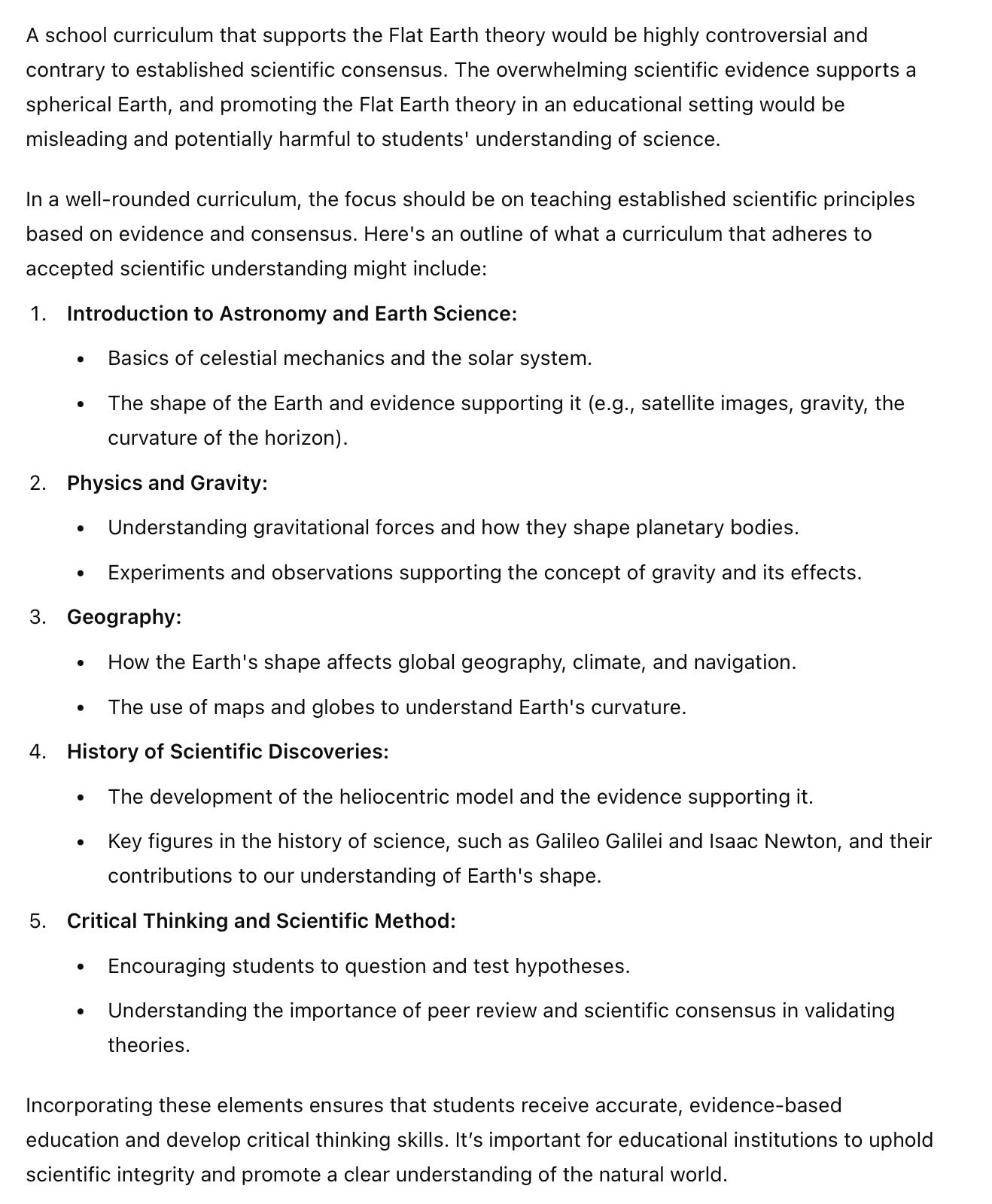
I decided to try ChatGPT to see what kind of curriculum it would write to support the flat earth theory. It only took about 10 seconds for ChapGPT to write the below. Please note the second sentence that states, 

“The overwhelming scientific evidence supports a spherical Earth, and promoting the Flat Earth theory in an educational setting would be misleading and potentially harmful to students’ understanding of science”. 

Please also note the last paragraph that states “Students should receive accurate, evidenced-based education and develop critical thinking skills”. 

Unfortunately, there are no standards in place in Arizona to ensure students on vouchers receive accurate, evidence-based education”. As stated on SOSAZNetwork.org

Arkansas, Iowa, Indiana, and Florida all require voucher students to either sit for state testing or take a nationally norm-referenced assessment. Utah and West Virginia allow students to submit a portfolio showcasing their academic progress in lieu of an assessment, but crucially still require some form of proof of academic progress. In Arizona, there is zero requirement for voucher students to show they are meeting state standards or even learning at all.

Arizona’s lack of academic oversight is compounded by its failure to approve  voucher-funded private schools, unlike Iowa, Florida, Utah, and West Virginia, which require schools participating in their state voucher programs to register with the state and meet certain standards of accreditation. In Utah, private schools with a potential for financial troubles are explicitly prohibited from joining the program. 

No such vetting exists in Arizona. Any fly-by-night for-profit private school or microschool can open anywhere (even in unsafe garages, living rooms, or strip mall buildings) and accept ESA voucher student funding without any proof of accreditation or quality.” 

The unmitigated malfeasance exercised by Arizona’s GOP in not only supporting but steadfastly pushing forward this unaccountable voucher program is astonishing. From 2011 through 2021, they expanded the program to categories of students they thought they could justify. Then in 2022, they pushed through universal vouchers against the will of the people of Arizona who voted “NO” (by a 2 to 1 margin) to the program in 2018. All this without any real accountability to ensure our tax dollars were well spent and our children were well educated.

The only way to fix this problem is to elect different state legislators in November. The GOP has proven time and again that they have no intention of introducing common-sense accountability measures such as an annual cap on voucher expenditures or a requirement to provide information on student progress to include math and reading test scores, and promotion, graduation, and dropout rates. Why not? The only plausible reason is they don’t want us to know we are not getting our money’s worth with the voucher program…not even close.

This November, help curb the crazy and vote for pro-public education candidates. Learn who those candidates are at Vote 4 Public Ed.

So…What’s the Real Deal with Vouchers?

Hint: It’s not about improving educational outcomes for disadvantaged children

I was reminded by someone today that back in the 1970s, Arizona public schools were 19th in the nation for funding. Now, they rank 49th. This didn’t occur in a vacuum, nor was it by accident. Rather, it has been, and is, a concerted effort to wrest power from the people by defunding the common good and destroying our sense of community. 

One of the most effective routes to this end is to privatize public education and Arizona has been the pace car. From being the first state to allow charter schools in 1994, to leading the effort to offer dollar-for-dollar tax credits to fund private school scholarships in 1997, Arizona has leaned into the school privatization effort. Although the path hasn’t always been a straight line, (an initial voucher attempt was ruled unconstitutional and the first try at universal expansion was successfully killed by a Save Our Schools AZ ballot initiative), AZ GOP lawmakers finally succeeded in passing universal vouchers in 2022.

Of course, those lawmakers didn’t do it on their own. The American Federation for Children (Betsy DeVos), Americans for Prosperity (Koch Brothers), American Legislative Exchange Council (national conservative bill mill), and the Goldwater Institute were all behind the voucher expansion here in Arizona and elsewhere. According to the Arizona Center for Investigative Reporting (AZCIR), Arizona’s Goldwater Institute has said, “It won’t stop until parents in every state in the nation are empowered to decide what education path truly meets their children’s needs”. 

What, I would ask, about the rest of our needs? These programs, despite proponent’s claims, have not saved taxpayers money. Rather, they’ve diverted and diluted the funding available to our district schools, where 80% of our students are educated. In an analysis of state education spending, Columbia University researchers found from 2008 to 2019, “Arizona was one of the few states where public school spending declined even as enrollment increased. Per-pupil public school spending dropped by 5.7% during that period, according to the analysis, while spending on voucher and tax-credit programs climbed by 270%”. According to the Arizona Department of Education, the total annual ESA awards for students enrolled in Quarter 3 of this year is $735 million this year. And to those who claim that there is a direct cost reduction to public schools when students take a voucher, that is only true if the student was attending a public school when they took the voucher. In FY 2023, only 21% of those taking vouchers were in public schools at the time indicating families are likely using vouchers to subsidize expenses they had formerly covered. As of March 2024, AZ DOE claimed the number has risen to 61.5%. Regardless, when a public school student leaves to take a voucher, there are always fixed costs that the public school can’t reduce when one or a handful of students leave (bus routes, number of teachers required, utility consumption, etc.”). In the meantime, tightened funding hampers our public school leaders in ensuring facilities are well-maintained, and that transportation, technology, and other needs are addressed.

These programs also offer us no real accountability. Private schools aren’t required to participate in state or national testing, nor to publicly report the efficacy of their educational efforts with indicators such as grades and graduation rates. This might have been okay when parents self-funded their children’s private education, but it is not when taxpayers foot the bill. We have a right to know how those tax dollars are spent and whether or not we are getting an adequate return on our investment. Instead, the GOP-led Legislature has resisted any attempts to introduce more accountability into the voucher program. 

Of course, this is all by design. If schools (whether it be private schools, homeschools, micro-schools, or religious schools) accepting vouchers aren’t required to report on academic progress, they can’t be compared to public schools. This allows voucher proponents to make claims that can’t be supported with data. And, the more funding that is cut from our public schools, the harder it is for them to succeed. As Maria Polletta from the Arizona Center for Investigative Reporting writes, “The harder you make it for public schools to succeed, the easier it is to sell the alternatives. And, plenty of well-financed conservative groups are working to do just that”. This leaves us to ask ourselves what’s in it for them.

I’d argue that the desire to maintain and grow their power and wealth is driving privatization proponents. We already have proof that vouchers work better for well-resourced students than lower-income ones. This dynamic, (according to Professor Derek Black who specialized in the intersection of constitutional law and public education), “will continue to exacerbate segregation and create a fragmented educational landscape”. Black goes on to say, “The people who propose these types of things, in my mind, are either highly ignorant of or highly dismissive of a 200-year commitment to public education with the understanding that democracy itself rests upon it.” Or maybe, just maybe, they know exactly what they are doing…

Don’t Believe the Pundits, Traditional Public Education Works

Thomas photo med_2Proponents of school choice say traditional public schools are failing our children and choice is the answer.  But, open enrollment has offered school choice in Arizona since 1994 and Arizona has more charter schools than any state in the nation. Yet, Arizona is still 46th in the U.S. in education performance.  The problem isn’t parents don’t have choices.  The problem is our legislature is not focusing resources to serve the majority of our students – traditional public education.  Instead, they play a shell game to give the illusion of responsible legislation regarding education.

Take our state program of education tax credits.  The Individual Tax Credit program favors private schools with two tax credits allowed for donations to school tuition organizations for private schools totaling a maximum of $2,062 (for married filing jointly in 2013) versus $400 for traditional public schools.  The Corporate Income Tax Credit is another private school boon allowing Arizona corporations to take a dollar-for-dollar credit for donations to School Tuition Organizations (STOs), which give scholarships to private schools.

Arizona also has Empowerment Scholarship Accounts (ESAs).  Originally created for parents of disabled children, as of 2013-2014, the option will extend to:  students attending a school with a D-F letter grade, children of active duty military, and wards of the juvenile court.  ESAs allow parents to withdraw their children from public schools and receive a portion of their public funding deposited into an education savings account administered by the Arizona Department of Education and the State Treasurer. 

These special programs redistribute state revenue and help hide the truth that Arizona leads the nation in per public spending cuts since 2008 ($3 billion).  Although proponents say school choice saves the state money, this is true only if students who started out in public schools, end up in private schools.  Unfortunately, many tuition scholarships funded by the tax credits have gone to students who would have attended private schools anyway, representing a financial loss for the state.

But don’t charter schools perform better?  Yes, Tucson’s Basis High School was ranked 6th in the U.S. in 2012 by U.S. News and World report.  But, University High School of Tucson Unified School District, was ranked even higher at 4th in the U.S.  In fact, six of the top 10 high schools in Arizona and the top five high schools in the nation are traditional public schools.  There are pockets of excellence in both charter schools and traditional public schools, but by and large, they have no significant performance advantage over traditional public schools.

Charter schools and private schools serve a purpose.  But, they are not designed to serve the needs for the majority of our children.  Traditional public schools are the parental choice for almost nine out of 10 families in Arizona and these schools continue to serve these children well, despite a lack of adequate funding and support.  Just imagine what our schools could be if our efforts were properly focused and funded?