Although not politically correct, the title of this post is a saying sometimes used in the military to describe decisions by senior leadership that seemed extra harsh and detrimental to troop morale. This saying came to mind when I read of Arizona’s Superintendent of Public Instruction Tom Horne’s response to an AZ Department of Education survey of teachers who chose not to return to the classroom for the 2024-2025 school year. The results were released earlier this week and the top four reasons for teachers leaving included: burnout, lack of respect, student behavior and discipline, and low salaries.
Almost 2,500 of the 5,900 teachers not returning responded to the survey, but 1,500 of the responses were removed for reasons such as those teachers were retiring, promoted to administration, or had accepted a monitoring job. The thousand or so remaining responses most often “strongly agreed” or “agreed” to the following:
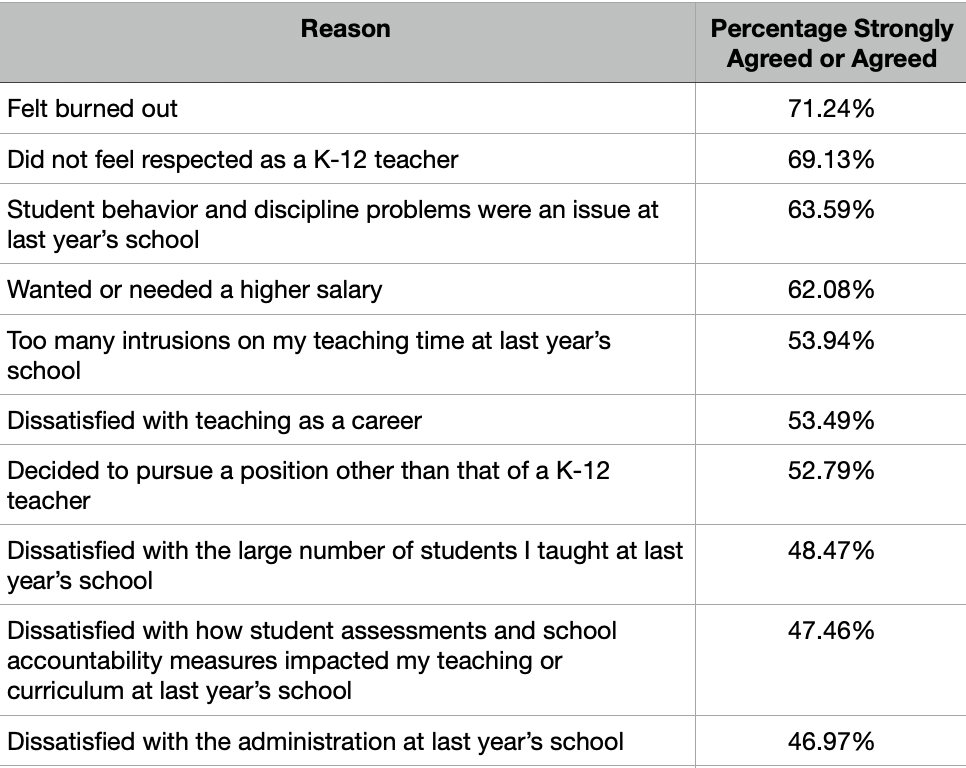
Of course, Superintendent Tom Horne honed in on “student behavior and discipline problems” (ignoring burnout and lack of respect) as the significant contributing factor for teachers leaving their jobs. This then, provided him more justification to further push proposed legislation to link school letter grades to a tougher stance on discipline. The AZ Daily Star reported SB 1459 would have required “the state Board of Education to lower a school’s letter grade if it did not implement disciplinary actions in at least 75% of the total number of student discipline referrals submitted by teachers in a single year”.
The bill was passed in the Senate, but two Republicans in the House refused to vote for it, killing the bill in this session. Of their vote, Horne said “Shame on the legislators who voted against it” claiming it is simply a way to incentivize district support for teachers regarding discipline.
Rep. Nancy Gutierrez, D-Tucson, saw an ulterior motive for the proposal. During the debate on the House floor, she said,
“It is my opinion that this bill has been put forward in order not to support teachers but in order to make it so that there’s an easier way to have more public schools with D and F grades to support some of the rhetoric that we hear that public schools are failing our students”.
This of course is just another way for Horne and GOP legislators to push parents toward vouchers and other privatization efforts. Representative Judy Schwiebert, D-Phoenix, agreed and blamed the Legislature for contributing to the teacher retention problems by funding Arizona schools at one of the lowest per-pupil rates in the nation. Schwiebert went on to say that,
“The job of our local schools and boards is to make direct decisions that apply most specifically to their schools,” she said. “We see the legislature criticizing public schools when we are not doing our job. Arizona ranks 49th in the nation in per pupil funding. We’re pointing our finger at public schools, blaming them for problems that we have created because of too large class sizes, failure to pay teachers enough, failure to provide support staff.”
A Forbes.com article titled, “No More Teachers: The Epic Crisis Facing Education in 2024” agreed, stating that low pay is the biggest reason for the declining numbers of new teachers. In 2022, says veteran teacher and author Jay Schroder, “teachers made on average 26.4% less than other similarly educated professionals”.
‘Schroder contends that the low pay, combined with high stress and a strong sense of disrespect from some outspoken sections of society, make the job of teaching unattractive to many college graduates. “If this were just a PR problem, it would be easier to solve,” he says. “The truth is that the pay is low and the stress is high.”’
According to K12Dive.com, the Educators for Excellence (E4E) 7th annual Voices from the Classroom survey of teachers this May, highlighted the crisis by reporting that,
“A mere 19% of teachers believe the profession is sustainable, with only 16% of teachers recommending the profession to others, and less than half expressing commitment to staying in it for the long haul.”
We have been headed for a real crisis regarding teacher shortages; one that has only been exacerbated by the pandemic. And while the trailblazing Arizona Teachers Academy (ATA), passed with bipartisan support in 2018 was working to address our state’s crisis, lawmakers cut $14 million from the program’s budget this year. According to AZCentral.com, the program had expanded in 2023, to serve 3,255 aspiring teachers with an average scholarship of $8,555. The cuts made to the program this year, mean that some 1,700 fewer students will be working their way through a proven pipeline. In the past, ATA has also provided funding for mentors to support new teachers and National Board Certification for experienced teachers.
Turning around teacher dissatisfaction won’t be easy, but neither does it seem super complicated. It boils down to treating them as the professionals they are, not “beating down” them, their administrators, or their schools. Competitive compensation, autonomy to do the jobs they were trained for, an adequate support structure, a collaborative environment, and quality school leadership are some of the more important tools. Also important though, is a recognition by the public and those we elect to represent us, that quality teachers are a most worthy investment critical to the future of our communities, our country, and our world.
As Anatole France, a French poet, journalist, and best-selling novelist, once said, “Nine-tenths of education is encouragement”. That applies to both students in the classroom and all the professionals who teach them. In my experience as a leader in the Air Force, the carrot is almost always mightier than the stick, but that approach does require a more confident and skilled leader. I guess it is just easier for Superintendent Horne to continue to try the “beatings” approach.

 Restore Reason