Putin’s assault on our election, Obama’s secret responses, and Trump administration missing in action on preventing future election hacks

Cross-posted from skyislandscriber.com

Yesterday evening (Friday, June 23rd), Rachel Maddow reported on a stunning Washington Post story about Obama’s secret struggle to punish Russia for Putin’s election assault. I am not in the least ashamed to admit that I cannot do justice to the Post’s story with a few – or even many – snippets. It’s a long article but if you want to understand what the Russians did to our election, and what serious threat remains, you must read this story.

Here are my take-away messages from the Washington Post report.

  • Putin ordered and directed the Russian effort to help Donald Trump and hurt Hillary Clinton.
  • Political push-back from Republican politicians, nationally and locally, prevented effective counter-measures.
  • American response was tempered by the fear that Russia would take additional cyber-action to disrupt the 2016 election.
  • Russia still has the means to disrupt future elections – 2016 was practice for a larger-scale intervention.
  • Obama initiated a U. S. program to develop cyber “implants” that could be triggered remotely as part of retaliation for any Russian aggression against our election system or power grid.
  • Trump has not interfered with that program but neither has he pushed for bolstering the security of our election infrastructure.

That last one based on an article by NBC News, Trump White House Has Taken Little Action To Stop Next Election Hack that appeared this morning (June 24).

The Trump administration has taken little meaningful action to prevent Russian hacking, leaking and disruption in the next national election in 2018, despite warnings from intelligence officials that it will happen again, officials and experts told NBC News.

“This attack is really the political equivalent of 9/11 — it is deadly, deadly serious,” said Michael Vickers, a career intelligence official who was the Pentagon’s top intelligence official in the Obama administration. “The Russians will definitely be back, given the success they had…I don’t see much evidence of a response.”

According to recent Congressional testimony, Trump has shown no interest in the question of how to prevent future election interference by Russia or another foreign power. …

Dozens of state officials told NBC News they have received little direction from Washington about election security.

That apparent top-level indifference, coupled with a failure to fill key jobs at the Department of Homeland Security and other agencies, has resulted in a government paralyzed by inaction when it comes to protecting the next election, experts and government officials told NBC News.

“The Trump administration is woefully missing in action,” said Gregory Miller, co-founder of the Silicon Valley based Open Source Election Technology Institute, a non-profit research group.

“It isn’t happening,” said David Jefferson, a voter security expert and computer scientist in the Center for Applied Scientific Computing, when asked whether he saw a U.S. government effort to address the problem.

What is the Trump administration doing? Apparently, they are pursuing a different agenda.

The White House says it’s sending letters to states and municipalities next week asking them to send data to an election fraud commission. It also points to the signing of a cybersecurity executive order as a step toward protecting elections.

WTF? They’re chasing a bogeyman down a rat hole while the clock is running out on time to strengthen our cyber defenses.

In interviews, dozens of state officials told NBC News they have had limited interaction with the Department of Homeland Security, which is tasked with helping them guard against cyber intrusions. They have seen no major initiative from the Trump administration, they added. …

And the threat remains.

… experts say Russia and other nation-states have shown themselves fully capable of manipulating actual votes.

“It was and is within the technical capacity of Russia and other nation states to interfere with our elections and to change votes, ” said Edward Felton, a Princeton computer scientist who served as deputy chief technology officer in the Obama administration. “We’re fortunate that they chose not to do it.”

J. Alex Halderman, professor of computer science at the University of Michigan, told a Senate hearing this week that he and his team demonstrated the ability to reprogram voting machines “to invisibly cause any candidate to win. We also created malicious software — vote-stealing code — that could spread from machine to machine like a computer virus, and silently change the election outcome.”

… U.S. intelligence officials say, it has to be made clear to the Russians or any other nation that there is a price to be paid for hacking an American election.

John McLaughlin, a former acting CIA director, said he had seen no indication that President Trump and his team have “weighed in with Russians or made clear to the Russians our determination to stop this.”

Links to clips from Rachel’s Friday show

Russian election hacks took US to brink of cyberwar: Rachel Maddow reviews some of the highlights of a lengthy, eye-opening report from The Washington Post about the reaction of the Obama administration to the news that Vladimir Putin was directing a cyberattack on the U.S. election.

Russia 2016 cyberattacks seen as dry run for future elections: Ellen Nakashima, national security reporter for The Washington Post, talks with Rachel Maddow about her reporting on Russia’s cyberattack on the U.S. election and the Obama administration’s deliberations on retaliation.

Uptick in Russian visa requests ahead of 2016 election: Ned Price, former NSC spokesman and senior director, shares with Rachel Maddow insights on the reporting by the Washington Post of an uptick in visa applications from Russia ahead of the 2016 election.
Senate releases Better Care for the Rich Act: What’s in it, How the Senate will try to get it passed, and What you can do to stop it

Health apocalypse
The Republican plan for America:
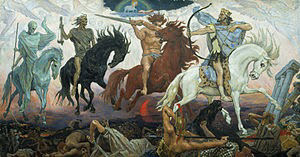
Ignorance, Poverty, Pestilence, Death

The Senate (McConnell, really) released the draft of the “Better Care” act on Thursday. In this post I cover three questions. (1) What’s in the Senate’s “Better Care Reconciliation Act”? (2) How will the TrumpCare fight play out? (3) What can you do?

What’s in the Senate’s “Better Care Reconciliation Act”?

The Better Care Reconciliation Act: the Senate bill to repeal and replace Obamacare, explained by Sarah Kliff, a vox.com contributor on health care. (h/t Mrs. Scriber)

The bill asks low- and middle-income Americans to spend significantly more for less coverage.

The bill would roll back the Affordable Care Act’s expansion of the Medicaid program, which currently covers millions of low-income Americans, and include additional cuts to Medicaid. It would rework the individual market so that enrollees get less financial help to purchase less generous health insurance with higher deductibles.

Here is how the Senate bill works:

The Senate bill begins to phase out the Medicaid expansion in 2021 — and cuts the rest of the program’s budget too. The Senate bill would end the Affordable Care Act’s expansion of Medicaid to millions of low-income Americans. This program has provided coverage to more Americans than the private marketplaces

It would also cut the rest of the public insurance program. Better Care would also limit government spending on the rest of the Medicaid program, giving states a set amount to spend per person rather than the insurance program’s currently open-ended funding commitment.

The Senate bill provides smaller subsidies for less generous health insurance plans with higher deductibles. The Affordable Care Act provides government help to anyone who earns less than 400 percent of the federal poverty line ($47,550 for an individual or $97,200 for a family of four). The people who earn the least get the most help. The Senate bill would make those subsidies much smaller for many people, and only provide the money to those earning less than 350 percent of the poverty line ($41,580 for individuals and $85,050 for a family of four). The Senate bill will tether the size of its tax credits to what it takes to purchase a skimpier health insurance plan than the type of plans Affordable Care Act subsidies were meant to buy. Essentially, these tax credits buy less health insurance.

The Senate bill seems to allow states to opt out of Obamacare’s marketplaces and essential health benefits requirement. A new waiver process would allow states to overhaul their insurance markets, including ending the essential health benefit requirement and specific subsidies that benefit low income Americans, so long as those changes do not increase the deficit.

The Senate bill repeals the individual mandate — and replaces it with nothing. The bill gets rid of the Affordable Care Act’s unpopular requirement that nearly all Americans carry health coverage or pay a fine. This could cause significant disruption in the individual market because it takes away a key incentive healthy people have to buy coverage, meaning only sick people may sign up.

The bill would cut taxes for the wealthy. Obamacare included tax increases that hit wealthy Americans hardest in order to pay for its coverage expansion. The AHCA would get rid of those taxes. Obamacare was one of the biggest redistributions of wealth from the rich to the poor; the AHCA would reverse that.

The Senate bill defunds Planned Parenthood for one year. This would mean Medicaid patients could no longer seek treatment at Planned Parenthood clinics. Experts expect this would result in low-income Americans getting less medical care and having more unintended pregnancies, as access to contraceptives would decline.

All in all, the replacement plan benefits people who are healthy and high-income, and disadvantages those who are sicker and lower-income. The replacement plan would make several changes to what health insurers can charge enrollees who purchase insurance on the individual market, as well as changing what benefits their plans must cover. In aggregate, these changes could be advantageous to younger and healthier enrollees who want skimpier (and cheaper) benefit packages. But they could be costly for older and sicker Obamacare enrollees who rely on the law’s current requirements, and would be asked to pay more for less generous coverage.

Kliff has lots of detail backing up her analysis in her vox.com report.

How will the TrumpCare fight play out?

This is part of an email message from Ezra Levin, Co-Executive Director, Indivisible. (Indivisible was founded by a group of former congressional staffers who want to turn the tables on the Tea Party types in service of resisting Trump.) (h/t Laurie Jurs via Miriam Lindmeier.)

Senate Republicans have promised a vote by the end of next week. But there are still several steps between now and passage of TrumpCare. Here’s how the former congressional staff at Indivisible Team think the fight will unfurl:

  • Tomorrow, we’ll get a Congressional Budget Office (CBO) score, which will quantify exactly how many millions of Americans will be screwed by this bill and in what ways.
  • On Monday or Tuesday, Republicans will officially announce the vote is happening by the end of the week and start debate on “the bill,” which is just a draft bill intended to make it look like they’re being transparent but in reality is a trick to hide just how awful their finished product will be.
  • Over the next couple days, Senators will submit amendments, most of which will fail and none of which would make this bill redeemable.
  • On Thursday, the Senate will plan to vote on the legislation, but first they will vote on all submitted amendments (known as “vote-a-rama”).
  • At the last possible minute, Senate Republicans will replace the entire bill they just got finished “debating” with an alternative TrumpCare bill secretly crafted behind closed doors.
  • By the end of Thursday, there will be a final vote in the Senate.
  • As soon as that same Thursday, the House may then pass the legislation and send it to Trump to sign. This could take longer, but this is the worst case scenario and quite possible.
  • Next weekend, one week of congressional recess begins. They’ll either have the bill done by then, or they’ll have to wait another week.

Throughout this process there will be precisely zero public hearings in the Senate. Make no mistake, this is a historically partisan, secretive, and undemocratic process for one of the most consequential pieces of legislation of our generation. This is atrocious.

What can you do?

From Indivisible:

So let’s fight it. All you need to pressure your Republican Senators, including DAILY scripts and new materials, is on our TrumpCareTen.org website. Need more background materials? We’ve got ‘em for you here. It’s critical that you’re showing up and that when you’re not showing up, you’re calling your Senators every single day.

Here is Scriber’s post on an alliance4action call to action from a few days ago.

Magically Madeover Moderate Martha McSally votes against transparency and accountability in government

Cross-posted from skyislandscriber.com

The AZBlueMeanie reports this morning that the AZ House GOP delegation votes to maintain the Trump swamp of conflicts of interest and corruption.

Democrats have forced seven votes in as many weeks on the House floor on resolutions calling for Donald Trump’s tax returns, all of which were defeated along party lines. An [eighth] vote failed this week. …

And what did our CD2 Rep. Martha McSally do? What else? She behaved just as she has always done – voted consistently with Trump’s views and toed the GOP party line.

Our Arizona House GOP delegation, including the local media’s invention of the mythical moderate Republican Rep. Martha McSally, have consistently voted to maintain the Trump swamp of conflicts of interest and corruption by rejecting any transparency and public disclosure.

Voting information below is from the Daily Star’s Capitol link: How members of Congress from Aritona voted on major issues (h/t AZBlueMeanie).

McSally - before
McSally – before the MMM

Disclosure of Trump Tax Returns:
The House on April 26 blocked, 234–191, a parliamentary attempt by Democrats to force floor debate on a bill now in committee that would require presidents and major-party presidential candidates to disclose their tax returns for the preceding three years. A yes vote was to quash the Democratic bid for disclosure. (H Res 275)
Yes:
McSally, Gosar, Biggs, Schweikert, Franks
No:
O’Halleran, Grijalva, Gallego, Sinema

Congressional Oversight of President Trump:
Voting 230–193, the House on April 27 blocked a Democratic bid for floor debate on a measure now in committee that would start congressional oversight of ethics and conflict-of-interest issues involving President Trump, in areas ranging from the public disclosure of official visitor logs to overlaps between the president’s business holdings and official acts. A yes vote was to quash the Democratic measure during debate on H Res 280.
Yes:
McSally, Gosar, Biggs, Schweikert, Franks
No:
O’Halleran, Grijalva, Gallego, Sinema

McSally - after
McSally – afterthe MMM

Combined with McSally’s consistent (that would be 100%) voting along Trumpian lines, these votes give lie to the new and improved Martha McSally. The make-over is purely cosmetic (cf. head shots) and Your Scriber debunked the politically moderate make-over in the 2014 election season: A Magical Moderate Makeover for Martha McSally (posted here on July 28, 2014). It’s MMM for short.

OK, don’t get on my case about being sexist. I practice EO – equal offensiveness – by following Molly Ivins in referring to Rick Perry as Governor Goodhair. …

I then reported the transcript of her latest campaign ad in which unidentified speakers praised McSally (with no details). For example:

(Jamie [no last name given], speaking) “Martha is the most determined, trustworthy, loyal person I know.” [This might be a line spoken by brain-washed soliders about Raymond Shaw (The Manchurian Candidate).]

And here is one of McSally’s responses:

(Martha McSally, speaking) “I am running for Congress I don’t walk by a problem. I have a fire in my belly to make a difference and when things are broken, I want to fix them."

Fix. Verb. To vote against transparency and accountability and to vote for conflicts of interest.

Clearly, McSally’s handlers learned from her previous defeats and are presenting a softer, kinder, more centrist image. Just remember: what I recall from a 2012 primary debate is that she is the one who said there is no difference between her and her then opponent, Jesse Kelly, with respect to core values. That’s why I place no credibility in the new McSally. The old Colonel McSally still lurks, but now just gone MIA – Moderate In Appearance.

That was the situation in 2014 and 2016 and continues to this day. CD2 is but a political stepping stone for the Magically Made-over Moderate Martha McSally. It will continue to be in her interest to vote along with other Trumpists until the CD2 voters give her the heave-ho.

Remember in November.

The AZ legislature’s funding of public education is unconstitutional

Cross-posted from skyislandscriber.com

This is required reading from AZBlueMeanie (Blog for Arizona), Arizona’s lawless Tea-Publican legislature and public education. What motivated the AZBlueMeanie post is this story by Linda Valdez in The Republic (azcentral.com): Who cares what Arizona’s Constitution says about education? Not Republicans.

I’ll quote some snippets from the Blue Meanie’s post.

I have made these constitutional arguments about public education in Arizona for years, but it’s nice to see The Republic’s Linda Valdez write an opinion that contextualizes the constitutional arguments in the current debate over public education in Arizona.

The Constitution is on the side of the people. It mandates a “system of common schools” that are “open to all pupils” and are “as nearly free as possible.” (Article XI, Section 6)

The Constitution also says: “(T)he Legislature shall provide by law for an annual tax sufficient, with other sources of revenue, to defray the necessary ordinary expenses of the state … “ (Article IX, Section 3)

Article XI, Section 10 calls for “taxation” to “insure proper maintenance of all state educational institutions.”

So what do our intrepid lawmakers do?

In addition to underfunding traditional public education, our GOP lawmakers continue diverting money from public schools to private and religious schools.

That’s despite Article XI, Section 7, which says “No sectarian instruction shall be imparted in any school or State educational institution …”

This year’s expansion of publicly funded vouchers for private and religious schools came despite strong evidence that the program contributes to a two-tier system that is nowhere mentioned in the Arizona Constitution.

Unanswered Question: When will the first lawsuit be filed against this unconstitutional “vouchers for all” bill, and who will be the plaintiffs filing it? I assume that it is already in the works and the litigants are just waiting for the appropriate time to announce the lawsuit.

But the thing is: the state supreme court ruled in favor of vouchers, effectively legitimizing money laundering. Here’s part of the March 21, 2014 report from the Arizona Capitol Times (subscription required), Supreme Court deems voucher-like program legal.

Without comment, the high court refused to disturb a Court of Appeals decision which said the program, officially dubbed “empowerment scholarship accounts,” does not run afoul of a state constitutional provision that bars public funds from being used to subsidize private and parochial schools. That court said the fact the parents control the money was sufficient to make the program legal.

The state supreme court flunked Logic 101. Money laundering is an instance of transitivity and takes this form: A gives to B, B gives to C, therefore A is giving to C. So the state gives to parents, parents give to private schools, therefore the state gives to private schools. And our state supreme court is OK with that.

The AZ legislators are not the only ones in government who are acting unconstitutionally.

Stock in Concrete Companies?

As a leader in the military, I learned a long time ago that if something was easy to fix, someone would have already fixed it. President Trump evidently hadn’t learned that prior to his election, but since then, has time and again realized that uh, YEAH, this shit is hard!

Take the border wall for example. It might have been good “red meat” for his supporters, but there are three good reasons why there is not a finished border wall along our southern border: 1) it is a very complicated endeavor, 2) it is really, really expensive, and 3) it won’t solve the problem of illegal immigration. I mean, get real! Trump isn’t the first politician to try to make hay with this issue, but the rhetoric always slams into reality eventually.

I knew for example in 2011, that Arizona Senator Steve Smith wasn’t going to get anywhere with his “www.BuildTheBorderFence.com” initiative and I was right. Smith promised to raise some $50 million to build a 15 foot fence at busy border-crossing points and erect fences where there were no federal fences. After three years however, the project had only raise $265,000, not even one-tenth of the $2.8 million needed to build the first mile of fencing. As for the $265,000, last I could find the advisory committee assigned to do something with the funding were asking sheriffs how they would use it.

I also knew Trump would never get the wall built and he sure as hell wasn’t going to get Mexico to pay for it. Recent negotiations over the continuing resolution have proven Trump’s real lack of commitment to demand the $25 billion or so his wall is estimated to cost.

I have personal experience with the border wall – or more accurately, the lack of a working border surveillance system. After my retirement from the Air Force, I was hired by L–3 Communications as Deputy Program Manager for the Strategic Border Initiative, or SBInet. This “virtual fence” that would stop illegal immigrants at the border with a mix of guard towers, cameras, sensors and other infrastructure feeding data to a sophisticated IT system, was President George W. Bush’s answer to the problem in 2006. As a subcontractor to Boeing, L–3 was responsible for designing and building the towers and microwave system that was to provide electronic surveillance for the Border Patrol. I worked on the project for almost seven months, but eventually quit because I just couldn’t continue to be a part of the fleecing of the government that was occurring. On one of my trips to field test the system, I was at Playas, New Mexico. I recall being out in the desert with a colleague driving around in circles for hours so that the microwave could try to lock in on us. It didn’t work, and when I went to a meeting at Boeing where I felt like they were sitting around joking about how we weren’t making progress, I decided I just couldn’t handle it anymore. Not even my writing my Congressman (Webb – Virginia) with my concerns had helped, since he never responded. That’s when I knew for my own piece of mind, it was time to resign.

In February 2008, a Government Accountability Office report cited that “the radar information was too slow to appear on screens, and was being inappropriately triggered by rain and other weather phenomena. Camera resolutions was insufficient for targets beyond 3.1 miles and the stylus-controlled laptops mounted on moving vehicles were not rugged enough and were difficult to use.” No surprise to me that the project was killed in 2011, after about $1 billion in taxpayer dollars were flushed down the drain.

Eventually, Border Patrol officials decided to take a look at preexisting, tested technology and a $145 million contract was awarded to a U.S. based subsidiary of Israel’s Elbit Systems. As of 2016, the IFT system had been used successfully at one installation on the border.

Using technology (including drones) to monitor the border though, is way different than building an actual wall over the entire 1,989 mile United States – Mexico border. For starters, the terrain is very rough in some areas, much of the land is privately owned (either by individuals or Native tribes), there are hundreds of tunnels in use, there are significant detrimental impacts on wildlife migration and survival with endangered species laws causing complications, and where there is a will, there is a way. As former Arizona Governor Janet Napolitano once said, “You show me a 50-foot wall, and I’ll show you a 51-foot ladder.” In fact, I remember a story told me by a Border Patrol agent who said that they once watched Mexican drug smugglers, drive up to a section of the border wall, push a button on a remote control to raise the wall like a garage door, drive through, and then close the door again. When there is money to be made, or a desperation to make something happen, people will find a way.

All this aside, the U.S. does already have barriers along 653 miles of the southern border (mostly the western portion.) border barriersThese barriers range from 18-foot-tall iron fencing and corrugated metal to makeshift vehicle barriers and barbed wire. And “in 2015, the Border Patrol claimed an 81 percent success rate in apprehending or turning back people who attempted to cross illegally.” A large number of those trying to cross now though, are asylum seekers, who present themselves to border agents at legal ports of entry. The Department of Homeland Security also says that in FY2015, about 530,000 simply overstayed their legal visas after flying into the country, about 200,000 more than were caught at the border with Mexico. No amount of wall would have helped in these situations.

Oh by the way, the Mexican border isn’t the only one the U.S. shares and, the other one is twice as long. Wall proponents will often claim we must build it to keep out terrorists and weapons of mass destruction, but you almost never hear someone talking about our border with Canada. Because of the heavy forests and numerous bodies of water the two countries share, it is much easier to slip across undetected. If I was a terrorist, I know which border I’d pick to cross.

Finally, Bloomberg News reported in February 2017 that an August 2016 poll found that 61 percent of Americans are opposed to “building a wall along the entire border with Mexico,” and only 36 percent favored it. A Pew survey conducted in November-December 2016 revealed that only 40 percent of respondents thought building a wall was very important, or somewhat important. I suspect many of those who think the wall is important, live a long way away from the border and don’t really understand the issues at hand. Most of those who live along the border know building a wall is a fool’s folly as a separate poll in May 2016 of Southwest border city residents which found 72 percent of them opposed to it. What is really needed, says one, is a sensible immigration policy and enforcement of the laws intended to prevent U.S. companies from hiring undocumented immigrants. Supply and demand anyone?

Ah yes, but then that would hurt the corporations and we can’t have that, can we? Better to make American citizens fork over the $25 billion of their hard earned taxpayer dollars to build the almost 2,000-foot-long 40-foot-high concrete wall President Trump wants so he can keep a campaign promise that won’t fix the problem. Hmmmmm, wonder if 45 owns stock in any concrete companies?

Republicans should be embarrassed by vouchers for all and should pay the political price

Cross-posted from skyislandscriber.com

Greg Miller, a Republican, charter school founder, and past president of the AZ Board of Education, holds the GOP support of voucher expansion bill an insult to most students. And it is an insult to the rest of us who understand, what our state supreme court does not, that the AZ voucher program is a scam. It is nothing more than money laundering to get around the constitutional prohibition against giving public money to private, religious schools. As such the voucher program is an assault on public education. Period.

Here is Miller’s opinion piece in the Arizona Capitol Times (subscription required) – emphases added.

As an advocate for education reform for the past 35 years, a co-founder of a very successful charter school, a lifelong Republican, and the most recent past president of the Arizona State Board of Education, I have never been more embarrassed, outraged, disappointed, and angry to call myself a Republican. How on earth do the Republicans in the state Legislature who voted for the Empowerment Scholarship Account (voucher) bill, or our governor, who signed it, look in the mirror and in good faith, not understand what they have just done.

This is an outrageous attack against public education. This out-and-out transfer of state taxpayer money to private education through “school choice” is just what it seems, political rhetoric and very bad financial policy. It even blurs the separation of church and state line defined in the U.S. Constitution by our founders. Public education has been the equalizer for 150 years of economic growth and assimilation of immigrants into the culture that we enjoy today. This is an insult to the hundreds of thousands of students who do not have the resources to pay the additional thousands of dollars for the tuition these private schools will be charging above the state subsidy, and without the opportunity of a quality education provided in their local schools where due process and common goals of expectation drive the continued development of economic expansion for everyone, not just a privileged few.

Does the existing system have its troubles? Yes it does. Has the education reform movement of the past 25 years made a difference? Yes, but with miles left to go. Is money the only answer to solve the major issues in public education? No, but as a state you can starve the system to death. Without adequate funding for public education we have: 35 or more students in classrooms, teacher shortages resulting in 2,000 to 3,000 classrooms going without teachers, hundreds of teachers walking away from their existing classrooms (500 this past fall) because of the stress of the job, the politics of the institutions, and the low pay in one of the highest stress professions. This is our current situation, but instead of finding solutions we are letting more state tax money flow out of the existing system without accountability or transparency.

Are our classroom teachers getting the job done? Many are not! But their efforts are not the only reason: first generation immigrants, exaggerated federal rules and requirements, poverty, highly mobile student populations, uninvolved parents, teaching resources, a lack of commitment to children by their families and the state, and the list goes on! But in a state that is ranked at, or near, the bottom in every category of financial support for public education, how on earth can anyone, let alone those who are responsible for the stewardship of our children’s education and our tax dollars, support or even condone this disgraceful attack on our state’s economic future?

A great big thank you to my fellow Republicans at the Legislature who held ground and used common sense by not giving in to the pressure of those who have crafted and moved this bill to signature. All Republicans that share this view use your vote in next summer’s Republican primary to replace anyone who supported this transfer of economic wealth from our public school system to the private schools of the wealthy.

— Greg Miller is president and superintendent of Challenge Charter School and a former president of the state Board of Education.

Arizona fails its future as Doug Ducey, our "Education governor", goes mum on teacher exodus

Cross-posted from skyislandscriber.com

Actually I’m not being fair. Dougie proposed a 0.4%raise (which works out to a couple of dollars a week) and then signed off on vouchers for everyone (that siphons off several thousand public dollars to private, religious schools). That’s what an “education governor” does. It gets worse. Read on and weep.

Arizona State University’s Morrison Institute for Public Policy has released a fact sheet highlighting the key findings of an upcoming report on Finding & Keeping Educators for Arizona’s Classrooms. (h/t BlueMeanie.) Here are the bullet points.

  • Arizona annually is losing more teachers than bachelor of education degrees produced by its three universities.
  • When adjusted for cost-of-living, Arizona elementary school teacher pay is the lowest in the nation. High
    school teacher pay ranks 48th of the 50 states.
  • When adjusted for inflation, elementary school teachers here are paid 14% less than in 2001. Arizona secondary teachers are being paid 11% less.
  • 74% of Arizona school administrators surveyed said their campuses are experiencing a shortage of teachers.
  • Arizona teacher rosters do not reflect state demographics, offering limited role models for children of color.

And on top of all that, Ducey sticks it to our teachers by proposing a niggardly, insulting 0.4% raise. See Laurie Roberts’ comments in Is Ducey joking? A 4/10th’s of a percent pay raise for teachers?

I know Ducey’s in a tough spot because money’s tight due to a quarter century of tax cuts and due to the fact that he wants to continue cutting taxes every year.

But Ducey could have proposed delaying previously approved corporate tax cuts set to be phased in next year, allowing him to double his proposed investment in public education. Even freezing automatic 20 percent increases in the corporate tax credit that funds private school tuition would have signaled a commitment to public education.

But a 4/10s of a percent pay raise?

This, again, is Ducey … :

“This is an investment by the state of Arizona in recognizing and rewarding the work of our teachers in a way that is fair, permanent and fiscally responsible.”

And they can take that to the bank …

Or maybe to a payday loan center.

If this isn’t a crisis, I don’t know what is. AZBlueMeanie agrees: New study: ‘Arizona teacher recruitment, retention and pay are at crisis levels’

David Fitzsimmons uses his sharp wit to expose the problems facing public education in Arizona as State Senator Rip Fiddler talks public education

The most piercing comments again come from Laurie Roberts at azcentral.com: Teachers fed up? In Arizona? Noooo. (h/t AZBlueMeanie)

The study – funded by the Arizona Community Foundation, Helios Education Foundation and The Pike and Susan Sullivan Foundation – concluded that teachers are leaving the profession for a variety of reasons – retirement, disillusionment, low pay and a belief that they aren’t supported.

Me? I don’t see how they can say that.

Our governor has proclaimed himself the education governor.

But wait: Look at all this help they’re getting

Why, just three months ago, Ducey, in his State of the State address, said he had “a new appreciation for the excellence occurring in our school system.” He attributed that success to teachers.

“I want teachers in our state to know: You make a difference. I value your work and it’s time we return the favor.”

Four days later, he proposed a pay raise that amounts to about $2 a week.

Three months later, he signed a universal voucher bill that’ll divert more public money to private schools.

This, in a state that already spends $1,365 less, when adjusted for inflation, to educate a child than it did in 2008.

Me? I can’t imagine why teachers are feeling slighted.

Here are selected observations from the Morrison Institute’s Report: AZ in crisis over teacher pay, retention

“Teacher pay and support is a proxy for how highly we think of students and their education,” said Steve Seleznow, President & CEO of Arizona Community Foundation and a former school administrator. “When we undervalue our educators, we under educate our children. This problem will not go away without fundamental change in the ways we support our teachers. If we value the education our children receive, we must provide teachers compensation commensurate with those values.”

Teachers are leaving the profession for many reasons – retirement, disillusionment, low pay and a feeling of lack of support.

"The teacher shortage is urgent, critical and very real,” said Rachel Yanof, Senior Director of Educational Initiatives for the Pike and Susan Sullivan Foundation. “It is imperative that those with the position to influence policy read this report and act in a manner that will stem this crisis as quickly as possible. Our children deserve it.”

Arizona, you see, is not just failing its teachers. Arizona is failing its future.

Ducey should sign SB 1080 (texting while driving). Here’s why.

Cross-posted from skyislandscriber.com.

Howard Fischer (Arizona Capitol Times, subscription required) reports that Texting ban on teenage drivers now only needs Ducey’s signature to become law.

Arizona is just one signature away from imposing its first-ever limits on the use of cell phones by teens.

On a 32–24 margin, the state House today gave final approval to legislation banning teens with a learner’s driving permit from texting or making calls from their cell phones while behind the wheel. SB1080 also extends that to the first six months they have their actual Class G license, which is reserved for the newest drivers.

The measure, which previously was approved by the Senate on a 24–6 margin, now goes to Gov. Doug Ducey.

Gubernatorial press aide Daniel Scarpinato said only that his boss will review the bill.

But the issue could be more personal for Ducey. He has three sons, two of whom are of driving age.

Thursday’s vote came over the objection of some legislators who want Arizona to remain one of only two states in the country with no limits at all on cell phone use by motorists. They said their fear is that once Arizona restricts what teens can do, it’s just a small step to extending that to adults.

Exactly. It should be extended to all drivers. Here is why.

In the early 2000’s, Psychologist David Strayer at the University of Utah investigated the influence of cell phone use on driving errors. Here is some of a review of that research by the American Psychological Association Driven to Distraction. Driving and cell phones don’t mix.

Cell phones may be convenient but there’s one place they seem to do more harm than good – and that’s behind the steering wheel. Psychological research is showing that when drivers use cell phones, whether hand-held or hands-off, their attention to the road drops and driving skills become even worse than if they had too much to drink. Epidemiological research has found that cell-phone use is associated with a four-fold increase in the odds of getting into an accident – a risk comparable to that of driving with blood alcohol at the legal limit.

In one study, when drivers talked on a cell phone, their reactions to imperative events (such as braking for a traffic light or a decelerating vehicle) were significantly slower than when they were not talking on the cell phone. Sometimes, drivers were so impaired that they were involved in a traffic accident. Listening to the radio or books on tape did not impair driving performance, suggesting that listening per se is not enough to interfere. However, being involved in a conversation takes attention away from the ability to process information about the driving environment well enough to safely operate a motor vehicle.

According to Strayer’s laboratory research, cell-phone drivers were also more likely to miss traffic signals and often failed to see billboards and other signs. A special eye-tracking device measured where, exactly, drivers looked while driving. Even when drivers directed their gaze at objects on the road (during simulations), they still didn’t “see” them because their attention – during a cell-phone call – was elsewhere.

The Utah lab is also measuring the increased risk associated with cell-phone use relative to other real-world activities – most recently, alcohol consumption. Disturbingly, forthcoming research will show that talking on a cell phone (even hands-free) hurts driving even more than driving with blood alcohol at the legal limit (.08 wt/vol). When talking on a cell phone, drivers using a high-fidelity simulator were slower to brake and had more “accidents” than when they weren’t on the phone. Their impairment level was actually a little higher than that of people intoxicated by ethanol (alcohol).

Strayer and his colleagues compared data for hand-held and hands-free devices and found no difference in the impairment to driving, thus, they say, raising doubts about the scientific basis for regulations that prohibit only hand-held cell phones.

Real life implications

… drivers should also be aware that whether a cell phone is hands-on or hands-free makes no difference in terms of mental distraction. According to the research, the mental activity of conversation, whether in person or over the phone, is what takes one’s mind off the road. What happens in the head happens regardless of what happens with the hands.

… drivers need to remember that warnings (and, in some localities, legislation) about cell-phones and driving are prompted by cross-sectional studies of drivers of varied ages, educational levels, and years of driving. Susceptibility to distraction while driving has nothing to do with smarts or skill

Arizona SB 1080 now sits on Gov. Ducey’s desk. It is not perfect – far from it because of its failure to accommodate the above two lessons from applied research. Nevertheless, it is an important first step. We have laws aimed at prevention of driving while drunk. We should have parallel laws aimed at prevention of driving while distracted. Ducey should sign SB 1080.

The Voucher Expansion is Not About Our Kids!

After I started this post, it was somewhat overcome by events. The preamble below gives the latest and then I dive into my original thoughts.

As of this posting, the AZ Senate had voted for the full expansion of vouchers and the House was on the cusp of doing the same. To all those who voted against our kids, our system of public education, and the foundation of our democracy, just know that public district school parents and advocates will not forget your choice to be on the wrong side of this issue. November 2018 is right around the corner and despite all the dark money corporate profiteers have poured into this fight, we each still have our vote and will use it wisely!

In a futile effort this morning to shift the hearts and minds of my LD11 legislators, I sent the following email to Senator Steve Smith and Representatives Vince Leach and Mark Finchem.

Hello Gentlemen,
I implore you to reconsider your position on the full expansion of vouchers. There is plenty of evidence that they do not produce better results, they do not provide any info on return on investment, they will cost the state general fund more than student attendance at district schools, and 75% of ESAs are used by parents who could have sent their kids to the private schools without taxpayer help. Additionally, as a taxpayer, I object to my tax dollars being siphoned off to private and parochial schools without any information available on return on investment. PLEASE do the right thing and vote NO!

I appreciate Representative Finchem’s reply (his was the only), but have some real problems with much of his response, especially this part:

Thank you for writing to share your thoughts. I think we can all agree that we want to see a quality education for as many children as possible. What I find troublesome is the call for an overwhelming number of parents -as high as 70% according to some polls- who are demanding choices in education. The top reasons for these demands include such feedback as:
* Objectionable content taught ranging from sex ed to Islamic studies
* Poor quality instruction from teachers bent on injecting political ideology into their classrooms
* School district level insistence on adopting the Common Core Standards package

Firstly, I’m wondering if he is conflating his 70 percent statistic. The 70 percentile statistic I know is the Dec 2016 poll that showed 77 percent of Arizona voters believe we need to better fund our public schools. The poll also revealed that 61 percent of voters are willing to pay more in taxes to do that.

Again, not sure where he is getting his facts, but Arizona requires board and parental approval for district schools to teach sex ed, so parents have control of whether this is taught to their children. As for his reference to “poor quality instruction from teachers bent on injecting political ideology into their classroom”, I would love to see his data and learn where it is coming from. I’m sure there are parents who feel this way (Finchem would no doubt be one of them), but I refuse to believe there are a significant number of them.

Finally, his assertion that school districts have taken it upon themselves to adopt Common Core is ludicrous. The Legislature after all, originally mandated districts implement the Common Core before they renamed them the Arizona College and Career Ready Standards. They then essentially worked to rescind the mandate but districts had already fully implemented them. To change again, would have wasted resources and wreaked havoc on student learning.

Finchem then asked why aren’t parents choosing to stay at public schools? Well, actually, over 80 percent of Arizona students have chosen to stay in public district schools. This, despite a quarter century of charter schools in our state. He also surmised district schools are inattentive to the customer. District schools though, with their locally elected governing boards, are the only schools that are completely transparent and fully accountable to all their customers, i.e., parents, voters, taxpayers and community members. Additionally, he writes “Parents have been very clear that they do not want their children to be treated or referred to as ‘human capital’.” I have to say that I’ve never heard a student referred to as human capital, at least not in our district schools. The “churn and burn” environment of some “high performing, no excuses” for-profit charter chains might think of them this way, but district schools, who take all comers, want to educate each child.

Finchem also wrote:

“So again I have to ask the question that nobody is asking but for me, and it is a critical policy question, why aren’t parents rushing to public schools? If the matter is rooted in a call for competition to be the best, then ESA’s are one tool to draw public schools into the arena of excellence. I am interested in knowing your thoughts on how public schools can move away from delivering what parents know intuitively is wrong, and toward what parents expect? This is not a question of money; it is a question of performance.”

To the above, let me just say that I’ll concede some competition is good to help fine tune our districts, but ultimately competition is about producing winners and losers. Shouldn’t we want all our students to be winners? As for “Parents know what public schools are delivering is inherently wrong?” REALLY???. Who says? And on what parents expect from public schools, I think it looks something like: a safe environment; a full curriculum to include art, music, language, and physical education; highly effective teachers; sufficient support staff to meet student needs; reasonable class sizes; up-to-date technology; reliable buses; and well-maintained facilities conducive to learning. What parents know about what is wrong in district schools is that over 2,000 classrooms are without a teacher and another 2,000 are without a certified teacher; that being forced to rely more heavily on locally supported funding means some districts can’t afford music or art or physical education; and that maintenance and repair funding for infrastructure is woefully inadequate.

Finally, Finchem tries to make the point that this is not a question of money, but of performance. But, all of the above inadequacies are a result of inadequate funding. And that inadequate funding is due to decisions made by the Arizona Legislature. They are the ones after all, who affected the highest cuts in per pupil funding in the nation from 2008 to 2014. They are also the ones who seem to think that having an educational performance ranking between 38th and 44th (depending on who you ask) is a good enough return on investment for a 48th investment in per pupil funding and 50th in teacher salaries. But I really doubt the majority of parents think either the investment or the return is “good enough.”  I certainly don’t, nor do I think many of our legislators are…starting with Smith, Leach and Finchem. #TimeForChange


ESA (Voucher) Vote Tomorrow!

Arizona’s public district school children (all one million plus), need your help! Both chambers of the AZ Legislature are scheduled to vote on the full expansion of Empowerment Scholarship Accounts (ESAs) tomorrow and district school advocates aren’t sure we have enough votes to kill the bills (SB1431 and HB2394.)

Please act now to help! Here’s information on how from the Arizona School Boards Association:

This is It! ESAs Going to a Vote

SB1431 and HB294 empowerment scholarship accounts; phase in
 The ESA expansion bills are going to a vote tomorrow. ESAs may have the one vote they need to pass the Senate but we still have a chance to stop them in the House. If we can help the House hold strong, it will be a victory for education advocates. Below are our friends and potential supporters who should know their constituents are watching! Take a moment to call and/or email and let them know:

  • Arizona cannot afford universal ESAs
  • ESAs are not a savings and will take general fund dollars away from all other state priorities, not just education.
  • No amendments will make universal ESAs an acceptable use of public funds. Tax dollars are still diverted for private use
  • ASBA considers this a fundamental indication of which members truly support public education

Thank/Stay Strong/Continue Support

LD 15 Rep. Heather Carter hcarter@azleg.gov 602-926-5503

LD10 Rep. Todd Clodfelter tclodfelter@azleg.gov 602-926-4850

LD 5 Rep. Regina Cobb rcobb@azleg.gov 602-926-3126

LD 16 Rep. Doug Coleman dcoleman@azleg.gov 602-926-3160

LD14 Rep. Drew John djohn@azleg.gov 602-926-5154

LD25 Rep. Michelle Udall mudall@azleg.gov 602-926-4856

LD28 Sen. Kate Brophy-McGee kbrophymcgee@azleg.gov 602-926-4486

Potenial No Votes

LD13 Rep. Darrin Mitchell dmitchell@azleg.gov 602-926-5894

LD28 Rep. Maria Syms msyms@azleg.gov 602-926-4840

LD8 Rep. David Cook dcook@azleg.gov 602-926-5162

ASBA *can* help stop ESAs. These members need to know that they will be supported for doing the right thing! Call and/or email now!