Plenty of Challenges in Schools Today

I agree the real problem with students being unready for college “starts long before high school.” Not though, with the premise that today’s school day emphasis is not stimulating and challenging. As a school board member, I can attest to the challenges our students, teachers and staff face every single day.

From increased standards, to excessive testing, to underfunding of districts, to the critical shortage of teachers, there is plenty of challenge in schools. As for the assertion that neglecting homework in favor of after school activities is bad, a 2013 study published in the Journal of Experimental Education found too much homework has negative effects on well-being and behavior and the negative effects can extend outside of school, including family, friends, and other activities.[i]

“Cultural mindset” is part of the problem, but it is that of our populace not being engaged enough elect those who truly care about our community public schools, and the 83% of AZ students they nurture.

[i] http://www.tandfonline.com/doi/full/10.1080/00220973.2012.745469

Teachers: Who’s on your side? Where can you go for people dedicated to truth-telling for democracy?

I am a part of the Education Bloggers Network, albeit probably one of the least knowledgable writers. If you want some unfiltered truth about what’s going on in education, this is a great place to go!

Ken Previti's avatarReclaim Reform

There are times when a teacher needs to have the facts, simple or complex. For complex information, very often there are multiple facets that need to be examined from different points of view. Who can you turn to when faced with the overwhelming problems that surround you? Who has no personal power base or money to gain from the information? What group of people will offer you unbiased facts and their experienced perspectives for you to consider?

EdBlogNet

The EduBloggersNetwork, a group of over 200 individual bloggers with solid education backgrounds and unique perspectives from schools across the country, are respected for their varied experiences and focus. They do not march in lock-step nor are they paid by billionaires and their tax-free mega-wealthy foundations which are heavily invested (for profit) in corporate education reform.

During one of the online conversations that questioned each blogger’s reasoning for blogging in support of…

View original post 547 more words

Come on Governor Ducey…LEAD!

Now Governor Ducey has, through his office of the Strategic Planning and Budgeting, clarified his position on the proposed $113 million reduction in state funding to District Additional Assistance [DAA] (the five percent reduction to non-classroom dollars.) To get right to the point of what this is all about, we need only to look at the main message of his clarification: “it does not change the amount of the proposed cut, but makes it clear that district options to comply can’t impact classroom spending.”

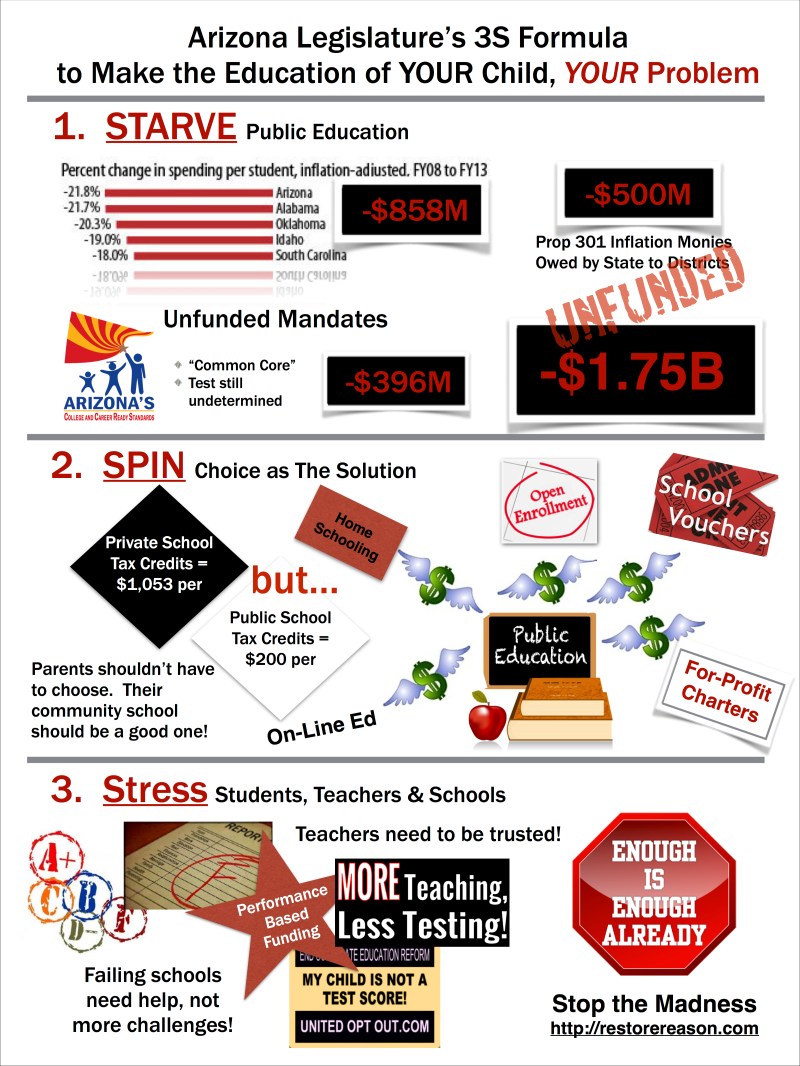
I think the really critical words in this “clarification” are “district options to comply can’t impact classroom spending.” Please note that the Governor didn’t stipulate that the cuts must not impact the classroom, but rather, that the cuts must not impact classroom spending. Okay, so I guess Governor Ducey thinks that the classroom spending determines the quality of education in our state? If that’s the case, we’re already hosed. Well, Arizona is actually 47th in the state with regard to “administrative” costs, so we evidently don’t have a problem with classroom spending. What we do have a problem with, it spending on education per pupil. From 2008 to 2013, we had the highest cuts per pupil in the nation. Although the state leadership would like the public to think as “non-classroom” spending as high paid superintendents and principals, the truth is that it includes bus drivers, food servers, librarians, speech therapists, and maintenance workers. In many cases in fact, teachers absolutely can’t accomplish their missions in the classroom without the help of the “non-classroom” personnel that support their efforts.

The biggest “tell” for me is that the Governor is that Districts would have to certify to the state that no reductions were made to classroom spending to comply with the state’s new reduction to District Additional Assistance. This is actually a change from what originally was said which was that the Districts would have to certify there was no impact to the classroom by virtue of the cuts.

However the Governor wants to spin these proposed cuts, these cuts ARE to K-12 public education. In addition, although our legislature seems to abhor all things federal, this five percent cut to “non-classroom” dollars is a lot like the federal sequestration cuts. Across the board cuts may be easy to dictate, but they aren’t strategic and they don’t support improvement.

My school district has done much to cut non-classroom spending in an effort to become more efficient. This five percent reduction however, won’t recognize our efforts, but rather, will lump us in with every other district whether or not they’ve focused on becoming more efficient.

We need leadership from our state government, but this isn’t it. We need the school finance formula to be totally revised and we need a strategic approach to how to improve K-12 public education in our state. This can’t be political, it must be strategic. It won’t be easy, but it is the right thing to do. Come on Governor Ducey…LEAD!

And the beat goes on…

Yesterday, the Arizona House Education Committee moved the state one step closer to fully privatized K-12 education with their passage of HB 2174 (empowerment scholarship accounts; grandchildren) on a 4-3 vote. This bill expands eligibility of Empowerment Scholarship Accounts (ESAs) or “vouchers” to grandchildren being raised by their grandparents. An amendment was adopted that removed the requirement that the grandchild meets the free and reduced price lunch eligibility requirements.

This removal of the requirement for the grandchild to meet the free and reduced price lunch eligibility requirements is significant. Let’s face it. The overall intention of this American Legislative Exchange Council (ALEC) promoted legislation is to provide for K-12 education via vouchers (taxpayer dollars intended for public education) given to parents to pay for private schools. The Arizona Legislature has been moving us down this road for several years.

In 2009, the Arizona Supreme Court found two similar school voucher programs violated the Arizona Constitution’s ban on aid for religious or private schools. The Goldwater Institute however, which had first proposed the idea in 2005, offered educational savings accounts as an alternative. In April 2011, Governor Brewer approved SB 15523 authorizing Arizona Empowerment Accounts (first state to do this) to give parents of eligible special-education students the opportunity to receive ESAs. Funds could be used for curriculum, testing, private school tuition, tutors, special needs services or therapies, or even seed money for college. According to the Arizona Department of Education, parents spent a total of $198,764 in scholarship funds in the first quarter of fiscal 2012. About 92 percent went to private schools.

The Arizona School Boards Association, the Arizona Education Association, and others filed a lawsuit, claiming the program unconstitutional. The Goldwater Institute, the Arizona Attorney General’s office, and the Institute for Justice defended the program. In January 2012, a Superior Court Judge ruled the savings accounts were constitutional. Her opinion was: “The exercise of parental choice among education options makes the program constitutional.” Education advocates continued to appeal this decision, but in October 2013, the Arizona Court of Appeals also ruled in favor of the accounts.”

In 2012, Gov. Jan Brewer signed HB 2622, expanding the program to include children from failing schools, children in active-duty military families, and children adopted from the state foster care system.2 These families began applying for accounts in 2013, and students began using the accounts in the 2013–14 school year. The legislature also expanded the program in 2013 to include incoming kindergarten students that meet the existing eligibility criteria, and increased the funding amount for each account award.3 More than 200,000 Arizona children are now eligible, or 1 in 5 public school students. New applicants must have attended a public school for at least 100 days in the prior school year.

The education profiteers won’t be happy until the public school districts are sucked dry of funding and private school and for-profit charter operators maximize profits on the backs of taxpayers. Shifting money from our public district schools to private schools and charters will not by and large pull disadvantaged children out of their situations and fix America’s education problems. Rather, it will continue to drive the highest level of segregation since the mid-1960s and ensure the advantaged continue to succeed and the disadvantaged fall further behind. Can’t help but wonder what the new Arizona College and Career Ready Standards and the accompanying AZ-Merits test will do to school performance grades and widening eligibility for these vouchers. Know this…I’ll be watching.

‘Best performing schools’ play by different rules

Gov. Doug Ducey recently pledged to expand school choice, vowing “serious reform” to ensure “equal access” to the state’s best-performing schools by eliminating waiting lists, such as the 10,000-student list at the Great Hearts Academies.

Choice won’t ensure equal access, there are too many barriers. These “best performing schools” achieve because they play by different rules — cherry-picking students, unlike district schools who educate all.

Charter schools are notorious for padding their waiting lists. The Arizona Charter Schools Association claims their schools were hit harder during the recession because they can’t ask taxpayers for overrides and bonds. Give me a break.

Charters receive $1,100 more per student than the district schools because they don’t have access to override and bond monies. The recession made it tough for district schools to get additional monies passed, but charter schools never missed a beat.

— Linda Lyon, Tucson

Socially Liberal, but Fiscally Conservative

If I had a dime for every time someone has said to me: “I’m socially liberal, but fiscally conservative”, I would almost qualify for the 1% club. I know the person who makes that statement thinks it proves they are enlightened and responsible, but I find it somewhat insulting.

A big part of the problem is labels. Labels we are marked with it seems, increasingly define us. All one must say is that they are a Republican, Democrat. Tea Party type, Libertarian, or Green Party, and we think we know everything we need to know about them. If they are Republican, they are for guns, God, and limited government. If they are Democrats, they are for gays, giveaways, and the environment. This stereotypical labeling prevents people from finding middle ground as both sides retreat to their highly partisan corners.

Typically, the conversations that cause non-Liberals to claim they are socially liberal have to do with sensitive issues such as gay marriage rights. The non-Liberal wants to make it clear they are not bigoted, but as tolerant as the next guy. At the same time though, they want to make it clear they are not real liberals because they are don’t believe in wasting money.

That’s the point at which I get a little peeved. After all, I was a Colonel in the Air Force. I grew up in a family that never owed any money; my parents paid cash for everything. I know how to maintain a budget, I believe in not spending more than I have, and I learned a long time ago to take care of my belongings. I don’t believe it is anymore appropriate for conservatives to claim fiscal restraint than it is for them to claim patriotism and religion as their own. After all, since World War II, Democratic presidencies have created more than twice the number of jobs than Republican presidencies. As for deficits, they have been more than twice as large under Republican presidencies, contributing early $4 trillion more to the national debt than their Democratic counterparts. Growth has also excelled under Democratic presidencies with business investment growth 165% higher and GDP growth 52% higher than under Republican presidencies. Finally, the need for social welfare programs has been higher under Republican presidencies with unemployment 23% higher than under Democratic ones.

I know, I know, don’t confuse us with the facts. It is so much easier just to listen to the talking heads spewing forth rhetoric that incites fear and hate. The problem is, that those who do not remember the past are destined to repeat it. If we ever want to move beyond extreme partisanship and failed policies of the past we must know the truth, look beyond labels, and be willing to make the tough calls. We must model this behavior ourselves and demand it from our leaders.

A Familiar Recipe for Disaster

I recently came across an August 2013 report by Lindsey M. Burke from The Friedman Foundation for Educational Choice titled: The Education Debit Card – What Arizona Parents Purchase with Education Savings Accounts. The report makes many claims begging to be refuted. In the executive summary, the author credits Arizona with creating “a model that should be every state policymaker’s goal when considering how to improve education: funding students instead of physical school buildings and allowing that funding to follow children to any education provider of choice.” The model referred to here are Empowerment Scholarship Accounts (ESAs).

In September 2011, Arizona’s ESA program started with a modest enrollment of 153 students with special needs. In 2012, enrollment had grown to include more than 300 children with special needs.   Expansion continued that year with eligibility granted to more than 220,000 Arizona students, including 125,000 children with special needs, 87,000 children in underperforming public schools (rated D or F), 11,500 children of active- duty military families, and any additional foster children.Currently, according to AZ Ed News, more than 250K students are eligible to apply.

Although I totally “get” a parent wanting the very best for their own child, I am also brought back to a quote by John Dewey’s (possibly the most significant educational thinker of the 20th century): “what the best and wisest parent wants for his child, that must we want for all the children of the community. Anything less is unlovely, and left unchecked, destroys our democracy.”

The real truth is, the majority of children (for a multitude of reasons) will simply not be able to avail themselves of the ESA opportunity. So, I find myself asking what are the real reasons Arizona legislators and other leaders are pushing vouchers as the solution for educating our children? Color me cynical, but let me offer some thoughts:

1. A voucher by any other name. The ESA bills are model American Legislative Exchange Council (ALEC) legislation. As reported by education activist and blogger David Safier: “The Goldwater Institute came up with the idea for ESAs as a second workaround (the first is our tuition tax credit law) to make vouchers legal in a state where the constitution prohibits the use of public money for religious instruction. (Did you know over 70% of Arizona’s private schools are religious?) The term of art for this kind of legislation is “backdoor vouchers.” The conservative’s ultimate goal is vouchers for all.”

2. What can parents afford with an ESA? AZ Senator Al Melvin (who is running for Governor this year) likes to tout vouchers for every child at $9,000 per child is either ignorant or disingenuous. First of all, if every child in Arizona were given that much funding, it would cost as much as entire budget of the state of Arizona ($9.054B vs. a budget of 9.18 billion.) Secondly, the ESA base rate this year is only $5,400 per child, not $9,000. So, what private school can parents send their children to for $5,400? The website Private School Review shows the average tuition at Arizona’s private elementary schools as $5,465. Please note, this is not the total cost. Private schools do not typically offer free transportation to/from school or like public schools do, nor is a free/reduced fee lunch program offered. Additionally, parents are often expected to donate time, or in the case of at least one school, get charged $10 per hour when they don’t donate the requisite amount. Finally, please note the $5,465 cost is just tuition. What else is not included in this cost – books, athletics, extracurricular activities?

3. Despite claims to the contrary, competition is not the answer for everything. Whereas public school districts should be collaborating with each other to ensure the most effective use of taxpayer dollars, open enrollment and school choice encourages just the opposite. Marketing campaigns and intra-district bussing is now the norm to boost enrollment numbers. Additionally, where engaged, caring parents would once get involved as part of the solution in their community public schools, now they vote with their feet and take their talents to private options versus applying them to the common good.

4. There is little accountability or transparency in the use of the ESA funding. A recent Arizona Capitol Times article reported parents with ESAs have saved up roughly $2.5 million of taxpayer dollars over the past three years causing many to question the program’s accountability. After all, these unspent funds equal 21 percent of the almost $12 million handed out since 2012 and represent 68 parents holding onto amounts from $10,000 to over $61,000. A representative for the Arizona Department of Education (AZ DOE) said they have no authority over how much of the quarterly disbursements must be spent, only that the receipts for the expenses reflect allowed expenditures. The AZ DOE administrator of the program said the department is aware of the growing accounts, but has no authority over how much of the quarterly disbursements must be spent. Obviously though, money held onto is not money spent on a child’s education. As a vivid case in point, one “tight-fisted parent has hung onto $61,047 while spending only $825.” How can this be in the child’s best interest?

5. But wait, weren’t ESAs supposed to save the state money? ESAs were supposed to save the state money, but now they will cost Arizona more than educating children in the public school system. Despite the legislature’s unwillingness to change the law to allow it, John Huppenthal, the AZ Superintendent of Public Instruction has unilaterally moved to provide all ESA students funding at 90 percent of the charter school funding level, which is currently higher than the district school level. This translates to all students on ESAs getting the charter school amount, an additional $1,684 to $1,963 over what was given for students transferring from traditional schools. Additionally, according to the AZ Joint Legislative Budget Committee, the newly expanded availability to kindergarteners that might have attended private schools anyway at parental expense drives up the cost as well.

6. Superintendent of Public Instruction, not public schools! Superintendent Huppenthal recently shilled for The Alliance for School Choice recording a robo-call that went out to 48,000 qualifying families and referred families to a Goldwater Institute website for more information. His$250,000 marketing campaign evidently produced results with applications for the 2014-15 school year doubling from 2,479 from 1,100 the previous year. When questioned about his actions, he said “he is the Superintendent of Public Instruction, not public schools.

Given the facts surrounding the push to expand ESAs, one must ask why? I suspect politics is largely responsible. “Arthur Camins, a teacher and director, center for innovation in Engineering and Science Education, Stevens Institute of Technology” posits the corporate reformers believe (or want us to believe) that “Improving all schools is hopeless. Poverty will always be with us.” That’s why he says, they believe they need to offer privately governed schools to serve the “best among the unfortunate.” They know not all children will be successful, they just need a system for sorting through those who can be. “This is the cold hard truth. Only we (the best and smartest) have the guts to act on it.”

Camins goes on to write that, “in-school tracking and magnet schools have long served to mediate dealing the hard truth that poverty undermines children’s readiness and ability to engage in and sustain learning.” Now though, the new well-funded partnerships trying to provide a systemic alternative to public schools is more “explicitly elitist and anti-democratic” than ever before. “As long as the only seeming rational choice is self-preservation, people who can, will choose it.” What is new now is “the scale of the effort and resulting damage, the ever-widening disparity in income and differential life chance opportunities and the erosion of the very idea of social responsibility for the common good.”

Dr. Tim Ogle, Executive Director of the Arizona School Board Association writes that “allowing some selected children to “opt out” of public education to go to schools with unknown aims and objectives removes incentives to develop new creative solutions to education’s toughest challenges. Let’s call these accounts what they are: government subsidies for private enterprise using children as the currency.”

Voucher programs aren’t about offering parents a choice, they aren’t about ensuring special needs children have every opportunity, and they aren’t about improving the educational outcomes for our students. What they are about is making money…lots of it. Big money, lack of transparency and accountability, and legislators collaborating with big business…sound like a familiar recipe for disaster to anyone else?
What about MY choice?

UGH!  Right on the heels of my last post about why school vouchers are a bad idea, comes the Arizona Supreme Court ruling yesterday that private-school vouchers are legal.  Okay, so there goes my belief that we had at least one sane decision making body in Phoenix!  In fact, they ruled without comment, refusing to override a Court of Appeals decision which said empowerment scholarship accounts “do not run afoul of a state constitutional provision that bars public funds from being used to subsidize private and parochial schools since parents decide where the money goes, not state officials.

This logic reminds me of another disastrous Supreme Court (the real one) decision that rule corporations are people and allowed unprecedented influence in our electoral system by the über-wealthy.  I mean really?  Because parents decide where the money goes, my tax dollars can be used to pay for private or parochial schools?  What happened to separation of church and state?  Why even the Arizona constitution states it is illegal to use tax dollars for religious worship or instruction.  In his ruling, appellate Judge Jon Thompson said nothing in the program amounts to the state providing funds for religious worship or instruction. He wrote: “The ESA students are pursuing a basic secondary education consistent with state standards, they are not pursuing a course of religious study.”  Wow!  That’s an amazing leap of faith (no pun intended) since lawmakers have continually fought any attempt to attach any kind of accountability to the ESAs and private and parochial schools already aren’t held to the same kind of accountability and transparency requirements as public schools.  That’s like the US Supreme Court’s statement about Citizens United that they had no reason to believe declaring corporations people would adversely affect elections.

This latest court ruling now clears the way for legislation currently working its way through the full House that would boost eligibility to 800,000 students in Arizona.  This, despite the fact that the Joint Legislative Budget Committee (JLBC) said this plan would cost more than the current budget ($12.5 million by 2019) for education because vouchers would be available to kindergartners who might otherwise have attended private schools anyway at parental expense.  

I am livid!  Why does a parent’s right to choose override my right to ensure my tax dollars are well spent and produce the right results?  As a school board member, I am directly engaged in governance at the local level.  Our Board meetings are open to the public and their comment is encouraged.  Together, in a spirit of transparency and cooperation, we work to ensure our student’s best interests are paramount.  When a child attends a private or parochial school on my taxpayer dime, I won’t know what he or she is being taught, how well he or she learned it, or what percentage of my money actually went directly to their education.  In that the funding can also be used for curriculum, testing, tutors (without any certification), special needs services or therapies, or even seed money for college, there is zero accountability for ensuring the public’s interests are represented in ensuring a well-educated electorate.  That is why the Arizona School Boards Association has strongly opposed vouchers and fought this court battle.

This is a bad decision which will produce bad results.  It will most certainly do what proponents are intending for it to do – accelerate the death of our public schools, at the very least, accentuating a two-tiered system of haves and have-nots.  And that, I believe, will lead to the eventual liquidation of our democracy.  Don’t believe me?  Just sit back, do nothing and watch the destruction. 


True liberty – eye of the beholder?

RE:  Senator Melvin SB 1062  “True liberty is where you are free to do what you want to do.”[i]

I am tired of radical right-wingers like Senator Melvin waiving the flag and touting liberty when I know he isn’t for my liberty.  I

Image

believe everyone has a right to life, liberty and the pursuit of happiness.  That means I want my partner (of 12 years) and I to be able to marry in our state and enjoy equal rights.

We are volunteers in our community, pay our taxes and SaddleBrooke homeowner dues, and are both retired military members with 48 years of total service.  We are proud Americans, registered Democrats, and fly our flag almost every single day.  This act doesn’t define us as patriots, that lies in our hearts just as does our belief in individual liberties, the strength our diversity brings to our nation, and, the responsibility we all have for each other and the common good.

I don’t believe true liberty means you can do whatever you want.  That leads to anarchy.  True liberty means you may live your life the way you want as long as it doesn’t hurt others’ or infringe on their liberty.  It may be politically convenient for Melvin to pursue his liberty and ignore mine, but it is not patriotic.