Trump reverses stand on EPA, orders trillion dollar investment in solar energy

Cross-posted from skyislandscriber.com

April Fool!

(I wrote most of this post yesterday – April 1.)

Let’s try a different headline. China, Chile, America – which does not belong?

If you picked America, you would be correct. China and Chile are leading the way in solar energy investment. This is another way in which Trump’s MAGA is a race to the bottom.

The Washington Post reports that While Trump promotes coal, Chile and others are turning to cheap sun power. Chile, the main focus of the report, aims to be “A solar Saudi Arabia.”

The Atacama desert in Chile is possibly the driest, sunniest place on the planet. It also is a popular tourist destination being home to some of the most interesting geological formations and ecologies: check out flocks of flamingos in the high plains salt flats, volcanoes, valley of the moon, the Andes, and more things to do in San Pedro de Atacama.

The Atacama is also interesting because of Chile’s immense national copper mine. Chile put this mine in place where no rational person would want to live – and then built a whole city to house the (well-paid) miners.

In addition to tourist cash and copper, the Atacama is an ideal place to situate massive solar arrays. No rain means no atmospheric interference with sun light. And that means super efficient solar production.

The sun is so intense and the air so dry that seemingly nothing survives. Across vast, rocky wastes blanched of color, there are no cactuses or other visible signs of life. It’s Mars, with better cellphone reception.

It is also the world’s best place to produce solar energy, with the most potent sun power on the planet.

So powerful, in fact, that something extraordinary happened last year when the Chilean government invited utility companies to bid on public contracts. Solar producers dominated the auction, offering to supply electricity at about half the cost of coal-fired plants.

It wasn’t because of a government subsidy for alternative energy. In Chile and a growing list of nations, the price of solar energy has fallen so much that it is increasingly beating out conventional sources of power. Industry experts and government regulators hail this moment as a turning point in the history of human electricity-making.

“This is the beginning of a trend that will only accelerate,” said Chilean Energy Minister Andrés Rebolledo. “We’re talking about an infinite fuel source.”

President Trump ordered U.S. regulators this week to reverse Obama-era policies aimed at curbing greenhouse gas emissions, and he has promised to “bring back” the U.S. coal industry. But construction of coal-fired power plants dropped 62 percent over the past year worldwide, according to a survey by the Sierra Club and other activist groups. In China last year, the number of new permits for coal-fired plants fell by 85 percent.

More worldwide generating capacity is now being added from clean sources than coal and natural gas combined, according to a December report by Bloomberg New Energy Finance, which closely tracks investment in renewables.

An investor in Chile wanting to build a hydroelectric dam or coal-fired plant potentially faces years of costly political battles and fierce resistance from nearby communities. In contrast, a solar company can lay out acres of automated sun-tracking panels across an isolated stretch of desert and have them firing quiet, clean electricity in less than a year, with no worries about fluctuating fuel prices or droughts. The sunlight is free and shows up for work on time, every morning.

Long dependent on energy imports, Chilean officials now envision their country turning into a “solar Saudi Arabia.” Chile’s solar energy production has increased sixfold since 2014, and last year it was the top-scoring clean-energy producer in the Americas, and second in the world to China, according to the Bloomberg rankings. (China is the world’s largest producer of greenhouse gases but also the leading investor in renewable energy.)

Driving the global shift to cheap sun power is a dramatic decline in the cost of the photovoltaic (PV) panels that can be used to create giant desert solar farms or rooftop home installations. China produces more than two-thirds of the world’s PV panels, and their price has fallen more than 80 percent since 2008.

Unlike many of South America’s other major countries, Chile has virtually no oil or gas deposits. With a heavy dependence on imported fuel, Chileans have been paying some of the highest electricity rates in the region, but prices are falling as renewable sources come online.

The Atacama is well-suited to solar energy production for the same reasons astronomers put high-powered telescopes in northern Chile for the clearest possible Earth-based views of the cosmos.

In nations such as Japan and Germany, which are some of the world leaders in solar energy production, the sun’s rays are partly diffused by water molecules floating in the air, even on days when it isn’t cloudy.

But in the super-dry Atacama, where it virtually never rains, the photons beam straight down. Put a solar panel beneath them and it’s like plugging into the sun.

At the Finis Terrae solar plant near the tiny town of Maria Elena, more than 500,000 PV panels blanket the desert. The 160-megawatt plant was the largest solar installation in Latin America when it went online last summer, capable of powering nearly 200,000 homes. Since then, another Chilean plant has surpassed it.

I am skipping over some of the hassles Chile faces because of the harsh conditions – the extreme radiation – in the Atacama. But the biggest problem with solar is what to do when the sun goes down. Chile is working on it. “Chile could generate all of its electricity with about 4 percent of the desert’s surface area, if there were a way to efficiently store and distribute that energy.”

A company looking to bridge this gap in Chile is building Latin America’s first solar thermal plant. You can see its solitary tower rising from the desert for miles around, like some sort of alien religious shrine. At nearly 700 feet, it is the second-tallest building in Chile.

Instead of PV panels, the solar thermal plant will have 10,000 giant, rotating mirrors set in concentric circles around the tower. They will concentrate the sun’s rays on a huge boiler at the top, filled with molten salts, that reaches more than 1,000 degrees and glows like the Eye of Sauron in “The Lord of the Rings.”

The superheated salts ooze downward to steam turbines at the base of the tower, retaining enough energy to generate electricity all night. It’s essentially a giant, rechargeable $1.4 billion battery.

The plant’s owner, Cerro Dominador, a subsidiary of U.S.-based EIG Global Energy Partners, says it will be completed in 2019. Larger solar thermal facilities based on the technology are in operation in California, and Chile has issued permits for others.

Ivan Araneda, the company’s top executive, said such solar thermal facilities can transform the industry.

“The attack on renewables is that they’re too expensive, but this is efficient, proven technology,” Araneda said. “On an even playing field, renewables can compete with anything.”

Nobody can beat McSally … until we find the right Nobody

Cross-posted from skyislandscriber.com

Blake Morlock writes a column “What the Devil won’t tell you” for the Tucson Sentinel. His latest is an argument that the Dems’ best hope to beat McSally could be a complete nobody. However, goes the subtitle, Harnassing midterm anger isn’t in establishment Democrat DNA.

So. Let’s do some genetic engineering. Here are snippets.

[Republicans] whiffed on doing something — anything — to Obamacare because apparently drafting a ready-to-go bill was too much work for Republicans during the seven years they railed against the Affordable Care Act as a freedom-destroying, job-killing socialism. I guess they had other things to do.

It’s going to take more than a golden retriever in a pickup truck to get U.S. Rep. Martha McSally out of this one. We can all agree that Boomer is, in fact, “a good boy,” but Obamacare was supposed to be the easy victory.

Republicans run the risk of failing to get any real changes through Congress before the 2018 midterms as President Donald Trump seems to prefer pissing off the losers across the country who don’t see his genius.

They would be smarter to move the goal posts to the 45 than try to deliver “comprehensive tax reform.” The idea of border adjustment tax is likely political hokum at best and the trigger of a trade war at worst. They gotta win something so they might just pass a standard-issue tax cut and call it The New Deal.

If they don’t, then they’re looking at an 0-Fer and they can’t be (deep breath) that stupid. The 2018 midterm was going to be hard for McSally when it looked like the GOP could run the legislative table. Political failures only make her prospects worse.

McSally is in trouble but to do something about it, the Democrats – the national Democratic establishment – may have to break form and follow their base. By national Democrats, I mean the big Washington money and shiney-shoed consultants who decide what’s what out here where plants bite.

The obvious candidates don’t yet inspire much fear in the GOP. Former state Rep. Matt Heinz suffered a double-digit loss to McSally and former state Rep. Victoria Steele couldn’t raise any money or beat Heinz in the primary. State Rep. Randall Friese might be an interesting choice but he’s just in his second term.

Why does it have to be a state lawmaker? Because that’s a safe bet and national Democrats will only dance with a safe bet.

I guarantee you that D.C. establishment looks at Martha McSally and doesn’t see a woman who won her seat in 2014 by a few hundred votes. They don’t see her serving a district Hillary Clinton won by five points. They see a congresswoman who raised a stupefying $7 million in 2016.

Then they look at the Democratic landscape and see no obvious candidate who can raise enough money to match because all the obvious candidates can be “called a liberal.”

They may try to coax Green Valley pecan grower Nan Walden to run for office (again). She’ll probably play coy and then say no (again). They may even try to get Ann Kirkpatrick to move from Flagstaff to Tucson to take on McSally (a lot of Dems seem giddy about this possibility). In which case, McSally may just be able to land this thing on autopilot.

A nobody may be their best bet but “nobody” will be a tough candidate for the D.C. types to swallow.

If that does not kickstart your depression, then you are the emotional equivalent of a cinder block. So let’s get over the get-mad and do the get-even.

The first step out of the downer mode, Morlock continues, is to understand mid-term elections.

Midterm elections with an unpopular president turn on one message: Wrath.

Voters don’t want to hear about a 10-point plan for inter-modal transit that moves Southern Arizona forward again. They want to hear “I’m pissed too and I’ll stand up to Donald Trump in Congress.”

Democrats have long preferred the resume to the voice and that has cost them.

So we need a candidate who will broadcast the Greats of Wrath.

An improving economy would improve the 2018 climate for the GOP, if Trump could stop creating his own weather. Yet all he seems to know is how to be a one-man pressure front happiest in storm and squall.

Those are the elements McSally is left to and her tenure in Congress could fall victim to the exposure.

Democrats don’t need a Latina, business-owning combat veteran who “can’t be called a liberal” who will drive out the base on identity alone. What they need is The Voice promising to be The Wrath. See: Sanders, Bernie.

Who can beat McSally? It may be a nobody out there thinking “I’m sick of this … I’m gonna run without apology" because no Democrat will beat McSally.

Donald Trump might.

[Especially] … If [McSally] keeps supporting him 100 percent of the time …

The obvious candidate? Sure, maybe a guy like Randy Friese could make a go of it. But anyone who says a loudmouth outsider channeling voter anger can’t win federal office against an establishment type has been living in a glass jar the last two years.

And voters have a lot to be angry about. All the BS spouted by Trump and defended by McSally’s 100% votes just got proven to be empty promises by the failure of the GOPlins to pass their own health care bill. That hurts. Health care is a very personal thing. McSally was poised to vote for that atrocity. Will she vote to support a budget that cuts cancer research in favor of a not-so-beautiful wall that will screw things up with Arizona’s southern trading partner? And, BTW, said research is the hope that Uncle Joe will get some life-saving treatment. Not to mention the economic injustice of Trumpcare being a transfer of working class wealth to Trump’s billionaire BFFs. Voting for this stuff is a slap in the face of CD2 voters. Take that, McSally.

And, let’s not forget that there is a scandal dominating the nightly news that is not going away – the Trump connection to Russia. For example, check out AZBlueMeanie’s report today Follow the money: USA Today’s investigation into Donald Trump’s Russian mob money connections. Will McSally vote against our national security?

Probably. Check out this Letter to the Editor by Kathy Krucker in this morning’s Daily Star.

Re: the March 26 letter “Where is McSally on Trump’s Misbehavior”

Excellent point about Rep. Martha McSally ignoring our Commander-in-Chief’s shameless history of denigrating women! McSally is an Air Force Academy graduate and served our country with honor. Hopefully, her Academy oath would carry over into Congressional governance: not tolerating those who lie and cheat.

Why won’t McSally call out the President on his denial of facts reported by our intelligence agencies and reputable news outlets? McSally is silent on the tweets of a president who accepts as true what he learns from Brietbart, Fox News and conspiracy outlets. She is silent about the ethical violations of her own chairman of the House Intelligence Committee (Devin Nunes), who seems more interested in protecting the president than conducting a bipartisan investigation into Russia’s interference in our democracy and elections. She is silent about a president, White House, and a cabinet with significant financial and ethical conflicts of interest.

The questions raised in the letter may not in themselves be enough to win the midterm but it might not hurt to pile on.

Below is a copy of a comment in response to Morlock’s column by “bettsph.” I edited it to flip the gender. Assume that the “I” in this comment is me.

I know of a “nobody” that I think would be perfect for the job, frankly… She is an ex military person (such an obviously better choice for rural arizona than an anti-gun female or a gay guy: apologies for stereotypes here but the margins seem to indicate that at least SOME thought needs to head in that direction….) with good solid values that are accessible to both sides, and is unabashedly AGAINST TRUMP. She has run a political campaign before and lost, despite being a fantastic communicator. She has a little more recognition than nobody, but a) she could do the job and b) she could win the district if she had some money and professional campaign consultants who wouldn’t try to get her to sell herself down the river in order to win. She is authentic. I am not interested in outing her if she doesn’t choose to run, I’m just saying’, keep your eyes open for Nobody. She’s out there!

Why Trumpcare died, Rep. McSally’s warped view of healthcare, and more

Cross-posted from skyislandscriber.com

Those of us, those Americans, who walked, sat-in, called, wrote letters, and otherwise pressured our legislators can take some credit for the outcome, Republicans give up on controversial, unpopular health plan, reports Steve Benen (MSNBC/MaddowBlog).

… The American Health Care Act, a.k.a. “Trumpcare,” has apparently died, but it’s unrealistic to think Republicans will simply give up on this issue and accept the Affordable Care Act as the law of the land. Health care proponents and their allies should remain vigilant, knowing that there are additional rounds to come.

But in the meantime, progressive activists and their allies can take a bow. They helped derail a dreadful and dangerous piece of legislation.

After Trump was elected, many assumed it was a foregone conclusion that the ACA would be destroyed by the new, dominant Republican majority. But as it turned out, the only thing GOP policymakers agreed on was that they hated “Obamacare” – and they had absolutely no idea what to put in its place.

There was some talk today about the White House demanding a vote anyway, getting members on the record about the bill Trump wanted, but there was ultimately no point to the exercise. Holding a vote on a GOP bill that would be killed by GOP votes would’ve needlessly put House Republicans in an awful position.

There’s no single explanation that captures why this fiasco ended this way, and a variety of factors contributed to this humiliating failure. Paul Ryan, for example, wrote a ridiculous piece of legislation behind closed doors, failed spectacularly to get any buy-in from stakeholders, couldn’t think of any substantive defenses, and had even more trouble leading his party’s factions.

Donald Trump, meanwhile, couldn’t be bothered to learn the basics of the debate, made no real effort to sell the plan’s purported merits to the public, and proved to be an abysmal deal-maker.

Republican divisions – there were never any core agreements within the party about why they were even pursuing a health care bill or the purpose of their legislation – are deeper than GOP leaders understood, and there’s been no meaningful effort to resolve them.

But let’s not overlook one of the more important factors: regular ol’ Americans stepped up in a big way, pressured lawmakers not to take their families’ health benefits away, and it made an enormous difference.

I’ll take these four factors in reverse order.

Republican divisions

One of the effects of the wrangling over Ryan’s Ripoff (aka Trumpcare) was to expose the deep rifts within the House Republicans. A new dynamic may be emerging in the House: A right and left flank within the GOP willing to buck leadership, the Washington Post reports. The net effect in the end was to position Reps, both conservative and moderate, against the bill. For example:

[Rep. David Joyce (R-Ohio)] made a simple, binary choice about Obamacare: “The American Health Care Act was not a better solution.”

And it was not as bad as some wanted it to be.

[Trent Franks (R-AZ)] remained upset that conservative proposals were left out of the bill because they would have violated Senate budget rules, meaning that the proposal to replace the ACA was nowhere near to his liking.

The president and his negotiations

Riddle: What’s the difference between a closer and a loser?
Answer: the letter C.

Robert Costa, Ashley Parker and Philip Rucker write ‘The closer’? The inside story of how Trump tried — and failed — to make a deal on health care in the Washington Post.

Shortly after House Speaker Paul D. Ryan (R-Wis.) unveiled the Republican health-care plan on March 6, President Trump sat in the Oval Office and queried his advisers: “Is this really a good bill?”

And over the next 18 days, until the bill collapsed in the House on Friday afternoon in a humiliating defeat — the sharpest rebuke yet of Trump’s young presidency and his negotiating skills — the question continued to nag at the president.

Even as he thrust himself and the trappings of his office into selling the health-care bill, Trump peppered his aides again and again with the same concern, usually after watching cable news reports chronicling the setbacks, according to two of his advisers: “Is this really a good bill?”

In the end, the answer was no — in part because the president himself seemed to doubt it.

But Trump’s effort was plagued from the beginning. The bill itself would have violated a number of Trump’s campaign promises, driving up premiums for millions of citizens and throwing millions more off health insurance — including many of the working-class voters who gravitated to his call to “make America great again.” Trump was unsure about the American Health Care Act, though he ultimately dug in for the win, as he put it.

But the closer lost.

Von Ryan’s Express

From Wiki: “Von Ryan’s Express is a World War II adventure film, released in 1965, about a group of Allied prisoners of war who conduct a daring escape by hijacking a freight train and fleeing through German-occupied Italy to Switzerland. It stars Frank Sinatra and Trevor Howard, and is based on the novel by David Westheimer. It was directed by Mark Robson. The film changes several aspects of the novel, most notably the ending, which is considerably more upbeat in the book. It became one of Frank Sinatra’s most successful films.”

The film ends with Ryan (Sinatra) being gunned down by the Germans as he is running in an attempt to reach the departing train that is full of the soldiers Ryan helped liberate.

I mean this little story to elicit metaphors in each of your imaginations. You can imagine that the train is a stand-in for the House and neither Ryan ended up in control. (There was quarreling between the Brits and Americans in the movie.) Or you can imagine that the departing train represents a set of policies that Ryan never mastered. In either, Ryan was brought down by forces beyond his control. Play with it. Have fun. And then go get and watch the movie.

But the most important thing underlying the failure of Ryan’s AHCA was not the divisions in the House or Trump’s naiveté. It was the failure of the underlying philosophy writes New Yorker’s John Cassidy in The health-care debacle was a failure of conservatism that Ryan has for so long embraced.

In the coming days and weeks, there will be more … blame shifting, and, in truth, there is plenty of blame to go around. Ryan failed to unify the House Republican caucus. Trump’s staff allowed him to endorse a bill that made a mockery of his campaign pledge to provide health insurance for everybody. And Trump himself blundered into a political fiasco, apparently believing he could win over recalcitrant Republican members of Congress simply by popping over to Capitol Hill.

But this is just politics. The larger lesson here is that conservatism failed and social democracy won. After seven years of fulminating against the Affordable Care Act and promising to replace it with a more free-market-oriented alternative, the House Republicans—who are in the vanguard of the modern conservative movement—failed to come up with a workable and politically viable proposal. Obamacare survived, and that shouldn’t be so surprising. When it comes to health-care policy, there is no workable or politically viable conservative alternative.

Massive resistance derailed the Republican plan

We have not seen anything like it says Rachel Maddow. If you missed her program check it out at the link below.

Massive, nationwide protest changed course of GOP anti-ACA plan. Rachel Maddow looks at how massive, nationwide protest and resistance attached human stories to the consequences of repealing Obamacare and made the Republican legislative plan much more difficult. Duration: 12:50

Remember in November: A last word about Mean Martha

GV News reprinted this Cronkite News story this morning: Obamacare replacement fails; Arizona lawmakers say fight goes on. CD2 Rep. Martha McSally was on record saying she would vote for Ryan’s Ripoff. She has not changed. The ugliness of the so-called replacement has totally escaped her notice, perhaps because it is so over her head. Here is what she had to say.

Rep. Martha McSally, R-Tucson, who had voiced her support for the American Health Care Act after extracting concessions from Republican leaders on tax credits for the elderly and other issues, said that Obamacare “is still failing families in Arizona, and so the mission has not changed.”

“Whatever the legislative vehicle going forward, I will continue to strive towards better healthcare for my constituents,” McSally said in a statement released by her office.

This last Friday I posted The rich get richer and the poor get poorer under GOP’s unhealthy plan in which I quoted the impact stats should Ryan’s bill pass.

A memo from Pima County Administrator Chuck Huckelberry dated March 22 says that if the American Health Care Act is enacted as drafted, it would end Medicaid for 380,000 Arizonans, including 57,000 people in Pima County.

Somehow, I guess, Mean Martha figures that ending health care for 57,000 of her constituents is “better healthcare.”

Remember in November.

ACTION ALERT: Ryan’s war on the safety net condemns the non-rich to poverty and sickness – and McSally is fine with that

Cross-posted from skyislandscriber.com

Here’s the call to action in case you are strapped for time. The House vote is scheduled tomorrow (Thursday) after a blitz from President Bully and the Grim Speaker. McSally is on record as voting for ACA repeal and against Planned Parenthood. She is a woman waging war on women. Go figure. So give her a piece of your mind.

For Email: https://mcsally.house.gov/contact/email
DC office phone: 202–225–2542
DC office fax: 202–225–0378
Tucson office phone: 520–881–3588
Tucson office fax: 520–322–9490

The New York Times economist explains What’s at Stake in a Health Bill That Slashes the Safety Net

Voters, pay attention. The House speaker, Paul D. Ryan, will try to sell his plan by leveraging Americans’ atavistic fear of Big Government, offering people the freedom to choose whether to have health insurance. You may want to focus instead on what the United States stands to lose.

The list is long. Examples follow.

The American Health Care Act … is decidedly about cutting people off. David M. Cutler, an expert on the economics of health care at Harvard University, put it like this: “No other Congress or administration has ever put forward a plan with the intention of having fewer people covered.”

Under the House Republican plan, 24 million more Americans will lack health insurance by 2026, according to the nonpartisan Congressional Budget Office. Of those, 14 million will lose access to Medicaid and “choose” not to spend money — money they don’t have — on health insurance. Millions more near-poor people in their 50s and early 60s will likewise be left without a policy they can afford.

What will happen? Millions of Americans — poor ones, mainly — will use much less health care. They will make fewer outpatient visits, have fewer mammograms and cholesterol checks. Access to Medicaid in Oregon increased use of health care services by some 25 percent. Losing Medicaid is likely to reduce use by a similar amount.

I realize this sort of speculation can sound excessively dramatic for what is ultimately a change in health insurance. Yet it is worth remembering that among advanced nations, the United States is a laggard in life expectancy and has one of the highest infant mortality rates. Men and women in the United States die younger than those in other rich countries for all sorts of causes. American teenagers have more babies. American men go to jail more often.

Better health insurance will not solve all of this, of course. But it will help some of it. As noted in a recent report by the National Academies of Sciences, Engineering and Medicine, Americans are more likely than those in other high-income countries “to find their health care inaccessible or unaffordable and to report lapses in the quality and safety of care outside of hospitals.”

So why would our representatives vote to make matters even worse? Here’s a clue. “They might pause to consider the consequences of a strategy that so openly redistributes money from the poor to the rich.”

Americans should want to know: "Why is my doctor a Republican?"

Cross-posted from skyislandscriber.com

Back in 1997 the Drs. Scriber moved to another city having accepted faculty appointments at another university. I selected a physician who was in my insurer’s network. I was most happy with my care: my plan, my doctor, his staff. After a couple of years, however, he announced that he was going back to school. He said medicine was increasingly becoming a business and he needed to retrain as an MBA! A couple of years after that, I observed that he had opened a new private practice. I inquired: could I sign up and have him be my doctor again? No, was the answer. He was not accepting medical insurance. In short, if you had the money, you could buy his services.

My doctor’s business decision was a sad commentary on the state of health care in America. It was also a harbinger of what is increasingly coming our way. Below I cover a report on that trend and then cover another op-ed making the case for a better way.

Mayo Clinic prefers patients with private insurance

The Minneapolis Star Tribune reported a few days ago that Mayo to give preference to privately insured patients over Medicaid patients. This morning the Daily Star reprinted part of the report, subtitled Pushback on Medicaid, Medicare part of a trend. Here are selected snippets.

Mayo Clinic’s chief executive made a startling announcement in a recent speech to employees: The Rochester-based health system will give preference to patients with private insurance over those with lower-paying Medicaid or Medicare coverage, if they seek care at the same time and have comparable conditions.

The number of patients affected would probably be small, but the selective strategy reveals the financial pressures that Mayo is facing in part due to federal health reforms. For while the Affordable Care Act has reduced the number of uninsured patients, it has increased the share covered by Medicaid, which pays around 50 to 85 cents on the dollar of the actual cost of medical care.

Mayo will always take patients, regardless of payer source, when it has medical expertise that they can’t find elsewhere, said Dr. John Noseworthy, Mayo’s CEO. But when two patients are referred with equivalent conditions, he said the health system should “prioritize” those with private insurance.

More than 300,000 Minnesotans have gained coverage in the last three years from Medicaid and the related MinnesotaCare program for low-income households, a result of federal health reforms under the ACA and shifts in the U.S. economy. That means hospitals now get paid for patients who might previously have received charity care — but at Medicaid’s mandated rates.

In his speech, Noseworthy said a recent 3.7 percent surge in Medicaid patients was a “tipping point” for Mayo.

“If we don’t grow the commercially insured patients, we won’t have income at the end of the year to pay our staff, pay the pensions, and so on,” he said, “so we’re looking for a really mild or modest change of a couple percentage points to shift that balance.”

Mayo reported a sharp increase in the amount of unreimbursed costs related to Medicaid patients, from $321 million in 2012 to $548 million in 2016. The figures include its campuses in Arizona and Florida. Mayo nonetheless remained profitable in 2016, with income of $475 million.

Mayo CEO meets with Trump

The accompanying photo shows “Mayo Clinic CEO John Noseworthy, right, left a meeting with President-elect Donald Trump, his transition team and Johns Hopkins Medicine CEO Dr. Paul Rothman, left, in December in Florida.” That would be the now president who is siding with the Republican effort to kick 24 million people off of health insurance.

So what should we do?

The case for universal health care

The GOP is fond of spreading fake news about how awful is the health care in other developed countries. However, the truth is far different. What is true of American health care, then, now, and in the GOP’s version of the future is that we are all subject to The Fake Freedom of American Health Care. Here are snippets from the New York Times op-ed by a now American citizen who, originally from Finland, is quite familiar with health care Scandinavian countries. The simple fact is that our spending more does not get us better outcomes than those in other countries. Here are essential snippets.

Eight years ago I moved to the United States from Finland, which like all the Nordic nations is a wealthy capitalist economy, despite the stereotypes you may have heard. And like all those countries, Finland has invested in a universal, taxpayer-funded and publicly managed health care system. Finns constantly debate the shortcomings of their system and are working to improve it, but in Finland I never worried about where my medical care came from or whether I could afford it. I paid my income taxes — which, again despite the stereotypes, were about the same as what I pay in federal, state and local income taxes in New York City — and if I needed to see a doctor, I had several options.

For minor medical matters, I could visit a private physician who was provided as a perk by my employer. Or I could call the public clinic closest to my home. If I saw the private doctor, my employer picked up the tab, with the help of public subsidies. If I went to the public clinic, it might cost me a small co-payment, usually around $20. Had I been pregnant, most care would have been free.

If I had wanted to, I also could have easily paid to see a private doctor on my own, again with the help of public subsidies. All of this works without anyone ever having to sign up for or buy health insurance unless he wants additional coverage. I never had to worry whether I was covered. All Finns are covered for all essential medical care automatically, regardless of employment or income.

Republicans are fond of criticizing this sort of European-style health care. President Trump has called Canada’s national health care system “catastrophic.” On CNN recently, Senator Ted Cruz gave multiple examples of how patients in countries with universal, government-managed health care get less care than Americans.

In Europe, he said, elderly people facing life-threatening diseases are often placed in palliative care and essentially told it’s their time to go. According to the Republican orthodoxy, government always takes away not only people’s freedom to choose their doctor, but also their doctor’s ability to choose the correct care for patients. People are at the mercy of bureaucrats. Waiting times are long. Quality of care is dismal.

But are Republicans right about this? Practically every wealthy capitalist democracy in the world has decided that some form of government-managed universal health care is the most sensible and effective option. According to the latest report of the O.E.C.D. — an organization of mostly wealthy nations — the United States as a whole does not actually outshine other countries in the quality of care.

I’m skipping the outcomes cited that show that American health care is not #1, among them survival rates following some diseases, for example, breast, cervical, and colorectal cancers. You should read the op-ed for the rest of the evidence.

What passes for an American health care system today certainly has not made me feel freer. Having to arrange so many aspects of care myself, while also having to navigate the ever-changing maze of plans, prices and the scarcity of appointments available with good doctors in my network, has thrown me, along with huge numbers of Americans, into a state of constant stress. And I haven’t even been seriously sick or injured yet.

As a United States citizen now, I wish Americans could experience the freedom of knowing that the health care system will always be there for us regardless of our employment status. I wish we were free to assume that our doctors get paid a salary to look after our best interests, not to profit by generating billable tests and procedures. I want the freedom to know that the system will automatically take me and my family in, without my having to battle for care in my moment of weakness and need. That is real freedom.

So is the freedom of knowing that none of it will bankrupt us. That is the freedom I had back in Finland.

Here is my appeal to Republicans: If you really want to free Americans and unburden American employers, why not try, or at least seriously consider, some form of government-managed health care, like almost every other capitalist democracy? There are many ways of giving people choice and excellent care under government management. Universal publicly managed health coverage would even free America’s corporations and businesses to streamline their operations, releasing them from bureaucratic obligations that to me, coming from Finland, I have to say look weirdly socialist. …

In wealthy capitalist democracies all around the world the government itself also has an essential kind of freedom. It’s a freedom that enables the government to do work on behalf of the citizens who elect it, including negotiating the prices of health care with providers and pharmaceutical companies — a policy that has led to lower drug prices in those countries.

But here is the thing. As long as Republicans believe that health care is a commodity, subject to the so-called “free market”, then all they have to offer America is the fake freedom of health care for profit.

The trouble with a free-market approach is that health care is an immensely complicated and expensive industry, in which the individual rarely has much actual market power. It is not like buying a consumer product, where choosing not to buy will not endanger one’s life. It’s also not like buying some other service tailored to individual demands, because for the most part we can’t predict our future health care needs.

So I return to my headline question. Given that we can manage health care better – as the Nordic countries do – why would any doctor be a Republican?

Trump’s budget cuts: Anti-science, anti-America, anti-human

Cross-posted from skyislandscriber.com

Here is a sample of headlines from the March 17th Daily Kos Recommended
* Another Trumpian monster: Tom Price blows off a cancer patient’s concern about losing Medicaid
* Trump budget director: Feeding elderly and children has to end, it’s not ‘showing any results’
* Trump’s budget director: Coal miners’ kids need bombs, not Sesame Street
* Ignorant, unskilled, sick, hungry, cruel and violent—what Trump’s budget would do for America
* Trump’s reward to ’coal country’—kill jobs, training, communities, and education—you’re welcome
* Trump budget slashes heat assistance for struggling families, saying it’s a ‘lower-impact program’
* Gutting the Meals on Wheels program would devastate millions, including 500,000 vets who rely on it
* Trump, Ryan budgets will kill more Americans per year than all Muslim extremist attacks combined

So much for humanism in the Trump administration. But as bad as all those headlines are, my Trumpism4Today is the wholesale slaughter of our agencies that do science and engineering.

The Trump administration thinks research on climate change is a waste of taxpayers’ money. The NY Times reports that Scientists Bristle at Trump Budget’s Cuts to Research and lists the other cuts to basic and applied research and development in medicine and other areas. It is impossible for any reasonable person to view these cuts as reflecting anything but a profound ignorance of the importance of research – or a malicious antipathy toward anything factual.

Wired.com, today, is even more blunt in its assessment: Trump’s budget would break American science, today and tomorrow.

YOU CAN GO ahead and assume President Trump’s proposed federal budget will never be the actual federal budget. Members of Congress from every political persuasion will find a lot to hate about it, and they’re the ones who have to approve it—assuming they can sort out the arcane, procrustean rules for getting any budget passed in Washington.

It’s still worth looking at the budget, though—not as a blueprint for governing but as a map of a government, a philosophy of a state. From that angle it’s a singularly terrifying document, fundamentally nihilistic, that assumes a violent present instead of attempting to build a future of peace, security, and absence of want. By eviscerating federal funding of science, this budget pays for a world where the only infrastructure is megacities connected by Fury Roads.

Here is a short list of some things on the block from the Times.

Climate science

The White House is also proposing to eliminate climate science programs throughout the federal government, including at the Environmental Protection Agency.

“As to climate change, I think the president was fairly straightforward: We’re not spending money on that anymore,” Mick Mulvaney, the director of the Office of Management and Budget, said at a White House briefing on Thursday. “We consider that to be a waste of your money to go out and do that.”

Cancer research

The American Society of Clinical Oncology, the leading professional society for cancer specialists, issued a statement warning that the proposed budget “will devastate our nation’s already fragile federal research infrastructure.”

“Now is not the time to slow progress in finding new treatments and cures for patients with cancer,” the group said.

Global health

… The proposed budget would eliminate the Fogarty International Center, an N.I.H. program focused on global health. The center, founded in the 1960s, has worked on H.I.V./AIDS, Ebola, diabetes, dengue, maternal mortality and numerous other health problems, and trains American and foreign doctors and researchers in developing countries.

“The Fogarty Center advances United States national interests in a multitude of ways, and it would be terribly unfortunate for the institution to cease to exist,” said J. Stephen Morrison, senior vice president of the Center for Strategic and International Studies and a member of the Fogarty Center’s advisory board.

“It has a high reputation outside our borders,” Dr. Morrison said of the center, which has had annual appropriations of about $70 million. “It’s a very tiny institution,” he added, in terms of the overall budget.

Energy technologies

The budget also calls for eliminating some programs that help bridge the divide between basic research and commercialization. Among the most prominent of these is the Advanced Research Projects Agency — Energy, known as ARPA-E, the Energy Department office that funds research in innovative energy technologies with a goal of getting products to market. Its annual appropriation of about $300 million would be eliminated.

James J. Greenberger, the executive director of NAATBatt International, a trade group for the advanced battery industry, said ARPA-E had been of enormous benefit to the industry.

“We’re absolutely stunned by it,” Mr. Greenberger said of the agency’s potential elimination, which he announced to industry leaders gathered at his group’s annual conference in Arizona. “I don’t know what’s going through the administration’s head. It’s almost surreal.”

The head of the American Association for the Advancement of Science (AAAS) said this:

“Do they not think that there are advances to be made, improvements to be made, in the human condition?” said Rush D. Holt, a physicist and the chief executive of the American Association for the Advancement of Science. “The record of scientific research is so good, for so many years — who would want to sell it short? What are they thinking?”

As best as I can determine, they [the crafters of the budget] are following their leader’s know-nothing approach to everything. (Back to the wired.com article …)

By radically reducing the amount of scientific research US scientists can do, the president’s budget willfully ignores 400 years of thinking about innovation and knowledge—and seven decades of the US’ advantage in the world. “It’s like we’ve forgotten we went through a scientific revolution,” says Robbert Dijkgraaf, director of the Institute for Advanced Study. “Facts can be shown with experiments. There’s a systematic way you can learn about the world.”

And that does not square with what Donald the Destroyer has in store for America. For example, again from the Times: ‘Before he became president, Donald J. Trump called climate change a hoax, questioned the safety of vaccines and mocked renewable energy as a plaything of “tree-huggers.”’ In the world dominated by Trumpiness, facts are “so called”, the reports of them are “dishonest”, and we are left to answer the call to enter a realm in which reality is what Donald Trump says it is. You see, facts are a perceived threat to Donald Trump because they show the volumes of falsehoods he speaks. Therefore, in Trump’s scheme eliminating the experiments stops the flow of those inconvenient facts.

If we want to make America truly great again, we would invest more on scientific research, not less.

Wired.com will have the last word for now.

… In 1945 Vannevar Bush wrote a report for President Franklin Roosevelt called Science: The Endless Frontier. In it, Bush laid out the logic and structure for the modern National Science Foundation, and justified the need for federal funding of science. Bush understood that it was science that won World War II—not just atomic bombs but radar and penicillin and synthetic textiles. And he understood that new science meant new technology, which meant new jobs and a bigger economy. “Without scientific progress no amount of achievement in other directions can insure our health, prosperity, and security as a nation in the modern world,” Bush wrote.

[But] Instead of propelling the country toward that gleaming tomorrow, this budget invests in the grimmest possible present. Pollution? Double down; corporations gonna corporation. Climate change? If it was real, the market would be taking care of it. Same for cancer. But guns? Yeah, we only spend as much on that as the next seven countries on the list combined; we better goose that a little because, oh yeah I forgot to mention, we’re cutting diplomacy by 29 percent, too.

Federal spending on research and development has never beat its Cold War peak. In 1976 Federal R&D was just over 1 percent of GDP; today it’s under 0.8 percent, and most of that is defense spending. Cuts of the kind the president is proposing go past the bone and into marrow. Broad research cuts will narrow the pipeline of trained scientists who depend on grants to fund their graduate work. They’ll terminate multi-year studies, reduce the output of university labs with fewer incoming students. You don’t come back from that for a generation. And the worst part is, that’s the only future anyone can predict with confidence. The country won’t be ready for anything—except war.

Great Barrier Reef example of coral reef die-off as oceans heat up

Cross-posted from SkyIslandScriber.com.

Back in August of 2016 I blogged about Planetary change: What we are doing to the oceans.

Direct experience drives human perception and cognition. We react to what we see and hear. What we think about the world is shaped by those aspects of our planet that can be observed. We note volcanic eruptions and earthquakes. We see and hear and are touched by more and more violent weather. We indirectly experience, via the media, the loss of wildlife to gruesome acts of poaching for profit. Some of us even experience the rising seas. But we do not normally experience or think about what lies beneath the planetary surface.

Most people don’t have any direct contact with what lies beneath the surface of our oceans even though oceans take up 71% of the earth’s surface. A few people, though, oceanographers and sport divers, are sounding alarms about what we are doing to our oceans. …

As a sport diver, I had occasion to experience directly “what we are doing to our oceans.”

… For 35 years my wife and I took our vacations in parts of the world renowned for the quality of their SCUBA diving. We rarely repeated visits, but the island of Little Cayman (in the Cayman Islands) was an exception. We first dove the Little Cayman walls and reefs in 1987 and repeated the diving there in 2001 and then again over the Christmas/New Year holidays in 2006. In 1987 coral reefs were majestic: huge mushroom corals and gigantic sponges were abundant. We noted some damage in 2001, but the visit in 2006 was depressing. We witnessed a lot of destruction and coral “bleaching”. I would be more cautious of our anecdotes were it not for confirmatory observations from another group who we met in 2006 and who had been diving that island every New Years for 25 years. They all were sickened by what they had been observing over the years – “in tears.”

We concluded “As the oceans warm and chemically change due to CO2 absorption, the coral reefs are under serious threat. We don’t see that damage but it is there – beneath the surface, out of sight, and all too often out of mind. We are killing the water planet.”

Coral bleached

An update

The New York Times features research showing that Large Sections of Australia’s Great Reef Are Now Dead, Scientists Find.

SYDNEY, Australia — The Great Barrier Reef in Australia has long been one of the world’s most magnificent natural wonders, so enormous it can be seen from space, so beautiful it can move visitors to tears.

But the reef, and the profusion of sea creatures living near it, are in profound trouble.

Huge sections of the Great Barrier Reef, stretching across hundreds of miles of its most pristine northern sector, were recently found to be dead, killed last year by overheated seawater. More southerly sections around the middle of the reef that barely escaped then are bleaching now, a potential precursor to another die-off that could rob some of the reef’s most visited areas of color and life.

The damage to the Great Barrier Reef, one of the world’s largest living structures, is part of a global calamity that has been unfolding intermittently for nearly two decades and seems to be intensifying. In the paper, dozens of scientists described the recent disaster as the third worldwide mass bleaching of coral reefs since 1998, but by far the most widespread and damaging.

The state of coral reefs is a telling sign of the health of the seas. Their distress and death are yet another marker of the ravages of global climate change.

Kim M. Cobb, a climate scientist at the Georgia Institute of Technology who was not involved in the writing of the new paper, described it and the more recent findings as accurate, and depressing. She said she saw extensive coral devastation last year off Kiritimati Island, part of the Republic of Kiribati several thousand miles from Australia and a place she visits regularly in her research.

With the international effort to fight climate change at risk of losing momentum, “ocean temperatures continue to march upward,” Dr. Cobb said. “The idea that we’re going to have 20 or 30 years before we reach the next bleaching and mortality event for the corals is basically a fantasy.”

Costs of coral bleaching

If most of the world’s coral reefs die, as scientists fear is increasingly likely, some of the richest and most colorful life in the ocean could be lost, along with huge sums from reef tourism. …

Australia relies on the Great Barrier Reef for about 70,000 jobs and billions of dollars annually in tourism revenue, and it is not yet clear how that economy will be affected by the reef’s deterioration. …

… In poorer countries, lives are at stake: Hundreds of millions of people get their protein primarily from reef fish, and the loss of that food supply could become a humanitarian crisis.

Conservatism is not conservationism

And what are we humans doing about damage we bring to our oceans? The answers range from nothing to making the problem worse.

With the election of Donald J. Trump as the American president, a recent global deal to tackle the problem, known as the Paris Agreement, seems to be in peril. Australia’s conservative government also continues to support fossil fuel development, including what many scientists and conservationists see as the reef’s most immediate threat — a proposed coal mine, expected to be among the world’s largest, to be built inland from the reef by the Adani Group, a conglomerate based in India.

Trump announced his budget and in it a 31% cut to EPA as the Times also reported yesterday: Donald Trump Budget Slashes Funds for E.P.A. and State Department

"AZ spends less in classrooms" awarded prize for best misleading headline

Cross-posted from SkyIslandScriber.com

The prize was awarded this morning by your Scriber. The headline was on the lead front page article in the paper version of the Daily Star. The on-line version had a similar title: Arizona spending in classrooms declines year over year. Both come from the report by Howard Fischer in the Arizona Capitol Times (subscription required): K–12 classroom spending reaches all-time low. All those headlines are correct. And all are misleading.

The short of it is that schools have two pots of money. One pot goes to cover costs of classroom instruction. The other pot goes to cover fixed costs of running a school: bus maintenance, physical facility upkeep, social workers, counselors, and, yes, administrators responsible for keeping all that from coming apart. If you cut the school’s budget, or let it functionally be cut by not keeping up with inflation, then the fixed costs consume a larger part of the budget and the classroom costs take a hit.

To be fair, Fischer explained this and more in his report. For example, he cites data showing that AZ schools are not particularly inefficient when compared to national averages. But that is not the take-away message from the headlines.

My beef is with the folks who write the headlines that are only partly correct. The voucher vultures are bound to swoop down to pick at the carcass of public schools while screeching about supposed inefficiencies and citing the misleading headlines.

The Presidential Poisoner

Cross-posted from skyislandscriber.com.

Alexander George, writing for the NY Times column The Stone, characterizes President Trump as Our Forger-in-Chief. Trump’s continual assault on the tools of rational thought and civil deliberation undermines our ability to distinguish fact from fiction and thus is a clear and present danger of the sort seen before only in authoritarian regimes such as Hitler’s Germany of the 1930s.

“Alexander George (@AlexanderGeorge) teaches philosophy at Amherst College. He runs Ask Philosophers, a website where anyone can pose questions to philosophers.” As such, he makes philosophical arguments about Trump’s “poisoning the well” of our sources of knowledge: science and the news media. I want to make the case differently. Please indulge my one-time, teen-age aspiration to be the Great American Novelist as I outline my crime thriller The Presidential Poisoner.

I would begin by researching what is known about the psychology of poisoners. A Psychological Profile of a Poisoner appeared in Psychology Today in 2012 with the subtitle Serial Murder By Subterfuge. Here are excerpts.

Killing someone with poison, by it’s very nature, requires careful planning and subterfuge, so it comes as no surprise that poisoners tend to be cunning, sneaky, and creative (they can design the murder plan in as much detail as if they were writing the script for a play). Male or female, they tend to avoid physical confrontation and, instead, rely on verbal and emotional manipulation to get what they want from others.

Convicted poisoners also tend to have a sense of inadequacy, for which they compensate through a scorn for authority, a strong need for control, wish-fulfillment fantasies, and a self-centered, exploitive interpersonal style. Often either spoiled as a child or raised in an unhappy home, some experts liken the poisoner’s personality to an incorrigible child whose immature desire for his/her own way leads him/her to try to control and manipulate the world. It’s as if the poisoner never grew up and is determined to take what s/he wants just as a child would from a candy store. Developmentally stunted, other people are viewed without empathy and the poisoner’s internal compass is guided instead by greed or lust rather than morals. And, because poison is often not detected initially, the power and control poisoners experience with success tends to increase his or her confidence in future endeavors.

Given that 1 out of 5 verified murders by poisoning is never solved, it’s hard to draw a definitive psychological profile of the typical poisoner. Those who’ve been caught and convicted give us some clues – clever, sneaky, emotionally immature, methodical, and self-centered. Many of them are amazingly skilled at pretending to be something they’re not – a doting husband, caring nurse, or devoted friend. Behind the mask, though, lies a psyche that is propelled by childish needs and unencumbered by moral restraints.

Then the task as novelist is to imagine a poisoner operating on a national and even international scale. Because the poisoner in this piece of fiction has a “psyche that is propelled by childish needs and unencumbered by moral restraints”, it is easy to imagine how such an individual would crave adulation and approval of the masses. It is just as easy to imagine how such an individual would be easily manipulated by some foreign power with motives inimical to our national security.

What could actually be poisoned on a national scale that could bring down our country? Try the food supply. We live almost day to day in dependence on the integrity of our production and distribution of food via grocery stores big and small, general and special. What if we collectively came to believe that all our food stuffs were no longer safe to consume? What nation-wide mayhem would ensue? You think lines at the gas pump were disturbing? Try hundreds of millions of people fighting for the last scrap of safe food on nearly empty shelves. And all this could be done just by an authority figure claiming that the food supply was unsafe – with no credible supporting evidence. You don’t have to poison a well in order to get people to avoid it.

And that brings us back to the present. Trump and his advisors and supporters are in the process of poisoning the well of our knowledge. If that well cannot be trusted, then the people will no longer drink from it. The foreign power, as in my novel, does not have to directly confront us to do us profound damage. That hideous strength just needs to make us believe that our well of knowledge is poison.

Alexander George, after his philosophical analysis, explains.

There is a lesson here about the lurking dangers of Donald Trump’s rhetoric and that of his minions. Citizens in a technologically advanced liberal democracy must rely on its scientific community to deliver disinterested information upon which to base their decisions about the policies they would have their elected representatives enact. Citizens are also highly dependent on a probing press to help them judge the performance of their elected representatives. Trump, first as a national candidate and now from the pulpit of the presidency, has not ceased to deny and denigrate the findings of scientific bodies concerning the rate and causes of climate change. In addition, he regularly calumnies individual members of the press and vilifies entire news organizations. They are dismissed as purveyors of “fake news” — a label Descartes’s skeptic might have been delighted to apply to the allegedly untrustworthy deliverances of our sense organs.

This behavior is not merely offensive and outrageous. The real problem is that it is dangerous: It poses an existential threat to our democracy. These attacks poison the wells of reasoned public discourse, a prerequisite for a functioning democracy. The problem is not merely that we are being fed a falsehood here, a lie there, though that would be problem enough. The issue is rather that by destroying the citizenry’s confidence in the institutions of science and the press, we risk being deprived of the tools needed to assess what to believe and want. If we cannot trust what vetted scientists or professional journalists tell us, then we will have been rendered rationally impotent. It is damaging to be fed falsehoods or to be outright lied to, but it is utterly debilitating to be deprived of the resources by which to sort fact from fiction.

Descartes’s skeptic is a traitor to knowledge: His threats are not directed piecemeal but instead to the entire enterprise of coming to know how things are. The assaults on science and the press by Trump and his followers are not local eruptions of deceit and mendacity but a well-poisoning assault on public rational discourse, a prerequisite for a healthy democracy.

Perhaps I should retitle my novel Putin’s Presidential Poisoner.

Notes and credits

New York Times: The Stone
A forum for contemporary philosophers and other thinkers on issues both timely and timeless. The series moderator is Simon Critchley, who teaches philosophy at The New School for Social Research.

From Wikipedia
That Hideous Strength “(subtitled A Modern Fairy-Tale for Grown-Ups) is a 1945 novel by C. S. Lewis, the final book in Lewis’s theological science fiction Space Trilogy. … The story involves an ostensibly scientific institute, the N.I.C.E., which is a front for sinister supernatural forces.” I recommend it as being still relevant 72 years later.

Happy Valentines Day…NOT!

On this Valentine’s Day, I thought I’d ask, when it comes to our public schools students in Arizona, “who loves you baby?”  Yesterday, I was listening in on the AZ House Education Committee meeting. There were many bills on the agenda, but I was primarily interested in HB 2394; empowerment scholarship accounts [ESAs]; expansion; phase-in. I wasn’t hopeful the bill would die, as its companion bill SB 1431, had already been given a due-pass by the Senate Education Committee. As expected, HB 2394 followed suit on a 6–5 vote as did HB 2465, which will allow all students eligible for an ESA account to remain on the program until age 22 and for up to $2,000 a year to be put into a 529 savings account.

The passage of these bills, along with the companion ones in the Senate, demonstrate the disdain many GOP legislators have for our district schools and, for the underpaid educators who toil within. This, because ESAs divert more general fund revenue per student to private schools than district schools receive. As reported by the Arizona School Boards Association, an ESA student, on average, costs the state general fund $1,083 more in grades K–8, and $1,286 more in grades 9–12 than a district student. This is in part because there are many school districts that enjoy a fair amount of locally controlled support in the way of overrides and bonds. The state therefore, is relieved of providing equalization funding to them, but when students leave to go to private schools, all the funding must come from the state general fund. ESA students also receive charter additional assistance funding of roughly $1,200 per student, which district schools do not receive. Turns out that the claim of voucher proponents that they save the state money, is not just “alternative facts” but totally untrue. And, although voucher proponents love to claim there is no harm to district schools when students take their funding and leave, the truth is that about 19 percent of a districts costs are fixed (teacher salaries, transportation, facility repair and maintenance, utilities) and can’t be reduced with each student’s departure.

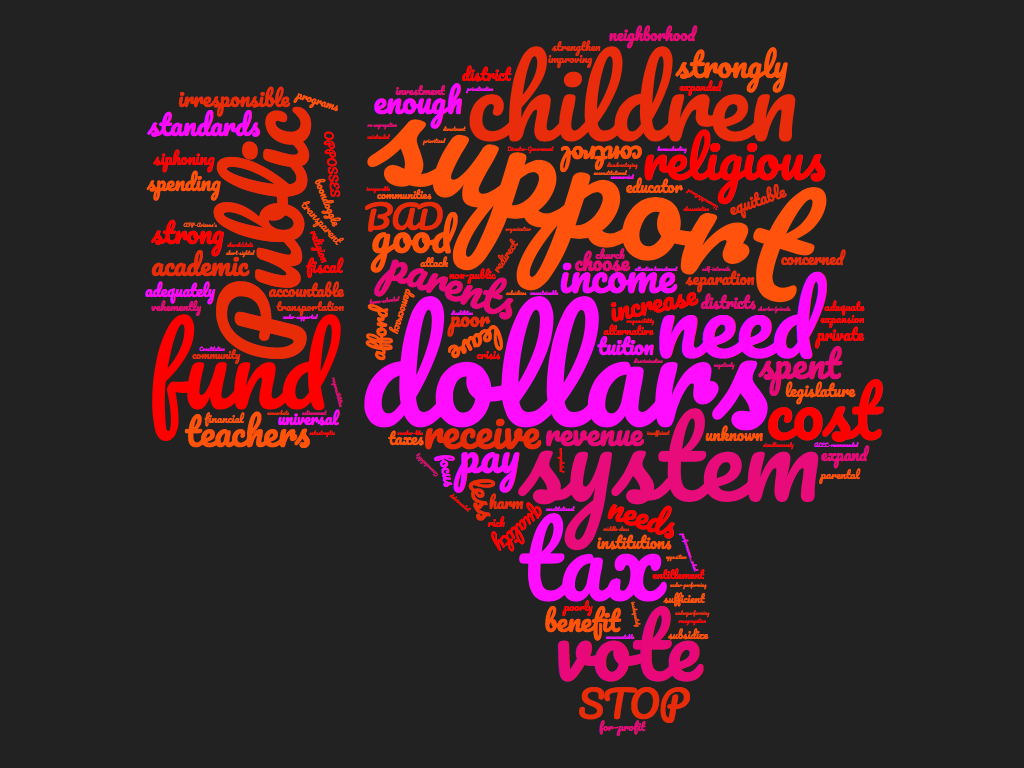
I am slightly encouraged though by the two Republican members on the House Education Committee who had the courage to stand up and do the right thing. Huge kudos to Representatives Doug Coleman and Michelle Udall who voted against the voucher expansion! I encourage each of you to email them and let them know how much you appreciate their show of support for the one million public school students in Arizona’s district schools. What also gives me hope, is the 400 plus people and their almost seven pages of 10-font, single spaced comments made against the bill in the Arizona Legislature’s Request to Speak System. Here’s a word cloud of the comments:

esa-wordcloud

This is compared to the 30 people who signed in to Request to Speak in favor of the bill. The vast majority of whom represent organizations in favor of commercialization of district schools such as The Goldwater Institute, Americans for Prosperity, Center for Arizona Policy, AZ Catholic Conference, AZ Chamber of Commerce and the American Federation for Children.

So, why these organizations? Well, let’s see. According to its website, the Goldwater Institute is a “national leader for constitutionally limited government.” Corporate reformers love to paint district schools as “government” schools, making them just another one of the targets to shrink the government, or as Grover Norquist said, “get it down to the size where we can drown it in the bathtub.” The Goldwater Institute also works closely with the corporate bill mill, the American Legislative Exchange Council (ALEC) to promote conservative corporate agendas (such as commercialization of district schools) in Arizona.

Cathi Herrod and her Center for Arizona Policy (CAP) have long pushed school choice. CAP’s website states the belief that, “Religious freedom is affirmed and protected, free from government interference.” Of course, they are for vouchers. They would love for every student in Arizona to attend religious schools on the taxpayer’s dime.

Americans for Prosperity is a conservative political advocacy group funded by the Koch brothers. On their website they write, “at the very top of AFP-Arizona’s 2017 legislative agenda is the expansion of our state’s program of parental choice Empowerment Scholarship Accounts (ESAs).” They also encourage their supporters to thank Senators Flake and McCain for voting to confirm Betsy DeVos.

It should be no surprise to anyone that the AZ Catholic Conference is also interested in fully expanding voucher eligibility. Around the nation, Catholic schools have been closing at rapid rate, from 13,000 schools enrolling 12 percent of U.S. school children in the mid–1960s, to about 7,000 schools enrolling five percent in 2012. In 2015 alone, 88 Catholic schools closed. But, a tax credit program highly favorable to private and parochial schools has helped stem previous losses in Arizona but charters are still causing them much competition for students. There are now 73 Roman Catholic private schools in Arizona and six of them are among the most expensive private schools in the Phoenix area charging from $13,300 to $17,712 per year in tuition. A $5,200 voucher obviously won’t help poor students get into these schools, but it will be a nice offset for those wealthy enough to afford the schools irrespective of the help. The average cost for private schools in Arizona by the way is about $6,000 at the elementary level and $18,000 at the high school level.

As for the Arizona Chamber of Commerce, let’s not forget how their President and CEO, Glenn Hamer, recently characterized teachers as “crybabies” for wanting adequate pay. This, when our teachers are the lowest paid in the nation and 53 percent of Arizona’s teaching positions were vacant or filled by uncertified personnel at the beginning of this year. Study after study shows a high-quality teacher is critical to student success. What does that say about the commitment of Hamer and his chamber to our students in Arizona?

Finally, let’s not forget that until she was confirmed as Secretary of Education, Betsy Devos was the Chairwoman of the American Federation for Children (AFC). AFC is a huge proponent of school choice and vouchers and has invested millions in purchasing legislators favorable to their causes. Since 2010 in fact, it has contributed some $750,000 to pro school choice legislative candidates in Arizona.

Looking at the list and knowing the resources at their disposal (just think of the Koch brothers and DeVos alone), it is easy to assume most of them have invested heavily in legislative outcomes in Arizona and around the country. Does anyone really believe these organizations have Arizona’s district school students, 56 percent of whom qualify for free and reduced lunch (an indication of their low socio-economic status) children at heart?

We all know when we read something, especially these days, we must consider the source. Well, when looking at the support for voucher expansion in Arizona, I highly encourage you to do the same. This fight against the full expansion of vouchers is far from over. Those pushing for it are no doubt emboldened by pro-voucher stance of the new POTUS and his SecED. But, the people of Arizona understand district COMMUNITY schools are the key to not only achievement for all our students, but also to the health of our communities, and the preservation of our Democracy. We must not sit on the sidelines and watch these bills get signed into law. Much too much is at stake. Want to know more about how to plug-in? Comment on this post and I’ll be in touch. Please don’t let it be said we let our students get sold out!