When is a charter school a bad idea?

Hint: the answer is not,  “never.” It is a bad idea, according to education blogger Peter Green, “when charters disrupt and displace [district] public schools.” I would add that often, these district schools are the hubs of their communities so charters contribute to disrupting these communities as well.

Case in point is a new charter school (Legacy Traditional School) being built in Glendale, Arizona. Scheduled to open in time for the 2016/17 school year, the new campus will serve 1,200 K-8 students at the northeast corner of 67th Avenue and Thunderbird Road. Sounds good, right? Problem is, this school is being built within the boundaries of the Peoria Unified School District, within two miles of 10 of their “A” or “B” rated elementary schools (50 percent of PUSD’s schools are rated “A”, another 25 percent are rated “B.)  When PUSD has the capacity to serve the 1,200 students Legacy hopes to eventually attract, why is this school necessary, or even in the best interest of this community?When the charter school concept was first embraced back in 1988, it was as “a new kind of public school where teachers could experiment with fresh and innovative ways of reaching students.” In Cologne, Germany, Albert Shanker visited a public school where teachers made the critical decisions about what and how to teach and the school had students with a broad mix of abilities, family incomes, and ethnicity. He said charter schools could “reinvigorate the twin promises of American public education: to promote social mobility for working-class children and social cohesion among America’s increasingly diverse populations.” Shanker also believed charter schools should be unionized because of the critical role he believed unions played in democratic societies.

Unfortunately, today’s charter schools are an entirely different animal than Shanker envisioned. They are more autocratic (empowering management versus teachers) and more segregated (by race and income) than ever and only about 12 percent of charters provide their teachers union representation. No wonder an “astounding 24 percent of charter school teachers leave their school each year, double the rate of turnover in traditional public schools.”

They are now seen as “a vehicle for infusing competition and market forces into public education.” Whether intentionally or not, charters have served to re-segregate education to a level not seen since the 1960s. A side benefit for the corporate reformers was also no doubt, the weakening of teacher unions and therefore less democracy in our schools and communities. All this eventually brought us to where we are today. Instead of charter schools augmenting and serving as “laboratory partners to public schools”, they are now in direct competition for students and the dollars they bring. Make no mistake, today’s charters – whether they are for-profit or non-profit – are as much about making a profit, as they are about educating children.

What suffers from this “competition” mindset is the collaboration between schools, overall efficient and effective use of available education funding, the richness of the educational experience that truly diverse schools can bring, and the strong school climate vibrant teacher voices can bring. This diversity isn’t just valuable for our students of color, but for their white counterparts as well. Those students who’ve experienced more diversity will be more successful in the ever-increasingly global economy.

So, here we are. A brand new charter school is under construction, right in the middle of 10 excellent district schools with plenty of capacity. As Legacy Traditional School is a non-profit entity, I suspect the school is funded with a bond issued by the Phoenix Industrial Development Authority (quasi-private so the taxpayer is not on the hook.) Nonetheless, the Legacy charter will compete directly with PUSD for what are already too few maintenance and operation dollars. As for other for-profit charters, they’ll likely turn to SB 1531 signed into law during this year’s legislative session which, provides $100 million to provide collateral for lower interest rates on charter school project loans. When those charters default, Arizona taxpayers will get the bill. (Don’t even get me started on how the $100 million could have helped our district schools.) In either case, said Tracey Benson, of the Arizona School Boards Association, charter schools added will “build corporate assets – those held by privately operated charter schools – versus community assets – our local district public schools that add value to our cities and neighborhoods.”

I’m not a charter “hater”, I’ve seen some that serve a special niche and provide a valuable alternative. What I do hate is the narrative that charters are superior to district public education, that they ensure disadvantaged students have access to a “high-quality choice”, and that they save the state money…because that narrative is largely false. At the end of the day, over 80 percent of Arizona’s students attend district public schools and that should be our first priority for funding and support.


Part 2 – Why Ducey’s Promise to Lower Taxes is a Lie

In my previous post, I showed why Governor Ducey’s focus on tax reduction is a disastrous recipe for our state. Now let’s look at how those tax reductions we’ve been seeing aren’t really helping the average Arizonan. Instead, we continue to see the tax burden transferred from those who have, to those who can least afford.

Governor Ducey is intent on eliminating income tax in Arizona. Why might you ask? Because, for this Governor and others like him, it is ALL about business. And although corporate tax breaks are good for large business, 97% of the employers in Arizona are small businesses like S-corporations, LLCs and partnerships. These businesses amount to over 40% of the private workforce and are currently taxed by the state via income tax. I’m not sure whether ASU’s Center for the Study of Economic Liberty 2015 policy report by Stephen Slivinski is the “policy roadmap to elimination of the Arizona income tax” as it claims, or, if it was written to support Governor Ducey’s tax reduction plan. At any rate, Slivinski concludes in the report that: “The best hope Arizona policymakers have to eliminate the income tax is to phase it out over a number of years while maintaining budget balance.” He also makes the point that now that the state is on “surer fiscal footing”; it is time for Arizona policymakers “to look at important and necessary reforms over the next couple of years.” Waiting longer he claims, “may result in losing a golden opportunity.” Sounds like a Ducey talking point commercial to me.

Arizona already has though, the 13th-lowest individual income tax and the 10th-lowest combined state and local income tax in the Nation. Additionally, according to an article in Business Insider in August 2014, Arizona’s economy was ranked the 4th fastest growing in the US after Colorado, California and Texas. Of course, we also have the 4th highest poverty rate in the US with one in five Arizonans living in poverty. Obviously, there are winners and losers in Arizona’s current economy and Governor Ducey’s insistence on eliminating the state income tax and shifting state revenue collection to increased sales tax will do nothing to help those who most need it. Although sales tax is said to be a less volatile form of revenue than income tax, it also is the most regressive, hitting the poorest the hardest.

Of course, income and sales taxes are just two ways a state can tax its residents, there are a multitude of others. Here’s just a few examples of how we continue to be “taxed” all the while Governor Ducey claims he is reducing our tax burden.

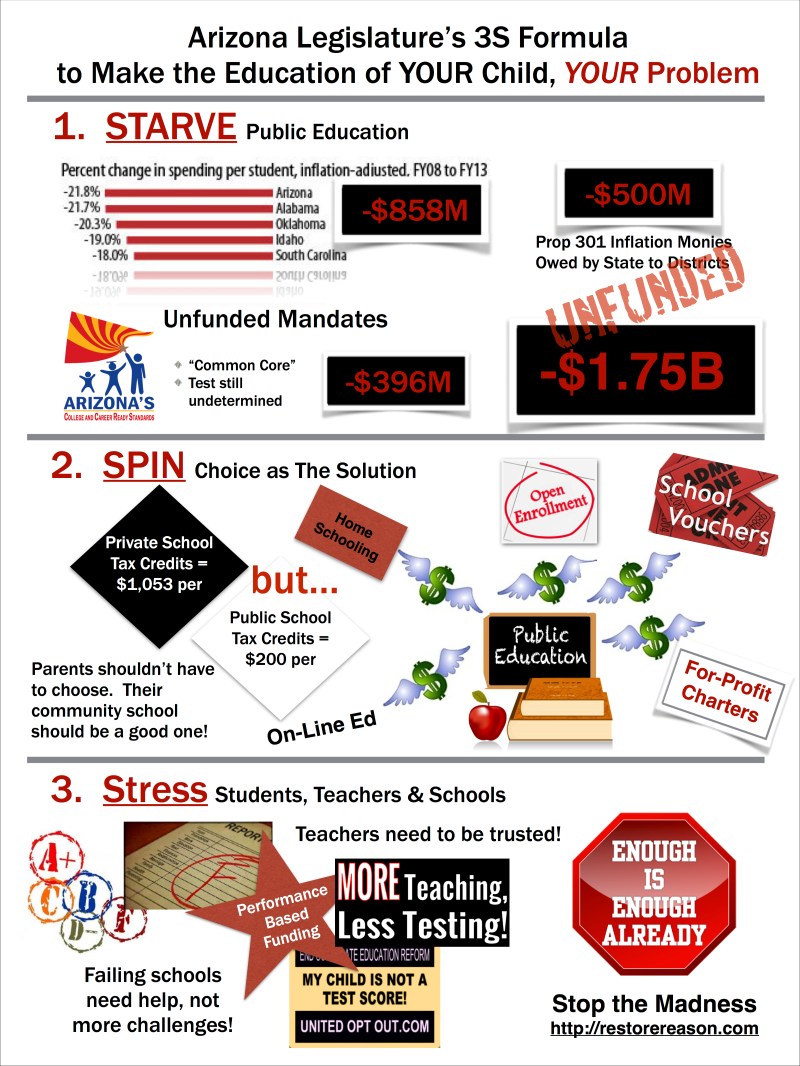
 1.  The highest per-pupil cuts in K-12 education funding in the Nation from 2008 to 2012 caused Arizona school districts to seek more locally controlled funding as a way to survive. The number of districts asking their communities for funding through bonds and overrides in 2015 was up 150 percent since 2008. The good news for districts is that the voters recognized the need for the funding and the approval rate for these measures was also high. The bad news is that this was no reduction in taxes, but just a shifting from the state to the local level. Unfortunately, often the communities with districts most in need have the least amount of capacity to help.

2.  Another solution many districts were forced to try in order to make ends meet was to reduce their school week from five days to four. As of May 2015, 43 districts (most in rural communities) in Arizona have already gone this route with many others considering following suit.  Arizona districts make up one-third of all four-day week districts in the Nation. There is debate over whether this move really produces the touted savings in the long run, but parents certainly don’t come out on top.  Rather, a four-day school week often requires parents to find childcare or, reduce the hours they work in order to care for their children when they are not in school. It also results in decreased wages for cafeteria workers and bus drivers. These people (especially in rural areas) may not have any real options to make up the difference.

3.  The state’s push of school choice via charters and Empowerment Scholarship Accounts (essentially vouchers) has been another way to transfer education costs to the local level. Charters usually require parents to transport their children to the school, do not offer any free and reduced lunch programs, and often require donations of parents. Schools in the Great Hearts Academy schools for example, “recommend parents contribute at least $1,200 to $1,500 per year per child to the school. There are also a variety of fees that are either not charged at all in district schools, or are much lower than what the charters charge.

4.  Even before Governor Ducey and the Legislature cut $99 million from our state universities and $19 million from our community colleges, Arizona had the deepest cuts in the Nation to higher-education spending. Those cuts drove the significant fee hikes and steepest tuition hikes as well, rising 83.6% since 2008.

5.  The Highway User Revenue Fund (HURF) which includes several taxes and fees such as the gasoline and vehicle license tax, was established to maintain roads, bridges and other transportation needs in the state. The Legislature swept about $860 million from this fund from 2000 to 2014 for other priorities. This forced local government to try to keep up with a more than $455 million in backlogs (with only 70% of cities reporting) for construction, repair, and maintenance of municipal streets. This isn’t just a double tax on Arizona residents (pay taxes to maintain the roads, then pay for car repairs after unmaintained roads cause damage), but also translates into a significant loss of jobs that could employ Arizonans to repair infrastructure and ensures that if and when the repairs occur, they will cost significantly more than if we had just maintained the infrastructure to begin with.

6.  In 2015, the state shifted 25% of the cost (about $12 million) for housing juvenile offenders to the counties, based on total population of the county. The counties are now required to raise the funds for this bill either through increased taxes or reduced services.

7.  Also in 2015, the cost to pay the Arizona Department of Revenue to collect and distribute sales taxes was passed down from the state to cities and counties. The change is expected to cost cities and counties about $17 million. This change applied even in counties that don’t charge a sales tax (such as Pima whose share of this new bill is $1.6 million.)

8.  In the past, the state picked up most of the cost of presidential primary elections. In 2016 however, the cost for these elections will be pushed down to the counties who will pay more than $3 million extra to cover those costs.

There are countless examples of this shifting of real costs, and even more in lost opportunity costs. Local governments say the state merely balanced its budget on their backs and saddled them with a huge financial burden that will continue to result in layoffs, tax increases and crumbling roads. Governor Ducey’s office responded that it is up to local government leaders to make responsible decisions. Really? How can local government leaders make responsible decisions when budget expenses they had no part in approving, are forced upon them without any vote in the process? Leave it to Ducey and Company to not only make a really bad brown matter sandwich for local governments to eat, but then also blame them for complaining how it tastes.

In this, as with any debate, it is possible to find a source to support any point of view. For me it is really this simple…does it make sense that you would tax the poor more to provide tax relief for the rich? Does it make sense that corporations are lured to locate in a state so they can pay even less than the under one percent they generally pay in corporate taxes? Or, does it make more sense that corporations are savvy and look at a variety of indicators to determine where to locate such as the quality of local schools, availability of a quality workforce, or a solid infrastructure? One doesn’t need to be a genius to understand basic economic concepts, all it really takes is a little common sense. A strong middle class is the best path to prosperity for our communities and our nation and economic policies that support its growth are the solution. Our tax policies should incentivize the behavior we need for the health of our communities, states and nation, not for the enrichment of a few. Finally, business definitely has a critical role to play, but so does government. It should ensure we are provided the basic essentials of safety, security, infrastructure and education and our tax policies should ensure sufficient revenue to do that properly. And, it should do that at the right level so as to ensure proper oversight and economies of scale.

No one party has the right answer here and there is no one right solution. It takes a smart application of available tools, wise employment of lessons learned and yes, a whole lot of common sense. Alas, as Voltaire is credited with saying in the early 1700’s: “Common sense is not so common.”


Why school vouchers are not in our collective best interest

Our state legislature has been busy introducing bills to redistribute taxpayer dollars designated for public education to private sources.  At last count, there were seven bills (HB 2150, 2036, 2256, 2291 and SB 1236 and 1237) on voucher expansion including one “strike everything” bill (HB 2139) slipped in at the last second.

When vouchers (aka Empowerment Scholarship Accounts) were first introduced in 2011, only children with disabilities were eligible.  That has now expanded to include children: who’s parent’s are in the armed forces, are a ward of the juvenile court, who attend a school or district assigned a D or F grade, are eligible to attend kindergarten, and who received a School Tuition Organization scholarship. This session, expansion efforts include those whose siblings receive ESAs, all first responder’s children and (HB 2291) children currently eligible for free or reduced lunch percent.  HB 2291 also seeks to further raise the income threshold of those who qualify by 15 percent ever year going forward.

ESA funds can be used for curriculum, testing, private school tuition, tutors, special needs services or therapies, or even seed money for college.  The program however, requires parents to waive their child’s right to a public education…a right that is guaranteed under the state constitution, in order to receive the benefits.

Vouchers are not about school choice, that’s just the smokescreen. They are about the redistribution of our taxpayer dollars from transparent, accountable, locally-led community public schools to private and religious schools not accountable to anyone. It is a zero-sum game. Every student who receives a voucher, pulls an average of $5,400 directly out of the budget from the public school he or she left. The vast majority of private schools cost more than what vouchers will provide and only those with means will be able to take advantage of them. Yes, that’s right. Those who don’t need the help will get it and those who are desperate for the help will just get more desperate, stuck in public schools starved for resources.

It should be no surprise to public education supporters that any attempt by pro-public education legislators to attach accountability amendments for these vouchers has been met with fierce resistance from the pro-privatization club.  In fact, one bill was held rather than risk having it pass with accountability measures attached to it.

Over 85 percent of Arizona students still attend public schools.  They shouldn’t have to make a choice.  The state should take care of their fundamental responsibility to properly fund and support these community public schools so that every school is a good school.  But then, this ideal isn’t just a political sound bite, nor is it a simple matter of just moving money around.  Ensuring our public schools have what they need would take a concerted effort and great political will.  Reminds me of a quote by James Freeman Clark:  “a politician thinks of the net election, a statesman [leader] of the next generation.”

Time to Act Against Arizona’s Axis of Evil

Nope, not referring to North Korea or Iran, but the American Legislative Exchange Council (ALEC), The Goldwater Institute and The Center for Arizona Policy led by Cathi Herrod. All of Arizona’s GOP legislators are or have recently been members of ALEC.  Led by Representative Debbie Lesko, ALEC’s Arizona Chair, they have introduced no less than 20 ALEC model bills including those that:

  • Criminalize undocumented workers, stripping native-born Americans of their citizenship rights and requiring that all materials disseminated by state agencies be written in English only;
  • Encourage the privatization of state prisons to the benefit of the private prison industry;
  • Disenfranchise tens of thousands of Arizonans via voter suppression bills
  • Attack workers by undermining unions and collective bargaining and eliminating public employment through outsourcing and privatizing of government functions;
  • Attack public education through private school voucher programs;
  • Attempt to prevent implementation of healthcare reform, and
  • Attack federal environmental regulation by attempting to deny the federal government the ability to supersede weak state environmental legislation.

SB1062, the so-called religious freedom (but really about state-sanctioned discrimination against gays and others) bill that Governor Brewer vetoed last week, was being pushed by Cathi Herrod and her Center for Arizona Policy.  The veto was a fairly significant setback for Herrod, but don’t worry, she has plenty of other tricks up her sleeve.  On next week’s House Education Committee agenda, is SB1237, which passed the Senate on a party line vote.  This bill expands the amount of this private school voucher to include the charter school additional assistance weight as well as 90% of the base support level funding the student would have otherwise received if they had attend a school district. This is a significant dollar increase as the additional assistance amount is $1,684 for K-8 and $1,962 for high school.

This bill is totally about increasing the diversion of public school funding to unaccountable private schools.  Not only is our GOP-led legislature taking orders from Cathi Herrod, but our State Superintendent of Public Instruction recently robocalled public school families to entice them to take state (taxpayer) funding to attend private schools.  When questioned about this, Huppenthal retorted that he is “the Superintendent of Public Instruction, not of Public Schools.”

Vouchers, by any other name, is model ALEC legislation.  “Wherever you see states expanding vouchers, charters, and other forms of privatization, wherever you see states lowering standards for entry into the teaching profession, wherever you see states opening up new opportunities for profit-making entities, wherever you see the expansion of for-profit online charter schools, you are likely to find legislation that echoes the ALEC model.”

It is important for people to understand that one can’t be pro community public schools while also being pro vouchers and school choice.  Despite what the privatization advocates are touting, school choice, and the various methods for providing options (empowerment scholarship accounts [vouchers], student tuition organizations, etc.), do not generally produce better results, especially when comparing similar populations.  In addition, this is a zero sum game.  When money is taken from public schools and diverted to for-profit charters, private and parochial schools, it begins a downward spiral that is very difficult for public schools to recover from.  In addition, open enrollment promotes competition over collaboration not just between schools, but also on the part of parents who act in the interest of their child without concern for all children.

The bottom line is that community public schools perform a huge public good.  In many cases, they are the thread that binds communities together.  They helped put America on the path to greatness and they are still where 85 percent of Arizona students are educated.  We don’t talk about how fire and police departments should be run by like a business or compete with one another for their raw product.  Public community schools should be treated no differently.  They are entrusted with an awesome responsibility, staffed by dedicated professionals, take all children who come through their doors and work against all odds to achieve their mission.  They need you on-board advocating for their success.  Please contact the members of the House Education Committee prior to Monday, March 10th and tell them to fail SB1237.  It is not in the best interest of our students or our state and will only serve to enrich those who would make profit on our public education dollars.

Five Biggest Lies by School Choice Advocates

Linda Retire Crop#5.  School choice saves the taxpayers money.  First of all, did you know that in the state of Arizona, charter schools get $1,000 more per pupil in state funding than traditional district schools?  Secondly, all the funding workarounds concocted (often by the American Legislative Exchange Council or ALEC) and implemented by our legislators, only serve to obfuscate the reality and prevent blame being laid where it belongs.  Tax credit donations, empowerment scholarship accounts, and school tuition organization donations serve to redistribute state revenue and hide the truth that Arizona led the nation in per public spending cuts between 2008 and 2012 ($3 billion).  Tax credits reduce funding into the state coffers and in the case of district schools, give the taxpayers the impression they are doing their part to support education when the reality is the funding doesn’t go into the classrooms, but only for extracurricular, fee-based activities.  In the case of private schools, it is even worse since tax revenue is diverted directly into private education.  Although proponents say school choice saves the state money, this is true only if students who started out in public schools, end up in private schools.  Unfortunately, many tuition scholarships funded by the tax credits have gone to students who would have attended private schools anyway, representing a financial loss for the state.

#4.  School choice puts parents in control.  Au contraire.  Local control puts parents in control.  School choice promotes competition versus collaboration amongst district schools, and encourages charter school development.  Although non-profit charter schools are technically classified as public schools, they are often owned or run (behind the scenes) by for-profit companies who don’t follow the same rules of transparency as district schools and, aren’t accountable to taxpayers.  Charter schools are also legally required to accept all, but they are very adept at cherry picking their students and therefore have less than their “fair” share of special education and English language learning students.  Despite this, charter schools do not by and large perform better than district schools.  Parents are often aware of this and just assume charters perform better.  Some do, but many don’t.

#3.  School choice is the rising tide that will lift all.  Arizona State Senator Al Melvin, now a gubernatorial candidate, says that giving $9,000 vouchers to parents for each child will allow them to send their children to the school of their choice.  This, he says, will cause the bad schools to close and improve the quality of the rest.  First of all, there isn’t enough money in the entire Arizona state budget for all 1.6 million school children in the state.  Secondly, those who have access to make the choice will go, leaving those who don’t “stuck” with less funding in the public schools and much less opportunity for improvement.  As Diane Ravitch writes in her latest book, Reign of Error, “in a democracy, important social goals required social collaboration.”  Schools are not businesses that can reject “inferior” raw product.  They must take all and teach all.  Yes, they should operate efficiently but that should never be their primary concern.

As profiled by Malcom Gladwell in The New Yorker, economist Albert Hirschman, in his best know book Exit, Voice, and Loyalty, said there are two strategies people have for dealing with badly performing organizations and institutions.  Hirschman said the “exit” option “failed to send a useful message to underperformers.”  When engaged parents “exit” the system, versus using their “voice” to improve it, they remove agitation that could have improved the school for all.

#2.  School choice is about the children.  To put it plainly, baloney!  School choice is about business…big business.  Those on the right are up in arms about “government shoving Common Core standards down the states’ throats.”  The real drivers behind the standards though, are huge corporations and their foundations such as Microsoft, Wal-Mart, and Koch Industries just to name a few.  The Bill and Melinda Gates Foundation alone gave at least $150 million for the development and implementation of the standards.  The National Governor’s Association Center for Best Practices and the Council of Chief State Schools Officers were big recipients and key to the adoption of the standards.  The education industry in the United States is a big pie (worth over $600 billion dollars) and everyone wants a piece of it.  This effort has been building for a long time, but Diane Ravitch says the current administration’s Race to the Top initiative and push for Common Core Standards is the “first time in history that the U.S. Department of Education designed programs with the intent of stimulating private sector investors to create for-profit ventures in American education.”

#1.  School choice is the civil rights issue of our time.  School Choice advocates say school choice ensures disadvantaged children the same opportunities as those more fortunate.  Not hardly.  By and large, disadvantaged children don’t have the access to make the choice.  Their parents either can’t drive them to the charter or private school, or their language skills don’t allow them to complete the complicated application, or they can’t donate time to help out at the school as often required.  School choice is not the civil rights issue of our time, poverty is.  Segregation, largely by socio-economic status (which often translates into race), is the highest it has been since 1964.  This has happened quietly and by design and the result is that those with less have a very good chance of always having less.  The American Dream is really now just a dream for many people.

Ultimately, parents shouldn’t have to make a choice.  Every district school should provide an equally high quality education.  The original intent of charters was not to compete with traditional district schools; rather, it was to meet unique needs.  In many cases, that original intent has now devolved into just another business opportunity and way to milk the taxpayer.  A strong public education system helped provide a sense of community and make our nation the greatest on earth.  The current trend of privatization will do nothing to help promote the public good and keep America strong.  School choice isn’t the solution, it is the easy way out and won’t work in the long run.  Blogger Steve Hinnefeld, in his blog School Matters, wrote “the contempt that school choice advocates commonly express for public schools is, at its root, contempt for democracy itself.”  I tend to agree since the democratic process requires education, engagement and is rarely easy or efficient.  It is much easier to cut and run.

Wizard of AZ?

ImageState Senator Melvin announced his exploratory committee for Governor.  He says his bid “will focus on giving every school student a $9,000 voucher to attend any school, public or private, of the parent’s choice.” Melvin sees that choice “as the only real solution to improving academic performance.”[i]

Let’s get real!  Arizona has over one million students in public education.[ii]  At $9,000 each, that equals $9 Billion.  Arizona’s entire 2013 budget was only $8.6 Billion.[iii]  Vouchers may put Federal funds at risk and significantly reduce Arizona’s revenue.  Assuming parents will use these vouchers, where is the funding coming from?

Vouchers were deemed unconstitutional in Arizona in 2008.[iv]  Additionally, Arizona has had open enrollment since 1994 and the majority of parents still choose their neighborhood schools (almost 90%.)  Every school should be good!  School choice is not the magic wand Melvin would have us believe, but it may well be a fairy tale.

[i] http://azstarnet.com/news/local/govt-and-politics/elections/state-sen-al-melvin-to-run-for-arizona-governor/article_13f5d53e-ab8f-11e2-b7bb-0019bb2963f4.html